 Первая страница
Kartlis Tskhovreba -Летопись Картли
Открываем Мровели -
И в месяц четвертый, который называется июнь, направилась она и достигла гор Джавахети, где она встретила большое сточное озеро, называемое Паравна. Когда же она взглянула на север, то увидела горы, которые даже в те летние дни были покрыты снегом и воздухом суровым. Поддалась тогда святая Нино испугу и сказала: «Господи, господи, прими душу мою от меня». Оставалась она там два дня и просила пищу у рыбаков, охотящихся на этом озере. Были в тех местностях и пастухи. Стерегли они паству свою по ночам и, взывая к богам своим, – Армазу и Задену, давали им обет жертвоприношения, если вернутся с миром (домой). Святая Нино была немного сведуща в армянском языке, ибо она раньше училась ему у ниафоры. Нашла она среди пастухов говорящего по-армянски и спросила его: «Из каких вы краев?», а тот ответил ей, что они «из селений Эларбини, Сапурцле, Киндзара, из рабатов, великого града Мцхета, где владычествуют боги и царствуют цари». Тогда спросила она: «А где находится Мцхета?». Пастух сообщил ей, что река, берущая начало из этого озера, течет в Мцхета.
Вот и все. Этот разговор на армянском состоялся в Джавахетии, это правда, но не потому, что Нино обратилась к местным жителям. Обратилась она, как видим, к пастухам из Центральной Картли, просто пасшим здесь овец.
Почему по армянски? Расхожий был язык в Иверии, а Нино его знала, так как сама провела время в Армении, откуда и бежала в Иверию.
Грузинского она не знала, а пастухи видимо умели изъясняться на армянском. Так что, ее беседа по армянски с пастухами в Джавахетии, никак не доказывает армяноязычность Джавахетии. И потому, что пастухи были не из Джавахетии, и потому, что армянский язык всего лишь послужил тут языком межнационального общения грузин и чужеземки, прожившей в соседней Армении и научившейся тамошнему языку.
А может еще проще версия - постухи были... армянами :) Напоминаю время, 310-ые года. Если принять мою концепцию, с которой Вы согласились в соседней теме, бдешхом в Гугарке был Михран III Великий, но он подчинялся царю Великого Айка Трдату II Великому. Мы не знаем статистики населения, приграничная зона, при том в тех условиях, когда границ-то не существовало...
Кстати, а Вы знакомы с данными Парпеци, который под начало 480-их годов за границу Армении и Грузии принимает "Темные горы", это те, которые южнее Батуми?
Цитата:
Я как-то больше доверяю Страбону. Он писал, что страну мосхов делили между собой Армения, Иберия и Колхида. Я полагаю, иберийская часть это Тори и Самцхе, колхидская часть это Аджария, армянская часть это Артаани и Джавахетия.
Таким образом, месхи в античный период обитали в Тори, Самцхе, Аджарии, Артаани, Джавахетии. Народность джавахов я считаю подвидом месхов, сильно арменизированных.
Я вообще не склонен в "джавахах" видеть отдельный этнос или племя. Это жители гавара Джавахк. Что до месхов, то ареал их обитания неопределенен, но думаю точно как минимум то, что они обитали в Аджарии. Видимо иногда оттуда переходили на юг.
Цитата:
Ошибаетесь, рельеф резко меняется гораздо ниже по Куре. Горы кончаются после Тмогви и Хертвиси. Эти две месхетинские крепости располагались на скалистых окраинах Самцхе, вот как раз после них и начинается джавахское плоскогорье. Ахалцихе совсем наверху отсюда, в глубине гор.
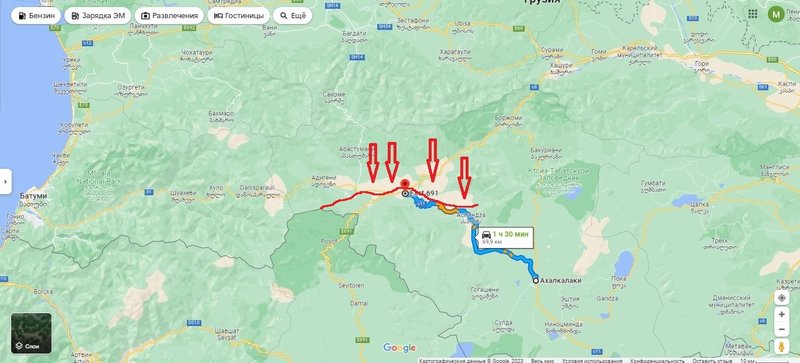
Я не понимаю чем Вы руководствуетесь, проводя такую линию. Если хотите провести ее по хребту, тогда берите севернее, по Месхетинскому хребту, но в таком случае Боржоми тоже попадает в Армению. Смотрите, вот как должно быть по Вашей логике, по ландшафту
Это не по ландшафту, это по современному ареалу расселения армян в Грузии :) Известно, что ареал этот заканчивается как раз на Ахалцихе, где они составляют половину населения города и потому этот город входит в число территориальных притязаний патриотов Армении. Вот и все объяснение, а история и география тут не при чем.
Цитата:
Я стрелками указал на ландшафт и прочертил ту вооброжаемую линию, где по моему на этом участке географически кончается "Армения".
Зато Анания Ширакаци проводил совсем другую линию. Он указал гавар Самцхе в составе Вирка и не указал его среди гаваров Айка. Значит Ахалцихе никогда не принадлежал армянам, что признается даже вашей историографией.
Годердзакан в составе Армения
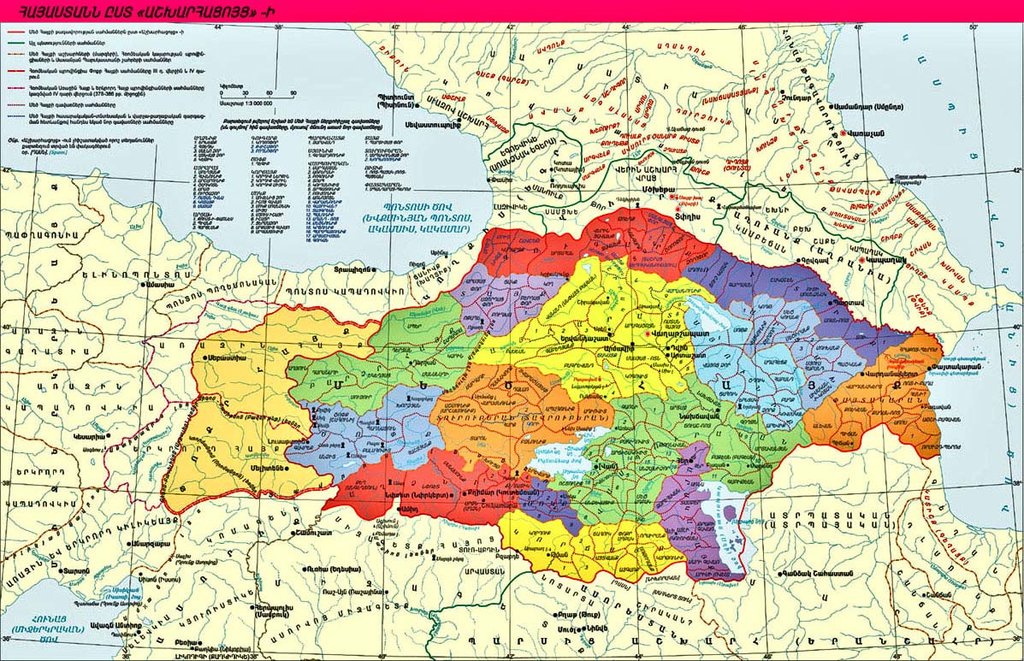
Есть мнение, что Годердзакан был выведен из состава Гугарка еще в 37-ом году, вот и оно не вошло в Ашхарацуйц.
Армяне всегда, всю историю жили почти по всей Грузии, за исключением разве что ее горных ущелий. Если мы, при определении границ исторической Армении, будем исходить из пределов армянского этнического ареала, то можно просто исключить Грузию из истории, потому что почти всю эту страну придется объявить частью исторической Армении.
Вы правы, поэтому например я так не поступаю. Ахлцха это просто удобная точка прямо на самой границе, смотрите сколько близко оно стоит к западной границе того же Трехк-Триалети.
Цитата:
Вон, Лион настаивает на том, что Батуми это историческая Грузия, а ведь в Батуми, в конце 19 века, армяне составляли большинство населения.
Батуми эти самая юго-западная точки исторической Грузии.
Годердзакан Это историческая Армения и до 37 года она была частью Великого Айка.
look at 19 page - Посмотрите 19 страницу
Жизнь Картли
Леонти Мроуэлл
Часть первая
Жизнь грузинских царей
Глава I
История восьми братьев
'Давайте поговорим о жизни грузинских царей, их праотцов и родственников.
Прежде всего следует отметить, что у армян и грузин, Рани и Мовакнелиса, герребов и леков, мегрелов и кавказцев был один
общий отец - Таргамос. Таргамос был сыном Таршиси, внуком Иафета и потомком сына Ноя. Он был храбрым и сильным человеком.
После разделения языков, когда был построен Вавилонский Годол и люди разделились на разные языки и разбросались по всему
миру, переводчик оставил своих родственников и поселился между двумя Миувальскими горами, между Араратом и Масисиси. Его
родственников было очень много, потому что у него было много жен, сыновей и дочерей, внуков и потомков, и дожил до шестисот
Наконец-то страна Арарат и Масисиси больше не могла их терпеть.
Страна, пришедшая в состав перевода, включала следующие границы:
Море Гургана на востоке,
На запад - море Понто,
С юга - море Орети,
На север — гора Кавказ.
Среди своих детей отличились восемь сыновей-героев, сильных и знаменитых:
Первый - это хаос,
Второй - грузинский,
Третий - Бардос,
Четвертый - у меня есть,
Пятый - Лекан,
Шестое - Герои,
Седьмой - Кавказ,
Восьмой — эгро.
Самым сильным и храбрым из них был Хаос — с силой и ростом, которых никогда не существовало до и после.
Когда земля Арарат и Масисиси больше не могла терпеть народ, переводчик разделил свою страну и родственника на восемь
героических сыновей. Половина родственников и большая часть страны отдали хаосу, а остальные семеро - по заслугам.
Грузин установил следующие границы:
На восток - Ерети и река Бердуж,
На запад - море Понто,
На юг - горы, которые следуют за вершиной Бердуджи и западом, и воды которых текут на север и между Кларджети и Тао,
На севере - маленькая гора Гадо, которая является частью Кавказа и сегодня известна как Лихи.
Вся страна между этими границами подходит грузинам.
Бардосу отдали южную сторону Мтквари от Бердуджи для объединения Мткви и Рахши; он построил город Бардави и поселился там.
Movakani Ergo Mtkvari северная сторона от маленького Алазани входа в море; он основал город Мовакнети.
Героя отдали северную сторону Мтквари от малого Алазни до Ткетбы (сегодняшняя Гулгула). Он построил город на пересечении двух
алазанцев и назвал его Ерети по имени, поэтому и назвал страну Ерети.
Эгрос владел приморской страной от горы Лихи до моря; он построил город Эгрис (сегодняшняя судьба).
В то время на севере Кавказа не было доли перевода и не жил народ - страна пустела от Кавказия до Дарубандского моря. Поэтому
Перевод поселил там двух героев - Лекан и Кавказ.
От Дарубандского моря отдали Лекан реке Ломек и великой реке Хазарет;
На Кавказ - от Ломека на запад, до конца Кавказской горы.
Хаос остался на родине отца и завоевал огромную страну: от гор Оретти на юг, до моря Гургана на восток и до моря Понто. Он
был Господом и Судьёй других семи братьев, и все повиновались Ему.
Сначала все восемь братьев были совместно послушны Неброту - первому царю человечества.
( Борьба с Небротом, победила его и создала королевство Хаосом.. )
Глава II
История Картли (начало)
После этого начнём историю грузинских и грузинских потомков и их жизни до нашего времени.
Впервые грузин приехал на то место, где Арагви привык к Мтквари, поднялся на гору Армази и построил там крепость. Он назвал
гору по имени - Картли. Отсюда страну ещё называли грузинской.
Он построил замок Орби (сегодняшний Ковчег) и замок пыли (Хунань). Среди грузинских детей отличились пять героев: Мцхетоси,
Гаргабоси, Кахоси, Кухоси и Гачиоси.
Самым ярким был Мцхета, который построил город между Мцквари и Арагви и назвал его Мцхета. Мцхета стала столицей и местом
центральной власти.
До сих пор армянский был языком грузин, на котором они говорили. Но когда столько родственников собралось на грузинском,
грузины тоже отказались говорить по-армянски и в результате слияния этих разных родственников образовался грузинский язык.
В то же время они понесли худшее наказание из всех родственников: в браке не считали родством; съели всякое живое; могил не
было, и умерших ели. "
Լեոնիդ Մռավելի - Леонид Мраели - Leonid Mraveli
Kartlis Tskhovreba -Летопись Картли

Карта Армении по данним книги Мовсеса Хоренаци
Նույն ժամանակահատվածում փախստականների խմբեր եկան Իվերիա երկիր ՝ բաղկացած հույներից, սիրիացիներից և խազարներից, որոնք հետապնդվում էին իրենց թշնամիների կողմից: [Իբերիան] ընդունեց նրանց [10] ՝ օգնելու իրենց ընդդեմ իրանցիների: Բացի այդ, միևնույն ժամանակ եկան Երուսաղեմը գրաված Նաբուգոդոնոսորից փախած հրեաները: Նրանք աղոթատեղի խնդրեցին Մցխեթայի տիրակալից, և նա նրանց տվեց [տարածք] Արագ գետի Zanանավ անունով, որն այժմ կոչվում է Քերք: Մինչ այս պահը Իբերիայի լեզուն հայերենն էր: Բայց այդ ժամանակներից, նրանց մեջ բնակություն հաստատած ժողովուրդների ազդեցության ներքո [Այվերս] սկսեցին փոխվել, սկսվեց լեզուների և ժողովուրդների խառնուրդը, ինչը, ի վերջո, հանգեցրեց այն բանին, որը մենք այժմ անվանում ենք վրացերեն և ժողովուրդ:
ქართული მატიანეები ქართლის ცხოვრება / ქართლის მატიანე
იმავე პერიოდში ლტოლვილთა ჯგუფები მოვიდნენ ივერიის ქვეყანაში, რომელშიც შედიოდნენ ბერძნები, სირიელები და ხაზარები, რომლებიც მტრის მიერ იყო შევიწროებული. [იბერიამ] მიიღო ისინი [10], რომ თავი დაეხმარათ ირანელების წინააღმდეგ. გარდა ამისა, ამავე დროს მოვიდნენ ებრაელები, რომლებიც გაქცეულან ნაბუქოდონოსორიდან, რომლებმაც იერუსალიმი აიღეს. მათ მცხეთის & nbsp; მმართველს სთხოვეს თაყვანისცემის ადგილი და მან მისცა მათ [ტერიტორია] მდინარე არაგზე, რომელსაც ზანავი ჰქვია, რომელსაც ახლა ქსერკი ჰქვია. ამ ეტაპზე იბერიის ენა იყო სომხური. მაგრამ იმ დროიდან, მათში დასახლებული ხალხების გავლენის ქვეშ, [ივერსი] შეიცვალა, დაიწყო ენებისა და ხალხების შერევა, რამაც საბოლოოდ გამოიწვია ის, რასაც დღეს ჩვენ ქართულ ენასა და ხალხს ვუწოდებთ.
The Georgian Chronicles
Kartlis Tskhovreba/Летопись Картли
“В этот же период в страну Иверия пришли группы беженцев, состоящие из греков, сирийцев и хазар, которые подвергались
притеснениям со стороны своих врагов. [Иверия] приняла их [10] в помощь себе против иранцев. Кроме того, в то же время пришли
евреи, бежавшие от Навуходоносора, захватившего Иерусалим. Они просили место для поклонения у правителя Мцхеты, и он дал им
[район] на реке Араг под названием Занав, который теперь называется Ксерк. До этого момента языком Иверии был армянский. Но с
того времени, под влиянием народов, осевших среди них, [иверы] начали меняться, началось смешение языков и народов, что привело
в итоге к тому, что в настоящее время называем грузинским языком и народом.
Georgian Chronicles CHAPTER 2
In the same period there came to the country of Iberia some fugitives from the Greeks, Syrians, and Khazars who were harassed
by their enemies. [The Iberians] accepted them to aid themselves against the Iranians. Also at that time came Jews who had
escaped from Nebuchadnezzar (Nabugodonosor), who had captured Jerusalem. And they requested a place for worship from the
tanuter of Mts’xet’a; and he gave them [an area by] a stream on the Arag river called Zanaw, now called Xerk. Up to this
point the language of Iberia was Armenian. But then [the Iberians] started to be changed by the peoples dwelling among them,
and there occurred a mixing up of everything, leading to that which is presently called Georgian.
At that time six languages were spoken in Iberia: Armenian, Khazar, Syriac, Hebrew, Greek, and the result of their
commingling, Georgian [g18].
В то время в Иверии говорили на шести языках – армянском, хазарском, сирийском, иврите, греческом и, явившимся результатом их
смешения, грузинском. [g18]
The Georgian Chronicles
Kartlis Tskhovreba/Летопись Картли
COMMISSION FOR THE STUDY OF GEORGIAN HISTORICAL SOURCES
KARTLIS TSKHOVREBA
A HISTORY OF GEORGIA
ARTANUJI Publishing
Tbilisi 2014
The Georgian Chronicles of
KARTLIS TSKHOVREBA
{A History of Georgia),
translated and with commentary
Leont'i Mroveli, The Lives of the Georgian Kings
Juansher Juansheriani, The Life of Vakht'ang Gorgasali
The Martyrdom of Saint Archil
Mat'iane Kartlisa (The Chronicle of Kartli)
The Life of David, King of Kings
The Chronicle of Giorgi Lasha and His Time
The Life and Tale of the Bagrat'ionis
The History and Eulogy of Monarchs
Basili, The Life of Tamar, the Great Queen of Queens
The Hundred Years' Chronicle
©ARTANUJI Publishing, 2014.
ISBN 978-9941-445-52-1
Foreword by
Academician Roin Met'reveli
Editor in Chief of the Georgian and Russian editions:
Academician Roin Met'reveli, Georgian Academy of Sciences
Editor in Chief of the English edition:
Professor Stephen Jones, Mount Holyoke College (USA)
aiao£?obo 2014
FOREWORD
The history of Georgia and Georgians occupies a significant place in world history. Human
society has experienced a long cultural and historic evolution on the territory of Georgia. Historical
investigation, from archaeological discoveries to ethnographic analysis, show convincingly that
Georgia was an ancient country where land farming and animal breeding was comparable to any
place in the more advanced and civilized world at the time. In Georgia, ploughing implements have
been used since earliest times, the principle of the wheel was long known, and the vine, which
requires sophisticated care and irrigation, was cultivated. The first state on the territory of Georgia
appeared three thousand years ago, and over the millennia, Georgians have created an original and
highly developed culture.
A civilization represents a cultural unity of high order. It is determined by common characteristics,
such as language, religion, common traditions, as well as self-identification by a people, or collection
of peoples.
History is unpredictable, but the historian who grasps the depth of history becomes a participant
in its creative process. Our task is to offer to the English-speaking reader the most important narrative
of the history of Georgia - kartlis tskhovreba (The History of Georgia). It is a major monument in itself
and a source of much of our known history. Georgian civilization, like others, occupies a particular
historical niche which is reflected in the writings of kartlis tskhovreba.
Georgian history is characterized by multiple wars, which put an utmost strain on the country's
physical and moral forces. At the same time, the country enjoyed significant success, such as the
political and territorial unification of the country (but only at certain crucial periods), the development
of cities and urban life, as well as of a high level of science, education and culture in general. The
life of our Georgian ancestors, their struggle, labor, and creativity have found reflection in folklore,
including poetry, oral stories, and written legends. The story of Amirani, the myth of the Argonauts,
and tales about the foundation of Tbilisi, have passed from one generation to another. Monuments
of material culture, such as churches, monasteries, castles, palace ruins, and large settlements, are
the evidence that tells us about our own past. A complete reconstruction of the country's history is
possible mainly through written sources.
The first manuscript of a historical character in the Georgian language is dated from the fifth
century A.D. The collection of historical works known as kartlis tskhovreba represents the only
coherent written source of the history of Georgia. It embodies the "official" history of the country. It
is a brilliant monument of Georgian historical writing. Since ancient times, the Bible, the Knight in
5
the Panther's Skin, and kartlis tskhovreba, were considered to be the "fair" and "holy" books which
together formed a necessary part of the dowry of a Georgian bride.
In kartlis tskhovreba, the historical works of different authors are set in chronological order,
which together create a unified history of Georgia. This literary monument is remarkable because
besides representing a history of Georgia and the Georgians, it contains much information regarding
the history of different countries and peoples (Azerbaijanis, Armenians, Greeks, Romans, Persians,
Arabs, Byzantines, Turks, Mongols and many others).
A great contribution to the study of kartlis tskhovreba was made by the King of Kartli, Vakht'ang
VI (1675-1737), who created a special commission of "learned men" to compile and edit the texts
of this literary work. The manuscripts of kartlis tskhovreba were copied many times (mainly based
on the MS of Vakht'ang's edition), but now we have about twenty such manuscripts. In 1849 the
Russian Academy of Sciences published kartlis tskhovreba, based on the MS of the post-Vakht'ang
period, edited by the French orientalist and Georgian Academician Marie-Felicite Brosset. Brosset
translated the text into French and published it. He made this source on the history of Georgia
accessible to the world community.
Brosset used three manuscripts of the eighteenth century, which had been reedited and
supplemented by the commission of "learned men" under Vakht'ang VI. A new MS of the eighteenth
century was later found. Five manuscripts were also discovered going back to the fifteenth to
seventeenth centuries, i.e. to the pre-Vakht'ang period.
In 1884 the eminent Georgian historian Dimit'ri Bakradze, uncovered a copy of the MS assigned
for Queen Mariam, wife of King Rost'om of Kartli, (1633-1648), dated from the seventeenth century.
The manuscript is preserved in the National Centre of Manuscripts (S-30). In 1906, the MS was
published by Ekvtime Taq'aishvili. The Queen Mariam MS contained the Fount of Treasure, which
J. P. Mahe and Ts. Kurtsikidze assume was translated from Arabic; The Lives of Georgian Kings
by Leont'i Mroveli; The Life of Vakht'ang Gorgasali by Juansher; The Chronicle of Kartli; The Life
of David, King of Kings; The Life and Tale of the Bagrat'ionis by Sumbat Davidisdze; a manuscript
of the first historian of Queen Tamar, The History and Eulogy of the Monarchs; and the work of an
unknown chronicler entitled The Hundred Years' Chronicle.
In 1913, Ivane Javakhishvili discovered an MS of kartlis tskhovreba in the house of A. Jambak'ur-
Orbeliani, in Lamisq'ana village. According to the colophon of the copyist, the MS was assigned for
Anna, wife of Aleksandre, the King of Kakheti (1476-1511), but in fact it was a later copy (sixteenth
century) of the MS. The manuscript published in 1942 by S. Q'aukhchishvili is preserved in the
National Center of Manuscripts (Q-795).
The MS of Queen Anna contains the writings of Leont'i Mroveli and Juansher, The Chronicle
of Kartli, The History of David the Restorer {The Life of David, King of Kings) and The Chronicle of
Giorgi Lasha and His Time. In 1923, Ivane Javakhishvili discovered one more manuscript, the so-
called Ch'alashvili MS. There are two parts to it: the earlier one was rewritten at the beginning of
the seventeenth century; the missing parts (at the beginning and at the end) were written in 1731
by Eraj Ch'alashvili, who supplemented the text according to the MS of Vakht'ang's edition. Now the
manuscript is preserved in the National Center of Manuscripts (Q-207).
6
The following manuscripts are included in the MS of Eraj Ch'alashvili: the manuscripts of Leont'i
Mroveli and Juansher, The Chronicle of Kartli, The History of David the Restorer, and the second
history of Queen Tamar (different from the History and Eulogy of the Monarchs). I. Javakhishvili
considered Basili Ezosmodzghvari (Lord and Steward of the King's Court) to be the author of the
second history of Tamar; the story was called The Life of Tamar, the Great Queen of Queens. At the
end of the manuscript, the new part, or the continuation of kartlis tskhovreba is included (fourteenth-
eighteenth centuries) composed by the "learned men" under Vakht'ang VI.
In 1942, S. Q'aukhchishvili studied the Machabeli MS, copied by Giorgi Machabeli in 1736. The
original was an MS of kartlis tskhovreba, which belonged to King Archil, as stated by the copyist.
The missing parts of the original (at the beginning and at the end) were taken by Machabeli from
Ch'alashvili's MS. Today the manuscript is preserved at the National Center of Manuscripts (H-2135).
The Machabeli MS includes an Introduction composed by the Commission of "learned men;"
the initial part of The Chronography of Pseudo-Dorotheus (sixteenth-seventeenth centuries); The
Lives of Georgian Kings, The Conversion of Kartli by Saint Nino, The Life of Vakht'ang Gorgasali,
The Martyrdom of Saint Archil, The Chronicle of Kartli, The History of David the Restorer, The
History and Eulogy of the Monarchs, and The Hundred Years' Chronicle. The MS ends with kartlis
tskhovreba (fourteenth to eighteenth centuries).
In 1959 Ak'ak'i K'limiashvili discovered an MS of kartlis tskhovreba in the family of Olga
Mach'avariani, in Upper Imereti (western Georgia). The MS was copied in 1697. The date was
indicated in the epilogue of the copyist. He also mentioned the original of the copied MS. The
manuscript is preserved in Svetitskhoveli Cathedral in Mtskheta. Conceivably, it is the same
manuscript mentioned in the Mtskheta Charter in 1546. In the epilogue the name of the person,
who ordered the manuscript - Nik'oloz Samebeli, Diocesan of Sameba (Trinity church near Ujarma
village, Kakheti) is mentioned. The MS is preserved at the National Center of Manuscripts (Q-1219).
The MS discovered by K'limiashvili includes: The Lives of the Georgian Kings, The Conversion
of Kartli by Saint Nino, The Life of Vakht'ang Gorgasali, The Martyrdom of Saint Archil, The Chronicle
of Kartli, The History of the Bagrat'ids, The Life of David, King of Kings, The History and Eulogy of
Monarchs, and The Hundred Years' Chronicle.
The above-mentioned manuscripts of kartlis tskhovreba contain the writings of an "ancient cycle."
The Commission of "learned men," convened on the initiative of Vakht'ang VI, and based on different
MS versions, edited and supplemented kartlis tskhovreba, and added a continuation, called the
New kartlis tskhovreba. Besides this work, the writings of Vakhushti Bagrat'ioni (S. Q'aukhchishvili
published this work in the fourth volume of kartlis tskhovreba), of Sekhnia Chkheidze, P'ap'una
Orbeliani and Oman Kherkheulidze (together with the work of Vakhushti) were included in the "new
cycle" and published by David Chubinashvili in St Petersburg, in 1854, as the second book of kartlis
tskhovreba.
In its original form kartlis tskhovreba was composed in the eleventh-twelfth centuries. Evidently,
political integration of the state, and its economic and cultural development, demanded an integrated
and complete description of the past of Georgia. The collection aimed not only at describing the
history of the state, but also supported ideologically the political integration of Georgia and the reign
7
of the Bagrat'ioni dynasty. Before that time, notes on the chronicles of Georgia were made "from
time to time," as Leont'i Mroveli puts it in his work, The Martyrdom of Saint Archil.
Ivane Javakhishvili demonstrated that initially the chronicles contained the history of Georgia
from ancient times up to the eighth century. Later, works on the history from the eighth to twelfth
centuries, and then the thirteenth to fourteenth centuries, were added. This would include The
Lives of the Georgian Kings and Patriarchs of the Georgians, The Conversion of Kartli by Saint
Nino, written by Leont'i Mroveli, The Life of Vakhtang Gorgasali by Juansher, The Hundred Years'
Chronicle, The Martyrdom of Saint Archil, by Leont'i Mroveli, The Chronicle of Kartli, The Life of
David, King of Kings, The Life and Tale of the Bagrat'ionis by Sumbat Davidisdze, The History of the
Five Reigns (Life of King Demet're, Life of King Giorgi, Life of Queen Tamar the Great, Life of King
Giorgi, the son of Tamar), the work of the first historian of Queen Tamar, The History and Eulogy of
the Monarchs, the work of Basili Ezosmodzghvari, The Life of Tamar, the Great Queen of Queens,
and The Hundred Years' Chronicle. The last work ends with the accession of Giorgi Brts'q'invale
("The Brilliant") at the beginning of the fourteenth century. The chronicler describes the first steps
of the King, but what happened later is not included; it is said that "the tongue is unable to tell such
wonderful and awesome (things)," and with this the narrative ends. What these "wonderful and
awesome (things)" were, remains a riddle. The so-called "ancient cycle" of kartlis tskhovreba ends
with The Hundred Years' Chronicle.
Perhaps some of the manuscripts of kartlis tskhovreba have been lost, and there was no
chance to continue the work. However, some notes about the events of that epoch exist. The new
cycle of kartlis tskhovreba, as we have already noted, was created by "learned men" of Vakht'ang
VI's Commission, who collected various historical materials and wrote a history of the fourteenth
to seventeenth centuries. It took twenty years to compile the new kartlis tskhovreba. The MS of
Vakht'ang VI's times provides evidence of the laborious work done by the "learned men." Kartlis
tskhovreba attracted the attention of Georgian society at that time. New customers and copyists
appeared. Vakhushti Bagrat'ioni pointed to the great number of manuscripts of kartlis tskhovreba.
The "learned men" used various sources for the creation of the New kartlis tskhovreba. They
expressed regret over the fact that for certain periods, the history of Georgia was "not written".
They had to borrow the material from "ancient books," from the history of Persians and Armenians,
chronicles and charters, stories of eyewitnesses, all of which is noted in the introduction to the New
kartlis tskhovreba. Vakht'ang VI and his commission made a significant contribution to the study,
editing and supplementing kartlis tskhovreba.
In 1955-59 Academician S. Q'aukhchishvili, examining the critical notes concerning all the
manuscripts of that time, published the complete text kartlis tskhovreba. This MS played a great
role in the investigation of Georgian history, and was also considered a textological and source
study. It combined the results of the colossal work performed by I. Javakhishvili and other Georgian
scholars. Over the last fifty years kartlis tskhovreba has been at the center of scholarly attention and
is considered the most important source on the history of Georgia. Many special studies have been
published in Georgia and abroad. Some works included in the text before the second half of the
twelfth century, have been translated into the Old Armenian language (in 1 953 Ilia Abuladze published
8
a translation with commentaries); E. Taq'aishvili, V. Akhvlediani, G. Tsulaia, M. Lordkipanidze,
K. K'ek'elidze, V. Dondua, and M. Shanidze translated some works into Russian; Marie Brosset
translated parts into French, G. Patch - into German, and K. Vivian and R. Thomson, into English.
In 1959 the manuscript of the so-called "ancient cycle," written in "nuskhuri" (an ancient Georgian
alphabet) and dated 1697, was discovered. This, along with continuing scholarly interest in kartlis
tskhovreba, led to the demand for a new publication of a critical text addressing this unique literary
monument. The Commission for the study of Georgian historical sources of the Georgian Academy
of Sciences started this work at the end of the last century. A group of historians and philologists of
the K. K'ek'elidze Institute of Manuscripts, the I. Javakhishvili Institute of History and Ethnology, and
Ivane Javakhishvili Tbilisi State University, took part in a textological and critical investigation of the
text of kartlis tskhovreba.
The manuscripts of kartlis tskhovreba selected for publication in different editions, are not
identical and depend on the objectives of the publishers (as well as the availability of the materials).
M. Brosset's publication and the monumental two-volume publication of S. Q'aukhchishvili (1955-
1959) are based on several manuscripts well known at the time of publication. The editions of a
separate MS by E. Taq'aishvili in 1906 (the MS of Queen Mariam) and S. Q'aukhchishvili in 1942
(the MS of Queen Anna) were designed to introduce earlier texts from the pre-Vakht'ang editions.
The selection of the edited manuscripts for publication in kartlis tskhovreba are different (see I.
Javakhishvili, K. K'ek'elidze, M. Lordkipanidze, M. Shanidze, Ts. Kurtsikidze, R. K'ik'nadze, G.
Arakhamia). The manuscripts of the "ancient cycle" are taken as the basis for the present English
publication (the manuscripts of Queen Mariam, of Queen Anna, of Ch'alashvili, of Machabeli, and the
MS discovered by A. K'limiashvili). The peculiarities of each MS and the result of the editorial work
of Vakht'ang VI, and of later times, have been taken into consideration for this publication.
Regarding the titles and authorship of the separate constituent parts of kartlis tskhovreba, we
wholly share the opinion of I. Javakhishvili. The traditional principles regarding the content and
structure of this literary monument, developed by I. Javakhishvili and others, and realized by S.
Q'aukhchishvili, were followed in the present edition with some modifications. Thus, The Lives of
the Georgian Kings by Leont'i Mroveli was considered to be the history of heathen kings, including
the reign of Mirian and the story concerning the conversion of Kartli by Nino of Cappadocia. The life
and feats of Vakht'ang Gorgasali was considered to be authored by Juansher, while the history of
the period after Vakht'ang and up to the beginning of the story of King Archil (before the story of the
raids of the Arabs) is regarded as pseudo-Juansherian; the story of the life and martyrdom of Archil
is singled out as a separate piece (the author is Leont'i Mroveli).
The success of the presented "lives" depends as a rule on the orderly narration and interpretation
of the chronicler. He may use different means to achieve the best effect; often he tries to render the
event realistically, builds the plot interestingly, and uses the ideological subtext skillfully.
I. Javakhishvili estimated highly the works that make up kartlis tskhovreba, and thought that the
most trustworthy among them were: The Chronicle of Kartli, the writings of the historian of David the
Restorer, The History and Eulogy of the Monarchs, The Life of Tamar, the Great Queen of Queens, by
Basili Ezosmodzghvari, works of the chronicles of the times of Lasha-Giorgi and Sumbat Davidisdze,
9
and The Hundred Years' Chornicle by an unknown chronicler. The scholar made critical notes on the
works of Leont'i Mroveli and Junasher; he assumed that their publication with commentaries was
necessary.
Among the authors of kartlis tskhovreba, the historian of David the Restorer, a highly enlightened
person, a connoisseur of Western and Eastern cultures, is the most trustworthy and competent.
He considered writing chronicles a proper occupation, and understood that for a responsible and
valuable representation of the activity of some person, the author must master the art of rhetoric, that
is the skill of an organized and trustworthy narration. At the same time, he believed the chronicler
should not exaggerate or distort the events, and he rebuked Homer and Arisobulus, the first for
glorifying the heroes of the Trojan War and the second for praising Alexander of Macedon. He
thought that due to the lack of sufficient factual material, Homer and Aristobulus were obliged to fill
in the narration by "rhetorical digressions."
The work of the historian of David the Restorer is distinguished for its elegance, style, language,
artistry and deep sincerity. Comparison of the chronology of the events with other sources confirm
the trustworthiness of his works. All this allows us to consider the chronicle to be a primary historical
source. Without discussing in detail other manuscripts of kartlis tskhovreba, we will just note that all
of them are valuable and must be considered vital to the study of the history of the Caucasus.
The main line of Georgian historical thinking developed along with the political development of
Medieval Georgia. At the time of the political strengthening and cultural revival of Georgia, Georgian
historiography revived and developed as an integral part of Georgian culture. The achievements
of Georgian historical writing were to a considerable degree determined by traditionally highly
developed philological (particularly hagiographical) and historical-philological schools. This is the
context for kartlis tskhovreba.
We believe that the current publication of kartlis tskhovreba in English is particularly important.
This unique historical monument should become available for the global public who speak and read
English.
Academician Roin Met'reveli
10
EDITOR'S NOTE
The transliteration system we used for Georgian is the Georgian national system, adopted in
2002 by the State Department of Geodesy and Cartography of Georgia and the Institute of Linguistics
of the Georgian Academy of Sciences.*
Georgian does not use capitals, a system we have generally followed, except for names and
places, and when a Georgian word begins a sentence. There are spelling inconsistencies between
the texts in Georgian, which span the ninth to fourteenth centuries; the texts have undergone many
subsequent edits by Georgian chroniclers and scholars. We kept mostly to the original spelling but
footnoted or added in parenthesis alternative spellings or names that might be more familiar to the
reader. Thus Trabzon will be translated in parenthesis as Trebizond, Tpilisi as Tbilisi, Q'ivchaq's as
Q'ipchaks, etc. Plurals we have rendered with an "s." Georgian authors in Russian translation will
have no diacritic marks.
For Russian, we use the US Library of Congress transliteration system without the diacritic marks.
At times, Russian spelling, such as Abkhazia, may be modified instead of Georgian equivalents
(Abkhazeti), if they are considered more familiar (and thus more understandable) to the reader.
Stephen Jones
* (http://www.translitteration.com/transliteration/en/georgian/national/)
11
Leont'i Mroveli
THE LIVES OF GEORGIAN KINGS
PART ONE
In the name of the Father and the Son and the Holy Spirit
I will begin to relate
The stories of the Georgian kings,
The patriarchs of the Georgians, and of their seed
Chapter One
The Story of the Eight Brothers
First, let us note that the Armenians, Kartvels, Ranis, Movak'ans, Eris, Lek'is, Megrels and
Caucasians, all these kinsmen had one father by the name of Targamos. 1 This Targamos was the
son of Tarsh, the grandson of Japheth, Noah's son. And Targamos was a hero.
After the splitting up of languages, when Noah's descendants built the tower in Babylon and the
languages were divided and the builders were dispersed all over the earth, this Targamos set out
together with his tribe, and settled down between the mountains of Ararat' and Masis, 2 inaccessible
to man. His tribe was great and innumerable, because he had sons with many wives, and daughters
too; and then there were the children and grandchildren of his sons and daughters He lived six
hundred years. The lands of Ararat' and Masis could not contain them all.
The country that fell to the lot of Targamos had these bounds: the Gurgan Sea in the east, the
Pontic Sea in the west, the mountains of Oreti 3 in the south, and the Caucasian Mountains in the
north. Of (all) the sons of Targamos, eight were the powerful and glorious heroes: the first was Haos,
the second was Kartlos, the third was Bardos, the fourth was Movak'an, the fifth was Lek', the sixth
was Heros, the seventh was K'avk'as and the eighth was Egros.
All eight were heroes, but Haos exceeded all the others, for there was no one equal to him
either before, or after the Flood, wether in bodily constitution, power, or prowess.
As the country of Ararat' and Masis could not contain the whole tribe any more, Targamos
divided the country and the tribe between these eight heroes: half of the tribe and the best half of the
13
country he gave to Haos, and to the other seven he gave each his share. Bringing the seven of them
to the north, he divided the land among them according to their merits. He gave to Kartlos his part
determining its borders as follows: Hereti and the river of Berduji in the east; the Pontic Sea in the
west; the mountain that stretches along the upper reaches of the river of Berduji, and the mountain
5 which extends further to the west, to the place from which the river flows, which then merges with
the Mt'k'vari, stretching along the mountain between K'larjeti and T'ao and down to the sea. In the
north, Ghado defines the border, and a small mountain which branches off from the Caucasus and
follows the edge of Ghado Mountain, and which is now called Likhi. And all the lands that lay within
these precincts Targamos gave to Kartlos.
10 To Bardos he gave the lands to the south of the Mt'k'vari from the river of Berduji and down to
the sea, to the place where the Mt'k'vari and the Araks merge. Bardos built the town of Bardru and
settled down there.
To Movak'an he gave the land on the left side of the Mt'k'vari from the mouth of the Little Alazani
and down to the sea. Movak'an built the town of Movak'neti and settled there.
15 To Heros he gave the land on the north side of the Mt'k'vari, from the mouth of the Little Alazani
to T'q'et'ba, now called Gulgula. Heros built for the first time a town between the two rivers at the
place where both Alazanis merge and gave this town his own name - Hereti. That is why this land
is called Hereti. Now the place between the two rivers is called Khoranta.
To Egros he gave a coastal land, defining its borders as follows: a small mountain in the east,
20 which is now called Likhi; the sea in the west; the river of Little Khazaria in the north, which is the
Caucasus mountain border. This Egros built a town and called it by his name - Egrisi. Now that
place is called Bedia. In the north, beyond Caucasia, Targamos had no lands; there were no people
there, the land was uninhabited from the Caucasus range down to the great river that flows into the
Derbent Sea. So Targamos picked out two heroes among the many - Lek' and K'avk'as, and gave
25 to Lek' the land with the borders from the Derbent Sea to the river of Lomek'i, and in the north up
to the Great river of Khazaria. To K'avk'as he gave the land from the Lomek'i and to the end of the
Caucasus range in the west.
Haos settled down on the land of his father Targamos, taking as well possession of the lands
that lay to the north of it, that is, as I have already said, to Mount Oreti in the south, to the Gurgan
30 Sea in the east and to the Pontic Sea in the west. The ruler and master over all these seven heroes
was Haos. All the seven were obedient to him and all the eight of them were subject to Nebroth, who
was the king over the whole world.
After some years passed, Haos called these seven heroes together and told them: "God granted
our tribe the power and greatness of numbers. Now with the help of our Creator we will not remain
35 any more in submission to anybody and will serve nobody but God - the Creator." The seven heroes
expressed their consent with Haos and confirmed their resolution. They broke with Nebroth and
stopped paying him tribute. At the same time they colluded with other tribes and they too turned their
backs on Nebroth.
Nebroth became angry with them, summoned his heroes and all the armies obedient to him
40 and set out against the Targamosids. Haos called on all the seven heroes and the whole tribe of
14
Targamosids. He was assisted by some of his relatives from the west. Haos gathered them all and
set his camp at the foot of Mount Masis. Nebroth approached the land of Adarbadagan and camped
there, and he sent sixty heroes and a powerful army to fight the Targamosids.
When Nebroth's army approached, it was met by the seven heroes, Haos's brothers, with their
powerful troops, while Haos himself with a yet stronger army stood behind them in the rear. A fierce 5
battle started, which resembled a whirlwind, with its brutality. The dust raised by their feet was like
a thick cloud, the glare of their armor - like lightning in the sky, the cry that parted their lips - like
thunder, the arrows and the stones fell like hail; the blood they shed ran like the streams that follow
a hailstorm. The fight gained in intensity, and people without number died on both sides.
Haos stood at the rear of his people and supported and encouraged them with his horrific voice, 10
which resembled peals of thunder. At last the Targamosids prevailed, destroying Nebroth's sixty
heroes and their armies. And the seven heroes of the Targamosids - Kartlos, Bardos, Movak'an,
Heros, Lek', K'avk'as and Egros remained safe and sound, and victorious. They thanked God.
When Nebroth learned of this, he got angry and advanced against them with all his troops.
Haos did not have an army equal in number to that of Nebroth, and so he fortified his position in 15
the depressions of the Masis. Nebroth approached him from below, clad in iron and steel, which
covered him from head to toe. He ascended one mountain wishing to talk with Haos and to propose
he submit to him if he wanted Nebroth's withdrawal. But Haos told his heroes: "Cover me from the
rear and I will approach Nebroth."
He came forward and stood facing Nebroth, close enough; and he shot an arrow at Nebroth and 20
hit him in the chest - right in his steel breastplate; and the arrow went through him. Nebroth fell, his
army fled, and so the tribe of Targamos freed itself. Then Haos proclaimed himself to be the king
over his brothers, as well as over the other tribes that lived next to the borders of his kingdom. And
all the seven brothers went to their domains, each to his own, and remained subject to Haos. Up to
this point we have been writing the story of all eight brothers. 25
Chapter Two
The Story of Kartli
And now we will tell the story of Kartli, its tribes, and their life until our time.
After the division by Targamos of the country between his tribes, his eight sons, and after giving
Kartlos the country we described above, Kartlos came to where the river Aragvi joins the river 30
Mt'k'vari, ascended the mountain which is called Armazi and built a house for himself and called this
mountain by his name - Kartli. Before the erection there of the idol Armaz, the mountain was called
Kartli. And so the entire country stretching from Khuani and to the Sp'eri Sea was called Kartli.
After that Kartlos built the fortress Orbi, which is now called Samshvilde. Then he built the
fortress Mt'ueri, which is now called Khunani. He lived a long life, and his descendants grew greatly 35
in number.
15
Among his sons, five heroes stood out: Mtskhetos, Gardabos, K'akhos, K'ukhos, and Gachios.
All of them were powerful, but Mtskhetos excelled all the others.
Kartlos died and he was buried on the top of Mount Kartli, which is now called Armazi. After that
his wife built Deda-tsikhe. She also built Bostan-kalaki, which is now called Rustavi. And Kartlos's
5 wife divided lands between the five heroes, her sons.
To Gardabos she gave Khunani and defined its borders: the river Berduji in the east, the town of
Gachiani in the west, Armazi mountain in the south, and the river Mt'k'vari in the north.
To Gachios she gave Orbis-tsikhe, the land from the river of Sk'vireti to the borders of Abotsi.
Gachios built the town Gachiani, which in those times was called "Hunting City."
10 To K'ukhos she gave Bostan-kalaki, which is now called Rustavi and also the land from Aragvi
to Hereti, down to the edge of Mount K'akheti, between the rivers of Alazani and Mt'k'vari.
To K'akhos she gave the land between the Caucasus and the mountains of K'akheti, from the
river Aragvi to the river T'q'et'ba, which is a border of Hereti. K'akhos built Cheleti, and K'ukhos
helped him; that is why, though Deda-tsikhe belonged to K'akhos, the latter gave it to K'ukhos as a
15 token of his gratitude for his aid in the development of Cheleti, which, being the first in K'akheti, was
given the name Ber.
And Mtskhetos, who excelled his brothers as a hero, remained on the land of his father Kartlos,
which is now called Armazi. He also built a town between the two rivers - the Mt'k'vari and Aragvi
- at the place of their confluence and named the town after himself - Mtskheta. From there he took
20 possession of the country from Tpilisi and the river Aragvi to the Sp'eri Sea in the east.
Mtskhetos was the ruler and master over all four of his brothers, and all of them were submissive
to him. Such was the division that took place between Kartlos's sons, and such were those whom
the mother separated after the death of Kartlos. Mtskhetos lived many years, and raised many of his
tribe as well as the other sons of Kartlos.
25 And among the sons of Mtskhetos three brave heroes stood out: Uplos, Odzrkhos, and Javakhos.
Mtskhetos divided the country and the entire tribe between them. To Odzrkhos he gave the rocky
country from T'asis-k'ari to the Sp'eri Sea. Odzrkhos built two reinforced towns: Odzrkhe and
Tukharisi. To Javakhos he gave the land from Panavari to the upper reaches of Mt'k'vari. Javakhos
built two towns with fortresses in each: Ts'unda and Art'aani, which at that time was called Kajta-
30 kalaki and now is called Khuri.
Uplos remained on the land of his father Mtskhetos - in Mtskheta. He owned the lands from the
Aragvi and Tpilisi to T'asis-k'ari and Panavari. He built Uplis-tsikhe, Urbnisi, K'asp'i and named this
land from Aragvi and Armazi to T'asis-k'ari - Zena-sopeli, which is now called Shida Kartli.
Until the death of Mtskhetos all these tribes of Targamos lived in mutual love; they lived in fear
35 of Nebrotids, believing that the Nebrotids were looking for a chance to avenge Nebroth's blood. Due
to this fear the tribes of Targamos tried to reinforce their city-fortresses.
But when Mtskhetos, the son of Kartlos, died, enmity sprang up among some of Kartlos's sons.
Feuds and mutual raids became common occurrences, because the brothers ceased to obey Uplos,
Mtskhetos' son; they did not address him as their master, though Uplos had been left on the throne
40 by Kartlos, and the power over the Kartlosids went to him from his father. The feuds went on without end.
16
When any two of the kinsmen rose against the third, the others came to their aid: some helped
this one and the others that one; when they fought each other, the others joined in. Sometimes they
were at peace, but discords and feuds soon started again.
So it continued and there was no one among them who could excel over the others in his
nobility or eminence; and the people were choosing their chiefs themselves. Only the one who sat in
Mtskheta was considered the head of the other chiefs. They were called neither kings nor eristavis,
but mamasakhlisis. The one among the mamasakhlisis that sat in Mtskheta was considered a
peacemaker between the hostile sides, and the judge in relation to all the Kartlosids, because the
city of Mtskheta towered above all the other cities of Kartli, and it was considered the capital.
This was the time when the people in Kartli forgot God, their creator and began to worship the
Sun, the Moon and the five stars; and the main and inviolable oath for them was the oath made in
the name of Kartlos's grave. 4
Khazars 5
At that time the Khazars had gained in strength. They began to fight with the Lek' and K'avk'as
tribes. And the Targamosids at that time lived in peace and had general love for one another.
Durdzuk', the son of T'iret, was master over the sons of K'avk'as. They entered into negotiations
with all six of the Targamosids' descendants, asking for their help in their fight with the Khazars.
Then all the tribes of the Targamosids gathered together and crossing Mount Caucasus ravaged the
Khazars' land and took prisoners from all over their territories. They built a town on the boundaries
of Khazaria and returned home.
After this, the Khazars chose a king for themselves; everybody submitted to him. Setting out
on a campaign the Khazars came to the south through the Sea Gate, which is now called Derbent.
The Targamosids could not offer them any resistance, because the Khazars were too numerous; the
Khazars seized the whole country of the Targamosids, ravaged the towns of Ararat' and the Masis
(mountains), and also the northern towns. Only the city-fortresses of Tukharisi, Samshvilde and
Mt'ueris-tsikhe, which is Khunani, remained untouched; Shida Kartli and Egrisi also remained intact.
The Khazars took control of both roads that went through the Sea Gate, or Derbent, and the
Aragvi Gate, which is Darial. The Khazars increased their raids, ravaging and taking prisoners in the
country of the Targamosids. The Targamosids could not withstand them and became the Khazars'
tributaries.
When the King of the Khazars captured the countries about which we have written, and crossed
Mount Caucasus, he had with him his son by the name of Uobos. He gave to his son the prisoners
of Armenia and Kartli; and he gave him besides, part of K'avk'as's land that stretched to the west of
Lomek'i river and to the western edge of Mount Caucasus.
And Uobos settled there. His descendants are the Ovses, 6 and the country is Ossetia, which
formerly had been the domain of K'avk'as. And Durdzuk', who was the most distinguished among
17
the sons of K'avk'as, settled in a mountain gorge, and called that land by his name - Durdzuk'eti.
He paid tribute to the King of Khazars.
The King of the Khazars, at this time, gave to the son of his father's brother the land of Lek',
from the sea of Derbent in the east to the river Lomek'i, and gave him besides the captives from Ran
5 and Movak'an. And he settled down there on the land that made up the Lek's' domain.
Khozanikh, being the most distinguished among the descendants of Lek', went to a mountain
gorge, and built there a town, and called it by his name - Khozanikheti.
Much time has passed since then; all these tribes remained tributaries of the Khazars.
Then the Persians became stronger from the side of the rising Sun; they were Nebroth's
10 descendants. And among Nebroth's descendants, one man stood out, a hero, and his name was
Apridon, "the one who put Bevrasp in chains, the lord of snakes, who fastened him to a mountain
that is inaccessible to man."
This is what the "Persian History" writes. Apridon became the master over all the lands of Persia;
he sent to other countries rulers, and his eristavis, and made them his tributaries. Once he sent one
15 of his eristavis, by name of Ardam, the son of one of Nebroth's descendants, with a great army on a
campaign. He came to Kartli and devastated all its towns and fortresses, destroying all the Khazars
whom he found there.
Ardam built a town by the Sea Gate and called it Derbent, which is translated as "the closed
gate." He also surrounded the town of Mtskheta with a wall of stone and mortar. Up to that time
20 there was no precedent in Kartli for using these construction materials. People here learned from
him. This same Ardam enclosed with a wall of stone and mortar the fortress of Armazi, extending
the wall up to the edge of Mount Armazi and down to the banks of the Mt'k'vari. And Ardam ruled
for many years. When Apridon divided his country among his three sons, he gave Persia and Kartli
to the same son. The name of this son was Iared. Four eristavis died after Ardam. After that peace
25 was broken among Apridon's sons, and a feud took place among them. Two of the brothers killed
Iared. Then the Kartlosids seized an opportunity. They started negotiations with the Ovses, which
prompted the latter to come over the mountains. They found the Persian eristavi in the valleys. He
was doing great harm by word and deed. They killed him. And together the Ovses and Georgians,
when they found any Persians, would kill them. The Georgians achieved their freedom. Only Ran
30 and Hereti remained in the hands of the Persians.
After the passing of many years, the Persians regained their strength. A Persian King arose
whose name was Kek'ap'os.
There lived at that time in Lek'eti a magician, a descendant of Khozanikh; he deprived King
Kek'ap'os and all his army of their sight. Unable to cross the bounds of Lek'eti, Kek'ap'os turned
35 back and only then he regained his sight. Kek'ap'os made the Georgians his tributaries, after which
he retreated.
Several years later the news came that Moses had crossed the Sea of Israel and that his people
travelling in the desert lived on manna. Everybody was in wonder and all the heathens praised the
God of the Israelis.
18
Several years later after that Kek'ap'os, the King of Persia, began to wage war with the Turks. 7
Availing themselves of this opportunity, the Georgians and Armenians broke with the Persians and
began reinforcing their fortresses and cities. The whole tribe of the Targamosids was unified.
Several years later Kek'ap'os, the King of Persia, sent his son by the name of Parborot', with
a great army against the Armenians, Georgians and all the other Targamosids. All the Targamosids 5
united and came out against the Persians and gave them battle in Adarbadagan, putting Parborot'
to flight and destroying his army.
Several years after this, the same Kek'ap'os sent his grandson, the son of Lucky Shiosh, to our
land. The latter was killed in the country of Turks as is written in the "Persian History."
The son of Shiosh, called Kaikhosro, came here. The Armenians and Georgians could not offer 10
resistance, because his power was too great. He crossed the whole of Armenia and the whole of
Kartli, ravaging and capturing people, sacking all the fortresses and cities. He left in the devastated
lands his eristavis, and built in Adarbadagan a house of prayer for the followers of his faith and left.
Several years later, king Kaikhosro again lost the benefit of peace, because he began to fight
the Turks, for he wanted to avenge the blood of his father. The Armenians and Georgians seized 15
the opportunity and broke with the Persians; they destroyed the Persian eristavis and regained their
freedom.
The Turks who were put to flight by Kaikhosro, appeared. They crossed the Gurgani Sea and
moving along the Mt'k'vari reached Mtskheta; there were twenty-eight houses of them. They entered
into negotiations with the mamasakhlisi of Mtskheta, promising him military aid against the Persians. 20
The mamasakhlisi of Mtskheta let all the Georgians know. The Georgians wished to make friends
with the Turks, for they were afraid of the Persians. And so for this promised aid they made friends
with those exiled Turks, and settled them in all of Georgia's towns. Most of them found a deep
depression to the west of Mtskheta, surrounded by rocks and asked the mamasakhlisi of Mtskheta
for this place. The mamasakhlisi gave it to them. They built houses there, surrounded themselves 25
with a strong wall and the place received the name of Sark'ine.
From that time on these Turks and Georgians lived in mutual respect, and in expectation of the
Persian invasion they reinforced their city-fortresses. In those times, any man, wherever he came
from, who had committed some evil deed and was banished from Greece, Syria, or Khazaria, found
a friendly reception among the Georgians, for they were looking for aid against the Persians. 30
After the passing of much time, King Nebuchadnezzar invaded Jerusalem. 8 The Hebrews who
fled from there came to Kartli; they asked the mamasakhlisi of Mtskheta to allot them some land
and to place them under tribute (khark'i). The mamasakhlisi complied with their request and settled
them in the gorge of the river Aragvi by the spring, which is called Zanavi. And the land which they
occupied on condition of paying tribute, is now called Kherk'i - from "khark'i" (tribute). Up to that time 35
the Kartlosids talked in the Armenian language. 9 When in Kartli, where the Georgian language was
formed, 10 so many tribes were gathered the Georgians gave up the Armenian language.
They adopted the faith that was the most disgusting for those tribes among which they lived: in
marriage they disregarded the blood relationship.
19
Several years after this, the son of the the Persian King Vasht'ashab, Sp'andiat' Rvali by name,
a giant and a distinguished man, came. The Armenians and Georgians could not offer resistance,
though they reinforced their cities and prepared for the enemy's attack. But when Sp'andiat' came
to Adarbadagan, he received the news from the Persians that his grandfather had been killed by
5 the Turks and that the Turks had crossed into Persia. Sp'andiat' stopped fighting the Armenians and
Georgians and turned to the Turks, wanting to avenge the blood of his grandfather. So in this way,
the Armenians and Georgians got rid of him.
Some years after that, Sp'andiaf's son became the King of Persia, by the name of Baram, 11 who
is also known as Ardashir. He was above all the other Persian kings. He conquered Babylon and
10 Assyria and made the Greeks and Romans his tributaries. The Georgians, too, were his tributaries.
All the tribes were mixed in Kartli. There were six languages: Armenian, Georgian, Khazar, Syrian,
Hebrew and Greek. All the kings of Kartli knew these languages and the whole population, men and
women, as well. 12
Chapter three
15 The Coming of Alexander and the Parnavazids
Alexander appeared in Greece, in the country called Macedonia. He was the son of Nik't'aniba,
an Egyptian, as it is written of him in the book of the Greeks. Alexander conquered all the four
ends of the earth. He came from the west and entered the south; came from the north, crossed the
Caucasus and entered Kartli. He had found that the faith of the Georgians was the most abominable,
20 compared to the faiths of all the other peoples, because they ignored the blood relationship in
marriage and ate every living thing. It is indecent to talk of their customs. Seeing this fierce pagan
people, whom we call the Bunturks and Q'ipchaks, Alexander who camped along the Mt'k'vari river
was in wonder, because no other people behaved like this. 13 Alexander wanted to destroy these
people, though could not do it for some time, because their fortresses were strong and their towns
25 powerful. Besides other people came from the South - the Chaldeans - and they too settled down
in Kartli.
Alexander was in wonder, for no other tribe behaved so. And he found in Shida Kartli the strong
city-fortresses: Ts'unda, Khertvisi on the Mt'k'vari, Odzkhre leaning up against the rocks of Ghado,
Tukharisi on the river that flows in Sp'eri and is called Ch'orokhi, Urbnisi, K'asp'i and Uplis-tsikhe,
30 the great city of Mtskheta and its suburbs, Sark'ine and Tsikhe-didi, Zanavi, the Hebrew settlement,
Rustavi, Deda-tsikhe, Samshvilde and Mt'ueris-tsikhe, that is Khuani, and the towns of K'akheti. In
all these city-fortresses Alexander had found warlike people. He divided his army and surrounded
all these city-fortresses. Himself, he remained in Mtskheta, his troops took positions on this and
that side of the city, as well as above and below it. After that he choose a place for himself on an
35 elevation over Ksani, in the place which is called Nast'ak'isi.
20
He did not fight against Mt'ueris-tsikhe and Tukharisi, because he would be unable to seize
them. But all the other fortresses and towns he conquered in a period of six months. When some of
the Bunturks of Sark'ine begun to abuse Alexander he became angry and refused to make peace
with them or to attend to any of their solicitations. He told them: "You choose to abuse me, and my
payment to you will be your destruction." He surrounded Sark'ine so that not one man could escape. 5
The Sark'inians had a difficult time, for Aleksander fought them for eleven months. Then they began
to hack a pass secretly through the rocks and achieved their goal in the end, for the rock was loose
and easy to cut. The Sark'inians got out of the town through this pass at night and fled to the ravines
of the Caucasus, leaving behind them the empty town.
In this way Alexander conquered the entire Kartli region, and destroyed all the tribes that came 10
to Kartli and mixed with the local population; he exterminated all those alien tribes and captured
women and innocent children less than fifteen years of age. He left only the tribe of Kartlosids. To
rule them he left a p'at'rik' by the name of Azon, the son of Iaredos, his kinsman from the country
of Macedonia. And he gave him one hundred thousand men from the Roman country, called the
Prot'atos. The Prot'atosians were strong people, they waged a persistent war against the Roman 15
country. Alexander brought them with him to Kartli, passed them to p'at'rik' Azon and left him as the
ruler of the country along with the troops, so as to keep Kartli in his hands.
Alexander ordered Azon to stick to worshipping the Sun and the Moon and five stars so that
everybody would serve God, the invisible creator of everything. Because there was no prophet at
that time, a teacher of the true faith who could teach and expose the heathens, Alexander himself 20
invented this faith. During his reign, he gave this faith to the whole world. After that Alexander left.
Azon razed the walls of Mtskheta to the ground but left intact the four fortresses that stood at the
borders of Kartli: the main fortress, Armazi; the one at the edge of Armazi; the one on the mountain
that rises over Mtskheta; and the fourth to the west of Mtskheta on the Mt'k'vari river.
He reinforced these fortresses and put his troops there. He removed the walls of all the other 25
towns of Kartli, occupied all its frontiers from Hereti and the river of Berduji to the Sp'eri Sea; he took
possession of Egrisi and made tributaries of the Ovses, Lek'is and Khazars.
Upon finishing his campaign against Egypt, Alexander built there the city of Alexandria. In twelve
years he traveled around the whole world. In twelve years he conquered the ends of the earth and
in the twelfth year he died in Alexandria. Before his death he freed all the noble people whom he 30
kept prisoner and in slavery. According to his orders, they left, each to his own country. Then he
summoned his four kinsmen, whose names were Antiokos, Romos, Bizintios and Plat'on.
To Antikoz he gave the land of Asurastan and Armenia, allotting him the eastern part of his state;
Antikoz built a town bearing his name - Antioch.
To Ramos he gave Trimikos and allotted him the western side; and he built the city of Rom. 35
To Bizintios he gave Greece and Kartli, and allotted him the northern side. He wrote a letter - his
last testament to patrik Azon, the eristavi of Kartli, ordering him to serve Bizintios. Bizintios built the
city Byzantium, which is now called Constantinople.
He left Plat'on in Alexandria.
And then Alexander died. 40
21
But Azon broke with the faith, the gift of Alexander, and begun to worship idols. He made two
idols of silver: Gatsi and Gaim. He was obedient to Bizintios, the King of Greece. Azon was an ill-
tempered, bloodthirsty man. He issued a decree and ordered his army "to execute every Georgian,
on whom any arms are found." And the Romans carried out this order: if there was found anybody
5 among the Georgians well-built and of mature age, they killed him. Great sorrow fell upon the
Georgians. Azon was bloodthirsty against the Romans too, and he destroyed many of them as well. 14
The Life of Parnavaz, who was the First Kartlosid King of Kartli
At that time, there lived in Mtskheta one youth by the name of Parnavaz. This Parnavaz was a
Kartlian by birth, a kinsman of Uplos, son of Mtskhetos, and on his mother's side - a Persian from
10 Isfahan. He was the son of Samar's brother, the same Samar, who at the time of Alexander's coming
to Kartli was the mamasakhlisi of Mtskheta.
Samar and his brother, Parnavaz's father, were killed by Alexander, and his mother took Parnavaz,
then a three year old boy, with her and fled to the mountains of the Caucasus. He came back to his
domain of Mtskheta when he grew up. Parnavaz was a clever man, an excellent horseman and a
15 skillful hunter. But he hid his virtues, being fearful of Azon. Once as a hunter, who often wandered
over the hills and in the valleys, he made the acquaintance of Azon. Azon grew fond of him, because
of his hunting skills. Meanwhile his mother implored him: "Oh, my son! Beware of Azon, do not show
him any of your good qualities! Do not give him any cause to kill you."
Fear and trembling possessed her, and she told Parnavaz: "My dear son, leave this country,
20 your father's domain, take me to my country - Isfahan, to my brothers. Save your life from Azon's
hands."
So the mother and the son went to Isfahan. For Parnavaz it was a great misfortune, but because
of his fear of Azon he decided to go.
After that Parnavaz had a dream: he was in an abandoned house, which he wanted to leave,
25 but could not. Then a sunbeam came through the window, embraced him by his waist and lifted him.
Finding himself in the field he saw the Sun, hanging low; he reached out and wiping the dew from
the Sun's face with his hand, he wetted his own face with it.
Waking up, Parnavaz wondered: "This dream means that I shall go to Isfahan and will find some
fortune there."
30 The same day he went to hunt and begun to circle a flock of deer in the field of Dighomi. The
deer fled through the gorges of Tpilisi. Parnavaz followed them, loosed his arrow and hit a deer; the
wounded deer ran a little and fell at the foot of a rock. Parnavaz approached it - the day was waning
- and sat at its side. He intended to spend the night there and go back in the morning.
There was a cave at the foot of this rock, the entrance was blocked with some masonry, erected
35 from time immemorial. The construction had begun to cave in. Then it started to rain. Parnavaz took
an axe and with its butt he made a passage into the cave to protect himself from the rain and keep dry.
22
He entered into the cave and found there a huge amount of priceless treasures: gold and silver,
and invaluable golden and silver utensils.
Parnavaz was astonished, joy filled his heart, and he recollected his dream. He covered the
entrance to the cave and went home hurriedly. He told his mother and his two sisters of his finding.
That same night all three of them went to the cave on donkeys taking all kinds of vessels with them. 5
Taking part of the treasure from the cave they buried it in a place that was more convenient for them
to access. In the morning they again covered the entrance to the cave. In this manner they took all
the treasures and buried them near their own place of residence.
Then Parnavaz sent his slave to Kuji and informed him: "I am a descendant of Uplos, the son
of Mtskhetos, I am the son of the mamasakhlisi Samar's brother; I am very rich. Show me your 10
willingness to receive me with all my possessions, so that we can become brothers and dispose of
them together. We must rise openly against Azon. And let fortune grant us victory over him."
Kuji rejoiced greatly. He answered: "Come to me, do not spare your possessions! With the help
of your possessions I will enlarge your army, until we are able to rise openly against Azon. Then
all the Georgians beaten and oppressed by Azon will rejoice. Many Romans will join us, because 15
thanks to Azon's endeavors they too are mercilessly oppressed without number."
Then Parnavaz went secretly to Kuji in Egrisi, taking with him all the treasures he was able to
muster, and he took his mother and sisters as well. He came to Kuji. Kuji said to him: "You are the
son and descendant of the sovereign rulers of Kartli; you should be my master. Do not spare your
possessions, so that we may multiply your army. If we win victory then you will be my master and I 20
will be your slave."
After this, they joined together and began negotiations with the Ovses and Lek'is, and the latter
rejoiced, because they did not want to pay tribute to Azon. The Ovses and Lek'is followed him and
Kuji, and Parnavaz strengthened his army. Many people came from Egrisi, and all of them wanted
to fight against Azon. Azon called his troops and gathered them around him. 25
One thousand selected Roman soldiers, to whom Azon had done some harm, broke with him
and came to Parnavaz. All the Georgians broke with Azon. Azon could not trust any more the troops
that remained with him, because he treated everybody like a villain. Azon left Mtskheta and went to
Klarjeti where he ensconced himself there in the fortresses.
Parnavaz came to Mtskheta and took possession of all the four fortresses. The same year he 30
seized the whole of Kartli, with the exception of K'larjeti.
Then Parnavaz sent an envoy to King Antioch of Asurastan, with many gifts and the promise
to serve him. In return he asked for Antioch's aid against the Greeks. Antioch accepted his gifts
favorably, named Parnavaz his son and sent him a crown, and ordered the Armenian rulers to help
Parnavaz. 35
In the second year after this, some troops from Greece joined Azon, increasing his forces
considerably. He set out against Parnavaz. Parnavaz had increased his Georgian army. Calling it
together, he appealed to Kuji and to the Ovses. Everybody gathered. Antioch's rulers from Armenia,
too, joined Parnavaz. Parnavaz gathered all these troops and met his enemy by the city of Art'aani,
which then was called Kajta-kalaki, that is Khuri, and gave battle there. It was a great battle, people 40
23
without number died on both sides. But the Greeks were defeated and put to flight. Azon was killed,
his innumerable army destroyed, and many taken captive.
Parnavaz moved forward, ravaged the enemy and took captives at the borders of Greece in
Andziandzor, and then from Ek'letsi he turned back and entered K'larjeti. He took possession of the
5 kingdom and returned to Mtskheta, feeling great joy. All the possessions of Azon were his, which
meant countless riches. 15
The land that lay below the river of Egris-ts'q'ali remained the Greeks' because the local
population did not want to break with them. Parnavaz married one of his sisters to the King of the
Ovses and the other - to Kuji. He gave Kuji the lands between Egris-ts'q'ali and Rioni, between the
10 sea and the mountain, in which are situated Egrisi and Suaneti, and appointed him eristavi there,
and Kuji built the city-fortress Tsikhe-goji there. 16
Parnavaz felt securely protected from every enemy: he became King over the entire kingdoms
of Kartli and Enguri; he increased the number of soldiers from the Kartlosids and assigned eight
eristavis and one sp'asp'et' in his kingdom. One of them he sent to Margvi as eristavi and gave him
15 the territory from the little mountain, that is Likhi, to the border of Egrisi, above Rioni. And the same
Parnavaz built two fortresses - Shorap'ani and Dimna.
The second eristavi he assigned in K'akheti and gave him the territory from Aragvi to Hereti, that
are K'akheti and K'ukheti.
The third eristavi he assigned in Khuani and gave him the territory from the river Berduji to Tpilisi
20 and Gachiani, that is Gardabani.
The fourth eristavi he assigned in Samshvilde and gave him the territory from the river Sk'vireti
to the mountains, T'ashiri and Abotsi.
To the fifth eristavi he assigned Ts'unda and gave him the territory from Panavara to the upper
reaches of the Mt'k'vari, namely Javakheti, Kola and Art'aani.
25 The sixth eristavi he assigned Odzkhre and gave him the territory from T'asis-k'ari to Mount
Arsiani, from the beginning of Nost'e to the sea, namely Samtskhe and Ach'ara.
To the seventh eristavi he assigned K'larjeti and gave him the territory from Arsiani to the sea.
And the eighth, Kuji, was the eristavi in Egrisi.
He assigned one as sp'asp'et', and gave him territory from Tpilisi and Aragvi to T'asis-k'ari and
30 Panavari, that is Shida Kartli. The sp'asp'et' was always with the King; as the first man at the court
he ruled over all the eristavis. He appointed sp'asalars and commanders of a thousand, subject to
the eristavis. Through them the King and the eristavis received tributes that were due to them. Such
was the order that Parnavaz introduced in his kingdom, similar to the rules in the Persian kingdom.
He chose a wife from the tribe of the Durdzuk's, descendants of K'avk'as.
35 Parnavaz surrounded the city of Mtskheta with a strong wall. All the towns and fortresses
ravaged by Alexander he built anew.
The Greeks could not avenge Parnavaz, because they were warring with the Romans. 17
Parnavaz created an idol and dedicated it to his name, that is Armaz. Parnavaz was called
Armaz in Persian. He erected a statue of Armaz on the top of Mount Kartli and arranged a great
40 celebration in its honor. Since then, this place has been called Armazi.
24
He ascended the throne at twenty-seven years of age and reigned quietly for sixty-five years. He
served Antioch, the King of Asurastan. All the days of his life, from the day of his ascension to the
throne, he spent in peace, building Kartli and filling it with all kinds of riches.
The spring months and the harvesting months, he spent in Mtskheta, in the royal city; the winter
months he spent in Gachiani, and the summer months - in Ts'unda. From time to time he came to 5
Egrisi and K'larjeti, visited the Megrels and K'larjs to settle matters.
And those one thousand Roman horsemen, who joined him after breaking with Azon, Parnavaz
distributed to the valleys and regions; he took care of them, because they displayed courage in the
war with Azon. He also granted them the title of aznauri.
After Alexander left Kartli, tranquility and joy set in thanks to the reign of Parnavaz, and everybody 10
said so: "We thank our fortune, because it gave us the King from the tribe of our fathers and freed
us from the tribute and sorrow, inflicted by alien tribes." All these deeds Parnavaz performed thanks
to his wisdom, valor, courage and riches.
He had a son, whom he named Saurmag.
Parnavaz was the first king of Kartli from the Kartlos family. He propagated the Georgian 15
language. And the peoples of Kartli did not talk other languages besides Georgian anymore. He also
created Georgian writing.
The Second King, Saurmag
After Parnavaz, his son Saurmag ascended the throne.
Then the Georgian eristavis colluded, saying: "It is not good for us to serve our own kinsman. 20
Let us unite and kill Saurmag, and we will be as free as we were in the past. And we will pay tribute
to those who overcome us. For only in such a life style could we find peace." And they decided to
kill Saurmag.
But Saurmag, feeling the danger, fled secretly taking his mother with him. He came to the
country of the Durdzuk's, to the brothers of his mother. The Roman aznauris followed him, and they, 25
too, came to Durdzuk'eti. They said to Saurmag: "Great good has been done to us by your father.
We are firm in our fidelity to you."
And Saurmag met the king of the Ovses, the son of his father's sister and asked him for his
help. The latter gladly came to his aid. Saurmag gathered around him the whole of Durdzuk'eti,
after which he set out against the Georgians. Nobody could withstand him and he seized Kartli, 30
destroying all who had abandoned him, though some of them he forgave. He reduced the rights of
the Kartlosids and advanced aznauris to the rank of nobility. He increased in number the Durdzuk's,
descendants of K'avk'as. At the time of the ravages and plunder by the Khazars, the population of
Durdzuk'eti remained intact, thanks to their country's strength. But now there was not enough room
for all the population in Durdzuk'eti. 35
25
Saurmag brought half of all the descendants of K'avk'as, made some of them nobles, and the
others he settled in the mountains, allotting them the lands from Didoeti to Egrisi, that is Suaneti.
The relatives on his mother's side he made his main supporting force. Saurmag sat on the throne in
Mtskheta. He multiplied the strongholds in Mtskheta and all over Kartli. He created idols by the name
5 of Ainina and Dalala, and erected them upon the road to Mtskheta.
Saurmag served the king of Asuristan. He married a Persian, the daughter of the ruler of Bardav.
With her he had two daughters, but no son. So he called from Persia a young man, Nebroth's
descendant and the kinsman of his wife, and adopted him as his son. His name was Mirvan. Saurmag
married him to his daughter and gave the town of Gachiani and the eristavdom of Samshvilde as a
10 dowry. Another daughter he married to the son of Kuji and his father's sister.
Saurmag reigned happily for many years. After his death his adopted son - Mirvan 18 - ascended
the throne.
The Third King - Mirvan, Nebrotid
Mirvan had a perfect constitution, he was handsome, powerful, fearless and valorous. At the
15 time of his reign the Durdzuk's had forgotten their loyalty to Parnavaz and Saurmag. They came
from Durdzuk'eti, joining on their way the K'avk'asians who populated Ch'artaleti and ravaged and
captured the population in K'akheti and Bazaleti.
King Mirvan summoned all the eristavis of Kartli, gathered around him all his troops, horsemen
and infantry. All the K'avk'asians resettled by king Saurmag were under his thorough control, with the
20 exception of the Ch'artalians. Mirvan gathered all of them at his side and set out for Durdzuk'eti. The
Durdzuk's gathered and established themselves in the strongholds built at the passes.
Mirvan dismounted his horse, went to his infantry and placed himself at their head; behind the
infantry he placed his cavalry. He rushed to the enemy's gates like a fierce leopard, fearless like a
tiger, roaring like a lion. A violent fight started. But the Durdzuk's' arms could not harm Mirvan, as if
25 he were bare rock. He stood still like a strong tower. The battle continued, and countless people died
on both sides. At last the Durdzuk's were defeated and put to flight. The Georgians encircled them,
destroyed them and took them captive. Mirvan entered Durdzuk'eti. He ravaged Durdzuk'eti and
Ch'artali. He erected a gate using stones and lime and called it Darubal. After that Mirvan remained
on his throne in Mtskheta and reigned quietly, having no fear of enemies.
30 He was a man, who gave generous gifts to people, and all the inhabitants of Kartli came to love
him. And he served the king of Asurastan. During his rule, the reign of Antioch in Babylon ended.
At the same time a man by name of Arshak' 19 came to the throne in Armenia. Mirvan arranged
the marriage of his daughter to Arshak"s son - also Arshak'. After the death of Mirvan his son,
Parnajom, became the king.
26
The Fourth King -
Parnajom, Nebrotid
King Parnajom intensified the construction works in all the city-fortresses. He built the fortress
Zadeni, and created an idol by name of Zaden, erecting him in Zadeni. He also began to build in
K'akheti the town of Nelkari, which is Nek'resi.
He came to love the Persian faith, and fire worshipping; he brought from Persia fire priests 5
and magicians and settled them in Mtskheta at the place, which is now called Mogvta, and began
to openly abuse the idols. 20 The inhabitants of Kartli hated him, because they were worshipping the
idols. Most of the eristavis conspired against him and sent an envoy to the King of Armenia with
this message: "Our King has abandoned the faith of our fathers and does not serve the gods, the
masters of Kartli, any more. He introduced his father's faith in Kartli and refused the faith of his 10
mother. He does not deserve to be our King. Give us your son Arshak', whose wife is from the family
of the Parnavazids, our kings. Give us your army's help and we will make Parnajom flee, he who
has brought a new faith to Kartli. Let our King be your son Arshak', and our Queen - his wife, the
daughter of our kings."
That proposal appealed to the King of Armenia. He sent back the envoy with a positive answer, 15
in which he said: "If you truly and honestly want to have my son as your king, give me your hostages
and I will give him to you and shower you with all kinds of presents."
Most of the eristavis of Kartli sent him hostages, declaring their renunciation of Parnajom, and
the Armenian King advanced to Kartli with his entire army. King Parnajom for his part called the
Persians to his aid, and brought to Kartli a powerful Persian army. He also gathered at his side 20
the Georgians who remained faithful to him. The Georgian eristavis who broke with him met the
Armenian King in T'ashir. Many Armenians and Georgians gathered there. And Parnajom, too, joined
battle in T'ashir.
A fierce battle took place between them and many people fell on both sides. Paranjom was
defeated by the Armenians and Georgians. Paranjom was killed and his army destroyed. Paranjom's 25
son Mirvan, a one-year-old boy, was taken by his tutor to Persia. The Armenian King gave to the
Georgians his son as king.
The Fifth King - Arshak', Arshak'id
Arshak' ascended the king's throne and took possession of the entire kingdom of Kartli. He
reigned tranquilly and reinforced all the strongholds in Kartli, first of all the walls in Javakheti, in the 30
town of Ts'unda. Arshak' died, and his son Art'ag became king.
27
The Sixth King
- Art'ag, Arshak'id
King Art'ag reigned only two years. In the second year of his reign the Persian eristavis came
with a vast army to avenge Paranjom and the Persian army that had been destroyed along with him.
Art'ag, the King of the Georgians was unable to withstand them, for the forces of the Persians were
5 great, but he reinforced the fortresses and towns. The Persians crossed over the whole of Kartli and
ravaged the valleys, but, being unable to seize any of the fortresses, they left.
Art'ag died and Bart'om ascended the throne.
The Seventh King - Bart'om, Arshak'id
King Bart'om reinforced the walls of Mtskheta and all the fortresses of Kartli. But the Persians
10 brought up Mirvan, Parnajom's son, who upon the death of Parnajom, his foster-father, took the
throne for himself. Mirvan was a valiant man, a fearless fighter tried many times in battle with the
Turks and Arabs.
Mirvan gathered a strong army in Persia and set out for Kartli. He sent envoys to the eristavis of
Kartli saying: "Remember the love of my grandfather Mirvan and the good he did for you. And though
15 my father introduced an alien faith, you must still remember his good deeds. My father was justly
killed, for he did not keep your fathers' faith. And now let the care and fear related to the death of
my father, leave your hearts, for on account of apostasy fathers kill their children and brothers, and
nobody tries to avenge those murdered for rejection of their faith. I am a descendant of your kings,
the Parnavazids, and though I have been brought up among the Persians, I profess the faith of your
20 fathers. I trust in gods, the patrons of Kartli, and, setting my hopes upon them, I am going to regain
my homeland. Now receive glory and good from me."
The eristavis of Kartli did not listen to Mirvan and joined Bart'om; very few of the Georgians who
were wellborn, joined Mirvan.
King Bart'om gathered at his side all the troops of Georgia and using the aid of the Armenians
25 met Mirvan at Khunani, keeping the town to his rear. Mirvan came to the river Berduji, and the
battle began. Heroes from both sides came forward and for one month every day, battles took
place in which each side alternately came out the winner. Over the month Mirvan killed thirteen
heroes personally, both Georgians and Armenians,. And there was not one among the Georgians or
Armenians able to beat Mirvan. And King Bart'om himself could not fight him, because he was not
30 of a powerful constitution.
King Bart'om brought up his troops and moved all his army against Mirvan. And Mirvan advanced
to meet him with all his troops, and a fierce battle occurred between them. People without number
fell on both sides, but the Georgians and Armenians were defeated by the Persians. And Bart'om,
the king of the Georgians, was killed.
28
Bart'om had no son, only one daughter, and while still alive, he had brought from Egrisi his
grandson Kuji, by the name of Kartam, who was a Parnavazid, and a descendant of Parnavaz's
sister, Kuji's wife, and of his mother, Saurmag's daughter and the wife of Kuji's son. And to this
Kartam from Egrisi, King Bart'om married his daughter, and adopted him as his son. Bart'om did this
following the wishes of the Georgians, for they respected the Parnavazids very much, and wanted 5
no king who was not descended from the Parnavazids.
Kartam, adopted by King Bart'om, was killed in that battle together with Bart'om. His wife -
Bart'om's daughter, who was pregnant, fled to Armenia and there gave birth to a son. She gave him
the name Aderk'i, and he was brought up there.
Killing Bart'om, entering Kartli and taking possession of the whole country, Mirvan gave a promise 10
of safety to the eristavis of Kartli, who remained in their fortresses, and induced them to leave their
strongholds. He took Bart'om's wife by force, who was from the Arshak'ids from Samshvilde, married
her, and ascended to the throne in Mtskheta.
The Eighth King - Mirvan
He reigned quietly for a short time. After his death his son Arshak' came to the throne. 15
The Ninth King - Arshak' II, Mirvan's son, Nebrotid.
King Arshak' was on his mother's side an Arshak'id, and on his father's side - a Nebrotid
and Parnavazid. Arshak' completed the building of Nelkari, a town in K'akheti, that is Nek'resi,
and reinforced the fortress of Uplis-tsikhe. He was strong and very tall. Aderk'i, the son of Kartam
and King Bart'om's daughter, whom we mentioned above, was brought up in Armenia. He had an 20
excellent constitution and was huge in stature. He proved himself many times in battles between the
Armenians and Assyrians. He killed many heroes and amassed much glory.
Aderk'i asked the King of the Armenians for aid. The King of the Armenians gave him an army.
Aderk'i set out against Arshak', King of the Georgians, his mother's brother. Arshak' gathered all the
eristavis of Kartli, added his Persian army and came out to meet him. Both armies came to Trialeti 25
and camped close to each other. Arshak' challenged Aderk'i. Aderk'i gladly donned his excellent
armor, mounted his horse and said to his troops: "Cover my rear and be afraid of nothing." Arming
himself, Arshak', too, came forward before the ranks of his men.
Issuing terrible battle cries, they rushed forward and begun to strike each other with their spears,
but they could not pierce each other's armor. They broke their spears in the fight; then they took their 30
maces and begun to fight with those. When they struck each other with the maces, it sounded like
the strike of a hammer on an anvil, and their battle cry was like thunder.
29
They still could not overpower each other; they were tired and stepped back. It grew dark and
both went to rest. In the morning they came out again, took their bows and began to shoot arrows
at each other.
Aderk'i hit Arshak' in his chest. His strong armor could not protect him. The arrow went through
5 his body and Arshak' fell from his horse.
Aderk'i turned back immediately to the Armenian army and told them: "I implore you by your
own gods, do not lift your arms against the Georgians, for they are my kinsfolk and now with your
strength and assistance, I am their King." The Armenians heeded his entreaties and remained in
place.
10 Aderk'i turned back. He approached the Georgian army and appealed to the people with a
strong voice: "I am the son of your kings and my fortune granted me the kingdom; I bring you
goods and happiness. As you see, I did not allow the Armenian army to approach you." Then the
Georgians answered him: "You proved to be the best among all the descendants of Parnavaz.
And as our King has died, henceforth you will be the king over us; and we thank our fortune,
15 for in place of our King, we have the descendant of our kings, a celebrated man and a hero."
And all the Georgians dismounted and rendered homage to Aderk'i, and the Armenians, Georgians
and Persians from Rani mingled with each other in peace; they took the crown of Arshak' and put it
on Aderk'i's head and took him to Kartli.
The Tenth King - Aderk'i, Bart'om's son, Archakid
20 Aderk'i took possession of the whole of Kartli and Egrisi. The King of the Armenians married his
daughter to him and he ruled from Mtskheta. He reigned happily, ascending the throne when he was
thirty years old, and reigned for fifty-seven years.
The first year of his reign our Lord Jesus Christ was born in the town of Bethlehem in the land of
Judea. And the Magi came to him with presents. At the time of the Magis' coming to Jerusalem, the
25 news arrived at Mtskheta of the "seizure of Jerusalem by the Persians." And cries and sobbing were
heard among the Hebrews who lived in Mtskheta. The next year more news came: "The Persians
came to Jerusalem not for its seizure, but brought with them gifts for some newborn boy." And the
Hebrews of Mtskheta rejoiced.
After thirty years, envoys from the Judeans of Jerusalem came to the Judeans of Mtskheta, and
30 told them that "the one to whom the Magi came with gifts has grown up and calls himself the son of
God. And now we have sent messengers to all the Judeans, inviting the experts in religious doctrine
to pass judgement on him. Let your experts of faith come to us." And Elioz from Mtskheta and
Longinoz from K'arsani went to Jerusalem and witnessed the crucifiction of the Lord. And they, Elioz
from Mtskheta and Longinoz from K'arsani, brought back with them the Lord's tunic, as is written in
35 the Conversion of Kartli.
30
King Aderk'i reinforced the strongholds of Kartli, its fortresses and towns, and made the walls
of Mtskheta stronger on both sides of the river. At the time of his reign, two of the twelve Apostles,
Andreas and Simeon Canaanite, also came to Abkhazia and Egrisi. Here in the town of Nicosia by
the Greek border, Saint Simeon Canaanite died, and Andreas converted to Christianity the Megrels,
and then went to K'larjeti.
When Aderk'i learned of the apostasy of the Megrels, he became angry at them and, sending
his eristavis, he converted them back by force, and they hid their icons and crosses. King Aderk'i
scolded severely the eristavi of K'larjeti for letting the apostle Andreas go in peace.
During the reign of Aderk'i, the Persian kingdom was restored. 21 Since the time of Alexander's
invasion of Persia, there had been no kings there and only in some places were there any rulers.
The Persian rulers gathered together and enthroned Azhghalan the Wise. At that time the
Armenians and Georgians were obedient to Azhgalan, King of the Persians. But until that time which
included the reign of Aderk'i, no matter how many kings' sons there were, only one of them occupied
the throne of Kartli. Aderk'i had two sons, one of whom was called Bart'om and the other - Kartam.
Aderk'i divided the town of Mtskheta and the whole of Kartli along the Mt'k'vari river between them:
Inner Kartli, part of Mtskheta with Mukhnari and the entire region of Kartli to the north of the Mt'k'vari,
from Hereti to the upper reaches of Mt'k'vari and Egrisi, he gave to Bart'om, his son; Mtskheta on
the side of Armazi, Kartli from Khunani to the upper reaches of Mt'k'vari and K'larjeti, he gave to his
other son, Kartam. Aderk'i died. 22
The Eleventh Kings - Bart'om and Kartam, Arshak'ids
After Aderk'i, his sons reigned. At the time of their reign Vespasian, the Roman Caesar, destroyed
Jerusalem, and the Hebrews who fled from there came to Mtskheta and settled down with the
Hebrews who had lived there from the earliest times; and among them were the sons of Barabbas,
whom the Hebrews freed at the crucifiction instead of our Lord Jesus.
Bart'om and Kartam reigned peacefully and in mutual love. Bart'om had a son, who was called
K'aos, and Kartam had a son, whose name was Parsman. When Bart'om and Kartam died their
sons became kings after them: Parsman - in Armazi, and in the Inner city - K'aos.
The Twelfth kings - Parsman and K'aos,
sons of Kartam and Bart'om, Arshak'ids
Beginning with Aderk'i the Georgian kings were subjects of the Armenian King, and particularly
the kings of Armazi, who supported the Armenians in their fight with all their enemies. When the
King of Armenia became the great King Ervand, he cancelled all the good that the Georgians had
31
rendered. He committed violence against Parsman of Armazi, taking away from him Ts'unda, which
was situated at the borders of Kartli and Art'aani down to the Mt'k'vari. He settled in Ts'unda where
lived a beast-like people of the tribe of devis, and called it Ts'unda Kajat'uni, which is translated as
"house of the devis." The kings of Kartli could not restore their borders, and Parsman and K'aos
5 died.
After them, their sons ascended the throne. Azork' - in Armazi, and Armazel - in Inner Kartli.
The Thirteenth Kings - Azork' and Armazel,
sons of Parsman and K'aos, Arshak'ids
These kings, Armazel and Azork', were brave and enterprising. They cooperated and decided to
10 restore the borders of Kartli. At that time Sumbat' Bivrit'ian killed Ervand, the King of the Armenians,
and enthroned Ervand's brother by the name of Art'ashan. Then the kings of Kartli, Azork' and
Armazel, called on the Ovses and Lek'is and brought over the kings of the Ovses, two brother-giants
by name of Bazuk' and Anbazuk', with the Ossetian army. They brought with them the Pechenegs
and Jiks, and the King of the Lek'is brought with him the Durdzuk's and Didoians. And the kings of
15 Kartli gathered their troops. They gathered together in countless numbers. They collected artfully,
secretly, before the Armenian army could gather. All of a sudden they invaded Armenia and ravaged
Shirak'un and Vanand down to Bagrevand and Basiani. Turning back they devastated Dasht' down
to Nakhch'evan, taking countless prisoners and spoils, and all kinds of goods; and they passed on
to the road of Parisos.
20 Then Sumbat' Bivrit'ian summoned the Armenian troops and they came without delay. He
began to cajole them as the northern tribes had already crossed the Mt'k'vari, and had come to
Kambechovani and were camped on the banks of the Iori, occupying themselves with the division of
their captives and their spoils. Sumbat' sent an envoy to them saying: "I leave to you all the spoils
you have taken from Armenia: the cattle, gold, silver and cloth; I also do not look for compensation
25 for the Armenian blood you have shed, but let the prisoners go and leave in peace, enriched and
filled with everything." They answered: "We came to Armenia for no other thing, but you, though we
could not find you. Now come. Do not refuse, for, wherever you go we will come for you, and you
will not escape us alive."
Sumbat' Bivrit'ian crossed the Mt'k'vari, and Bazuk', the king of the Ovses challenged him to a
30 duel; he sent him an envoy and proposed single combat. Sumbat' armed himself, mounted his long-
maned horse and came forward before the ranks of troops, from which Bazuk' suddenly darted out.
They uttered battle cries and rushed toward each other. Sumbat' with his spear struck Bazuk' in his
waist and the spear came out from his back a whole cubit; he lifted Bazuk' from his horse and threw
him on the ground. Then Anbazuk' rushed forward to help his brother, but Sumbat' took his spear,
35 moved forward to meet him, and speared him too. He lifted him (Anbazuk'), threw him on the ground
and said: "This is for the Armenian women, men and babies you have killed." Then all the troops of
the Ovses, Lek'is, Georgians and all the northern tribes uttered a united cry and said: "Since these
32
two brothers, the embodiment of every manly valor have been killed, what is the value of our lives?"
So embittered were they that they rallied to the side of the Georgian kings Azork' and Armazel and
attacked Sumbat' and the Armenian army. A great battle occurred between them, which continued
from three to nine o'clock; countless people died on both sides, and from the dust raised the day
grew dark and turned into night. The fighters mingled with each other and those assembled could
not distinguish their enemies because of the dust.
The camp of the northerners was defeated by the Armenians, they were scattered and fled.
Sumbat', who received many wounds began to pursue them, and he chased them until nightfall.
He destroyed almost all the Ovses and Lek'is, only a few of them survived. Many more Georgians
escaped, due to their knowledge of the roads. And both kings of Kartli were wounded and found
shelter in Mtskheta.
Sumbat' triumphantly entered Kartli and devastated it, as well as everything he found outside
the fortresses and towns. He did not assail the fortresses and reinforced towns, because he was
not prepared, due to the haste with which he organized his campaign. He built a fortress on Mount
Ghado in the Ordzkhevi area, which is called Samtskhe, in the place called Demoti. He left a garrison
in the fortress to render aid to the inhabitants of Ts'unda in their struggle with the Ordzokhevians,
and then he left. But the kings of Kartli, thanks to their steadfastness did not give in to their fear, but
reinforced their fortresses and towns. Sacrificing the plain of Kartli, they did not stop fighting with
the Armenians. And the Ovses (too) began to avenge the Armenians for their spilled blood. They
came from the mountains down to Kartli and allied themselves with the Georgians. The Ovses and
Georgians joined each other, and continued without pause their fight with the Armenians.
There lived in the town of Ordzokha one eristavi of King Armazel, an aznauri, who was truly
devoted to Armazel. He was aided by the Megrels. The Ts'undians and Demotians too, helped each
other. So the war continued ceaselessly. The main battle took place at the river, which was called
Nost'e.
There lived in K'larjeti another eristavi of King Azork', an aznauri, who was inflicting harm
upon Armenians at the border, the Parkhali area that is called T'ao. No enemy could enter K'larjeti,
because it was strong and inaccessible, due to its forests and its rocky landscape; and its residents
were foot soldiers as well as horsemen.
And the kings of Kartli themselves more than once went to Armenia from Mtskheta on the road
to Abotsi. The Georgians were fighting constantly. Then Art'ashan, the King of the Armenians set out
with all his forces and his sp'asp'et' Sumbat' Bivrit'ian. The Georgians reinforced their fortresses and
towns and brought in the forces from Ossetia, which filled their towns and fortresses. The Armenians
came and faced Mtskheta. They fought for five months and every day there was combat between
heroes.
Then the Georgians and Ovses began to experience difficulties. They appealed for peace and
promised to obey the Armenians and not to look for revenge and restoration of their borders. The
King of the Armenians heeded their request. They gave a solemn promise. The King of the Armenians
enslaved the Georgians and Ovses and left.
33
Several years passed and again the revived Kartli was ravaged by the Armenians. Then the
Armenians became occupied with other things, for war broke out between the Persians and the
Greeks. The Georgians and Ovses seized the opportunity and began to raid the Armenians, because
all the Armenian troops, the King's two sons and Sumbat' were fighting the Persians. But when the
5 damage inflicted by the Georgians and Ovses on the Armenians became intense, King Art'ashan
gathered the troops remaining in the country, and charged his son Zaren to battle the Georgians.
The Georgians and Ovses united, met the Armenians in Javakheti, and gave them battle there.
The Georgians and Ovses were victorious and put Zaren, son of the King of the Armenians, to flight
and destroyed his entire army. They pushed him back to the Armenian borders, seized Zaren, the
10 King's son, on the banks of Lake Tseli, and took him with them.
The Ovses wanted to kill Zaren as revenge for the blood of their kings, but the Georgians
preserved his life, wishing to restore their borders. They imprisoned him in the fortress of Darialan.
The Armenians could not intercede, for they were occupied by the war with the Persians. The third
year after this Sumbat' Bivrit'ian and the King's two sons, Artavaz and T'igran, came with their army.
15 The kings of Kartli ordered the entire country to take cover in the fortresses, towns and mountains.
The Armenians camped in Trialeti. But the envoys from both sides concluded peace. The Georgians
gave back to the Armenians the captured prince and promised to render aid on the following terms:
"If any of your enemies come to fight you, we, both Kings, will come to your aid with our armies. If
you go to fight, then each one of us Kings, will give you one thousand armed horsemen. And we will
20 mint coins with the image of King Art'ashan."
In exchange for this promise, the Armenians gave back the borderlands of Georgia - the town of
Ts'unda, the fortress of Demoti, Javakheti and Art'aani. From that time on the Armenians, Georgians
and Ovses lived in mutual love, and all of them fought together against their enemies.
Then Azork' and Armazel who experienced great relief having regained the frontiers of Kartli due
25 to their great courage, died. Their sons reigned after them: Amazasp' in Armazi, and Derok' in the
inner city.
The Fourteenth Kings -
Amazasp' and Derok', Sons of Azork' and Armazel, Arshak'ids
After them reigned their sons Parsman the Valiant in Armazi, and Mirdat' in the inner city.
34
The Fifteenth Kings - Parsman the Valiant and Mirdat',
Sons of Amazasp' and Derok', Arshak'ids
Up to that time, all the kings that reigned together lived in mutual love and displayed their love
and enmity against others jointly. At that time Mirdat' took a wife - a Persian of the royal family, and
instigated by the Persians, he became the enemy of Parsman the Valiant of Armazi. Mirdat' decided 5
to kill Parsman the Valiant perfidiously. Mirdat' invited Parsman the Valiant to his house supposedly
for a feast and delectation. But somebody warned Parsman of the danger, and he did not go to visit
Mirdat'.
After this they became enemies. Mirdat' was supported by the Persians, and Parsman - by the
Armenians. Mirdat' was a vain and bloodthirsty man, and Parsman the Valiant - kind, generous, 10
indulgent, handsome, tall, powerful, brave and daring in battle; he was fearless like some incorporeal
creature. He surpassed in everything all of the kings of Kartli who had reigned before him. He was
loved by the Georgians of Mirdaf's camp, who hated Mirdat' for his bloodthirstiness and treachery.
And most of the supporters of Mirdat' joined Parsman. Parsman the Valiant was victorious and put
King Mirdat' to flight, obliging him to flee to Persia. 15
At that time Parsman the Valiant's sp'asp'et' was a man endowed with no less valor and strength
- Parnavaz (by name). Parnavaz was a foster brother of Parsman, a reliable, loyal and devoted
man. Parsman assigned him to Shida Kartli in place of Mirdat'. Parnavaz was also the sp'asp'et' of
the whole country when King Parsman the Valiant traveled and administered his own country.
Mirdat' led a Persian army against Parsman. Parsman called to his side the Georgian army, 20
some forces from Armenia, and met the enemy in the ravines of Rk'inis-khevi. The giants clashed
and fighting went on for many days. And if some giant appeared among the Persians with whom the
Georgian and Armenian fighters were unable to fight, King Parsman or his sp'asp'et' Parnavaz came
out to meet the giant in single combat. In this way they prevailed over their enemy. In this battle
Parsman killed seventeen Persian heroes, and his sp'asp'et' Parnavaz - twenty-three. 25
At that time there was among the Persians one giant, Jumber by name, who could catch a lion
with his bare hands. He proposed that King Parsman fight him one-on-one. Parsman the Valiant
armed himself and came forward. The two of them uttered terrible battle cries and rushed toward
one other. They began to fight with swords. The fight sounded like peals of thunder. Parsman
overpowered Jumber, threw him off his horse and killed him. Then he turned to his people and called 30
in a loud voice, saying: "See, fierce lions here are like sheep bitten by hail!"
And the Georgians and Armenians rushed at the Persians, and put them to flight, destroying and
taking captive countless numbers. And Mirdat' again fled to Persia. The next year Mirdat' returned
with a stronger army. Parsman gathered his troops, the infantry and horsemen, and camped in the
town of Mtskheta, because he had not as many men as Mirdat'. Mirdat' arrived at Jachvi. Again 35
combat between heroes took place every day. Parsman personally killed twelve giants and sp'asp'et'
Parnavaz - sixteen.
King Parsman, who had a fervent heart, caring not for the number of the Persians, set out in
the morning with his army. Fortune granted him victory: he put to flight their camp and destroyed
35
a countless number of his enemies. Mirdat' fled once more to Persia. After this, the names of
Parsman the Valiant and his sp'asp'et' Parnavaz became famous. Parsman became commander of
the Georgian and Armenian troops and fought the Persians. Nobody could withstand Parsman the
Valiant.
5 Then the Persians resorted to a trick. They found a cook and promising him all kinds of rewards,
said to him: "Go and secure the patronage of Parsman the Valiant, take a deadly poison with you,
mix it in Parsman's food and make him eat it." This cook did everything as he was told and he killed
the valiant King.
Weeping, wailing and crying was heard among the Georgians, and everybody, from nobles to
10 beggars, participated in the doleful cries. In the villages and towns they beat their heads. Everybody
gathered and recollected the courage, valor, beauty and goodness of Parsman the Valiant, bewailing:
"Woe unto us, for misfortune has befallen us. And the King, thanks to whom we were freed from
slavery, has been killed by magicians. Now we will be captured by alien tribes."
Then the Persians set out, taking Mirdat' with them, and conquered Kartli. They gave to Mirdat'
15 part of the country, and Parsman's part they occupied themselves, and appointed a governor in
Armazi. Sp'asp'et' Parnavaz with Parsman the Valiant's wife and son, fled to Armenia, because
Parsman's wife was a daughter of the King of the Armenians. Mirdat' and the Persian governor took
possession of Kartli, but the Megrels remained faithful to Parsman's son.
At that time the Armenians and the Greeks were on good terms with each other, and the King of
20 the Armenians along with the Greek forces set out to fight the Persians and Georgians. The Megrels
joined him and infinite numbers of them gathered. Mirdat' and the Persian governor called for more
forces from Persia.
The Armenians, Greeks and Megrels came to Shida Kartli: there they were met by the Persians
and Georgians by the river, which is called Liakhvi; and there in the place called Rekha, the battle
25 took place. Countless people fell on both sides and the Persians and Georgians were defeated;
Mirdat' and the Persian governor died, and their troops were destroyed.
The Sixteenth King - Adam, 23 Son of Parsman the Valiant, Arshak'id
Then the son of Parsman the Valiant, by name of Adam, was made King. He reigned only three
years and died. He left a son, a one-year-old boy. While he was growing up, Adam's mother reigned,
30 the wife of Parsman the Valiant, by name Gadana. When the grandson of Parsman the Valiant,
whose name was also Parsman, grew up, he became king.
36
The Seventeenth King -
Parsman, Son of Adam, Arshak'id
This Parsman reigned in the entire land of Kartli and he had a son, whose name was Amazasp'.
After the death of Parsman his son Amazasp' reigned.
The Eighteenth King - Amazasp', Son of Parsman, Arshak'id
King Amazasp' was a powerful man, a hero, resembling Parsman the Valiant. At the time of his 5
reign a great army of Ovses set out against him. They traveled by the road of Dvaleti, and Amazasp'
did not notice their coming until the Ovses had crossed the mountains. The Ovses camped at the
river Liakhvi and rested there for eight days. They did not send their men to raid, because they came
to destroy Mtskheta.
Amazasp' called all the eristavis of Kartli. All the eastern eristavis came: the eristavi of K'akheti, 10
the eristavi of Khunani, the eristavi of Samshvilde. Also all the horsemen of the sp'asp'et' came,
but before the arrival of the western eristavis the Ovses came from the northern side of the town,
which is Mukhnari. King Amazasp' withdrew to the fortresses and placed his troops at their gates.
Many unmounted Mtskhetians rallied, defending the gates and walls of the city. Apart from these foot
soldiers there were thirty thousand troops outside the town's walls. Besides this, the King had ten 15
thousand horsemen at his disposal. Amazasp' set out and arranged his foot soldiers on both sides of
the Aragvi river, in the fortresses by the gates, and led his horsemen to the place called Sapurtsle,
securing his rear by the city; his foot soldiers he placed inside the city and at its gate.
And the heroes began to fight. Amazasp' came with his bow and began shooting arrows with
his powerful arm. He shot his arrows so far that the opposing Ovses could not see them from a 20
distance; they could not even see whether he had a bow in his hands. The King was shooting
arrows so that no armor could withstand them. That day Amazasp' himself killed fifteen select men
and many horses, and the other heroes under Amazasp' killed many heroes of the Ovses, causing
them great damage.
That day Amazasp' returned to the city with his horsemen, and the footsoldiers remained in their 25
place at the gate. During the night they were joined by horsemen, whom the eristavis could not bring
earlier, because of the haste with which they had to make their preparations. Next day Amazasp'
came out again, this time taking his spear. A man stepped forward from the Ovses, whose name was
Khuankhua. Both uttered battle cries and rushed toward each other. In the very first sally Amazasp'
struck him with his spear, pierced him through and killed him. Drawing his sword he dashed to meet 30
the other giants, killed two of them and returned to the city with his horsemen. The footsoldiers
remained at their place, by the gate. That night Amazasp' was joined by more horsemen.
The Ovses intended to attack him, but at dawn Amazasp' came out and attacked the Ovses with
all his infantry and horsemen; he defeated them and put their entire camp to flight. The King of the
Ovses was killed and his army destroyed. 35
37
Next year, taking with him some forces from Armenia and gathering all his troops, Amazasp'
occupied Ossetia and nobody could withstand him. He devastated Ossetia and returned home
victorious.
After that he became conceited and vindictive. He murdered many noble men, for which the
5 Georgian people hated him. He became hostile to the Armenians and displayed fondness to the
Persians and their religion.
Then five western eristavis broke with him: two eristavis of Egrisi and the eristavis of Odrzkhe,
K'larjeti and Ts'unda. They conducted negotiations with the King of Armenia and asked the King for
his son, to make him their own king, for he was their King's nephew, son of Amazasp"s sister. The
10 King of the Armenians went to Kartli with a great army, taking some Greek forces with him. They
also came to an agreement with the Ovses. The Ovses were glad to join in, because they wanted
to take vengeance on Amazasp'. They crossed the road of Takveri and arrived at the lands of the
eristavis of Egrisi. Then Amazasp' called the Persians and a powerful army to his aid. He gathered
the Georgians, who remained faithful to him. The Ovses and Megrels crossed the small Likhi range,
15 joined the rebellious eristavis of Kartli and appeared before the King of the Armenians.
Amazasp' met them at Gutis-khevi and not a man could be found in the numerous army of
the Greeks, Armenians, Ovses, Megrels and Georgians, who would dare fight with Amazasp'. The
armies met in a great fight and a battle took place between them. Amazasp' was defeated and his
army took flight. Amazasp' was killed, his army destroyed and Kartli occupied. 24 The King of Armenia
20 left his son - Amazasp"s nephew who was called Rev, as King of Kartli.
The Nineteenth King - Rev, Arshak'id
Rev took a wife for himself from Greece, the daughter of Logothete, by name of Sefelia. Sefelia
brought with her an idol, by the name of Aphrodite and erected it over Mtskheta.
King Rev, though a heathen, was a kind man and rendered help to all the needy. He knew some
25 things from the Gospel of our Lord Jesus Christ; he even felt some fondness for Christ. During his
reign he did not allow anybody to kill children, while before his reign they were sacrificed to idols.
And while he was the King, nobody killed children for the sake of idols. The King established a rule
to sacrifice sheep or cows instead. Because of this he was called Rev the Righteous. Rev reigned
happily until his death.
30 The Twentieth King - Vache, Son of Rev, Arshak'id
And after him reigned his son Vache.
38
The Twenty-first King - Bakur, Son of Vache, Arshak'id
After Vache reigned Vache's son - Bakur.
The Twenty-second King - Mirdat', Son of Bakur, Arshak'id
After Bakur reigned Bakur's son - Mirdat'.
The Twenty third King - Aspagur, Son of Mirdat', Arshak'id 5
After Mirdat', his son Aspagur reigned. Aspagur built the city-fortress Ujarma. After Alexander's
invasion all the kings who reigned in Kartli were idol worshipers. Aspagur was the last king, who was
a descendant of the Parnavazids. At that time the King of Persia was Khosrov Anushrivan Sassanid,
known by the name of Ardashir, who destroyed the Ajgalanid kings, or so it is written in the history of
the Persians. 25 In Armenia, K'osaro reigned, who began to wage war with the Persian King Khosrov. 10
Aspagur, the King of the Georgians helped him. Aspagur had more than once opened the gates
to the tribes of the Caucasus, and bringing the Ovses, Lek'is, and Khazars with him, he went with
K'osaro, King of the Armenians, to fight the Persians.
In his very first invasion of Persia, he encountered the Persian King Khosrov who joined battle
with him, but he was put to flight, his army destroyed. After that, the Persian King could offer him no 15
resistance. The raids into Persia became more frequent and more destructive. Thus ended the reign
of the Parnavazids in Kartli.
Chapter Four
The Arrival of the Persians in Kartli and the Reign of Mirian,
Khosrov's Son 20
The Armenians, Georgians and northern tribes put to flight the King of the Persians, and the
invasions and pillaging of the country became more frequent, as the Persian King was unable to
offer any resistance to them. He called together the rulers and pit'iakhshes of other countries, and
began to look for a remedy for this evil. He promised a reward and honors to anyone who would be 25
able to find a means to revenge these attacks.
39
Among the men gathered there was one noble ruler by name of Anak', a relative of the Armenian
King K'osaro. Rising to his feet, he said: "Our armies are put to flight by the Armenian King Kosaro,
our soldiers are destroyed and the Persians are terror-stricken. Our enemies have gained in strength
and we are unable to withstand them. This is my opinion: we must sooth King K'osaro by peace,
5 entreaties and tribute."
But Anak' was not sincere, for he had a motive that he was hiding from the assembled people.
He approached the King and told him confidentially: "You must know, that what I have said now is
not my real opinion, but if grant me an opportunity to give you my advice in private, I will tell your
Majesty what my real idea is." Then each of the nobles consulted separately with the King and left.
10 After that the King called secretly for Anak', and Anak' said to the King: "My King, may you live
for ever, I will find for you a way to take revenge on K'osaro. I will go to him with all my family and
he will trust me, for we are relatives. And let fortune send you luck, I will kill the King and give my
life for you."
The King of the Persians liked the idea and some days later Anak' and his brother with their
15 families set out as if they had broken with the Persian King and came within the precincts of Armenia,
in the town of Khulakhila, the winter residence of the King of the Armenians. King K'osaro received
him with great honor, for Anak' did everything to present his arrival as genuine. The King, seeing that
Anak' came to him with all his family, rendered him homage and raised him to the level of second-
in-command after himself, and spent the winter days with him in happiness and tranquility. Then the
20 summer came and waters rose in the rivers. The King left the palace and came to the town of Arat.
King K'osaro was making preparations for the invasion of Persia. One day K'osaro set out to hunt.
Anak' with his brother accompanied him. They secretly took with them, under woolen rain cloaks,
keen swords, and, seizing an opportunity, killed the King and ran away. But the Armenian nobles
organized a pursuit, and caught up with them at a bridge. Another group of pursuers met them at
25 the ford locking them up in a gorge, so that nobody could escape. They killed the brothers and all
their relatives. Only two of their children remained, who were taken by their tutors; one of whom fled
to Greece and another to Persia.
Hearing this news the Persian King Khosrov Sassanid rejoiced greatly. First, he went with all his
forces to Armenia and conquered it, destroying all the relatives of the Armenian Kings. However one
30 of King K'osaro's sons - a small boy, whose name was Trdat', fled to Greece and was brought up
there. Seizing Armenia the King of Persia invaded Kartli. Then Aspagur, King of the Georgians went
to Ossetia in order to replenish his army and reinforce his towns and fortresses. But death overcame
him in Ossetia.
Aspagur had no son, only a daughter. All the eristavis of Kartli gathered in the city of Mtskheta,
35 called by the sp'asp'et', whose name was Maejan. Filled with grief they decided unanimously: "We
should not give ourselves to sorrow so as not to lose our minds, but we must look for a means to
rid ourselves of our misfortune and these dangers." Then sp'asp'et' Maejan said: "If we had forces
equal to a third of the Persians, we would give our lives and resist them. And if our King had an
heir or there was some descendant of our kings deserving to reign, we would fortify ourselves in our
40 towns and fortresses and would, if necessary, eat human flesh to survive, like our forefathers did.
40
But the bad times have come and have brought us such sorrows, like the murder by the Persians of
the great King of Armenia, and the seizure by them of Armenia to which our kingdom was allied. 26
The King of the Persians has opened his mouth and wants to swallow the whole world. We have
nobody to withstand him, we are left as orphans, like sheep, without a shepherd. Now my decision is
this: let us submit to him and ask him to make his son our King. Let us implore him to marry his son 5
to the daughter of our Aspagur. We will inform him of the origin of this woman from the Nebrotids,
the famous Arshak'ids and our kings, the Parnavazids. Let us ask him for the right to follow the
faith of our fathers, not letting the Persians mingle with us and rule us. Maybe he will comply with
our request and treat us well. But if he deprives us of the faith of our fathers, raises the Persians
above us and destroys the relatives of our Kings, then it will be better to die than to see all that. 10
Then we will stick to our fortresses and towns and die, every one of us." All the eristavis agreed with
the sp'asp'et. They sent their envoys to the King of Persia and informed him of everything they had
decided.
The Persian King asked firstly about the city of Mtskheta and he was told of its size and
reinforcements, and of the proximity of the Khazars and Ovses. The King asked once more about the 15
genealogy of Aspagur's daughter. They told him of her descent from the Nebrotids, Arshak'ids and
Parnavazids. The King of the Persians liked all this and complied with the request of the Georgians,
for he himself considered it better to set his son as King in Mtskheta, because he thought that
Mtskheta was larger and stronger that any other town of Armenia, Kartli or Rani, and was closer to
his northern enemies, so it would be easier to wage wars and control all the Caucasian tribes from 20
there. He conceded to their wishes, and giving them a promise and swearing an oath, he came to
Mtskheta. Here he was met by sp'asp'et' Maejan and all the eristavis of Kartli. They brought from
Samshvilde King Aspagur's daughter by name of Abeshuru. The King of the Persians married her to
his son, who was then a boy of seven years of age. He was born of the King's concubine and his
name was, in Persian, Mikhran, and in Georgian - Mirian. He is the very Mirian, who in his old age 25
came to know God the Creator, received the Gospel of the apostles from St. Nino, and began to
profess the Holy Trinity and worship the Holy Cross.
Chapter Five
The Twenty fourth King - Mirian, Son of the King of the Persians, Khosrovid
Now we will relate the life of Mirian, son of Khosrov Ardashir Sassanid. 27 When King Khosrov, 30
heeding the Georgians' request, married the daughter of the King of Kartli to his son Mirian and
gave his son as King to the Georgians, seating him in Mtskheta, he gave him possession also of
Kartli, Armenia, Ran, Movak'an and Hereti. Mirian was seven years old at that time. Mirian's mother
was also with King Khosrov in Kartli, but he did not leave her with Mirian, because he loved Mirian's
mother like his own self. But he left with Mirian one noble man by name of Mirvanoz as his tutor and 35
41
governor. He also left him forty thousand select Persian horsemen. According to the oath, given by
him to the Georgians he placed them not within the precincts of Kartli, but in Hereti, Movak'an and
Armenia. He also ordered Mirvanoz to take from these Persians seven thousand choice horsemen
and keep all of them in the city as guards for his son. He concluded peace with the Georgians on
5 condition that only the gates of the fortress would be occupied by Persian troops, and there would
be no other Persians in the country of Kartli who could mix with the local population. "And let my son
profess both religions: fire worship of our fathers, and your idols." He did all this in accordance with
the oath he had given at the very beginning.
The King of the Persians went further and occupied all the Khevis of the tribes of Caucasia,
10 assigning everywhere chiefs and ordering them to be obedient to his son Mirian. He also ordered
his son Mirian and his tutor to wage war with the Khazars, and then returned to Persia. Mirvanoz
reinforced the fortresses of Kartli, and particularly the walls of the town of Nek'resi. Mirian had
grown up serving seven idols and fire. He liked the Georgians and, forgetting the Persian language,
he learned Georgian. He added decorations to the idols and the temples, graciously treated the
15 idolatrous priests, and with more diligence than any other King of Kartli, observed the ceremonies
dedicated to the idols. He also decorated Parnavaz's grave. All that he did because of his love for
the Georgians. He treated the Georgians kindly, exalting them in every possible way, and he did
them every kind of good. The Georgians came to love him more than any other King of Kartli. And
so Mirian reigned in Mtskheta over Kartli, Armenia, Ran, Hereti, Movak'an and Egrisi.
20 But when Mirian was fifteen years old, his wife, the daughter of the King of Georgia, died and
with it ended the reign of the Kings and Queens of the Parnavazid family. The Georgians grieved,
because of the death of their Queen, but they remained faithful to Mirian, for there was no descendant
of the Parnavazids worthy to reign over them. For that reason they accepted with love the reign of
Mirian.
25 King Mirian continued doing good things for the Georgians and married a Greek from Pont, the
daughter of Oligothos, Nana by name. Mirian waged war uninterruptedly with the Khazars. When the
Lek'is broke with Mirian and called the Khazars to their aid, Mirian met them in Hereti or Movak'an,
and there he gave them battle, and when the Durdzuk's and Didoians came with the Khazars,
he fought them too. Not once could the Khazars overcome Mirian, he always defeated them. His
30 biggest campaigns were his marches against Derbent, because the Khazars came often to Derbent
with the intention of occupying it and launching raids from there on the Persians. But when the
Khazars approached Derbent, Mirian came to its aid. Sometimes the Khazars fled, offering no fight
to Mirian, though at other times he put them to flight in a battle.
When Mirian was forty years old his father, the King of the Persians, died, and after him the
35 Persian King was Mirian's younger brother Bart'am. Learning of this, Mirian called all his troops and
set out for Baghdad with the purpose of taking his father's throne.
His brother gathered a countless army and was ready to give him battle by the gorge of
Nasibin. But the elders and marzapans of Persia, being afraid that the sword could kill both, set
up ambassadors and undertook mediation between them. Both Kings agreed to this and when
40 everybody gathered for a counsel, Mirian expressed his complaint: "I am the firstborn of my father,
42
and have been granted by him the heritage of foreign lands, won by him thanks to his power; and I
have spent all my life fighting with the Khazars and more than once defended Persia from them at
the price of my own blood. Therefore my father's throne belongs to me."
Bart'am answered: "Though Mirian is the firstborn, he was born from a concubine, and for one
born of a concubine it is enough to possess the kingdoms that have fallen to his lot. I was born of 5
the daughter of the King of India, the Queen of the Persians. And the last will of my father is known
to you, and you have seen how he entrusted the crown to me."
All considered the matter and gave the reign over Persia to Bart'am, and to Mirian, in order to
console him, they gave Jazira, half of Sham and Adarbadagan. 28 All this was joined to Kartli, Armenia,
Ran and Movak'an. Then Mirian departed, but while he was in Persia the Ovses led by Perosh and 10
Kavtia, devastated Kartli. Mirian immediately went to Ossetia, ravaged it, reached Khazaria and
through Dvaleti again returned to Kartli.
Several years passed and the Khazars came as usual to attack Derbent. Mirian again set out
to render Derbent aid and while he fought with the Khazars, the King of the Goths with a countless
army invaded Greece. The King of Greece, gathering a great army, set out to meet them. Then the 15
King of the Goths challenged Caesar (King of Greece) to single combat, but Caesar was unable to
fight with him. At that time the son of the Armenian King K'osaro, by name of Trdat', whom we have
mentioned before, was serving in the Greek army. He was brought up in Greece and was a real
giant of a man. The Greek army selected him unanimously and putting on him Caesar's dress and
armor, sent him in Caesar's guise to fight the King of the Goths. The King of the Goths presented 20
himself and they rushed against each other. Trdat' won the combat and turned back the Goths. And
Caesar gave an army to Trdat' and sent him to Armenia, his own domain. The army entered Armenia
and drove away from there the Persian eristavis of Mirian.
Mirian returned from the war with the Khazars and called on his relative in Persia, a descendant
of the kings, by name of Peroz, who brought with him a great army. Mirian married his daughter to 25
Peroz and gave him the lands from Khunani to Barda on both sides of the Mt'k'vari, and appointed
him an eristavi. He brought other forces from Persia and began to battle with Trdat'. But when Trdat'
drew to his aid forces from Greece and advanced against Mirian, the latter was unable to offer him
resistance but reinforced his fortresses and towns, while Trdat' invaded his country. When Mirian
reinforced his troops with the help of Persia, Trdat' could not offer him proper resistance, and Mirian 30
invaded Armenia. And so continued their enmity for many years, there was not one among the
Persians who could withstand Trdat'. He defeated all his adversaries and gained fame in the whole
world as it is written in The History of the Armenians.
Then the third brother of Mirian and Bart'am became the King of Persia, who sent Mirian an
envoy with the following proposal: "Let us unite our forces and crossing Armenia invade Greece." 35
The King of the Persians set out and Mirian met him. They gathered an innumerable army; people
were like grass in a field or leaves in a tree. They crossed Armenia and Trdat' could not oppose
them; he just reinforced his towns and fortresses. They seized Armenia and invaded Greece. The
King of Greece, Constantine, also could offer no resistance to them and gave himself up to great
sorrow. 29 40
43
When they started to ravage Greece, some servants of God appealed to Constantine, saying:
"We have seen the wonders of Christ and the victories of those who set their hopes on Him; those
who trust in Christ and let themselves be led by the Cross, defeat their enemies." And as it is written
in The Conversion of the Greeks, Constantine was baptised and advanced with a small army, led by
5 the image of the Cross, and joined battle with the countless enemy of the Persians. And with faith in
Christ, he put the enemy's camp to flight and destroyed many of them.
Both Kings fled, accompanied by a small group of horsemen, while Constantine pursuing them,
crossed into their lands. The Persian King returned to Persia while Mirian remained in Kartli and
reinforced its towns and fortresses. Mirian lost all his forces and was afraid of complete banishment
10 from Kartli, for all his nobles, the Georgians as well as the Persians, were thoroughly destroyed. So
he sent envoys to King Constantine and asked him for peace, promising to break with the Persians,
to serve him and to become his ally. Constantine approved, for he still feared the Persian King, and
he made peace with Mirian. He took Mirian's son, who was called Bakar as hostage. He strengthened
the ties between Mirian and Trdat', establishing bonds between them: Trdat' married his daughter,
15 Salome by name, to Mirian's son, by the name of Rev. Constantine determined the borders of Mirian
and Trdat' as follows: the lands, on which the rivers flowed from the south and merged with the
Araks, he left to Trdat', and the lands on which the rivers flowed to the north and merged with the
Mt'k'vari, he left to Mirian.
King Constantine, being a mediator between them, arranged their affairs and departed for his
20 kingdom. 30 Mirian reigned in Kartli, Ran, Hereti and Movak'an, he possessed also Egrisi down to the
river of Egris-ts'q'ali. He gave to his son K'akheti and K'ukheti and set him up in Ujarma. Rev and his
spouse Salome, Trdaf's daughter, lived in Ujarma. And to Peroz, Mirian's son-in-law, belonged the
country from Khuani to Barda, which Mirian assigned to him. And Peroz was eristavi there. At that
time our saint and blessed mother, our adored Saint Nino, had already been in Mtskheta for three
25 years and was glorifying the faith of Christ, performing healing without medicines. And from that time
she began to praise openly the true faith of our Lord Christ.
44
PART TWO
CONVERSION OF KARTLI BY ST. NINO
Conversion of King Mirian and the Entire Kartli
by our Saint and Blessed Mother Apostle Nino
At first we will relate the life of our saint-mother, the enlightener of the whole of Kartli, apostle 5
Nino, which we were told by the Blessed herself at the hour of her passing away and which was
recorded by the faithful Christian Queen Salome from Ujarma - spouse of the son of King Mirian,
daughter of Trdat', the King of the Armenians.
At the time when Saint George of Cappadocia received the crown of martyrdom in the name
of Christ, there lived a man in Cappadocia, equal to sovereigns, the servant of God, by name of 10
Zavilon. He went to Rome to serve Caesar and gained favor with him. At the same time there
lived in Kolastra one man who had two children - a son and a daughter. The son's name was
Juvenal and the daughter's Sosana. The husband and his wife died and the brother and his sister
remained orphans. Then, to the joy of all the Christians, on the day of Holy Resurrection they went
to Jerusalem and found shelter there. Juvenal was ordained with the rank of devtalar and his sister 15
served as niafora Sara of Bethlehem.
The youth from Cappadocia by name of Zavilon, who we mentioned above, came to Rome and
appeared before Caesar. At that time the Branjis 31 were waging war with Rome and made their camp
in the fields of Patalan. 32 God granted to Zavilon, the youth from Cappadocia, such overwhelming
power that he set out against the countless enemy, put the Branjis to flight, took captive their King 20
and all their leaders, and brought them to Caesar. And Caesar decided to put them to death. Then
the Branjis began to cry and implored Zavilon: "Share with us your belief and bring us to the temple
of your God, and then perform your execution. You have captured us, now do this for us and you will
be innocent of the spilling of our blood, and will be a hero."
Hearing this, Zavilon immediately informed Caesar and the Patriarch. They baptized the Branjis 25
with the ordination of Zavilon, then introduced them to the temple of God, and gave them communion
and the holy sacraments of Christ's flesh and blood, revealing to them the greatness of the deeds
of the Apostles.
In the morning the Branjis put on the dress of prisoners sentenced to death and came out to the
place of execution and the shedding of blood; they prayed and thanked God for their christening, 30
saying: "We are immortal even in our death, for God favored us with such great sight and supplied
us with inexhaustible food for our travels - the flesh and blood of Christ, the son of immortal God,
who is higher than any summit and deeper than any abyss, and who is blessed for ever and ever.
But woe to our offspring - fruits of bitterness and dwellers of darkness." And they appealed: "Let the
executioner come and take our heads." 35
45
Seeing this Zavilon was deeply moved, and shed a few tears, for they bowed their heads like
sheep, committing themselves to execution, moaning in plaintive voices like lambs.
And then, taking pity on them, he went to Caesar and intervened for those who were ready to
die.
5 Caesar took pity on them and told him: "I give them to you and do what you want with them."
And he set all of them free.
The Branjis implored Zavilon to go with them to their country in order to give Christ's faith and
baptism by water to its whole people. He listened to their entreaties, asked the Patriarch for some
priests, obtained an order from Caesar, and then they departed joyfully. When they approached the
10 country of the Branjis for a distance of one day's walk, the news that "the King is alive and returning
with all the other chiefs" outpaced them. Then representatives of the principalities of Kholam, Khozab,
Khlach', Kheneshgi, T'imgarago, Zakai, Gzai, Zarga, Zarda, Zarma and the kingdom of Tmogon,
came out and met them at the great and deep river.
The King divided the people in two parts on both banks of the river. Then the priests consecrated
15 the water and all the people entered the river. Performing ablutions they came out on the bank to
the place where Zavilon put his hand on them. Remaining by them for ten days Zavlion gave the
people communion and Christ's sacraments. He left his priests there with them and established a
Christian order.
After that he took his leave of them and left for Rome with rich gifts. He decided: "I shall go to
20 Jerusalem and dedicate my riches to the Holy places." So he went to Jerusalem.
Arriving at Jerusalem he distributed his goods according to God's commandment among the
beggars. Here he learned that the devtalar whom we mentioned above had become Patriarch.
Zavilon and the Patriarch became close friends with one another.
Then niafora Sara said to the Patriarch: "This Zavilon, the father and baptizer of the Branjis is a
25 perfect man in his wisdom and piety, marry him to your sister Sosana." Because the Holy Patriarch
liked the proposal of niafora Sara, he married Sosana to Zavilon, and Zavilon left for his town of
K'olast'ra.
They gave birth to their only daughter - Nino. Sosana brought her up in service to the paupers.
When Nino was twelve years old her parents sold all their possessions, went to Jerusalem
30 and distributed everything among the paupers. When they arrived in Jerusalem, Zavilon received a
blessing from the Patriarch. He parted with his wife, embraced his daughter and bitterly crying, said
to her: "My only daughter, I am leaving you an orphan and entrust you to the Heavenly Father, God,
who brings up everybody, for he is father to orphans and a judge to widows. Do not be afraid, my
dear daughter, but take vengeance for Mary Magdalene, who suffered for her love of Christ, and of
35 Lazarus' sisters. If you come to love Him as they did, He will give you everything you ask for." Saying
that he kissed her one last time and set out for the wild people that lived beyond the Jordan, for his
sojourn there for our omniscient God, creator of everything . The Patriarch appointed the mother of
St. Nino as a servant for the destitute and for sick women, along with St. Nino, and she served for
two years with one niafora, an Armenian from Dvin; St. Nino questioned her thoroughly about the
40 passions of Christ, the crucifiction, the burial and resurrection; she asked about His chiton, shrouds,
46
cerement and the cross. She kept asking persistently, for there was no one in Jerusalem equal to
her (the niafora) in the knowledge of the laws of faith both old and new.
She began her narration, telling Nino: "I see, my daughter, your power is equal to the power of
a lioness, which roars louder than any four-footed animal, or like a female-eagle, which flies higher
than a male eagle and encompasses with the pupil of her eye the whole earth like a small pearl, and 5
like fire seeks food for herself, and seeing the food, folds her wings and falls upon it. Let your life be
like this, guided by the Holy Spirit!
And now I will tell you everything. It was the time when mortal men beheld the immortal God
on the earth, who died, and who came to arouse heathens and save the world. And He began to
perform all kinds of good things for the Jews: restoring sight to the blind, healing the sick, raising 10
them from the dead. But the Jews became envious of him; they agreed among themselves and sent
stratiotis' 33 all over the world calling upon the Jews to come as soon as possible to them. And they
said: "We are approaching our destruction, come to us!"
People in great numbers came from all places of the world, versed in the faith of Moses. They
rose against the Holy Spirit and did to Christ what was predestined: they crucified him and distributed 15
his clothes among themselves. His unsewn cloak went to the northern citizens of Mtskheta. They
buried Christ, and the Jews sealed his grave and placed guards around it. But he was resurrected,
as he himself said earlier, and the shrouds were found in the grave. When the sun had risen, all this
became known. Pilate and Pilate's wife came to Christ's grave, where finding the shrouds, Pilate's
wife took them with her; she went at once to Pont, and in her house she came to believe in Christ. 20
Upon the passing of time the shrouds fell into the hands of evangelist Luke and he put them in a
secret place, which only he knew about, but the cloak was not found, though some people said of
Peter that it was he who "took it and kept it." But nothing was clear. The Cross is buried in the city
of Jerusalem, though nobody knows the place; if God wishes it so, it will be discovered."
Hearing all this from niafora Sara, St. Nino gave thanks to God, blessed niafora and asked 25
again: "Where is that northern country, from which the Jews took with them the cloths of our Lord
Christ, which fell to their lot?" In answer to that niafora Sara told her that there is a town in the
west, which is called Mtskheta, in the country of Kartli and Somkhiti - a mountainous area where
heathens live, but which now belongs to the Ujiks." From Ephesus one woman came to worship the
Holy Resurrection, and niafora Sara asked her: "Does Queen Helen still persist in her delusion and 30
darkness?" And she answered her: "I am her servant and know all her designs including the secret
ones, and I know that she has a great desire to enjoy Christ's faith and baptism."
Hearing that St. Nino said to the niafora: "Send me and I will go to Queen Helen and appear
before her with the word of Christ." The niafora informed the Patriarch of Nino's desire. Then the
uncle called Nino, his niece, made her stand by the middle gate of the altar, put his holy arms on her 35
shoulders, let out a sigh to heaven from the bottom of his heart and said: "Our Lord, God of Eternity,
I entrust to Your arm this orphan, the daughter of my sister, and I send her to preach Your divinity,
to spread the news of Your resurrection. And there, where her coming is desired, be for her, Christ,
our Lord, her travelling companion, her haven, her teacher, the one who understands her language,
as in the past yoou were for those people who feared Your name." 40
47
He separated her from her mother, gave her a farewell kiss, blessed her with the sign of the
cross and let her go with prayers addressed to God. St. Nino set out with the woman, who came
from Ephesus, and when they arrived at the kingdom of Rome, at the house of St. Nino's companion,
they found there in a convent, one Queen, a descendant of the kings, by the name Ripsime, and
5 her governess Gaiane, who, having the desire to commune with Christ, were waiting for a baptism
from Jerusalem.
The woman from Ephesus passed St. Nino on to St. Ripsime, and told the latter of the former's
deeds. Seeing her, the pious Ripsime embraced St. Nino with joy and welcomed her to her house.
During St. Nino's stay with her, Ripsime received the baptism she wished for so much; her
10 governess Gaiane and other members of her household also received a baptism, fifty persons in all.
And most of them received baptism with the assistance of St. Nino. Then they left for their convent,
and St. Nino remained with them for two more years.
At this time, Caesar sent his people around to find a woman of noble origin and beautiful,
who could be his spouse. 34 When these men reached the convent, they saw Ripsime, and seeing
15 her face, they made inquiries about her origin, for there was not one equal to Ripsime in beauty.
They carved her likeness on wood and sent it to Caesar. Caesar liked her, and greatly rejoicing,
commanded that a wedding be prepared. He immediately sent envoys and masters of ceremonies
to all his domains, calling everybody to come with gifts and jubilation to his wedding.
But the saints, seeing the secret devices of an enemy, grieved, for they knew that Caeser was
20 like the serpent, who turned into a magician in Paradise, and that this deluded unbeliever worshiped
vile and despicable idols.
Seeing the danger that threatened them, the blessed Ripsime, Gaiane and the other saintly and
worthy women, remembering their vow of chastity and their worthy life in seclusion, about which
they had been taught, cried and wailed, because the godless Caeser had found out about the
25 beauty of St. Ripsime through the picture which was carved and sent to him. They prayed tirelessly,
committing themselves to the strictest canons, and by unanimous decision they, all fifty-three of
them, left the country. And they came to Armenia, to a place called New Town - Valarsbad, that is
Dvin, which was the residence of the King of the Armenians. They found shelter in the wine-pressing
rooms, which were built in the northern and eastern part of the town and they earned their livelihood
30 by selling items of needlework.
Caeser, filled with grief, sent his people everywhere to find them. Then Caeser's envoy came
to Trdat', King of the Armenians, and handed him Ceaser's message, in which was written the
following: "I, the autocratic Caesar, am sending my greetings to my beloved brother, friend and co-
ruler Trdat'! Let your brotherliness and ever readiness to help know of the things of which we suffer
35 from this lost tribe of Christians; for in all things, we have to endure abuses by their community, and
they reject our kingdom, because they serve some crucified man, and worship wood, and honor
human bones. And they consider it greatness to die in the name of their Lord. They are not afraid
of the Jews, but fear the One, crucified by them, wallowing in delusion. They revile kings and abuse
gods, they ignore the force of light, the Sun, the Moon and the stars, but think them creations of
40 that crucified one. They brought to their side so many in the country that they separated husbands
48
from their wives, and wives from their husbands; and though we destroyed them by threats and
cruel tortures, they have grown in number. And now I happened to see a young girl of their tribe and
decided to marry her. But she has not only refused me, the Caesar, but having found me hateful and
impious, fled from me secretly and set out for your country. Now knowing this, my dear brother, find
them and, if you find anybody similar, kill him. But send the one with a beautiful face, whom they 5
led astray, and whose name is Ripsime, to me. And if you like her, then consider her yours, for you
will find not one like her in the country of the Ionians. Remain in good health and serve your gods."
Reading Caesar's order, Trdat' began at once his search and found them in the wine presses.
Seeing Ripsime, Trdat' was inflamed with desire, rejoiced greatly, and decided to marry her. But
not submitting to him, Ripsime was committed to tortures along with her governess Gaiane and many 10
others as well. Their martyrdom and wonders are described in the Conversion of the Armenians,
where by the grace of God, Trdat' turned into a wild boar. Some of the saints hid themselves and
fled. Hiding herself among the thorns of a rose bush, which at that time had not yet blossomed, St.
Nino saw the moment when the souls of the saint martyrs left their bodies, and a deacon resembling
Stephan, who descended from above with a radiant epitrachelion 35 and a censer in his hand from 15
which a fume of incense was coming that covered heaven. There was a heavenly army with him,
and the souls of the martyrs joined them.
Seeing this St. Nino began to pray: "Oh, my Lord! Why you have left me among the serpents
and vipers?"And then she heard a voice from heaven, which said to her: "Such will be your reception
when the thorns that surround you have turned into fragrant roses. Get up and go to the north, 20
where there is a rich harvest, but no reapers." And St. Nino went there and reached Orbantu at
the border of Armenia, and she wintered there, suffering many privations. And on the fourth month,
which is called June, she set out and reached the mountains of Javakheti where she encountered
a great lake called Paravna. When she looked north, she saw mountains, which even in those
summer days were covered with snow and severe weather. Yielding then to fear St. Nino said: "O 25
Lord, O Lord, take my soul from me." She remained there for two days and asked for food from the
fishermen who were fishing in the lake. There were also shepherds. They guarded their sheep at
night and appealing to their gods, Armaz and Zaden, promised to offer them sacrifices when they
returned home in peace.
St. Nino knew some Armenian, for she learned it from the niafora. She had found among the 30
shepherds a man talking Armenian and asked him: "Where are you from?" And he answered her that
they were from "the villages of Elarbini, Sapurtsle, Kindzara, Rabati, which are in the great city of
Mtskheta, where the gods rule and the kings reign." Then she asked: "And where is Mtskheta?" The
shepherd answered her that the river that sprang from the lake was flowing to Mtskheta.
Putting a stone under her head St. Nino lay down and went to sleep by the spring flowing 35
out of the lake. And she had a dream: a man appeared before her of medium size and age, and
almost bald. He gave to St. Nino a sealed message and said: "Give it to the King of the heathens in
Mtskheta." St. Nino began to cry and implored him: "O Lord, I am a stranger here and do not know
the language; how should I go to an unknown country and to a strange tribe?"
49
Then the man opened before her the message and gave it to her and read it. And it was written
in the language of the Romans, and there was a seal of Jesus. And there were ten commandments
in the message:
a. Wherever this Gospel is taught, let this woman be mentioned there.
5 b. There is no male or female; for you are one in Jesus Christ.
c. Go and teach all the heathens, baptizing them in the name of the Father, Son and Holy Spirit.
d. The light began to shine over the heathens for the glory of the people of Israel.
e. Wherever the Gospel of this kingdom is taught, it will be repeated in the whole world.
f. Who listens and receives you, receives me; and who receives me, receives the one who has
10 sent me.
g. And the Lord loved Mary very much, for he always listened to her true words.
h. Do not be afraid of those who kill your body, but who cannot kill your soul.
i. And Jesus said to Mary Magdalene: "Go, woman, and bring the news to my brothers and
sisters."
15 j. Wherever you preach, preach in the name of the Father, Son and the Holy Spirit." 36
Reading these words St. Nino began to pray to God and realized that that dream was a godsend
and lifting up her eyes asked Him for His help in the morning. After this, she went along the river,
which ran out of the lake, and which flowed to the west. She walked by difficult and hard roads,
undergoing many troubles and going through mortal fear because of the wild beasts, until she
20 reached the place where the stream turned to the east. And from that time on, she enjoyed her
journey, for she had found companions, with whom she reached the principalities of Kartli and the
town called Urbnisi. There, she saw alien people serving alien gods, for they worshiped fire, stones
and trees as gods. And the soul of the saint grieved. She entered the temple of the Jews and stayed
there for one month. She was observing the powers of that country.
25 Then one day many people of this town set out for the great capital city of Mtskheta with the
purpose to trade and make sacrifices to their god - Armaz. The saint followed them. When they
reached Mtskheta, and stopped behind the bridge of Mogvta, St. Nino had an opportunity to see the
priests who revere fire, and the delusion of fire worship by the people. She mourned the perishing
of their souls and grieved that she was a stranger to them. The next day a trumpet sounded and a
30 countless number of people like field flowers came out, and an awful rumbling was heard, though the
King had not yet appeared. And when the time came the people began to run, hiding fearfully under
cover. Soon Queen Nana came out and people began slowly to appear, decorating the streets with
many-colored dresses and leaves. Then the people began to glorify the King. And King Mirian came
out with a gaze both frightening and dazzling. St. Nino asked one woman, a Jew: "What is it?" And
35 she answered: "It is the god of gods Armaz, and there is no idol besides him." Then St. Nino went to
look at Armaz and the mountains filled up with banners and people, like fields covered with flowers.
St. Nino entered into the fortress of Armazi and sat close to the idol by a cleft in the wall. What
she had seen was inconceivable, something that is impossible to describe: how great was the fear
of the King, his nobles and the whole people before the idols that towered above them. And St. Nino
40 saw a man of copper, who had golden chain mail on his body and a hard helmet on his head. His
50
shoulders and eyes were adorned with precious stones - emeralds and beryls; he held a sword in
his hands, which shone like lightning, and which he was rotating. And nobody dared to touch him,
being afraid for their lives. And they said: "Woe to me; is it possible that I caused some harm to the
glory of the great Armaz, or made some mistake conversing with the Jews, or listening improperly to
the sun worshippers, or to any other ignorant person talking of some great man, the son of god? And 5
if he finds any such fault with me let him strike me with his sword, which brings terror to everybody."
And they bowed before him in fear.
On the idol's right stood a statue of a man of gold, by name Gatsi, and on his left - a statue
of silver, by name Gaim; and the people of Kartli believed them to be deities. The blessed Nino
cried for that northern country, because the light was hidden from them while the dark held sway 10
over them, for she saw an all-powerful King and his chiefs who, while alive, were immersed in hell.
Abandoning the Creator, they worshiped stones, trees, copper and forged iron as a god.
Then she remembered the words from her saint-father, Patriarch Juvenal: "I am sending you as
a man, so that you will arrive in the foreign country and to the tribe of the daragevel zepel, bakadul,
which in the language of the Branjis means "people that struggle with god." 37 15
Then she lifted her eyes to heaven and said: "O Lord, I appeal to your great power and your
all-embracing generosity, do not leave them without your care, for a man is made in your image,
and you alone from the Holy Trinity became a man for their sake, and saved the whole universe.
Look favorably on this tribe and bring your wrath upon the masters of an unruly world and the lords
of the dark. And help me, my Lord, your servant, in my effort to show them the whole world, so the 20
North can rejoice with the South, and every language can worship you, the only God, in the name
of Christ, your son, who is the one worthy of thanks and praise."
That same instant, as St. Nino finished her prayer, a western wind began to blow, a terrible
peal of thunder was heard and clouds appeared sweeping across the sky - a horrible omen. And
the western wind brought with it the smell of bitter and stinking bile. When the people saw the 25
approaching storm they all ran into the city and the neighboring villages. And they had time to hide
in their homes. Swiftly came the cloud of wrath, mercilessly cruel, and brought down hail with each
hailstone equivalent to one lit'ra, upon the place where the idols stood, turning them into fine dust.
And the frightful wind destroyed the walls of the fortress and swept them away into the clefts of the
rocks, while St. Nino remained tranquilly in the same place. 30
Next day King Mirian came out with all the other people to look for their gods, but could not find
them. And savage as they were, they were frightened, and they said grieving: "Itrujan, god of the
Chaldeans and our god Armaz were each other's enemies since olden times. Armaz brought the
sea upon Itrujan, and Itrujan has taken vengeance on him, everything is his doing." But some said:
"All this has been done by the power of the god who turned Trdat' into a wild boar, the same power, 35
through which he again became a man. No other god can do such a thing." They said this, because
King Trdat' was turned into a wild boar by the will of Christ, and by Christ's will he was turned back
again into a man. Since that time, people in Kartli openly praised Christ, and God's grace began to
cover the East.
51
On that day of wrath, when the hail stopped and the wind calmed down, St. Nino came out of
the cleft of the rock, found the stone of beryl and went to the front ledge of the rock where an ancient
fortress stood. At its side an acacia grew high, with fine branches, and this was the place of rest and
shade for King Bart'am. She approached the tree, traced a cross of Christ and prayed there for six
5 days, giving thanks to God and asking Him to show his mercy to these people who had strayed, and
to save them from devil. When this destruction of the idols occurred, it was the sixth day of August,
the sixth month from March, on which day the Transfiguration of Jesus Christ before his disciples
and prophets had taken place.
St. Nino was still sitting in the shade of the tree when a woman called Shroshana found her.
10 She wondered at seeing her there, and brought a woman that knew the Greek language and asked
St. Nino who she was, and what was she doing there. St. Nino related to her of all her affairs,
concealing only who her parents were, and passed herself off as a prisoner. Shroshana took pity on
her, cried, and insisted on taking her to the King's house. But St. Nino refused to go with her and
Shroshana left.
15 Three days later St. Nino descended into the city, crossed the Mt'k'vari and went to the King's
garden where there is still a pillar, erected by God and the church of the Katholicos. Approaching
the gate of the garden, she saw a little house of the watchman. St. Nino entered it and saw there
a woman by name of Anasto. Seeing St. Nino the woman stood up and welcomed her, washed her
hands, oiled them, and offered her bread and wine. St. Nino remained with her for nine months.
20 Anasto and her husband had no children and grieved on this account very much. Then St. Nino
had a dream: en enlightened man came to her and told her: "Enter this garden; there under the
cedars is a little vine, which is ready to blossom with fragrant flowers. Take the soil from that place
and give it to those people to eat, and they will have a son." So she did, saying to them: "By the will
of Christ, son of the eternal God, who is co-ruler of his father and Holy Spirit, and who in order to
25 save us took human shape, was crucified and resurrected on the third day, ascended to heaven and
sits at the right hand of God. He will come again in his glory to judge those living and dead, and give
you his teaching." And she told them all the ways of truth. And St. Nino prayed for them and gave to
the husband and wife the soil, and they begat a son and many daughters.
Anasto and her husband recognized Christ and secretly became St. Nino's disciples. And upon
30 the passing of nine months, St. Nino found a thorny bush on the outskirts of the city where at present
there is located an altar of the upper bishopric church, and made it her shelter. Making a cross from
a vine she erected it under the bush. And she prayed incessantly day and night. The husband and
wife served her, wondering at her deeds, her fasting, her praying, and her vigil.
Many times St. Nino visited the Jewish quarter, looking for Christ's cloak, of which she learned
35 in Jerusalem from the niafora, who told her that "the Jews from Mtskheta took with them the cloak of
the Lord." So she questioned the local Jews, eager to find out something of the cloak. She met one
priest, a Jew, by name of Abiatar, and preached the Gospel of our Lord Jesus Christ to him and his
daughter Sidonia. They believed in Him and became her disciples, and six other Jewish women as
well. They took upon themselves the burden of the teaching of St. Nino without baptism, for there
40 was no priest there who could christen them, and they became her disciples in secret. St. Nino cured
52
people and made miracles by the will of Christ: she cured many lepers, but did it as if with the help
of medicines. And so she remained in the city of Mtskheta for three years. At this time, King Mirian
and his nephew, the great King of the Persians, launched an invasion in Greece, but Constantine,
the King of the Greeks, with his faith in Christ and the cross, put the kings to flight and destroyed
their numberless army. 5
Chapter Six
The Story of Priest Abiatar,
Who Became a Disciple of the Holy and Blessed Nino
"I, Abiatar, was a priest in the parish the year the holy and blessed Nino came to Mtskheta. A
letter came to me from the Judaic priests of Antioch, in which they wrote: "God has split the kingdom 10
of Israel into three parts. Our prophets have fallen silent, and all, whom the soul had called, have
passed away. We are scattered all over the world. The Romans conquered our country. We cried
together with the people, for we have angered God the Creator. Have a good look in the books of
Moses and at the words, where he said that "whosoever declares himself the son of God, he must
perish." Can it be that we made a mistake killing Jesus of Nazareth? For we see that when in the 15
past our ancestors sinned before God and forgot Him thoroughly, He committed them to captivity and
heavy oppression. But when coming to their senses they appealed to Him, He immediately delivered
them of their troubles. We know from the Holy Scripture that this has happened seven times. But
now since the time our ancestors seized the son of that wretched woman and killed him, God has
refused us his grace, split our kingdom, removed us from his holy temple, and forgot thoroughly 20
about our tribe. More than three hundred years have passed since that time, but He does not listen
to our prayers and He has not freed us of our troubles. We believe this is God's Providence." Such
letters became more frequent.
And when I heard all that, I began to question Nino about Christ, where he was from or why
the son of God became a man. Then St. Nino began her narration from the ancient days like a 25
gushing well. She read our books by heart and explained them to me. She awakened me as if I
was asleep and brought me to my senses as if I had lost my mind; she made me pity our ancestors
and persuaded me to change my faith. I believed her words, that Jesus Christ is the Son of God, I
believed in his passions and the resurrection, his awesome second advent. He is the hope of the
heathens. My daughter and I received an aspersion, we were cleansed of our sins by the water from 30
the font, which David wished so much but could not attain. And I heard the voice of faith, the sound
of singing, of which David dreamt, and we were honored to receive communion of the flesh and
blood of Christ, God's son and the lamb, who was sacrificed for the sake of the sins of this world,
and of which the taste is so sweet. My Lord, let me abandon my flesh! And during these times my
eyes have seen many other wonders performed by St. Nino in Mtskheta." 35
53
The Story of the same Priest Abiatar
of the Coat of Our Lord Jesus Christ
"I, Abiatar, relate to you the events, which were imparted to me by my father and mother and of
which they knew through the accounts of their ancestors and their parents. When Herod reigned in
5 Jerusalem we heard that Jerusalem was conquered by the Persians. And there was a great cry of
grief because among the Georgian Jews, the inhabitants of Mtskheta, were the priests of Bodi, the
scribes of K'odists'q'aro and the interpreters of the canons of Soba. And all of them wanted to render
help to the inhabitants of Jerusalem, but after a little time the news reached us that the Persians had
not come to conquer Jerusalem, but instead of arms they brought with them the gold of their king,
10 chrism that could instantly cure wounds, and sweet-smelling incense. They were looking for some
newborn, son of David, and had apparently found a wretched baby, born by a wanderer untimely
and in an unsuitable place. And they came to bow before the infant, and gave him the presents. And
there was joy among all the Georgian Jews.
And after that, after thirty years passed, the priest Anna wrote a letter from Jerusalem to my
15 grandfather Eloiz: "The one for whose sake the kings of Persia came with gifts, has grown up,
come of age and (now) is calling himself the son of God. And we gather here in order to fulfill the
commandment of Moses."
And Elioz set out, the father of my father, an old man. His mother came from the family of Ilia the
priest, and he had one sister. His mother implored him: "Go there, my son, and obey the call of the
20 Highest Priest according to the law of the faith, but do not participate in what they have decided to
do; do not, my son, for such is the word of the prophets and the parable among the men of wisdom."
Elioz of Mtskheta and Longinoz of K'arsa departed and witnessed the crucifiction of the Lord.
But when they crucified the Lord and the executioner began striking the nails with his iron
hammer, Elioz's mother heard this and cried: "Farewell kingdom of Hebrews, for you have killed the
25 savior of your country and are murderers of the Creator. Woe to me, who did not die earlier, so as
not to hear all this with her own ears." And with these words she passed away.
And the cloak of the Lord went by lot to the Mtskhetians. Elioz brought it to Mtskheta. His sister
met him there and crying bitterly embraced him by his neck, took the cloak of Jesus and pressing it
to her breast breathed her last, due to the threefold pain she had experienced: for the death of Christ
30 and for her mother and for her brother, who were involved in the spilling of the blood of the Lord.
Great wonder and uneasiness reigned in Mtskheta, for the great King Aderk'i himself and all the
people and mtavaris were amazed at these things. Aderk'i wanted to take possession of this cloak,
but shaken and frightened by this wonder he did not dare to take it out of the hands of the dead
woman, who clasped it fast to her bosom. Elioz buried his sister and she kept the cloak of the Lord
35 in her hands. Only God knows the place.
Upon the passing of many years, the great grandson of King Aderk'i, King Armazel was looking
for this cloak among the Jews, but could not find it, and though he was told of all that had happened,
nobody knew anything of that place, except that "it is located close to the cedar, brought from
Lebanon and planted in Mtskheta, which has grown there." Though our mother St. Nino had many
54
times ordered us to find this cloak, even she was only told that the "place is the one where people's
lips will never fail to sing praise to God." Elioz's house stood on the western side of the city, behind
Mogva, by the bridge.
These days St. Nino was having one vision over and over again. She dreamed, while kneeling,
as if some heavenly black birds came flying, they plunged into the river, washed themselves and 5
came out white; then coming into the garden they picked vines and ate flowers. They approached
St. Nino with desire and love, as if the garden was hers, and surrounded her with wonderful singing.
St. Nino recounted all that to her disciple, Sidonia, Abiatar's daughter. And Sidonia said to St.
Nino: "Stranger and captive, who was not born here, saviour of prisoners, as I know you are, through
you the new era came and owing to you we now hear the old story of what our fathers did to that 10
divine man, of that unlawful shedding of his innocent blood which brought shame on the heads of the
Jews. They are scattered all over the world, their kingdom fell, the holy temple was taken from them.
They are a homeless people, their glory has been appropriated by others. Jerusalem, when will you
spread your wings and gather your tribe from all around the world under the shadow of those wings.
And here is this woman, who will change all the rules of this country." She turned again to St. Nino 15
and said to her: "Your vision means that you will turn these places into a garden."
Yet before King Mirian, who was put to flight by King Constantine, returned from Greece, St.
Nino began to preach Christ's faith openly, for she was saying publicly: "I have found the inhabitants
of the North who were dwelling in delusion." She revealed to the people the cross of the vine and
performed wonders with it, for she cured lepers without medicine by touching them with the cross, 20
and her disciples, who had secretly become her followers earlier, preached with her - seven women
of the tribe of the Jews - Sidonia, the daughter of Abiatar and six others, the guards of the garden
- the husband and wife, and the priest Abiatar, a new Paul who tirelessly and fearlessly propagated
Christ's faith. Being versed in the old faith, he was learning the new one from St. Nino, and no less
assiduously then she, he was teaching people the true faith. 25
Then the Jews rose against Abiatar and wished to stone him, but King Mirian sent his servants
to them and saved Abiatar from death, for King Mirian was interested in Christ's faith, because he
had heard from Greece and Armenia of the wonders of Christ's faith. For this reason he did not
try to interfere with the preaching of St. Nino and her disciples. But the devil, this invisible enemy
struggled within him, and he could not make his mind up to profess Christ, and Queen Nana was 30
hard-hearted, and reviled Christian preaching.
St. Nino prayed tirelessly in her abode, under the bush. The heathen wondered at her prayers
and her vigil; it seemed to them quite uncommon. They began to question her, and she told them of
the old and new books, and she turned fools and those lacking understanding into sages, and she
kindled the love of Christ in their hearts. 35
Three years passed since St. Nino began to preach about Christ openly, and she had found
many disciples. 38 At that time there was a youth who was gravely ill. His mother took him everywhere,
looking for somebody learned in medicine who could help him. Everybody examined him, but could
find no remedy for his disease; and the physicians said to this woman that there was "nothing to
help this youth." This woman was a hard-hearted heathen. And she always abused the Christian 40
55
faith and prevented others from visiting and questioning St. Nino. But when she gave herself up to
despair after the advice of the physicians, she went to St. Nino, prostrated herself before her and
implored her to cure her child. Then St. Nino said to her: "I will not bring him a cure that comes from
man, but let Christ, my God give him succor, and cure this doomed boy."And she ordered the boy
5 to be placed on the hair bedding, on which she was permanently praying, and she began to pray to
God; the boy recovered at once, and she gave him, revived, to his mother. And the mother of the
boy acknowledged Christ saying: "There is no God besides Christ, about whom Nino preaches." She
became Nino's disciple and followed her, and glorified God.
At this time Queen Nana fell ill with a grave and acute disease, which nobody could cure, though
10 all the skillful physicians applied every medicine they knew, finally giving in to despair. Then some
people said to the Queen, that "the prayers of the woman, a captive from Rome, whose name is
Nino, have cured many who are diseased." And the Queen ordered her servants to bring Nino to her.
The Queen's servants came to St. Nino and found her under the blackberry bush praying,
already for six hours, and informed her of the Queen's order. But St. Nino said to them: "I am not
15 allowed to go where there is no comfort for us; let the Queen come to the place of my dwelling and
she will be truly cured by the will of Christ." The servants imparted to the Queen what St. Nino told
them. Then the Queen said resolutely: "Prepare for me a coach and bring me to her." The servants
seated her on the coach and her son, Rev, and many other people accompanied her.
When they came to the abode of St. Nino and put the Queen on the hair shirt, St. Nino began
20 for a long time to pray and implore God; then she took the cross she had, and touched the head, the
legs and the shoulders of the Queen, cross-like. In an instant, the Queen recovered and got up, full
of life. And she now believed in Christ and said: "There is no other God besides Christ, about whom
this captive is preaching." And from that day on she became her dear and intimate friend, and she
constantly questioned her at great length about Christ's faith; and St. Nino, Abiatar - the new Paul,
25 and his daughter Sidonia taught her. And the Queen became a believer and became acquainted with
the true God.
The King asked the Queen how she had recovered so instantly, and the Queen related to him
everything that had happened to her, how she was cured without medicines - just by prayers and
the touching of a cross; and the people that witnessed all this confirmed the Queen's words.
30 And then King Mirian wondered and began to ask questions about the faith of Christ, repeatedly
asking the former Israelite Abiatar about the old and new books, and Abiatar related to him everything,
about the book of Nebroth among other things, which king Mirian owned. In this book he read that
when Nebroth was erecting the pillar, he heard a voice from the sky, which told him: "I am Michael,
the one who is assigned by God to rule the East. Leave this city, for God favors it, and on the last
35 day, when the Lord of Heaven comes to you as one of the despised people, then you will understand
that fear of him will dispel the joys of this world, and the kings will refuse to reign and will suffer
misery. Then seeing you in trouble, He will deliver you." King Mirian understood that the old and new
books were in agreement with one another and the book of Nebroth confirmed it.
After this, he wanted to adopt the faith of Christ, but the invisible enemy struggled within him,
40 inspiring reverence towards the idols and fire. But the Queen entreated him tirelessly to profess
56
Christ's teachings. King Mirian remained hesitating for the whole year after the conversion of the
Queen. And St. Nino was teaching all the people, relating to no one who she was, or where she
came from, pretending to be a captive.
A little time later the chief priest - a Persian, by name of Khuara, fell ill; he suffered bitterly in his
impious soul and was close to death. And this noble was king Mirian's relative. 5
Then Queen Nana and King Mirian came to implore St. Nino, but the King still looked on her
with some doubts: "By the will of what god are you curing people? Whose daughter are you: Armaz's
or Zaden's? You came from a foreign country and have found their protection; and they showed you
their grace, granting you the power to cure so that you would be able to survive in a foreign country.
Let their greatness last unto the ages. You should be for us like a wet-nurse of our children and be 10
respected in this town, but do not say foreign words, do not preach the faith of the lost Romans, we
do not wish to talk of all that. For let the great gods - the Lords of the world, that radiate the sun,
send rains and raise seeds upon the earth, the gods of Kartli - Armaz and Zaden, that know all the
secrets, the ancient gods of our fathers Gatsi and Gaim - let them remain believed in by our people.
If you cure this nobleman I will make you rich and an inhabitant of Mtskheta, servant of Armaz. And 15
though air and hail have threatened it with destruction, this place is invincible. The god of Kartli,
Armaz and the god of the Chaldeans, Itrujan, are enemies. The former set upon the latter the sea,
and he responded with this storm. Such is the practice of the lords of the universe. Let this order be
accepted by you."
And the blessed Nino answered: "You, King, are blessed already in the name of Christ, by the 20
prayers of His mother and all the saints. God, the creator of heaven and earth, of all the creatures,
reveals to you the sparks from the fire of his great, glorious and countless grace, to help you in
understanding the height of heaven, the light of the Sun, the depth of the sea, the breadth and
foundation of the earth. You must know, King, of the one who covers the sky with clouds, whose will
shakes the air, whose force moves the earth and strikes lightning, whose footprints leave the fire of 25
his wrath. All this I told you so that you could understand that God is in heaven. He is invisible for
those who He created, except for his son, who came from Him here upon the earth in the shape of
man and performed all that he had to do. He ascended to his father in heaven, and there he alone
beheld the eternal one, who sits high, but sees the lowest and discerns what is high from far away.
Oh, King, close is the hour when you will see the God, for there is a wonder in this city: the cloak 30
of the Son of God is here. Some say that there is the sackcloth of Ilia here. And there are many
wonders, which God reveals to us. And now I will cure your nobleman by the will of Christ - my God
and the cross of his passions, as I cured the Queen of her painful disease. And when I told all this
to her, she was only eager to do her best to illuminate her soul and to bring her people to God."
And they brought to her the nobleman, and the Queen came to the garden under the cedars. 35
She seated him with his face to the east, ordered him to lift up his hands and to say three times: "I
renounce you, devil, and follow Christ, son of God." Crying and sighing Nino asked God to help this
man and her disciples remained there for a day and two nights. Soon the evil spirit left this nobleman
and he became Nino's disciple with his whole household and people; and they praised God.
57
Chapter seven
The Story of the Woman Sidonia, who was Nino's Disciple and
who Beheld and Described the Conversion of King Mirian,
and Nino's Supplications to him to Recognize Christ,
5 to Erect a Cross and to Build Churches, and the Performances
of Miracles in them.
God, give us your blessing!
And so it was. One summer day, on the twentieth of July, a Saturday, the King set out to hunt at
Mukhnari. And the invisible enemy, the devil, assaulted him, sowing in his heart the love of idols and
10 fire. And he decided to serve them in every possible way and to destroy thoroughly the Christians.
Then the King told his four accomplices: "We are worthy of the wrath of our gods, for we have
become careless in our services to them, and we overlook the Christian prophets while they profess
their faith in our country: for they perform their miracles by magic. Here is my decision. We must
eliminate all who trust in Christ and must serve more ardently our gods - the Lords of Kartli. And we
15 will tell Nana, my wife, that she must repent and renounce her faith in Christ, and if she does not
obey me, I will forget her love and destroy her with the others." And his accomplices supported him
in his resolution, for they were devoted to this cause, and had wanted it from the beginning, but did
not dare to speak openly of it.
And the King walking on the outskirts of Mukhnari, ascended the mountain of Shkhoti to look
20 over Kasp'i and Uplistsikhe. He came to the very top of the mountain and then, right at midday, the
Sun grew dark, it became pitch-dark as at night. The dark wrapped up all the places around him and
people scattered away to hide themselves from disaster.
The King remained alone, wandering in the mountains and forests, frightened and dumbfounded.
Exhausted the King stopped, losing his hope of survival. But when he regained his senses, he said:
25 "So I called my gods, but found no release for myself. Now, maybe those, whom Nino preaches
about, the cross and the crucified One, with whose trust she cures people, are able to save me
from this calamity? For now I am alive in hell, and do not know whether the whole world has been
doomed or only me. If this disaster is intended only for me, enlighten me, God of Nino, indicate to
me my location and I will acknowledge your name, erect a cross and bow before it. I will build a
30 house for myself, to pray there, and will be obedient to the faith of Nino and the Romans." As soon
as he said these words the day broke out and the Sun shone. The King dismounted from his horse
and remaining on the same place, raised his hand to the east and up to heaven and said: "You are
the God over all gods and the Lord over all lords, the God of whom Nino talks. Your name deserves
to be praised by every creature living under heaven and upon the world, for you have saved me
35 and scattered the dark. I understand that you want my deliverance, and happiness, and closeness
to you, my Lord, the blessed. On this place I will erect a Cross of wood, which will glorify your name
and be mentioned through the ages." He remembered the place and returned home. Seeing light,
58
the people who had dispersed joined him, while the King told them: "Glorify the God of Nino, for He
is the eternal God and only He deserves to be glorified for ever and ever."
And Queen Nana and all the people came out to meet the King, for there was a rumor, first of
his death, and then of his coming back in peace. They met him by Kindzara and Ghart. At that time
St. Nino, following her custom, gave an evening prayer at the proper time under the bush and we, 5
fifty souls, were with her. When the King came the whole city was shaking and the King called in a
loud voice: "Where is that foreign woman, who is my mother, and her God - my saviour." And when
he was told that "she is here, under the bush and prays," he approached her in person and all his
hosts with him. He dismounted from his horse and told Nino: "Now I am worthy to say the name of
your God and my saviour." St. Nino ordered him to bow immediately to the east and pray to Christ, 10
the Son of God.
And then thunder and the cry of people was heard, and the Queen was in tears. The next day
King Mirian sent envoys to King Constantine of Greece with the letter of St. Nino to Queen Helen.
The messengers told them of the wonders of Christ that had taken place in Mtskheta and what had
happened to King Mirian, and asked them urgently for priests to perform a christening. And St. Nino 15
and her disciples tirelessly preached to the people and showed them the paths to the true kingdom.
Her Story of the Construction of the Church
The King and all the people fervently converted to Christianity before the arrival of the priests,
and the King said to St. Nino: "I am in a great hurry to build the house of God, but I do not know
where to build it?" St. Nino answered him: "Wherever you decide, oh King." Then the King told her: 20
"I love the place where your bush grows, and I am going to build it there. This royal garden will not
stop me, neither the tall cedars, nor the fruitful vines and the fragrance of the flowers, for you had a
vision of how black birds with incandescent wings washing in the water turned white, and perched on
the trees, and sang with sweet voices. The garden is a place of the flesh - it is pernicious, so let us
replace it with an eternal garden. We will build a house of God where we will perform prayers until 25
the arrival of the priests from Greece."
He immediately began to instruct the carpenters; they cut down the cedars and made seven
pillars from them for the church. When they had built the wooden walls and erected six pillars, the
tallest one, which was uncommon in appearance and intended for the middle of the church, could
not be fixed in place. And they informed the King of this strange thing; they could not move the pillar 30
from its place.
Then the King came with many people. They brought with them powerful mechanisms and using
all their strength they tried to erect the pillar, but still failed to do so. And the King and the people
were amazed, and they asked themselves: "What can it be?" And in the evening the King went home
aggrieved, and St. Nino and her twelve disciples remained by the pillar; and she, the blessed one, 35
wailed and shed tears upon the pillar.
59
And at midnight both mountains, Armazi and Zadeni seemed to fall, as if collapsing suddenly,
and dammed both rivers. The Mt'k'vari burst through the barrier and began to carry away the city.
And frightful cries and lamentations were heard, and the Aragvi rushed upon the fortress with a
terrible, thunderous noise.
5 The frightened women tried to run away, but the blessed Nino called to them: "Don't be afraid,
my sisters, the mountains are staying in their places, the waters flow as they did it in the past, and
it just appears to you that the mountains have collapsed; only the mountains of disbelief have fallen
in Kartli. The dammed waters are the blood of the infants that were offered to the idols, and the
howling voices are from the devil, for they deplore being driven from these places by the will of the
10 Almighty and the cross of Christ. Turn to God and pray!" And in the same instant the voices calmed
down and there was silence.
Then St. Nino got up, lifted up her hands and prayed to God for the successful accomplishment
of the things the King wished for. And before the next cockcrow, the alarm bells sounded at all
the three gates of the city and a great army broke in through the gates and the city was filled with
15 Persians. Frightful roars, cries and calls were heard from everywhere and a massacre began. Blood
covered the earth, flesh was melting from fear and souls crumbled; and the people bemoaned their
loved ones.
Suddenly a loud cry was heard: "The King of the Persians, King of Kings Khuaran-Khuara
orders that all the Israelites be spared death from the sword." Hearing that and regaining (a little) our
20 senses we began to wonder at this, while the soldiers with their swords were already close, striking
and killing.
And a voice was heard: "King Mirian has been captured." But the fearless devotee turned round
and said: "I know that whoever cries so is in a great difficulty, and I thank God, for this is a sign
of their destruction, of the salvation of Kartli and the greatness of these places." In this way, she
25 encouraged us like an artful tutoress and Christ's envoy.
And she addressed the army of destroyers: "Where are the Persian Kings Khuara and Khuaran-
Khuara? You departed from Sabastan yesterday and you have come here quickly; your army is
massive, and you have annihilated this city, smashed it with your swords, and let the wind disperse
it towards the northern mountains. But here comes the one from whom you flee." And Nino stretched
30 her hands in the shape of a cross. Immediately everything disappeared, a complete silence fell, and
the women began to praise God.
At dawn, the women dozed, but I, Sidonia, remained awake, as Nino continued to lift up her
arms. And a youth, enlightened and enveloped in a shroud of fire, approached the blessed one. And
he said to her three words, and she prostrated herself before him, and the youth touched the pillar
35 with his hand, lifted it, and took it up with him to heaven. I approached her in wonder and asked
her: "My Lady, what is it?" And she answered: "Bow your head down to the ground!" And she cried,
trembling.
After some time she got up, helped me to get to my feet, and we left the place. The women
here also saw how a pillar of fire descended to the root of the cut cedar. At daybreak the King got
40 up and worn out by his grief, cast his eyes at the site of the construction of the church and saw a
60
light which came from the garden and rose into the sky as lightning. The King hastily went there with
the members of his household and all the townsfolk. Having seen that miracle, how the pillar of light
came from heaven with no human intervention, the people rejoiced with happiness for all that had
happened. The city of Mtskheta was seized by both fear and joy, and the King, the mtavaris and all
the people shed their tears and praised God, envying St. Nino. And this was a day of great wonders. 5
At first, a Jew came, blind from birth. He approached the pillar and recovered his sight in an
instant, and began to praise God. The second was a youth from the King's house, by name of
Amazasp'an, who for eight years had lain ill. He was brought by his mother inspired by hope, who
placed him, lying in his bed, before the pillar of light, the true one, and implored Nino: "Look, my
Lady, on my son, who is so close to death, for I know that the God of Gods is the one whom you 10
serve and preach about." Then St. Nino touched the pillar with her hand, put it on the head of the
youth, and said to him: "Be cured from now on and praise the One, by the will of whom you have
recovered!" And the youth got up that same instant, as if he had never been ill at all. Then a great
fear seized the King and all the people. All kinds of sick people came and then returned healthy. And
so it continued until the King built a wooden shelter around the pillar and covered it from the people's 15
eyes. But people continued to come; they touched the fence around the pillar and were cured. And
the King soon completed the construction of the church in the garden.
When the envoys of King Mirian came to Constantine, the King of the Greeks, and told him
of everything that had happened, the King and his mother, Queen Helen, rejoiced: firstly because
the grace of God had embraced yet more people, and with their assistance Kartli was receiving 20
its baptism; and secondly, because they received from King Mirian his assurance of the thorough
destruction of the Persians, and his inviolable love for them. They praised and thanked God. And
they sent to King Mirian a true cleric - Bishop John, and two other priests, and three deacons on
top of that. King Constantine wrote a message to King Mirian with prayers, blessings and thanks to
God. He sent him a cross and an icon of Our Savior as well as great gifts; and Queen Helen wrote 25
him a letter, praising and encouraging him.
Bishop John came to Mtskheta, and the deacons, and the envoy with him. And the King, the
Queen and the entire people rejoiced, for everybody wanted to receive the baptism. Then without
delay King Mirian sent an order to the lords, sp'asalars, and all the persons in power to come to him,
and they immediately came to the city. 30
The King received his baptism with the ordination of St. Nino, and then the Queen and his
sons, with the ordination of the priest and deacons. After this, they sanctified the river Mt'k'vari
and the Bishop prepared one place by the very gate of Mogvta, next to the bridge, where formerly
there was the house of priest Elioz, and there he baptized the nobles, each one separately. And
this place was called "mtavarta sanatlo," which means, the place of the christening of mtavaris, and 35
below this place on the river bank two priests and the deacons baptized people. People were in a
hurry, pushing and shoving each other and imploring the priest to baptize them first. The desire to
be baptized was so strong among the people, because they had heard the preaching of St. Nino,
who said: "A man, who does not receive baptism, will not find the eternal light." So all the people of
Kartli were baptized. But the Caucasian mountaineers did not accept baptism. They did not come to 40
61
the christening and remained for some time in the dark. The Jews of Mtskheta also refused baptism,
except the ones of the Baraba family, about forty houses in number, who became true Christians.
After this, they were raised by the King, and he granted them the town of Tsikhe-didi. Peroz, the
son-in-law of King Mirian, who was given Ran down to Barda, also refused baptism as well as his
5 people; he served King Mirian only in the flesh.
Then King Mirian sent Bishop John and one noble person with him to King Constantine and
asked him for some parts of the life-giving wood, which the God-loving Queen Helen had discovered.
He asked also for a certain number of priests, in order to send them to all the towns and places to
christen the people there, so that every soul in Kartli could receive baptism; and he also asked for
10 builders and masons for the erection of churches.
When they came to Caesar Constantine, the latter gladly presented them the parts of the life-
giving wood, the board to which the Lord's feet were nailed, and the nails from his hands.
And he sent to Kartli priests and a lot of builders, for in the time of his reign Constantine had
built five hundred holy churches and temples of God. He presented the great treasure to Bishop
15 John and ordered him: "Wherever you choose to build churches, do it in my name, and place these
gifts in the towns of Kartli."
The Bishop departed, and the envoy with him. When they arrived in Erusheti, the Bishop left
there the builders to build churches, as well as the treasure and the nails of the Lord, and departed.
He left builders and the treasures in Ts'unda also, and as soon as the builders began their work, he
20 departed. He came to Manglisi and began to build churches and left there the boards that had held
our Lord.
This saddened King Mirian, because they did not come to the capital city, but built churches in
other towns and left the relics there. But St. Nino came to the King and told him: "Do not grieve,
King, for so it should be; wherever they go, they will sow the name of God, and here in this city there
25 is God's miraculous cloak."
Then the King called the priest Abiatar and a lot of Jews with him, and began to question them
about this cloak; and they told him everything that was written above. Then Mirian lifted up his hands
and said: "Blessed are you, our Lord Jesus Christ, the son of immortal God, for from the very first
you desired to deliver us from the devil and this dark place. And You sent Your sacred dress from
30 the holy city of Jerusalem to these Jews, estranged from Your divinity, and presented it to us through
the hands of the foreign tribe."
The King and the whole city stood firmly on the path of Christianity. They began to build a church
behind the wall, over the bush, the dwelling place of St. Nino. And then St. Nino said: "Blessed is
our Lord Jesus Christ and the Father of our Lord Jesus Christ, who sent us the holy word from the
35 heavenly heights with the one who descended from the omnipotent throne down to earth. He was
born of the seed of David, from a saintly and pure woman; he was the only child and became a
favorite of his father, for he came to save us. He was born as a man, and as the adherent of the true
faith received baptism by water and by spirit. He was crucified and buried, rose from the dead on
the third day, ascended into heaven to the height of his Father. But he will come again in his glory,
40 the one who is worthy of the glory and the honors and devotion, together with his Father and the
Holy Spirit.
62
On the Erection of the Holy Cross
At that time a tree was growing on an inaccessible crop of rocks. The tree was beautiful and
sweet-smelling. It was miraculous: if a beast, wounded by an arrow ate its leaves or seeds, it escaped
death, even if the wound was mortal. It was a wonder to the former heathens and they told Bishop
John of this tree. The Bishop said: "Truly, God singled out this country from the beginning to serve 5
him, for he has nurtured that tree and preserved it till this hour. And now because God's grace has
enlightened Kartli, it is time to make a holy cross from that tree, so that all the inhabitants of Kartli
can worship it."
And Rev, the King's son, the Bishop and many other people went to the place, cut the tree and
brought it together with its branches to town. People gathered to see its green leaves in the winter 10
time; when all the other trees stood dry it was blooming and issuing sweet fragrance. They erected
the tree by the gate of the church, where the southern wind gently blew, stirring its leaves and
branches and, as I have heard, it was a great pleasure to behold that slender tree.
They cut the tree on Friday, the twenty fifth of March, and it remained so for thirty-seven days,
and its leaves did not change their color, as if it stood with its roots on some spring, until the trees 15
in the woods shed their leaves and the fruit trees lost their blossom.
Then on the first day of May they made a cross from it, and on the seventh day of the same
month they erected it with the ordination of the King to the joy of all the inhabitants of the city.
And all the inhabitants of the city could see how a cross of fire descended from heaven and there
was something like a crown of stars around it, and it stood over the church until dawn, and at 20
daybreak two stars parted and moved, one to the east, and another to the west. And the cross
itself, remaining as radiant as before, slowly moved away in the direction of Aragvi and stopped
over a rocky promontory, by its upper side, close to the brook that sprang from the tears of St. Nino,
and from that place it then ascended to heaven. Over and over again all the people could see the
salvation that comes from our Lord. Then they asked the blessed Nino: "What do those radiant stars 25
with one moving to the east and the other to the west, mean?" And she answered: "Send people to
the east up to the mountains of K'akheti and to the west up to the outskirts of this city and let them
see where these stars will stop, and there the crosses of Christ are to be erected."
Then the King ordered people to place themselves on the tops of the mountains. It was Friday
and the next day in the morning the same wonder took place. Next day came the observers from the 30
west, who stood on the mountain of Kuabta-Tavi and told the King that "the star appeared, ascended
and reached the top of Tkhoti Mount on the pass of K'asp'i, there it stopped at one place for some
time and then disappeared."
Then came the observers from the mountains of K'akheti and said: "We saw the star coming,
which stopped over the village of Bodi from K'ukheti." Then the blessed Nino ordered them: "Take 35
two crosses and erect one on Tkhoti, where God revealed his power to you, and give another to
Salome, Christ's servant; let her erect it in the town of Ujarma, so that Bodi, the village in K'ukheti,
will not fall into opposition to the town of the kings - Ujarma, for there live many people within it,
63
while the village of Bodi is a place dear to God. Let her visit the place herself." And they did as she
had ordered them.
Following the wondrous sign from heaven, the people of Mtskheta lifted up the Holy Cross in
their hands and went to the foot of the mountain, spent the night over the spring praying, and the
5 blessed Nino mixed her tears into the waters of the spring. Great restorative miracles and wonders
occurred. And the next day the people ascended the rock, and she, the blessed one, came to the
top, prostrated herself on the stones crying, and the Queen and the mtavaris and all the other people
cried with her so that the mountains echoed. Putting her hand on one of the stones she said to the
Bishop: "Come here, and bless this stone." And he did so. Then innumerable people came to the
10 cross that was erected and kneeled before it, worshipping it and acknowledging the crucified One as
the true Son of the Immortal God.
And the great mtavaris did not leave the holy church, the pillar of light and life-giving cross, for
they witnessed staggering miracles and the restoring of health, all beyond description. On Sunday,
the day of the Easter celebration, King Mirian and the entire town of Mtskheta made sacrifices, and
15 the whole of Kartli observes that rite to this day. Some days after the day of the Martyr, on Thursday,
they saw a frightening wonder: a cross-like pillar of light which had been hanging over the erected
cross and twelve stars, surrounded it like a crown. Its top was covered with smoke and exhaled a
sweet smell. And everybody could see the wonder, and many unbelievers were converted that day,
receiving baptism, and the Christians became even more ardent believers, and praised God. Then
20 they saw another wonder of the cross: as if the fire above it was seven times brighter than the light
of the Sun. And some fiery sparks, angels, or God were ascending and descending it, and the hill on
which the cross stood was shaking strongly. But when this wonder ended, the shaking of the earth
ceased also. Seeing this miracle, people praised God more eagerly. And while such miracles took
place every year, the people looked upon them with fear and trembling, and came to worship the
25 cross zealously.
At that time Rev, the King's son, had a small son, who was ill and close to death. Because he
was the only son of his parents, Rev brought him to the Cross and laid him before it, saying with
tears in his eyes: "If you grant this boy life, I will build a shelter for you." The boy recovered instantly
and Rev took the boy home with him, healthy and lively. Then Rev, the son of the King, fulfilled his
30 promise gladly and diligently: he built a shelter for the Cross of Mtskheta. And he came there every
year to perform the vow of sacrifice. And from that time on all the ill and sick people came there to
recover from bad health, and happily praised the Holy Cross of Christ.
There was one youth, blind in both eyes. He sat before the Cross of Christ and after seven days
recovered his sight; and he praised the Holy Cross.
35 There was also one woman, who suffered permanently from the evil spirit who had lost her
strength and mind from the age of eight and was tearing the dress she wore. When they brought her
to the Holy Cross and placed her before it, she recovered in twelve days and went on her way on
her own legs, praising God and worshipping the Holy Cross. There was also a small boy, who died
suddenly. His mother put him before the Cross and prayed from the dawn and till the sunset. People
40 said to her: "Take him, woman, and bury him, for he is dead, do not bother with him." But she did not
64
give way to despair, prayed more eagerly and cried lamentably. Towards the evening, life returned
to the boy and he opened his eyes. After seven days he had recovered thoroughly; and the mother
of the boy thanked and praised God.
Seeing these wonders and these healings, there came many childless people, asking for children
and many received them; they made sacrifices and praised God. Not only those who came to the 5
Cross were healed, but also those who prayed from afar to the Holy Cross. After receiving grace and
defeating enemies, they would hurry to the cross to give their thanks.
Appealing to the Holy Cross, many ungodly people found immediate relief from their troubles;
and then they came and received baptism and praised the Cross. Even today, the diseased, sickly
and infirm turn to the Cross, and receiving God's grace, praise the Father, the Son and the Holy 10
Spirit.
The Message Written by the Patriarch of Rome and the King of
the Branjis to Nino and King Mirian and the entire People of Kartli
At this time, a message came from Rome, from the Holy Patriarch to Nino and the King and all
the people of Kartli. The Patriarch sent a deacon, a Branji by birth, for the lauding of the Almighty, 15
to give benediction, and partake of communion with the blessed Nino. He had a letter from the King
of the Branjis to Nino, who wanted to have his country of Branjis baptized. He had learned from
Jerusalem and Constantinople that the Sun of truth illuminated Kartli. So he wrote her a letter with
a request to know more about the wonders coming from the tree and the bush, and of their healing
powers. And the deacon, learning all this and seeing the wonders that took place in Mtskheta, was 20
deeply amazed, and praised God. He took with him the letters and departed.
Then the King told St. Nino and the Bishop: "This is my will: to convert by force of arms the
mountaineers and my son-in-law, Peroz, to make them the servants of the Son of God and bow
before the Holy Cross." But they said to him: "God does not allow the raising of swords, so let us
show them peacefully the path of truth that leads to eternal life. With the Gospel and the Holy Cross, 25
let the grace of God enlighten the darkness in their hearts."
St. Nino and Bishop John departed, and the King sent also one eristavi to accompany them.
They arrived at Tsobeni and summoning the mountaineers - people resembling dumb creatures like
the Chargalians, Pkhovians, Ts'ilk'anians and Gudamaqarians - preached the faith of Christ, the true
faith, which leads to eternal life, but they refused to receive baptism. Then the eristavi accompanying 30
them, lifting his sword a little above their heads, victoriously destroyed their idols. From there they
went to Jaleti and preached to the Erts'o-Tianetians. The latter accepted the preaching and received
the baptism, and the Pkhovians left their country and settled in Tusheti, while the majority of the
mountaineers still refused to convert. And because they refused to receive baptism, the King raised
their taxes. And they fled, persisting in their delusion. Many of them were converted only recently by 35
Abibos, Bishop of Nek'resi, though some remain heathens to this day. 39
65
St. Nino went to Ran in order to convert Peroz, and, arriving in K'ukheti, the village of Bodi,
remained there for several days. Many people came to her, questioned her about her teaching and
accepted it. And there she fell ill. When Rev, the King's son, and Salome, his spouse, who were then
in Ujarma, learned of it, they went to her and informed the King and the Queen, who sent Bishop
5 John to bring Nino back, but St. Nino did not obey them. Then the King went himself with many of his
people, for all of them looked on her as an angel from heaven. They tore the hems of her dresses,
and kissed them. The queens, sitting around her prayed and wept bitterly seeing the approach of the
time when they must part with their tutor, zealot and artful healer of the sick. Salome from Ujarma
and Perojavr from Sivnieti, and the eristavis and mtavaris with them asked St. Nino: "Who are you,
10 and from where did you came to this country as our savior, and where were you raised, our Lady?"
Tell us of your life. Why do you say that you are a captive, our deliverer and beloved one, and if, as
we have learned from you, there were prophets before the Son of God, and the twelve apostles and
seventy more of them after him, why has God revealed us just you? And how do you say that you
are a captive or stranger?"
15 Then St. Nino began to talk: "Daughters of the faith, my dear queens, I see that you are confirmed
in the faith of Christ, like those first women. You want to know about me, an unworthy servant. Now
I will tell you, for my soul is already in my throat and I am going to sleep forever with the sleep of
my mother. But bring me something to write upon, and record my unworthy and negligent life, so
that your descendants can learn about your faith, the reception I received here and the miracles of
20 God, that you have seen." Then Salome from Ujarma and Perojavr from Sivnieti brought in writing
materials. St. Nino began her narrative, and they recorded it. And she told everything as we have
described it above - her life of blessed sainthood.
She told the King to make Jacob the Bishop after John. Then Bishop John held a service and
administered communion to St. Nino with the flesh and blood of Christ. She delivered her soul to
25 the hands of the Lord of heaven on the fourteenth year of her coming to Kartli, in the year of three
hundred and thirty-eight after the ascension of Christ, and in the year of five thousand eight hundred
and thirty-eight from the creation of the world (338-5838). And the death of St. Nino shook both
towns - Mtskheta and Ujarma, and the whole of Kartli. Her sacred remains were buried in K'ukheti,
in the village of Bodi, for she herself asked the King to be buried there, according to a sign from
30 God. And Nino did so because of her modesty, for there was nothing remarkable in this place. The
King and all the nobles grieved because of her choice of this place, and only because of her will and
command were her remains buried there. And when King Mirian, enlightened by God, did all this, he
made all Kartli and Hereti follow the faith of the Holy Spirit and the consubstantial God, the maker of
all things. And they strengthened their faith.
35 Caesar Constantine, who kept Mirian's son Bakar by him as a hostage, let him go with rich
presents and a letter to Mirian, in which he wrote: "I, Constantine, the autocratic King, formerly a
prisoner of the devil, rescued by the Creator and now a new slave of the Lord of heaven, write to
you, a new convert also enlightened by God like me. Let peace and happiness be with you! Because
you have recognized the consubstantial Trinity, the eternal God, the maker of all things, I need no
40 hostage from you. For me the mediation of Christ is enough, the Son of God, born in ancient times
66
and incarnated as a man to save us, and His Holy Cross given to us, for those who have set their
hearts on him. And with the mediation of God, the maker, we will live henceforth in brotherly love. I
give you your son; behold him and be happy! Let the angel of peace, sent by God be always with
you, and let God, the maker drive away the devil, the seducer, out of your kingdoms!"
Bakar, Mirian's son and the envoy of King Constantine came to Mtskheta. King Mirian and 5
Queen Nana rejoiced greatly and offered their thanks to God, who grants true riches.
King Mirian completed the church of the bishopric, and celebrated its consecration with much
splendor. Twenty five years after the conversion of King Mirian, his son Rev, the son-in-law of Trdat',
King of the Armenians, whom Mirian granted the kingdom in his lifetime, died. He was buried in a
tomb, built by Rev himself. 10
The same year King Mirian fell ill, and before his death he summoned his son Bakar and his
wife Nana and said to Nana: "Now I am going to the place whence I came from, and I thank God,
the maker of heaven and the earth, who saved me, a prisoner of the devil, from the jaws of hell and
favored me with a place on his right hand. And you, Nana, if the time will be given to you after me,
divide our royal treasure in two parts and take one to the grave of Nino, our enlightener, so that its 15
importance will not diminish over time, for this is not the place of the royal throne, but a wretched
spot." He asked the bishops to praise the place, "for it deserves to be respected."
And to his son he said: "My son, for me the dark was changed by light and death by life. I am
giving my royal crown to you. Let God, the Creator of heaven and earth strengthen you in the true
faith. Learn all the commandments of the Son of God and set your hopes thoroughly on them. Let 20
death in the name of Christ appear to you, through which you will win eternal life. And wherever you
find these harmful idols of fire, burn them and give their ashes to those who trust in them, and tell
your descendants about all this. For I know that this belief will disappear among the tribes of the
Caucasus. Do this work, apply your heart and entrust yourself to the Son of God, born in ancient
times, who became a man and underwent tortures in order to save us. Guided by the Holy Cross 25
you will win victories over your enemies, like those who love him with their hearts. Respect the life-
giving tree, erected by God. Set your hopes upon it, and proceed to eternal peace with faith in the
Holy Trinity."
And he made them bring the cross of St. Nino, upon which she had in the very beginning, hung
the royal crown. He brought his son Bakar and blessed him, took the crown from the cross and put 30
it on the head of his son. King Mirian passed away 40 and was buried in the upper church by the
middle southern pillar, on the northern side, and in that pillar there is a part of the original pillar that
was erected by God. The following year Queen Nana died and was buried by the same pillar, where
King Mirian had been buried earlier, just on its western side.
67
The twenty-fifth King - Bakar, son of Mirian, Khosrovid
Bakar, his son, became the King; he was a believer like his father. He converted most of the
Caucasian tribes, which his father had failed to convert. And there arose enmity between him and the
Armenians, for the Armenians wanted to set on the throne of Kartli, Bakar's nephew, Rev's son, the
5 son of the daughter of Trdat', the King of the Armenians. Bakar arranged things with the King of the
Persians, his cousin, and entered into relations with him; he exchanged teritories with his brother-
in-law Peroz, whom Miran had granted Ran down to Barda, giving him instead the country beyond
Samshvilde down to the beginning of Abotsi. Then Peroz and his people received the baptism.
After that they joined the forces from Khuasro and gave battle to the Armenians in Javakheti. They
10 defeated them and put the Armenians to flight. Then King Bakar with the mediation of the King of
the Greeks and the King of the Persians wrote a note on behalf of his nephews and their mother
Salome, asserting that while there are descendants of Bakar able to reign, they will control the
kingdom, not the descendants of Rev who will never claim the throne.
Bakar brought his nephews to him and gave them Kukheti; one of them he assigned to be an
15 erismtavari in Rustavi. Bakar spent his lifetime following the faith; he increased the number of priests
and deacons to serve in Kartli and Rani, and built a church in Ts'ilk'ani. He was buried beside his
brother.
The Twenty-sixth King - Mirdat', Son of Bakar, Khosrovid
His son Mirdat' ascended the throne and he reigned, also abiding by the great faith. He built a
20 church in the fortress of Tukharisi, for there was no church in the ravine of K'larjeti, and assigned
the priests as shepherds of the K'larjis. He added decorations and construction to the churches of
Erusheti and Ts'unda. At the time of Mirdaf's reign, the Georgians began to make crosses from parts
of the life-giving wood, because great wonders occurred wherever these parts of the life-giving pillars
had been placed. King Mirdat' did not forbid the removal of these parts, because Bishop Jacob also
25 gave his consent: "It is granted by God, and from the pillar erected by God the image of the cross
can be made." And so the parts of the life-giving pillar were spread all over Kartli. Then king Mirdat'
made a large cross from the pillar, and around what was left of the pillar, erected a stone wall with
the use of mortar, of the size equal to the initial height of the pillar, and on the top of it, he erected
the life-giving cross. And all his days he spent without trouble, abiding in great faith. Bishop Jacob
30 died and was replaced by Job, an Armenian, a deacon of Katholicos Nerse.
68
The Twenty-seventh king - Varaz-Bakar, 41 Son of Mirdat', Khosrovid
After Mirdat', his son, Varaz-Bakar, became King. He took two wives: one - the daughter of
Trdat', Rev's son and Mirian's grandson, and the second - daughter of Peroz, son of Mirian's
daughter. Rev's granddaughter gave birth to two sons, whose names were Mirdat' and Trdat', and
Peroz's granddaughter - to one son, whom they named Parsman. 5
King Varaz-Bakar was an unbeliever and an enemy of the faith, but he did not dare to disclose
to the people around him his hatred of the faith, for Kartli was converted and the aznauris and
the entire people abided by the great faith. Out of fear Varaz-Bakar did not dare to declare his
abandonment of the faith. He did not build churches and added nothing to the ones already built. He
behaved like an unbeliever in everything. 10
At this time the King of the Persians sent a commander with a great army to bring the Armenians
and Georgians under tribute. The Armenians sent an envoy to Varaz-Bakar and proposed an alliance,
to join with the Greek forces, and open the gates of Caucasia to bring in the Ovses and Lek'is, and
thus offer resistance to the Persians. His nobles also advised him to resist the Persians. But he
did not listen to the words of the Armenians, or to his nobles, for he was timorous and a coward. 15
He established himself in the ravines of K'akheti, built a fortress in Khidari, reinforced the town-
fortresses and ordered everybody to hide their crosses.
The Persians set out first for Armenia, devastated it and then entered Kartli. The Persian
commanders built a fortress between the gates of Tpilisi, intending to seize Mtskheta. Then Varaz-
Bakar implored them, asking for peace, but the commander said to him: "Give me Ran and Movak'an, 20
for they are parts of the Persian domains and belong to those who are the true descendants of
the Kings of the Persians and are sitting on the thrones of their fathers. For you, who are born of
a concubine, Kartli is enough. Let Kartli remain in your possession and pay tribute to the Kings
Khosrovids."
Terrified, Varaz-Bakar could not answer; he gave him Ran and Movak'an and promised to 25
pay tribute, and the Persian commander handed him the fortress of Tpilisi and left. After that the
Georgians and Armenians became tributaries of the Persians. The K'larjis broke off with Varaz-
Bakar and joined the Greeks. The Greeks conquered Tukharisi and the entire territory of K'larjeti
from the sea and up to Arsiani, and so only Kartli remained - without K'larjeti - in Varaz-Bakar's
possession, as well as Hereti and Egrisi. The commander of the Persians took prisoner Peroz's 30
sons, the grandchildren of Mirian, the believing King. Varaz-Bakar died, leaving behind him small
children who were unable to reign.
69
The Twenty-eighth King - Trdat', Varaz-Bakar's father-in-law, Khosrovid
The nobles of Kartli, consulting among themselves made Varaz-Bakar's father-in-law, Rev's son
and Mirian's grandson, an old man by name of Trdat', the King. They gave him his grandchildren,
sons of Varaz-Bakar to bring up. The third son of Varaz-Bakar, Parsman by name, was brought up by
5 the eristavi of Samshvilde. And this old man reigned happily. He believed in God and was a wise and
reasonable man. With the help of his wisdom he pacified the Persians, he brought out the crosses
and decorated the churches. At his time Bishop Job died, and he assigned Elias in his place. Trdat'
paid tribute to the King of the Persians. He seized Rustavi and built a church in Nek'resi. He reigned
knowing no troubles and died in great faith.
10 The Twenty-ninth King - Parsman, Son of Varaz-Bakar, Khosrovid
Varaz-Bakar's son and Peroz's grandson, Parsman by name, became King, because he was
the elder among his brothers. Bishop Elias died and Simon took his place. Parsman believed in God
and was a brave man. He carried on negotiations with the King of the Greeks and asked him for
his aid. The Caesar complied with his request. Then he broke off with the Persians, refused to pay
15 them tribute, increased the number of crosses, renewed churches all over Kartli and built a church
in Bolnisi. But his reign was short.
The Thirtieth King - Mirdat', King Parsman's Brother, Khosrovid
His brother Mirdat' became King. He was Trdaf's grandson, son of Varaz-Bakar, Bakarid on his
father's side and Revid - on his mother's, descendant of both of Mirian's sons. Mirdat" was a brave
20 man and a fearless soldier, but an unbeliever and impious, carefree and arrogant. Relying on his
military valor, he did not serve God, did not build churches and added nothing to those already built.
Due to his lack of concern, he became an enemy of the Greeks and the Persians. He demanded the
lands of Kartli - K'larjeti from the Greeks - and refused to pay tribute to the Persians. Then the King
of the Persians sent against Mirdat' his commander Usharab 42 by name, with an army. Mirdat', again,
25 due to his nonchalance, ignored the numerical superiority of the Persians, met them with a small
army at Gardabani and joined battle. The Persians put the Georgians to flight and captured Mirdat'.
The Persians conquered Kartli and desecrated the churches. And the King's relatives remained in
the ravine of K'akheti, and Bishop Simon with them. And they took Mirdat' to Baghdad, where he
died.
70
Targamos (Torgom), a mythological forefather of the Armenians, appears in Moses of Khorenatsi's work, Istoriia
Armenii (The History of Armenia), trans. G. Emin, Moscow: 1858.
Ararat' and Masis are at present the names of one and the same mountain, but in the story of Leont'i Mroveli
they are two different mountains: "Targamos moved away with his tribe and settled between two mountains
which were inaccessible to man - Ararat' and Masis" ("And the lands of Ararat' and Masis could not contain
them"). In this connection Strabon is of some interest. According to him, T'igran I built a town, T'igranskert, by the
mountain chain of Masios (contemporary Tell-Armen). T'igranokert was situated on the territory of contemporary
Syria, on the river Tigris (now called Farkin). Perhaps, Strabon's information was known to the ancient Georgian
chroniclers, which explains the above stated interpretation of Mroveli.
Perhaps the riddle of this name can be solved based on information supplied by Pliny the Second, who,
describing the Taurus range says that the mountains have different names in different parts. Two of the names
in the southern part of the mountain system sound like Oreges and Oroandes.
Mroveli advances the idea here that the Georgians were initially monotheists and only afterwards began
to worship heavenly bodies, which is perhaps an appropriate view for a cleric, but of course this does not
correspond with fact.
As has been repeatedly noted in Georgian historiography, mention of the Khazars during this epoch is an
anachronism (Khazars were spoken of only in the sixth-eighth cc. when they created their Kaganat and achieved
regional power). Mroveli, when talking about the Khazars may have meant the Scythians, whose invasion,
together with the Cimmerians took place in the eighth century B.C.
The mention of the son of Uobos, the King of the Khazars, as a forefather of the Ossetians seems interesting,
because the Ossetians (Alans) represent one branch of the northern Iranian tribes - the Scythians and
Sarmatians, as suggested by linguistic data. As we have noted above, Mroveli's Khazars could be the Scythian-
Sarmatian tribes, so we are in fact dealing with the relationship between the Alans-Ossetians and the Scythian-
Sarmatian tribes.
The denomination "Turks" probably means Turanians.
The conquest of Jerusalem by Nabuchodonosor (Nebuchadnezzar) took place in 597 B.C., and its thorough
destruction - in 586 B.C.
There are different opinions in Georgian historiography regarding this problem. We are inclined to think that there
were many tribes at that time, who inhabited the territory or Kartli, who spoke in Georgian, but in communications
with the neighboring peoples, such as Armenians, they probably spoke in their language.
There is a marginal inscription in the Rumiantsev manuscript: "here appeared the Georgian language."
In reality, according to the sources, Sp'andiaf's (Isfandir) son was not Baram (Bahram), but Baaman (Bahman,
compare: Vohuman).
The assertion that there were six languages in use in Georgia is somewhat confirmed by data from archeological
excavations. In the ancient capital of Georgia, in Mtskheta-Armazi, inscriptions in Greek, Aramaic, Hebrew and
Pekhlevan languages were found. See G. Tsereteli, Armazskaia bilingva, dvuiazichnaia nadpis, naidenaia pri
arkheologicheskikh raskopkakh v Mtskheta-Armazi, (The Bilingua of Armazi: Bilingual Inscriptions Found at the
Archeological Excavations in Mtskheta-Armazi), Tbilisi: 1941, p. 70.
The story of the Bunturks can be found in the Conversion of Kartli. In scholarly writings there have been several
attempts to explain the word "bun," but there is no final conclusion. In kartlis tskhovreba, Bunturks are described
as a "fierce heathen people." It seems that for Mroveli the term "bunturks" has a quite concrete meaning and
points to people of Turkish origin, living somwhere in the north.
There are different opinions in the scientific literature regarding the conquest of Georgia by Alexander. Some
scholars refute the conquest. In connection with this problem, the opinion expressed by L. Chilashvili in his
monograph about the towns of ancient Georgia is interesting. See L. Chilashvili, Goroda feodalnoi Gruzii (The
Towns of Feudal Georgia), Tbilisi: 1968, Vol. 1, pp. 36-37.
71
In the foreground of this story are the interrelations of a newly created Eastern-Georgian state with two powerful
state formations in the Middle East - the state of Seleucids on the one side and "Greece," that is the kingdom
of Pont (the Seleucids supported Parnavaz against Jason, who was supported by Pont). This probably reflects
the real situation. There was a fierce struggle between these two states, formed as a result of dissolution of the
Empire of Alexander of Macedon, which ended only in the second century B.C., when new players - Parthia and
Rome, entered the region as historical players.
Parnavaz is shown here as the King of almost the whole of Georgia; besides the other territories his state
included the eristavdom (principality) of Kuji, the territory between the rivers of Rioni and Egris-ts'q'ali, and
Svaneti. Only "the land that lay below Egris-ts'q'ali remained Greek, because the inhabitants of these places had
no desire to break with the Greeks."
Here we should discuss eristavi Kuji's name. Mroveli claims Kuji had built a city-fortress by Tsikhe-goji
(archeologists identify it as Nokalakevi, the ancient Greek Archeopolis). See N. Lomouri, "Raskopki v Nokalakevi"
("Excavations in Nokalakevi",), in dzeglis megobari, 1975, #3). The local population calls this territory at present
in the local Mingrelian language, Jikha-Kuji, that is the fortress of Kuji. Probably the same name - Kuji - should
figure in the other toponym of Western Georgia - Gocha-jikhaishi. The second part of this name is typical for
Kartvelian languages "jikha" (Georgian "tsikhe") - fortress.
The aspiration of Rome to expand to the East was apparent in the middle of the second century B.C.
Mirian reigned at the time when the state of the Seleucid Empire was gradually losing its position in the Middle
East due to the incursions of the Romans. The defeat of the Seleucids by the Romans at Magnesia (190 BC)
finally decided the fate of their state. The dissolution of the Seleucid state began before the battle at Magnesia.
Many regions subject to the Seleucids were already autonomous or independent. There were two Armenian
states: one in Sofen, and the other - in the northern area.
King Arshak', mentioned by Mroveli, is in fact Artashes I (189-161 BC), who was a Seleucid ruler, and is known
by Greek sources as Artaxy. He built the town Artashat and declared it to be the capital of the newly created
Armenian kingdom.
In the middle of the third century B.C., the kingdom of Parthia was formed, established by the Arshak'id dynasty.
The first King of this dynasty - Arshak' I the Great (he ascended the throne in 247 BC) - began his kingdom's
expansion in the middle of the second century when Parthia became a powerful state. Perhaps the story of
Mroveli reflects the change in orientation of the Georgian kings at that time. Armenia, which was pressing the
Iberian kingdom in the second century B.C., annexed a number of its southern areas, and tried to expand its
hegemony over other parts of Iberia. The kings of Georgia colluded with Parthia and with its help tried to repel
Armenia. The situation continued under subsequent kings. See G. Melikishvili, K istorii drevnei Gruzii (On the
History of Ancient Georgia), Tbilisi: 1959, pp. 298-301.
This information, if we take its chronology to be right, does not correspond to reality, because as was noted
above, the kingdom of Parthia had been formed in the middle of the third century B.C. The subsequent story
about the origins of the "kingdom of Persia" reflects the state of affairs of a much earlier epoch.
According to the ancient Georgian sources - the Conversion of Kartli and kartiis tskhovreba - the Eastern
Georgian kingdom splits into two separate kingdoms after Aderk'i. There is nothing in the sources as to why.
It is not easy to determine whether the split in the kingdom corresponds to reality at all. Incidentally, there is
no information about it in the sources in other languages (Greek or Armenian). According to G. Melikishvili, the
so called "kings of Armazi" of kartiis tskhovreba were perhaps not real kings, but the King's sp'asp'et's ("the
second person after the King"), who at certain times gained great power and carried out their own policies,
including separatist goals. (G. Melikishvili, ibid., pp. 347-348). In kartiis tskhovreba, it is always emphasized that
both Georgian Kings lived harmoniously together in mutual love. The joint reign ended after a conflict between
Parsman and Mirdat'. Parsman finally secured for himself the second half of the Eastern Georgian kingdom.
Kartiis tskhovreba states that the sixteenth king was Adam, but we think that the name must be distorted,
because the appearance at that time of the biblical name Adam was rather strange. The testimony of the
Conversion of Kartli is probably more accurate, according to which the name of this king was "Gadam." This
opinion is supported by the fact that the name of Gadam's mother is Gadana. These names are of Alanian
origin.
72
Towards the end of the first quarter of the third century, great changes took place in the alignment of forces in
the Middle East. Rome gradually lost its former power and Iran began to gain in strength. In 226, the dynasty
of the Sassanids emerges in the state. The Parthian dynasty of Arshak'ids is overthrown and Ardashir, son of
Papak, receives the title of King. The state of Ardashir included almost the whole territory of the former Parthian
kingdom. The power of Sassanid Iran grew still more at the time of Ardashir's successor Shapur I, who dealt
crushing blows to the Roman army. According to Iranian epigraphic monuments, the King of Iberia Amazasp',
was on the list of the allies of Shapur (G. Melikishvili, ibid., pp. 391-395). The information of kartlis tskhovreba
that Amazasp' came to love the Persians and the Persian religion, we should probably understand as a change
in orientation of the Eastern Georgian state after the success of Shapur I in his fight with the Romans. The end
of this story indicates that the Persians, yet again, suffer defeat, and their ally, Amazasp', with them. The Greeks
here we should perhaps interpret as Romans. Emperor Diocletian (284-305) managed to inflict a number of
defeats on the successors of Shapur I and in 287 B.C., he installed Trdat' on the Armenian throne, who reigned
until 330 B.C.
The mention of Khosrov Anushirvan or Ardashir, the founder of the Sassanid dynasty, at the time of Asagur is an
obvious anachronism. But the description of the events during the reign of Aspagur corresponds to the period,
when the power of Iran was considerably diminished. Along with Aspagur there is mention of the Armenian King
Khosrov (K'osaro), who according to Moses of Khoren was a contemporary of Ardashid I. As Mroveli writes,
Khosrov was murdered by Anak', who was sent by Ardashir. The mention of Emperor Valerian at the time of
the reign of Khosrov of Armenia, indicates that the events described by Moses of Khoren had already taken
place at the time of Shapur I, when Amazasp' reigned in Georgia. It seems that the story of Khosrov, taken from
Agafangel's work, is attributed in kartlis tskhovreba to the time of Aspagur's reign.
There is disagreement regarding this question. After the loss of Armenian independence and its subjection to
Byzantium, and then to the Seljuks, the majority of Armenian territory liberated by Georgia became part of the
Georgian kingdom. The feudal aristocracy of Armenia tried to strengthen their legal position at the court of the
King of Georgia, so historians do not exclude the possibility that changes in the ancient manuscripts of kartlis
tskhovreba were introduced under their influence, which gave rise to the critique concerning the second half of
the twelth century, of the tendentiousness of certain facts regarding the history of Georgian-Armenian relations
(M. Lordkipanidze, Chto takoe "kartlis tskhovreba" (What is "Kartlis Tskhovreba)," Tbilisi: 1989, pp. 77-79).
As is rightly noted in specialist literature, the information regarding Mirian's origin in kartlis tskhovreba must
be fictional. If we take into consideration the timeline, Mirian could be the son neither of Ardashir Sassanid,
nor of Khosrov Anushirvan. On the other hand, the chronicle of the Conversion of Kartli after Aspagur, names
Lev (perhaps Rev), Mirian's father, as King. The possibility of such pressure by Iran on Caucasia at this time,
particularly on Georgia at the end of the third century, is unlikely (see G. Melikishvili, ibid., pp. 61-62).
The borders of Mirian's domains are obviously exaggerated. The sources nowhere indicate that half of Syria
(Sham), Mesopotamia (Jazeera) and South Azerbaijan (Adarbadagan) were ever part of the Eastern Georgian
kingdom.
According to this information, Iberia still held on to its Iranian orientation. The emperor at the time of these
events is Constantine (306-337). But perhaps here the chronology is wrong and we must attribute these events
in Iberia to the earlier period (296-297), to the time of Iranian-Roman wars (Ocherki po istorii Gruzii, torn II,
Gruziia v IV-X vekakh [Essays on the History of Georgia, Vol. II, Georgia in the IV-X cc] Tbilisi: 1973, p. 62).
This corresponds to reality. The strengthening of Byzantine power presented Georgia with new problems, and
appearently, Mirian at some time changed his political orientation and together with Armenia found himself in a
united camp with Byzantine. The logical conclusion to this switch in the policy of Georgia was the adoption of
Christianity as a state religion during the lifetime of Constantine (he died in 337).
73
Part II
It is not easy to guess who is meant by the author of this work. The word means in Arabian tradition, the Franks,
but the list of the regions of this country, given later (see below) is unidentifiable.
Patalan - is Catalaun (Catalaun fields) in Champagne by the town of Troua in France. Here, the Romans gained
a decisive victory over Atilla on June 15, 451. Maybe there is an echo of this battle here, and hence the violation
of chronology.
stratiotis - The Greek term stratiotisZ-ai (oTpcmu)Tr|<;/-c(i) was in use since classical antiquity with the sense of
«soldier».
The following story, Leont'i Mroveli takes from the work of Agafangel. Agafangel indicates Caesar as Diocletian.
epitrachelon - (from Greek - EnupaxnAiov, "around the neck") is the stole worn by priests and bishops as the
symbol of their priesthood.
The noted commandments, with the exception of two (g, j) of them, are taken from the Gospel, though with
some changes: a) Matthew 26:13; Mark 14:19; b) Galatians 3:28; c) Matthew 28:19; d) Luke 2:32; e) Matthew
26:3; Markus 14:19; f) Matthew 10:40; h) Matthew 10:28; and i) Mark 16:9.
The phrase "daragevel zepel bakadul," which in the text is interpreted as Branjis, is in fact a combination of three
Syrian expressions, which were interpreted by N. Marr as follows: dargul-el, zekop-el, bar-radol-el "enemy of
God, crucifier of God, son of God's murderer." Pronunciation of "k" is "g" and "t" is "d". N. Marr explains this by
the peculiarity of pronunciation. He also thinks that "we obviously have to deal with the epithets of the Hebrews
in Christian monuments" (N. Marr, Bogi iazicheskoi Gruzii (Gods of Heathen Georgia), 3BOMPAO: 1909: Vol. 14,
ed. I-IV, pp. 20-21).
The story that comes after these words, including the construction of a church in Mtskheta, can be found in
shorter form in the works of Greco-Roman authors at the end of the fourth and the first half of the fifth century.
The information about the dissemination of Christianity among mountaineers indicates that the new religion was
not always received benevolently in Georgia, and that the royal authorities had to impose it on the population by
force of arms, especially where the communal system retained its power.
Dating Mirian's reign is bound up with certain difficulties. If we start with the date of the adoption of Christianity
in Georgia as a state religion as 337 (the last year before the death of Emperor Constantine), then Mirian died
in 362 (337+25). This date is, it seems, confirmed by the Roman author Ammian Marceline, according to whom
Arshak' reigned in Armenia in 361, and in Iberia - Meriban (A. Gamq'relidze, S. Q'aukhchishvili, Bizant'ieli
mts'erlebis tsnobebi sakartvelos shesakheb (Byzantine Writers on Georgia), Tbilisi: Georgica,1961, Vol. 1).
The texts with the Georgian translation were edited and supplied with comments by A. Gamkrelidze and S.
Q'aukhchishvili (Ibid., pp. 80-81, 101, 146). Mirian also takes part in the war of the Persians and Romans. That
could have happened in 296-297. To all appearances, he became King before Trdat', the King of Armenia (the
prevailing opinion maintains that Trdat' became King in 287, this date was shifted to 298, and therefore coincides
with the date of the conclusion of the Nizibin peace treaty between Iran and Rome). Of course, if Mirian had
participated in the war of 296-297, he would have been quite grown-up at that time. Even if we suppose that he
became the King at age seven, as it is said in kartlis tskhovreba, then at the time of his death he would have
been about ninety years old. These calculations are in accord with other information in kartlis tskhovreba, which
states that he became a Christian when he was already an old man.
According to kartlis tskhovreba, "the reigns of Varaz-Bakar, Trdat', Parsman and Mirdat' were characterized by
serious changes in the foreign policy of Iberia. Sassanid Iran begins its open attacks with the goal of occupying
Georgia and propagating the religion of Zoroastrism. On the other hand, the Byzantine Empire, which is fighting
with Iran, tries to seize as many territories as possible. As neither Armenia, nor Georgia was able to defend
their territories any more, they were divided between Iran and the Byzantine Empire. Kartlis tskhovreba tells us
that after the invasion of the Persians - at the time of Varaz-Bakar - K'larjeti had broken with Georgia and the
74
Byzantine Empire occupied K'larjeti and Egrisi. This is an accurate description of the then state of affairs. The
last of the Kings listed - Mirdat' - fought with Iran as well as with the Byzantine Empire, trying to regain the
lost territories. His undertaking ended rather sadly for him. The Persians occupied Kartli, and Mirdat' was taken
prisoner. These events took place in the twenties of the fifth century.
The name of the Persian commander - Usharab - judging by different copies of kartlis tskhovreba, was distorted.
Its appropriate ethymology has not been found from Iranian sources. The other variations of the name also do
not give us any clues. The more correct name would have been the one listed in the Conversion of Kartli -
Varash - which was widespread in Iran at that time.
75
4
(^n^lwjj^J.- XlMifynlti' ^klxi- rtw^jjl, ^»G5- i^^^l
' * V <m~£,|L V^Z.
Leont'i Mroveli, The Lives of Georgian Kings. The Conversion of Georgia by St Nino. Kartlis Tskhovreba,
MS of Queen Anna (XVII a), National Centre of Manuscripts, Tbilisi, Q-795, 20v.
76
Juansher Juansheriani
THE LIFE OF VAKHT'ANG GORGASALI
On the great God-serving King and his parents,
He, who showed himself to be the most outstanding among the kings of Kartli.
PARTI
Captured in the war with the Persians, the King of Kartli, Mirdat', 1 was taken to Baghdad, 2 where
he died. And the Persians invaded Kartli and desecrated the churches, but the Georgians hid their
crosses. And in all the churches of Kartli, the Persian fire worshipers lighted fire. The relatives of the
kings of Kartli remained in the valleys of Kakheti. 3 Three years later the King of Persia was obliged
to attend to other things, for his enemies had risen in the East. 4 Then the aznauris of Kartli 5 brought
the son of Trdat', a nephew of the captured King Mirdat', who was called Archil 6 and set him up as
king in Mtskheta.
Archil had taken a wife from Greece called Maria, from the family of King Iovian. He declared the
Persians his enemies. He retrieved the crosses and adorned the churches; he destroyed and drove
away the fire worshipers beyond the limits of Kartli, then summoned some forces from Greece and,
led by the cross, began to fight the Persians.
In those times, the Persian King's 7 eristavi ruled Kartli; this was before the reign of Archil. Rani
and Movak'an 8 were also under his power. He (the eristavi) gathered an army in Rani, Movak'an
and Adarbadagan, 9 and set out against Archil. Archil, putting his hopes and his trust in God, met
him at the borders of Kartli and Rani; 10 he arranged his troops on the banks of the Berduji River and
with the power of the Holy Cross defeated and captured the enemy, captured Rani, and returned
victorious to his country. He sent heralds all over Kartli to announce to all: "We overpowered the
enemy not by our power, not by our vigor and wisdom, not by the numbers of our army, but by the
cross of our Lord Jesus Christ, the son of God, who gave us his Holy Cross as a weapon. Let every
Georgian glorify the consubstantial Trinity, and God Primordial, the creator of all existing things. Give
Him your thanks, and let your hearts remain firm in your belief in the Holy Trinity." And the Kartlians
gave thanks to the Lord and repaired the churches.
77
Archil built the church of Saint Stephan 11 in Mtskheta above the Gates of Aragvi where he also
erected impregnable battle towers.
Archil begat a son, who was named Mirdat'. 12 Mirdat' grew up and came of age. He was a
believer, and a godly youth, like his father. He was valiant and fearless. He extended the war with
5 the Persians, invaded and ravaged Rani and Movak'an, for the Persian King had no time to deal
with him, because he was fighting the Inds, Sinds and Abashs, and could not put up a large army
to oppose Mirdat'. The Kartlians could cope with the troops of Rani, Movak'an and Adarbadagan.
Mirdat' leading his father's army, ravaged Rani and Movak'an several times.
The eristavi of Rani at that time was Barzabod. Unable to offer resistance to the Kartlians, he
10 reinforced the fortresses and towns. Wherever the Persian troops remained and fought with the
Kartlians, who had ravaged them in Rani, they were always defeated.
Barzabod, the eristavi of Rani, 13 had a daughter, a very beautiful girl by the name of Sagdukht'.
The rumors of her beauty kindled the flame of passion in Archil's son, Mirdat'. He said to his father:
"I ask your majesty to marry me with Barzabod's daughter, Sagdukht', 14 and to make peace between
15 us, for though we have overpowered him with the help of Christ, we cannot seize the fortresses and
towns of Rani. If the Persian King finds time, he will take vengeance; he will ravage our churches
and do many other terrible things in our country. Let the enmity stop between us, and the King of
Persia will meet our demands. In this way we will secure the borders of our country; the faith of
Christ will grow stronger in Kartli, and no Georgian will doubt and abuse the Persians when their
20 arbitrariness ends.
Mirdat' said all this because of his love for this woman. And Archil fulfilled his wish. He sent an
envoy to Barzabod with the request to marry his daughter to his son. Barzabod rejoiced, and felt
great happiness, for his country 15 was ruined and he personally was in straitened circumstances;
he asked for an oath and the promise of peace. They took the oath. Barzabod married off his
25 daughter and gave her a great dowry. They brought her to Mtskheta and celebrated their wedding
there; and for many days they enjoyed themselves and celebrated. The King presented his son with
Samshvilde 16 and all its lands, and Mirdat' and Sagdukht' settled there.
Queen Sagdukht' showed a desire to learn the Christian faith. Her spouse gathered scholars,
versed in the faith, and they began to translate the Gospel of our Lord Jesus Christ for her. And they
30 showed her that the true God is Christ, who sacrificed himself to save us. When Sagdukht' became
aware of the true faith, she gave up worshiping fire, converted and was baptized. She also built Zion
of Samshvilde. 17
At this time in Archil's reign, three bishops passed away: Iona, Grigol and Basil. After Basil died,
Archil appointed a bishop, who was called Mobidan. 18 He was a Persian by birth and outwardly
35 observed Orthodoxy. But he was a faithless man, a violator of mores. King Archil and his son did not
discern the faithlessness of Mobidan at once, but continued to take him for a believer. And Mobidan
did not preach his faith openly, being afraid of the King and the people, but wrote secret outrageous
books, which after his demise were burned like all his (other) writings by the true bishop Michael,
who was later discharged due to his impertinence toward King Vakht'ang.
78
King Archil ended his days in dedication to the Holy Trinity; he erected churches and increased
the number of priests, deacons and church attendants all over Kartli, and then he died.
His son Mirdat' was enthroned in his place. Like his father he reigned with great faith. Sagdukht'
gave birth to a daughter and she was given the name of Khuarandze. 19 King Mirdat' and Queen
Sagdukht' still prayed to the Lord to send them a son. And four years later Sagdukht' gave birth 5
to a son and gave him a Persian name - Varang-Khuasro-Tang, and in Georgian he was called
Vakht'ang. The birth of Vakht'ang filled his parents with joy, and they sent heralds to all the eristavis.
They brought out great treasures, gold and silver, and distributed them to the poor and wretched,
and thanked God in day-long prayers and night vigils.
Then the King summoned all the nobles to the city and they feasted and rejoiced for many days, 10
and all prayed to the Lord for the health of the infant Vakht'ang. Sp'asp'et' 20 Saurmag begged to
be given the privilege of bringing up Vakht'ang. The King charged him with this task and entrusted
him with his son. There was a custom, according to which the King's children were educated in the
houses of nobles. 21 Six years after this, Sagdukht' gave birth to yet another daughter and gave her
the name of Mirandukht'. A sp'asalar from K'asp'i 22 asked for the privilege of bringing her up, and the 15
King gave her to him; and he took her to the town of K'asp'i, where she grew up. Two years after
that Mirdat' passed away, leaving Vakht'ang as a boy of seven.
The imagination of Queen Sagdukht' was stirred by thoughts about her father; and an idea
suddenly came into her head: "What if my father wants to take vengeance for all the malice inflicted
on him by my father-in-law and my husband, he will exercise his revenge upon me, too, for my 20
apostasy, and destroy my son, ravage Kartli, and exterminate Christ's faith." Imagining all this she
fell into great despair. Praying to God, she decided to appear before her father and to appeal to him
for mercy. She called all the eristavis to the sp'asp'et' and with tears in her eyes, charged them with
her son.
Then she went to her father in Bardav. 23 She appeared before him, uncovered her head, fell 25
to her knees and exposed her breasts, then touching his feet she wetted them with her tears and
begged him for mercy. She implored him not to ask her to renounce the faith of Christ, for He was
the true God. She implored him to leave her son on his estate and acknowledge him as under the
protection of the King of Persia.
Then Barzabod who had thought of doing some evil to the Georgians, took pity on his daughter: 30
he did not urge her to renounce her faith, and fulfilled all her requests. However, of her faith he said:
"We will not force the Georgians to renounce their faith in Christ, but we will send to your town our
priests who worship fire; let them minister our faith. You should not prohibit Georgians from choosing
our faith, at least those who are willing to do so." And Sagdukht' submitted out of great fear of her
father, and by God's grace, returned to Kartli. Barzabod sent the fire worshipers to Mtskheta at once 35
with bishop Shinkaran 24 as their leader; they settled in Mogvta. 25
Queen Sagdukht' ruled her kingdom with the power and assistance of her father. Then Barzabod,
Sagdukhf's father, died, and the King of Persia made his son Varaz-Bakar, Queen Sagdukhf's
brother, his successor. Sp'asalar Saurmag, Vakht'ang's tutor, 26 also died. The King of Persia assigned
another sp'asp'et', by the name of Juansher. And Binkaran, a high priest of the fire worshipers, 40
79
preached his faith among the Georgians. But not one noble yielded to his persuasions, and only a
small number of people were converted to fire worship.
Fire worshipping crept in among a small number of people 27 in Kartli. Queen Sagdukht' grieved
about this, but did not dare to do a thing due to Persian dominance. She summoned from Greece a
5 righteous priest by the name of Michael and seated him as bishop in the heavenly church 28 because
bishop Mobidan had passed away. Bishop Michael came out against Binkaran, the seducer, and
taught the true faith to every Kartlian. He won back to Christian faith all the nobles and most of the
population, but a small part of the simple people still remained fire worshippers.
When Vakht'ang was ten years old, armies of the Ossetians, without number, came and captured
10 Kartli from the head of the Mt'k'vari down to Khunani; 29 they ravaged the valleys but ignored the
fortress towns, with the exception of K'asp'i. They captured K'asp'i and devastated it; they took
away Vakht'ang's sister Mirandukht', a three year old girl. Seizing the valleys of Kartli, and Kakheti,
Klarjeti and Egrisi, they invaded Rani and Movak'an; after capturing these places, they passed
through the Darubandi Gates, for the Darubandians themselves showed them the way, and then
15 they returned victorious to Ossetia.
At that time the Greeks from Abkhazia 30 also came, for they owned the lands in the lower
reaches of Egris-ts'q'ali; 31 they seized the lands from the lower reaches of Egris-ts'q'ali to the
fortress of Tsikhe-goji. 32 The Georgians were seized by grief, and distressed. They said: "We have
increased our sins before God, iniquitously observing Christ's faith. And the Lord justly sends his
20 wrath upon our heads, giving us as captives to foreign kin; 33 the Greeks stole our lands, as they had
stolen K'larjeti 34 from King Varaz-Bakar. That happened to Varaz-Bakar, because of his sinfulness,
for he did not adhere firmly to the faith of Christ. And what befell us happened not because of the
sinfulness of our King, but because of the sinfulness of our people. 35 Our King is still young, and
there is no one who, trusting Christ and guided by the cross, can lead us. We shall take vengeance
25 first on the Ossetians and retrieve the Georgian land from the Greeks." 36 Steeped in sorrow, all the
Georgians lamented.
Vakht'ang grew up learning from bishop Michael all things related to divine wisdom, and loved
Christ's faith from an early age more than any other king of Kartli. But he grieved much, for there
were too many fire worshipers in Kartli, and because of the dominance of the occupiers in the
30 country. He grieved for his faith mainly in his mind, for seeing the power of the Persians, he did not
dare disclose his designs.
When he reached fifteen, Vakht'ang summoned all the noble Kartlians and gathered them all in
the city. He prepared a room, and set himself on a high throne. On the throne he also set sp'asp'et'
Juansher and two bishops; all the other eristavis were sitting in their seats, and the commanders of
35 thousands and hundreds of battalions, as well as other warriors stood at attention.
The King began in a loud voice like a wise old man brought up among philosophers: "Our Kings
suffered trials and tribulations 37 and they were sent to people by God for their sins. When believers
fail in their devotion to God and ignore His precepts, God sends tribulations to such people to
admonish them; the father-King lovingly educates his son, edifying him for the performance of good
40 deeds. But if the son is negligent in following his father's teaching, the father punishes him, beating
80
him and instructing him, in order to teach him all the good things and make him well behaved. So
the Lord - the creator of the Sky and the Earth - teaches us. That is why we must thank Him for his
mercy." Everybody thanked the Lord.
Vakht'ang continued his speech before the nobles of Kartli: "Now, listen to my word! I am young 38
and you have not seen any good from me yet, but my ancestors granted you great favors, so that you 5
could continue to rule. But if the Lord grants us good fortune, I will give you such goods and nobility
that you have never seen before among your ancestors. Imagine our common trial - from which
we all suffer -as if it was only mine. But if someone takes this burden on himself, I will not suspect
in the depths of my heart that he does so G us t) out of vengeance, but will accept it as a service
to me, and will repay him with good things. I cannot stand any more the Ossetians' mockery. I am 10
setting my hopes upon the consubstantial Trinity, which gave birth to the infinity of God. Led by His
cross, which He provides as a guide and weapon to those who keep it in their hearts, we are going
to have revenge on the Ossetians. If these misfortunes had fallen on us on account of the King of
Persia or the King of Greece, we would have endured them. But we cannot suffer oppression by the
Ossetians, it would be better to die then to bear it." Then sp'asp'et' Juansher stood up and said: "Be 15
blessed, King, for ever and ever in your greatness and in the fulfillment of your will upon your enemy!
You speak the truth: these calamities befell us because of our sins, and the Lord judges us justly, for
we have multiplied our sins against Him. And we should thank God, because we deserved greater
sufferings than those that fell to our lot. But the merciful Lord sent us ordeals incommensurable with
our sins, edifying us through such insignificant trials. So we, the true Kartlians, 39 have to thank the 20
Lord greatly. For He sent you to us as our leader, the best among all the Georgian kings, you, who
surpass your ancestors, and are perfectly in everything like Nebrot 40 the giant. God charged you with
the task of dispersing our troubles - old as well as recent ones. And while our sins may not allow
it, we expect from you the ending of all our misfortunes and the achievement of more successes
within the bounds of our country than ever before, for not one of our forefathers is equal to you. Be 25
blessed, Our King, for all eternity! From the time when the Ossetians invaded us, we have lived in
great grief; for you were young and unable to fight, lead the army and put things in order in your
kingdom. Now, Our King, you are vested with wisdom and strength, courage and stature, though you
are not yet of the age for performing feats of arms. But I see your wisdom: and young though you
are, you are able to rule the kingdom although the time of your military feats and your leadership of 30
the army has not yet arrived. Such is my opinion: according to your understanding and following your
mother's advice, choose one of us to command the army and entrust us to him, whom we will obey
like your father; and with the power of the Trinity, and our consubstantial God, we will reek revenge.
You, meanwhile, remain in your house and rule the kingdom. If we are defeated by the Ossetians,
because of our sinfulness, your kingdom will not suffer. But if you fall on the battlefield due to our 35
sins, the whole country will be defeated, for nobody can replace you." So said sp'asp'et' Juansher
and all the nobles and eristavis supported him.
Then the King said: "Juansher! You talk as becomes one who is faithful and full of wisdom, but
I am not going to follow your advice, for since the time this trial befell us, I spend all my days in
grief, like a man imprisoned in a dungeon. Pity for my sister pierces my heart like a fiery sword, and 40
81
death for me is more desirable than life. And entrusting myself to God and led by his Holy Cross, I
am going to go with you in person trusting in his infinite mercy, hoping that He will not abandon me,
but grant me a victory."
Unable to dissuade him, all the nobles who were present agreed and said: "Be blessed, Our
5 King, for ever! Let your plans be fulfilled, let the Lord send his angels to you for assistance, and let
all your enemies fall, and your kingdom become strong." They decided to campaign in Ossetia and
parted for their homes to make preparations.
And King Vakht'ang sent an envoy to his uncle Varaz-Bakar, the eristavi of Rani, to inform
him of the campaign in Ossetia and asked for help. Varaz-Bakar responded gladly, for his country
10 had also been ravaged by the Ossetians. Vakht'ang summoned the whole army of Kartli. They all
gathered and set up camps in Mukhrani 41 and Kherk'I; 42 along the banks of theAragvi, there were one
thousand horsemen 43 and sixty thousand infantry; and Varaz-Bakar sent twelve thousand horsemen.
King Vakht'ang set out from Mtskheta, replenished his army and advanced. He rejoiced seeing the
number, and at the excitement of his well-supplied cavalry, at the cheerfulness of his people, happy
15 to take revenge upon the Ossetians. He was filled with joy and sent thanks to God. He returned to
the town 44 and spent a week in prayers and night vigils, lavishly handing out riches to paupers. He
left his mother Sagdukht' and his sister Khuarandze to govern the kingdom in his absence and wrote
for them his will: "If I do not return alive, let my sister Khuarandze marry Mirian - who is the son of
Mirian of the Rev family, the son-in-law of the Armenian king Trdat' 45 and Vakht'ang's cousin on his
20 father's side - let him be the King." Writing this, he handed the letter to his mother saying nothing to
anybody, and he left his cousin Mirian in Mtskheta.
Vakht'ang advanced and placed his troops in Tianeti. 46 There he was joined by all the kings of
the Caucasians - fifty thousand horsemen. With the name of God on his lips, he passed the Darialan
Gates. 47 On entering Ossetia, Vakht'ang was sixteen years old.
25 Now the Ossetian kings gathered their men; they summoned some forces from Khazaria and
met the Georgians by the river which runs through Darialan and into the Ossetian Valley. 48 This river
is also called the Aragvi, because the Aragvi of Kartli and the Aragvi of Ossetia 49 originate from the
same mountain.
Both armies set up their camps on the opposite sides of the river, the steep and rocky banks of
30 which were covered with meagre forest, and criss-crossed by valleys. They reinforced their positions
and closed the passes, and so stood for seven days. Only the bumberazis 50 were combating with
each other at this time. There was a goliath among the Khazars, who were the Ossetians' allies;
his name was Tarkhan. Tarkhan came forward and called out loudly: "I am challenging every one of
Vakht'ang's men, any who is powerful enough to fight with me."
35 There was a soldier by the name of Parsman-Parukh among the Persian allies of Vakht'ang. To
that day, nobody could stand up to him in combat, for he was catching lions with his bare hands.
He came out to fight with Tarkhan. With loud cries they grappled with each other. And in the very
first clash Tarkhan cleaved Parsman-Parukh's head down to his shoulders striking his sword upon
his helmet. Vakht'ang and his men were sorrowful, for there was not one among them equal to
40 Parsman-Parukh. Shocked by what had happened the soldiers were filled with grief.
82
Night fell. Vakht'ang retired to his tent. He began to pray tearfully, appealing to God, pleading
for His help until dawn. And with the help of the Lord he decided to engage in combat with Tarkhan,
filled with the belief in God and his own power, for he was fearless, as if he were without a physical
body.
In the morning Tarkhan again came to the riverbank and mockingly asked for a rival, but there 5
was not one among Vakht'ang's men willing to fight with him. Then Vakht'ang turned to his people: "I
rely not on my strength and courage, but trusting the infinite God and the consubstantial all-powerful
Trinity, I will fight with Tarkhan." The nobles full of wonder, tried to dissuade Vakht'ang from this
combat by every means, for he was young and they knew nothing of his experience.
But Vakht'ang would not listen to them and decided he would fight. He dismounted his horse, 10
prostrated himself on the ground, prayed to God and, lifting up his hands declared: "Oh, Lord! The
Creator! He who increases the good and raises up those who trust Him! Be a support to me, send
me your angel, strike this infidel and put to shame your defamers. I believe not in my powers, but
in Your grace." He rose, mounted his horse 51 and said to his men: "Pray to the Lord and do not
doubt." Then Vakht'ang advanced, leaving his people behind shocked and excited; everyone was 15
beseeching his God. 52
Vakht'ang descended the slope on horseback, approached the river and stopped on the bank.
Both the adversaries were armed with spears. Tarkhan looked at the King and said: "I am a fighter
used to battles with experienced goliaths and giants, not with youths, but if you want this, I will
lower myself." And with battle cries they rushed towards each other. In the very first clash Vakht'ang 20
pierced Tarkhan with his spear in his loins. And his strong armor did not save him; the spear ran
through him and killed him.
The Georgians rejoiced and begun to cry in exaltation and offer thanks to God. And Vakht'ang
himself dismounted his horse and fell on the ground and praying to the Lord said: "Blessed are You,
the Lord, who sent me an angel and killed my enemy: you raise high those who trust you; you help 25
those who fall to stand on their feet, and You raise the humble." Vakht'ang cut off Tarkhan's head
and returned to his troops. His people glorified Vakht'ang, and with joyful cries they sent their thanks
to God.
The next day another giant, by the name of Baq'atar 53 emerged from the ranks of the Ossetians.
He was a goliath. When he mounted his horse nobody could withstand him. He killed all his 30
adversaries in combat, for he fought with an arch of twelve spans length, and with arrows of six
spans. Baq'atar approached the riverbank and called out loudly: "King Vakht'ang! Do not boast of
your victory over Tarkhan, he was not considered a goliath, and that is why he was killed by a youth.
If you engage in a fight with me, you will not escape bloody combat and you will find no escape. If
you refuse, I am ready to fight with any of your men." Vakht'ang answered Baq'atar: "I overpowered 35
Tarkhan not by my strength, but by the power of my God. And I fear you no more than a dog, for the
power of Christ is with me and His pure cross is my weapon.
Vakht'ang prepared his army for battle, mounted his horse dressed in armor, and protecting
himself with a shield of dragon's hide, 54 which no sword could penetrate, he descended the slope
and approached the river. He called Baq'atar and told him: "I will not cross the river, for I am a King. 40
83
I will not approach the Ossetian troops, for if I die, my whole army will perish. But you are a slave, 55
and your destruction will not harm the Ossetian army, just like the death of a dog. Cross the river and
come to me." Baq'atar, the Ossetian, obeyed, but said: "I am the one who will kill you, I will cross
the river, but withdraw from the bank three ut'evans." 56 Vakht'ang did as he was asked. Baq'atar
5 crossed the river and began to let loose one of his arrows. But Vakht'ang evaded it adroitly, for his
sight was keen and his mind alert, and his horse was fast, so he saw the flying arrow from far away
and evaded it skillfully. On this and the other side of the river the troops were blowing trumpets and
beating timbrels. The mountains and hills were shaking because of the violent cries of the soldiers
on both sides - Ossetian and Georgian. Twice Baq'atar hit Vakht'ang's shield with his arrows, but
10 they did not pierce it. He shot another arrow and hit Vakht'ang's horse. But before his horse fell,
Vakht'ang pounced upon Baq'atar, struck his shoulder with his sword and cut down to his heart.
After that Vakht'ang's horse fell, but the King caught Baq'atar's horse adroitly. At first Vakht'ang sank
to the ground, and said his prayers yet more zealously than before. Then he mounted Baq'atar's
horse, came galloping to his troops and exclaimed in a loud voice: "Be of good cheer and take
15 courage, for God is with us." The troops advanced ready to fight: heavily armed cavalrymen dressed
in armor with metal helmets were in the front, after them came the infantry, and after the infantry,
more cavalry. They attacked the Ossetians. The Ossetians took to the tops of the rocky mountains
and rained down arrows on their heads like rain. Vakht'ang with some chosen horsemen was in the
rear of his army, reinforcing it and encouraging the soldiers. Heavily armed cavalrymen navigated
20 the rocky trail and entered the valley. After them came infantry and more horsemen. A fierce battle
took place. Vakht'ang's assaults on the right shook the enemy on the left, and his attacks to the left
shook it on the right. In the melee of fighting armies, Vakht'ang's cry was heard like a lion's roar. Two
horsemen accompanied Vakht'ang in the battle: his foster brother 57 Art'avaz, sp'asp'et' Saurmag's
son, and prince Bivrit'ian. 58 They also fought bravely.
25 They overpowered the Ossetians and put their camp to flight. They destroyed them and took
them prisoner. They caught most of the fleeing Ossetians to exchange them for Georgians captured
before in another battle. Returning from the pursuit, they gathered in their camp. Resting for three
days and offering thanks to God, they invaded Ossetia, seized the towns, took great spoil and many
captives. They entered P'ach'anik'eti, 59 because at the time P'ach'anik'eti was located on the other
30 side of the Ossetian river bordering Ossetia; Jiketi 60 was next to it. Much later the Turks 61 threw
out the P'ach'anik's and Jiks. The P'ach'anik's went west, and the Jiks settled along the borders of
Abkhazia. 62
Vakht'ang devastated P'ach'anik'eti and Jiketi, and on his return, again approached Ossetia. The
Ossetian kings fled and hid themselves in the fortresses of the Caucasus mountains. 63 They sent
35 envoys to Vakht'ang to make peace with him. The Ossetians asked for thirty thousand Ossetians,
select people whom they listed by name, to be returned in exchange for Vakht'ang's sister. Vakht'ang
gave them thirty thousand prisoners in exchange for his sister and regained her freedom. Vakht'ang
exchanged those Georgians who were taken captive by the Ossetians over six years ago, for an
equal number of Ossetians. He took a hostage from the Ossetians and gave thirty eight thousand
40 more prisoners for him. The captives ransomed in Kartli were three hundred and fifty eight thousand
84
in number. There remained six thousand and fifty eight, not counting the P'ach'anik's and Jiks. All
this was done in four months. 64
Then the King let his allies go, the Persians and the kings of Caucasia, with great gifts. He sent
his sister Mirandukht' and the prisoners over the Darial pass, and he himself, leading the large Kartlian
army, advanced over the Abkhazian road. 65 He began fearlessly to seize Abkhazian fortresses, for 5
the King of the Greeks - the great Leon 66 - was at that time engaged in war with the Persians and
could not send his army against Vakht'ang in Abkhazia. Over three years Vakht'ang took all the
fortresses of Abkhazia down to Tsikhe-goji. Finally, he returned to his royal city of Mtskheta. He was
welcomed by his mother and sisters, and many subjects, men and women, bowed before him and
placed cloth under his feet, and strewed drahmas e7 and drahk'ans e3 on his head, and glorified him 10
loudly, for no king had fought such a fierce battle.
And King Vakht'ang thanked God in many prayers, at night vigils, and presented alms to the poor.
He dispersed gifts among his people, and granted noble status to the experienced cavalrymen who
had bravely fought against the Ossetians. He sent gifts from his own spoils to his mother's brother,
Varaz-Bakar, including one thousand slaves, one thousand steeds, and one thousand mares. Then 15
to the Persian King he sent ten thousand slaves, ten thousand steeds, and ten thousand mares. All
this he presented to the King of Persia through the hands of bishop Binkaran, 69 and asked to wed
the King of Persia's daughter, by name of Balendukht. 70 The King of Persia gave him as a dowry
Somkhiti 71 and all the kings of Caucasia, and sent him a message, which began with these words:
"To Vakht'ang, Varang-Khuasro-Tang, the great King of ten kings, from Ormisd, the King of all kings." 20
And he asked Vakht'ang for his help in his war against the Greek Caesar, for the Caesar had set out
on a campaign against Persia.
Vakht'ang summoned his army and the armies of all the kings of Caucasia. About two hundred
thousand men gathered on both sides of the river Mt'k'vari. Upon the order of the King of Persia,
they were joined by his uncle on his mother's side, Varaz-Bakar, the eristavi of Rani, with troops from 25
Adarbadagan, Rani and Movak'an, about two hundred thousand cavalry in all. Vakht'ang at that time
was twenty two years old. 72 He was taller than any other man of his time, beautiful by appearance
and so strong that armed and on foot he could overtake a deer and catch it by its antlers; or he
could hoist a saddled horse upon his shoulders and carry it from Mtskheta up to the Armazi fortress.
He was the only-begotten son of his father; his sister Khuarandze was also strong and beautiful. 73 30
Only Vakht'ang and his sisters remained kin to King Mirian. Pious, they were both descendants of
Bakar, 74 son of Mirian, and Mirian and Grigol were descendants of Rev, another son of Mirian; they
owned K'ukheti and lived in the city-fortress of Rustavi, for they had been devastated by feuds. Eight
generations and ten kings after Mirian led to Vakht'ang, one hundred and fifty seven years divided
them; during this time, eight righteous bishops of the true faith had passed away, while others were 35
violetors of the canon. 75
Vakht'ang set out on a campaign to Greece. He reached Armenia, and in P'erjok'ap, 76 where
Peroz had erected a fortress, he was joined by Armenian rulers: Arev of Sivn, Juansher of Aspurag,
Amazasp of T'arov from the town built by Gregory, and Trdat', kin of Trdat' the Great. They
approached the fortress, which was called K'arakhp'ol and now is called K'arnukalaki. 77 They began 40
85
to attack, but they could not capture it, because it was encircled by three high walls. Vakht'ang left
two commanders there with twelve thousand men to keep it under siege.
Vakht'ang set out for Pont and ravaged three towns on his way: Andzoreti, 78 Ek'letsi, 79 and
St'eri. 80 Then his troops approached the great coastal city of Pont; 81 the army fought for three
5 months, and the army reached the city of Constantine. The Persians destroyed all servants of the
church they could catch. King Vakht'ang told the Armenian soldiers and all the Persians that they
should not kill monks, but take them captive, and said: "When the father of my father, Mirian, came
once with the Persian King who was the son of his brother, to fight the Greeks, they treated the
monks and church servants in the same way, and because of that their countless troops were
10 beaten severely by a small army. It was at that time that the Greeks confiscated our Georgian lands
to the east of the sea. And the battle of the first kings occurred at Andziadzor, where now the grave
of the great teacher Gregory 82 is located. And our kings fled from there. But we have covered ten
days journey and are looking north, and we, too, profess the Greek faith that Christ is the only true
God. Have you not heard of the miracles performed by King Constantine guided by the Cross, 83
15 or of the miracles that took place in the country of Greece with the heathen-king Julian? He was
struck by a heavenly spear; he gathered the Greek warriors and made Iovian 84 king, but Iovian did
not accept it until the idols were destroyed and crosses were erected. And only after that was the
crown placed on his royal head. It was a heavenly angel who raised the crown and placed it on the
head of the true monarch, Iovian. A voice was heard from Heaven, which declared to the Persian
20 King Khosro-Tang: 85 "Stop fighting with Iovian, for he is invincible from the power of the Cross." 86 And
the King and Khosro became friends to the end of their days. Don't you, the heirs of the Armenian
Arshak'unians, p'it'iakhsh Bivrit'ians, remember the deeds of Gregory of Parthia and his adversary
Trdat' Arshak'unian, 87 how he fell because of his pride and turned into a wild boar? But Gregory
converted him and from that time on he became a toiling servant of the church. And because Trdat'
25 was a hero, he erected a great church with his own hands. 88 And you, the indigenous inhabitants of
Kartli, relatives to the Kartlian kings, who are made kings by the Highest, and who are descendants
of Nimrod who appeared on the earth before any other king, who tamed a lion like a sheep and
could catch running onagers and wild goats. His power increased, and all the tribes of Noah gave in
to him, until he erected a city. The stone was golden and its foundation was silver, he faced it with
30 brick and lime, and the crosspieces for doors and windows were made of saphires and emeralds,
and the night retreated, powerless before their light. Inside he built temples and towers, which would
be difficult for you to imagine; it is impossible to recall all his wisdom, which was given to him. He
erected a ladder which was three days' walk in length; he fixed it on the wall in order to ascend, for
he wanted to reach Heaven and to behold its celestial inhabitants. But as soon as he trespassed the
35 aerial bounds, and entered into the astral region, his construction could bear him no more; the gold
and the silver melted, because the power of fire increases greatly due to the rotation of this world.
And he heard calls of the seven celestial realms which put people into confusion. Every man of every
tribe began to talk his own language and ceased to understand the words of his neighbor; and they
dispersed. And he said to Nebrot in Persian: "I am Archangel Michael, who is assigned by God, the
40 monarch of the East. Leave this town, for the Lord favors it until the coming of the paradise, which
86
is located at the edge of your own settlements, between which there is a mountain and from which
the sun rises and two rivers flow - the Nile and Geon. 89 And Geon carries sweet-smelling wood and
grass from paradise which people mix with musk. 90 And now go and settle between the two rivers
- the Euphrates and Jila, 91 and let those tribes go where they want, for they have been set free by
God. And you will reign over all the kings; and in the future, the heavenly Lord will appear, whom 5
you wish to see and who was rejected by the people; fear of Him will lead to the dispersal of (all)
worldly pleasures, and the kings will leave their kingdoms in penitence. Then the Lord will find you in
sorrow and save you." They left the town. He left those who talked Hindi in India, and the Sindians
in Sind, the Romans in Rom, the Greeks in Greece, the Gogs and Magogs in Magogia, the Persians
in Persia; though the main language remained Syrian. Those are the seven languages which people 10
spoke before Nebrot. I have related all this because our fathers kept these writings in secret, and I
was forced to reveal it because of God's jealousy. After that our father, Mirian, 92 accepted the gospel
of Christ from Nino. 93 Did not our forefathers have to pay a tribute before the coming of Christ?
Our weakness started in the time of the Greeks when they began to fight on the other side. And he
(Mirian) saw Nebrot in hell and saved him. He is the first among the kings, even Daniel 94 obeys him, 15
because Michael 95 was backed by the strength of the Persians. And you, the Georgians, 96 behold the
miracles performed by Nino. Maybe you think that the Lord betrayed the Greeks? They overpowered
and annexed most of the Persian lands, and now it is six months already and they have learned
of our campaign, and their Caesar has set out to meet us, for he was told about our arrival and he
is already close and ready to give us battle. And now let every tribe serve the Lord, and the tribe's 20
sufferings will be assuaged in church."
Saying all this, he sent heralds to bring all the monks from their shelters, and he freed the
captives and let them go where they wanted. And many priests and deacons, monks and encratits 97
came down from the caves and rocks, but mostly from the town of Pont, 98 for it had been besieged
for almost four months. 25
There were two men among them: a monk Samuel, and Peter, a priest and a disciple of Gregory
the theologian. Peter had officiated at Gregory's graveside. They appeared before Vakht'ang to
thank him for granting freedom to the prisoners and for liberating the churches and priests. And upon
finishing his prayer the King kindly came to see them, and ordered all the captives and monks, the
infirm whom he had freed, to appear before him - for all these wretched people had been left outside 30
the town. He gave them mules, and to every young person, three drahk'ans, and he let them go. But
he kept the priest Peter and the monk Samuel by his side.
When the soldiers returned to their tents, the King took his supper, and he told Peter: "It was
a good deed to please God, for I have protected the churches and given freedom to the captives."
And Peter said: "Should your humblest slave talk daringly in your presence or should he praise 35
you falsely?" And the King told him: "Tell me what you have to say, for I look for honesty in order to
avoid lying."
Peter said: "God favors the churches of the living above the temples of stone. A church of stone
will crumble some day, and it will be built up again with the same stone. But if a church of the living
falls, no one will be able to cure it, neither physician, nor king. So, how many people have you 40
87
destroyed? I am talking of the blood of Abel: all the blood was washed off by Noah's flood, and as for
the blood of Zachariah, Barukh's son, the Hebrews were repaid by complete disgrace. Isaiah says:
take and destroy all his children born through Titus and Vespasian. Or did you not read the book
of Moses. When one Israeli committed adultery with an alien seed, how many lives were destroyed
5 for that one sin?" So, how many virgins and how many of God's temples were profaned by your
people?
And the King said: "But don't you know that Iovianus who cared so much about the protection
of churches was at the same time in the service of the impious Julian? And if a man stumbles let
him fall all the way." Peter said: "I would not push a man who had stumbled, and if you fall I will lift
10 you up, like David who was saved from the temptation of Uriah. And I do not want you to resemble
a man, who creates with his right hand and destroys with his left, nor the one who blesses with
his lips, but curses and defames with his heart; you must be like the kings of blessed memory,
who possessed this world but did not drift away from the Heavenly Kingdom: kings like David,
Solomon and Constantine, Iovianus 100 and others. But how do you resemble Iovianus, who is your
15 Lord, whose sword is hanging over your neck, like Julian's sword hung over Iovianus? Have you
suffered like Iovianus who was tortured by Julian? Who has the Lord selected as your sovereign to
testify before Him about your righteousness? He assigned you as a sovereign over all of them and
entrusted you with everybody. From now on the Lord will make you responsible for every evil, and
you will be punished if you do not repent."
20 The King said: "I would like to defend myself, but you have justly censured me for my lack of
righteousness." Peter said: "When you have begun on the path of confession, your sins will depart.
But now I will tell you the word of your heart: you have engaged yourself in the fight against God's
children not because of your ignorance, but in order to assist your Persian relatives. And don't you
know that the Greeks are of the Lord's tribe by oath; He named them God's children and handed
25 them a seal, which destroyed Hell, which we now know as the Cross?
The King said: "And now what do you want?"
Peter told him: "I want you to extinguish the fire which you set yourself, and become a friend of
Caesar like you have been to the Persians." The King answered: "It is my wish, with the help of your
prayers, to meet the Caesar this very night and to establish relations of love between us, and let me
30 learn Christ's will in accordance with your appeal."
Peter said: "Your request puzzles me, for that can be done only by chosen people who are like
angels, the perfect ones, who live among these rocks; only they can manage to do the thing which
you ask. Give me some time to go over to them and tell them your wish and let them fulfill your will
through their prayers. We must stop covering ourselves with shame, for we are sinful people and
35 the Lord finds us impudent."
The monk Samuel became angry with him and said: "Priest! You are talking of the Lord's affairs
like the ways of the people. Have you not read what the Lord said to Polycarp: 101 "If the angels
wanted some good for humankind, I would be willing to crucify myself in any town for the happiness
of every man." Isaiah said to Ahab, the King of Israel, who was higher than any Christian king, ask
40 for a miracle of great height and depth; and he said, did not the virgin become pregnant? Or did you
88
forget what was said to Israel: what you ask in my name will be given to you. Iso told the celestial
world - "turn" - and it turned three times. And henceforth the word of your humbleness is virtuous,
Peter, but this is an obstacle for those who are lacking in faith. You, our King, help us with your faith,
so that the prayer of the wretched ones in this town may help fulfill your will."
And the saints went away to their dwellings. But the King prayed for a long time and then went 5
to bed. As he began to fall asleep, a woman appeared before him, who turned out to be Saint Nino,
and she said to him: "Rise, oh King, and prepare humbly for a meeting, for both kings, the celestial
and the terrestrial, are coming to see you." And as he looked over, he saw at once a city, the city
of Constantine. He approached it in haste and saw two thrones with an armed young man on one
with a crown, while on another sat an old man in a white smock with a luminous crown on his head, 10
though not of gold; and at his feet Nino was sitting. And the priest Peter was holding Vakht'ang's
right hand, and the monk Samuel - his left hand. And Samuel said: "First, you must fall to the feet
of the heavenly lord Gregory." 102 He approached him and bowed to him. And Gregory said: "What
an evil you have done, so ravaging my camp and giving the sheep I tended to the mercy of a beast.
And if it was not for the two of them who stay at your side and this saintly woman who tirelessly, no 15
less than Mary, toils for you, I would take vengeance upon you, like I once did on your forefathers,
who glorified fire and not the light-bearer who consecrates all the people." He stretched his hand
to Vakht'ang who kissed it. And as if touching the glowing crown on Vakht'ang's head, he gave him
one equal to it, saying: "Place it on Peter's head." And Peter took the crown, a simpler one, and put
it on the monk Samuel's head. And Nino said to Vakht'ang: "Now go to the King and take your gifts." 20
And he (Vakht'ang) came before the King and they kissed each other, and the King pointed him to
a place on his throne and made him sit beside him. And he gave Vakht'ang a ring with a seal and a
dazzling stone and Caesar said: "If you want to receive a crown from me give your promise to Him,
who has risen above us, that you will fight His enemies and take the crown." Vakht'ang looked and
saw a cross, on the crossbar of which there was a crown, and the appearance of the cross made 25
him tremble in dread, and he fell silent. But Nino rose and looked at Peter and Samuel, and they
said in one voice: "We vouch for him, oh Victorious Cross, he will succeed in this beyond all the
others." And Caesar stretched his hand, took the crown off the cross and put it on Vakht'ang's head.
They begun to leave the place, and the bishop proclaimed three times: "Vakht'ang, Vakht'ang,
Vakht'ang! You will be a deep believer, more than any of your Persian relatives." And second: "You 30
will build churches and appoint bishops and archbishops." And third: "You will receive the crown
of martyrdom." And still in his dream, but as if awake, he summoned Peter and Samuel and told
them of his dream, and they interpreted it: "The one you saw on the throne with a shining crown on
his head was the great teacher, Gregory, and the one who gave me the crown from him gives me
supremacy over the bishops, and my giving a crown to my neighbor, makes him bishop, and the one 35
with a golden crown who sat on the throne was Caesar; and his giving you a ring with a seal means
that he will marry you to his daughter and give all the lands of Kartli which were taken in the past,
back to you. The crown from the cross which was given to you means that you will toil diligently
to further the faith; and making three announcements our teacher solicited three gifts for you, so
that the Katholicoses and bishops will establish with your assistance the truth in Kartli, and you will 40
89
overpower your enemies to the end of your days. And close to the end of your days you will receive
the crown of martyrdom in a battle so as not to fall into the hands of your enemy. All that will come
before you become decrepit and old."
Waking up King Vakht'ang thanked God, who had presented him with all this, and he called
5 hastily to Peter and Samuel and asked them: "What have you seen?" And they answered: "Your
Majesty, one of us stood at your right hand and another at your left, when you appeared before
Caesar and the Theologian sitting on their thrones; then our Queen soothed the teacher, who was
angry with you, and entrusted you to his hands."
And the King said to them: "Keep silent, saints, for you have seen the same thing as me. What
10 would you wish for this city which is so close to falling? What should we do with all these captives
of whom the number exceeds bevri, 103 and who are now in our hands? Let a herald announce at
once that the Persian King is moving towards the country of Jazira, 104 and that the Persians crossed
Pilist'im in Caesar's wake, who has ravaged the country of the Persians. The Persian King could
offer him no resistance. And Caesar, learning that we have invaded his country, hastens to make
15 war on us. And we see that the Persian army will quickly come to our aid; and it is clear for us that
the army of the Persians exceeds the troops of Armenia and Kartli; and there is not one true believer
among us. 105 What our father, Mirian, or Trdat', my relative on my mother's side, imposed on us we
know perfectly well, now everybody comprehends that faith, and that it is full of temptations. When
my deeds are realized, my uncle will be angry with me and we will have to fight with each other,
20 and become a laughing-stock for all our enemies. But nevertheless I will act this way: as soon as
our troops set off and I have news of Caesar's arrival, we will retreat. We will inform Caesar about
our intention when he approaches us; then let it be as your holinesses will advise. And let not one
of the prisoners suffer."
Peter set out for Caesar while Samuel remained by the King. Next day an envoy came and
25 informed the King that the Greek troops had left Constantin(ople). And King Vakht'ang called his
mother's brother and all the other kings and told them: "What do you say, for you know the great
numbers in the Greek army and their menacing nature in battle and the swiftness of their ships. For
they invaded Persia, a country of knights and goliaths, and the Persians were unable to withstand
them. Now I wonder, what if their troops come on ships and intercept our path, and kill us like sheep
30 in a pen. Let's move from here and make camp to the south of the sea, so as to secure a path of
escape in case of good or bad fortune."
The troops set off from the city and walking south for five days camped by Speri. 106 The residents
of the town, who considered themselves doomed came out and thanked Vakht'ang, and presented
him with one thousand lit'ras of gold and five hundred pieces of precious cloth; and they began to
35 trade and work peacefully. 107
When Peter appeared before Caesar and told him of all these things, Caesar rejoiced greatly
and acknowledged everything he promised Vakht'ang in the dream. And he sent the priest Peter and
assured Vakht'ang firmly and emphatically that he will be worthy of his reign, and that they will join
forces with Vakht'ang and destroy the Persians, and so prevent them from becoming his masters.
40 And while Peter and the envoys were on their way to Vakht'ang, Caesar entered Constantin(ople)
90
and sent five hundred dromons, 108 each of which contained five hundred men, and ordered them to
go to Vakht'ang without engaging in battle. Caesar himself set out with eight hundred thousand men
on the Pontian road. 109 When the army approached, the Persians decided to fight them, but the King
held them back allowing no battle.
When Caesar's envoys and Peter gave Vakht'ang gifts, he learned of Caesar's secret as well 5
as his declared words. And publicly he said: "Do not retreat, but stay until I arrive, so I can have the
chance to destroy the Persians who are with you, those who had escaped at the time of our invasion
of Persia."
And secretly, 110 he gave him a pledge - a cross, a crown and some vestments, and accompanied
them with the words: "As soon as we meet I will give you the fortress of Tukharisi 111 and all Kartli that 10
lies within its borders." And King Vakht'ang on his side gave a public answer: "We came here for
no other reason than to fight you. Come and meet us, otherwise we will come to Constantin(ople)."
But secretly he notified him: "Do not make others do the things that do not befit you, and which you
would not do yourself, for treachery does not become honest people. And would not my name be
dishonored, if I betrayed the Persians? And many of them love Christ more than we, but they hide 15
it because they are afraid. 112 So let's conduct this thing nicely, and continue so to its end, as was
done in the case of Iovianus and the Persians. And then, upon the happy conclusion of all this, it will
be easier for me to deliver them to your hands, and it should not be done indecently and cause you
any trouble; and your people will not die from the sword, for your men feel overly confident, winning
victories over the Persians. The Persians have not lost their courage and are going to fight with a 20
sense of vengeance: to die or to revenge themselves. I will wash my hands of it if your people start
to fight them."
And Vakht'ang's teacher's brother - Varaz-Mihr 113 - and the monk Samuel set out to see Caesar.
And Caesar approached the town of Pont, and the Pontians came out to meet and glorify him, and
expressed gratitude to Vakht'ang, for he protected them instead of condemning them to destruction. 25
When the envoys of King Vakht'ang reached the town, they were given gifts: one thousand pouches
of musk, five hundred pouches of ambra and one thousand lit'ras of perfume.
And Vakht'ang's men dispersed the plunder, but the Greek infantry fell on them, together with
three hundred thousand rabble of all kinds, horsemen from the country and towns. 114 Vakht'ang held
back these thieves by force until the arrival of his mother's brother, the Persian eristavi, who told him 30
angrily: "Oh, you, serpent and descendant of a viper! Was it not known that the mother of your father
was Greek from the Iovian family? And your father's mother nature has prevailed and kindled love
for the crucified man, and you want to deliver us into the hands of the Greeks." Vakht'ang said: "Here
you are and here are the Greeks, you will witness yourself the power of this crucified mortal as well
as that of the living one, on whom you set your hopes." And trumpets sounded, and from all sides 35
came the Armenians, Persians and the King of Daruband. And King Vakht'ang and the Georgians
came to see and stood there. And the King sat on a white elephant by the woody beach of that sea,
on the peninsula. 115 And before the arrival of the Persian army, the Greeks destroyed about twenty
seven thousand of them. The battle hardened, and the brother of Vakht'ang's mother, the eristavi,
was killed. And Ip'ajaj, the King of the Leks was killed, and a lot of the erismtavaris; the eastern 40
91
camp was overpowered. There was a commander among the Greeks, Polycarpos Logophet by
name, their King's nephew. He was strong and destroyed many brave Persian warriors, and he also
slew their eristavis. And then Vakht'ang jumped down from the chariot and said: "We did not think of
it at all, but it was God's will, for we wanted peace, but the impudence of the Persians enraged the
5 Lord and He punished them for killing the eristavi of Rani; and the whole of Persia will mourn him,
as if it were their own perdition. Now the arrogance of the Persians has been put to shame, let's take
out the cross and carry it in front of us, for we have overpowered them; and let us be the children
of power, do not get involved in a feud giving in to somebody's provocation, and do not stand as a
superior over your enemy; let your hands be my hands, so as not to doom ourselves to complete
10 destruction. And we will drive them not only out of here, but the whole way down to Adarbadagan,
like ravens driven out by their own nestlings."
And the priest Peter brought out the cross, and the King said: "Stay in front of the enemy and
our people and call: "Bow before the cross and we will overpower the enemy." And he ordered
Demet're, his eristavi, and Juansher, his sp'asp'et' to follow the cross and to slay everyone who
15 would not bow to it. And a herald cried out loudly: "He who does not bow before the cross will die!"
And all the people came and bowed and stood before the cross. But Borzo, 116 the King of Movak'an,
said: "I will not renounce the burning fire and never will I bow before a rotten piece of wood adorned
with gold and precious stones." 117 And sp'asp'et' Juansher struck him with his sword, and he fell
dead. Henceforward nobody dared to defame the cross, and the soldiers swore before Vakht'ang: "If
20 the cross helps us we will know no God besides the Crucified One."
And the King dismounted and bowed before the cross and the whole his army with him. And
the King said: "Oh, Lord, show these faithless people your power in order to draw them to the faith
of those who trust you; though fallen, they remain alive, and those that live find their power through
your life." The Greek troops appeared like a lightning bolt. And Polycarpos came like a wolf who had
25 wallowed in blood; he roared like an enraged lion and put to shame the soldiers. But the King said:
"Is there anyone among you who is willing to fight with him and (so) become equal to me?" A herald
passed twice among the ranks, but nobody dared to answer the King's call.
Then Vakht'ang said: "A man is great not through strength, but through the power granted him
by the Lord. And setting my hopes on Your power, like David, I will set out with a sign of the cross;
30 and give me the strength, like You gave to David against Goliath, for he, too, came to humiliate and
disgrace your cross. When he beheld the cross, erected to help us, he did not run away, but trusting
his own power fought with it." And he said: "Lord, see the conceited and put them to shame; see
those who suffer and save them. This one before me is not worthy, and I am not afraid of him, for
the power You give is great and I will win with its help, but I am afraid of You; hear the voice of a
35 humble servant and help me."
He unsheathed his sword, touched the cross with it and said before his troops who stood in
ranks: "A lion is not equal to a bull, 118 for I am a King, and you are serfs, but I am ready to humbly give
my life for my people, to make them believe in the power of the cross." And Polycarpos approached
him. Vakht'ang walked to meet him steadily and confidently. The soldiers on both sides began to cry
40 in terrifying voices, and their screaming was like the peals of thunder, which shook the earth. And
92
Polycarpos thrust his spear into Vakht'ang's shield which was made of dragon's skin, and the spear
sank into it to an elbow's depth, and the spear was as thick as a man's hand. Leaving his shield
on the spear, the King met (Polycarpos) face to face and struck with his sword on his helmet and
cleaved his head down to his shoulder. And stretching out his hand he took one half of the head, put
it before the cross and said: "Such will be the lot of everyone who abandons you." 5
Vakht'ang's men fell on the Greek troops and put them to flight, and dividing into fighting groups
they pressed them to the edge of the sea. And not one of them escaped except those who embarked
upon the ships and put out to sea. 119 Forty three thousand of Vakht'ang's men died that day, while
seventy two thousand of the Greek soldiers were killed; one hundred and twenty five thousand were
taken captive. When Vakht'ang's troops returned and came upon the remains of Varaz-Bakar, the 10
brother of Vakht'ang's mother, they were sorely grieved, and they anointed the body with aloe and
myrrh and sent it to Barda.
King Vakht'ang summoned his army and ordered all the captives be brought before him. And
they brought them: there were men and women, seven hundred eighty thousand in all. He sent all
of them to the Caesar, accompanied by his eristavis Nasre and Adarnase. And he wrote a letter, 15
which said: "God's wisdom is incomprehensible. God's will triumphs over the human mind and will.
As I know, your will had no part in what Polycarpos did, neither did I participate in the intrigues of
my mother's brother; the malicious intentions of both brought evil on their heads. And the Lord did
this to show the newly converted people, who were seized by dread seeing the power of His faith.
But He brought them happiness and treated them like His prodigal children. You have a privileged 20
birthright before God and will retain it forever. I have assuaged my grief over my mother's brother,
and avenged the murderers of your sister's son. I wish to console you with seven hundred and eighty
thousand men whom the Lord has saved. And if you would deign to meet me, be quick, otherwise
let us settle our affairs through envoys, for it is distressing for us to stay longer in this country, which
is in a ruined condition." 25
Until the arrival of the envoy, the great Caesar had been sunk in depression. But when they
told him that the prisoners, captured earlier, along with others seized in pursuit, were set free by
Vakht'ang, he rejoiced greatly and all the sorrows left him. Caesar embarked in a simple ship,
and sailed with three hundred dromons to a strip of beach, and summoned Vakht'ang. And they
exchanged oaths and settled their affairs. 120 And Caesar returned Vakht'ang Kartli to its boundaries, 30
and the fortress of Tukharisi and the whole K'larjeti, from the sea to the Arsiani mountains, 121 and the
valleys that adjoin the mountain of Ghado.
Caesar questioned him about the country that bordered Greece, which is Abkhazia, and he
said: "From the time of Alexander 122 the lands from Egris-ts'q'ali to the river of Little Khazaria were
in the boundaries of Greece; now you have taken them away from us. Return them to us and when 35
you take my daughter as your wife, I will give you this country as a gift." And he assigned the lands
between Egris-ts'q'ali and K'lisura 123 as a dowry, and the remaining part of Abkhazia, 124 Vakht'ang
returned to the Greeks.
Vakht'ang set out on the K'larjeti road; he sent his troops back on the Somkhiti road. Reaching
Tukharisi, he gazed at the fortress and fell in love with it at once. He said: "Are you the fortress?"
93
Going on further, he discovered a large rock in the center of K'larjeti, and a village which was called
Art'anuji. 125 He called his foster brother Art'avaz and made him an eristavi, and ordered him to build
the fortress Art'anuji, and then told him to find a place in the gorge for a monastery and to build a
church there. They built a monastery like the ones they had seen in Greece. He told Art'avaz: "If the
5 Persians overpower us with their forces, we will find shelter here."
And Art'avaz built the Art'anuji fortress and a monastery, which is called Op'iza, 126 and three
churches in Babameri, Bidonia and Akiza. And he reconstructed the fortress of Akiza and made
a hideaway there. When Vakht'ang came back and entered the town of Mtskheta, the population
greeted him with great joy, and thanks were offered to God for his happy return. And he gave lavish
10 gifts to his people.
Learning that Vakht'ang had joined the Greeks, the Persian King returned to Persia, and
there he died. His son became king, but three years passed before he came of age. The Queen
bore King Vakht'ang twins, a son and a daughter; and during the childbirth Queen Balendukht,
daughter of the King of Persia, died. And Vakt'ang named his son in the Persian style - Darchil; 127
15 in Georgian it is Dachi. King Vakht'ang did not marry the daughter of the King of Greece and he did
not summon Katholicoses and bishops, for he was expecting an invasion by the King of Persia and
was occupied with reinforcing his fortresses and towns, provisioning them, providing equipment for
his horsemen, and other preparations for war. He imprisoned the seducer Binkaran, the Bishop of
the fire worshippers, and destroyed and drove off all the fire worshippers from Kartli.
20 Three years later the Persian King, setting out against Vakht'ang, approached Indabrian, 128
where he set up camp. Vakht'ang sent an envoy to the Greek King and informed him: "So the day I
promised you has come; I will deliver the Persians into your hands. I let them through into the middle
of Kartli, about three hundred thousand men in all. The King of the Persians was hoping to increase
his troops in Armenia and receive the help of the kings of Caucasia, but they refused to join with
25 him; while some of them believe in the crucifix, the others, (like) the kings of Daruband, 129 remain
in the hands of Devil, and joined him. I fulfilled my promise: wherever I discover a house of fire
worshippers, I flood it with urine, and I subject their priests and spies to severe tortures. I have put
in prison the seducer Binkaran, though he evaded death. And it was he who brought the Persians
to Kartli. I appointed a faithful man, Michael, as bishop. And Binkaran died, when he reached the
30 borders of Kartli. Send here at once your army to destroy all the enemies of the cross and free
yourself of your foes; if they overpower us, the Persians will enter the borders of your country too by
the Shimshat'i road." 130
But before King Vakht'ang's envoy reached the great Caesar, the latter had set out towards the
country of the Khazars, and so was unable to go to Kartli. Vakht'ang reinforced the city fortresses
35 and installed elite troops, who were with him - about one hundred thousand horsemen and one
hundred thousand footmen - in Dighomi 131 down to the Gates of Kartli; the Persians were stationed
below in Tskhenist'erpi. 132
Vakht'ang widened the Mogveti Bridge to sixty mkharis, 133 so the troops could pass one another.
The King and sp'asp'et' Juansher remained in Mtskheta, and Nasra and Mirdat' were assigned as
commanders over the troops of Somkhiti (Armenia) and Kartli, which were based on the outskirts
94
of Armazi. When the Persians fought at Armazi, Vakht'ang's troops left Mtskheta. When the Persian
troops came to Mtskheta, Vakht'ang's men gave them battle on the Aragvi river. At times, they
waded across the Mt'k'vari and fought by the Tbilisi ford. Sometimes they prevailed and sometimes
the enemy did.
Vakht'ang had made a golden helmet for himself with an image of a wolf on its front and of
a lion on its back. And he rushed to the places where the Georgian forces were weakening and
the Persians fell under his pressure like an onager under a lion's charge. The Persians could not
withstand him, and when they saw the helmet with a wolf and a lion, knowing it was Vakht'ang they
cried: "Duraz Gorgasal," which means "Take care of the wolf's head." After that they named King
Vakht'ang - Gorgasali.
The battles between them continued for four months. Then an envoy from Caesar came who
brought gifts to Vakht'ang and about eight thousand Greek horsemen; and he wrote to Vakht'ang the
following: "I returned from the war with the Khak'an and I am sending you eight thousand horsemen;
I wrote to Leon: "If the army summons you, the lands from Melit'ina 134 to Lameda and further to
K'arnukalaki will spread before you; I ordered him to join you."
The Greek army reached Javakheti. When the King of Persia learned of the Greeks coming to
the Georgians' aid, he began negotiations with Vakht'ang. He sent him an envoy who told Vakht'ang:
"Why do we destroy each other? We are brothers, Nebrot's children! If God is fire, then let Him help
us; and we will remain in love with our forefathers. Let each of us serve (God) according to the
disposition of his soul."
When the envoy came to Vakht'ang and told him everything the Persian King had charged him
with, it appealed to Vakht'ang and his people. King Vakht'ang presented gifts to the envoy and sent
him back with the message: "You have seen the power of the cross, for before the appearance of the
savior on the cross, all kings gave you tribute. With His appearance, you will be beaten by everyone
who believes in Him; and the Greeks, your tributaries, fight on His side, and they dispersed the fire
worshippers. If you begin to fight us in order to tear us away from our faith, we will die like He died
for us, and He will resurrect us. But if you fulfill your promise, and cease to consider fire as your
God, and recognize Christ to be the only Lord of ours, I will take you as my father and my master. 135
And though I am the first-born son, you will sit on the throne of our forefathers."
Having been told Vakht'ang's words, the King of Persia received them favorably and gave
Gorgasali rich gifts, including a crown adorned with sapphires; and they arranged a time to meet.
The Persians retreated to Rustavi; they set out at dawn and camped in the K'ala valley, for the
territory of Tbilisi and the fortress of K'ala had been ravaged. King Vakht'ang camped in Jach'vi,
and the two kings met each other in this valley. They greeted each other and acknowledged the
inviolability of their faiths, each to his own. And on the same day Gorgasali invited the King of Persia
with his army to Tbilisi and presented him with one thousand female slaves, five hundred male
slaves, five hundred (pieces of) precious gold-brocaded cloth, five hundred bolts of silk cloth, ten
thousand mares, five hundred pack-horses, three hundred mules, four thousand oxen, 136 and ten
thousand sheep. Next day Gorgasali came to him, taking with him Leon, the Caesar's antipat, and
they prolonged the discussions. And the antipat asked Gorgasali to negotiate a peace between the
95
great Caesar and Khosro, for the Greeks feared that the Persians could invade Greece and ravage
it, as the Greek troops were in Khazaria.
Khosro told Gorgasali: "Ask me anything you like, or something you would like to give somebody."
And Gorgasali answered: "I want peace between you and the great Caesar." Khosro said: "Your
5 request has upset me, for the Greeks will seize any opportunity to treat us most unmercifully. And
I favored you in order to invade Greece and take my vengeance on them. Recently I received a
messenger from the Khazar king, and ten days have passed; but you do not know the cause of our
enmity. I will tell you now of their impudence and then I will fulfill your wish, because I swore solemnly
to do nothing contrary to your desire." And he related the following: "As you are well aware, we have
10 possessions on this side of the sea, which were given to us from the time of Noah, but he, the great
Caesar, is trying to win over Jazira and Sham 137 from us; the towns have been ravaged, and Sham
is rightly our kingdom. But half of Jazira, which was (also) assigned to us by our forefathers, make
up your land, and the Greeks have appropriated it. I wanted to fight them, to get it back for you. Now
you yourself divide the lands of your ancestors. That is your own and the Greeks' business. But the
15 other part of Jazira the Greeks must give us back, this I demand of you."
Hearing all this, antipat Leon rejoiced immensely and bowing to both kings said: "Let five towns
of Jazira be yours, for we return you half of Sik'ilia 138 which we took from you, and let peace be
established between you and him."
And the King said: "Who can be sure the King of Greece will acknowledge our deal." But Leon
20 said: "When the King sent me as his authorized representative, some wise and godly monk told him
that God wants peace between these three kings. And it has turned out so. And the great Caesar
ordered his scribe to write a letter proposing peace. And here is this message."
They read that message, written like an oath: "I will claim nothing besides what the Persian King
gave to Iovian." The Persian King summoned the envoy of the King of Khazars, and he tried to incite
25 the Persians against the Greeks. Then the Persian King brought in a scroll and with his own hand
wrote an amiable letter to the Greek King with the acknowledgement of the borders and the return of
Sik'ilia. He acknowledged Pilist'im and Jerusalem as belonging to the King of Greece. And he said:
"Jerusalem is the city of your faith." And he gave Gorgasali gifts: three thousand lit'ras of spices, five
hundred lit'ras of amber, five hundred lit'ras of musk, three thousand geldings, one thousand regal
30 garments, and three thousand sables.
Vakht'ang went home. Next day the King (of Persia) sent Barzaban, his own mobidan, to
Vakht'ang notifying him of the following: "Henceforward I promise to fulfill everything you want. Rule
your country as you like: send your representatives and take your towns, which I gave you as well
as to Caesar. And I order Barzaban to go to the great Caesar with the purpose of getting your lands
35 and towns back. Though you must know that because of all I do, the Persian elders have become
angry, for they expected I would ravage Greece, but instead I granted them two kingdoms on my
borders. Now I have one request to you: marry your sister to me and come to visit my native land,
to see your relatives and to be an aid for me against my adversaries - the Abashs and Elamits, the
Hinds and the Sinds, for they dared to commit an evil deed, and they humiliated my throne. If you
40 come, I will declare to the elders and to my marzapans: "I sanctioned love with my friends, for this
96
was the wish of my brother King Vakht'ang. We gave them some lands, but with their assistance we
turned our enemies into our tributaries." In this way we will assuage the anger of our elders with the
Greeks. You will support me in person, but your troops you must left in place."
Vakht'ang summoned his counselors, and antipat Leon said as follows: "You have rendered
the Greeks a great good, more than that of their kings who sat on their thrones, for you saved the 5
town of Pont from destruction and delivered to the great Caesar seven hundred and eighty thousand
souls, and now you are giving him Jazira and Pilist'im, which not one of the kings of Greece has
taken peacefully. And Khosro is right: if you do not honor his request, his people will consider him
to be good-for-nothing. He did not tell you: let us invade, for such is true love. So I will give you ten
thousand armed men and go myself together with your envoys to the great Caesar, and from there 10
I will join you in Jazira with a strong army."
Such was the advice of antipat Leon. And King Vakht'ang and all his nobles looked favorably
on his advice.Vakht'ang married his sister to the King of Persia, whose name was Mirandukht', and
who was once captured by Ossetians and had been rescued by Vakht'ang. But he did not marry off
Khuarandze, because she was promised to the p'it'iakhsh of Somkhiti. And Vakht'ang took his son, 15
who was called Darchil in Persian and Dachi in Georgian. He was five years old; and he put the
crown on his head and made him King. He assigned him his nobles: the first was sp'asp'et' Juansher,
the ruler of Inner Kartli and master of all eristavis; then came Demet're, the eristavi of K'akheti and
K'ukheti; then Grigol, the eristavi of Hereti; and then Nesran, the eristavi of Khunan; and Adarnase,
the eristavi of Samshvilde; and Samnaghir, the eristavi of the Inner Egrisi and Svaneti; 139 and Bak'ur, 20
the eristavi of Margvi and Tak'veri. 140
And Vakht'ang entrusted them with his son Dachi and ordered them to build Ujarma 141 and
bring up King Dachi there, because he found this place convenient for hunting and sheep breeding.
He took with him his four nobles: Art'avaz, the eristavi of K'larjeti, Nasra, the eristavi of Ts'unda,
Bivrit'ian, the eristavi of Odzrkhe and Saurmag, his chief ejib; U2 and also ten thousand horsemen, 25
selected from among his men.
Leon, the antipat, left him ten thousand Greeks from his army, and himself set out for Caesar.
King Vakht'ang assigned the eristavi of K'larjeti, Art'avaz, to him as an envoy and sent with him all
the presents received by him from Khosro to Caesar, leaving for himself only the valuable cloths and
horses; all the rest he sent away and ordered Art'avaz, together with Leon, the antipat, to join him 30
in Jazira.
Vakht'ang's mother and sister Khuarandze begged him to take them with him, so as to offer
their prayers in Jerusalem. He took them; and Vakht'ang and Khosro went by the Adarbadagan road,
and from there Vakht'ang, his mother and sister set out for Jerusalem, and Khosro waited for them
in Antioch. They entered Jerusalem and prayed on the day of the Holy Resurrection at all the holy 35
places and said their prayers on Holy Resurrection day; they made abundant sacrifices and returned
to Antioch. 143
Leon, the Caesar's antipat, and Art'avaz, Vakht'ang's eristavi, came with twenty thousand select
horsemen and brought Khosro innumerable presents from the great Caesar, and an immense
amount of gifts to Vakht'ang. And Caesar sent them his thanks with joy through his envoys, praising 40
97
Vakht'ang immensely and sending him inexpressible thanks. And he told Vakht'ang: "I order Leon
to do the following: to be in fear of you and to be obedient to you like he is with me." And fifty
thousand select horsemen gathered there under Vakht'ang's command: the Greeks, Georgians and
Armenians.
5 Then the King of Persia proposed to Vakht'ang: "Because your mother and sister have seen so
much trouble, let them also come to my kingdom to celebrate together our joy. Then if they want to
go back to Kartli, let them return by the Rani road. 144 But if they are willing to wait for you, let them
wait for you in the town of Urha." 145 Vakht'ang liked Khosro's suggestion. After making preparations
for the journey, they set out together. And the Persian King sent messengers to all his nobles and
10 informed them. They rejoiced greatly, because they were seized by the desire to fight the Hinds,
Sinds, Abashs and Jorjans. 146 They came to Baghdad, and the Persian nobles came joyfully out to
meet them. They celebrated the King's wedding, which continued for six months in ceaseless joy
and amusement. Upon the completion of the wedding, he presented Vakht'ang's mother and sister
with rich gifts, and they went to Urha. And the whole Persian population rendered honor to Vakht'ang
15 exactly as they did to their King Khosro. Then they left to fight their enemies.
First they came to Jorjaneti, seized it, destroyed the whole population, and settled the Persian
people there. Since then, the Jorjans have became peasants and now they are tributaries of the
Persians. After that they invaded India and fought fierce battles and single combats. There was
a custom there: the camp of the loser in single combat, took flight. King Vakht'ang beat fifteen
20 bumberazis, who had killed many Persian giants. They spent three years fighting in India, and seized
most of the Indian lands, but they could not overpower the fotress towns and castles, for they were
surrounded by great walls. They took tribute from the Indian King: one thousand lit'ras of musk, the
same amount of amber, ten ships full of perfume, a whole ship of rubies and emeralds, and all kind
of sapphires, one hundred camels loaded with gold and five hundred camels loaded with silver. 147
25 From India, they entered Sindia. The Sindian king distributed his troops among the fortresses
and towns. Wherever the Persians went, the Sinds came out of their fortresses and delivered some
heavy blows. A great number of Persian soldiers died. 148 But Vakht'ang's people remained intact due
to the power of Christ, and they overpowered the enemy everywhere. Vakht'ang's four nobles 149 who
accompanied him, and the Greek Leon stood out by their courage, for they killed a lot of brave Sind
30 knights. The King of the Sinds was in the town of Sindia. They came to Sindia with all their forces
and fierce battles took place. Every day the Sindian King fought in person, for he was a powerful and
fearless giant; he took the Sindian horsemen with him and many combats among the knights on both
sides took place. Sometimes this side won and sometimes the other. The Sindian King defeated all
the knights who fought against him, though for many days he did not meet Vakht'ang face to face.
35 And then one night the Sindian King dug out a pit in the field by the town's gates to disguise his
horsemen, and making artful exits from the pit, placed ten select men there. Early in the morning
he sent one knight out. That day it was Vakht'ang's turn to keep guard at the gate. The knight came
out and challenged him to a fight, wishing to draw him into the trap and deliver him to the hidden
horsemen. Then Saurmag, Vakht'ang's master of ceremonies, stepped up and said: "You are not
40 worthy to fight with a King, I will fight with you, a slave with a slave," 150 and rushed at him. But the
98
Sind fled, and Saurmag, as was his way, begun to pursue him, for more than once he had fought in
the field. As he passed the horsemen hidden in ambush, they pounced on him at once. The pursued
Sind turned suddenly to meet him. Saurmag struck him dead with his spear, but the other ten knights
killed Saurmag.
Vakht'ang with his three nobles: Art'avaz, Bivrit'ian and Nasra, and the Greek Leon rushed 5
forward. But the Sinds fled. Vakht'ang with his companions pursued them to the town gates, but the
Sinds hid in the town. Filled with grief, Vakht'ang returned and mourned over Saurmag's body like
his own beloved brother. After all, they grew up together, for he was a nephew of his tutor, Art'avaz's
father, a faithful, reliable and brave man.
Then the King of the Sinds came out of the town gates and cried: "King Vakht'ang, you are 10
like that unreasonable crow which met a wounded hawk, beaten by the eagle; unable to fly it was
doomed to death. And the crow behaved contrary to the usual rules of crows. For when the ordinary
crow sees a hawk, it begins to caw loudly, informing the other crows, and the whole flock falls upon
the hawk to drive it off from its nest and secure peace for themselves, for even animals understand
what is in their interest. 15
The crow did not act in this way, but took pity on that hawk. It ceased to bring up its nestlings
and began to collect diligently grasshoppers and snakes for the hawk, because it is not easy for a
crow to obtain other food. And in such a way it supported the hawk. When the wounds on the hawk's
wings healed, it said to itself: "How many days I am eating grasshoppers and snakes; I cannot
regain the power of my ancestors this way, for grasshoppers do not give me the strength I need. If I 20
could catch some bird I would feed myself; but let me catch that crow, my benefactor; I will eat it and
rest for a couple of days: when I regain strength, I will start to hunt according to the customs of my
ancestors. And he did so: he caught the crow and ate it. Then it began to hunt large and fast-winged
birds. And the crow gained no glory for its kindness, and they talk of it as of an unreasonable suicide.
Nor was the hawk censured for its ingratitude and cruelty, for such is the usage and the custom of 25
the hawk's race: it would lose strength and die feeding on those grasshoppers and so it behaved
according to the rules and saved itself from death. The crow, on the other hand, behaved contrary
to his own rules and died.
The Persians, who were from the beginning, are now, and will ever be in the future, the enemies
of the worshippers of the cross, are now showing love with a powerless hypocrisy. But when the 30
time comes there will be no mercy or fond memories on their part for the worshipers of the cross.
This has happened more than once, and we know this from books. When you saw the Persians
exhausted by their fight with me, you did not behave as you should, you did not rejoice and offer
thanks to your God, and summon other tribes and enemies to make war with the Persians and give
aid to the enemies of Persia. You did nothing of the kind, but leaving your fathers' home turned to 35
the commander of the great Christian army of Greeks, and (toiling hard), in two years became the
main support for the Persians. But as soon as they recover, they will doom you and your country to
destruction and eliminate a multitude of cross worshipers. This you truly bring on yourself and on the
heads of the worshippers of the cross. Now, why did I tell you this parable about the crow? Because
99
you, King, sovereign and brave, voluntarily enslaved your own self to your enemy. So why should I
not call you unreasonable?"
Then Vakht'ang said: "You think that your speech was inspired by the eye of wisdom. But your
words are false. I will tell you the truth. You are mad! You resemble a mole, devoid of eyes which
5 lives underground and knows nothing of the brightness of the sun and the fascinations of space, who
is content with his life, because he thinks that all living things live like that. And he does not want to
see the light and all the charms of heaven and the earth.
So are you blind in the eyes of your mind and deaf to the reason of your ears. You do not see or
hear, or even know anything of the spiritual life; and you do not want to enter the everlasting, bright
10 and infinite life, the greatness that is unspeakable and inconceivable. And you know nothing of the
Lord, the maker of all beings, creator of everything.
I came into this world not for its glory, not to serve the King of Persia, but to serve the Creator,
incomprehensible, and the consubstantial Trinity, the Maker of the world, in Their glory, for ever and
ever. By my appearance here I am saving, in the first place, Jerusalem, the holy city, where the feet
15 of our Jesus Christ walked and where He toiled in order to save our souls. And I saved Christianity
from destruction, for the King of Persia could capture the whole Christian world.
And while my country was protected by the power of Christ and the courage of my army, the
Greeks were busy and they could offer no resistance. And so we who trust Christ, we are ready to
give our own lives for our neighbor. And an immense amount of lives were saved this way, and all
20 this I did in order that our Lord, the Creator, would accept my service to Him and absolve me of my
sins. And what of your words, that "when the Persians are ready they will become the Christians'
enemies" - but I, with the power and assistance of Christ, have saved the Christians from great
disaster, and later the Creator will grant His mercy to those who put their hopes upon Him.
And while there was no need for the salvation of the Christians, I came here to assist the
25 Persians. It must be so, in the first place because of my relationship with them, and then because,
though the Persians do not abide in the true faith, they are learned in the ways of the Creator and
believe in a spiritual being. But you are absolutely ignorant in the ways of God and unthinking like
horses and mules, whom the Creator did not create to be His servants.
And your mind is one of the disgusting things of this world, because you praise the treacherous
30 acts of the hawk that ate the crow which nursed him. And our nature is such that we must give our
lives for our benefactors and be rewarded by the Lord's mercy, and be blessed by eternal life, and
acquire human glory in this world. And if we die in the name of God and His commandments, we will
enter immortality and gain life through death."
Then the King of the Sinds said: "Our talk is magniloquent and empty, but when you say that
35 "by dying in God's name you acquire life" it means that if a man knows of his future greatness and
the goods he is going to acquire, he should long to retire to the other world. Now I understand your
craving to leave this place for the other world. Come out and fight me in order to obtain your life
through your death; one of your nobles has already preceded you and now perhaps, is preparing a
shelter for you."
40 Vakht'ang said: "My death now will not be to my advantage, because I am sinful and have not
fulfilled all the commandments of the Lord, I have not thoroughly expiated my sins by repenting
100
them; but Christ is powerful and I am not afraid of death from your hand, for He is my patron and
I am securely protected by Him. And the infinitely merciful Lord will kill by his absolute power His
defamer through me, His (humble) slave, and your soul will enter into the pitch dark and into fiery
hell."
The King of the Sinds came out and Vakht'ang addressed his men: "Trust the Lord and cover 5
me from the rear." And Vakht'ang went forward. Both were gripping spears tight in their hands. And
they began galloping over the field each trying to hit the other with the point of his spear. At last,
seizing a moment, the King of the Sinds rushed to Vakht'ang intending to strike him and kill him. But
due to his courage, dexterity and power, Vakht'ang evaded the strike, rounded on him like a whirl
and struck the King of the Sinds on his left shoulder. The firmness of his armor did not save the King 10
of Sinds, and he received a deep wound, for the spear ran through him at a cubit's depth. And the
King of the Sinds fell; Vakht'ang approached him, took him by his leg and dragged him to the King
of the Persians.
The whole army praised Vakht'ang with loud cries, and the Persian King and all his camp
rejoiced. All the nobles came to Vakht'ang with tributes and gifts. Then the Persian King called the 15
artful physician to come and entrusted him with the King of the Sinds, to cure his wounds and then
to receive from him the whole country of Sindia. And in the absence of their king the Sinds made
his son their king.
King Vakht'ang gave advice to the King of Persia: let the King of the Sinds free and take from
him a tribute and hostages, because it would be impossible for the Persians to conquer Sindia. The 20
Persian King liked Vakht'ang's advice: he let the King of the Sinds go and took from him tribute twice
as much as he had taken from India, and his sons as hostages; and all that tribute of Sindia he gave
to Vakht'ang.
Then the King of the Sinds, feeling a great fondness for Vakht'ang, made friends with him,
because, in the first place, when he fell at the hands of Vakht'ang, the latter did not kill him but 25
brought him alive to the King of Persia; then thanks to Vakht'ang he was freed from captivity. He
gave Vakht'ang great and incomparable gifts. And they left Sindia the fourth year after they had
invaded, and the Sindian towns - Sindas, Topori and K'imrai 151 - remained intact.
From there they went to Abasheti. The Abashs were living in a country surrounded by waters
and reeds; ships could not sail there, beasts did not prowl. The Abashs bordered Persia and were in 30
a state of prolonged war with the country. However, the Persians changed the course of the waters,
burned the reeds and captured the entire Abasheti. And the Persian King divided the Abashs lands
into two parts: in one half he left the people in place and the other, about one thousand house-
holds, he took with him and settled in different places. The Kurds are descendants of the captured
Abashs. 152 35
On the eighth year of his arrival in Persia, Vakht'ang returned to Antioch and came to Urha. The
Persian King proposed Vakht'ang marry one of his regal relatives. But Vakht'ang said: "It is improper
for me to have two wives, for I already have the great Caesar's daughter as my spouse." 153 King
Khosro was distressed by these words but he said nothing; and Vakht'ang met his mother and sister
in peace, and went to the border that divided the Greeks and the Armenians. 40
101
Leon the Greek and his men went to Shimshat'. Vakht'ang sent an envoy with a mission to
bring his spouse, and Katholicos Peter and Bishop Samuel. Vakht'ang turned to Kartli, where his
son Dachi came to meet him and all the Sp'asalars with him, as well as the bishops. But when the
bishop learned that the King had sent an envoy to bring the Katholicos and the bishops, he was
5 upset and even tried to resist it, sending an envoy to the King with the words: "It seems, you have
renounced Christ and have begun to place your trust in fire." 154 But Vakht'ang sent him an envoy
with the words: "By the power of Christ I entered this country and by the right of Christ's power I left
it, and God knows I feel no guilt. But I sent the envoy to bring here the Katholicos and the bishops."
Hearing this, the bishop decided to delay the time of their arrival, and cursed the King and his
10 whole army. But the King said: "So much as we are innocent we must be humble." The King came,
dismounted from his horse and bent to the bishop's feet, but the bishop jerked his leg and hit the
King with his heel in the face, and knocked out a tooth. The King responded: "This impudence and
pride of yours are the machinations of the Devil. If the abundance of my sins made you so indignant,
you still have no right to be so angry; you must absolve them, like the Gospel teaches: "Do not
15 extinguish a sensitive lamp and do not stamp on a trampled reed." 155 But you think that with the help
of your machinations you will stop our love for Christ; and your perfidy becomes particularly obvious
when you learned that a man has been brought to Kartli who will be charged to supervise you, and
a malicious envy seized you, of the kind that Judas felt for Peter, for you are like Judas and the
Church is like Peter. You are a money-grubber and the Christ's treasurer. 156 Now I am sending you
20 to the Patriarch in Constantinople and let him judge what you deserve."
And he sent him with envoys and his tooth in addition, and asked the Patriarch to send him a
Katholicos and twelve bishops as soon as possible. And he asked to appoint Peter as Katholicos
and Samuel as bishop, but regarding the others, let him choose who he wanted. And when the
bishop reached (Constantinople), the Patriarch said to him: "As blood has been shed on the earth
25 because of you, you are not worthy of the cloth of bishop; besides, for your insolence with the King
you deserve execution, for it is said: "Obey your kings, because it is not for nothing that they are
armed with their swords; they receive their power from God, to rule like lions among sheep." And he
immured Bishop Michael in the Monastery of Vigils.
They sent priest Peter and monk Samuel to Antioch. Caesar and the Patriarch of Constantinople
30 wrote to the Patriarch of Antioch the following: "From the very beginning, at the time of the conversion
of Georgia by the Roman-woman, a bishop was sent there, but while there was a struggle between
the Persians and the Greeks they could not establish all the rules of faith there. As you know, Kartli
and the East and the North belong to the Holy See, as it is designated in the glad tidings of the
apostles, and they dispose of all the advantages." And they informed them of the deeds of the great
35 King Vakht'ang, and said: "We evicted the bishop who was formerly appointed by them, and now
Kartli is newly converted. Now bless the two who they ask for, and as for the other twelve, bless
whomsoever you want. Let them come to us and we will send them there with gifts and all that they
need." And the Patriarch of Antioch blessed the twelve bishops, 157 and Peter as Katholicos.
They came to Constantinople. The King granted them many gifts and gave his daughter Helen in
40 marriage to Vakht'ang, and assigned a great army to accompany her up to the borders of Armenia.
102
Here they were met by King Vakht'ang, and the Greek troops turned back. The Georgians set out
for Mtskheta.
King Vakht'ang built in Mtskheta the Church of Apostles, Svet'itskhoveli, which is the Great Zion,
and erected a pillar 158 south of the place where a church once stood and was later destroyed. And
he established Peter there as Katholicos, and in the same Mtskheta See, established Samuel as 5
bishop. He installed one bishop in K'larjeti, in the church of Akiza; one in Art'aani, one in Manglisi,
one in Bolnisi, one in Rustavi, one in Ninots'minda, one at the approaches of Ujarma which was
built by Gorgasali, one in Ch'eremi, also built by him; and there he built a town between the two
churches, which he, too, erected himself; one in the church of Cheleti, which he built at the end of
the village, one in Khornabuji and one in Agarak'i, which is opposite Khunani. 159 10
After that he built the church of Nikozi, 160 in the place where there was an altar of the fire
worshipers, and he placed a bishop there; here the relics of Saint Razhden 161 were kept, who was
tortured to death by the Persians during Vakht'ang's campaign. This Razhden was the tutor of
Vakht'ang's spouse - the daughter of the King of Persia, to whom he was married at first; he was
converted to Christianity and became a zealous believer. He fought powerfully in battle. He was 15
caught by the Persians and forced to renounce Christ, but this saintly man chose everlasting glory
for himself and was tortured to death for Christ's sake.
Vakht'ang had three sons and two daughters with his Greek-wife. And to his first-born son with
his first spouse, Dachi, he gave the towns of Ch'eremi and Nek'resi, and K'ambechovani which is
Khornabuji, and all the lands to the east of the Mt'k'vari. Vakht'ang himself stayed in Ujarma and 20
adorned it immensely. And his sister Khuarandze he married to the p'it'iakhsh of Somkhiti, Bak'ur.
Soon after that Khosro, the King of Persia, died, and his son, Khosro, came to the throne in his
stead. The Persians gained in strength, for after Vakht'ang joined them their enemies completely
submitted. The King of Persia set out to wage war against the Greeks and sent an envoy to Gorgasali
with the words: "My father passed away and my people placed me on his throne. My elders ordered 25
me to appear before you and put myself at your disposal, and to ask you to place yourself at the
head of our army, and to take command of our invasion of Greece. Marry your daughter to me so I
become equal to your sons." When the envoy came before King Vakht'ang, he was occupied with
the building of Tbilisi, laying down its foundations. 162
And as the envoy passed King Khosro's message to Vakht'ang, the King answered: "In such 30
cases they say: "Smith, temper your sword quickly so we can pierce your limbs." Now Vakht'ang
was approaching sixty and he answered so: "Say to King Khosro that he should prepare first for the
war with us, and only after that invade Greece. For any force is based on the power of the Cross.
Henceforward our life is in setting hopes on He who was crucified."
And he sent heralds everywhere so that people left their unfortified villages and towns and fled 35
to the Caucasus or to K'akheti, for K'akheti, being covered with thick woods, was inaccessible to
enemies. And King Dachi and Vakht'ang's nephew retreated to K'akheti and entered Lopoti valley 163
- the land surrounded by rocks. There lived people who worshipped fire and water, and the valley
was crowded with them down to Nosari. 164 Gorgasali's spouse and children hid themselves in the
40
103
Ujarma valley. He himself stayed in the foremost fortress and Juansher and Adarnase were with
him. Demet're, Nasra and Bivrit'ian he left in Mtskheta and sent an envoy to Caesar with the news.
King Khosro came and destroyed the town of K'ambechovani, the fortress of Ch'eremi and
Velistsikhe, and entering K'akheti set up his camp on the bank of Iori. And Vakht'ang's men stood
5 on the plain around the reinforced town, which is called Darpak'a. 165 They engaged in battle on the
banks of the Iori and fought for three days in a row, and many people fell on both sides. Vakht'ang
called Katholicos Peter and told him: "You should know that they fight with us not in order to impose
tribute on us but to take Christ from us. Now I have decided that I would prefer to die in the name of
Christ than live such a life, to obtain the kingdom of God promised to those of whom it is said: "Who
10 gives his life in my name gains life."
Katholicos Peter answered him: "To support the devotees of Christ you did things which none
of your kin has ever done. For you, in your wisdom, are aware of how Satan, who tests us, tries to
turn us from the Lord, as he did with Job. For the Lord commits to perdition those who hate Him,
but those who love Him, He raises to Himself. Live in accordance with the Lord's precepts so that
15 we should not perish." And with these words he foretold him of his death in the battle, and said: "Not
only Kartli will be ravaged, but Jerusalem as well, which is the mother of all the baptized children."
And the King said: "Stay in the church of Saint Razhden, which I built on the outskirts of Ujarma,
for there we have erected thick and strong defences." And the Katholicos did as he was told and all
the saintly bishops gathered there." Vakht'ang's army numbered two hundred thousand men and the
20 Persians had seven hundred and forty thousand. Vakht'ang divided his army into three parts: he sent
infantry to the rock, he sent the p'it'iakhsh and sp'asp'et' in the opposite direction, and himself with
an army of about one hundred thousand, went to where the Persian King was located.
At dawn, when the night mist had cleared, Vakht'ang came to his troops and addressed his men:
"Everyone who escapes death without bringing us a head or an arm of our enemy will be put to
25 death by us." And as the heavenly gates opened wide he rushed forward and stormed through the
enemy's ranks to the (Persian) King's chambers. He burst in into the King's tent, but the King jumped
in time onto his horse, though Vakht'ang killed his son Bart'am and cut his head off. And there, one
Persian struck Vakht'ang in the chest with an arrow; and the battle continued to noon. Vakht'ang's
army overpowered the Persians, killing about one hundred and thirty thousand of them, while about
30 twenty eight thousand of Vakht'ang's people died. They took the spoils: about one hundred thousand
horses, though because of the number, they could not bring all of them back. The Persian King
retreated and camped in Rustavi. Vakht'ang's wound was aggravated, for the arrow had pierced his
lungs. He went to Ujarma, and ordered the Kartlian sp'asalars to remain in their places.
The Persians learned of Vakht'ang's severe wound and ravaged Tbilisi and Armazi 166 town.
35 They could not seize Mtskheta but devastated all the places outside its walls from Mukhnari to the
backwaters of Aragvi. The King of Greece, Vakht'ang's father-in-law, died and his son Zenon 167
became Caesar. He set out for Speri in order to enter Kartli, but learning of the gravity of Vakht'ang's
condition stopped in K'arnukalaki. Khosro came there, and Khosro and Caesar engaged in battle
in K'arnipora. 168 And so many people died on both sides that a river of blood formed; this was the
104
reason for the name K'arnipora, which means a bloody womb. No side prevailed in the battle, both
armies lost. Khosro returned by the Kartlian road. 169
Vakht'ang, feeling the approach of death, summoned the Katholicos, his spouse and sons, and
all the nobles and told them: "I am leaving for my Lord and I am blessing His name, for he did not
refuse me access to the circle of his select servants. Now I entrust you to stay firmly by your faith 5
and look for death in the name of Christ, to acquire His perpetual glory."
And he said to the nobles: "You, the original residents of Kartli, remember my good deeds, for
you were favored with eternal baptism in my house, and I, through the embodied greatness of mine,
have glorified you as among my kin. Do not hold my house in contempt and do not give up your love
to the Greeks." 10
He said to his son Dachi: "You are my first-born son and I entrust you with my crown, and to
your brothers I give the estates from T'asisk'ari 170 and Ts'unda to Somkhiti and Greece; the land
bordering with Abkhazia between Egris-ts'q'ali and K'lisura belongs to the brothers of your mother,
let them own them and remain eristavis for your descendants."
He called Nasra, eristavi of Ts'unda, Art'avaz, eristavi of K'larjeti and Bivrit'ian, eristavi from 15
Odzrkhe and charged them with his spouse Helen and his sons, who were called Leon and Mirdat',
and shedding tears entrusted all the three of them to the eristavis and God's care.
And there came the time of trial, a howl and cry from the nobles and the whole population
(of Georgia), and they strewed their heads with ashes and hoped for their death. And the earth
shuddered from the sounds of moaning, and the believers prayed for the soul of their beloved King, 20
and to the glory of the innocently murdered Christ. And Vakht'ang passed away, and he was buried
in Mtskheta, in the Church of Svet'itskhoveli, where he rests under the protection of the God-given
pillar. 171
PART II
His son, Dachi, came to the throne. Vakht'ang's spouse and two (other) sons were taken in by 25
the three eristavis; they took possession of Western Kartli, which was granted to them by Vakht'ang.
They lived in the summer in Ts'unda, and winters they spent in Odzkhre. They were not called kings,
but heads of the eristavis, and they were obedient to their brother, King Dachi.
King Dachi began to rebuild Kartli, 172 for all the Georgian lands, with the exception of K'akheti,
K'larjeti and Egrisi, were devastated. He completed the fortification of the walls of Tbilisi, and he 30
turned it into the King's House, as Vakht'ang had ordered. Katholicos Peter died, and was replaced
by Samuel. The King proposed him to live in Mtskheta, for such was Vakht'ang's will. Dachi proposed
Christ be recognized by the mountain dwellers of K'akheti. But they showed no desire to do this; the
Nukhp'at'ians 173 too, had fully departed.
Of the two sons of Vakht'ang, who he had with his Greek-wife, Leon died, and only Mirdat', 35
remained. His brother Dachi arranged with Mirdat' the exchange of estates: the King took from
105
Mirdat' the area between Egris-ts'q'ali and K'lisura 174 - the lands of Mirdaf's mother that bordered
Greece, and gave him in exchange Javakheti from Paravani to the Mt'k'vari. Vakht'ang's son Mirdat'
took possession of the lands from Paravani and T'asisk'ari down to the Sp'eri Sea 175 and ruled there,
but remained in submission to his brother, King Dachi. He built Ts'q'arostavi church in Javakheti.
5 King Dachi died. Then his son Bak'ur became King. Then Bak'ur died. His son Parsman was
crowned King. Katholicos Samuel died and Tavpechag became Katholicos. Tavpechag died, and
Chermag became Katholicos. And from Vakht'ang to this time these kings lived in peace, and
Mirdaf's children obeyed the children of Dachi. During Parsman's reign, the Persians came and
ravaged Kartli and Ran. King Parsman of Georgia asked the King of Persia to refrain from destroying
10 the churches and let Kartli keep its Christian faith. The Greeks at that time were occupied with
other things - their enemies had risen in the east - they could not support the Georgians in their
resistance to the Persians. The Persian King listened to his entreaties and preserved the churches.
Parsman promised obedience and service to him, and the Persian King left.
After this, a division took place between the descendants of King Vakht'ang, because Dachi's
15 children were obedient to the Persians, and Mirdaf's children remained in subjection to the Greeks. 176
Parsman died and his nephew, whose name was also Parsman, acceeded to the throne.
He was a devoted believer like his uncle. He beautified all the churches. Katholicos Chermag
died, and King Parsman set Saba in his place. Then Katholicos Saba died and the King appointed
Evlali as Katholicos. From that time on they did not bring Katholicoses from Greece, but appointed
20 them from among the Georgian noble families.
During Parsman's reign, a man by the name of Iovan came from Mesopotamia, who was (also)
called Zedazadeneli. This enlightener of Kartli and purifier of faith, as well as the builder of churches,
together with his pupils demonstrated many miracles, which amazed all the Georgians. And books
were written on (these) miracles and these books were placed in the Kartlian churches. From 177 the
25 reign of King Mirian to the second Parsman, two hundred and fifty years passed. Fourteen kings
passed away. And from Vakht'ang's time, eight Katholicoses passed away. Parsman died. And his
son Bak'ur became king.
Bak'ur was a devoted believer and builder of churches. He increased the number of churches
and priests in his kingdom. And he cleaned Kartli of all kinds of disbelievers. 178 Katholicos Evlali died
30 and the King installed Macarius as Katholicos. At that time in Persia Ormisd reigned.
In Somkhiti, there was one man by the name of Varsken, a son of a mtavari. His wife was the
daughter of Vardan, also a mtavari, 179 and her name was Shushanik'. The Devil took possession
of this Varsken and he became a fire worshipper. He went to the King of Persia to renounce the
Christian faith. The King of Persia granted him great gifts and made him eristavi of Rani. When
35 he came back his wife Shushanik' learned he had abandoned Christ's faith, and refused to be his
spouse. She thoroughly forgot her love for her husband and with her whole heart adhered to Christ's
precepts.
Varsken resorted to many measures: at first to hypocrisy, exhortations, and the granting of
presents; then he subjected her to severe torture, the multitude of which I am unable to describe
40 fully to show how saint Shushanik' suffered. At last her husband Varsken, the ruler of Ran, killed her.
106
Then Bak'ur, King of the Georgians, summoned all his eristavis, covertly gathered his troops
and secretly set out against Varsken. Varsken dwelled beyond the valley on the banks of the
Mt'k'vari River, where the river of Anak'ert' joins it. The King fell unexpectedly upon him, caught and
dismembered him, and then hung him on a tree. And the remains of Saint Shushanik' they took with
great honor and buried them in Tsort'avi. 5
King Bak'ur sent an envoy to the King of the Persians and informed him of everything that had
happened and asked for his pardon. The King of the Persians thought: "If I become angry with the
Georgians, they will join the Greeks," and so he decided to spare them and sent back Bak'ur's envoy
with a positive answer, laying all the blame on the mudered Varsken and justified Bak'ur's action. He
sent another eristavi by the name of Darel to Ran and Movak'an, and instructed him to be on friendly 10
and peaceful terms with the Georgians.
Katholicos Macarius died, and the King established Simon as Katholicos. Bak'ur died, leaving
small children behind him who could not govern the kingdom. Then the Persian King, Urmizd, gave
Ran and Movak'an to his son, who was called Ambarvez. He arrived and set himself up in Barda,
and summoned the eristavis of Kartli. He promised them good things in abundance, and assigned 15
them their property with the right of hereditary transference to their descendants. It was with such
hypocrisy that he lured them to his side. The eristavis dispersed and each brought Kasre Ambarvez
tribute.
Bak'ur's children remained in mountainous K'akheti. And the children of Mirdat' - Vakht'ang's
son - who ruled in K'larjeti and Javakheti, remained in the mountains of K'larjeti. The Persians 20
seized the remaining parts of Kartli, Armenia and Aspuragan, waging war with the Greeks at the
same time.
A few years later, a great disturbance occurred in Persia, for the King of the Turks invaded,
and the Greeks engaged the Persians in Mesopotamia putting them to flight. The Greeks entered
Persia and began to conquer the land. Then Kasre Ambarvez left Ran and Kartli and went to help 25
his father. While the Persians were thus occupied, the eristavis of Kartli - of both the upper and the
lower regions 180 - came to an arrangement and sent an envoy to the Greek King with the request to
assign somebody from Kartlian royalty as their king, and to leave the eristavis in their principalities.
The great Caesar complied with their request and sent them as king, Mirdaf's nephew - Vakht'ang's
son from his Greek spouse - who was called Guaram and who ruled in K'larjeti and Javakheti. 30
Caesar granted the title of Kuropalate to Guaram, and sent him to Mtskheta. King Bak'ur's sons,
the descendants of Vakht'ang's son Dachi, to whom the crown was granted by King Vakht'ang,
remained in K'akheti. They seized K'ukheti and Hereti by the river Iori and settled in Ujarma, and
remained in subjection to Kuropalate Guaram. 181
Then Caesar sent great treasures to Kuropalate Guaram and ordered him, in payment, to gather 35
and bring an army from the North, and to add troops from Kartli and send them to Persia. Guaram
did so: he took the Ossetians, Durdzuk's and Didoians and assigned the Kartlian eristavis as their
chiefs. Guaram entered Adarbadagan and captured it. Such misfortunes and troubles fell to the
Persians.
Then a man by the name of Baram Chubin appeared in Persia. He fought with the Turks who had 40
invaded Persia, as is written in the history of Persia, killed the King of the Turks and put his camp to
107
flight. And the Greek army, which had invaded Persia, turned back and retreated to their country. The
Northerners sent by Kuropalate Guaram also returned home, for as soon as the Persians had done
with the Turks, the Kartlians grew timid, and they were fearful and trembled before the Persians.
Kuropalate Guaram set out to reinforce the fortresses and towns. Again God favored the
5 Christians - new troubles emerged in Persia, for Baram Chubin broke with the King of Persia, and
the brothers of King Ormisd's wife gouged out the King's eyes. A feud started between Chubin and
Kasre. Kasre was driven off by Chubin and fled to Greece. The Caesar Mauricius married him to his
daughter, then gave him an army and sent him against Chubin. Chubin fled Persia and Kasre took
possession of the lands.
10 Then Mauricius, feeling responsible for the Georgians, told Kasre: "Since the time the Georgians
rejected idolatry, they have become submissive to the Greeks. At the time of your dominance, Kartli
was devastated. You have no right to it. Now you and I have come, by the will of God, to a mutual
understanding, so let Kartli remain free and in peace. I am an ally and guardian of all the Georgians
and Christians."
15 The King of Persia obeyed Caesar, and the Georgians regained their freedom. And Kuropalate
Guaram submitted to the Greeks. He was a devoted believer and builder of churches. He laid the
foundation for the Holy church of Jvari. 182 Up to that time Jvari was located on the plain, and he built
only half of the church. He ruled beneficially and tranquilly. He did not remove the eristavis of Kartli
from their domains, because they had hereditary letters from the Kings of Persia and Greece. But
20 they were obedient to Kuropalate Guaram.
Katholicos Simon died, and he was replaced by Samuel. Katholicos Samuel died and they
installed another, also Samuel by name. Kuropalate Guaram repaired the foundations of Tbilisi Zion,
for all the descendants of the devoted believer Mirian were builders of churches.
Kuropalate Guaram died. His son St'epanos took his place. But out of fear of the Persians and
25 Greeks, he did not dare to assume the title of king, but he was acknowledged as head 183 of the
eristavis. Then Katholicos Samuel died and St'epanos established Bartholomew as Katholicos. This
St'epanos was an unbeliever and ungodly man, and did not serve the Lord and added nothing to
our faith and the Church.
A great revolt took place in Greece at this time: Commander Pok'a broke off with Caesar
30 Mauricius and killed him and his children. Commander Pok'a took possession of Greece. Then
Kasre, Caesar's son-in-law and the King of Persia, set out to avenge the blood of his father-in-law
and the brothers of his sister, by invading and seizing Greece. He overpowered the Greeks; Caesar
Pok'a could offer no resistance, and St'epanos, the mtavari of Kartli, being afraid of the King of the
Persians, broke with the Greeks and joined the Persians. At this time King Kasre seized Jerusalem
35 and removed the Tree of Life. 184 But after that the Lord withdrew His merciful hand from Kasre: he
was seized by his own son, placed in prison and died (there) from a malicious disease.
During the time of St'epanos, Mtskheta decreased in size, while Tbilisi grew larger. Armazi was
going to ruin, and K'ala 185 was just emerging. St'epanos's brother, Demet're by name, was building
the Holy church of Jvari, and though a malicious disease possessed him, he could not leave the
108
gates of the church. St'epanos ruled over the whole of Kartli. He was located in Tbilisi and he
obeyed the Persians.
Several years afterward, a man by the name of Heracles 186 and a relative of Caesar Mauricius,
appeared in Greece. He killed Caesar Pok'a and seized Greece. He gained strength, brought the
Turks from the West, gathered a countless army and set out for Persia to search for the Tree of Life.
He entered Kartli first. St'epanos showed no desire to break with the Persians, he reinforced the
towns and fortresses and based himself in Tbilisi. King Heracles approached Tbilisi. But St'epanos
was a brave and fearless rider; every day he came out of the city's gates and engaged with the
Greeks. In one of those battles St'epanos was overpowered and killed. And the Greek Caesar seized
Tbilisi.
People in the fortress of K'ala did not submit; and the chief of the fortress abused the Greek
Caesar, saying: "You have a goat's beard and a goat's neck." Then Caesar ordered: "That man calls
me a goat, these words should have some basis." And he took the book of the Prophet Daniel and
found there the following lines: "And a goat comes forward from the West and destroys the horns
of the ram of the East." 187 And Caesar rejoiced, convinced that he would gain a victory over the
Persians.
Then Caesar summoned Bak'ur, son of the King of the Georgians from the line of Vakht'ang's
son Dachi - who was called Adarnase, 188 and charged him with holding Tbilisi and controlling Kartli.
He appointed under him an eristavi, who was called Jibgha, and ordered them to conquer K'ala. He
himself set out to wage war with the Persians. A few days later they seized K'ala and they caught
the chief of the fortress. The eristavi Jibgha at first filled his mouth with drahk'ans, which, as was
told, delighted the Greek Caesar. After that he skinned the chief of the fortress and sent the skin to
Caesar in Gardabani, for he had been so insolent with him.
So St'epanos and his servitors were subjected to such punishments. And the reason why the
Lord did all this to the mtavari St'epanos was because St'epanos did not set his hopes upon the
Lord, but persecuted believers and made friends with the faithless. Then the Greeks seized the
Georgian frontiers: Speri and the outskirts of K'larjeti along the sea. St'epanos's children remained
in the mountains of K'larjeti, and Bak'ur's son seized all the remaining part of the country by force.
As mtavari, he did not dare to call himself king. The eristavis lived separately, each in his own
principality, and obeyed the mtavari Adarnase.
Then Heracles invaded Persia and killed King Khosro, seized Baghdad, and took away the Tree
of Life. He returned by the same Kartli road, seven years after his campaign had begun. And the
holy church of Jvari and Tbilisi Zion were completed by the Kartlian mtavari Adarnase.
Then King Heracles took from Manglisi and Erusheti the nails of the cross of our Lord Jesus
Christ, and the boards to which His feet had been nailed, and gave them to Mirian. It vexed Adarnase,
mtavari of Kartli, and he implored Caesar not to remove those heaven-sent gifts. The Greek Caesar
did not listen to his entreaties and took them away. At the time of ruling of this Adarnase, three
Katholicoses passed away: Iovan, Babila and Tabor. Adarnase died, and his son, St'epanos became
the ruler.
109
This St'epanos was a devoted believer, the purifier of the faith 189 and a church builder to a
greater extent than any other Kartlian king or mtavari. It was he, who built a wall around the Holy
Church of Jvari, erected palaces, and instituted Friday gatherings at which all the bishops and the
priests of the vicinity and the neighborhood assembled before the Holy Jvari, glorifying Friday in
5 the same manner they glorified Good Friday. And they gathered every Thursday in the eparchy to
glorify the Holy Zion, and on Maundy Thursday they gathered for the sacrament of Christ's flesh and
blood. And every Tuesday they gathered in the Mtskheta bishopric and prayed for the first Christian
martyr Stephan, 190 and all the martyrs who were killed during the great Persian dominance, including
the Bishop of Nek'resi, Abibo, who converted most of the mountaineers to the east of the Aragvi, to
10 Christianity. His saintly remnants were placed in the episcopacy of Mtskheta, in the episcopal burial-
place. And on his commemoration day more than on any other commemoration day, people like to
gather and praise God. 191
Mohammed of the Ismaili family, a preacher of the Saracen faith, appeared at this time, and he
took possession of the whole of Arabia and Yemen. He died, and his place was taken by Abobikar.
15 He invaded Persia, because Heracles had also invaded and devastated Persia. And there was
nobody in Persia who could offer him any resistance. The Agarian Abobikar conquered Persia,
entered Baghdad, and forced the majority to reject fire worshipping and convert to the Saracen faith.
Then he died and Omar took his place, and he increased the ruler's power even more.
King Heracles was informed that the Agarians had invaded Sham and Jazira, which is
20 Mesopotamia. Heracles set out for Palestine, to fight them there. But there happened to be a monk,
a godly man, who told Caesar: "Flee, for the Lord gave the East and South to the Saracens, which
means the dogs of Sara." 192 These words from the monk were confirmed by Caesar's astrologers and
all the soothsayers. Caesar Heracles erected a pillar and inscribed on it: "Farewell, Mesopotamia and
Philistia until seven times seven will have passed." The philosophers have learned from the books of
25 Hermis T'rismejist'on, the length of this term, and it equals two hundred and fifty years. Then all the
noble families buried their treasures in the earth so as to find them easily upon returning.
Caesar Heracles marched by the Rani road, and entered Kartli a second time. He announced to
the Persians who were hiding there from the Saracens: "You have understood at last that your rule
is finished; leave the North and come over to us." They left, hiding their treasures; some of them
30 followed Heracles and some remained and composed maps and charts, noting in them their tribes
and lands, so that upon their return, the Greeks could find by these charts their relatives, and give
them back their lands and treasures.
St'epanos had two sons, Archil and Mihr. He divided the entire fortune of his kingdom, the gold
and silver treasuries and precious stones, between the two of them; and half of it he took with him
35 to the country of Egrisi along with his first-born son Mihr; and another half of his fortune he gave to
Archil, his younger son. Archil buried his part of the treasury in K'akheti gorge, and the golden and
silver utensils - in Ujarma gorge. The Kartli and Javakheti treasury he left in Gori, which Heracles
assigned as a depository for the treasure which he was unable to take with him. The name Gori is
T'ontio, which means "Golden mountain." He left a talisman there so nobody would find it. He hid the
40
110
treasures of all the churches of Kartli in the shade under the protection of the great Zion of Mtskheta.
A little later, Archil came to Egrisi. 193
Murvan the Deaf approached Kartli. He was an Agarian amir and a son of Mohammed's tribe,
who had been sent to Kartli by Eshim, 194 the al-mu'menin of Baghdad, who was son of Abdal-Melik of
Baghdad 195 of the same tribe. His name "the Deaf was given because he never gave consideration 5
to reasonable advice. 196 All the mtavaris and p'it'iakhshs, the descendants of the eristavis and nobles
fled to the mountains of Caucasia and hid themselves there in woods and caves. And the Deaf
toured the lands of Caucasia, seized the Darial Gates and crushed all the towns and most of the
fortresses within the boundaries of Kartli.
Learning this, the Kings of Kartli left for Egrisi with their households and hid themselves in 10
Abkhazia; the Deaf followed them and destroyed all the towns and fortresses of the country of Egrisi.
He destroyed the three-walled fortress of Tsikhe-goji, smashed the boundary wall of K'lisura, and
crossed it. 197 At the time of his invasion, the Katholicos was Tabor.
As the Deaf passed K'lisura, which was the border between Greece and Georgia, he destroyed
the town of Apshileti - Tskhumi, and approached the fortress of Anak'opia, where there is an icon of 15
the Mother of God, not man-made but sent by God. It is unknown who brought it to the top of the
mountain that borders with the sea in the South and with a marshy wood in the North. At that time
in Kartli, there were the Kings Mihr and Archil in Anak'opia. Their father had died and was buried
in Egrisi. And the eristavi of the Caesar, Leon, was in the fortress of Sobghisi, 198 situated on the
Ossetian pass. And nobody could oppose the Deaf, for his army was greater in number than the 20
trees in the forests of Egrisi.
Then Archil said to his brother Mihr: "This fortress is doomed to destruction. And if they catch us,
they will find out about the treasures buried in the ground, which have been won by our godly kings,
first Mirian then Vakht'ang and all their children, who gave birth to us. And then they will demand of
us what King Heracles hid, the whole list we put together including two crowns with emeralds as well 25
as dark red rubies, which our father the great King Vakht'ang brought here from India and Sindia,
which we buried in Ujarma by two unprotected towers. And all that is imprinted in my memory. Take
these two crowns, the golden one and the one made of rubies: one belongs to King Mirian, and the
other to Vakht'ang, which was given him by the Persian King, together with the gold and silver which
he loaded onto five hundred pack animals with two thousand infantry. You and our father placed all 30
this in Kutaisi and Tsikhe-goji. But I have hidden my crowns and charters, sealed by lead stamps, 199
separately. If we die now, all those treasures will remain hidden; and with the coming of the Greeks,
the great Caesar will find them and will restore those treasures to our family and those that reign.
We will not become the cause of the devastation of Kartli and Greece, but leaving the place will
fight on this side of the sea. And if it is the Lord's will, one will drive away a thousand, and two - ten 35
thousand."
They came to the holy image of the Mother of God, kneeled before it and said: "We depart,
setting our hopes upon Your Son and our Lord, to whom you gave birth. Be our mediator before
Him and show us Your mercy." And there were just a few courtiers 200 and relatives, eristavis and
p'it'iakhshes with them: about one thousand men, and two thousand Abkhazian fighters. Before 40
dawn the Lord brought about a severe sultry wind from the South over the Saracens and affected
111
them with a bloody diarrhea. And an Angel appeared before Archil the same night, who told him:
"Go and fall upon the Agarians, for I sent a destructive and bitter disease upon these people and
their animals. Setting out you will hear mourning and cries and lamentation from their camp. You
must be fearless and put your trust in the Lord." And with the coming of dawn sounds of crying and
5 lamentation from the enemy's camp reached their ears.
Putting their hopes in God, they attacked them. They engaged the enemy and the Lord sent
power to this small Christian folk; thirty five thousand Saracens died of the disease, and three
thousand of the sword. Mihr was wounded in the groin with a spear. About sixty Christians were
killed that day, and the Saracens' horses fell in numbers like trees, and all of them were thrown into
10 the sea.
Then a spirit appeared before one of the Agarians, and prophesied like their prophet: "The Lord
gave them victory over us, which will last until the time of the expiration of ten kings, as the Lord
prophesied to Abraham and Agari. Beware of holy churches and people that serve God, as I taught
(you) in my Koran." 201
15 They broke camp quickly and fled, retracing their steps. Passing Tsikhe-goji they set up a camp
between two rivers. The rain came down in torrents; the waters rose immensely and the lesser river
flooded over the Abashs' troops, and drowned thirty three thousand infantry, and the larger river ran
over the cavalry, whose camp was pitched in a woody place, so that they were scattered about in
different directions. Some saved their lives by climbing the trees. The river took with it thirty thousand
20 horses, and from that time on, one of the rivers is called Tskhenis-ts'q'ali and the other - Abasha. 202
They left by the Gurian road, then by the Sp'eri road; it was not possible to see there the
decrease in their number. But they had to cut the tails of their horses for it was hard for them to drag
their tails due to the mud which stuck to them. 203
The lands of Georgia, 204 Armenia and Ran were devastated, and it was impossible to find a
25 building or subsistence for a man or animal anywhere. And Mihr, Archil and Leon, 205 the eristavi of
Abkhazia, sent an envoy to the Greek Caesar, and told him of everything that they had performed by
the will of the Lord, and with their own hands. He sent them two crowns and a charter to Mihr and
Archil, in which he wrote: "You reign in Kartli, and courage and wisdom are with you. Though you
have been persecuted along with us for devotion to the Cross and zeal for Christianity, you, as the
30 Lord says, will be raised together with us. But remain in your strongholds until three hundred years
pass, for on the two hundred fiftieth year of its existence, their kingdom will be divided, and upon
expiration of three hundred years our kingdom will gain in power and we will destroy the Agarians
and all who have been raised by them will fall, while those who glorify us will rise."
He wrote to Leon the following: "We inflicted damage on the lands of Kartli, though we received
35 much help and goodwill from their kings. Now they have rendered assistance to our royal throne
for the third time. They received the baptism from our hands; they saved from destruction the great
city of Pont, and created peace between us and the Persians. 206 King Vakht'ang became a mediator
and with his sword recovered Palestine for our kingdom and both parts of Jazira. And if the Lord,
with their help, had not withstood our malicious foe, they would have reached Constantinople. The
40 Lord glorified those among the descendants of Nebrot, for true men of wisdom and warriors do not
112
decrease in number among their kin, as it is written in the charter that we wrote, which tells of the
kings distinguished by their tribes and their lands. I order you to be the eristavi of Abkhazia; you and
your children and your descendants shall rule for ever and ever. But honor with kindness the kings
and the people of Kartli, and do not infringe henceforth on their freedom and the borders of Egrisi,
as long as they remain there or even when they leave." 207 5
Mihr was stricken by mortal wounds and he said to his brother Archil: "So, brother, I am going to
meet our ancestors; take me and bury me among the graves of our forefathers. I will tell you of the
places where we hid our treasures. I have no heir to pass them to, for seven daughters were born
to me; so you are henceforward the heir to the crown from the house of our King Mirian. As you are
aware, we did not marry the girls, our daughters, to any of the eristavis, but to kings or to the family 10
of the Persian kings, just as King Mirian gave his daughter away in marriage to Peroz. 208 But we are
at a disadvantage now, for you are not married and I have no son or heir. Yet as our fathers married
the daughters of eristavis, let us marry my daughters to them and divide the lands of Kartli between
them: half to you and another half to them. However, the role of the head of the family, which I have
been till now, I am giving to you; let it remain so, and you will be head of our family with possession 15
of Egrisi, Svaneti, Takveri, Argveti and Guria. And Klarjeti and Mtiuleti give to my daughters, in order
that they remain there through all these bad times. Our father, too, died at a time of trouble and we
could not bring him to Mtskheta; take his remains and bury them in the Kutaisi church so that he can
testify to our legacy. And you should remain here and be on friendly terms with the Greeks, until the
existing darkness disperses." 20
And Mihr died and they took his remains and buried them in the upper part of the church, by the
threshold. Archil summoned the eristavis of Kartli and gave them in marriage his nieces: one - to the
nephew of his father, the son of Guaram Kuropalate, who ruled Klarjeti and Javakheti; the second -
to the p'it'iakhsh from the Peroz family, who ruled in Trialeti, T'ashiri and Abotsi; the third - to Nerse
Nersian from the family of one of King Vakht'ang's distinguished nobles; the fourth - to Adarnase 25
Adarnasian, and granted to them both the Upper Lands, that is Kartli; the fifth he married to Varzman
and gave him the area from Kot'man to Kurdis-Khevi (Varzman was from the family of the Persian
ruler of Barda, who was the father of Vakht'ang's mother); the sixth - to Juansher Juansheriani,
who was from the family of King Mirian, one of the descendants of Rev; and he was given Jvari and
Kherk'i and the entire Mtiuleti, Manglisi ravine and Tbilisi. 209 30
Archil's portion was represented by half of all these khevis. 2W When they saw that he gave the
most substantial part to Juansher, they were somewhat dispirited. He sent these mtavaris together
with their spouses to their dwelling places. Then Archil called upon Leon and told him: "Be blessed
by the Lord, for you took care of us, protected us and provided peace in your land during the time
of our sojourn there. But now, you should know, our possessions above Klisura are restored. I am 35
going to settle in Tsikhe-goji and Kutaisi. Ask for something you want as a reward for your good
service."
Leon answered: "The Caesar gave me this country in hereditary possession due to your glorious
courage. Now it has been given to me for eternal ownership form Klisura to Great Khazaria, which
adjoins the mountain ridges of the Caucasus. Join me to the number of your slaves and to those 40
whom you deign to be your sons and brothers. I do not need your lands, but let mine be yours."
113
Then Archil married Gurandukht, his niece, to Leon, and gave him the crown which was given
by the Greek Caesar to Mihr. And they gave promises to each other and swore that there would be
no enmity between them, and Leon obeyed Archil during all his days. 211 Archil established himself
in Egrisi down to Shorap'ani. He put all the fortresses and towns in order and built a fortress on the
5 border of Guria and Greece. After twelve years they started restoring Kartli. 212 Mtskheta on the other
hand became unfit for living. Archil came from Egrisi and settled in the former fortress of Hidari.
Then a prince came to Archil, one of the descendants of the Prophet David, 213 by name Adarnase.
He was the nephew of Adarnase the Blind on his brother's side, whose father was related to the
Bagrat'ionis, and was appointed by the Greeks as ruler in some areas of Armenia. At the time of the
10 seizure of Kartli by the Deaf, he went to the sons of Guaram Kuropalate in K'larjeti and remained
there with them. He asked Archil: "If you deign to make me your successor, give me land." And Archil
gave him Shulaveri and Art'aani.
After that Archil came to K'akheti and granted K'akheti to all his nobles, 214 made them aznauris
and built a church in Sadzmori. He married the daughter of Guaram Kuropalate, who was a
15 descendant of one of Vakht'ang's children through his Greek-wife. He settled in Ts'uketi and built a
castle, 215 and in Lakuasti ravine he erected a fortress. He found there the rulers 216 to whom Ts'uketi
was granted by King Vakht'ang; the Tushis, Khunzs and all the heathens of those places were
governed by erista w Abukhosro. Archil did not show any desire to take Ts'uketi from him, 217 but built
a fortified town, Nukhp'at'i, between two rivers. The Nukhp'at'ians were heathens and of a predatory
20 nature, but the Deaf killed them in many numbers. Archil baptized them by force.
The Saracens gained strength on the lands of Ran. They conquered Gazir 218 and Armenia.
Maslama fought with the Greeks. The nephews of Adarnase the Blind, those three brothers who
gouged out their father's eyes, came from T'arov to Shak'is and settled there following Archil's order,
for all the lands of the Caucasus down to Ran were depopulated. Hereti and K'akheti escaped that
25 fate due to the abundance of forests there. And the three brothers settled there, down to Gulgula.
Some p'it'iakhshes were not allowed to come to K'larjeti; half of them left and took possession of
the rocky area in T'ao, which was called K'almakhi, and built a fortress there. Another half came to
K'akheti and Archil. To one of them Archil had married a woman from the Abukhosro family, because
she was a widow and had no husband, and he granted them Ts'uketi with the fortress and castle. At
30 that time, on the fiftieth year since the retreat of the Deaf, the Saracens attempted to invade Kartli.
Up until then they had tried nothing of this kind, and had just received tribute from the eristavis.
Archil had two sons: "Juansher and Iovan, and four daughters: Gurandukht', Mary, Mirandukht' and
Shushan. 219
NOTES
Part I
1 Mirdat' - according to the list of kings of ancient Georgia, composed in the form of titles in "Vakht'ang's edition."
Mirdat' was a "second" descendant of the "thirty seventh" King, Varaz Bakar. The genealogy of Mirdat' (II) can
be traced in the "Annals" version of The Life of St. Nino, included in kartlis tskhovreba (KT) (KT, I, p. 72 and
114
further). The real genealogy of Vakht'ang Gorgasali does not allow precise reconstruction, and there are different
opinions in Georgian historiography.
In Georgian sources, it is called Babylon. One of the frequent anachronisms in KT.
The information that "the relatives of the kings of Kartli" after the devastation of their estate "remained in the
valleys of K'akheti" points to the low level of political life in K'akheti in the fifth century. It is noteworthy, that in
Juansher's narrative, K'akheti plays no political role of any importance.
This echoes the struggle of Sassanid Iran with the eastern nomads, who invaded Iran in the 420s and kept it
under permanent pressure (M. M. Diakonov, Ocherki Istorii Drevnego Irana (Essays on the History of Ancient
Iran), Moscow, 1 961 , pp. 269-270). Aznauris (pi.) - a stratum of the dominant noble class in feudal Georgia; the
term, of foreign origin, had a specific meaning in Georgia (Essays, (Ibid.), II, p. 138 and further).
This is evidence of the absence of a king in Kartli. Unlike the aspiration of aznauris for autonomy described
in Pseudo-Juansher's Historical Chronicle, in this case the tendency is towards undivided authority. Perhaps
a conspiracy with the purpose of uniting certain feudal groups in order to resist a foreign invasion, had taken
place.
Archil - according to the genealogy given in KT, is Vakht'ang's grandfather. He is also mentioned in the work of
the Armenian author of the fifth century, Korun, in the Adzul form (Korun, Zhitie Mashtotsa [The Life of Mashtots],
Erevan, 1962, pp. 120, 213. The story of Archil is told in moktsevai kartlisa (The Conversion of Kartli ) in
Shatberdis k'rebuli (Shatberdi Collection), Tbilisi: 1979, p. 325). It is noteworthy that here we see the succession
"from father to son" among Georgian kings is not always applied. Archil is called Mirdaf's "nephew." This might
be evidence not so much of the nature of hereditary rights in the Parnavazid dynasty, as of the complexity of the
political situation. Some researchers, not without reason, think that neither Mirdat', nor Archil were kings in the
full sense of this word, because the Persian policy in the countries of Caucasia was so severe that the kingdom,
before Vakht'ang Gorgasali, if not wholly abolished, was heavily controlled (A. A. Bogveradze. Politicheskoe i
sotsial'no-ekonomicheskoe razvitie Kartli (The Political and Socioeconomic Development of Kartli), Tbilisi: 1978,
pp. 38-39).
It was common among medieval writers and chroniclers to apply their own social terminology to other peoples.
Persian governors in the Caucasus (as everywhere) were called marzapans - "heads of the country" (N. Adonts,
Armeniia v epokhu Justiniana (Armenia in the period of Justinian), SPb: 1908, p. 222); in Georgian sources -
p'it'iakhshs.
Ran and Movak'an - according to Georgian sources, the names of the two main parts of Caucasian Albania.
The medieval name of Azerbaijan. The form retained in The Life of Vakht'ang Gorgasali goes back to the
Arabian name of the ancient Atropatena - Aderbeidagan - and cannot be older than the middle of the fifth
century.
This is about one of the military conflicts between the Georgians and the armed forces of the Sassanid vicariate
in Caucasian Albania. The river Berduji, mentioned in connection with the "borders of Kartli and Ran," was a
border between the Sassanids' domains in Transcaucasia and Kartli.
In The Conversion of Kartli, there is more detailed information about the building of the church of St. Stephan
("Stephan-Ts'minda") (Shatberdi Collection, p. 325). The image of this half-historical figure, St. Stephan was
particularly popular in early medieval Georgia, which the visual arts and writing traditions of the time clearly
testify to. (Sh. I. Amiranashvili, Istoriia gruzinskoi monumental'noi zhivopisi (The History of Georgian Monumental
Painting), Tbilisi: 1957, p. 138, 143; see also Sh. I. Amiranashvili, Istoriia Gruzinskogo isskustva (The History
of Georgian Art), Moscow: 1963, p. 105, table 34; Sinas mravaltavi (The Homiliary of Sinai), pp. 58-62; N. I.
Marr, Agiograficheskie materiali po gruzinskim rukopisam Ivera (Hagiographic Materials Related to the Georgian
Manuscripts oflver), SPb: DATE, Vol. I, pp. 48-49; S. N. Janashia, Shromebi (Works), Tbilisi: 1952, II, p. 291.
There is no indication of the relationship between Archil and Mirdat', Vakht'ang Gorgasali's father, in The
Conversion of Kartli, which may be due to the laconic style of the source.
The name is also encountered in The Conversion of Kartli and the person is called a p'it'iakhsh; after Archil,
"Mirdat' reigned. Glonokor was Archbishop. This Archbishop was appointed in Kartli and Hereti by p'it'iakhsh
Barzabod." (Shatberdi Collection, p. 325). N. A. Berdzenishvili thought that the term p'it'iakhsh corresponded to
the Georgian eristavi. See N. A. Berdzenishvili, sakartvelos ist'oriis sak'ithebi (Questions of Georgian History),
115
Tbilisi: Vol. IX, pp. 30-31. See also A. P. Novoseltsev, Genezis feodalizma v stranakh Zakavkaziia (Genesis of
Feudalism in the Countries of Transcaucasia), Moscow: 1980, p. 188.
Sagdukht' - is a composite anthroponym, produced from the Old Testament name Isaac (Geor. Sahak) and
the ancient Iranian word "dukht" - daughter (see M. K. Andronikashvili, nark'vevebi iranul-kartul lingvist'ikur
urtiertobidan (Essays on Iranian-Georgian linguistic relations), Tbilisi: 1966, Vol. I, pp. 493-494. According to
different sources in the family names' list of Vakht'ang's nearest ancestors, multiple names of Iranian origin
prevailed, and the structural regulations of their composition followed the norms of the Iranian language. The
popularity of this name in medieval Georgia is testified to by the Georgian hagiographic work The Martyrdom of
St. Sagdukht' (N. I. Marr, op.cit, p. 66).
"kveq'ana" in the original, an exceptionally Kartvelian, polysemantic term, in contemporary Georgian usually
means "country." In ancient Georgian many more synonyms were in use. In this context, the word is translated
as "country," "land," "large area," "domain," and even "soil." (I. A. Javakhishvili, tkhzulebani (Works), Vol. VI,
Tbilisi: 1976, pp.1 84-1 86; N. A. Berdzenishvili, sakartvelos ist'oriis sak'itkhebi (Questions of Georgian History)
Vol.VII, Tbilisi: 1967, pp. 85-109, 140; A. P. Novoseltsev, V. T. Pashuto, L. V. Cherepnin, Puti razvitiia feodalizma
(The Directions of the Development of Feudalism), Moscow: 1972, p. 120.
One of the ancient areas of historical Georgia with the town and fortified city of the same name; also one of the
centers of artisan production, trade and agriculture. The analysis of the early sources is in G. A. Melik'ishvili, K
Istorii Drevnei Gruzii (On the History of Ancient Georgia) (Henceforth Hfll"), Tbilisi: 1959, p. 138). Researchers
think that during Vakht'ang Gorgasali's reign, the town of Samshvilde, along with Manglisi and Tsurtavi,
represented the centers of Lower (kvemo) Kartli, which according to Arab sources was an ethno-political entity
with the center in Manglisi (D. L. Muskhelishvili, sakartvelos ist'oriui geograpiis dziritadi sak'itkhebi (The Main
Questions of the Historical Geography of Georgia), Tbilisi: Vol.11, pp. 49-51. Our text suggests that Samshvilde
was an administrative center of the whole princedom (N. A. Berdzenishvili, BUT, VIII, p. 145). Being a border
zone with Armenia, the population of Samshvilde was mixed Georgian-Armenian. Samshvilde was also one of
the centers of ancient Georgian writing. L. N. Janashia, Svedeniia Lazara Farpetsi o Gruzii (The Reports of
Lazar Farpetsi on Georgia), p. 174 ; Iak'ob Tsurt'aveli, Shushanik'is ts'ameba (The Martyrdom of Shushanik'),
Tbilisi: 1978; L. M. Melikset-Bek, K izucheniiu pamiatnikov kulturi i toponimii Trialeti-Tskali (On the Study of
Cultural Monuments and the Toponymy of 7r/a/ef/-7s/ca//), Tbilisi: 1934, pp. 41-43; S. T. Eremian. Armeniia po
Ashkharutsuitsu (Armenia according to "Ashkharutsuits"), Erevan: 1963, p. 87; Z. N. Aleksidze (ed.), Ukhtanes:
ist'oria gamoq'opisa kartvelta somkhetagan (Ukhtanes: The History of the Separation of the Georgians from the
Armenians), Tbilisi: 1975 (An Armenian text with Georgian translation and annotation by Z. N. Aleksidze).
Zion of Samshvilde - one of the exemplary monuments of ancient Georgian architecture; there are inscriptions
that date from 759-777, belonging to the period of the monument's reconstruction (L. V. Muskhelishvili, Nadpisi
Samshvildskogo Siona i data ego perestroika (Inscriptions of Zion of Samshvilde and the Date of its Rebuilding),
Vestnik IAHIAMK, 1943, Vol. XIII, pp. 95-106; N. Chubinashvili, Samshvildskii Sion (Zion of Samshvilde), Tbilisi:
1969.
Mobidan goes back to the title of the head of priests in the Zoroastrian religion in Sassanid Iran (M. M. Diakonov,
op. cit, pp. 291 , 298, 300). V. V. Bolotov pointed out that Mobidan, mentioned in The Life of Vakht'ang Gorgasali,
is directly related to the title given to the head of fire worshippers (V. V. Bolotov, Khristianskie chteniia [Christian
Readings], Moscow: 1896-1897, p. 262). The precise title is Mobidan-Mobed. M. I. Brosset supposed that
Mobidan must signify an ideologist of Nestorianism in Georgia (M. Brosset, Histoire de la Georgie [History of
Georgia], op.cit, Vol. I, p. 174). This opinion has not been proven because of its chronological inconsistency (I.
A. Javakhishvili, kartveli eris ist'oria (The History of the Georgian People) [Henceforth W~H], Vol. I, p. 305). The
existence of the title reflects Zoroastrism's influence in Caucasia, although in the local peasant dialogue it had
a pejorative color. (K. S. K'ek'elidze, Kto takoi glonkor "Obrasheniia Kartli" (Who is Glonokor in "The Conversion
of Kartli") in Etiudi (Sketches), Tbilisi: 1955, Vol. Ill, p. 38). I. A. Javakhishvili maintains that the story of Mobidan,
borrowed by Juansher from an unkown source, testifies to the spreading of Manichaeism in Georgia in the first
half of the fifth century. (I. A. Javakhishvili, MTH, Vol. I, pp. 304-305). Manichaeism was a current in Christianity
in which Christian and Mazdeian outlooks closely interacted with each other (I. A. Javakhishvili, MTH, I, p. 306).
The distorted initial name must be Khuaranzan - "Sun-girl:" compare with the Georgian female name "mze-kala"
which has the same meaning (M. K. Andronikashvili, op. cit., pp. 511-512).
Sp'asp'et'- "commander in chief;" the term is borrowed from middle Persian. The sources, including The Life of
Vakht'ang Gorgasali (Henceforth LVG), testify to the great role which persons occupying this position played in
society. It may have been a position of "second, after the king," or the head of state administration. Strabo (The
Geography of Strabo, ed. and transl. H. L. Jones, 8vol., Loeb Classical Librafy)relates that in Iberia "the second
after the king was an arbiter and commander" (G. A. Melikishvili, Hfll", pp. 347, 455). N. A. Berdzenishvili (BUT,
IX, p. 25) noted that from the Juansher text we can see that the historian did not know yet that sp'asp'et' was
a commander in chief, the head of all eristavis, and that he thought him to be a bearer of the honorary title of
king's tutor (A. I. Boltunova, "Opisanie Iberii v "Geografii" Strabona (Descriptor! of Iberia in the "Geography" of
Stabon," in Vestnik drevnei istorii (Bulletin of Ancient History) (Henceforth BflM), Tbilisi: 1947.
Atalikism was practiced all over Caucasia (V. K. Gardanov, Atalichestvo (Atalikism), Moscow: 1973).
This corresponds to the contemporary town of K'asp'i (about 50 km. to the north-west of present day Tbilisi).
There is a reference to it in The Conversion of Kartli, in which it is associated with the towns of the Kartlians
in the first century B.C. (shatberdis k'rebuli (Shatberdi Collection), op.cit., p. 321. Z. I. Jampolski pointed to the
ethnonym of the ancient population of the K'asp'i of the Middle Steppe, and supported the argument that the
town of "K'asp'i in Georgia was in ancient times connected with the Middle Steppe by a comparatively small
part of the great land-waterway on the Indian-Transcaucasia-Black Sea road." The author advances the idea
that the toponym "K'asp'i" is form the K'asp'is, who "lived (appeared and then remained) there, surrounded by
the bearers of another ethnonym, making up a minority of the population." (Z. I. Jampolski, K'asp'i Gruzii i etno-
toponimicheskie zakonomernost: Arkheologicheskie pamiatniki feodalnoi Gruzii [K'asp'i of Georgia and Ethno-
toponymic Patterns: Archeological Monuments of Feudal Georgia], Tbilisi: 1974, Vol. II, pp. 273-274).
Barda - the ancient name - Berda, (Georgian: Bardav-i, Armenian: Partav). One of the centers of Caucasian
Albania. In the fifth century A.D., it was a center of the Sassanid vicariate in Albania. This status is fixed in LVG.
Beginning from 789 the town became a residence of one of the Arabian rulers, and the local population entered
a period of ethnic decline.
In a number of copies, as well as in the summary text of KT composed by S. G. Q'aukhchishvili - "Binkaran"
as opposed to Mobidan (see note 18). "Shinkaran" must be an antroponym in the narrow sense of this term.
In moktsevai kartlisai (The Conversion of Kartli), it is present in the distorted form of "Glonokor" (Shatberdi
Collection, p. 325; E. S. Taq'aishvili, Opisanie (Description), II, p. 721; K. S. K'ek'elidze, etiudebi (Essays), Vol. Ill,
pp. 38-39). In kartlis tskhovreba, Anna dedoplis nuskha (KT, The Copy of Queen Anna) in S. G. Q'aukhchishvili,
Tbilisi: 1942, pp. 93, 94, 104, 120-121, the form "Shinkaran" is used, which should be considered the original
use (there was a substitution of analogous graphemes B and Sh in ancient Georgian) which came from the
Iranian "shinkar" - "builder" (M. K. Andronikashvili, op. cit., p. 451).
The center of Mazdeism propaganda in Kartli. The term "mog-vi" which became so widespread in languages of
different systems, in Georgian was borrowed directly from the Iranian.
In the original, "mamadzudze," means "a father who suckled (his child)." In parallel the term "dedamdzudze"
- "mother who suckled (her child)" was also current (Shatberdi Collection, p. 322; I. V. Abuladze, Slovar'
drevnegruzinskogo iazika (Dictionary of the Ancient Georgian Language), Tbilisi: 1973, p. 139; S.-S. Orbeliani,
leksikoni kartuli (Dictionary of the Georgian Language), Vol. 2, Tbilisi: 1993). According to N. D. Chubinashvili
(see his Slovar' Gruzinskogo iazika s russkim perevodom (Dictionary of the Georgian Language with a Russian
Translation), Tbilisi: 1961, p. 203) "a male baby-sitter ... is called mamadzudze or lata." The latter goes back to
Greek lalas and is practically never met in Georgian. The existence of this institute in Georgia is known from the
earliest sources such as the Martyrdom of Shushanik and the Martyrdom of Razhden.
For a more accurate presentation of the source corresponding to the text we give a word-for-word translation of
the Georgian "tsvrili eri." The complexity, polysemanticity and historic evolution of this notion are given by I. A.
Javakhishvili, in his dzveli kartuli saist'orio li'terat'ura (Ancient Georgian Historical Literature) [Henceforth flri/IJl],
pp. 193, 205. In LVG "tsvrili eri" - "small people" is represented as an independent category or as a part of the
population of Kartli low on the social ladder. N. A. Berdzenishvili believes it means "a free peasantry" (see his
sakartvelos ist'oriis sak'itkhebi (Questions of Georgian History), Tbilisi: 1974, Vol., VII, pp. 70-73). See also S.
N. Janashia, shromebi, (Works), op.cit., Vol. I, p. 161. A part of the town's trading population might also have
belonged to this group.
117
"zemo eklesia" in the original. This suggests a false designation. What is at issue in reality is an important event
in the ecclesiastic life of Kartli when "Bishop" Mobidan falls, and is replaced by the Christian Bishop of Greco-
Byzantine orientation, Michael. The term "zemo" - "upper" indicates the exceptional significance of this position.
Khunani - the center of the historical region of Gardabani, known also in Armenian and Arabian sources (D. L.
Muskhelishvili, peodaluri sakartvelos arkeologiuri dzeglebi (Archeological Monuments of Feudal Georgia), Tbilisi:
1974, Vol. II, p. 275). Regarding the account of the Ossetian invasion, we should also remember the campaign
of the Huns which took place before 448.
Abkhazia in its narrow ethno-territorial meaning. The author of LVG testifies to the fact that the control of
Abkhazia gave Byzantines the ability to control all Georgian territory, and by implication, Caucasia as a whole.
It is not accidental that the process of unification of Georgia in a single feudal kingdom began with the struggle
of the Abkhazian principality against Byzantium, fighting for hegemony within the Georgian territories.
Egris-ts'q'ali - literally "Egrisi river," the contemporary name is Galizga which in Mingrelian means "boundary
river." Eremian's opinion (see Armenia According to "Ashkharutsuits," op.cit., p. 50), that Egris-ts'q'ali was the
name of the middle part of the Ch'orokhi river, is unfounded. It is not accidental that the Egros principality was
associated with the basin of Egris-ts'q'ali, in which the town of Egrisi, now called Bedia" was built (KT, I, p. 5).
The center of Lazika was Egrisi. The word-for-word translation is "fortress (tsikhe) Goji." However, the first part
- "tsikhe" became so stable in its character that it transformed the name into a complex and stable toponym (we
have taken this into consideration in the translation of LVG). It remained like that untl the invasion of the Arabs,
led by Mervan ibn Mohammad, in the 730s. The contemporary name of Goji - Nakalakevi (literally, "a place of
the former town"), is connected with this event. The latter name does not correspond with the other name of this
town - Archaeopolis - or "ancient town," which is known from the work of Procopius of Caesarea.
An impressive illustration of the level of ethnic self-awareness of the Georgians; no other religious community
within Byzantium shared this.
Varaz-Bakar (in the 370s) is mentioned in the concluding part of Leont'i Mroveli's work, in which, though with a
different interpretation, he tells of the K'larjis voluntarily joining Byzantium. LVG points to the seizure of K'larjeti
by the Romeas (KT, I, p. 136). The events described here took place during the establishment of Iranian
dominance in Kartli and Tbilisi (the Georgian sources disclose the nature of the events: Varaz-Bakar offered no
resistance to the Persians and so earned a reputation as an "impious person").
Georgian "eri" - a multi-valued term distinguished by its peculiar nuances in which different social facets are
reflected ("army," "feudal assembly," "people," etc). For more details see: I. A. Javakhishvili, tkhzulebani (Works),
Vol. VI, pp. 192-193. Here, we translated eri as tribe.
The struggle of the Georgians against invasions from Western Asia and Asia Minor could be successful only
if their rear in North Caucasia was secured. The Byzantines, Persians and Arabs have always looked at the
peoples of this region not just as rivals but as potential allies in their attempt to establish dominance there. The
"hate" toward the Ossetians by Vakht'ang is subjective in character; the main reason for this attitude lies in the
role the nomads of the North Caucasus in the political and military conflicts in Caucasia and in adjacent regions.
This is the original. The Georgian word mepe or "king," definite as it is - is still a poly-semantic term. In conditions
of political fragmentation, which continued for many centuries, each feudal unit ("kveq'ana") was considered a
"kingdom" (see N. A. Berdzenishvili, sakartvelos ist'oriis sak'itkhebi, VIII, p. 98). "All the kings of the Caucasians"
(KT), strictly speaking, did not apply to North Caucasia.
The motive of a "young hero" in this case has hardly any folkloric origin, nor is it a product of the author's
imagination. In LVG, these elements are also present. Vakht'ang's biographer was well-informed about the age
categories of the persons who were appointed to different state positions (especially in the military sphere) in
early medieval Georgia.
In the original, the Georgian term "mk'vidri," means "belonging personally to somebody," "owned," or "genuine;"
in relation to population, tribe and so on, it means "aboriginal" or "native."
Nebrot, or Nimrod - a biblical hero (Gen. 10, 8-10). As opposed to the works of Leont'i Mroveli (KT, I, pp. 6, 7,
10, 12, 13, 105), in which he is assigned an important place - even the existence of Georgia is mentioned in the
"Book of Nebrot" In LVG, this person is given a humbler place, though associations with his apocryphal image
are still present.
Mukhnari - literally: "oak wood" or "oak-grove;" S. G. Q'akhuchishvili interpreted it as a toponym, though N. A.
Berdzenishvili (BUT, VIII, p. 337) justly rejects this suggestion, pointing out that "mukhnari" is at the northern
outskirts of Mtskheta.
Kherk'i - a toponym. N. A. Berdzenishvili (BUT, VIII, p. 338) argues that Kherk'i - is "an area on the other side
(of the Aragvi river)." See also G. G. Gvasalia, Ocherki istoricheskoi geografii Vostochnoi Gruzii (Essays on
the Historical Geography of Eastern Georgia), Tbilisi: 1983, p. 101; G. V. Tsulaia, Letopis Kartli (The Georgian
Chronicle), Tbilisi: 1982, p. 89, note 59.
Common in the early cycle of KT is the fantastic exaggeration of the number of troops of the armies on both
sides; it is not just a peculiarity of Juansher's epic manner. There were several other reasons for such an
overstatement; the main one was related to the fact that taking spoils and rewards in men was one of the main
sources of obtaining forced labor.
Here, the town of Mtskheta.
Trdat' - the first Christian king of Armenia, Trdat' III (289-330). All the aspects of kinship are observed in LVG
(they are absent in The Conversion of Kartli), and are reflected also in the work of Leont'i Mroveli (KT, I, p. 70),
in which Trdaf's daughter, supposedly on the insistence of the Byzantine emperor Constantine, was married to
Rev (son of the first Christian king of Kartli - Mirian), whose descendants formed the branch of the Revids within
the Farnavazid dynasty (see A. A. Bogveradze, op. cit, p. 22). No matter what our attitude to the details of this
narrative, for which there is no verification, there is nothing improbable in familial bonds between the dynasties
of Armenia and Kartli. The phrase "his cousin through his father" - is a gloss added by the copyist, because it
is expressed in the third person and is illogical in such form.
It is difficult to say whether we should assume a certain ethno-territorial unit existed in Tianeti, or simply take
its literal meaning - "mountainous country." Caucasians is a collective name of the autochthonous population of
North Caucasus.
The Darial Gates.
"Ossetian plain" is the middle land between the two rivers of Urukh and Sunja, which compared with the high
mountainous upper reaches of the rivers Ardon and Terek leaves the impression of a flat plain.
"Ossetian Aragvi" refers to the upper reaches of the river Terek. The Terek and Aragvi originate in the same
mountain range. Another name of the Terek in Georgian sources is Lomeki.
The words "bumberaz" and "goliath" in ancient Georgian literature were often used as epithets for knights. The
first is borrowed from the Persian language and is therefore older; the second is taken from the Old Testament.
In the original, "Taichi" or "Arab horseracing." It goes back to the name for Arabs in Middle Persian; compare
Armenian "tatchik" or "Arab;" afterwards it becomes "Turk" (M. K. Andronik'ashvili, op. cit, p. 375).
One of the interesting places in LVG, is where the ethnic diversity of Vakht'ang's army is noted; however, the
various ethnic groups professing different religions are collectively referred to as Kartlians, in the same way as
their adversaries, the Ossetians and Khazars (Huns). As N. A. Berdzenishvili (BUT, VIII, 268) points out, they
were often jointly called just Ossetians.
The Ossetian Bakatar mentioned here was probably a historical person, whose life was later connected to
multiple legends. The name "Bakatar" is not an anthroponym in the narrow sense of this term, it is rather a
nominal nickname (like "Caesar," "emir" etc.). The Arabian historicist Kudam (died in 948) attests to this; he
notes that "the king of Alans is called 'bagair.' That name belongs to everybody, who is a king for them" (N. A.
Karaulov, Svedeinia arabskikh pisatelei o Kavkaze, Armenii i Azerbaijane (Information of Arabian Writers on the
Caucasus, Armenia and Azerbaijan), Tiflis: CMOMI1K,(edition 32) 1903, p. 51; see also V. I. Abaev, Istoriko-
etimologicheskii slovar' osetinskogo iazika (A Historical-Etymological Dictionary of the Ossetian Language),
Moscow: 1958, pp. 245-246.
"Vigri" in the original. In Georgian, it is encountered in LVG. For a more detailed interpretation see: S. S.
Orbeliani, op.cit., Vol. 2. According to the explanation of N. Chubinashvili, "vigri is an animal resembling a lizard,
but exceeding it in size; its skin is covered with bones; it is used for covering scabbards and other military
outfits." (N. Chubunashvili, kartul-rusuli leksik'oni (Georgian-Russian Dictionary), Tbilisi, 1984). It is borrowed
from ancient Iranian (M. K. Andronik'ashvili, op. cit, pp. 239-240; see also G. Acharian, op.cit, Vol. IV, p. 292-
293).
119
In the original, "mona", a poly-semantic term ("slave" - in contemporary Georgian), in ancient times it also meant
"servant."
A measure of length in medieval Georgia, about 198 metres.
In the original, "dzudzusmte" has the meaning of a "foster brother;" Art'avaz, son of Saurmag, is a sp'asp'et'
and Vakht'ang's tutor (mamamdzudze). The Georgian historical tradition, fixed in LVG, assigns him an important
place in the period of Gorgasali's rule. The name "Art'avaz" was popular among the family of the Mamikonians,
who originated from the Chans, a people who inhabited the T'ao region (bordering K'larjeti), where the foster-
brother of the King of Kartli was appointed as an eristavi.
Bivrit'ian - the family name of the rulers of Somkhiti (see note 71 ). The person mentioned in LVG belonged to the
class of sepetsuli: people, belonging to the royal family. (G. A. Melik'ishvili, Mflr, p. 468). G. A. Melik'ishvili notes
that in the work of the Armenian historian of the fifth century, Favstos Buzanda, the term sepetsuli is used for the
representatives of the Farnavazid family. See G. A. Melik'ishvili, Hfll", pp. 468-469, with bibliography. Regarding
the annotated text, the following is worth noting: sepetsuli Bivrit'ian sits next to Art'avaz - the foster-brother
(dzudzusmte) and the eristavi of K'larjeti, which indicates the importance of the institute of mamamdzudzeoba,
or atalinity in the social life of Kartli as well as in K'larjeti, at least in comparison with Samtskhe-Ach'ara, where
the eristavi was Bivrit'ian. See nark'vevebi (Essays), op.cit, p. 455; A. P. Novoseltsev, op. tit, p. 110.
On "P'ach'anik'eti" or "the country of P'ach'anik's," see Z. V. Anchabadze, "Kipchaki Severnogo Kavkaza
po dannim gruzinskikh letopisei" ("Kipchaks of the North Caucasus According to Materials of the Georgian
Chronicles"), in Trudi (Proceedings), Nalchik: 1960; in the same collection, see V. I. Abaev, "Ob alanskom
substrate v balkaro-karachaevskom iazike" ("On the Alanian Substrata in the Balkar-Karachai language"). See
also P. Golubovski, Pechenegi, tiurki i polovtsi do nashestviia mongolov (Pechenegs, Turks and Polovtsians
before the Mongol Invasion), Kiev: 1884; S. A. Pletneva, Pechenegi, tiurki i polovtsi v iuzhno-russkikh stepiakh
(Pechenegs, Turks and Polovtsians in the South-Russian Steppes), Materiali i issledovaniaa po arkheologii
SSSR (Materials and Research on the Archeology of USSR) (Henceforth MI/IA), # 62, Moscow: 1953.
Jiketi - the settlement area of Jiks (north-west Caucasus), the ancestors of contemporary Abazins. The ethnonym
Jikis, a form of "zikhoi" (zikhi) has been around since the first centuries A.D. (Ptolemy, V, 8, 12); the ethnonym
"zikhi," is present in the S. T. Eremian's notable work , "Armenian Geography of the Seventh Century" (see S. T.
Eremian, Istoriko-filologicheskii zhurnal (Historical-Philological Journal) (henceforth MO>K), 1973, # 2, p. 262; Z.
V. Anchabadze, op. cit, p. 116).
"Turks" in the early cycle of KT, as well as in The Conversion of Kartli, are mentioned time and again; it most
likely corresponds to the notion of "Turks" (for detailed analysis see: Z. V. Anchabadze, op. cit, pp. 116-117;
also see: E. S. Taq'aishvili, Tri istoricheskie khroniki (Three Historical Chronicles), Tiflis: 1900, pp. 1-2; N. I. Marr,
Arabskoe izvlechenie iz siriiskoi khroniki Maribasa (Arabian Extract from the Syrian Chronicle of Maribas), CI16:
3BOPAO, 1902, Vol. XIV, pp. 081, 086; S. T. Eremian, Opyt rekonstruktsii (The Experience of Reconstruction),
op. cit, p. 274, notes 128, 129; Leont'i Mroveli, The Life of Kartlian Kings..., op.cit, pp. 28, 59, 60). See also
Melikset-Bek, "Khazari po drevno-armianskim istochnikam v sviazi s problemoi Moiseia Khorenskogo" ("Khazars
According to the Ancient Armenian Sources Connected to the Problem of Moses Khorenski), in Isledovaniia
istorii kulturi narodov Vostoka (Researches on the History of Culture of Eastern Peoples), Moscow-Leningrad,
1960. This is one of the complex problems not only of Caucasology, but of Turkology.
The Jikis lived beyond the borders of Abkhazia, as Georgian writers later pointed out. Already, at the turn of
the seventeenth and eighteenth centuries, S. S. Orbeliani wrote: "Another society bordering Abkhazia is the so-
called Jiki," Sochineniia (Works), op.cit, Vol. 4, part 2, p. 456. Here is an indication of the stability of the territory
of the ancestors of contemporary Abazins, confirmed not only by archeological materials, but also by written
sources. L. I. Lavrov, "Obezi" russkikh letopisei ("Obezs" in Russian Chronicles), C3: 1946, # 4; G. V. Tsulaia,
Obezi po russkim istochnikam (Obezs According to Russian Sources), C3: 1975, #2.
Here is an echo, perhaps, of the territorial shrinkage experienced by the medieval Alans. As a result, we see
a narrowing of the collective meaning of the ethnonym "Alans." European writers, knowledgeable about the
period of Mongol conquests, also talk of the mountainous ravines as natural shelters of the Alans. See B. A.
Kaloev (ed.), Osetini glazami russkikh i evropeiskikh puteshestvennikov (Ossetians in the Eyes of Russian and
European Travelers), Orjonikidze: 1967, p. 29.
The exchange of prisoners of war was one of the favorite subjects of early medieval historians of Armenia and
Georgia. The overstatement of the amount of prisoners of war in LVG may be evidence of the great role the
seizure of captives played, and their use as "monas" or slaves, in the wars of the ancient Kartlian kings. (G.
A. Melik'ishvili, Hfll", p. 430); on the tactical and organizational bases of military science in feudal Georgia see
K. A. Chkhat'araishvili, peodaluri sakartvelos samkhedro ist'oriis nark'vevebi (Essays on the History of Military
Science in Feudal Georgia), Tbilisi: 1979.
The "Abkhazian road" was one of the important strategic trading routes which gave Abkhazia an opportunity
to broadly communicate with the outside world: in the north - along the K'odori River ravine through the Main
Caucasian range, across the Klukhori pass, and in the south, across the south-western regions of Georgia to
the Byzantine Empire. The researchers maintain that the road represented a part of a major trade route, which
according to the Roman roadmap Tabula Pleutengeriana ran through the territory of Western Georgia. See Z.
Anchabadze, Iz istorii srednevekovoi Abkhazii (From the History of Medieval Abkhazia), Sukhumi, 1959, p. 63.
See also S. N. Janashia, op.cit., p. 47; N. Iu. Lomouri, dzveli sakartvelos savach'ro gzebis sak'itkhebisatvis (On
the Question of Trade Routes in Ancient Georgia) in sakartvelos metsnierebata ak'ademiis ist'oriis inst'it'ut'is
shromebi (Works of the Institute of History of the Georgian Academy of Sciences), Vol. IV, part I, Tbilisi: 1 958.
Here, the Byzantine Emperor Leon I (457-474). Leon I was occupied with the problems of the Western Roman
Empire, with the Goths and the remnants of the Huns (S. Skazkin, Istoriia Vizantii (The History of Byzantium),
Moscow: 1967, pp. 202-203).
Drahma - a coin and a measure of weight, originated with the Greek drahme. In Georgian as well as in Armenian,
it is probably connected with the Pehlevian form dram. In Georgian sources, it is mentioned from the ninth and
tenth centuries (see G. I. Japaridze, op. tit, p. 31-36).
Drahk'an is a measure of weight. S. S. Orbeliani considered "pluri" the Georgian equivalent (S. S. Orbeliani,
leksik'oni, op.cit, Tbilisi: 1991, Vol. 1). It corresponds to the Byzantine nomisma or 4,56 grams of gold (A. G.
Shanidze, kartvelta monast'eri bulgaretshi da misi tipik'oni. dzveli kartuli enis dzeglebi (The Georgian Monastery
in Bulgaria and its Typicon. The Monuments of the Old Georgian Language), Tbilisi: 1971, p. 274.
See note 24.
About this name see: M. K. Andronik'ashvili, op. tit, p. 445.
Somkhiti: both medieval Georgian authors and Armenian scholars used this term (the later form was Somkheti),
for Armenia and for the southern regions of Georgia bordering with Lower (Kvemo) Kartli. The population in these
regions was often denoted by a double ethnonym - Somkhitars-Kartlians; it probably implied a mixed Georgian-
Armenian population. Etymologically the term originates from the country of Sokhmi (Sukhmi), known in the
ancient Eastern (Hattian and Assyrian) sources (G. A. Khalatiants, O nekotorikh geograficheskikh nazvaniakh
drevnei Armenii v sviazi s dannimi vanskikh nadpisei: Drevnosti vostochnie (On Some Geographical Names of
Ancient Armenia in Connection with the Information from Vani Inscriptions: Eastern Antiquities), Moscow: 1901,
p. 128; G. Melik'ishvili, Nairi-Urartu, Tbilisi: 1954, chapter I, section 6; G. Melik'ishvili, Urartskie klinoobraznie
nadpisi (Urartian Cuneiform Inscriptions), Moscow: 1960. The appearance of the term "Somkhiti" in the sense it
is used in Georgian sources, is not known. N. A. Berdzenishvili noted (BUT, VIII, p. 303) that this term is not only
absent in the Martyrdom of Shushanik', but the territory is quite definitely called "Kartli." The well-known Bolnisi
inscription of the fifth century in the Georgian language, supports this usage. The LVG text testifies to the great
importance of Somkhiti (Lower Kartli) in the cultural life of Georgia as a whole. The Sassanids extended their
power over this territory.
From the events recounted by Juansher in this story, we can perhaps see the echo of the last conflict of
the Kartlians with the tribes of North Caucasia. The event described in LVG coincides with what took place
in 481-484, and is described in the History of Armenia by Lazar Farpetsi (L. N. Janashia, lazar parap'etsis
tsnobebi sakartvelos shesakheb Lazar Farapetsi and His Information on Georgia), Tbilisi: 1962, p. 136).
Vakht'ang Gorgasali was hardly young at that time, as Juansher suggests. We have to deal here with one
more chronological discrepancy, the result of an attempt to romanticize Gorgasali's image which acquires an
increasingly epic-type character. It is not accidental that after this story, the image of the Kartlian king begins to
experience legendary inventions by his biographer.
One of the characteristic features of the social life of medieval Georgia was the active participation of women.
A woman was not only the "keeper of the family hearth," but an active participant in all spheres of family
121
and social life. The anonymous author of the Passions of the Proto-martyr Razhden, the tutor of Vakht'ang
Gorgasali's wife, when describing the deeds of Georgian fanatics, notes: "But not only the men were so fearless,
but the weak women too; womanly by nature, they were brave, and forgetting their feeble nature and knowing
no fear, they underwent cruel and merciless tortures." The author emphasizes that among these women were
"peasants of humble origin, and sovereigns, and women who lived in noble palaces" (S. Kubaneishvili, dzveli
kartuli agiograpiuli krestomatia (The ancient Georgian hagiographical Textbook), Tbilisi: 1946, Vol. I, p. 241.
Bakar - according to the KT collection, was the son and successor of the first Christian King of Kartli - Mirian
(first half of the fourth century). Leont'i Mroveli ascribes to him the successful continuation of Mirian's work
connected to the conversion to Christianity of the population of North Caucasia - the "Kavkasianis" - whose
territories bordered Kartli (see KT, I, p. 130; G. A. Melik'ishvili, Mflr, op.cit., p. 130). The closest successors of
Bakar in KT are considered to be Archil, the son of Bakar, father of Mirdat'. The son of the latter was Vakht'ang
Gorgasali. The other branch of the later Farnavazids, who also originated in Mirian's house, came from King
Rev. According to Leont'i Mroveli's story (KT, I, p. 70) K'akheti and K'ukheti were given to him as hereditary
possession. Mroveli calls these two dynastic branches the Bakarids and the Revids. (KT, I, p. 138).
There is evidence of heretical currents in Kartli, the participants and leaders of which were priests themselves.
Here begins a new chapter in the legendary biography of Vakht'ang Gorgasali, which is characterized by unlimited
idealization. P'erjok'ap is a distorted form of the name Firuzikabad (Armenian - Peroz-Kavat) fortress, built by
Anushirvan (sixth century) and named by him to honor Shah Peroz (459-484) and his son Kavad. Researchers
have been unable to locate this fortress (D. L. Muskhelishvili, Osnovnie voprosi istoricheskoi geografii Gruzii
(Principal Questions on the Historical Geography of Georgia), Tbilisi: 1980, Vol. II, p. 21, but mention of it is
made in the work of Baladzori: Anushirvan, we are told, "built a castle called Gates of Viruzikobad, and a castle
that bears the name - "Gates of Lazik" in the Jurzana area, which borders the Rums (Byzantines), and another
one, called the "Gates of Barik", which is located on the Trapezund Sea." (See Baladzori, Kniga zavoevania
stran (The Book of the Conquest of Countries), Transl. by P. K. Juze, Baku: 1927, p. 6). The toponym "Jurzan"
mentioned by Baladzori corresponds to Juzdjan in Asia Minor, and Juansher's story may well correspond to the
geographical nomenclature of his time. The mention of Peroz in LVG as a founder of the fortress is connected
to the fact that Vakht'ang Gorgasali was active at the time of this Shah's rule.
K'arnukalaki (literally, Karnutown) was built by Byzantines during the reign of Emperor Theodosius (408-450)
and named Theodosipol in his honor. It was one of the strongholds of Byzantium at the eastern borders of the
empire. After the conquest by the Seljuks at the end of the eleventh century, it was renamed Arzan-ar-Rum
(contemp. Erzerum).
Andzoreti is connected with the "town" Andziadzor. There is no precise location (for more details, see G. A.
Melik'ishvili, K istorii drevnei Gruzi (On the History of Ancient Georgia), pp. 47. 282-283, 290-291).
Ek'letsi is the antique Akilisena. It is mentioned for the first time in Strabon's Geography (XI, ch. XIV, 2). Strabon
names Akilisena as among those lands annexed by Armenia in the early period of its political rise (third and
second century B.C.) (Strabo, XI, ch. XIV, 5); see also I. A. Manadian, O torgovle i gorodakh Armenii v sviazi
s mirovoi torgovlei drevnikh vremen [On the Trade and Cities of Armenia in Connection with World Trade in
Ancient Times], Erevan: 1954, p. 10.
Steri is a distorted name of a town or place. However, if we juxtapose the combination "Ek'letsi and Steri," given
in LVG, with Strabon who places Sispiritids next to Akilisena (XI, ch. IV, 8; ch. XIV, 12), there may be some
sense in identifying "Steri" with the historical Sispiritids.
Here the town of Trapezund is implied; it was famous in ancient times and in the middle ages for its commercial
and strategic importance. In 1204-1461 - the capital of the Trapezund Empire was founded on the initiative of
the Georgian Queen Tamar (1189-1207). Written sources of different periods, including Georgian (Juansher in
our case) and later Turkish ones (notably Evli Chelebi as the most distinguished among them in the sixteenth
century) testify to a native coastal population with significant maritime and commercial skills.
In this case, reminiscences of the image of Gregory of Nyssa, one of the outstanding theologians of the early
Middle Ages.
Here, it is about a legend, widespread in church history, of the appearance of the "sign of the cross" before
Emperor Constantine I (324-337) during the war with his political rival Maxentius: see A. P. Kajdan, Of Khrista
k Konstantinu (From Christ to Constantine), Moscow: 1965, pp. 5-33. This legend was already popular in
Georgia in the second half of the first millennium A.D. The "Sinai Doc. of 864" (A. G. Shanidze, Sinas mravaltavi
[Homiliary of Sinai], Tbilisi: 1959, p. 237), testifies to this.
Time and again, in LVG we see evidence of particular piety in early medieval Gerogia, connected to the memory
of Byzantine Emperor Iovianus (363-364), who restored the worship of Christ in Constantinople.
The name "Khosrovtang", means "likened to Khosrov", that is, to the "symbol" of the Sassanid rulers. At this
time Ezdigerd I (439-457) was ruler in Iran (M. M. Diakonov, op. cit., p. 274). Perhaps this is not accidental and
reflects the traditional respect the Georgians felt towards this outstanding ruler of the Sassanids.
As a result of an unsuccessful war with the Persians in 363 (which cost Emperor Julian his life), the Byzantines,
on the initiative of the new Emperor Iovianus, made peace with the enemy; the advantage for the Romans
was the preservation of their army from complete defeat. Here in Juansher's work we can see an apology for
Iovianus, traditional in Kartlian society.
This echoes the legend of relations between Gregory the Enlightener (Armenian: Lusavorich) and the Armenian
King Trdat' III (298-330), at the beginning of the fourth century when Christianity was recognized as the official
ideology of Armenia. According to this legend, Trdat', for his persecution of Gregory, was miraculously turned by
Gregory into a wild boar, and then again into a man; only this fact "convinced" the King to recognize Christ as
the "true God."
A common New Testament cliche, according to which the former persecutor of Christians was miraculously
illuminated by "Christ's light," and became an ardent proselyte.
Geon - an ancient Georgian form of the name of one of the four rivers flowing from Paradise.
Musk - in the original "mushki." Borrowed from the Iranian, it was widely applied in medieval Georgian medicine,
which is reflected indirectly in our source (see S.-S. Orbeliani, leksik'oni, Vol. 2, Tbilisi: 1993; V. I. Abaev,
M3C05T II, Moscow: 1973, pp. 142-143; Z. Panask'ert'eli-Tsitsishvili, usts'oro k'arabadini (The Peerless Medical
Handbook - k'arabadini), Tbilisi: 1978.
Jila - one of the names of the Tigris River (from Arabian, Jile).
Mirian - the first Christian ruler of Kartli (the first half of the fourth century).
Nino - the bringer of Christianity to Kartli, also known as Nino of Cappadocia (beginning of the fourth century);
information about her can be found in the works of the early historians of the Chrisitan church (Sozomen, Rufin),
and also in the History of Armenia by Movses Khorenatsi (fifth century). The cult of Nino as the first and the only
female preacher of Christianity in Georgia, prevailed in Georgia from the end of the ninth and beginning of the
tenth century, and was in the final version of local church legends apparent in the spirit of the decrees of the
Chalcedonian Council in 451.
Daniel - a biblical prophet.
Archangel Michael.
Georgians - in the original "q'ovelta kartvelta" - literally "all the kartvels."
Encratites - a sect in early Christianity, a variety of asceticism.
The town of Trabzon (Trebizond).
A metaphrase of the well-known evangelical maxim, "And if thy right hand causeth thee to stumble, cut it off, and
cast it from thee: for it is profitable for thee that one of thy members should perish, and not thy whole body go
to hell" (Mt., 5, 30); "But when thou doest alms, let not thy left hand know what thy right hand doeth; that thine
alms may be in secret" (Mt., 6, 3-4).
We think here we are dealing with the genealogy of the ruling dynasty of the Bagrat'ionis, tendentiously created
in the period of the strengthening of the medieval Georgian kingdom, in the ninth and tenth centuries.
Polycarpos - this name is encountered several times in LVG, and once even his title "logothete" is mentioned.
Most likely it is just a literary image, which serves the idealization of Vakhtrang Gorgasali's personality.
This refers to Gregory Parthian. According to the early tradition, preserved in the Armenian sources (Agafangel,
Movses Khorenatsi), the enlightener of the peoples of Caucasia (see N. I. Marr, Kreshenie Armian, Gruzin,
Abkhazov i Alanov cv. Grigoriem: Arabskaia versia (Baptism of the Armenians, Georgians, Abkhaz and Alans
by St. Gregory: the Arabian version), 3BOPAO, Vol. XIV. Cn6: 1905). There are extensive Georgian versions
of Gregory's life extant: see, for example, P. M. Muradian, Drevnegruzinskie redaktsii Agafangela (The Ancient
Georgian Editions of Agaphangel), Erevan: 1982. The excerpt from LVG echoes the cult of Gregory Parthian in
Georgia, which finds additional confirmation in the mystical piety of Gorgasali's biography.
123
bevri - "10000" (S-S. Orbeliani, op.cit, vol. 2); it is used also in the sense of "many," and is encountered in the
monuments of medieval Georgian literature. Researchers suppose that it originates in the Avestanian baevari
10000. See M. K. Andronik'ashvili, op. cit, Vol. I, p. 290; V. I. Abaev, op.cit, p. 262.
Jazira, Jazireti - the name of Mesopotamia as a whole in the Georgian historical tradition; according to Arabian
sources, "Upper Mesopotamia."
In this case we have a testimony of double import: an indication, in the first place, of the presence of different
currents in the Christian ideology of Georgia in Vakht'ang Gorgasali's time, and second, a critical estimation by
scholars of the tenth century of the cultural accretions of Georgians from previous centuries.
Speri - a historical area in the south-western part of the Black Sea; the native population were Saspers as
repeatedly mentioned in the History of Herodotus (I, 104, 110; III, 94; IV, 37, 40; VII, 79). Later, Sappers were
mentioned by Greco-Roman and Byzantine authors. According to Georgian sources, the Ch'orokhi river was
called the "Sp'eri River" (KT, I, p. 17), and the Black Sea was called the "Sp'eri Sea" (KT, I, p. 8, 9, 19). Compare
this with the Lazic name of the Black Sea, identical with the river Akampsis (for a detailed analysis of this topo-
ethnonym see N. I. Marr, Kreschenie armian, gruzin, abkhazov i alanov, op.cit, p. 168; G. A. Melik'ishvili, Hfll",
op.cit, p. 91, 102, 233, 281).
What kind of goods were traded in these marketplaces is quite noteworthy; Juansher testifies to what goods
attracted Georgians' attention, which supplements our knowledge of the level of commodity circulation in medieval
Trabzon (Trebizond). On this, S. R Karpov, Trapezuntskaia imperiia i zapadno-evropeiskye gosudarstva v XIII-
XIV vekakh (The Trabzon Empire and Western European States in the XIII-XIV Centuries), Moscow: 1 981 , p. 18.
A type of ship in Byzantium. In Georgian literature we meet it for the first time in sinas mravaltavi (The Homiliary
of Sinai) (864) in the form of it;" a later form of this term was preserved in LVG, but hardly appears in the sources
of the earlier period. The word "dromon" in LVG, and in Orbeliani's Dictionary of the Georgian Language, and in
Juansher's work describes it as "the largest among the ships" which could contain "five or six hundred, or even
more men" (S.S. Orbeliani, op.cit, Vol.2; T. N. Beradze, zghvaosnoba dzvel sakartveloshi (Navigation in Ancient
Georgia), Tbilisi: 1981, p. 51.
Pont road - this quite fits in with the Juansher's narration about a "Great Pontian city" - Trabzon - and was
probably a route connecting Constantinople with Trabzon.
Evidence for the existence in feudal Georgia (at least at the time of the LVG) of "secret diplomacy." It suggests
Georgian rulers had considerable experience in international relations.
Tukharisi - one of the important political units of early medieval Georgia. According to Leont'i Mroveli, the
fortress of Tukharisi was situated in the Odzrkhe area, which in Georgian sources is identified with Samtskhe or
"the country of Meskhis" (KT, I, 47; G. A. Melikishvili, MTfl, p. 113). It is mentioned in the Armenian Geography
of the Seventh Century in the form of "Tukhar-k, a fortress in the K'larj (K'larjeti) area (see S. T. Eremian, op.cit,
p. 111). According to S. T. Eremian's observation (p. 53), "Tukhar-k or Tukharisi is a fortress in K'larj gavara
(region), now Kheres village on the borders of Taika." D. L. Muskhelishvili shares this view, and believes that
Tukharisi was situated within the borders of T'ao (see sakartvelos ist'oriuli geograpiis dziritadi sak'itkhebi [The
Main Questions of the Historical Geography of Georgia], II, pp. 170-171). In our opinion, the name "Kheres" is
a distorted form of Geogian (Tu)kharis-i. N. A. Berdzenishvili (BUT, VIII, pp. 59-60) supposed "tikha" - "ground,"
"soil," or "clay" to be the root of this toponym (see the name of the fortress mtveris-tsikhe - "fortress of earth").
This confession of a Georgian author of the eleventh century testifies to the use of an earlier source, likely
from the period of persecution of the Christians in Sassanid Iran (M. M. Diakonov, op.cit, p. 264-269) after the
proclamation of Christianity as a state religion in the Roman Empire. Taking into consideration that Christianity
initially penetrated Georgia (Kartli) by roads which crossed Syria-Armenia-Iran (N. A. Berdzenishvili, BUT, IX, p.
24), and that the new religion was accepted largely by the lower classes, we should suppose the context given
in LVG, is related, indirectly at least, to this historical circumstance.
Varaz-Mihr - this is the only mention of Vakht'ang Gorgasali's relative. However, the main significance of this
testimony is not in the historicity of this person, but the fact, stressed by the author of LVG, of active participation
of the King's tutor's family in the affairs of state.
This realistically depicted a scene of marauding by Vakht'ang Gorgasali's men, representing the way of life
of feudal society. Both in the written sources and in popular speech it was called "mekobreoba," a proper
Georgian term, corresponding to the English word "robbery." This phenomenon was so common that it became
an institution, and the authorities tried to mobilize all social forces of the country to fight it. Laws were introduced
which severely punished not only bandits, but false informers as well (see kartuli samartlis dzeglebi (The
Monuments of Georgian Law), Edited by I. S. Dolidze, Tbilisi: 1963, p. 450; K. A. Chkhat'araishvili, op.cit., p. 125.
Special bodies were organized to fight "mekobreoba", and dues were introduced - such as the "samekobreo" -
to help suppress it. In this connection, according to Juansher Juansheriani's words, Gorgasali's reaction towards
his own soldiers, who were indulging in this anti-social action, was understandable.
In the original - "khertvisi" - a term which appears repeatedly in medieval Georgian literature. C. G. Q'aukhchishvili
takes it for a toponym (KT, I, p. 429). A. G. Shanidze interprets it as "island" or "peninsula" (A. G. Shanidze,
tkhzulebani (Works), Vol. II, Tbilisi: 1981, pp. 260-275). This interpretation conforms with the data of medieval
Georgian texts and scientific works.
Borzo - this name we encounter twice in ancient Georgian literature. The first time - in the hagiographic writing
evstate mtskhetelis tsamebai (The Martyrdom of St. Eustacius of Mtskheta), in about the 370s where its bearer
was a Persian converted to Christianity (S. Kubaneishvili,, op.cit. I, p. 46). The name is Georgianized and
originates from burz, or "tall," testifying to its long use in Georgian circles (M. K. Andronik'ashvili, op. cit., I, p.
452). The term "mepe" ("king") applied to Borzo ("And Borzo - the Movak'an king") in this case has a synonymic
significance and we should understand it in the sense of a "sovereign" or "ruler," and consider it as further
testimony of the polysemanticism of the term "mepe" in ancient Georgian social terminology. But the main point
is that in this passage (independent of the degree of its fictitiousness), it testifies to the spread of Christianity by
the Kartlians in the regions of Caucasian Albania, bordering with Eastern Georgia (Kartli).
"Antraks" in the original, goes back to the Greek anthrakos ("pearl").
There are many reminiscences, images and direct references to ancient Greek literature in ancient Georgian
literature (M. D. Lordkipanidze, K voprosu ob ispolzovanii antichnikh i vizantiiskikh pismennikh istochnikov v
gruzinskoi istoriografii: Istoriko-filologicheskie raziskaniia (On the Question of the Use of Antic and Byzantine
Written Sources in Georgian Historiography: Historical-Philological Research), Tbilisi: 1980, p. 150). In this case
we think the maxim "A lion is no match for a bull" goes back to the ancient Roman saying "What is allowed to
Jupiter is not allowed to the bull" - "Quod licet Zovi, non licet bovi."
This swift development of navigation by the Turk-Osmans is puzzling in the scientific literature. V. V. Bartold
(Islam i Chernoe More (Islam and the Black Sea), Sochineniia (Works), Vol. VI, Moscow: 1966, p. 661) wrote in
this connection: "The speed and perfection with which a continental people like the Turks mastered the sea, is
notable. The Arabs of North Africa considered the Turks as navigators; the Sultan of Morocco called the Sultan
of Turkey mockingly "the king of fish." How far reaching the Turkish marine raids were can be seen from the
fact that Iceland was ravaged by them in 1627. The sea piracy of the Berberian regions was organized not by
Arabs or Berbers, but by Turks." Till recently, few have paid attention to the "Turkish seafarers," who were mostly
coastal tribes of the southern and south-eastern Black Sea, notably the Lazik-Chanians and Abkhazians, which
was noted by the Turkish historian and geographer Evlia Chelebi (Evlia Chelebi, Kniga puteshestvii (The Book
of Travels), 3 rd . ed., Moscow: 1983, pp. 40, 42). The coastal regions of the southern Black Sea of the Byzantine
Empire were populated not so much by Greeks as by Lazic-Chaneans. The Constantinople emperors called
the Trabzon emperors "Kings of the Laziks" (Michael Panaret, Trapezuntskaia khronika (The Trabzon Cronicle),
Moscow: 1905; V. A. Gordlevski, Izbranie Sochineniia (Collected Works), Moscow: 1960, p. 56; T. N. Beradze,
op.cit, p. 32
"sakme tsindobisa" in the original. S. G. Q'aukhchishvili questioned the word, suggesting it was about the
exchange of hostages (KT, I, p. 459). In the Dictionary of I. V. Abuladze (op.cit., p. 134), among the different
meanings for the word "tsindoba" is "to connect." Judging by the text of LVG, this meaning of "tsindoba" is the
most appropriate one, which is reflected in our translation.
Arsian (mountains) - a mountain chain, part of the watershed of the river basins of the Mt'k'vari and Ch'orokhi.
As written sources, including LVG, indicate, the Arsian Mountain chain in the Middle Ages represented a natural
boundary with neighboring countries. The Arsian ridge crossed rather important communication roads known as
the Arsian Way and the Arsian Gate (I. Javakhishvili, kartveli eris ist'oria (The History of the Georgian People)
(henceforth Mm), Tbilisi, 1951, pp. 17-18).
Alexander the Great (356-323 B.C.). The note on the establishment of the political boundaries of the Byzantine
Empire at the time of the Macedonian King and Commander points, first of all, to the time when this legend was
125
invented - and it would be no earlier than the final restoration of iconolatry which led to the revival of Hellenism
in Byzantium; it also points to the importance of the territory of the Eastern Black Sea - the central region of the
future Abkhazian kingdom up to the upper reaches of the river Kuban ("the river of Little Khazaria") for Byzantine
foreign policy and for the formation of a single Georgian kingdom.
The territory noted in this context included the area between the rivers Inguri (etrists'q'ali) and Kelasuri
(Abkhazia). The term "k'lisura" (from the Greek "key" or "pass") was often used technically and was widespread
in many regions of Caucasia and Asia Minor. (G. Kapantsian, Assyro-Babylonian Words in the Armenian
Language, Erevan: 1945, p. 18). Theophylact Simocatta noted that "fortifications" which represent the "keys" of
mountain passes... the Romanians usually call "k'lisuras" (Theophylact Simocatta, Istoriia (History), Moscow:
1957, p. 167). Theophanes the Confessor (790-818) also comments on this. The translator of his work, I. S.
Chichurov, writes: "The Greek "k'lisura" meant not only a mountain pass, ravine, but a fortification on the pass"
(I. S. Chichurov, Vizantiiskie istoricheskie sochineniia: "Khronografia" Feofana, "Breviarii" Nikofora (Byzantine
Historical Works: the "Chronography" of Theophanes, the "Breviary" of Nicephorus), Moscow: 1980, pp. 66,
138). That this term gained a firm foothold as a definite hydronym in Abkhazia does not exclude the probability
of a precise correspondence of K'lisura in LVG to the contemporary name of the Kelasuri river. (KT, I, p. 235).
Independent of the degree to which Vakht'ang Gorgasali could exercise power over Abkhazia in a narrow territorial
sense, "the rest of Abkhazia" should be understood as a broader interpretation (the Abkhazian kingdom). (N.
Berdzenishvili, BUT, VIII, p. 257).
Art'anuji - the center of the south-western part of historical Georgia, or K'larjeti. The legend that Art'anuji
was built by Vakht'ang Gorgasali is confirmed in Sumbat Davidis-dze's work (Sumbat Davidis-dze, Istoriia i
povestvovanie o Bagrationakh [The History and Life of the Bagrat'ionis], trans, by M. D. Lordkipanidze, p. 31; D.
L. Muskhelishvili, op.cit, Vol. II, pp. 174-176). Art'anuji was rebuilt by Gregory of Khandzti in the eight and ninth
centuries. Lexicological analysis of the toponym "Art'anuji" suggests it belongs to the Megrelo-Chanean branch
of Kartvelian languages (A. G. Shanidze, tkhzulebani (Works), Vol. II. Tbilisi: 1981, pp. 492-493).
A monastery in K'larjeti. Op'iza was rebuilt in the eighth century in the place of the older church built by local
Megrelo-Chan inhabitants (N. I. Marr, Giorgi Merchul: Zhitie Grigola Khadztiiskogo (Giorgi Merchul: Life of
Gregory of Khadzta), SPb: 1911 p. XXII). Lexicological analysis of the toponym "Op'iza" connects it with the
Megrelo-Chanean branch of Kartvelian languages, meaning "front place," "bank" or "shore" (A. G. Shanidze,
op.cit, Vol. II, p. 27; see also Sh. I. Amiranashvili, Beka Op'izari (Beka Op'izari), Tbilisi: 1959).
Darchil - a distorted Persian from of Darius (M. K. Andronik'ashvili, op. cit., I, pp. 462-463). The name Dachi was
popular in early medieval Georgia, and only following the cultural domination of Byzantium did it fall into disuse.
Indabrian - a distorted (maybe invented?) geographical name; it is impossible to locate.
Derbendian kings. Derbend (Georgian Darubandi) - is the name of a town and district on the western coast
of the Caspian Sea. (V. V. Bartold, Sochineniia (Works), Vol. III. Moscow: 1965, p. 419 and V. F. Minorski,
Istoriia Shirvana i Derbenda (The History of Shirvan and Derbend), Moscow: 1963). Juansher evidently knew of
Georgian missionary activity in the Derbend area in the period when the process of feudal disintegration began
there (hence the formulation - "kings of Derbend).
Shimshat'a corresponds to the name of the town Samosat (Ptolemy, V, 14, 8), encountered in the Armenian
Geography of the seventh century in the chapter about Syria (S. T. Eremian. Armenia po "Ashkharatsuits"-u
(Armenia According to "Achkharatsuits"), op.cit., p. 112). See also N. G. Andonts, op.cit., pp. 34-36.
Dighomi -now one of the districts of Tbilisi.
Tskhenist'erpi - the phrase sounds rather vague in the original. N. A. Berdzenishvili (BUT, VIII, c. 227-228)
argues that at the time of writing by Juansher of his work, the toponymical names "Gates of Kartli" (kartlis k'ari)
and "Tskhenist'erpi" (literally "Horse's foot") really existed; the problem is in their identification. Berdzenishvili
believed that the "Gates of Kartli" and "Tskhenist'erpi" were technical terms. Vakhushti Bagrat'ioni (see KT, pp.
109-338) places "Tskhenist'erpi" in Didube, now a district within Tbilisi.
Mkhari - a Georgian term meaning literally "side" or "shoulder" - a unit of linear measure, often used in ancient
Georgian literature. According to S.S. Orbeliani (S.S. Orbeliani, op.cit) , it is equal on average to two metres. ( G.
I. Japaridze, nark'vevebi kartuli metrologiis ist'oriidan IX-XIX ss. (Essays on the History of Georgian Metrology),
Tbilisi: 1973, p. 142).
126
Melit'ina (Melitena), an Antique form of the name of one of the regions of Asia Minor within contemporary Malatya
(for details on the ethno-territorial relations of this region with ancient Georgian tribes see G. A. Melik'ishvili,
MflH pp. 75, 351, with bibliography).
Bifurcation of the Georgian term "mama-upali" ("father-Lord") was in common usage, and became part of the
official administrative terminology in the period of developed feudalism in the form "mampali." The Georgian term
"mampali" corresponds to the English "Lord." For comparison, see uplis-tsikhe - literally "the Lord's castle" or
"the capital."
"Dzrokha" in the original - a cow in contemporary Georgian; in ancient Georgian it meant cattle. If we exclude
the hyperbole, characteristic of Juansher, we can get a general idea of the economic development of the country.
Sham - the pre-Arabian name of Syria.
Sik'ilia - a country of this name is unknown.
One of the ethno-territorial units of Georgia, already known in ancient written sources (Greco-Roman, Byzantine,
Armenian, Arabian). In ancient times, the area of settlement of the Svans' ancestors exceeded the boundaries
of contemporary Svaneti, and included a part of the northern ridge of the Main Caucasian mountain range. See
L. I. Lavrov, Rasselenie Svanov na Severnom Kavkaze do XIX v: Kratkie soobshcheniia Instituta Etnografii AN
SSSR (Settlements of Svans in North Caucasia before the Nineteenth Century: Short Reports of the Institute of
Ethnography of AS [Academy of Sciences] USSR), Moscow-Leningrad: 1950; T. C. Eremian, Opit rekonstruktsii...
(The Experience of Reconstruction...), op.cit, p. 263; G. V. Tsulaia, Opisanie Kolkhidi i svedeniia ob Abkhazakh
v Armianskoi Geografii VII v. (Description of Colchis and Information on the Abkhazians in the Geography of
Armenia of the Seventh Century), in Onomastika Kavkaza (The Onomastics of Caucasia), Orjonikidze: 1980, p.
76. In Byzantine, sources dedicated to Maxim the Confessor, a religious figure of the seventh century, it is said
that he died in the "town of Alania - Skhimari," and in the epistle of the individual who accompanied Maxim to
the town of Fusta (Phustas), the phrase "in the bounds of Apsilia and Misimiana" is mentioned (V. G. Vasilevski,
Trudi [Works], CI16: 1909, Vol. II, part I, p. 277). K. S. K'ek'elidze observes, that Lazika, Megrelia and Alania,
mentioned in different versions of the Life of Maxim the Confessor, represent in fact one and the same territory -
the north-eastern side of the Black Sea, bordered on the south and east by the Rioni river, and on the north-east
- by the Main Caucasian Range (K. S. K'ek'elidze, Svedeniia Gruzinskikh Istochnikov o Maksime Ispovednike
(Information on Maxim the Confessor in Georgian Sources), in Etiudi (Essays), Tbilisi: 1960, Vol. VII, p. 25. The
"town of Alania - Skhimari" is similar to the name of an area in Svaneti - Tskhumar, and Fusta is the Fostafori of
Leont'i Mroveli, and the Fosforon in the Geography of Armenia of the Seventh Century (S. T. Eremian, op. cit., p.
264, note 39). Later, in the period of the formation of the Abkhazian kingdom and in the period of the unification
of Georgia (ninth and tenth centuries), Svaneti was mentioned under the name of "Abkhazia" (Apkhazeti). See
Kirakos Gandzaketsi, Istoriia Armenii (The History of Armenia), Moscow: 1968, p. 181, 234. In Georgian sources
both usages - the broad and narrow ethnic names of Svaneti - are used. The last such source goes back to
the epoch of Arab dominance in Caucasia, when the territory of Svaneti sheltered the population of the ravaged
regions of Georgia.
Based on this text of LVG, G. A. Melik'ishvili (MflH p. 132) posits the following conclusion: "The ancient Georgian
historical tradition depicts relations of Kartli and Western Georgia (Egrisi). However, behind this picture we see
the Byzantine sources, which say nothing of the political dominance of Kartli (Iberia) over Western Georgia." We
think that the silence of the Byzantine authors on the political role of Kartli in Western Georgia can be explained,
in the first place, by the weakness of this influence, though the influence was apparent at all stages of Georgian
history; secondly, and we must keep this in mind, there was a Great Power disdain towards political processes
in neighboring countries, a characteristic feature of foreign political activity among Byzantine rulers. Tak'veri
and Margvi are ancient ethnographic regions in Western Georgia (D. L. Muskhelishvili, sakartvelos ist'oriuli
geograpiis dziritadi sak'itkhebii [Main Questions on the Historical Geography of Georgia], Tbilisi, 1980, vol. II, p.
141).
Ujarma - one of the largest centers of Georgia in the late Antique epoch and the early Middle Ages. It was
situated in the Jaleti area on the bank of Iori river. The ruins of the town have been preserved. See I. Tsitsishvili,
kartuli arkhi'tekt'uris ist'oria (The History of Georgian Architecture), Tbilisi: 1955; D. L. Muskhelishvili, tsikhe -
kalaki ujarma (The City-Fortress of Ujarma), Tbilisi: 1966. The city reached a high level of prosperity in Vakht'ang
Gorgasali's reign; medieval Georgian authors describe considerable building activity at the time. The fortified
127
constructions in Ujarma were a barrier against North Caucasian nomads, as well as a base for conducting
offensive operations. Sassanid silver coins of the period of Shah Peroz's reign (438-484) have been found on
the territory of Ujarma. Ujarma was destroyed by the Arabs in the tenth century. Later, it was restored and turned
(in the twelth century) into one of the king's depositories for his Treasury.
Ejib (Arab) - a "doorkeeper," "master of ceremonies," and also "king's representative" (S.S. Orbeliani, op.cit.,
Vol. 2).
Motifs from the journeys of Georgian pilgrims to Jerusalem in the fourth and fifth centuries are in the story of
Vakht'ang Gorgasali's visit to Palestine. Pilgramage was so popular in Georgian society at this time that the
authors writing about Gorgasali probably could not resist the temptation to ascribe such a journey to him. See
L. V. Menabde, dzveli kartuli lit'erat'uris kerebi (Centers of Ancient Georgian Literature), Tbilisi: 1980, Vol. II, p.
79-80; N. I. Marr, commenting on the historical importance of the text, wrote: "The legendary journey of Georgian
King Vakht'ang Gorgasali to the Holy City in the fifth century included in the Georgian Chronicles" is grounded
on the early pilgrimages of Georgains to Jerusalem (N. I. Marr, Antioch Stratig, op.cit, p. 4, note 1). K. S.
K'ek'elidze also noted that the legend of Gorgasali's visit to the "Holy City" in the fifth century is grounded on
"the undoubted fact that pilgrimages of Georgians to Jerusalem took place" (K. C. K'ek'elidze, Etiudi (Essays),
op.cit, Vol. IV, p. 359.
Rani road was one of the most important strategic routes connecting Kartli, enclosed by mountains, with the
outside world. Relations of Eastern Georgia and Iran were likely established by this route in the period of
Sassanid rule, and possibly much earlier. There is no mention of it in later Georgian sources, probably, because
of shifting strategic routes after the conquest of Iran by the Arabs.
Urha - otherwise Edessa, a town in Syria, one of the centers of Christian religion in the East.
Here are echoes of the Arabic-Iranian wars in the first years of Khijra, one of the many anachronisms in LVG.
This information points to the most prestigious commodities in Georgia in the early Medieval Ages.
The author of LVG, who is prone to exaggeration, in this case expresses the true notions of his countrymen
regarding the bloody wars of the Persians with the Arabs (the last fundamental work on the subject is A. I.
Kolesnikov, Zavoevanie Irana arabami v VII-VIII vekakh [Conquest of Iran by the Arabs in the Seventh and
Eighth Centuries], Moscow: 1983).
Four nobles - this is about the four legendary nobles of Vakht'ang Gorgasali - Art'avaz, Nasra, Bivrit'ian and
Saurmag.
"mona" (literally "slave") is a polysemantic term in Georgian literature up to the Golden Age of Georgian history,
and it designates the subject part of the population, namely the vassal nobility. "Monas" made up the main
contingent of military forces. In LVG, most prisoners are usually called slaves (mona). Researchers see this as
a reflection of the role that prisoners - who subsequently became "monas" - played in the economic life of Kartli,
as well as their involvement in the building activity of local rulers (G. A. Melik'ishvili, Hfll", p. 430-432).
Sindas, Topori, K'imrai - these towns cannot be located today. Sindas is perhaps the "country of Sinds," and
could therefore have been invented by the author of LVG. What of the others? They most likely represent names
taken from sources which were then distorted beyond recognition.
The idea of the "Arabian" origin of the Kurds is one of the numerous legends regarding the ancestry of the
Kurds. For a detailed review of the sources, see G. V. Akopov, Arabskie istochniki po etnicheskoi istorii kurdov
i versii ikh arabskogo proiskhozhdeniia (Arabian Sources on the Ethnic History of Kurds and Versions of their
Arabian Origin), in Strani i Narodi Blizhnego i Srednego Vostoka (The Countries and Peoples of Near and
Middle East), Erevan: 1967, vol. III. This version emerged in early medieval Georgia as a result of the close
relations of the Kartlians and the Arabs of the Tbilisi Emirate in cultural life. Many people, Georgians by birth,
actively participated in these close cultural relations.
According to historical tradition, Vakht'ang was married to a daughter of the Byzantine Caesar. But its mention in
this context serves to demonstrate the distinction between Persia and Byzantium. Reading the text, we feel the
faithfulness of LVG to the spirit of the period, that is the time when Vakht'ang stood at the political "crossroads"
between East (Persia) and West (Byzantium). His dependence on Persia led to diplomatic maneuvers, and not
just to a "sharp" rejection of one side or the other. The legends depicting the hesitation of the ruling circles in
choosing this or that religion in the early Middle Ages are well known.
128
This is a striking confirmation of the fact that any opposition to the church was considered by the clergy to be
organized by the agents of Mazdaism - the worst sin in the eyes of Orthodox followers.
Matthew 12: 20.
According to the New Testament, Judas Iscariot, called a thief, served as the treasurer to Christ (John, 12, 6). As
has been noted, this association in Juansher's mind is due to exclusively economic reasons. Vakht'ang accused
bishop Michael of money grabbing and appropriation of the church's riches. See Z. N. Aleksidze, O konflike
mezhdu Vakhtangom Gorgasalom i arkhiepiskopom Mikaelom (On the Conflict between Vakht'ang Gorgasali
and Archbishop Michael), Tbilisi:1976, p. 103.
See Christ and his twelve disciples. According to N. A. Berdzenishvili (BUT, VIII, p. 280) the number thirteen here
has sacral meaning, and was adjusted to the number of apostles in Evangelical legends.
Svet'itskhoveli - the Cathedral in Mtskheta, literally "Life-giving Pillar," one of the outstanding monuments of
medieval Georgian architecture.
Khunani - according to some researchers (for instance, D. L. Muskhelishvili, op.cit, II, p. 20), it is a fortress and
capital in the epoch of Vakht'ang Gorgasali's reign in the historical territory of Gardabani (Eastern Caucasia),
which afterwards was united with Kartli.
Nikozi Church - the center of one of the bishoprics in Kartli in the early Middle Ages and situated in Inner (Shida)
Kartli.
Razhden - the tutor of Vakht'ang Gorgasali's spouse; a Persian by birth, he converted to Christianity, served
under the then ruler of Kartli. The work razhden pirvelmots'ame (The Protomartyr Razhden) was dedicated to him
in the twelfth century. In this work, more ancient sources were used. According to an anonymous hagiographer,
several years after the murder of Razhden, Vakht'ang Gorgasali brought his remains to the Nikozi bishopric
church, which he had built.
The story behind the creation of Tbilisi as the capital by Vakt'ang Gorgasali, which was founded at the time
of his reign, is a legend. The establishment of Tbilisi as a capital is mentioned only in the psevdo-juansheris
ist'oriuli kronik'a (The Historical Chronicle of Pseudo-Juansher), and then as an act of Vakht'ang's son and
successor Dachi. The historical foundation of Tbilisi is in Juansher's story as part of a belief, widespread among
many peoples, about the curative nature of hot springs. See G. N. Akhvlediani, ist'oriuli realobis asakhva kartul
legendebshi (Reflection of Historical Reality in Georgian Legends), Tbilisi: 1981, p. 113; see also V. P. Kobichev,
"Ob odnoi pozabitoi gipoteze" ("On One Forgotten Hypothesis",), CO (Soviet Ethnography), # 4, 1983, p. 120.
The foundation of Tbilisi as a new center for Georgia was determined by its strategically and economically
advantageous position.
Lopoti Ravine - a place in Eastern Georgia, at the time of Juansher, one of the constituent parts of K'akheti. It
represented a reinforced structure with a fortress at its center (N. A. Berdzenishvili, BUT, VIII, p. 62).
A place with this name is not known in other sources.
Any town with this name cannot be found.
"Armazi town" - in the collection edited by S. G. Q'aukhchishvili, it is noted: "They ravaged Tbilisi and Armazi
Kartli." The nonsense of such a sentence is quite obvious. N. A. Berdzenishvili (BUT, VIII, p. 203) indicates that
in a number of copies of KT, this reads: "Tbilisi and Armazi Town" (kartlis tskhovreba - the copy of Queen Ann.
S. Q'aukhchishvili, ed., Tbilisi: 1942, p. 138, note 12). We adhered to this reading in our translation.
Emperor of the Eastern Roman empire Zeno (474-491) was not a son of Leon (Leon I, 457-474), but the
commander of his personal guard. The real situation during the period of Zeno's reign was quite the opposite
to what Juansher describes. According to Byzantine authors, an attempt was made at the period of Zeno's
reign to establish a balance in relations with Iran due to the difficult situation in the western provinces of the
Empire. Zeno took practical measures to ransom Shahinshah Peroz (484), whom Juansher calls by the general
dynastic name "Khosro," from Eftalite captivity. The author defended such an interpretation of the historical facts,
because it showed the final triumph of Byzantium in the person of Vakht'ang Gorgasali.
K'arnipora - a fortification in Kola district.
Kartli Road was one of the strategic routes in south-western Georgia, later called Gujibogaz by the Turks (I. A.
Javakhishvili, op.cit., II, pp. 67, 70).
T'asisk'ari, or Tashisk'ari - one of the important points in the border zone of Inner (Shida) Kartli, which points
to the meaning of the name - "The Gates of Tasi (Tashi)." It appeared for the first time in the work of Leont'i
129
Mroveli, according to whom Shida Kartli included the lands from Tbilisi and Aragvi to T'ashiri and Panavara (KT
S. Q'aukhchishvili, ed., Vol. I, p. 24).
Here we gave a literal translation of the name Sveti (tskhoveli), which means a (life-giving) pillar. There can
be no doubt that Vakht'ang Gorgasali was buried according to all the canons of Christian rites. Archeological
materials from the Mtskheta-Armazi area show that already in the fourth and fifth centuries, the burial rites of a
purely Christian character were widespread in the life of different social strata of the local population, though the
materials from some excavations indicate the partial preservation of pre-Christian elements.
Part II
172 The term Kartli here means the whole of Georgia, so we can see see by the eighth and ninth centuries, the
deepening of ethnic consolidation of the Georgian (Kartvel) tribes and a corresponding change in the author's
self-awareness in this regard.
173 Nukhp'at'ians - a tribe in ancient Daghestan.
174 The term "k'lisura" is often encountered in Georgian sources. It has a Greek root and is a stable toponym
(see note 26). Different chronological periods are intertwined in this context. First, the division of the united
Kartli kingdom by Vakht'ang Gorgasali's successors; second, the aggressive policy of Byzantium, which tried
to turn the territory of contemporary Abkhazia between the rivers Inguri (Egris-ts'q'ali) and Kelasuri (K'lisura)
into a springboard for expansionist plans in Caucasia, (compare S. N. Janashia, op.cit, Vol. II, p. 372, and Z.
V. Anchabadze, Iz istorii srednevekovoi Abkhazii VI-XII vv. (From the History of Medieval Abkhazia), Sukhumi:,
1959, p. 37-40).
175 The ancient Georgian name of the Black Sea (see LVG, note 106).
176 This is about the division of Georgia between Sassanid Iran and Byzantium in 532 after the Persians ended
the right of sovereign rulers in Iberia-Kartli in 523 ( S. G. Q'aukhchishvili, Georgica, op.cit., Vol. 2, p. 38).
Geographical factors played an important role in the division of Georgia between Iran and Byzantium. The
Georgian elites were largely attracted to the Western (in this case Byzantine) world.
177 There is an elaborate "insertion" added before this phrase about the activity of the "Syrian fathers," the preachers
of Christianity in Georgia during the sixth century (Iovan, David, Shio, Ise, Antony), and a concise story of the
conversion of the Abkhazians as a whole, taken from the biography of Shio Mghvimeli (Shio of the Cave) and
the work of Ephraim Junior (mtsire) about the conversion to Christianity of the population from the Eastern Black
Sea.
178 Perhaps this refers to heretical excesses in Georgia.
179 Vardan Mamikonian was not a mtavari, to which title "nakharar" would correspond in Armenian sources. The
Armenian sources call him sp'asp'et' - "commander in chief." See Yegishe, O Vardane i Voine Armianskoi (On
Vardan and the Armenian War), I. A. Orbeli and K. N. Uzbashian (eds.), Erevan: 1971. The Georgian source
contains some archaisms - the term "mtavari' in ancient Georgian often corresponded to sp'asp'et' (on the poly-
semantic nature of the term mtavari in Ancient Georgian see I. Abuladze, op.cit, p. 239; S.S. Orbeliani, op.cit,
Vol. II).
180 Here, on the further division of Georgian principalities, which according to our source was carried out with the
support of Byzantium. The mention of the "Upper and Lower" eristavis of Kartli points to Upper (Zemo) and
Lower (Kvemo) Kartli, as small estates. Some information of this period is also in the Conversion of Kartli, but
there is a substantial divergence in the names and descriptions (see A. A. Bogveradze, op.cit, pp. 60-61). This is
one indication that our source was written independently from the Conversion of Kartli. In the historical literature
of early Christian Georgia, notions of "upper" and "lower" were complex and confusing. In the beginning, they
were used, perhaps, in the usual geographic sense to indicate mountainous and plains. But with the growing
socio-economic and cultural activity of Kartli (Georgia) the notions of "upper" and "lower" acquired a more
cultural-historical content. In his Historical Chronicle of psevdo-juansher, N. A. Berdzenishvili (BUT, VIII, p. 632)
notes that the notions "upper" and "lower" corresponded to the rulers of Eastern (Kartli in the narrow sense) and
Western (Egrisi, Argveti) Georgia. The latter included the lower course of the Egris-ts'q'ali river.
130
Guaram - one of the prominent political figures in the second half of the sixth century; he unified Georgia for
a short time, as indicated in the Conversion of Kartli (see n'arkvevebi, op,cit, II, pp. 270-271). A Byzantine
historian, Theophan, calls him the leader of an anti-Iranian rebellion of Georgians in 571, to which Guaram had
drawn North Caucasian peoples. The Byzantine Emperor awarded him the highest title of Kuropalate (S. G.
Q'aukhchishvili, Georgica, op.cit, III, p. 257; S. B. Kovalevskaia, Kavkaz i alani (The Caucasus and the Alans),
Moscow: 1984, p. 132).
Jvari - literally "Church of the Cross" - a distinguished monument of Georgian architecture of the early Middle
Ages.
In this case it is necessary to translate the term mtavari with its direct lexical meaning - the "head."
The capture of Jerusalem by Persians in 614, described by a Christian-Arabian author Antioch Stratig, whose
Arabic work was wholly preserved only in a Georgian translation. See Antiokh Strati: Plenenie lerusalima
persami v 614 g. (Antiokh Stratig: The Capture of Jerusalem by the Persians in 614). N. I. Marr, [trans, and ed.],
SPb: 1909, pp. 11-12.
K'ala - the citadel (acropolis) in Tbilisi.
Here, the Byzantine Emperor Heraclius (610-641), who took Jerusalem back from the Persians, and liberated
the "Tree of Life."
The whole previous passage represents a concise rendering of the biblical legend of the vision of Prophet
Daniel (Daniel, VIII). The seizure of Tbilisi by the enemy described in the Georgian source has a corresponding
description in the work of the ancient Armenian historian Movses Kalankatvatsi (10 th century). See M.
Kalankatvatsi, Istoria strani Agvank, (The History of the Country of Agvank), Erevan: 1983.
Adarnase - one of the outstanding figures in early medieval Georgia, a contemporary of the Byzantine Emperor
Heraclius (61 0-641 ). The author of our source calls Adarnase the "uniter of the entire Georgia," and a builder of
churches.
An indication of the inner religious currents within the Georgian church.
As evident in the ancient cycle of the KT collection, the "Saint proto-martyr" Stephan was one of the earliest
preachers of Christianity in early medieval Georgia (especially in the Eastern part). He was particularly honored
in early Christian Georgia, evident in part by the widespread use of the name "Stephan" in Georgia of this
period. This name was displaced from the anthroponymic repertoire of the spiritual and secular elite of Georgia
by the popular adoption of the names of local saints.
Here, in our opinion, the first part of the Historical Chronicle of Pseudo-Juansher comes to an end, and its
second part begins.
An artificial etymology which points to the knowledge of the Greek language by the Georgian author, from which
he borrowed the word kinos - "a dog." In reality, the Arabian word sark or "East" is the root of this term.
Throughout this story, the elements of apparently real events are mixed in with legends, which existed in the
Georgian oral tradition. In the copies of KT collections of the eighteenth century, the words "Archil also entered
Egrisi" are followed by the "insertion," which had originated in some ancient tradition: "At the time of his sojourn
there (in Egrisi) Stefanoz, the eristavi of Kartli, passed away and in his place his son Mir became king." (KT, S.
Q'auk'chishvili (ed.), Vol. I, p. 233, note 1).
Eshim - the Georgian form of the name of caliph Khisham (724-743), one of the outstanding rulers of the
Caliphate. In Georgian sources he is designated by the Arabian title "amir al-mu'menin" - "leader of the true
believers." At the time of Khisham's rule, Khazar raids in Caucasia became more frequent and the number
of their settlements rose (K. E. Bosworth, Ibid., p. 29; V. F. Minorski, The History of Sharvan and Darband,
Cambridge, 1958, p. 37).
Abdal-Melik of Baghdad - Abd al-Malik-Caliph (685-705). Here an inaccurate genealogy of Khisham is given.
Four rulers governed the country between these two caliphs: al-Valid I (705-715), Suleiman (715-717), Umar ibn
Abd al-Aziz (717-720) and Iazid II (720-724) (see K. E. Bosworth, Ibid., p. 29). The Georgian historical tradition
merged the first two representatives of the Ommiad dynasty listed in this note, who played an outstanding role
in the historical events that took place in Georgia in the first half of the eighth century.
Murvan the Deaf (Georg. Murvan-Q'ru) - Marvan ben Mohammad, Vice Regent of the caliph in Caucasia and
the future ruler of the Caliphate. According to the Arab author Baladzori, while in Caucasia as a consequence
of his successful assault on the Slavs who lived in the country of Khazars, twenty thousand families were
131
resettled in K'akheti (V. F. Minorski, Ibid., p. 146). It is known that Western Georgia was not Marvan's personal
field of activity. Here he probably sent some separate factions of his army. Our author reflects the notion of a
future powerful caliph. The story told by our Georgian author about the invasion of Abkhazia is confirmed in the
Chronography of Theophanus (S. G. Zateishvili, Svedeniia ob Alanakh v "Khronografii Feofana" (Information
on the Alans in "Chronography of Theophanus"), Moscow: 1976, p. 82); see also S. G. Zateishvili (Ibid., p. 85)
regarding the veracity of the information of the Byzantine chronicler.
"K'lisura Wall" - the ruins of the "border wall of K'lisura" were preserved into our time. Judging from the context
of our source, notably that the Arabs came to this country after destroying Tsikhe-goji, and since no other
intervening obstacles are mentioned, the wall probably represented a border between the ancient Abkhazian
formations and the territories under the control of the ruler sitting in Tsikhe-goji.
Sobghisi - a fortress, was a staging post on the road between Alania and the territory of ancient Abkhazia.
Researchers situate it in the area of the K'lukhori Pass (contemporary Karachai-Cherkessia). See Z. V.
Anchabadze, Ibid.; Z. V. Anchabadze, T. D. Botsvadze, G. D. Totoshvili, M. N. Tsintsadze, k'avk'asiis mtiel
khalkhta ist'oriis nark'vevebi (Essays on the History of the Mountain Peoples of Caucasia), Tbilisi: 1969. The
sources demonstrate (S. G. Zageishvili, op. cit., p. 82) that relations between the Abazgs and the Alans were
peaceful as well as combative. The fortress Sobghisi was not only a stronghold in case of military confrontation,
but a place for all kinds of exchanges in times of peace. The Georgian sources, the only ones which contain any
information about Sobghisi say nothing about who possessed the fortress, the Ossetians-Alans or the Abazgs-
Abkhazians. The suggestion that it was located on the "Ossetian pass," adds little to our knowledge, because
that may mean "on the road to Ossetia." The same Georgian sources indicate that the sovereigns of Abkhazia
also used the fortress at critical moments. Anakolia is an Abkhazian (Abazgian) name of a locality on the territory
of contemporary New Athos (Abkhazia); Tskhumi - the root of the contemporary name of Sukhumi - goes back
to the ancient Svan word "tskhum"-i - "hornbeam" (G. A. Melik'ishvili, K voprosu o drevneishem naselenii Gruzii:
Kavkaza i Blizhnego Vostoka [On the Question of the Most Ancient Population of Georgia: Caucasia and the
Near East], Tbilisi: 1969, p. 64-66).
In the copies of KT as well as in S. G. Q'aukhchishvili's edition: "gujarni tq'vivisani" means "charters of lead." M.
Brosset and E. S. Taq'aishvili supposed that it must be read "tq'avisani" (literally - "leather").
"Tadzreuli," in the original. This is one of the social terms for the highest order in Georgia in the early Middle
Ages.
One of the apocrypha belonging to the author of our source. It is based on the Biblical story of Agari, Abraham's
concubine, who bore him Ismail and who was driven out by his spouse Sara (Gen., chapt. XVI).
Actually, the etymology of the hydronym "Abasha" remains unknown. The hydronym "tskhenis-ts'q'ali, literally
"Horse's river" coincides in meaning with ancient Greek-language sources.
It was one of the primitive techniques of the Arabian cavalry in similar conditions.
Here again "Kartli" (as in the original) means Georgia as a whole.
Under this name we might imagine Leon I, the predecessor (father?) of Leon II - the founder of the kingdom of
Abkhazia with its center in Kutaisi.
In this case the author of the Chronicle followed the text of LVG.
This context sounds like an ultimatum to the eristavi of Abkhazia, who successfully competed with the powerful
adjacent empire of Byzantium; the successors to the eristavi founded the Abkhazian Kingdom (at the turn of the
eighth and ninth centuries). All that became a serious obstacle for the Byzantine Empire's plans of hegemony
in Georgia. According to Theophan the Chronographer, when Justine II (685-695, 705-711) sent his Spatharios
and the future emperor Leon III, the Isaurian, to Caucasia at the beginning of the eighth century, he informed the
Abazgs: "If you keep safe our Spatharios and let him go without inflicting any harm upon him, we will absolve all
your sins" (S. G. Zeteishvili, op. cit, p. 83.).
Here we have an obvious anachronism: the Iranian Shah Peroz died in 484 in the war with Hephtalites, and his
contemporaries in Kartli did not know any ruler by the name of Mirian. Most likely at issue here is the memorable
period for the Kartlians of Peroz's rule in Persia (458-484).
The text singled out in a separate paragraph may represent a later gloss, introduced in the source not earlier
than the eleventh century. Its author's objective is to validate the local political traditions in order to confirm the
juridical rights of the Georgian separatist princes to their possessions.
132
The term "khevi" should in this case be understood as "area" (like the Armenian "gavar").
This phrase with its definite political meaning was likely composed in the period when the political unification of
Georgia, initiated by the rulers of the Abkhazian kingdom, had passed the period of formation and had become
an accomplished fact.
In this context, the term "Kartli" must imply Eastern Georgia, because it is mentioned in parallel with Western
Georgia - "...in Egrisi (up) to Shorap'ani."
This note on the legendary genealogy of the Georgian Bagrat'ids has a nuance, which distinguishes it from
analogous information in LVG.
In the original: "tadzreuli," see note 29.
In the original: "k'asri" (from the Arabic).
In the original: "mtavaris."
Ts'uketi - a territory in Eastern Georgia. Also, one of the earliest reports of unification of mountain dwellers of
Iberia-Kartli in the ethnographic group of Eastern Georgia.
In the copy of Chalashvili's collection of KT- "Jizar'.
It is followed by Archil's biography, then by the Chronicle of Kartli; the beginning is modified by the editors of KT
with the addition of the story of the martyrdom of the ruler of Kartli.
ABBREVIATIONS
KT kartlis tskhovreba
LVG The Life of Vakht'ang Gorgasali
BB Vizantiiskii vremennik (Byzantine Chronicles)
BflM Vestnik drevnei istorii (Bulletin of Ancient History)
BUT Voprosi Istorii Gruzii (Questions of Georgian History)
flri/lfl Drevnegruzinskaia istoricheskaia literatura (Ancient Georgia Historical Literature)
>KMHn Zhurnal ministerstva narodnogo prosveshenia (The Journal of the Ministry of People's Education)
3BOPAO Zapiski vostochnogo otdeleniia Imperatorskogo russkogo arkheologicheskogo obshchestva (The
Proceedings of the Eastern Section of Emperor's Russian Archeological Society)
I/1TH Istoriia gruzinskogo naroda (The History of the Georgian People)
Mflr K istorii drevnei Gruzii (On the History of Ancient Georgia)
M3C0f1 Istoriko-etimologicheskii slovar' osetinskogo iazika (A Historical-Etymological Dictionary of the Ossetian
Language)
MO>K Istoriko-filologicheskii zhurnal (The Historical-Philological Journal)
MflMMK Institut iazika, istorii i materialnoi kulturi Gruzii (The Institute of Language, History and Material Culture
in Georgia)
MMA Materiali i issledovaniia po arkheologii SSSR (Materials and Research Works on the Artheology of the
USSR)
CMOMI1K Sbornik materialov dlia opisaniia mestnostei i piemen Kavkaza (Collection of Materials for Description
of the Places and Tribes of the Caucasus)
C3 Sovetskaia etnografia (Soviet Ethnography)
XB Khristianskii vostok (The Christian East)
133
u U
jyij
•an
Juansher Juansheriani, The Life of Vakht'ang Gorgasali. Kartlis Tskhovreba, MS of Rumiantsev MS
(1703), National Centre of Manuscripts, Tbilisi, H-2080, 125v.
134
THE MARTYRDOM OF SAINT ARCHIL,
WHO WAS KING OF KARTLI 1
Fifty years passed and there came Ch'ich'naum, 2 the son of Mohammed, who devastated
and destroyed all buildings in Kartli 3 and departed for K'akheti 4 to ravage it and to totally depopulate
it.
The kings, mtavaris 5 and all the people shared a great fear. They were unable to resist Q'ru,
6 who plundered the country; it could not be restored to its previous condition, although much time
has passed in peace.
Then Saint Archil 7 decided from the courage of his heart, to appear before Ch'ich'naum and ask
for peace in his country, for protection of the churches, and to end the encouragement of apostasy.
And with hope in God he chose to sacrifice his life for the salvation of Christians. He went to
Ch'ich'naum, who was called Asim. 8 When Asim learned about his visit, he went to meet him. He
greeted him joyfully and with much honor. They spent that day together. Asim praised his goodness
and liked his splendid figure and especially the beauty of his face.
A few days later Asim began to address Archil with flattering words, promising him gifts. He
urged him to renounce the religion of Christ and to convert to the Saracen 9 religion. But Saint Archil
did not bend to his will and with a firm mind replied: "It cannot be, though I have heard your words
encouraging me to abandon Christ, the living God, who is the true God, who for our salvation
endured death in the flesh. But know, if I do as you tell me, I shall die a death and doom myself to
eternal tortures. But if you kill me I shall rise like our God and shall be glorified with him."
When the impious one heard these words and saw Archil's steadfastness, he was astonished
and ordered him arrested and put in prison to force him, by ruse, to adopt their (the Saracens')
religion. He did not wish his death because of the comeliness of his face and elegance of his figure.
And when they led Archil into the dungeon, he blessed God and appealed for His help and for
His mercy, and to be ranked among the assembly of those who obtained immortality through death
for God's sake.
Then a mtavari from Gardabani, 10 who had been converted to the Saracen religion, came to
Asim. His uncle (the brother of his father) was killed by pagans but King Adarnase, 11 who was
grandfather of Archil, set his murderers free.
135
In order to take revenge for this the Gardabanian said to Asim: "Do you not know who this Archil
is? He is the son of St'epanoz, 12 a descendant of the great King Vakht'ang, 13 kinsman of Mirian, 14
son of Kasre. And he was together with his father when they buried the royal treasure of Kartli.
He also knows where King Heraclius 15 buried his treasure, as Heraclius showed him that place."
5 Hearing this, Asim again summoned Archil and said to him: "Previously your magnificence and
goodness, and your very elegant form, distracted me. Now I have been told that you are son of the
great Khosroid kings, which makes you greater in my eyes, and if you heed me, I will return your
kingdom together with your ancestors' treasure to you. But first, show me the treasure of the Greek
kings, embrace my religion, become a Saracen and I will make you spasalar^ 5 of the land of Kartli."
10 Then, Saint Archil said: "You do know that I was young in age when King Heraclius crossed this
country. My father and my brother stored all the treasure in the fortress from where the emir 16 Q'ru
retreated, and now the treasure is in the possession of the Greeks. As for me, I will neither abandon
the Lord my God nor will I change the eternal glory for a transient one."
Asim turned to him and said: "You have seen the defeat of Abkhazia 17 by Saracens, haven't
15 you?" Saint Archil replied: "I was there, when God defeated them." Then Asim asked: "Whose God
overcame the Saracens?" And Saint Archil said in response: "The living God who is the creator of
heaven and earth 18 and who came down from heaven for the salvation of the human race through
his death, and who was raised from the dead 19 and granted us eternal life. He was the one who
defeated and humbled them." Then Asim replied: "Your God is mortal and if your hope is in Him, if
20 you put your faith of life in a mortal, you youself and are fit to die and deserve to."
And he ordered the beheading of Saint Archil, not taking into account either his goodness or the
splendour of his glory.
They led him out and beheaded him with a sword. This happened on the twentieth of the month
Mirkan, 21 which is March. And he (Saint Archil) entrusted his soul to the Creator, preferring death,
25 the harbinger of immortality. He did not exchange the eternal glory for a transient one and joined the
assembly of Saints and heroic martyrs and appeared before God.
And he was crowned with them, and he rejoices in the presence of the Holy Trinity. And when the
holy martyr had passed away, there came the people of Goderdzi from Tbeti 22 and other aznauris 23
from the family of Mame. And they secretly took the holy martyr Archil's body away that night. They
30 embalmed the body and buried it with great honour at Not'k'ora, 24 in the church 25 which had been
built by him. And his (Archil's) wife gave to those, who had brought Archil's body to K'akheti, villages
for their inheritance.
In this book, which was found, is given the brief story of the martyrdom of King Archil; because
of hard times there was no opportunity for a proper description.
35 Now this book of the History of the Georgians up to Vakht'ang was composed over time. And
Juansher Juansheriani 26 who was husband of the niece of Saint Archil, a descendant of Rev, 27
and son of Mirian, described the history of the Georgians from Vakht'ang down to the present. And
beginning from this time, future generations as eye-witnesses, will describe the events in compliance
with the time and the wisdom given to them by God.
136
The title in the surviving manuscript is the following: 5o8q&oo 63n£onbo> coo coocogb'gcjnbe) 3roE>e>3obo ortBoe^nbo,
fnm92c?o gbg oyro 83032 jjofocncjoban (The Passion of the Saint and Glorious Martyr, who was King of Kartli).
Ch'ich'naum is identified with Khuzayama ibn Khazim, who was the caliph's viceroy in the Caucasus.
Kartli -eastern Georgia, which gave the country its name - Sakartvelo (Georgia)
K'akheti (eastern Georgia) was one of the principalities ruled by appointees of the King of Kartli-Iberi, beginning
from the fifth century.
mtavari (Georg: Smo^^o) - prince, provincial governor. The word mtavari comes from the root of the Georgian
word "tav(i)" - head. This word is already present in the fifth centuary hagiographic work The Martyrdom of
Shushanik.
Murvan Q'ru - Murvan ibn Mohammed, was appointed the governor of the Caucasus in AD. 730, later he was
caliph (744-50) and was the last of the Umayyad line in Damascus. He seized and devasted Kartli (eastern
Georgia) in AD. 735, and then he destroyed the cities and strongholds in western Georgia. The Georgians named
Murvan ibn Mohammed Q'ru (Deaf) for his punitive expeditions, and their ferocity and special ruthlessness.
The Christian prince Archil (719-45) of eastern Georgia, was son of Prince St'epanoz II (who ruled from 685-
736). Historians are divided as to the years of his activity and death. According to Cyrill Toumanoff, his princely
rule was established A.D. 736- 86. (C. Toumanoff, Studies in Christian Caucasian History, Washington: 1963).
The Georgian church canonized him and the day of his commemoration is December 13/November 30.
Khazim
Saracen in the Middle Ages, was any person - Arab, Turk, or other - who professed Islam. Earlier in the Roman
world, there had been references to Saracens (Greek: Sarakenoi) by late classical authors in the first three
centuries A.D., the term being then applied to an Arab tribe living in the Sinai Peninsula (Britannica Concise
Encyclopaedia, 2007). According to the Book of Genesis (16:3), Abraham's first wife was named Sarah and his
second wife - Hagar. Sarah (then Sarai) gave her maid Hagar in marriage to Abraham, so that Abraham might
have an heir. John of Damascus described the Saracens in the early eighth century thus: "They are descended
from Ishmael, who was born to Abraham from Hagar, wherefore they are called Hagarene and Ishmaelites.
And they call them Saracens (John of Damascus. Fount of Knowledge or The Fount of Wisdom, Chapter on
Heresy, New York: 1958J. The authors of kartlis tskhovreba use words "Saracen," "Hagarene" and "Ishmaelite"
interchangeably.
Gardabani was a province in K'akheti principality in the epoch of the Georgians' struggle against the caliphate.
Adarnase I was a mtavari (erismtavari) of Kartli (Iberia, eastern Georgia) from 627 to 637/642 (Sumbat
Davidisdze: tskhovrebai da utsq'ebai bagrat'ionta (The Life and Tale of the Bagrationis), S. Q'aukhchishvili
(ed.), kartlis tskhovreba, Vol. 1, Tbilisi: 1955; Z. Aleksidze, epistoleta tsigni (The Lapidary Book), Tbilisi: 1968;
G. Arakhamia, Sumbat Davidisdze: tskhovrebai da utsq'ebai bagrationta (The Life and Tale of the Bagrationis),
Tbilisi: metsniereba,1990; J. Martindale, The Prosopography of the Later Roman Empire, Cambridge: Vol.3,
1992. He was a contemporary of the Byzantine Emperor Heraclius (610-41), who made Adarnase I ruler of
Kartli (Sumbat Davidisdze, op.cit, Tbilisi: 1955). He is identified by art historians with Adarnase, recorded on
the inscription from Jvari (Cross) monastery at Mtskheta. There are disagreements regarding the years of his
rule. According to Vakhushti, it was A.D. 619-639 (Vakhushti Batonishvili, aghts'era sameposa sakartvelosa
(Description of the Georgian kingdom), in S. Q'aukchishvili (ed.), kartlis tskhovreba, Vol. IV, Tbilisi: 1973; G.
Chubinashvili suggests A.D. 604-605 to 634-635 (G. Chubinashvili, Pamiatniki tipa Jvari (Monuments of Jvari
Style, Tbilisi: 1945); C. Toumanoff suggests late seventh century (C. Toumanoff, Medieval Georgian Historical
Literature (VII-XV centuries), Traditio, I, 1943). The author of our sources attested he was a builder of churches.
St'epanoz II was mtavari of Kartli (Iberia, eastern Georgia), was son of Adarnase I (637/642 to 650), and father
of King Archil. His name is mentioned among the architects of Jvari (Cross) church (586-605). According to
historical sources St'epanoz II ruled in AD 639-663 (see Vakhushti, op.cit, Tbilisi: 1973). G. Chubinashvili in his
Pamiatniki tipa Jvari (Monuments of Jvari Style), (Tbilisi:1 945) suggests A.D. 634 -635. G. Abramishvili suggests
A.D. 634-635 (st'epanoz mampalis preskuli ts'arts'era at'enis sionshi [St'epanoz Mampali's Fresco Inscription in
137
Ateni Sioni], Tbilisi: 1977). N. Shoshiashvili in his lapidaruli ts'arts'erebi (The Lapidary Inscriptions in Ateni Sioni)
Tbilisi: 1980, suggests the middle of the seventh century.
King of Kartli, Vakht'ang Gorgasali (A.D. 440-503/4). The Persians named him Gorgasal (Pers: gorg(a) sar-
wolf-head) as he had a wolf and a lion depicted on his helm. "Hero of Nebroth" was the leading champion
of Georgian independence (C. Toumanoff, Les Dynasties de la Caucasie chretienne, Rome: 1990, p. 378 ).
Vakht'ang achieved autocephalous status for the Georgian chuch, partially from Antioch, and joined western
Georgia to eastern Georgia, or Kartli. During his reign the head of the church of Kartli received the title of
Katholicos. He appointed Peter (A.D. 447-522) the first Katholicos of Kartli, constructed churches, fortresses
and founded new eparchies. He began preparation to move the capital of Kartli from Mtskheta to Tbilisi, which
his son Dachi finally did. The dates of Vakht'ang Gorgasali's rule and death are still in dispute. He was mortally
wounded in Samgori valley near Tbilisi in the battle against Persian invaders and died in Ujarma fortress, which
he had built himself. The Georgian church canonized him and the day of his commemoration is December 13/
November 30.
King Mirian was the last pagan and the first Christian King of Kartli (Georgia). He was a contemporary of the
Greek Emperor Constantin (306-337).
Byzantine Emperor Heraclius (575-541) ruled in 610-641.
sp'asalar- commander in-chief (from Persian sipahsalar), who was second in charge after the king.
Emir (Arabic: amir, emira, amTrah) - commander» or «general», also «prince,» used throughout the Muslim
world. Emirs are usually considered high-ranking sheikhs, but in monarchical states the term is also used for
princes, with «emirate» being analogous to principality in this sense. The word entered Georgian in the 730s.
Abkhazeti (Abkhazia) - kingdom of western Georgia.
Gen. 1:1
Matthew 28:10
The old Georgian names for the month were the following: Ap'nisi (January), Sarts'q'vnisi (Februari), Mirk'ani
(March), Igrik'a (April), Vardobistve (May), Tibatve (June), Mk'atatve (July), Mariamobistve (August), Enk'enistve
(September), Ghvinobistve (October), T'irisk'ani and Giorgobistve (November), Krist'eshobistve (December).
T'beti (Georgian: (8,&gcr>o) - the south-west part of Georgia, Shavsheti.
aznauri (Georgian: o^Bo^rto) - noblemen, minor feudal aristocracy of Georgia from the fifth century. In the
ninth-tenth centuries they began to distinguish themselves by adding the title "didebuir or "the aznauri who held
dideba." In the Middle Ages aznauri was a dependent noble.
Not'k'ora (Nadok'ra, Nak'orna) - a village in eastern Georgia.
The approximate construction of the church found inside the King Archil monastery is regarded as the grave of
King Archil and dates from around A.D. 735-740
Juansher Juansheriani - Georgian historian (Xlth century). He is author of The Life of Vakht'ang Gorgasali.
Rev II (Georgian: fogg) was a prince of Kartli, eastern Georgia. He was son of Mirian III, the first Christian ruler
of Georgia. 345-361 was the period of their joint reign. According to the medieval Georgian chronicles, Rev had
an appanage at Ujarma in the eastern province of K'akheti. He was married to Salome, daughter of Tiridates
the Great. Salome played a role in the conversion of Iberia, in A.D. 337. Rev died before his father, possibly in
the same year. Rev's possible son, Saurmag then succeeded Mirian in A.D. 361. His other son, Trdat, reigned
in Iberia in A.D. 394-406 (C. Toumanoff, Studies in Christian Caucasian History, Washington: 1963, p. 377.
*Jf><r »&*4 iftf^ V apsr fl 4r*3
w <4t^ Met V^ir- 3 i-r 1
Leont'i Mroveli, The Martyrdom of Saint Archil. Kartlis Tskhovreba, MS of Baratashvili MS (1767),
National Centre of Manuscripts, Tbilisi, S-25, 21 6v.
139
a« »£. W^. >£»go «Ts4nr if
oA^jji* &vg3-> 3<^° ■ "^if Q*"$ff$ ' DtfT'tl "T^*"^ "jfi^Jt
•{giro • ip y ^V^ 7 Tq.ijj.rfw-i) ''iLia^ia ivjj^'"> 9h^.^-^3^
1
■
3r
I
Leont'i Mroveli, The Martyrdom of Saint Archil. Kartlis Tskhovreba, MS of Baratashvili MS (1767),
National Centre of Manuscripts, Tbilisi, S-25, 21 7r.
140
MAT' IAN E KARTLISA
After this, when the holy martyr Archil died he left behind two sons: Iovane and Juansher. Iovane
went to Egrisi, 1 taking his mother and two sisters with him, while Juansher and his two sisters remained
in the country of Kartli 2 and K'akheti. 3 His younger sister was beautiful in appearance. Rumours of her
beauty reached the khak'an or king of the Khazars. He sent an envoy to ask for the hand of Shushan, 5
promising aid against the Saracens. When the khak'an's envoy arrived, Juansher advised his brother
and mother of his mission. But they refused the khak'an's request, saying: "If our situation becomes
untenable we should better retreat into Greece 4 and appeal to Christians rather than have our daughter
defiled by heathens." And Shushan too spurned the King of the Khazars.
Three years later the khak'an sent his sp'asalar 6 Bluchan 6 who, taking the road of Leketi, 7 entered 10
K'akheti and besieged the fortress in which Juansher and his sister Shushan resided. He captured them
both in a few days. Then he ravaged the city of Tbilisi, 8 devastating the entire land of Kartli.
As Bluchan was travelling along the Darialan road 9 (with his captives), Shushan said to her brother:
"It is better for me to die so that the Lord might grant me a place among the holy women rather than
be defiled by the heathens." Then plucking the gem out of her finger-ring, she sucked the deadly 15
poison under it and died instantly.
Bluchan arrived at the khak'an's residence, bringing Juansher with him and telling the story of his
sister's death. The khak'an was angered at his failure to bring Shushan's corpse along, for he had
desired to view it. Bluchan was seized, a rope thrown round his neck, and two riders were ordered to
pull the ends in opposite directions, mercilessly severing his head. After keeping Juansher for seven 20
years, the khak'an released him and sent him back home with many gifts.
Hencefoth the sway of the great Khosroid 10 kings began to decline. First, the power of the
Saracens grew and the whole of this country was from that time periodically subject to incursions and
depredation. Then there arose many mtavaris in the land of Kartli, resulting in mutual enmity and
strife. And if anybody worthy of being king emerged from among Vakht'ang's 11 children, he would be 25
denigrated by the Saracens. The city of Tbilisi was captured by the Hagarenes and turned into their
place of residence. They received tribute called kharaj. Thus, by Divine providence, because of the
multiplicity of our sins, the nation of the Hagarenes became powerful.
This Juansher married Adarnase's daughter, Lat'avri by name, a descendant of the Bagrat'ids. 12
Juansher's mother rebuked him for marrying Lat'avri, for she was not aware that the Bagrat'ids were the 30
141
descendants of David the Prophet who was called the Father of God in the flesh. But when she saw her
son's wife she liked and blessed her.
When many years had passed the Hagarene emir, Khusrau 13 by name, who ruled Armenia, 14 Kartli,
and Hereti came. 15 He rebuilt the city of Tbilisi ravaged by the Khazars.
5 When the Greeks became weak, the eristavi 16 of the Abkhazians, Leon by name, cousin of
Leon the eristavi to whom Abkhazia had been granted as an appanage, lost power. This second
Leon 17 was the son of the daughter of the King of the Khazars, and with Khazar aid, he separated from
the Greeks, took possession of Abkhazia and Egrisi up to Likhi, 18 and assumed the title of King of the
Abkhazians, for Iovane was dead and Juansher had grown old. Then Juansher died too.
10 In the lifetime of Juansher, Adarnase the Bagrat'id bargained 19 for himself one third of Klarjeti, 20 ,
Shavsheti, 21 Achara, 22 Nigali, 23 Asispori, 24 Art'aani 25 and Lower T'ao, 26 and the fortresses held by the
grandchildren of King Vakht'ang. Adarnase went to Klarjeti and died there.
Following the death of Adarnase, the Lord augmented the kingship of Ashot' the Kuropalate. 27
He extended his power to Kartli and its regions. At that time Maslama had entered Greece from where
15 he retreated weakened and disgraced. At the same time the Greek King granted Ashot' the title of
Kuropalate. 28 The Saracens were weakened, and Ashot' the Kuropalate gained in power. None of the
Saracens remained in Tbilisi except Ali the son of Shuab. 2 9 Grigol 30 ruled in Kakheti.
At that time Ashot' the Kuropalate set out on a campaign, and was assisted by Tevdosi, King of
the Abkhazians and son of the second Leon, son-in-law of Ashot' the Kuropalate. Grigol came from
20 Kakheti. He (Grigol) was aided by the Mtiulis and the Ts'anars, 31 and by the emir of Tbilisi. Ashot' and
Grigol fought a battle on the Ksani river. Grigol, the mtavari of Kakheti, was put to flight, and the land
he had taken away from Kartli was regained. Ashot' took possession (of the territory) from K'larjeti to
Ksani.
After this, Khalil, 32 son of Yazid the Arab, came and captured Armenia, Kartli, and Hereti. Ashot'
25 the Kuropalate was slain in the church of Gardabani, and his blood, which was shed, is still visible
to this day. The Saracens again took possession of Kartli. Departing, Khalil left Ali, son of Shuab,
as the emir. At the same time the Gardabanians conspired and appointed Dachi, son of Iovane
K'vabulisdze, as khorepiscopos. The same Khalil the Arab returned. The Gardabanians gave him
battle at Gavazi. Khalil was put to flight and a great number (of Arabs) were slain. Sahak', 33 son of
30 Ismael, again established himself as emir of Tbilisi. However, Khalil came for the third time, and was
killed in Javakheti. 34 His son Mohammed came to Kartli. Bagrat', son of Ashot' the Kuropalate, joined the
latter, and he (Mohammed) gave Kartli to him.
Sahak', the emir of Tbilisi, marched out with his troops and took up a position at Rekhi, while
Mohammed and Bagrat' took Uplistsikhe. 35 The Gardabanian Kakhis came to Sahak"s aid. A battle
35 was fought at Rekhi. Neither side fled, until they separated. Mohammed broke camp and went to
Bardavi 36 .
Two hundred and nineteen years had passed from the advent of Mohammed who lay down the
faith of the Saracens. Then Bugha 37 the Turk, a slave, came from Baghdad with a great army, sent by the
amir al mu 'minin. He devastated the whole of Armenia, taking captive all of her rulers. And he came
40 and laid siege to the city of Tbilisi, for Sahak' the emir refused to submit to him. He slew Sahak', razed
Tbilisi, set it on fire, and ravaged all its environs.
142
Tevdosi, 38 King of the Abkhazians, marched out against him, taking up a position at K'vertskhobi.
Learning this, Bugha sent his sp'asalars Zirak and Bagrat', son of Ashot' the Kuropalate. A battle was
fought and the Abkhazians were put to flight; a countless number of men perished. The fugitive King
Tevdosi took the Dvaleti 39 road.
The returning troops (of the Saracens) were intercepted at Jvaris-gverdi by the Gardabanians; the 5
latter inflicted heavy losses on them. When Bugha received tidings of this, he broke camp and came to
Ch'artaleti, and established himself there. He took hostages from the Mtiulis - three hundred men - and,
in a bid to invade Ossetia, 40 he advanced to Tskhavat'i. ButAbulabaz, the eristavi of the Armenians, and
Guaram, son of Ashot', wrote to the Mtiulis, asking them to keep the enemy out. They abandoned the
hostages to their fate. God helped the Mtiulis, for there was a snowfall. They were able to bar the way 10
to the enemy; a battle was fought and God gave them victory. A countless number of Saracens died.
Their horses ate azalea and many were lost. However, no diminution of the (Arab) army was apparent,
for it numbered one hundred and twenty thousand men.
Withdrawing, Bugha wintered at Bardavi. He captured a certain priest's son who had become
the ruler, and razed Gardabani to the ground. He opened the Gate of Daruband 41 and brought over the 15
Khazars - over- three hundred households - settling them at Shankor. 42 He brought the Ossetes -
about one hundred households - through Darialan and settled them in Dmanisi. 43 He was planning
to enter Ossetia in the summer. When the amir al mu'minin learnt of his negotiations with his kindred
Khazar tribe, he advised Bugha to leave Kartli to Humed, son of Khalil. Bugha departed and Humed,
son of Khalil, took over the office of emir. The amir al-mu'minin dismissed Humed and appointed Isa, 20
son of Shikh, and a relative of Humed.
Gabriel Donauri, brother of Samoel the Khorepiscopos, now filled that office. Then Isa departed
and another emir, Abraham, arrived. Khalil's son Humed came back and established full sway over
Armenia, Kartli, and Rani. 44 Khalil's son departed, and a slave of Sahak', Gabulots by name, became
emir. Guaram, son of Ashot' the Kuropalate, seized Gabulots and sent him to Greece, for Gabulots had 25
become powerful and the Gardabanians submitted to him.
Ashot' fought against his father's cousin, brother of Guaram. Guaram had captured Javakheti,
Trialeti, 45 T'ashiri, 46 Abotsi, 47 and Art'aani. 48 Guaram fought the Saracens: at times Guaram gained the
upper hand, and at other times, the Saracens. Guaram divided the lands between his brothers Adarnase
and Bagrat', and he gave Abotsi to the brother of his wife, King of the Armenians. 30
At that time, Giorgi, King of the Abkhazians, brother of Teodose and Demet're, son of Leon, marched
out on a campaign. He captured Kartli and left Demet're's son as eristavi of Chikha. And when Giorgi,
King of the Abkhazians, died, Demet're's son, whose name was Bagrat', was in his minority. He is
known to have been exiled. King Giorgi's wife killed Demet're's son, the eristavi of Chikha, and
she seduced the mtavari Ivane Shavliani. Bagrat' was cast into the sea. But God saved him and he 35
reached the city of Constantinople. King Iovane wedded his son Adarnase to the daughter of Guaram,
Ashof's son. Iovane, King of the Abkhazians died, and his son Adarnase succeeded him. Lip'arit' 49 took
possession of the lands of Trialeti, built the fortress of K'lde-k'arni, and declared David, son of Bagrat',
his patron.
Now, Nasra, son of Guaram, and Gurgen sided with the Abkhazians, whereas David and 40
Lip'arit' aided the Armenians. The Armenians and the Abkhazians fought for the possession of
143
Kartli. At that time Guaram became a monk. And when Gabriel Donauri, Khorepiscopos of the K'akhis,
died, Padla Arevmaneli, a wise and clever man, occupied the seat of Khorepiscopos.
At that time, Guaram's son Nasra ensnared David, son of Bagrat', his father's cousin, and killed
him. The Armenians, Lip'arit' and the Kartvels, as well as Ashot', David's brother, joined by the
5 Saracens, united against Nasra. They gave him battle and put him to flight, taking fortresses away from
him. Departing for Greece, Nasra presented himself to the King of the Greeks.
Guaram, son of Ashot', died and he was buried at Op'iza, 50 which had been rebuilt by him. Bagrat',
son of the Abkhazian King Demet're, resided at Constantinople in Greece. The King of the
Greeks gave him troops, sending him off by sea. Arriving in a ship, he landed in Abkhazia. Slaying
10 Adarnase, son of Iovane, he captured Abkhazia and married Adarnase's widow, daughter of
Guaram. Bagrat', King of the Abkhazians, sent for his brother-in-law Nasra, who was in Greece and
gave him his own troops. Nasra seized three fortresses in Samtskhe: 51 Odzrkhe, 52 Jvaris-tsikhe, and
Lomsianta, 53 built by Guaram himself.
Gurgen and Adarnase, son of David came, aided by the Armenians. A battle was fought on the
15 Mt'k'vari. The Abkhazians were defeated; Nasra and Baq'atar, chief of the Ossetes, as well as the
eristavi of the Abkhazians, were slain.
Padla the Khorepiscopos became powerful and made the Gardabanians submit to him. He was
succeeded by K'virik'e the Khorepiscopos. The aznauris 54 held sway in Kartli.
At that time, Konstantin, King of the Abkhazians, 55 marched out and captured Kartli. Sumbat'
20 T'iezerak'al, King of the Armenians, was hostile to him. Marching with a large army, Sumbat' invaded
Uplistsikhe. Piling pack-saddles one on another to the top of the wall, the fortress was taken in this
manner. However, Sumbat' and Konstantin became allied through marriage, Sumbat' restoring (to
Konstantin) Uplistsikhe and the whole of Kartli.
After this, a Hagarene emir, Abul-K'asim by name, son of Abu-Saj, arrived in Kartli. He had been
25 sent by the amir al-mu'minin with an army so great and innumerable that the country could scarcely
hold it. First he came to Armenia, devastating the whole country, including Sivneti, Vaedzor, and
Aspuragan. Sumbat' King of the Armenians, failing to withstand this terror, fled and found refuge in the
mountains of Abkhazia, where he stayed.
The son of Abu-Saj came to Tbilisi where at the time Japar, son of Ali, was emir. He invaded Ujarma. 56
30 The fortress had three hundred men within who fought the enemy for many days. When the besieged felt
that they could not stand their ground any longer, they abandoned the place by night and fled. Some
escaped but some were overtaken and slain.
When the guards of Boch'orma learnt about the fall of Ujarma, they abandoned the fortress and fled.
The enemy found it deserted and said: "They offered stiff resistance for a pen but have deserted a
35 fortress." Taking Boch'orma, they retained it as a fortress, but demolished the walls of Ujarma.
Now K'virik'e the Khorepiscopos, seeing that he could avail nothing against the enemy and trusting
Abul-K'asim's oath, visited him. The latter asked him: "Who advised you to come here?" K'virik'e
replied: "My mother did." Abul-K'asim said: "I shall not cause anguish to a person whose hopes are
pinned on her only son." He liked K'virik'e for his goodness and let him go, but kept Boch'orma for
40 himself.
144
After this Abul-K'asim invaded Kartli, ravaging the country. Before he entered, the Kartlians demolished
the walls of Uplistsikhe so that the enemy might not hold it. Passing into Samtskhe, Abul-K'asim ravaged
Samtskhe and Javakheti, and came to the fortress of Tmogvi. But seeing its strength and defenses,
he broke camp and came to Q'veli, which he began to attack. There was within it a youth, Gobron
by name. Together with his comrades he made daily sorties. When the fortress was taken, the saintly 5
Gobron was captured and tortured. His martyrdom has been described in detail by our saintly father
Stepane Mt'bevari. 57
Abul-K'asim broke camp and marched to the city of Dvin. 58 He was informed here that King Sumbat'
had entered the fortress of K'ap'oet'i. He immediately struck camp, ordering his troops to bring every
man they found alive before him. He besieged the fortress of K'ap'oet'i. He seized all the wives and 10
children of the guards who he found outside the fortress. As a result, the fortress was yielded and
Sumbat' was captured. Abul-K'asim took him to Dvin where he hung him from a tree and he died.
After this, when several years had passed and the country had recovered, K'virik'e the
Khorepiscopos summoned Konstantin, King of the Abkhazians. They entered Hereti and laid siege to the
fortress of Vezhini. 59 The King of the Abkhazians approached from the upper side and K'virik'e from 15
the lower. And when they were on the point of capturing the fortress Adarnase the Patrikios 60 came
and offered peace terms, on Friday, the Day of the Cross. He ceded Arishi 61 and Gavazi 62 to the King
of the Abkhazians, and Orch'obFto K'virik'e. As soon as they made peace they departed. Konstantin, 64
King of the Abkhazians, came to Alaverdi 65 where he prayed before St. George and embellished his
icon with gold. He sent most of his troops home and, after being greatly honoured by K'virik'e the 20
Khorepiscopos, he departed for his own country.
Within a few days Konstantin, King of the Abkhazians died, and for some time the land of Abkhazia
was in turmoil. For King Konstantin had two sons: one elder, and the other younger, born to him by
his second wife. The elder was called Giorgi, and the younger Bagrat', and there was a bitter strife
between them, the detailed story of which you can find in their Life. 25
Now this Bagrat' was the son-in-law of Gurgen, eristavi of eristavis. Gurgen aided him with all his
might. There was no peace until Bagrat' died. And after his death, King Giorgi 66 assumed full sovereignty
over the Abkhazians. He was filled with every virtue, courage and valour, God-fearing and, above all,
a builder of churches, compassionate to the poor, generous and meek, perfect in every goodness
and grace. He ordered and settled all the affairs of his patrimony and kingdom: he built the church of 30
Ch'q'ondidi, 67 setting up an episcopate and embellishing it with many relics of holy martyrs.
At that time K'virik'e the Khorepiscopos died, and Padla son of K'virik'e succeeded him as
Khorepiscopos. The latter built the fortress of Lots'obanni. 68 At this same time the Saracens, led by
Sadj, arrived. They despoiled K'akheti, burned down Jvari 69 and Mtskheta, and departed. Leaving, they
took along the honourable cross, broken into pieces. But they contracted gastric diseases, and they 35
understood that the visitation was from the cross. Putting the pieces together, they returned the cross
to Jvari (church). They restored the cross to its base and erected it at its former place.
Prior to the reign of Shkhanik', in Hereti all were originally heretics. But Shkhanik' was the cousin
of Gurgen the eristavi of eristavis, and Shkhanik"s mother, Queen Dinar, converted him to Orthodoxy.
At that time the Salars seized Bardavi and Adarbadagan. 40
145
Giorgi, King of the Abkhazians, gave Kartli to his elder son Konstantin. After Konstantin had ruled
(Kartli) for three years, he began to nurse a grudge against his father, seeking control of the King's
realm. When his activities were exposed, he isolated himself in Uplistsikhe where he was joined by
the T'betians and many other aznauris.
5 When King Giorgi received confirmation of his son's desertion, he marched out with all his forces,
bringing along the kings of T'ao, and Padla the Khorepiscopos. Coming to Uplistsikhe, they stormed it
for many days but failed to inflict any damage, for there were many defenders inside. On some days
horsemen skirmished, and on other days, foot soldiers.
King Giorgi incited the aznauris of Sazvere 70 to win Konstantin over by saying to him: "Come out,
10 we shall take you to Abkhazia, you shall ascend the throne, and your father will remain out of your
affairs." Konstantin believed and trusted these words. However, the aznauris who were loyal to him
tried to dissuade him, but he would not heed their advice. At night he came out on the Mt'k'vari 71 on a
raft. And when he pushed off the bank of the river, his men, dashed out to seize him. Becoming
aware of their malicious intentions, he fled from the surrounding rafts to enter the fortress. The pursuers
15 lost control of their rafts and fell overboard. At this noise, the King and all the troops came out and
surrounded the fortress. When dawn came a search was started. Konstantin had climbed out of the
water and hidden himself in a cleft in the rock. He was found by a worthless man, captured, and brought
before the King, who punished him cruelly: first his eyes were gouged out, then he was castrated, and
finally he died. The King brought out the aznauris who were within the fortress, and upon his word of
20 honour, he let the T'betians leave in peace, sending them to Vaspurakan. 72
Padla the Khorepiscopos died, and K'virik'e succeeded him. After this the aznauris of Gardabani
drifted away: they began to scheme with King Giorgi. Marching out, King Giorgi came to K'akheti,
burned and ravaged it, and returned to his own country. Then he stationed himself in At'eni. 73 His
son Leon was eristavi of Kartli. Giorgi again urged Leon to enter K'akheti with his entire army. But
25 when K'virik'e understood that he could not offer resistance, he presented himself to Leon. He wanted
to escape perfidiously, but Leon seized him and departed for K'akheti to capture his (K'virik'e's)
household. However, the household had fled, for the aznauris of the Kartvels had warned them.
Shurt'a, brother of K'virik'e the Khorepiscopos, joined King Giorgi, ceding to him the fortress
of Ujarma. Other fortresses of K'akheti were also taken, barring three: Nakhichevani, Boch'orma, and
30 Lots'obanni.
Lots'obanni was taken by Ivane Arshis-dze. He fortified it and betrayed his master. Shuris-tsikhe
was built for him and manned with troops. The fortress of Marani was then held by Khakhua Arshis-
dze, brother of Ivane. Like his brother, he intended to keep the fortress with the power of his own
arms. King Giorgi arrived and ordered his troops into action. They took the fortress by a ruse and
35 brought the captured Khakhua into the King's presence, and the latter sent him to Jiketi 74 as a prisoner.
The fortress of Nakhichevani was held by Padla son of K'virik'e. He too sheltered inside. When
K'virik'e the Khorepiscopos saw that he was powerless, he begged to be spared, and ceded K'akheti to
King Giorgi. However, Leon, the King's son, did not intend to let K'virik'e go, for he had not wanted to
pardon K'virik'e at his first capture, but then his father did not listen to him.
146
K'virik'e begged for a pledge that they would not take the fortress of Boch'orma that winter, promising
to vacate it after Easter. This was granted. Instead, the fortress of Nakhichevani was taken, and his
youngest son David taken as a hostage. K'virik'e was released at Candlemass.
The King departed for Abkhazia, and K'virik'e entered Boch'orma. He made preparations for his
intended departure after Easter. Then the aznauris of Kartli made an alliance with him, together with 5
the K'akhis: Goderdzi Mgdeuri, Mama Q'ancheli, Dachi K'orinteli, Dachi and Ivane Skhviloseli, the
Pkhveneli brothers Sara and Grigol, and fifty other aznauris. They all joined K'virik'e. They began
to attack the fortresses, capturing all of them within a few days. They demolished Shuris-tsikhe and
Lots'obanni, and K'virik'e regained possession of his patrimony.
Messengers came to King Giorgi to tell of the seizure of K'akheti. He was heavy at heart at the 10
tidings, and blamed all those who had advised him to let K'virik'e the Khorepiscopos go. And when
the winter passed, he again sent his army under the command of his son Leon. The latter came and set
K'akheti on fire. During this campaign he was informed of the decease of the great and God-loving
King Giorgi. Then Leon called on K'virik'e the Khorepiscopos for a meeting. They met at Bazaleti, 75
on the bank of the lake, each accompanied by a single rider. They conferred the whole day, before 15
Leon informed K'virik'e of the death of his father. Professing his love for K'virik'e, Leon suggested that
K'virik'e's son become his son-in-law. On hearing this, K'virik'e dismounted and thanked him with a low
bow. He rejoiced at this demonstration of peace, and mostly at the prospect of alliance in marriage.
Leon returned and established his sovereignty over his patrimony and kingdom, for he entered
Abkhazia at once. And God enhanced his kingship, similarly to his father's. He too was God-loving 20
and filled with every virtue. He built a church at Mokvi 76 which he made into an episcopal see.
Consecrating the church, he ordained all the rules for it. When he had established his sovereignty
over his patrimony, he honoured the pledge he had given to K'virik'e the Khorepiscopos by giving his
daughter in marriage to K'virik'e's son. Soon afterwards Leon's daughter died.
Leon again started to show enmity toward K'virik'e, with an eye on K'akheti. Marching out with a 25
great army, he stationed himself on the banks of the Aragvi, 77 ravaging Mukhnari, Kherk'i, and Bazaleti.
Falling ill during the campaign, he returned home and died.
After him, Demet're, brother of Leon, ascended the throne. He established his sway over Kartli.
Some time passed before he settled the affairs of his kingdom. His brother Teodosi was in Greece.
Certain men in this country called on him to oppose his brother. In the lifetime of the great Giorgi, King 30
of the Abkhazians, his two sons, Teodosi and Bagrat', had been sent to Greece to be brought up there
so there would not be a struggle and dissension between them.
Arriving from Greece, Teodosi came to Samtskhe. He stationed himself at Margis Mere, from where
he appealed to the Meskhian aznauris and mustered troops with the intention of taking his patrimony
by force of arms. But King Demet're sent his army, and after a surprise attack, Teodosi was put to flight. 35
He went to Kartli and appealed to Adarnase, mtavari of Dzama. He was taken into the fortress of Dzama
from where he continued to fight for his cause.
Then King Demet're sent his troops to the fortress of Dzama, which they besieged and attacked
for about three months, the vicinity suffering considerable harm. When the defenders were pressed
147
hard, they begged for a guarantee under oath that Teodosi would be allowed to depart in peace. This
was granted and he left peacefully. He went to David the Kuropalate and spent one year with him.
From T'ao, Teodosi set out for K'akheti. Then King Demet're sent an envoy to Teodosi and K'virik'e
the Khorepiscopos, saying: "As my brother has come from Greece, there will be no end to strife between
5 us, fuelled by insulting words. Now, through your mediation reconcile my brother to me, and let us both
rule our patrimony equally, as Leon and I did before. Accept from me a pledge and mediators, and I shall
greatly appreciate this." When K'virik'e the Khorepiscopos received this message from King Demet're,
he summoned Teodosi and urged him to place trust in the King's words, adding: "Should anything go
wrong, I shall avenge your blood." Entrusting Teodosi to his brother, K'virik'e sent him away.
10 Then Teodosi, under an oath and pledge sworn before the Life-giving Pillar by the Katholicos, and all
the chief priests and nobles came to his brother, and spent a few days with him. But King Demet're forgot
the intercession of God and men and dared to break his oath. Seizing Teodosi, he had his eyes gouged
out. On seeing this, the residents of his patrimony sought to install their brother, nicknamed the "Straw
King," 78 in Demet're's place, but failed to do this, for King Demet're was strong and valiant. And when King
15 Demet're passed away, all the residents of the country, seeing that the King had left no successors in
Abkhazia and Kartli, brought Teodosi out and made him king.
Then the K'akhis came and invaded Uplistsikhe. At that time Ivane Marushisdze 79 , a powerful man
with a great following, was eristavi of Kartli. He dispatched an envoy to David the Kuropalate, 80
advising him to set out with his army and take Kartli: then either to hold it himself or grant it to
20 Bagrat' son of Gurgen, son of the daughter of King Giorgi of the Abkhazians, to whom Abkhazia and
Kartli belonged on his mother's side. This Ivane Marushisdze favoured Bagrat' as king. Hearing Ivane
Marushisdze's message, David the Kuropalate set out with his entire force and arrived in Kartli. As
soon as the K'akhis learnt of David's arrival they withdrew like fugitives, leaving Kartli to him.
David the Kuropalate stationed himself at Kvakhvrelni 81 where he was met by Ivane Marushisdze,
25 eristavi of Kartli. Receiving Uplistsikhe from Ivane Marushisdze, David granted it to Bagrat' and his
father Gurgen, for David the Kuropalate had no son, and he had adopted Bagrat', son of Gurgen.
David the Kuropalate outdid all the kings of T'ao. In the first place he was God-fearing and
compassionate to the poor, humble, patient and not rancorous; he was a builder of churches, sweet
and generous, philanthropic, the patron of monks, the doer of good, and filled with every virtue. He built
30 the monastery and God's throne - the holy church of Khakhuli. 82
And when he turned back for home, he left Gurgen and his son Bagrat' at Uplistsikhe. At that time
Bagrat' was still in his minority, hence David left his father Gurgen as co-administrator. David summoned
the aznauris of Kartli and commanded them: "This is the successor (of the kings) of T'ao, Kartli, and
Abkhazia, my son and ward, and I am his guardian and supporter; obey him all of you." He spent a few
35 more days there and departed for T'ao. After the passage of some time, the aznauris
of Kartli embarked - as is their wont - on malicious treachery. r Conspiring with the aznauris
of Nakurdevi and Sabot'ari, they brought troops from K'akheti, and yielded Uplistsikhe (to them), and,
seizing Gurgen and his son Bagrat' and Queen Gurandukht', 83 took them away to K'akheti.
David the Kuropalate was heavy at heart when he learnt this. Marching out with all his forces, he
40 came to Trialeti in order to enter K'akheti. As soon as the K'akhis received tidings of this they sent an
148
envoy with an offer of peace terms according to which they released Gurgen and Bagrat' and Queen
Gurandukht', returned Kartli and Uplistsikhe, but retained the fortresses of Ts'irkvali' and Grui. At that
time Uplistsikhe and Kartli was in the possession of Gurandukht' the Queen. This Gurandukht' the
Queen was the daughter of Giorgi the King of the Abkhazians, and mother of Bagrat'.
Three years elapsed, and Teodosi the Blind reigned in Abkhazia. The whole country fell into decay 5
and all the rules and principles laid down by the first kings, were changed. Seeing this, the nobles were
greatly worried.
Ivane Marushisdze wanted to bring Bagrat' and made him King of Abkhazia. Together with him,
all the didebulis, eristavis, and aznauris of Abkhazia and Kartli entreated David the Kuropalate to give
them Bagrat' as King. He granted their request reluctantly, after long persuasion. For as I have said 10
earlier, David the Kuropalate was childless, and he had adopted and reared Bagrat', and wished him to
possess both parts of T'ao. Only when the country of Kartli and Abkhazia was left without a successor
did he give Bagrat' away, receiving a pledge and hostages.
He (Bagrat') was brought to Abkhazia, consecrated as King, and all submitted to his command,
for he now was in his majority. Within two years he began to look into and zealously administer all the 15
affairs, like his grandfather the great King Giorgi, but even better, I should say, for in everything he
acted like the man who had brought him up, the great King David the Kuropalate, and every good
deed was seen to come from him. He sent King Teodosi, his mother's brother, to David the Kuropalate
in T'ao, for he found this the best way out, so that all men both great and small might look to him in
hope and be fearful of wrongdoing. 20
After this he came over to Kartli to bring order into its confused affairs. He established himself at
Tighva. 84 But at that time some of the Kartlian aznauris did not favour his coming, for they administered
the affairs of Kartli on their own, even though they were in allegiance to Gurandukht'.
Choosing Kavtar T'beli 85 as their leader and setting out to oppose Bagrat', they took up a position
near Moghri. 86 Seeing this, Bagrat' King of the Abkhazians, called on his troops and they engaged the 25
rebels. The Kartvels were put to flight; some were slain, some captured, and still others left the country
and dispersed as fugitives. Bagrat' came to Uplistsikhe and took the fortress over from his mother. He
stayed a few days, introducing some order into the affairs of Kartli. Then, taking his mother with him, he
departed for the country of Abkhazia. And like a skilled captain of a ship, he administered all the affairs
of Abkhazia. He punished all whom he found disobedient, and in their place elevated those who were 30
true and loyal to him.
Several years passed after this. At that time Rat'Fwas eristavi of K'lde-k'arni. He had the fortress of
At'eni and all the land of Kartli southward of the Mt'k'vari: Trialeti, Manglis-khevi, and Sk'vireti. He did
not obey Bagrat' the King, in good faith.
King Bagrat' secretly mustered his entire army and entered Kartli with the intention of capturing 35
Rat'i the eristavi. David the Kuropalate was informed in the following manner: "He is heading for no
other place, but seeking your death." And Gurgen father of Bagrat', was ready to go to his son. But
David the Kuropalate came hurriedly, mustering his troops and summoning all the kings of Armenia.
Bagraf's grandfather Bagrat', King of the Kartvels, was still alive at the time. He too came to David the
Kuropalate, for he feared that his son Gurgen would deprive him of the kingship. They came with a great 40
army without number and took up a position at Dlivi. David sent the troops against Gurgen. They
149
marched out against the latter and engaged him at Gardatkhrilni, at the entrance of Shavsheti. Gurgen
was put to flight, and the fugitive entered the fortress of Ts'epti.
By that time Bagrat' had come to Trialeti and taken up his position at Karusheti. Sending a
messenger and reviewing his troops, he saw that he could not stand up to David the Kuropalate's
5 forces. He left his troops where they were stationed and went alone to David. Begging to be forgiven, he
said: "I have come for no other purpose but because of the disobedience of Rat'i." David sent him
away, saying: "I was told that you had come out seeking my death. But now I have become convinced
of your innocence. I am giving you a free hand against Rat'i: bring him to submission in whatever
manner you desire."
10 Then, filled with joy, Bagrat' went back to Abkhazia so as not to arouse Rat'i's suspicions and to
attack him by surprise when he was unaware. When the winter season came he arrived with all his forces
and besieged K'lde-k'arni. Seeing this, Rat'i came out, bringing his son Lip'arit' with him. Commending
Lip'arit' to Bagrat' King of the Abkhazians, he yielded his fortress to the latter and established himself
in his patrimony in Argveti. 88
15 When some time had passed, Bagrat' put all the administrative affairs of Abkhazia in order: he
replaced rebellious nobles by loyal ones who obeyed his commands without demur. He outdid in his
administration all the kings of Abkhazia and Kartli, and increased the number of his army beyond its
earlier size.
Marching out with his entire army and coming over into Kartli, he sent an envoy to K'akheti,
20 demanding the Kartlian fortresses held by the K'akhis. David was at the time Khorepiscopos (of K'akheti).
He refused to cede the fortresses, sending Bagrat' this message: "If you are seeking the fortresses,
let arms and battle decide it between us. I shall confront you on the Ksani."
Bagrat', King of the Abkhazians and the Kartvels, was angered with him. At the time the Kuropalate
was at Dlivi, for he was administering the affairs of T'ao and Kartli. He came into possession of T'ao
25 upon the death of his father Gurgen, King of kings. Bagrat' sent a man hurriedly to summon the
troops of Abkhazia and Kartli, himself marching with the army of the Upper Regions. Passing through
Trialeti, he crossed the Mtskheta bridge, and was joined by Abkhazians and Kartvels. Stationing
himself at Tianeti, he began to ravage K'akheti. David could not withstand him, for Bagraf's force was
innumerable. Bagrat' began to attack the fortresses, and this time he captured the country of Hereti.
30 Appointing Abulal as mtavari, he returned home.
When Bagrat', King of the Abkhazians, departed for home, the men of Hereti left him and joined
David. David took Hereti. After a short while he died. Bagrat' set out again with his entire army and
took Hereti for the second time. He took Dinar 89 the Queen for himself, occupied K'akheti, and within
two years captured all its fortresses with his unassailable force. He shut K'virik'e up in Boch'orma,
35 set guards round the fortress and within a year captured it too. Conquering the whole of Hereti and
K'akheti, he led K'virik'e away and kept him at his court.
At that time Padlon, 90 the emir of Gandza, gained great power and began to harass the eristavis of
Hereti and K'akheti, from time to time engaging in brigandage and surprise incursions and depredations.
The great King Bagrat' was dismayed by his insolence, and was filled with feelings of vengeance.
40 Making preparations with his entire army, he sent a messenger to Shahanshah Gagik', King of the
Armenians, urging him to wreak vengeance on Padlon. Gagik' was overjoyed (at the request) and
150
hurriedly mustering all his troops, marched out and came to Bagrat' King of the Abkhazians. Both met
at Dzorak'ert' and advanced against Padlon who had grown arrogant, hated Christians and sought in
everyway the destruction of all servants of the Cross. Fearful of their invincible force, Padlon withdrew
and found refuge in his strongholds.
The great and victorious King Bagrat' ravaged the land of Rani, came to the city of Shankor, set 5
up mangonels, and within a few days Shankor's walls were shattered. Bagrat' intended to raze the
city to the ground and capture it on the following day. On the same night Padlon sent a messenger
to him, begging to be pardoned. He pledged to serve him while he was alive, undertook to pay him
the kharaj, and gave a written promise to combat Bagraf's enemies. Then Bagrat' ordered all the
didebulis to assemble in his presence and commanded that they should hold the city with their forces. 10
They looked into the matter and after consideration, reported back that it was beyond their powers, the
more so as they would be busy with other military campaigns. Bagrat' again commanded the didebulis
to assemble and advised them to make peace with Padlon. They all, in their wisdom, deliberated
and came out in favour of peace. The King sent a messenger to announce peace on his behalf. Then
Padlon was overjoyed and did everything he had promised verbally: he gave great and innumerable 15
gifts, filled all the didebulis with abundant presents, and Bagrat' returned home victorious.
The same great King built the church of Bedia, 91 turning it into an episcopal see in place of the
episcopate of Gudaq'va. Donating many villages with all their ravines and open spaces, he laid down
rules, embellished the church abundantly, consecrated it and enthroned a bishop. Whoever wishes to
see and realize Bagraf's greatness let him first consider the splendour of the Bedia church and he 20
will understand that there has not been any other King like him in the country of Kartli and Abkhazia.
He also consecrated Kutatisi 92 church with great and unparalleled pomp, for he called together
all the neighbouring kings and catholicoses, chief priests and abbots of the monasteries, and all the
nobles from the Upper and Lower regions residing in his patrimony and kingdom, and those of all other
states. 25
Bagrat', King of the Abkhazians and Kartvels, outdid all sovereigns in matters of administration.
All neighbouring kings and chiefs of his patrimony and kingdom fawned on him and begged
to be allowed to join his campaigns as his trustworthy subjects. 93 And God subordinated all his
enemies and opponents to him, gracing his reign with peace and great tranquility in the country.
Should anybody desire to describe in detail all his works, his powers will fail him; I have narrated but 30
a few so that they might not be forgotten in the course of time. I shall say this too: after the great King
Vakht'ang Gorgasali, no one has appeared like him in greatness, power, and wisdom. He was a builder
of churches, compassionate to the poor, and dispenser of justice to all men.
Bagrat' reigned thirty-six years, and he died, adorned with beautiful grey hair, in the year two
hundred and thirty-four of the koronik'on, on the seventh of May, a Friday. On the day of his death, he 35
was in T'ao, and Zviad the eristavi of eristavis brought his body from there and buried it at Bedia. His
son Giorgi became King after him. He too was filled with every virtue. This Giorgi was twelve years
old when he became King - and established his sovereignty over his entire patrimony and kingdom.
In the seventh year of his reign, Basil, 94 King of the Greeks, marched against him with the entire
Greek army and countless foreigners. King Giorgi went out with a great army to resist him. They both 40
151
encamped in the land of Basiani 95 for many days, without joining battle. Withdrawing, King Giorgi came
to the city of Oltisi 96 and burnt it down. Thence he came to K'ola, and Basil, King of the Greeks followed
on his heels, finding himself in Giorgi's rear. Giorgi's rear-guards and Basil's advance-guards came
together and a great battle was fought at a village called Shirimni. 97 Many were slain on both sides; the
5 eristavis and didebulis, and Rat'i son of Lip'arit', and Khursi were killed. The tidings of the engagement
with his rearguard reached Giorgi late. He gave orders to his troops and they armed themselves hurriedly.
King Giorgi led the army himself, for he was courageous and absolutely fearless, like one incorporeal, and
with him were his numerous soldiers. King Basil came up with his entire army. The armies were drawn
up and a great battle was fought. Many Greeks were slain and booty was taken. The battle lasted so
10 long that Basil the King was ready to flee.
But the Kartvels, showing lack of spirit, turned back and retreated. The Greeks pusued them,
putting many to the sword. The (enemy) troops reached Art'aani, which they captured and ravaged.
And when King Giorgi left for Trialeti, Basil followed. He devastated the land of Javakheti, and moved
into Trialeti. They again encountered each other, for Giorgi had acquired strength, summoning troops
15 from Kakheti and Hereti. However, Giorgi was dissuaded from engaging the enemy for the second
time.
Retreating from Trialeti, Basil the King went through Javakheti and Art'aani, again laying these
lands to waste and wreaking a more bitter punishment than before. He wintered in the land of the
Chaldi, 98 not far from the city of Trebizond. Envoys began to go to and fro with the object of establishing
20 peace and amity.
At that time there was a great rebellion 99 in Greece. The commander-in-chief and Ts'arvez, son
of Pok'as the Apostate, conspired and seized the eastern lands. Basil was greatly dismayed at this.
However, God did him honour, and Xiphias was punished for his unfaithfulness to Ts'arvez. He was lured
into a fortress by the Dalassenoi and seized in revenge for the blood of the son of Pok'as, and handed
25 over to Basil the King. The latter banished him to a certain island. Many of Xiphias's accomplices
were beheaded with a sword, among who was Peris, son of Jojik, a native of T'ao, the other culprits
being Greeks.
Basil returned to Basiani. He demanded lands and fortresses, promising peace and concord.
Learning this, King Giorgi dispatched Zviad the eristavi with his troops with orders to distract Basil for
30 a short time by peace overtures, while he himself followed Zviad with a powerful army. He reasoned:
"If King Basil desires peace, so be it, and if he desires war, we shall make ready for it." Those who
did not want peace began preparations for war. Giorgi came to King Basil's army encamped in the
manner called svindaksi by the Greeks.
The armies engaged and part of Basil's troops were put to flight. King Basil was angered and he
35 ordered the Life-giving Cross to be fetched, and spreading the holy mandylion on the ground, he said:
"If you deliver me into the hands of the enemy I shall not make submission to you to eternity." And
the battle continued between them, the troops being put to the sword and others taken captive. The
Greeks took abundant booty and the royal treasury that was with the King.
King Basil followed in pursuit. And again peace talks were started, as on the former occasion, for
40 Basil was greatly afraid of a rebellion in Greece. Peace was made and a treaty concluded. King Giorgi
152
gave his three-year-old son Bagrat' as hostage and ceded the fortresses which the aznauris had
earlier turned over to him; and other fortresses granted earlier by Basil, and a further fourteen fortresses,
as well as the lands owned by David the Kuropalate in T'ao, Basiani, K'ola-Art'aani, and Javakheti.
However, Basil granted some churches, villages and surrounding land to King Giorgi. And Basil the
King departed, taking with him Prince Bagrat', son of our King Giorgi, as hostage. Basil vowed (to Giorgi) 5
under oath: "In the third year I shall send your son back to you." And Bagrat' was for three years at the
royal city of Constantinople. And in the third year Basil sent him back as he had promised.
When Bagrat' approached his patrimony and kingdom he was accompanied by the catepan™ 0 of
the East to the boundaries of his patrimony. And when the catepan turned back he was approached
by a mandat'ur^ who delivered King Konstantin's message to him in which he wrote as follows: "By 10
God's will, my felicitous brother Basil the King has passed away, and in his place I have become King
of all Greece. Now, whatever place in my dominions Bagrat', son of Giorgi, King of the Abkhazians,
has reached, turn him back with great haste and let him come into our presence."
On reading the King's command, the catepan wished to turn Bagrat' back in accordance with
the order. He hurried to overtake the prince. When he approached him he saw a great multitude 15
had come to welcome the prince: didebulis, eristavis, and aznauris of T'ao, Meskheti, and Kartli, whose
number was beyond counting. Taking aside the mandat'ur who had approached him, the catepan said:
"If you can, turn him back; now it is impossible for me to do this."
Oh, great marvel and grace of God! How soon the upright youth was rescued from the hands
of those who wished to return him by ruse. And if anybody desires to see such grace, with God's 20
help, behold and consider the countless instances of God's grace upon the great Bagrat', King of the
Abkhazians, not granted to any other king, which will be shown by what follows.
When Bagrat' came into the presence of his father King Giorgi, at their house in Kutatisi, his parents
saw their son evincing, like them, unseen and untold virtues; he was handsome in appearance, whose
perfection men cannot describe. Beholding him, they were filled with ineffable joy and they offered 25
thanks to God. At that time it was koronik'on two hundred and forty-five.
Two years later King Giorgi died, in the prime of his life, filled with all virtues, whose like had
not appeared among his forbears in power, such chivalry and valour, body and face, knowledge and
perfection in the administration of the state. He died in two hundred and forty-seven of the koronik'on,
on the seventeenth of August, in the land of Trialeti, at a place called Mq'invarni or Its'roni. And he left 30
behind lamentation and grief among the residents of his kingdom. All mourned for his virtues, youth,
and valour. He was buried in the Kutatisi church.
He had four children: sons Bagrat' and Demet're, and daugthers Gurandukht' and K'ata. His fifth
child Marta was dead. After the death of the great King Giorgi, Bagrat', aged nine, was at once made
King of his entire patrimony and kingdom, Upper and Lower. 35
At the same time Vache K'arich'is-dze and Iovane the Bishop of Bana - aznauris of T'ao - departed
for Greece, and with them many (other) T'ao aznauris. About a year later, King Konstantin dispatched
the parakoimomenos™ 2 with a countless host. Arriving, he invaded and ravaged the same lands that
King Basil had laid waste. Entering Trialeti, he came up to the fortress of K'lde-k'arni, which at that time
belonged to the eristavi of eristavis Lip'arit', son of Lip'arit'. Lip'arit' rallied other aznauris too. 40
153
They took up a position at Gandza and engaged the enemy outside the fortress. When the
parakoimomenos saw that he could not storm the fortress, he retreated. At the same time Chanchakhi
Paleli left for Greece. Ceding the fortress of Garq'lobi to the Greeks, he defected to them. Arjevan
Hololas-dze yielded the fortress of Ts'erepti to the Greeks.
5 When Saba, the bishop of T'beti, saw that there was no other defence in Shavsheti, he built a fortress
on a hill commanding T'beti. He siezed the land of Shavsheti and showed great loyalty to Bagrat', King
of the Abkhazians. God did honour to him (Saba), and his enemies failed to wrest the land from him. It
was at that time that the parakoimomenos-proedros' 103 sent Iovane Baneli the chartularius, m who took
with him Valanges 105 with a large army Demet're K'larji, son of Sumbat', was also included in the party
10 with a view to winning over the people of the country. In this way they won over many of the common
folk. Ezra Anch'eli entered the same fortress (of T'beti), and the aznauris who remained loyal, joined him
in the same fortress, augmenting its strength.
The fortress of Art'anuji was held by eristavi Iovane Abuseri , and at that time there were hostilities,
strife and numerous clashes. And since this country was in great turmoil God again did honour to
15 Bagrat' King of the Abkhazians and the Kartvels. King Konstantin was visited with a deadly disease. He
wrote to the parakoimomenos-proedros, recalling him. The latter hurried back but King Konstantin passed
away before his return. Before his death Konstantin enthroned another King, Romanus by name, giving
his own daughter Zoe to him in marriage.
In the third year after this, Queen Mariam, mother of Bagrat', King of the Abkhazians, went to Greece
20 to seek peace and concord, as well as to obtain the title of Kuropalate for her son, as is the custom
and rule in their (Bagraf's) house. She also planned to bring back a bride for her son.
And when she reached Greece and came into the presence of the King of the Greeks, he fulfilled all
her petitions with joy: he gave her a pledge and guarantee of alliance and amity, wrote a golden bull,
granted (Bagrat') the title of Kuropalate, and gave her Queen Helen for Bagrat' to marry.
25 When Mariam the Queen reached the patrimony of her son, the country of T'ao, she presented her
son with the title of Kuropalate, a wedding ceremony was performed, and the coronation took place at
Bana. After a short time Queen Helen died at Kutatisi. King Bagrat' married Queen Borena, daughter
of the King of the Ossetes, sister of Dorgholel.
King Giorgi had (left behind) another son at Anak'opia, 106 by his second wife - the daughter of the
30 King of the Ossetes. And there was talk regarding his possible accession among some of the aznauris,
but the boy, Demet're by name, was in his minority. They failed to crown him, though some harboured
the thought. Neither did King Bagrat' and his mother succeed in winning the boy over, nor did the chief
nobles of the realm. Losing ground, Demet're left his kingdom and sought asylum with the King of the
Greeks, transferring Anak'opia to him. Since then, to the present day, Anak'opia has been lost to the
35 King of the Abkhazians.
After this Bagrat' gained in power and established his sway over the Upper and Lower parts of his
patrimony. The great Padlon acted in a foul way, disparaging all the chiefs of this kingdom. And while
Bagrat' was still a boy, the armies of his kingdom rallied; Lip'arit' and Ivane Abazas-dze were won over,
and so came the great K'virik'e, King of the Ranis and the K'akhis, David, King of the Armenians, and
40 Japar emir of Tbilisi. It was at K'virik'e's insistance that all should assemble at Ek'letsi, against Padlon.
154
He was put to flight and his army destroyed and countless spoils and treasure taken. From then on up
to his death, he was rancorous.
During the minority of King Bagrat', Lip'arit' son of Lip'arit' and Ivane Abazas-dze, eristavi of Kartli,
deceived Japar, emir of Tbilisi, into going to Mukhatgverdi. They seized him and kept him in confinement
for a long time, taking Birtvisi away from him. The King of the Abkhazians showed mercy towards Japar 5
and sent him back as emir of Tbilisi. From then on enmity rankled between Lip'arit' and the emir.
A little while later, Lip'arit' advised Bagrat' to capture Tbilisi. The troops of the King of the Abkhazians
closed in on Tbilisi on this side of the Mt'k'vari - upstream and downstream; on the other side of the
river - from Isani - came the troops of the K'akhis and the Hers. At that time the great King K'virik'e of
the K'akhis was killed by a certain Ossetian slave, for in a battle King K'virik'e had slain Urdure, King 10
of the Ossetes. King K'virik'e was killed by the Ossetian slave through a blood feud during a hunt in
the Pidrazi hills.
At that time, Gagik', son of David, the Armenian King of Samshvilde and Dzorak'ert', son of K'virik'e's
sister, was King of K'akheti. For two years they waged warfare against Tbilisi. At the time, Japar son
of Ali was the Tbilisi emir. The Tbilisians were in such dire straits that they paid five hundred dramas for 15
a lit'ra 107 of asinine flesh; they could not stand the starvation and fierce fighting. The residents of Tbilisi
decided to surrender the city. At the time of the siege of the city, the troops of the King of the Abkhazians
captured the fortresses of Orbeti and Partskhisi. The emir made ready his troops, built rafts and boats
in order to leave for Gandza by night to join Padlon's son Lashkari. 108 Now, certain didebulis of the King
of the Abkhazians, acting without Lip'arif's knowledge, counseled the King not to expel the emir, and 20
- without informing Lip'arit' - imposed peace on the emir, proclaiming and reinstating him as emir of
Tbilisi. The King of the Abkhazians brought over to his side the K'akhis, Ashot' the mtavari of Marghili,
King K'virik'e's sister's husband, and Khakhvila Gurta of Jvaris-tsikhe. The King of the Abkhazians left
the city and opened hostilities against the K'akhis. Henceforward Lip'arit' cherished a grudge against
his master. 25
The King of the Abkhazians set out on a campaign against K'akheti. Contacting the K'akhis,
he engaged them on the mountain of Michael and Gabriel. In the battle the King of the Abkhazians
captured St'epanoz Varjanis-dze, eristavi of P'ank'isi, Vache, son of Gurgen Beri, eristavi of Khornabuji,
and Jedi, son of Goderdzi's sister, eristavi of Sht'ori and Mach'eli. Crossing into Tianeti, he burnt
down the Bodoji palace, a magnificent edifice built by the great King K'virik'e. And these eristavis 30
ingratiatingly surrendered their fortresses to him. However, the King failed to enter K'akheti, and
turned back, for Lip'arit' became active with his crooked designs.
After a short time Lip'arit' brought Bagraf's brother Demet're over from Greece, with an army of the
Greek King. Joined by some other didebulis and aznauris, they marched through the Upper Country,
entered Kartli, and besiedged At'eni, setting some areas of Kartli on fire. 35
Though Lip'arit' had the K'akhis and Greeks with him, they failed to take At'eni, for the masters of
the fortress were firm in their loyalty to Bagrat', except Parsman Tmogveli and Beshken Jaq'eli, eristavi
of Tukharisi. Passing into Javakheti, they (Lip'arif's men) began to build walls round Akhalkalaki, for at
the time the city was not fortified. The winter came and the Greeks chose to return home. Lip'arit' made
peace with the King of the Abkhazians, and the King granted Lip'arit' the eristavate of Kartli. The Greeks 40
departed for Greece, taking Demet're along.
155
King Bagrat' again became powerful and supreme in his patrimony, for his fortune now rose: the
Vesfes 109 joined him with nine fortresses of Anisi, except Amberdi. The residents of Anisi transferred
Anisi to Bagraf's mother, for the Armenians were their kinsmen: Queen Mariam, Bagraf's mother, was
the daughter of Senakerem, King of the Armenians.
5 It was spring and Bagrat' was in Abkhazia. He had besiedged Anak'opia, and was on the point of
taking it when the elders of Tbilisi arrived with the news of the recent death of Japar, emir of Tbilisi.
Promising him the city, they urged him to come without delay. He departed, leaving Otagho, son of
K'vabuleli Ch'ach'a, with the Abkhazian army, in charge of the siege. Bagrat' came to Kutatisi, where he
augmented his force with troops from, Samokalako, near Kutatisi; he brought the Gurian aznauris and
10 the Lomsiani to Khupati. Mangonels were set, and the attack began. The King then came to Kartli
where more elders from Tbilisi came to petition him to come to the city.
He went on to Tbilisi and was met in the field of Dighomi by the city elders, courtiers, riders, and all
the populace on foot, lined up at Umedeuli, with many women and men in the square. On both sides
the sound of trumpets and tambourines was so terrific as to make the earth tremble. And the joy on
15 both sides was astonishing. The King was led in and shown the town, dramas and drahk'ans were
showered on him, the keys of the town were presented to him and he was led into the emir's palace.
King Bagrat' sat down to administer affairs. He took over the entrance towers with their men; this
included Darijeli, the fortress of the city, and both towers of Tsq'alq'ini and Tabori, and he manned them
with his own troops and eristavis. But the residents of Isani broke the bridge and did not surrender
20 Isani. Mangonels were put in position and Isani was attacked; arrows were fired. The King of the
K'akhis, Gagik' and Goderdzi the eristavi of eristavis, and all the didebulis of K'akheti came to King
Bagrat' to seek peace. Then King Bagrat' went into the field of Isani, summoned the K'akhis and accepted
their homage, granting them peace and let them go. And there was joy and peace, and prosperity
growing from day to day.
25 When the summer season passed, Lip'arit' again embarked on his perfidious scheming. By
subterfuge he got out of Anisi - with the Queen's consent - and he seized Abuseri, eristavi of
Art'anuji
and master of Khikha, Tsikhisjvari, and the fortress of Ats'q'uri, as well as Ivane the eristavi, Ivane
Dadiani, and Guaram son of Goderdzi, master of the fortress of Bech'i. They were captured at the gate
30 of Anisi. The King left Tbilisi for Javakheti.
After this Mats'q'vereli (the bishop of the Ats'q'uri see) brought out the Meskhians, paid from
Bagraf's treasury, to aid the King. The King had taken up a position at Ghrt'ila. Lip'arit' mustered the
K'akhis and came to Pok'ani. Mats'q'vereli defected from King Bagrat' and conspired with Lip'arit'. As
soon as the King learnt of this he passed through Shavsheti in a fearful winter blizzard and came to
35 Kartli.
Lip'arit' again brought Demet're, brother of King Bagrat', from Greece, aided by the treasury and
troops of the Greek King. Lip'arit' split the men of this kingdom: some he brought over to Demet're,
while others remained loyal to Bagrat'. But Lip'arif's son Ivane remained a hostage in Bagraf's hands.
Lip'arit' begged Bagraf for his release, and in return let Abuseri go in peace and restored his fortresses
40 to him. The K'akhis with their forces stood by Lip'arit', as well as King David of the Armenians with
156
his force. With their aid, Lip'arit' became powerful in this part of K'akheti. Intrigues against the King
continued.
The Varangians came, three thousand men in all. Lip'arit' (?) stationed them at Bashi. 110 He brought
with him seven hundred more men. Bagrat' came with troops from the interior of the kingdom. Failing
to wait for the Meskhians, the Varangians came and engaged Bagraf's men at the entrance to Sasireti 5
forest. The interior troops fled. In this battle Abuseri and other didebulis with him were captured; they
failed to withstand the Varangians. Lip'arit' gave the Varangians servants who prepared food for them.
They crossed the Likhi range.
Prior to this Bagraf's brother Demet're had died. After his flight, Bagrat', fearing a split in his
kingdom and patrimony, entreated Lip'arit', and, with a few horsemen, went to see him in Khovle. When 10
Lip'arit' learned about Bagraf's arrival, he avoided meeting him and left. The King too turned back and
departed for Abkhazia. Within a short time, Sula eristavi of K'almakhi and Grigol eristavi of Arfanuji
entered into a compact and, enlisting other Meskhian aznauris, summoned King Bagraf. Setting out
with an army and traversing the Rk'inis-jvari road, Bagraf encamped at Arq'is-tsikhe. Learning of this,
Lip'arit' mustered his troops and enlisted the K'akhis and Armenians. He had Greeks with him too. 15
He made a surprise attack on Bagraf's troops at Arq'is-tsikhe. A battle was fought in which Lip'arit'
was again victorious, putting the King to flight. Sula eristavi of K'almakhi was captured and, subjecting
him to many tortures they suspendced him from a pole, and demanded that he yield K'almakhi, but he
refused. Grigol son of Abuseri was captured in the same battle and, under the threat of death, Arfanuji
was demanded from him; he surrendered it. Lip'arit' became powerful in the Upper Country, taking 20
fortresses and winning over the chiefs. With the same troops Lip'arit' set out on a distant expedition for
Dvin. He conducted a campaign against the ruler of Dvin on behalf of the Greek King, and returned
home. Within a year, Turks of the Sultan Ibrahim Inal 111 appeared in the land of Basiani. The army of the
Greek King marched out and Lip'arit' was called upon. Lip'arit' went to aid the Greeks with all his troops
from the upper parts of the country. A battle was fought below Ordro and Ukumia 111 and the Turks put 25
the entire army of Greece and Lip'arit' to flight. There was a great slaughter, and Lip'arit' was captured
and sent to the Sultan of Khorasan. The didebulis of this kingdom and Lip'arif's sons Ivane and Niania,
sought security, and so acknowledged Bagraf as their King. Bagraf regained power and captured
Lip'arif's sons. He took Uplistsikhe and released Ivane. The Turks had halted in the land of Gandza,
and Gandza was on the point of being taken. The King of the Greeks sent the rectori 112 on his behalf with 30
a large army. Bagraf was summoned with his entire army, and he marched out with them. Advancing
on the Turks, they came up to the gate of Gandza. Avoiding a confrontation, the Turks retreated. Having
saved the land of Gandza, the army returned in peace. After this the residents of Tbilisi again invited
Bagraf, yielded the city to him, and led him in. There was great joy and peace.
After this, Lip'arit' redeemed himself from the Turks and entered Anisi. Bagraf left Tbilisi because 35
of Lip'arit' and, passing through Kartli, came to Javakheti. Lip'arif's power increased, for he had been
taken captive for serving the Greek King. He went to Greece where he saw the Greek King and
received forces from him. Bagraf could not stand up to him.
157
Before this, Bagrat' had a son, Giorgi. Leaving Giorgi at Kutatisi to be King of the kingdom of
Abkhazia, Bagrat' left for Greece. At that time Constantine Monomachus was King of the Greeks, and
after him, Michael. Fearful of Lip'arit', Bagrat' could not return to his patrimony, and he stayed there for
three years in great honour and respect.
5 While Bagrat' was in Greece, Lip'arit' asked Giorgi's mother and the didebulis of his country to
make Bagraf's son King. Giorgi was brought to Ruisi church and enthroned. Lip'arit' was appointed
his tutor, and Bagraf's sister, Queen Gurandukht' - a perfect person, matchless in appearance,
wisdom, generosity, devoutness, and every virtue - was his patroness. After a short time, Gurandukht'
asked the Greek King to return Bagrat', and the King of the Greeks sent him back with great honour,
10 and countless gifts and treasures. The entire army of Abkhazia came to meet him at Khupati, on the
seashore. And there was great joy and thanks to God. He commanded and entered his own house
in Kutatisi.
Lip'arit' established his sway over the entire Upper Country, and he was befriended by Toghril-Beg in
Khorasan and by the Greek King in Greece. He brought up Bagraf's minor son Giorgi on behalf of the
15 King, while Bagraf was in possession of the entire land below Likhi.
After a short while, the didebulis of this kingdom grew weary of Lip'arit' 's sway. Sula of K'almakhi
and all the Meskhians deserted Lip'arit'. They seized Lip'arit' and his son Ivane at Dlivi, while Mania fled
to K'lde-k'arni, but the guardsmen of his father's fortress did not let him in; so he went to the Greeks in
Anisi. Sula took Lip'arit' and Ivane captive, and took them to K'almakhi. Sula immediately despatched
20 heralds to the King. Gurandukht' and Bagraf's son Giorgi were at Ghrf ila, and when they learnt of the
capture of Lip'arit' they took him to Akhalkalaki where they waited for Bagraf to hand the captives
over. Bagraf arrived, and as a reward for this service, the King granted Sula Tsikhisjvari and Odzrkhe
with Bodo-k'lde as his patrimony, as well as much other property and church-plate, and whatever he
desired.
25 Sula came into the presence of the King in Javakheti, bringing Lip'arit' and Ivane captive with him.
He reported that he had deprived the Lip'arit' house of the fortresses of Arfanuji and Q'veli, Uplistsikhe
and Birtvisi. But K'lde-k'arni was firmly held by the garrison, for Anamori, Lip'arif's mtsignobartukhutsesi, m
was within the fortress. Lip'arit' and Ivane were taken to Trialeti. The guardsmen refused to surrender
K'lde-k'arni notwithstanding the persuasive negotiations. They erected poles and suspended Lip'arit'
30 and Ivane from them, exposing them to death. A few days later Lip'arif's guardsmen got the King and the
didebulis of this kingdom to agree to let Lip'arit' and Ivane leave in peace. K'lde-k'arni was surrendered.
Lip'arit' took his property (from the fortress), clothed himself in a monk's garment, and committed his
son Ivane to the King. The Argveti patrimony was left to Ivane. Swearing to the King that he would
commit no more offences, Lip'arit' was set free, and he departed to the kingdom (of Greece).
35 After a short time Ivane stole away to Greece and stayed there for several years. Niania died at Anisi,
in the service of the Greeks. Ivane's father interceded for him (Ivane) with Bagraf. Bagraf himself
won Ivane over and brought him back to his kingdom, granting him the patrimony of Argveti and Kartli.
He served the King loyally. He was chief of the tavadis m of this kingdom and a good sp'asalar. Lip'arit'
40 passed away in the royal city of Constantinople in Greece, and his loyal friends and pupils conveyed
him home with great honours: he was brought to Katskhi and buried in the family vault.
158
Bagrat' won fame and became more powerful than all the kings of his country. He took over all the
fortresses of Hereti and K'akheti, apart from K'vet'ari and Nakhchevani. And after this great deeds were
done and great kings arose.
In the time of Bagraf's reign, the Sultan Alp-Arslan, King of Persia, made some inroads. In a surprise
move, he ravaged K'angari and Trialeti, and in a single day his raiders reached the environs of Q'veli, 5
spilling over into Shavsheti, K'larjeti, and T'ao, up to Panask'ert'i. On the same day they reached Tori
and Ghvis-khevi, the Sultan himself halting in Trialeti for three days.
Now, at that time the King was on his way to T'ao. With him were his mother, sister, and his son
Giorgi. They had halted at Khek'rebulni. And when they were on the point of continuing their journey,
the Sultan's troops appeared: they came and occupied the ridge. However, the King and his household 10
managed to reach Kartli. The invaders went to Javakheti and laid siege to Akhalkalaki. The Meskhian
aznauris and those of the upper part stood firm at Akhalkalaki and fighting continued for three days. As
Akhalkalaki was not fortified well with a strong wall, the residents of the city, failing to withstand the bitter
fighting, armed themselves, opened the gates, and engaged the enemy fiercely. Many were put to the
sword. The Turks entered the city and took countless number of Christians prisoner. 15
They took treasures and many spoils, and the waters of Akhalkalaki were dyed red with blood.
From Akhalkalaki the Sultan dispatched an envoy to King Bagrat'. Foisting on him an alliance by
marriage, the Sultan asked Bagrat' to give his niece to him in wedlock. Then the Sultan turned to Anisi,
ravaging and taking the city. He massacred and took captive a countless number of people. And he
departed to Persia , his country. Taking Anisi away from the Greeks, he gave it to Manucha son of 20
Abulasvar. 115
Now, Bagraf's niece, whom the Sultan requested in marriage, was the daughter of the Armenian
King K'virik'e's brother. Bagrat' asked the Armenian King but he refused the request. Bagrat' sent the
eristavi Varaz-Bak'ur Gamrek'eli as a high-ranking envoy. Bagrat' also won over men of the Armenian
King, and the Armenian King K'virik'e and his brother Sumbat', who were entering Samshvilde, were 25
captured in the Kveshi 116 forest, and this was reported to Bagrat'. He hurriedly left K'vakhvrelni, and the
prisoners were brought to him near K'lde-k'arni. Bagrat' requested Samshvilde from K'virik'e, but was
refused, for one of K'virik'e's brothers, Adarnase, resided in Samshvilde. Then K'virik'e was taken to
Samshvilde, and a pole was erected from which the Armenian K'virik'e was suspended for three days.
The Armenians asked for peace and ceded Samshvilde. Two eristavis of the Armenian King had come: 30
the eristavis of Luk'ia and of K'akvakar. Sumbat', brother of K'virik'e, offered and ceded three fortresses:
Opreti, K'oshk'i, and Varzakar. Bagraf's heart went out to K'virik'e: he vacated all the fortresses and
gave them back, barring Samshvilde. He did not allow any other noble owners of the fortress into
Samshvilde, but kept it for his own residence. In this way, the Armenians submitted to him.
The great King Bagraf gave his daughter Marta in marriage to the Greek King. After that he gave his 35
niece in marriage to the Persian King, the Sultan. Three years later the Sultan marched out, skirted
Rani, and entered Hereti by surprise. In that country the didebulis were at one, and loyal to Bagraf. At
that time, Aghsartan, son of Gagik', a man of modest substance, was King of K'akheti. All (K'akhis)
abandoned their fortresses and fled to the Caucasus (mountains). Bagraf was on a campaign to take
K'akheti, and his troops had been sent forward with Ts'irkvaleli, eristavi of Vezhini. Returning safely, they 40
159
informed Bagrat' about the invasion of the Sultan and the abandonment of the fortresses. Turning back
at once, he came to his own country, Kartli.
Aghsartan defected to the Sultan. He made him large gifts, abandoned his faith, circumcised
himself, and pledged to pay tribute. The Sultan gave him all the deserted fortresses: those abandoned
5 by the men of the Abkhazian King as well as those vacated by Aghsartan's men. And three weeks later
he marched out against the King of the Abkhazians. He was joined by the Armenian King Kvirik'e, the
emir of Tbilisi, and Aghsartan. Entering Kartli via Jach'vi and letting out the marauders at dawn, the
whole of Kartli was filled with them towards evening, on Tuesday the tenth of December; and it was two
hundred and eighty-eight of the koronik'on.
10 And bread and wine were in abundance in Kartli. The Sultan stayed six weeks, and he began to
ravage and slay the people. His marauders crossed into Argveti, laying waste the place up to the
fortress of Sveri. A countless number of Christians were slain and taken prisoner. The land of Kartli was
abominable for men to see: all the churches were devastated and one could not set one's eyes on the
ground for the number of dead bodies. The sky above bore witness to God's wrath for our sins, and
15 a blood-raining cloud covered Kartli in the east, and the light of the day changed into a dark night. Its
sight was terrible and awesome, and at places men saw visions of a rain of blood. And there came
a harsh winter: whoever left for the mountains died from the severity of the season. The army (of the
Turks) was deployed throughout Kartli, while the Sultan himself established his quarters at K'arbi, and
then he came down to Shertulni. He suffered from the hard winter and strong blizzards.
20 King Bagrat' sent Ivane, son of Lip'arit', as an envoy to the Sultan to seek peace. But the Sultan sent
him back to Bagrat' in Abkhazia, demanding tribute and promising peace. However, unable to wait for
an answer because of the severe winter, the Sultan left Kartli. On his way out he took Tbilisi and Rustavi
and turned them over to Padlon, ruler of Gandza. He took this kingdom of Tbilisi and Rustavi not only
out of hostility to our kings, or just because of the hypocrisy of the emirs at his court, but because the
25 Turks do evil to every man in repayment for the good service they render. For they trusted in the power
of their godlessness, and were perfidious in every respect. And during the desolation of Kartli the
Sultan's army numbered five hundred thousand men.
The Sultan went back to his own country. And when the spring season came there was great
flooding, and the Mt'k'vari, finding its bed too narrow, covered the valleys and carried away many of
30 those who had survived the Sultan's invasion. Padlon, with arrogance and lawlessness, began to take
artisans from the environs of Tbilisi. When spring came the King arrived in Kartli and stationed himself
at Didgori, 117 for that place is a summer retreat of the kings. Padlon ignored the King's presence in
Didgori. Marching out with an army of thirty-three thousand men, Padlon came to Tbilisi and encamped
in the Isani valley. Leaving his tents there, he marched round Mukhnari through the night and ravaged
35 the marches of Kartli.
When the King of the Abkhazians, residing outside Tbilisi, learned about the damage done to Kartli
by Padlon's invasion, he sent Ivane son of Lip'arit', Niania son of K'vabuli, Murvan Jaq'eli eristavi of
Q'veli, and a small number of other aznauris, with picked troops, to reconnoiter. However, they failed to
find Padlon in Kartli, but caught up with the retreating enemy in front of Mukhnari, near the Ts'ilk'ani hills.
40 Engaging the rear-guard, they put Padlon to flight at the very first touch of swords. Padlon's fugitive
160
troops came to the Narek'vavi ravine. The troops of the Abkhazian King slew and captured the enemy,
so that the ravine was filled with horses and men.
The fleeing troops that were above the ravine began to escape through the Shobo forest. Bagraf's
troops caught the troops of Padlon hiding like sparrow nestlings in the woods and bushes. Coming upon
them in the Gharta defile, few were allowed to escape. Bagraf's troops pursued the enemy up to the 5
Kherk'i mountain. Padlon's troops were cut down and taken prisoner. With about fifteen riders, Padlon
took the Ts'ilk'ani road, came to the bank of the Aragvi, then passing through rugged country, reached
Erts'o. He pretended to be a messenger, saying: "I am Padlon's messenger bearing good news for
Aghsartan: we have put the army of the Abkhazian King to flight."
There was a knowledgeable man there who knew Padlon, and he said: "You are not a messenger 10
but you are Padlon, emir of emirs". Padlon replied to that man: "Accept gold and silver in abundance
and many other valuables, and do not denounce me; lead me out into the valley and accompany me."
The man answered: "I cannot do that, for I am a native of this land. Now listen to me and follow me, and
I shall take you to Aghsartan and let him send you to your country".
Padlon did not wish to do that, but he was unable to get out of Erts'o. The man led him to Isak 15
T'oloshelisdze, a Meskhian aznauri, who lived in Zhaleti. When the latter learnt about Padlon's arrival
he robbed his men, threw them off their horses, laid hold of them, and put Padlon on a mule. Isak was
oblivious of the fact that he was a subject of the Abkhazian King and that, having captured Padlon
who had fled from the King of the Abkhazians, he ought to have taken him to Boch'orma for
Bagrat'. Instead, he hurriedly took Padlon away and handed him to Aghsartan in Telavi. And Aghsartan 20
immediately took him to Khornabuji, for he feared pursuit by the King of the Abkhazians. When Padlon
was shown to the guards of Khornabuji 118 he ceded Khornabuji. He was taken to Aradeti and he
turned Aradeti too over to Aghsartan.
Bagrat' feared that Padlon might be released by the K'akhis. He gave Boch'orma and Ujarma to
the K'akhis, and took Padlon with him. Padlon was put on a pole and taken to Tbilisi. Tbilisi was taken 25
with difficulty, for a certain man within the city intended to become emir. Bagrat' did not hold onto Tbilisi,
but sought out Sitil-Arab, 119 whom he had left in Dmanisi, led him to Tbilisi, and gave the city to him.
For himself, Bagrat' took the fortresses of Rustavi, Partskhisi, Agarani, Grigol-ts'midani, Kavazini, and
forty-four thousand drahk'ans and hostages, as well as Padlon's cousin, son of Manucha, and three
chiefs of Gandza. 30
The Sultan sent Alkhaz the sarang™ and, through his mediation and at the Sultan's instance, Bagrat'
made peace with Padlon and let him go, sending him back to his dominion in Gandza. And the sarang
went with him. Bagrat' was presented with the keys of Gagi, and the King of the Abkhazians took Gagi.
After this Padlon broke his oath and the surety of the great Sultan and stole Kavazini. After this the King
was in Abkhazia, and Padlon came and besieged Agarani. The commandant yielded Agarani. But the 35
King came in haste, laid siege to Agarani and captured it.
Bagrat' brought Dorgholel, King of the Ossetes with forty thousand of his troops, put his own son,
Giorgi the Kuropalate at their head, and ravaged Gandza. He took innumerable prisoners and spoils,
then sent them to his kingdom. After this, Dorgholel, the great King of the Ossetes, wished to visit
his brother-in-law Bagrat' the Sebastos, m and requested an audience with him. Bagrat' assented and 40
161
the King of the Ossetes set out joyfully with all the chiefs of Ossetia and, taking the road of Abkhazia,
arrived in Kutatisi. He saw his sister the Queen, mother of Giorgi the Kuropalate. Giorgi the Kuropalate
had been granted the title earlier.
The King (of the Ossetes) was brought to Kartli. The King was stationed in T'iniskhidi forest, at
5 Nadarbazevi. He met the Ossetes with great pomp and honours. They got together at Kezuni. There
was great joy and a terrific sound of trumpets and tambourines. They spent twelve days together,
sporting in great peace and joy. But they cut short the visit owing to the approach of winter. Bagrat' gave
gifts and presents to the King and all the nobles of Ossetia. He sent them away, and they departed
joyfully.
10 After this the Sultan sent envoys and presents to King Bagrat', asking for tribute with some sweet
talk. However, King Bagrat' did not assume payment of his tribute, but he too sent envoys and presents.
There was ostensible amity between them in words.
A few years later, King Bagrat', who was staying at the Samshvilde lakes, was afflicted with stomach
disease. He went to Marabda, but the disease became worse and he was carried in a litter, accompanied
15 by Giorgi the Kuropalate and all his didebulis. Giorgi the Kuropalate had earlier received the title of
Kuropalate. The King was brought to Kartli, and all his didebulis came too. His mother, Queen Mariam,
his wife Borena, and his daughter Mariam arrived. Within a few days he offered Giorgi the Kuropalate as
King to the didebulis of this kingdom. To his mother he said: "Mother, I pity you, for you will die having
first buried all those born by you." After this he passed away on the twenty-fourth of November, two
20 hundred and ninety-two of the koronik'on.
At the time of Bagraf's death, the Sultan was killed in his tent, right among his own troops, by
an old Turk. The Sultan crossed the Ghihon 122 with seven hundred thousand men, fought against
the King of the Turks and besiedged a fortress close to Samarkand, but was killed by the owner of
the fortress. The Turk had no time to find safety in the fortress: he was mercilessly cut to pieces with a
25 sword. Bagrat' and the Sultan were unaware of each other's death.
After this, Bagraf's son Giorgi the Kuropalate became King. The grief at Bagraf's death was
universal and "even hens fell silent through the land." 123 With great praise and honour he was borne
to Ch'q'ondidi and buried there. King Bagraf became King at the age of nine, and when he died he
was fifty-six years old. Bagraf was first Kuropalate, then nobilissimus,' 124 and subsequently he became
30 sebastos. In appearance he was the handsomest of all men, full of wisdom, a philosopher, felicitous with
fortune, the richest of all the kings of Abkhazia, gracious to wrongdoers, and generous. 125 However,
in his time, the country had little peace: the churches and peasants, the aznauris and the poor failed
to find justice. 126
King Giorgi was kind and just to the poor, a redoubtable man and most generous of all the kings
35 of Abkhazia, the best banqueter of all men, a choice rider and archer. After the death of his father,
Giorgi spent one winter and half of the summer in peace. But afterwards the tavadis of this country -
Niania, son of K'vabuli, Ivane son of Lip'arif, and Vardan eristavi of the Svans acted, as if they had lost
something and because of Giorgi's youth, cast the country into turmoil. Ivane enlisted the K'akhis and
took up a position on the bank of the Ksani; Niania seized the Kutatisi armoury and entrenched himself
40 in Kutatisi; Vardan led the Svans, bent on evil, to rebel. They raided and devastated Saegro 127 .
162
However, Giorgi conquered with goodness, wisdom, and lack of rancour. He granted Samshvilde
to Ivane, and to Ivane's son Lip'arit' he gave Lots'obanni in return for Rustavi which was given to the
K'akhis; to Niania he gave Tmogvi and other choice property; to Vardan he granted Ask'alana, and -
on the advice of Ivane - he gave Utaghubo to the house of Jaq'eli. Thus King Giorgi granted all - both
the faithful and the false - with favour, thereby pacifying his kingdom. 5
Ivane, son of Lip'arit', again broke away. King Giorgi's soon found out. Coming to Samtskhe from
Kutatisi, he enlisted the support of the Meskhians. Marching out, he came to the gate of Samshvilde. He
brought Aghsartan, King of the K'akhis, to the same place. Failing to stand his ground in the fortress,
Ivane retreated into the southern mountains. In those troubled times, Aghsartan took Lots'obanni away
from Lip'arit'. Leaving Samshvilde and crossing into Javakheti, Giorgi, the King of kings, had Ivane 10
brought into his presence, and they swore an oath at Ekranta, and Ivane was endorsed as ruler of
K'lde-k'arni and Samshvilde.
Ivane again rebelled. He took Gagi from the guards of King Giorgi by ruse and sold it to Padlon,
ruler of Gandza. And the Sultan Malik Shah came as an enemy of all Christians. Ivane sent his son
Lip'arit' to the Sultan who accepted him. Lip'arit' stayed for a while with him and then stole away. 15
The Sultan laid siege to Samshvilde and siezed it. Ivane himself, his wife and grandchildren, and all
the aznauris with their families were taken prisoner. The Sultan held Samshvilde, and during his stay
there he ravaged Kartli, carried off countless captives and spoils, and departed. He took Gandza and
left a sarang as chief of Gandza and fifty thousand men with him to fight the whole country. Padlon
entrenched himself in strong fortresses but failed to withstand the enemy. He too was brought out 20
and imprisoned.
After a short while, the sarang mustered all his own troops and those of Gandza and, supported by
the emirs of Dvin and Dmanisi, marched against King Giorgi. Giorgi, King of kings mustered all his
troops of the Upper and Lower regions, brought Aghsartan, King of the K'akhis, and the two sides
confronted each other. God gave power to King Giorgi and, bearing the honourable cross in front of him, he 25
attacked the enemy below Partskhisi. The sarang's camp fled: the enemy was driven out and destroyed.
It was evening time and dusk saved the remnants of the sarang's army. Giorgi King of kings returned to
his kingdom without loss and in peace.
After this God granted (Giorgi) the fortresses taken forcibly by the Greeks. He took away from the
Greeks Anak'opia - the principal fortress of Abkhazia - and many fortresses of K'larjeti, Shavsheti, 30
Javakheti, and Art'aani. And afterwards God granted him the city of K'ari - the fortress and the adjoining
country, and the strongholds of Vanand and K'arnipora, and he drove the Turks out of the land.
163
The Old-Georgian designation of Western Georgia deriving from the tribal name Egri. Egrisi is coterminus with
Colchis and Lazica.
A region in Eastern Georgia. According to historical tradition, the designation derives from Kartlos, one of the
Georgian ethnarchs. In the 3rd century B.C., a state took shape here under the hegemony of Kartli, with its centre
at Mtskheta. In the Middle Ages the cultural and political influence of Kartli over the adjacent and distant regions
grew, resulting in the emergence of Georgia as a new historical entity.
A region in Eastern Georgia, encompassing the middle and lower course of the Iori river and the Alazani basin.
Its ancient centre was Cheleti; from the 4th century A.D., it was Ujarma, and from the 11th century, Telavi.
In medieval Georgian historiography Byzantium was referred to as Greece. The present translation follows this
usage.
"General" - Old. Persian: spada-salar, later sipah-salar.
Commander of the Khazar King. In 764 he led a campaign against Kartli.
The Georgian designation of Daghestan.
The capital of Georgia. It became the capital of Kartli early in the 6th century A.D., when Dachi, son of Vakht'ang
Gorgasali, transferred the capital from Mtskheta. The city played a major role in the Middle Ages.
The road linking Trans- and Cis-Caucasia. The designation is Persian, signifying the "Gate of the Alans." In Old
Georgian and foreign sources it is referred to as Darialan, Dariela, the Aragvi Gate, the Gate of the Ossetes,
Iberian Gate, Caucasian Gate, etc.
The Iranian Khosroids are implied.
Reference to Vakht'ang Gorgasali, King of Kartli (circa 450s- 50s), under whom Kartli waged a successful struggle
for independence. He died of a grave wound received in a battle against the Iranians.
The royal dynasty in Georgia from the ninth century, to 1810, originating in the ancient Georgian province of
Speri. Adarnase was the first Bagrat'id to assume the title of King. Bagrat' III (975-1014), the first king of a united
Georgia, belonged to that branch.
This was probably Ibn Usaid as-Sulam, a high-ranking Arab military ruler under whom (754-764) the Tbilisi Emirate
grew in importance and the city recovered from Khazar devastation.
Occurring in Georgian sources both as Somkheti (Armenia) and Somkhiti (a province in south-eastern Georgia).
Reference in the present text is exclusively Armenia proper.
A historical province in Eastern Georgia, occurring in the sources for the first time in the fifth century. In ancient
times it formed part of the kingdom of Caucasian Albania. In the twelfth century., the Hereti Eristavate, an
administrative-political unit of the Georgian feudal monarchy, came into being on its territory.
A term denoting the ruler of a province in early Georgia. Originally the eristavis were officials of the Kartlian king,
but subsequently they came to inherit the office. According to the historian Juansher, this took place in the sixth
century A.D., when eristavis received charters from the Persian kings and Byzantine emperors, conferring the
office on them in perpetuity. From the eleventh century, the eristavis were officials of the Georgian kings. A system
of eristavates developed, which continued to the fifteenth century
Leon II was the first King of the so-called Kingdom of Abkhazia, a West-Georgian state. Taking advantage of the
weakening of the Byzantine Empire in the last quarter of the eighth century, and enlisting Khazar support, Leon II
declared himself King. The kingdom, embracing the whole of
Western Georgia (with Kutaisi as its capital), received the designation "Kingdom of the Abkhazians," after the
royal dynasty. Beginning with the rule of Leon II, the traditions of the East Georgian Church supplanted Byzantine
traditions in the West Georgian Church.
The range which divides Georgia into eastern and western parts.
See the translation of this paragraph in M. F. Brosset, Historie de la Georgie (History of Georgia), St. Petersburg:
1849 p.259, note 5.
A region in historical southern Georgia, covering the lower course of the Ch'orokhi river basin, from the Arsiani
Range to the Black Sea. The fortress of Tukharisi was the ancient centre of Klarjeti. The region was governed by
the King's eristavi whose residence from the fifth century, must have been the fortress of Art'anuji. The royal house
of the Bagrat'ids established itself here in the eighth century.
A region in historical south-western Georgia, bound by the Arsiani Range, the Art'anuji rocky massif and the
Ch'orokhi river. There were numerous churches and monasteries here. The T'beti episcopate was founded in the
tenth century.
An ancient historical province of Georgia, located in south-west Georgia on the Black Sea shore.
A region in historical southern Georgia.
An historical stronghold in ancient Georgia.
An historical region and fortified city in southern Georgia, in the upper reaches of the Mt'k'vari (Kura). In the
second century, the Tsunda eristavate was set up here. In the fifth century, Vakht'ang Gorgasali founded an
episcopate, with its centre at Erusheti.
T'ao lay in historical southern Georgia, in the middle course of the Ch'orokhi river. In the third-fourth centuries,
T'ao formed an integral part of the kingdom of Kartli. It was seized by the Armenian state in the second century,
becoming a disputed territory for some time. Subsequently it reverted to Kartli, both politically and culturally. In
the eighth to tenth centuries, it was a scene of extensive monastic construction. The rule of the Bagraf'id dynasty
started here.
Founder of the Bagrat'id dynasty of T'ao-K'larjeti. His successors - called "Kings of the Georgians" - founded the
royal dynasty of the Bagrat'ids.
Kuropalate was a high-ranking official at the Byzantine Court.
In the eighth century, it developed into an honorary title conferred on representatives of the higher aristocracy.
From the eleventh century, foreign and Byzantine authorities received a curopalateship in acknowledgement of
some service. From the eleventh century, the title was conferred on Iberian - first T'ao-K'larjetian, and later all-
Georgian - kings and princes (mtavaris).
AN ibn Shuab (829-833), emir of Tbilisi. For the history of the Tbilisi Emirate see M.Lordkipanidze, Tbilisis saemiros
ist'oria (History of Tbilisi Emirate), Tbilisi: 1 951 . See also J. Marquart, Osteuropaische und Ostasiatische Streifziige
(Eastern Europe and Eastern Asiatic raids), Leipzig, 1903.
Grigol was the mtavari of K'akheti. He united K'akheti, Kukheti, and Gardabani, and was called mtavari or
Khorepiscopos of the K'akhis. Early in the eleventh century, he captured a large part of Inner Kartii, which was
later taken over by Ashot' the Kuropalate.
The Ts'anars were a Georgian (K'akhetian) people settled in the territory of the Darial Gorge (the historical
Ts'anareti province). Attaining greater power in the eighth-ninth centuries, the Ts'anars took an active part in the
social, economic, political and cultural life of K'akheti between the eighth and eleventh centuries.
Khalil ibn Yazid, Arab commander. For references see M. Lordkipanidze, op.cit, n.31.
Sahak', or Ishak ibn Ismail, was emir of Tbilisi in 831-853. A descendant of the Shuab house and a powerful ruler,
he succeeded in controlling the neighbouring peoples. With the capture of Tbilisi by Bugha the Turk in 853, he was
taken prisoner and put to death.
A region in Upper Kartli, southern Georgia. From early times it was one of the eristavates of the kingdom of Kartii,
with Tsunda as its centre. From the eleventh century, Akhalkalaki became the centre of Upper Javakheti. From the
eleventh century, Tmogvi was the centre of Lower Javakheti.
A city hewn in the rock. It is situated in Inner Kartli. The architectural complex was mainly built in the Early Classical
(from sixth to fourth century B.C.) and Hellenistic periods (from third to first century B.C.). Several medieval rock-
hewn complexes also occur here. During the struggle for the unification of Geogia, Uplistsikhe frequently changed
hands. Georgian kings also fought actively for its possession.
The capital of (Caucasian) Albania from the fifth century. Lying at the junction of trade routes, it was a major centre
of commerce and handicrafts.
In 853-854, the Arabs, acting on the order of the caliph al-Mutawakkil, captured Tbilisi. The Arab army was led by
Bugha the Turk. The Arab campaign caused great devastation in Georgia. Tbilisi was burnt down, with the loss
50,000 lives.
165
Tevdosi was king of Western Georgia (the Kingdom of the Abkhazians) in 798-825. Mat'iane kartlisa erroneously
credits him with fighting against Bugha the Turk. During the latter's invasion (853), Tevdosi's brother Demet're II
was King of the Abkhazians.
An historical region in medieval Georgia, lying in the central part of the Main Caucasus Range, between the Darial
Gorge and the Mamison Pass. From the time of the emergence of the Iberian state (fourth-third centuries B.C.)
this territory formed part of Georgia.
A state in the central part of the Northern Caucasus. It grew in power in the tenth-thirteenth centuries.
Daruband (Derbent) is a city in Daghestan. In the seventh-ninth centuries, it was within the Caliphate, and from
the tenth century, the centre of a feudal principality.
Shankor (Shamkor) lies in the territory of modern Azerbaijan. In the mid-seventh century it was seized by the
Arabs. Later it belonged to the Shaddadid dynasty, emirs of Ganja.
A city situated in Georgia's southern uplands. Inhabited from ancient times, it was a small settlement in the sixth-
eighth centuries. The city boasted the cathedral church of the Dmanisi episcopate. In the ninth century it was
under Arab rule.
According to the Georgian sources, Rani, Arani; in Armenian, Ran; in Syriac, Aran; in Greek, Aryana - an
Arabicized designation of the territory of Caucasian Albania.
A region in medieval Eastern Georgia. It encompassed the upper reaches of the Ktsia river and the ravines of
the Shavts'q'arosts'q'ali. From early times it belonged to the eristavate of Samshvilde. In the eleventh century,
Guaram Mampal wrested it from the Arabs and, adding the neighbouring areas, created Samamplo. In the 1070s,
an Argveti noble, Lip'arit' Baghvashi, built the Klde-k'ari fortress and, by uniting the political entities of Trialeti, set
up the Klde-k'ari eristavate.
A region in medieval Georgia, covering the valley of Tashists'q'ali, a left tributary of the Debeda. Its centre was
Odzuni. Trade-and-caravan routes to Akhalkalaki in Javakheti and to Abotsi lay through the province. At the turn
of the tenth to eleventh centuries, it formed part of the kingdom of T'ashir-Dzorageti.
A historical province on Georgia's southern border, forming an integral part of the country from the seventh century.
According to Old-Georgian sources, it first belonged to the eristavate of Samshvilde, and later to Lore-T'ashiri.
A region and town in historical south-western Georgia
This is Lip'arit' Baghvashi, first eristavi of the eristavate of Klde-k'ari. Owing to the struggle for supremacy waged
between the principalities in the 880s, he emigrated from the Argveti patrimony of the Baghvashis and settled in
Trialeti where he built a fortress and set up the eristavate of Klde-k'ari.
A major administrative unit in feudal Georgia from the 880s to 1103 (See also preceding note). One of the oldest
monasteries in Georgia, and a major seat of old Georgian culture.
Historical province in south-western Georgia.
A historical province in southern Georgia. According to one view, it was earlier called Odzrkhe. Its oldest centres
were Odzrkhe and Ats'q'uri. A historical stronghold in southern Georgia, founded by Odzrkhos, one of the Georgian
ethnarchs. From the first half of the third century B.C., it was the residence of the eristavi of Samtskhe and
Achara. From the fifth century A.D. it was the residence of the royal family. In the eleventh century, the Georgian
King Bagrat' IV granted it to Sula Kalmakheli, an influential feudal lord.
The old name of Akhaltsikhe.
The ruling class of Georgian feudal society. The existence of great aznauris and non-aznauris (uaznoni) in Georgia
is attested to from the fifth century.
King of the early feudal West-Georgian state ("The Kingdom of the Abkhazians"). "King of the Abkhazians" became
firmly established in the title of Georgian kings, e.g. "David, King of the Abkhazians, the Kartvels, the Ranis, the
Kakhis, and the Armenians".
A fortified city and major political and economic centre of historical Kakheti. From the fourth century, Ujarma was
the centre of the eristavate of K'akheti.
A tenth-century Georgian churchman and bishop of T'beti. He authored the hagiographic work "The Passion of the
Saintly Martyr Gobron," in which the struggle of the Georgians against the Arabs is described.
An Armenian city. In the fourth-thirteenth centuries, it was a major trading and artisan centre.
A village in K'akheti. At Vezhini (Vejini) fortress the "King of the Abkhazians," Konstantin III and K'virik'e I, mtavari
of K'akheti, concluded a truce with Adarnase the Patrikios, ruler of Hereti.
For a discussion of the term patrician/patrikios, see C.Toumanoff, Medieval Georgian Historical Literature (Vll-XVth
centuries), Traditio, 1943 p., 578.
A strategic point in ancient Hereti. It was situated on a trade route connecting Kartli and K'akheti with the interior
of Albania in early feudal times.
This is the first reference to Gavazi in mat'iane kartlisa. Situated in K'akheti, it was an important agricultural point.
One of Hereti's fortresses.
Konstantin III, King of the "Kingdom of the Abkhazians," circa 893-922; son of Bagrat' I, he fought for the unification
of Georgia.
A well-known Georgian architectural monastic complex in the Alazani valley, K'akheti. It was founded in the sixth
century by K'virik'e Alaverdeli. In the eleventh century, K'virik'e, King of the K'akhis, built a large cathedral church
on the site of the small church of St. George. Alaverdi became a major seat of learning.
This is "King of the Abkhazians," Giorgi II (922-957), son of Konstantin III. Giorgi II founded the Ch'q'ondidi
Episcopal see.
A city in Western Georgia. In the first half of the seventh century, a church was built here, which turned into an
episcopal see in the tenth century.
A historical stronghold in Inner Kartli, Eastern Georgia. It was built by the Khorepiscopos Padla II, in the tenth
century.
"The Church of the Cross" (at Mtskheta) is an important Georgian architectural monument, built at the turn of the
sixth and seventh centuries.
A geographical point in Inner Kartli.
The Georgian name of the Kura, the largest river in Caucasia, running through Georgia.
A medieval Armenian kingdom ruled by the Artsruni dynasty.
A city of feudal Georgia, built in the At'eni ravine in the mid-eleventh century, by King Bagrat' IV (1 027-1 072).
The land inhabited by the Jiki (Circassian) tribes of Abkhaz-Adyghe provenance, lying in the north-western
Caucasus.
A historical province in Kartli, Eastern Georgia.
A village in Western Georgia. It boasts a cathedral church built by Leon III (957-967), King of the Abkhazians.
A river in Eastern Georgia.
The Georgian ch'ala means straw, hence worthless. According to M. Lordkipanidze's conjecture, reference here
may be to Teodosi the Blind. See M. Lordkipanidze, mat'iane kartlisa, Tbilisi: 1976, p. 77, note 126; see also M.
F. Brosset, op.cit, p. 292, note 2; Herausgegen von Gertrud Patch, Das Leben Kartlis. Eine Chronikaus Georgien
300-1200 (The Life of Kartli. Georgian Chronicles 300-1200), Leipzig: 1985, p. 345.
A great feudal lord in Western Georgia, eristavi of Kartli in the 970s. An initiator of the unification of Georgia, he
actively supported the process.
David III, the Great Kuropalate (d.1 001 ), representative of the Bagrat'id branch, and King of T'ao. It was under the
leadership of David III and the backing of Ivane Marushisdze that the plan of enthroning his foster son and ward
Bagrat' III, as leader of a united Georgian kingdom, was implemented.
A geographical point in Inner Kartli.
A seat of Georgian culture in T'ao - from the Middle Ages, historical southern Georgia. The monastery is an
important architectural monument.
A political figure of the second half of the tenth century. She was the daughter of Giorgi II, King of the Abkhazians
(922- 957), and wife of Gurgen, the King of kings (994-1008). Residing in Western Georgia, Gurandukht' ruled
Kartli, with its political centre in Uplistsikhe.
A village in Inner Kartli, mentioned in mat'iane kartlisa for the first time.
A great Kartlian aznauri in the second half of the tenth century. Under his leadership the aznauris of Kartli gave
battle at Moghri to Bagrat' III on his way from Western Georgia to Kartli. The King defeated the aznauris and
confiscated part of Kavtar's patrimonial lands.
A geographical point in Kartli.
167
Rat'i Baghvashi, ruler of the K'lde-k'ari eristavate in the mid-eleventh century.
An historical province (eristavate) in Western Georgia. In the 730s, David and Konstantin Mkheidze were mtavaris
of Argveti. In the first half of the eleventh century, Khursi and Giorgi are mentioned as mtavaris of Argveti. The
patrimony of the Baghvashis was here.
According to Brosset, this queen was already dead, so Bagrat' must have taken her remains; see Brosset, op.cit,
p.298, n.7.
Ruler of the Shaddadid state in the first half of the eleventh century (985-1031).
An important monument of Georgian architecture. Its donor, Bagrat' III, is depicted on the southern wall.
One of the oldest cities of Georgia; second in size to Tbilisi; centre of Western Georgia.
An obscure passage. See Brosset's translation (op.cit.) and note 2, p. 301. See also Patsch, op.cit. p. 356.
Basil II (976-1025). For references on his campaigns in Georgia see Brosset, op.cit., pp. 306-310; M. Lordkipanidze,
op.cit, notes 159-168, pp. 79-80; G. Tsulaia, Letopis Kartli (The Georgian Chronicle) Tbilisi: 1 982, notes 91-100,
pp. 92-94..
A province in historical southern Georgia.
A geographical point in southern Georgia.
The scene of a great battle between the Georgians and the Byzantines in 1021.
For a discussion of the word, see Toumanoff, op.cit, p. 544., note 49.
For references on the rebellion see M. Lordkipanidze, op.cit. notes 165 and 166, p.80; Tsulaia, op.cit. notes 94-96,
p. 93; Brosset, op.cit, note 2, p. 307, note 102, p.308. Toumanoff, op.cit.
From the Greek katepano; a provincial governor under the Byzantine emperors.
An official at the Byzantine Royal Court.
"The night-nurse on duty, guard" - an official at the Byzantine imperial court. See Brosset, op.cit. p. 31 2, note I.
"One who sits in the first place, a president," a Byzantine official.
"Keeper of archives", an official at the Byzantine imperial court. See Brosset, op.cit, p.312.
According to the Georgian chronicler Sumbat' Davidis-dze, Valanges was the name of Iovane the Chartularius;
('kholo moavlina man p'ark'imanosman Iovane Chart'ulari, sakhelit Valang, lashkrita did dzalita" ("And the
Parakoimomenos sent Iovane the Chartularius, named Valanges, with a great army"), Kartlis tskhovreba, S.
Q'aukhchishvili (ed.), Tbilisi: 1955, Vol.1, p. 386.
A fortified city in feudal Georgia.
Old Georgian measure of weight, approximately equal to 1 lb.
AN Lashkari II (1034-1049); M. Lordkipanidze, op.cit, p.82, note 202; G.Tsulaia, op.cit, p.95, note I, 15; C. E.
Bosworth, The Islamic Dynasties, Edinburgh: UP, 1967.
For a discussion of the term and references see Tsulaia, op.cit, p. 96, note I, 18; Brosset, op.cit, p. 319, note 2.
The Old Georgian text characteristically begins with the predicate, omitting the subject. Thus, "Stationed them
at Bashi:" who stationed them, Bagrat' or Lip'arit'? Hence the controversy over the translation of this passage.
Brosset (op. cit. p. 321) believed that the Varangians fought on King Bagraf's side. M. Lordkipanidze (op.cit. p. 50-
51) concurs with N. Berdzenishvili's view, according to which the Varangians were on Lip'arif's side. See N.
Berdzenishvili, Sakartvelos istoriis sakitkhebi, (Questions of Georgian History), Tbilisi: Metsniereba, 1971, pp.
192-204. Tsulaia's Russian translation follows the Georgian original is not stating the subject, thus admitting
to a dual interpretation. Z. V. Papaskiri argues that the Varangians supported King Bagrat'. See his article in
Istoriia SSSR (History of the USSR), Vol. 3. Moscow, 1981: pp. 164-172. Interesting evidence has recently come
to light. According to one Viking saga, the Vikings, who came to Georgia on their way to the East during the
period in question, assisted the King against his brother who wanted to assume power. See Mats Larsson, "The
Varangians in Georgia in the 1040s and Swedish Rune Stones", II Saertashoriso kartvelologiuri simpoziumis
shromebi ("Proceedings of the 2nd International Symposium in Kartvelian Studies"), Tbilisi, 1989: pp. 24-33; Mats
Larsson, "Ingvar's expedition and the Georgian Chronicle," in Saga-Book (Notes and Reviews), Vol. XXII, part 2
(Viking Society for Northern Research), 1987.
The Seljuks' military leader.
According to Q'aukhchishvili, "commander-in-chief (Q'aukhchishvili (ed.), KT , Vol. I, p.442). Sh. Badridze believes
likhturi to be a corruption of the Byzantine title "rector." In his view reference here is to the Stratopedarchus and
Rector Nicephorus. See Sh. Badridze "Kartlis Tskhovreba o Gruzinsko-Vizantiiskikh vzaimootnosheniia pervoi tretii
XI veka," ("Kartlis Tskhovreba on Georgian-Byzantine Contacts in the First Third of the Eleventh Century") in
Istochnikovedcheskie razyskaniia (Research into Historical Sources) Tbilisi: Metsniereba, 1979, pp. 47-54.
Chief of the royal chancellery in feudal Georgia.
Headman, leader, later became a head of state
Ruler (emir) of Anisi in the mid-eleventh century.
A fortress in Lower Kartli in Kveshis forest.
An importanl city of medieval Georgia, situated near Tbilisi.
The fortified town served as a strategic outpost to protect the eastern borders of the Georgian Kingdom.
The last Jafarid emir of Tbilisi. For references see Tsulaia, op.cit, p. 99, note 142.
Persian, "officer," "constable;" see Marjory Wardrop's translation of Sh. Rustaveli's The Man in the Panther's Skin,
London: 1912, quatrain 1157.
Greek "venerable", "revered," "august" - a Byzantine title. See Toumanoff, op.cit.
The Amu Darya.
Literally, "not a single hen flew up." Cf. Brosset, op.cit. p. 341 .
A Byzantine title.
Brosset replaced the Georgian alagtan, "paths" with glakhakta, the poor," op.cit, p. 342, n.l.
This sentence seems to contradict the preceding statement. See Brosset's translation, op.cit, p. 342. note 2. The
Georgian "ver ikitkhvebodes," is rendered: "n'etaient point consultes." M. Lordkipanidze suggests: "failed to find
justice;" Tsulaia writes: "nobody cared for the fate of the churches."
Egrisi, Megrelia, Samegrelo, (Mingrelia).
169
■
*rdaih thrt>n> *fcifit$ T&ypT' gey*** (H(tftgw(f~v& trnflmfrityd 7tmU»t-
I
Mat'iane Kartlisa (The Chronicle of Kartli). MS of Palavandishvili (middle of the XVIII c. with 1 767
year additions), National Centre of Manuscripts, Tbilisi, H-988, 112v.
170
LIFE OF DAVID, KING OF KINGS 1
Then Sultan Malik-shah came. 2 He surrounded Samshvilde 3 and seized it, took Ivane, Liparif's 4
son prisoner, and ravaged Somkhiti. 5 Then he left. That same year Sarangi, 6 heading the Sultan's
forces, encamped in the valley of Samshvilde. 7 King Giorgi's 8 army advanced and joined battle with
the enemy by Partskhisi. Giorgi's forces put the Persians to flight, 9 for the Lord granted a great 5
victory to Giorgi.
King Giorgi departed for his estate of T'ao 10 and came to Bana. 11 Then the zoravar^ of the East,
Grigol, son of Bak'uriani, 13 who held Oltisi, 14 K'arnu-kalaki 15 and K'ari, 16 presented himself, and they
spent time in brotherly recreations. Grigol gave to King Giorgi the fortress of K'ari with its adjoining
lands; and King Giorgi, having left the aznauris u of Shavsheti 18 in K'ari, returned home. 10
When the Turks gained in strength, the Greeks abandoned the fortresses and towns they had
occupied in the East and left. The Turks took over their goods and settled down. They approached
our borders; our fears and troubles began to grow, for they took to sacking our towns, and ravaging,
slaying and capturing Christians.
At that time the Turks had great numbers and were led by Amir Ahmad, a powerful man and an 15
excellent archer, 19 who had seized K'ari, and had cunningly attacked King Giorgi, who was besieging
Q'veli. 20 This happened because of the treachery of the Christians; and the Turks put King Giorgi
and his innumerable men to flight.
After seizing immense treasures, including royal cutlery made of gold and silver, precious
k'araseuli, 2 ' 1 wine vessels, women, tents belonging to the King and the nobles, they left. King Giorgi 20
for his part, departed by way of Ach'ara 22 for Abkhazia. The Turkish troops returning with the loot met
the Grand Amirs - Isa-Bari and Bu-Iaq'ub with a great number of followers who were making their
way to Greece. 23 Beholding so much gold and treasure, and learning of Giorgi's flight and listening
to the advice of the looters who said - "Why make your way to Greece? Georgia is unpopulated and
full of riches," they turned round immediately and spread all over the Georgian land like locusts. 24 25
On the Day of Ivane, Asispori 25 and K'larjeti 26 all the way to the sea, as well as Shavsheti,
Ach'ara, Samtskhe, 27 Kartli, Argveti, 28 Samokalako, 29 and Ch'q'ondidi, 30 were flooded with Turks. They
killed and captured the whole population. That same day they burned down Kutaisi and Art'anuji, 31
and K'larjeti was devastated. The Turks remained until the next snowfall, plundering and slaying
every living soul who had managed to retreat to the forests, rocks, caves and burrows. This was 30
the first conquest of Georgia by the Turks (the year was koronik'on three hundred). 32 And if anybody
stayed in the mountains or in the fortresses, they died due to hunger, to the bitter winter and the
lack of shelter.
171
And the miseries of the Christians continued; the Turks became accustomed to coming in the
spring, dong things they were used to, then leaving for the winter. There was no more sowing and
harvesting in these lands; the forests crept back, and wild beasts and critters in the fields took the
place of men. Insufferable distress seized every living man, unmatched by any ill that had ever fallen
5 to a man's lot in the past, or had ever been heard of at all.
The holy churches were turned into stables for their horses, they filled the sanctuaries with their
filth. Priests were slain during divine services, and their blood was mixed with that of the Savior;
others were committed to a miserable captivity. The old men were not spared; young women were
defiled, the young men were castrated and infants kidnapped. Fire, fierce and merciless, wiped out
10 all that man had created; streams and rivers of blood irrigated the ground. Borrowing words from
Jeremy, for only he was able to mourn such a calamity fittingly, I say: "The sons of Zion, upright and
inexperienced in evil, travel through strange paths of captivity, and the paths of Zion bemoan their
absence; kind maternal arms no longer nourish their offspring, and mothers feed upon their own
dear children." And there were innumerable examples, and many other things too.
15 King Giorgi, witnessing all these things and aware that there was no imminent rescue or relief
for the calamities that had overtaken the country - for the Greeks were weak and all the lands that
belonged to them overseas in the East had now been seized by Turks - held a council with his
didebulis, 33 who among themselves decided that he should go and appear before the great Sultan
Malik-Shah. He had to sell his soul and his blood for the deliverance of the Christians. Entrusting
20 himself to the Lord, King Giorgi set off to Asp'ani (Isfahan) and met the Sultan who welcomed him
and received him like his beloved son. 34 He was a man not just endowed with immense lands, but he
also surpassed any living person in his cordial demeanor and grace, and he possessed innumerable
other virtues: he was a fair judge, merciful and fond of Christians - and to keep a long story short
- he possessed a mind unable to conceive any evil. He fulfilled everything that King Giorgi asked
25 for, and went beyond his expectations. He freed Giorgi's kingdom of the raiders and granted him
Kakheti and Hereti, 35 though he demanded of him a kharaj (tribute), which he had to pay for many
a year. And he sent Giorgi, exalted, to his kingdom, escorted by large forces, so as to ensure his
peaceful journey, and to enable him to win over K'akheti.
The King and his followers arrived in Kakheti in the fall and laid siege to the fortress of Vejini. 36 It
30 started to snow while the war was still in progress. King Giorgi recalled his hunting in Ajameti, 37 and
forgetting everything, did not wait for the capture of Vejini and Kakheti, and granted Sujeti 38 and all
the lands of Kukheti 39 along the banks of the Iori 40 (they remain desolate to the present day) to the
Turkish soldiers, and crossing the mountain range of Likhi, 41 descended to Abkhazia. 42
At that time Aghsartan, 43 King of Kakheti, presented himself to Malik-Shah. He renounced his
35 Christian faith and adopted the faith of the Saracens; in this way he received Kakheti from the
Sultan. There was no peace in the world during these times; a man could find no consolation due
to the impiousness of those who peopled the world. Men and women of all ages and ranks were
sinning against the Lord and indulging in all kinds of improper deeds. Our Lord, kind and merciful by
nature, was enraged and those sinners incurred His wrathful judgment, as foretold by the prophet
40 Isaiah: "Woe to you, the seed of evildoers, you who are overflowing with hypocrisy from the soles of
172
your feet to the top of your heads; you have no health, but open sores which cannot be healed." And
then, "Because of this your country is desolate; the cities burnt down; strangers devour your fields
and aliens have stripped your country."
All this came upon us; we beheld it with our own eyes, much more than is related here, for who
could recount everything that has happened to us, and relate each one of our misfortunes? And even
now the wrath of the Lord has not diminished, for we have neither repented, nor forced ourselves
to understand; we never returned, as we should have done, to the ways of the Lord. And the evils,
others than the earthly ones, were sent by God so that no sinner could say: "These troubles afflicting
nations befall us not for our sins; they were not sent by God, but came about because of a change
in the times."
And so on Easter Day, the very day of our Lord's resurrection, when people rest and are happy,
the Lord spilt his wrath onto the Earth and shook it to its foundations. High mountains and hard rocks
turned into dust. Cities and villages crumbled into pieces, churches tumbled, houses were swallowed
by the earth and became graves for those living within. Tmogvi, 44 was destroyed and K'akhaber, 45
son of Niania, with his wife were buried under the rubble. And this terrible earthquake lasted until the
end of the year, during which time an immense number of people perished.
Consumed by His wrath for so long, our Lord who instructs every one of His dear children,
who destroys and revives them, who is always prepared to show kindness like a most loving father,
decided to be merciful, for the Scriptures say: "If not for the seed that the Lord granted us, we would
be as Sodomites and would be like those of Gomorrah." Then the breath of life began to blow and
the clouds appeared to ascend; and after twelve years of such miseries in the very midst of pitch-
darkness, the sun of all the kingdoms began to rise, and the namesake of David, father of the Lord,
great be his name and still greater his deeds, appeared, the seventy second descendant of David.
He was then sixteen years of age and the year was koronik'on three hundred and nine. 46 And on
his head, the only-begotten son of Giorgi, his father placed the king's crown, or to be more precise,
the Father of the Heavens himself chose David, his servant, and consecrated him with a sacred
unction; for His hand supported him, and His right hand strengthened him, and He invested him with
mercy and truth. He exalted him above all the kings of the world until he placed his left hand upon
the sea and his right hand upon the rivers, though that happened only after many days of tireless
labors and great battles, as we shall see.
When David ascended the throne, Kartli was in ruins; there was not a man anywhere, only in a
few strongholds, and there were no complete buildings left. In those times, Trialeti, and K'lde-K'ari 47
with its adjoining lands were owned by Liparit', 48 who pretended to be loyal to King David, as did
Niania, son of K'akhaber. Other aznauris who had remained began to rally, descending little by little
from mountains and settling in the villages.
And the border of the kingdom was the Lesser Likhi Mountains, and the King's residence was
in Tsagulistavi. 49 When going to hunt in the valleys of Kartli or Nach'armagevi, 50 which was abundant
with deer and wild boar, they did not descend at once, but first sent some men there on fast horses
to scout, and only then would they descend and hunt in the dale.
173
Four years of such life passed; Sultan Malik-Shah died, and Amir Liparit' followed the devious
footsteps of his forefathers, contemplated mischief, thinking he would betray the King's trust. Though
Christian by countenance, from his kin he inherited falsity and hatred for his superiors; he refused
to embrace the good and entered upon the path of evil. Seeing all this, David decided to teach him
5 a lesson. He put him in prison for a time, which would have been enough for a reasonable being to
draw the necessary conclusions. Then he released him after receiving all kinds of firm oaths from
him. Liparit' called on God to witness his fidelity, and he paid David homage, depriving him of nothing,
giving all that was due to him. A good person is hesitant to accuse some other man, whether honest
or evil, for having no skill at evil things himself, he does not expect such things in others.
10 But Liparit' went back to his vomit like a dog. Like a pig, he began again to wallow in the mud.
He soon revealed his hostility and began to conceive all kinds of misdeeds as he lay in his bed.
Then, seeing there was no way to straighten a dog's tail or to make a crayfish walk upright, the
gentle and saintly minded King David caught him again the following year, and after having kept him
in prison for two years, exiled him to Greece, where he parted this life.
15 At this time the Franks 51 came and seized Jerusalem and Antioch, and with the help of God,
recovered the land of Kartli. David gained more power and gathering his forces, he stopped to pay
kharaj to the Sultan. The Turks were unable to spend the winters in Kartli anymore. Up to that time,
when winter approached, they used to come with their felted tents to Avch'ala and Dighomi 52 and
descend along the Mt'k'vari and Iori rivers, and camped there.
20 K'virik'e 53 reigned in K'akheti at that time, a sovereign and a thorough master of his passions,
a true Christian. God granted King David an opportunity, so he seized K'virik'e's fortress, Zeda
Zadeni. 54 His greatness grew along with his victories, but then something happened: Rat'i, son of
Liparit', died, an unfaithful man, a member of the veritable brood of vipers. And so the clan of
Baghvashi 55 came to its end, the clan of mischief-doers, for they had sucked the last drops of wrath
25 from the drink of the sinners of our world; and no heir had been left in their dwelling places, for the
iniquities of their fathers were remembered before God, and the King took their lands.
King K'virik'e died towards the end of the following year and his nephew, son of his brother
Aghsartan, 56 was placed on the throne of K'akheti, a man who possessed not one of the attributes
befitting a king, for he was slanderous, wicked and unjust in his ignorance, a thorough contrast to
30 his father's brother.
Then the King, drawing on his own insight, conceived a goodly thing which would win him
the favor of God and bring about much good. At that time, the holy churches, the houses of God,
had been turned into something like robbers' dens. With the help of unworthy and dishonorable
powers, rather than through their own virtue, these villains seized the episcopacies, not entering
35 the doors as behooves honest shepherds, but by devious means, as is the custom of robbers. They
installed priests and chorepiscopuses 57 who, instead of adhering to God's ways, set about instructing
their charges with iniquity. And the iniquities and sins came from God's house and from the priests
themselves, and as a result, the all-seeing eye of God grew angry, as our words have shown. For
the sin of a priest is not equal to that of a soldier, and the layman's sin is not the same as that of a
40 high priest, nor a shepherd's is the same as of his sheep. And as the Scripture says: "A servant that
knows his master's will but shows no diligence, will be severely punished."
174
In order to put an end to such painful sores, a crowded council 58 gathered. David summoned to
his presence at the appointed time and place, the Katholicos, archpastors, anchorites, and ordinary
pastors and scholars from his kingdom; and during many days they thoroughly studied and corrected
all the errors, putting everything in God's proper order. Those who had shown themselves unworthy
were defrocked and deprived of their altars, though it was not easy because of the influence of their 5
kin, for all of them were the children of mtavaris and grandees who had unlawfully taken possession
of these altars. True and pious shepherds were appointed in their place.
An excellent code 59 of the true faith was drawn up; it conformed to, and confirmed the Twelve
Saintly Sessions. And receiving gifts from the King, every one was sent home. That, too, King David
did, just like the Great Constantine; 60 and we see how God, the reader of our hearts, and a vigilant 10
guard of Israel, arranged everything.
Aghsartan, who we have mentioned above, the King of the Kakhis, was seized by the didebulis
of Ereti - Arishan 61 and Baram, their mother's brother - and by Kavtar, Baram's son. They delivered
him to the King. The King captured Hereti and K'akheti, and at Erts'ukhi; 62 he gained a victory that
became famous. With a small army and few troops, he eliminated the innumerable host of the 15
Sultan. God, a wonder-maker, delivered to our hands the atabag 63 of Ganji 64 and most of the troops
of the country of K'akheti, who surrounded us together with our enemies, and who were so easily
defeated that one person could pursue a thousand and even capture them, and two could route a
multitude, and pull them from their hiding places in the forests and ditches, taking them captive.
The King, for his part, did not remain in the rear of his army directing it from far away like some 20
royal princes have done, but led the soldiers himself, bellowing with a thundering voice, and like a
lion, rushed about like a storm. Like Goliath falling upon his enemies he defeated giants, destroyed
and crushed all he encountered until, owing to all those blows, his arm stuck to the hilt of his sword,
as had happened to Eliazar, son of Dudeia, and the blood streamed back over his sword, and filled
his sleeves and chest. All this we found after the battle; when he removed his belt there were clots of 25
caked blood, which fell to the ground. At first we thought it was his. Three horses were killed under
him that day and only on the back of the fourth did he finish the day's fight. And we have told only
a minor part of a long story.
He majestically seized Hereti and K'akheti, which submitted their fortresses and strongholds
to him. Like the sun, he spread his favor to every man abiding within the country. It was as if 30
God himself was arranging David's affairs, giving him directions in all his enterprises, granting him
time and again wonderful victories, which led him to greater and greater power. He did not neglect
working on his talents - he completed good and godly works; he wholeheartedly served the Lord
and performed those things he held to be God's will, and which were pleasing to Him, of which we
shell tell further. 35
He decided to build a monastery in a beautiful and perfect place, chosen by God's divine grace.
Here he erected, like another vault of heaven, a temple to the Blessed Mother of God: 65 its beauty
and proportions, the amount and the quality of materials, and its matchless ornamentation, surpassed
everything that had been constructed before by far. Those who have seen it with their very own eyes
can bear witness to this. He filled it with holy relics: the venerable remnants of saints, holy icons, rich 40
church instruments and other rare objects. And in addition he endowed the temple with the spoils he
175
had collected: the thrones and the seats of the Great Hosrauids, different candlestick holders and
colored chandeliers, crowns, necklaces, bowls and drinking vessels taken from the Arabian kings
after he had captured them. All those things he brought to the temple and offered to the Lord in
gratitude for his wonderful victories.
5 He gathered around him worthy people who possessed every kind of virtue, and not only those
who lived within the borders of his kingdom. He took them from every corner of the world, from
wherever he had heard of somebody endowed with spiritual perfection and other bodily virtues. He
looked high and low and when he succeeded in finding them, he brought them to his side.
The ancestral estates of Liparit', of whom no heir remained, together with the other lawful and
10 uncontested properties, he gave to the (temple of) the Mother of God and left them at her servants'
disposal, and so ensured them a carefree life. Even now, the church stands before the entire East
as a second Jerusalem, a symbol of all that is good, of instruction and learning, the second Athens,
superior to it in its godliness, an example and a model of ecclesiastical beauty.
David conceived of one more thing in accordance with the kind and gracious God-like love he
15 had for his fellow-men. He built a hospice in a fine place, and gathered there brothers suffering
from various diseases; he provided them with all they needed, assigning everything fully and in
abundance. He came to see them himself, greeting and kissing each, like a father cherishing them,
humoring them, encouraging them, calling for patience, inspecting their beds, their clothes and
linen, as well as every other thing they used, giving each gold, and admonishing their wardens, and
20 arranging all their affairs with unmatched excellence and devotion.
Until then, the towns of Tbilisi, Rustavi, 66 Somkhiti, Samshvilde, and Agarani 67 were in the hands
of the Turks, while Trialeti and K'lde-K'ari were owned by Tevdore, 68 son of Ch'q'ondideli's sister,
a reasonable and influential man. When the King went to Abkhazia, the Turks and their garrisons
breathed a sigh of relief. On one such day when the King left for Abkhazia, Giorgi Ch'q'ondidel-
25 mts'ignobartukhutsesi, Tevdore, Abuleti, 69 and Ioane Orbeli gathered and together captured
Samshvilde by a ruse. This gave great joy to all, for the territories of the kingdom were expanding
daily. Learning of the seizure of Samshvilde, the Turks left most of the fortresses of Somkhiti and
fled at night, leaving the towns at our disposal. Turks had long occupied Somkhiti with their felt tents;
they placed their camps in Gachiani by the banks of the Mt'k'vari, all the way from Tbilisi down to
30 Bardavi and to the banks of the Iori, all excellent places for wintering. You can mow hay there in the
winter like you do in spring, there are woodlands and waters in abundance, and there are beasts of
various kinds there to hunt, and all the things you may need for your delight. In all these places the
Turks pitched their camps, erecting their tents, and there was no end to the horses, mules, sheep
and camels.
35 They lived a life you would just dream of, spending their time hunting, resting and being joyful,
wanting nothing. They traded in their own towns, but plundered our frontiers. At the approach of
spring, loaded with spoils and with many captives, they set out for the mountains of Somkhiti and
Ararat. And the summers, too, they spent in repose and joy, living among beautiful meadows and
fields, among springs and flowering crops. Their forces were so immense that one could say: "All
40 the Turks from the entire world were here." And nobody, not even the Sultan himself, could have
imagined it would ever be possible to drive them away or cause them any harm.
176
That year, when Samshvilde 70 and Dzerna were taken, the Sultan's army appeared unexpectedly
and cunningly; all the Turks together numbered up to a hundred thousand. The King, with his suite,
was at Nach'armagevi. In the evening, learning that the Turks had entered Trialeti, he rushed to
meet them with his troops 71 - one thousand five hundred men in all, for he could only gather this
number quickly. He travelled the whole night. At daybreak the Turks approached and a fierce and 5
cruel battle took place. With God's grace, the Turkish camp was defeated, and towards the end of
the day they were routed. They were scared and ran away in such haste, that they were oblivious
to their tents and goods. They focused rather on the quickness of their legs than on the desire to
salvage their possessions. They dispersed in their own countries. Their flight was so unexpected
and seemed so incredible to the King and his troops that they did not pursue them, thinking that the 10
battle would continue the next day.
Then, when the King went to Mukhnari, 72 Giorgi Ch'q'ondideli seized Rustavi. 73 That upset the
Turks so much that they began to avoid the places where they used to spend the winter; for every
time the King learned of the presence of any unwelcome intruders, he attacked and eliminated them.
And he did so not one, two or three times, but many times; we shall relate just one. 15
A lot of Turks were camped at T'ao, putting up tents and trusting on the severity of the winter
and inaccessibility of the surrounding mountains. So the King contrived a trick: he ordered the troops
of Kartli to stay in readiness, while he himself set out for Kutaisi, lulling the Turks into a false sense
of security. In February, he sent word to the troops of Kartli and Meskheti to wait for him at a known
place in K'larjeti, while he, with shida spa 74 made for Khupta 75 along the Ch'orokhi 76 riverbank. Joining 20
together, they fell unexpectedly upon the unsuspecting Turks who were quietly and confidently sitting
in their camps, all the way to Basiani 77 and the mountain of K'arnifor. 78 Destroying countless numbers
of them, David and his ally captured their families, took their horses, sheep, camels and all their
belongings, and filled up the kingdom with all kinds of goods.
The same year he sent his daughter, K'at'a, to Greece to marry the son of the Greek king. 79 25
Before this, he sent his first-born daughter, Tamar, 80 to become the queen of Shirvan. 81 He did
this for his descendants who would inherit from their father his sun-like splendor, illuminating the
firmament, shining in the East and in the West.
The following year he seized Grigol's sons, Asat and Shota, 82 and conquered the fortress of
Gishi; 83 then he sent his son Demet're 84 with a strong army to war with Shirvan. And Demet're fought 30
wonderfully, amazing those who witnessed it and later heard of it. He captured the fortress Kaladzor
and returned victorious to his father with immense spoils and numberless captives.
Next year on Palm Sunday, Demet're set out from Ganukhi along the bank of the river Rakhsa 85
and celebrated Easter in Nakhiduri. 86 Here he was informed of the murder of Beshken Jaq'eli 87 by the
Turks; the didebulis tried to dissuade him from leaving to take revenge. Not heeding their warnings, 35
he attacked the Turks who were camping on the Rakhsa riverbank and destroyed them, taking many
captives and a lot of riches. The same year, in June, he took the fortress Lore 88 in Somkhiti, and
the day after that, at dawn, he seized Agarani; his grandfather Bagrat, had taken three months' of
fighting to capture it. The same year in August, Sultan Malik, Malik-Shah's son and Aleksi, King of
the Greeks 89 died; neither of them having learned of the death of the other. 40
177
Understanding the abundance of favors and aid, the victories and successes which had fallen
to his lot, as well as the kingdoms, countries, cities and fortresses granted to him by God from
above, King David realized that there were not enough troops in his kingdom to keep the cities and
fortresses manned in order to keep them secure, or to escort him in his constant travels in winter
5 and summer, or on his military campaigns.
He called upon his reason, which was kind and obedient to him, like it was to the other great
David, and he appealed to the Holy Spirit, and raised his head high to observe the world around
him with his mind's eye, and he understood with all his kingly reason that there were not enough
people in his kingdom to fulfill all the desires and aspirations of his soul. And like Alexander, 90 when
10 he was told by a philosopher: "There are a lot of countries where even your name is not known", he
answered with a sigh: "If that is so, what is my dominion worth?"
And like Alexander, David conceived a plan, for there was no other way out. Knowing the
numerical strength of the Q'ipchaks, 91 their courage in battle, their quickness in travel, their fury in
assault, their nimble control, their readiness to obey their commander's will - and because they lived
15 close by and in poverty, that made them easy to call upon, and because many years before he had
brought the worthy Guarandukht', daughter of the Q'ipchaks' leader Atrak, son of Sharaghan, 92 and
made her his lawful spouse and Queen of the entire Georgia - for all these reasons he sent some
men to summon the Q'ipchaks and his own father-in-law. And the Q'ipchaks accepted the invitation
with joy and asked only for assistance in passing peacefully through the territory of the Ovses
20 (Ossetians).
The King had to go to Ovseti. Giving the necessary orders, he set out at once and took with him
Giorgi Ch'q'ondideli, his mts'ignobartukhutsesi, a man who possessed every spiritual and physical
virtue, endowed with wisdom and understanding, reasonable, successful and prudent. Brought up
with royal Masters, he himself now instructed the Master and became his companion in all his ways,
25 deeds and endeavors.
They entered Ovseti; 93 the kings of the Ovsetians and all their mtavaris 94 came out to meet them,
standing like slaves before them. And David took hostages from both the Ovses and the Q'ipchaks
- and thus he united these two peoples in an easy way, creating peace and love between them as
if they were brothers. He took the fortress of Dariali and all the others located at the passes which
30 cross the Caucasian mountains and Ovseti territory. Thus he secured a peaceful journey for the
Q'ipchaks. And he brought a multitude of them: his father-in-law and the brothers of his wife; and
the trouble he went to was not in vain, for with their help he destroyed thoroughly the Persian forces,
evoking fear and awe in all the kings of the world. He did many unbelievable things with their help,
as will be shown in the following narration.
35 At the time of their sojourn in Ovseti, Giorgi Ch'q'ondideli, who from his youth had served his
Patron, 95 died, and his remains were carried with the greatest honor possible to a new monastery,
and they were buried there. The entire kingdom and the King mourned him as if he were someone
more than their father, and they remained dressed in black for forty days; and the mourning ended
only upon the coming of good news - the birth of David's son, Vakht'ang. 96
40 The King settled the Q'ipchaks with their families in places, which were fitting for them; there
were forty thousand of them, selected men ready to fight. He provided them with horses and armor
178
in plenty; and he had five thousand 97 of the choicest servants, well-experienced in war, all of whom
adopted Christianity, trustworthy and proven in their valor in battle. Most of the Q'ipchaks turned
gradually to Christianity and came in large numbers to Christ's bosom.
Gathering the Q'ipchaks and organizing them according to their clans, he assigned sp'asalars 38
and commanders to them. And so the troops of his kingdom were select and well-armed, with excellent 5
horses, people who knew no retreat. David was an unmatched commander and warrior, resembling
the hero of the old tale of Kaikhosro." He began to raid Persia, Shirvan and Great Somkhiti. 100
Indefatigable, never considering it a burden, he kept everything in order, doing everything in time;
and he managed everything so according to his understanding. Who could withstand him, or make
war against him, or take up arms against him? 10
Some writings compare Alexander the Great with a winged leopard, because of the ferocity of
his assaults, the speed with which he travelled across countries, and the great diversity of his deeds
and designs. But our crown-wearer, the new Alexander, though he came after the first Alexander,
could easily bear comparison with him, whether in actions, in designs or courage, and even in
those very deeds in which Alexander had surpassed all others. David, to my thinking, far from being 15
inferior to him, exceeded him by far. As much as Alexander surpassed his peers and contemporaries
in all matters temporal and connected to the flesh, no less do we see the superiority of David over
the former in works godly and those related to the percepts of Christ, including mundane virtues.
For he did not allow his eyes to sleep, his eyelids to close, his flesh to rest, neither was he inclined
to pleasures, nor to carnal delights, or gluttony, or playing and idle singing, nor did he indulge in 20
anything devilish or carnal, in things that chain the mind and urge the will to lapse into inaction and
idleness. David followed all the godly and spiritual things.
Now learn of the immensity of his deeds during these four years, even from the little that I
am going to recount. The King got into the habit of going to Abkhazia, 101 and so doing, lured the
Turkmans down to the wintering places by the banks of Mt'k'vari. Spies had been watching the King 25
and were following his tracks. The King went to Geguti 102 and from there to Khupati and thus gave
the Turks the confidence to return. Learning that he was away, they descended to Bot'ori. There
were many of them, and they set up camps to pass the winter. The King for his part, kept his eyes
open, and rushing along on the fourteenth day of February fell upon the Turks unexpectedly. Only a
few of them had time to take their horses and flee. There was a countless number of captives and 30
much booty was taken. 103
Then he went to Ganukhi and the same week, the week of the Great Fast, he seized Kabala 104
city in Shirvan, filling his kingdom with gold, silver and other riches. He came back to Kartli and
quickly gathering his troops descended to Shirvan on the seventh of May and ravaged the country
from Lizhata to Kurdevan and Khisht'alan, returning to Kartli loaded with yet more spoils. At this 35
time the rulers of Derbent 105 and Shirvan set out to conquer each other; Apridon was killed and the
Shirvanians were destroyed. In November, the King went to Ashornia, 106 attacked the Turkmans,
destroyed them and took their spoils. On his return, he fell again upon the Turkmans in Sevgelameji,
not leaving even mourners in their tents. And that was in just one year.
That same winter he set out for Abkhazia, came to Bich'vinta 107 and arranged all affairs there: 40
he favored those worthy of grace and punished the guilty. The winter was severe with much snow.
179
Learning that the King was far away, the Turks descended from the mountains without any anxiety
and settled themselves on the banks of Mt'k'vari river. However, the skillful lion was neither idle
nor asleep, and there was no force able to hold him back when it came to battle. He hastily left
Abkhazia and advanced through heavy snow; he made his people dig a pass over the mountains
5 of Likhi, where the snow was up to three mkharis' 108 thick. The army met him quite ready for battle,
and without waiting for news from Kartli, he attacked Khunan. 109 The troops filled up the entire
territory from the mountain bases to the Mt'k'vari, and from Gagta 110 up to Berduja. 111 They destroyed
everyone with the sharp blades of their swords, leaving not one able to turn his face to the wall 112
and relate what had occurred.
10 In the spring, the Mt'k'vari rose, the riverbed was unable to contain it. Relying upon this, the
Turkmans confidently camped in Bardavi. Having tracked them down, the King crossed the raging
Mt'k'vari, wading with his Q'ipchaks through the extremely high waters. He slew the Turks and
ravaged Bardavi. He spent two days there and returned home content with his large booty. That
was in June. Upset by such a disaster, the Turkmans, together with the merchants of Gandza, Tbilisi
15 and Dmanisi, went to meet the Sultan. Arriving in Persia, some painted their faces black, some their
hands, and some their whole bodies; and so they appeared before the Sultan and related to him
the calamities that had fallen upon them, prompting the Sultan to promise his help. They grieved
immensely about the state of their affairs.
The Sultan 113 summoned the King of the Arabs, Durbez, 114 son of Sadaq'a, and gave him his
20 own son Malik 115 and all his troops to help the Turkmans. He appointed Il-Gazi, son of Ardukh
(Arduq'), 116 a daring and cunning man, as sp'asalar, and called all the Turkmans who were able to
carry arms to Damask or Aleppo, along with the Atabag of Gandza 117 with his army, and all the Amirs
of Somkhiti. They gathered, arranged matters among themselves, and joined in countless ranks like
the sand in the sea, which the world is unable to contain. On the twelfth day of August they came to
25 Trialeti, Manglisi 118 and Didgori, 119 and there was not enough space for all of them to stand upright.
King David, fearless and steadfast in is heart, formed his army; how perfectly and prudently
he arranged things, ordering everything to be done calmly and without fuss, demonstrating his
experience and wisdom. With help from heaven, in the very first battle, he scattered the enemy
camp, routing it. He destroyed the celebrated warriors of Arabia; skillfully, he pursued and destroyed
30 those who were fleeing, filling the valleys, hills and gullies with their corpses. He saved his own
troops from great losses - the power of my tongue is inadequate to relate all these things, and nor
could any other wise man upon this earth tell this story, for no man would be able to tell the whole
series of events properly and in detail.
The arm of the Almighty assisted him and the heavenly powers protected him. Saint George
35 was leading him openly before everyone's eyes, eliminating the infidel heathens who were attacking
him. The infidels and ignorant souls later themselves told us this tale, recounting the miracle of the
Great Martyr Giorgi. 120
And our troops - and not only them but the whole kingdom was overflowing with gold and silver,
Arabian horses, Assyrian mules, tents and carpets, and countless military devices, diverse copper
40 drums and catapults, refined vessels for feasts and ablutions, and kitchenware - how much paper or
180
ink it would take to describe all that! You should have seen how peasants were driving the captured
Arabian kings, how could you tell now that they had been great fighters! 121
Reaching this place in my account, I see that the great and celebrated narrators such as
Homer and Aristovul 122 in Ancient Greece, or the Hebrew Joseph, 123 need to be severely censured.
The first of them recounted colorfully the battle of Trojans and Achaeans, describing the battles of 5
Agamemnon and Priam, Achilles and Hector, and then of Odysseus and Orestes, 124 indicating who
defeated whom. The second narrated the valor and invincibility of Alexander, and the third told of the
distress of his tribesmen brought about by Titus and Vespasian. 125 Not having enough knowledge
of the events for their narrations, they embellished them using the art of rhetoric (which they had in
great quantities). As Alexander himself said: "Achilles, you were not so great yourself, but you met 10
a great eulogizer - Homer." Nothing worthy happened during the twenty eight years of the siege,
which was how long the Trojan War lasted. King David's battle with so many enemies lasted up to
three hours, and the enemy was unable to withstand even the first attack. If the stories of these wise
men were about the deeds of David, and if they described them with the eloquence so peculiar to
them, only then would David' s deeds get the right amount of praise! But let's leave it at that for now. 15
The following year the King in the very first attack captured Tbilisi, 126 which for four hundred
years had been in the possession of the Persians, and he entrusted it to his descendants as the
treasury and eternal abode for Georgians.
The next year the Sultan 127 came to Shirvan. He captured Shirvan-shah, took Shamakhia and
sent a messenger to the King with the reproach: "You are a King of forests and will never be able 20
to come out into the open; now I have taken Shirvan-shah prisoner and demand kharaj from him
for myself; if you want the same, send me some worthy gifts and come out of cover to see me."
Hearing this, the King called promptly for all his troops, and instantly, as soon as he had finished
issuing orders, all the troops of his kingdom appeared before him. He advanced against the Sultan;
the Q'ipchaks, who were with him, counted up to fifty thousand alone. 25
When the Sultan was informed of the advance, and of the strength and number of David's
troops, he was terrified; he left the field where he had kept his camp, and sheltered in the town,
protecting himself on one side by a wall and a dike, and on the other - by the rampart of Shamakhi
town. Learning this, the King considered an assault on an absconder unworthy, and prostrating
himself over the ground thanked God - the worker of wonders, and the gracious lover of mankind. 30
David remained in place. Then the Sultan, far from asking for any more gifts or calling for a fight,
like a suffering slave or a humiliated servant, humbly bent his head upon his breast - quite against
what is proper for a Sultan - and sent an envoy with gifts for negotiations. He implored and assured
David of his allegiance, and asked only for a way of retreat, for he suffered from hunger and thirst.
That same day, the King's troops destroyed the atabag of Rani, Aghsunghul, 128 with his numerous 35
army -about four thousand men - which was advancing to give aid to the Sultan; the soldiers barely
escaped and the Atabag alone was able to reach the Sultan. That night, the Sultan fled secretly
and, scrambling through a drain hole, made for his country by another road. The King, victorious and
praising the Lord, returned home for a few days of rest.
181
The following month, in June, he set out for Shirvan once again, and there in the midsummer
heat, he took Gulistan, 129 the residence of the ruler of Shirvan; he annexed Shirvan and handed
innumerable gifts to all the people who were obedient to his will. Then he returned to Kartli and set
out in the autumn for Geguti, to hunt, to rest and to arrange all his affairs there. In March he returned
5 to Kartli and seized the town of Dmanisi. 130 In April he attacked the ruler of Derbent, Shaburan, 131
destroyed the Kurds, Lek'is 132 and the Q'ipchaks who were in the service of the ruler of Derbent; he
seized the fortresses of Shirvan - Ghasan, Khozaond, and the adjoining lands.
And suddenly, like an eagle shooting skyward, in May he seized the fortresses of Somkhiti, 133
Gagta, T'erunak'al, Kavazin, Norbed, Manasgom and Talinjakar. In June he set out with his army,
10 crossed Javakheti, Kola, Karnifor, Basiani, descended down to Speri 134 and destroyed or captured
all the Turkmans he met on his way. Then, passing Bugda-Q'uri, 135 he set Oltisi on fire and returned
to Trialeti with a great victory. A few days passed and the troops were dismissed, each regiment
returning to its own place. On the twentieth of August, messengers sent by the grandees of Anisi 136
came to the King, who was camping at the springs of Bozhana, 137 and reported on the surrender of
15 their town and its fortifications. He at once sent summonses, and on the third day sixty thousand
horsemen appeared before him. He marched forward and on the third day took Anisi and its
fortifications easily, and also the villages and the adjoining lands.
Taking Bulasvar, he sent his eight sons, servants and daughters-in-law to Abkhazia. Leaving
the aznauris of Meskheti to protect Anisi, he returned to Kartli. David allowed his troops to rest
20 for a few days and then set out for Shirvan. 138 He seized the town of Shamakha and the fortress
of Birit', the whole of Shirvan, and left many troops - Eris and Kakhis - in the fortresses and the
towns. To administer and supervise all the affairs there he appointed his mts'ignobartukhutsesi -
archbishop Simon Ch'q'ondidi, who at that time was the bishop of Bedia and Alaverdi. 139 Resembling
in everything his mother's brother, Giorgi, he was a man of exceptional perfection and wisdom.
25 The King arranged all the affairs in Shirvan and lavishly bestowed gifts upon the Kurds, Lek'is
and Tarases. Travelling all over Kartli he assigned winter camps for the Q'ipchaks, provided them
with subsistence and appointed supervisors over them. And he put in order all the affairs in Kartli,
Somkhiti and Anisi, planning to accomplish great deeds in the spring and to perform yet a greater
march, for there was nobody who could oppose him. Even the Sultan himself, wherever he was,
30 trembled in fear; the towns and countries over which the Sultan ruled before, he no longer considered
his own. Though the distance was much between them, the Sultan was fearful in his sleep, and he
saw death on waking up.
The Sultan sent envoys one after another with gifts to propitiate the King. He sent precious
things, rich and dainty things, diverse rare overseas birds and beasts, and he asked for peace, love
35 and security from the raids of the Q'ipchaks. He did not care about his considerable expenses, if
only he could find peace and security for himself, wherever he was. I believe that David, this man of
courage, recovered countries, captives and riches in an amount far exceeding what had been lost by
his ancestors. The country calmed down; it was filled with abundant riches of all kinds; everything that
had been ravaged was revived and restored. In the place of ruin, peace and prosperity, exceeding
40 all that had been achieved in the past, reigned in the country.
182
Such are the tales of his royal campaigns, battles and wars - victory, success, and the conqu-
est and seizure of many great kingdoms and princedoms. The story, however, of the great and in-
describable deeds he performed, is conveyed in modest and vain words; we are trying to present
a lion by his claws only, and the entire cloth by a small rag, a man by his shadow, all of which is
impossible. 5
It may seem that a man who accomplished such worldly deeds would have had no spare time
even to remember or think of godly things and spiritual virtues, let alone to perform them, for it is
enough for any man to do what he did and to succeed at it. And if the man remembers in what an
abased condition his kingdom was when he inherited it, and the level to which he raised it, and how
he extended its borders and how he turned the vanquished into victors, then let them not blame 10
(him); for an investigation designed to learn all the details will reveal that all these worldly deeds we
have related here are incomplete and not so important, even minor and insignificant in comparison
with his everlasting deeds that are solid and will be deified forever, and which he accomplished in
much greater number than worldly deeds, as he considered them more important. We will relate a
few of the many, just one sip from the river. 140 15
Solomon says: "The path to wisdom is to acquire wisdom." And David, the ancestor of God says:
"The source of wisdom - is the fear of the Lord." David had had his fear of God from a young age;
at all stages of his life, this fear of God produced fruit, which made his life beautiful. He adorned his
life with deeds, ordering worldly things and directing spiritual things.
Considering that a fear of the Lord is the mother of wisdom, and that the mother of this fear of 20
the Lord is the Holy Scriptures, then how well David performed. He gathered such scriptures in great
numbers; all he could find was translated into Georgian from other languages, the old as well as
the new, like the second Ptolomaeus. 141 He assimilated them, he lived by them and they kept him in
motion. They made his food much tastier than anything else, and his drink the sweetest and most
desirable. They served him as consolation and delight; from them he drew instruction and usage. 25
Spending days and nights in constant travel, in permanent marches and in tireless labors, he kept
many mules and camels loaded with books. Dismounting his horse a book would be the first thing
in his hands and he did not stop reading until he was exhausted. After supper, instead of going to
sleep or doing something else, he continued to read. And when his eyes became droopy, he would
switch to his ears: he listened to a reader whom he placed before him and not just with half an ear 30
as it may seem, but with full attention. He sought the meaning of what the books were telling him,
asking questions and more often, interpreting their points and fathoming their profundity.
The most amazing thing was the following: all of you know how enjoyable a hunt is for everyone,
how it enslaves anyone who practices it, how it captivates a person, forcing him, while he hunts, to
think of nothing but tracking, pursuing and seizing a beast. However, the King's diligence overcame 35
even the hunt, and he would keep some book in his hand; and when the time came, he would give
the book to one of his servants and only after that start the pursuit. And you should not think that he
would return empty-handed or toil in vain. There was no one among the men like him, who was so
lucky as he was in the hunt. They say that a Hebrew, Mosomakh 142 by name, exceeded everyone
in Alexander's army as an archer and a sharpshooter; there was Achilles among the Greeks, taught 40
by a centaur in the art of archery; and there was Bahram-Jur 143 among the Persians, who performed
some amazing things. But really, as we have seen, nobody could be compared with David.
183
I shall tell you yet about another incident that shows his love of books. And there is not a scrap
of falsity in it; for the Lord destroys those who tell lies. He was accustomed to reading one book in
particular, "The Apostle", and each time he finished it, he put a note at the end; as the year passed
we counted these notes and found that he had read the book twenty four times.
5 There are many other proofs like this, but I shall add just one: there were times when the town of
Tbilisi was not under the yoke of obedience, as it is now, but was bleeding with Christians' blood; at
times, during a mutiny of some kind, the heathens exterminated all the Christians they met on their
way without the minutest reason for doing so. They handed over the Christians, entering or leaving
the town, to the Turks who had arrived with caravans, and condemned them to captivity or to death.
10 And so the country was devastated for a long time, causing pain to David's soul.
One time, a large caravan from Ganja (Gandza), accompanied by many Turks entered the town.
Learning of this, the King sent fifteen of his chosen servants to drive away the town's cattle which
was at pasture in a place called Loch'ini, 144 in order to exterminate the Turks in case they undertook
the pursuit. He, on his part, with three hundred horsemen, hid in one of Avch'ala's 145 valleys. Trusting
15 nobody with the task of keeping watch, he patrolled alone, without arms, having only a sword. He
took a book of St John the Divine with him and ordered his troops to stay in place until he returned.
The servants, doing what they were ordered to do, took away the cattle. The Turks, about a hundred
in number, overtook them and after a fierce struggle they unseated the servants from their horses,
and killed their horses; the servants continued to fight bravely on foot.
20 The King dismounted his horse; not expecting the Turks so soon he had absorbed himself in
reading, his mind engaged with it so much, he forgot thoroughly about the plan, until the shouts
reached his ears. Putting his book aside, he mounted his horse in a moment and went to where the
noise was coming from. And so he came upon his servants, who were fighting on foot. Being a long
way off from his troops and having no time to let them know what was happening - for meanwhile
25 the servants would be slaughtered - he fell upon the Turks like an eagle and scattered them about
like partridges. And he destroyed many of them immediately, and the number of the horses they
left behind turned out to be enough for his servants, and mounting them, they killed so many of the
Turks, that only few were given the chance to hide in the fortress; and the roads were full of their
corpses, while the King's sword, made crooked in battle could not get back into its sheath. Only
30 then he returned to his soldiers, who reproached him severely. So, learn from me, how was it that a
man burdened with so much labor, and having no spare time (at all), regarded reading as the most
attractive thing in the world. But enough of this.
I shell say one more thing: being versed in bookish wisdom and aware of the deeds performed
in the past, he considered them to be a warning or an example and used the experience of former
35 kings - whether they were successful or unlucky. As Solomon says: "He knows the course of time,
the meaning of parables, and likens the future with the past." If not, how could he raise up as no one
else could, the scepter and his reign from such abasement, which was so difficult to achieve? For he
became wiser than Beseliel and Ethan the Ezrakhite, who we know about from the Holy Scripture.
And who can count how many things a man must do when he reigns; how many people he
40 must govern, how many things he must put in order? A King has to conquer countries, reinforce
184
borders, prevent revolts, ensure tranquility in the country, launch campaigns, catch the intrigues
of the mtavaris, command troops, take care of the people's affairs, appoint officials and judges,
look after the treasury's income, receive envoys and give them answers, reward properly those
who present gifts, instruct wrongdoers kindly, lavishly present servants, ensure the fair trial of the
accused, demand reports, and organize armies for skillful raids. Who can exhaust in words the 5
bottomless abyss of the King's works; David had no match both among the ancient or the recent
kings; that is convincingly proved by the things he performed so wisely, more brilliant and impressive
than the crown of the Sun.
He made the Sultan his tributary, and the King of the Greeks he treated like a member of his
household; he crushed heathens, eliminated barbarians, humbled kings, enslaved monarchs, routed 10
the Arabs, defeated the Ishmailites, scattered the Persians like ashes and turned their rulers into
peasants, and to cut a long story short, all the former kings, judges, heroes, warriors, and all the
people distinguished since ancient times for their valiance and power, or celebrated for their good
deeds, all of them look like dumb brutes in comparison to David, in any action and in any dynastic
house. 15
And still, who can grasp his godly virtues and the spiritual deeds he performed, and whose
tongue can recount them all? For like God (himself), he judged his flock fairly, by impartial judgment,
and like Solomon, the pointer on his scales never swung wide; this is what the laws of Moses and
the tales of old impart to us.
His main virtue was the holiness he displayed, which was of the same degree as the great 20
Antony's. 146 Now do not tell me of the sins of his youth of which God himself remembers not a thing! 147
What I know for certain is that during ten years with pure lips and a clear heart he continuously
received the incorruptible sacrament of Christ, moved by the command of his conscience rather than
by the command of his mind, for which there is an honest witness in heaven. Is there any need to
tell how much he prayed and how much he fasted? And still the monasteries and the eparchies and 25
all the churches received from the King's court all the rules and schedules to minister their prayers,
and he established ecclesiastic order like the true canon, excellent and harmonious, regulating all
prayers and fasts. The devilish songs, buffoonery and pleasures, impious abuses and all kinds of
disgraceful practices were eliminated in his army, and among the countless tribes under his rule
speaking different languages, so may it be among heavenly dwellers. 30
He was so merciful to the poor that he filled the sea and the earth with his charitable activities.
He filled lavras with goods, and the churches and monasteries not only of his own kingdom, but
of Greece - the one on the Holy Mountain, 148 in Bulgaria, 149 Syria, Cyprus, 150 the Black Mountain,
Palestine, 151 and most of all the Holy Sepulcher. The ones situated in Jerusalem he enriched with
various donations. Still further - on Sinai Mountain, 152 where Moses and Ilea beheld God, he built 35
a monastery, and sent there many thousands of gold coins, gold-woven shrouds, a whole set of
ecclesiastical books and church utensils made of solid gold.
Who can count the daily contributions he distributed secretly with his own hands, except for our
Heavenly Father, who rewards people openly? For he had a small purse, and filling it up himself with
drakhk'ans^ 53 at noon, he brought it back empty in the evening, happy in spirit and with a joyful face. 40
185
But sometimes, he dispensed only half of it, being unable to find anybody needy at all, and he put
the purse back still full to keep it for the next day, saying with a sigh: "Today I could render nothing to
Christ, for I am overburdened with my sins." And all that he gave, he took not from what was brought
to him by his officials or from the Treasury, but from what he procured by his own hands. Of this
5 money he gave once twenty five thousand drakhk'ans to his confessor, Johann, to dispense among
the poor. And that, too, is just a little of what could be related.
He not only freed monasteries and lavras from the mosak'argavis K4 who harassed them, but all
the priests in his kingdom from all duties and cares, to enable them to perform freely their sacred
services to God. And how many churches he built, how many bridges over the fierce rivers, how
10 many impassable roads he paved, how many churches defiled by heathens he cleared from filth,
turning them back into God's houses. And how many heathen tribes he turned into the children
of the Holy Font, bringing them to Christ's bosom! Most of his diligence he dedicated to the task
of seizing the entire world from the devil's hands and delivering it to God, for which he received
apostolic bliss, like Paul and the Great Constantine.
15 Along with the other virtues, he had this one: owing to the great number of his troops and
the frequency of his movements, petitioners - the oppressed and the suffering - had difficulties
approaching him during his trips all over the country. Thus some of them, in need of kingly judgment
and help, climbed roadside hills or rocks, or into trees, like Zake, and from there relying on their
voices to hail him, let him know of their complaints. He appointed some of his people to investigate
20 these cases, to consider them, and to give the petitioners fair judgment.
Many times we saw his cheeks wet with tears, as he beheld people suffering from various
illnesses and infirmities that affect our vulnerable and miserable flesh; such people are living most
abundantly in the lands of Kutatisi. Who can count the captives freed by him, and the number of
Q'ipchaks he ransomed! Who can describe adequately the honor he rendered to monks, the humility
25 with which he met and greeted them, the fondness with which he received them! Who can list all the
gifts and things to eat he handed out to each, providing them with all they needed?
And this all-wise King had one more peculiarity, which made him most fearful and menacing for
others; it was God's gift - a rather wonderful feature. Nothing, good or evil, that was conducted far
away from him, whether in his kingdom or in the army, by a grand person or a minor one, or just a
30 word that was passed on by somebody - nothing could be hidden from him. Anything performed or
told in secret, all was visible to him and to such an extent, that somebody telling of his designs and
desires could bring him into real dismay. He knew perfectly well the devotion of the secluded monks
in their cells, and their virtues, and he knew the length of the road to the church down to the last
inch, and he praised the patient ones, and humored them.
35 My dear reader, don't try to find out how all this could be! But he gained great benefit from
such a gift; for he used it not just to reproach somebody for disgraceful behavior, nor to censure
someone - God save us from such unfounded suggestions - but to accomplish some great and
important things; he made it his mission to do good. Nobody - whether an important or insignificant
person - could even dream of intriguing against him or committing treachery, to say nothing of telling
40 somebody about it, not even to his spouse who shared a bed with him, nor to a friend, neither his
186
child, for everyone knew it well. Any word parting someone's lips became immediately known to the
King; and many were exposed and punished for such (words). And so nobody conspired against the
King and nobody thought of betrayal, for everyone heeded and feared him.
For all the archpastors, priests, deacons, monks and the people, this trait was a law and a path
to all manner of virtues. Being afraid of him they did not dare to walk along unrighteous paths; for 5
they knew that nothing could be hidden from him, and they knew how he praised virtue and how he
condemned impious and unrighteous acts. No one - neither a villager, nor a soldier, nor a man of
rank, nor some ordinary person without position - not one of them dared to walk along unrighteous
paths. There was an order for all, and fairness for all; even the prostitutes followed these rules.
Everybody had this fear (in his heart), which pushed him towards godly and peaceful ways. 10
Due to this, he could perform great things, feasible only for God, with ease, while no one else
could perform even the easiest ones. And the great fear and awe before him spread down to the
ends of the Earth, putting every inhabitant of the world in fear.
Once a number of shrewd people gathered before the King - bishops from among the malicious
Armenians and many father superiors from their monasteries, who believed self-assuredly that they 15
had reached the peak of all learning and knowledge. And they asked the King to call a council for
discussions and investigation of the matters of faith. In addition they said that if they lost the debate,
they would turn to his faith and curse theirs, but if they won they would like to be granted only one
favor: "Do not take us any more for heretics and curse us for that" - and nothing more was asked.
Then the King summoned John, the Katholicos of Kartli, and the bishops subject to him, and the 20
anchorites, and Arsenius from Iq'alto, the translator, an expert of Greek and Georgian languages and
enlightener of all the churches, as well as other learned and wise men. And they disputed among
themselves starting at dawn and until nine in the evening and were unable to conclude the debates,
because there was only a desire to win and vanity on both sides. They got into an impassable maze,
and could not find the way out. Having had enough, the King told them: "You, fathers, as is a custom 25
among all philosophers, sink into the depths with inscrutable vision. We, being unenlightened and
thorough laymen, can understand nothing. You know that I am far from (any) scholarly things and
science, and being brought up for the business of war, I will talk with you in the words of the
unenlightened, simple and easy to understand."
Saying that he began his speech and told them the words that undoubtedly God himself had 30
placed upon his lips. How many parables, examples and statements with indisputable and irrefutable
explanations he introduced, and in this way, he plunged the listeners into the deep, like the Egyptians;
he shut their mouths, and silenced them, depriving them of the power of speech in the same manner
the Great Basil 155 had done in Athens with similar heretics. He frightened them so, depriving them
of the smallest possibility of defense. Admitting their obvious defeat they just said: "We thought that 35
you were only a pupil of your teachers; however, as we see it, you yourself are the true teacher, and
these false teachers of yours will never reach your heels." And so excusing themselves, they turned
back disgraced, not daring after this to undertake anything of the kind.
But, still, there are people who blame the King for insistently conducting wars, for the incessant
mobilization of his troops and the hardships they had to endure. They said: "Even a bow string 40
187
cannot be strained for ever, nor can the string of a musical instrument always be tuned, for in time
of need each will prove unfit." And such things they said of him, to the irreproachable and guiltless
King.
But let these people listen to this; as a result of many misfortunes, David received the Abkhazian
5 kingdom much reduced and humiliated. He had a small detachment of soldiers at his disposal, who
were not fit to conduct military action, as they had been routed many times by their enemies; they
had neither horses, nor arms; they could not fight the Turks at all, being quite timid. If not for his
marches and minor battles, his instructions, and his reasonable and firm command, and victories
gained by superiority, how otherwise could he teach them the art of the battle and the courage they
10 needed. He had to praise and reward the brave, to dress cowards in frocks and to censure them,
until not one man was left in his army who you could call a coward - how else could he win so
many victories or conquer so many kingdoms? Could he perform all this by indulging in sleep or
feasting on green pastures, by spending his energies on luxury and occupying himself with things
that deprive a man of his manliness? Not in the least! Alexander himself did not do otherwise!
15 Gathering the people of his land, he conquered the western countries: Europe, Italy, Rom and
Africa. Then with their help he conquered Egypt, entering Carthage, and from Egypt - Palestine and
Phoenicia. And, capturing Cilicia he made war on Darius. And after adding Persia to his domains,
he engaged in war with Porus of India. And then together with all of them, he circled the world and
accomplished all that we have seen. With only a Georgian army, Alexander himself would have not
20 been able to achieve any good at all. Were David the king of the Persians or had he an army of
the Greeks or the Romans or of some other great kingdoms, then you would see his deeds and
compare them with the deeds accomplished by other much-praised commanders!
I shell tell you one more reason for his behavior: the Georgian race is by its nature disloyal to
its sovereign. As soon as they have raised themselves, put on some flesh, reached a state of honor
25 and peace, they immediately start to contemplate all kinds of mischief, as the ancient chronicles of
Kartli relate, and which we see to the present time. David, the wisest among men, knew this only too
well; and he never left them any spare time to conceive of evil, nor the opportunity to rally together
to do mischievous things. He brought to a conclusion all those works he began with such perfection
and excellence. And those people accuse a lion for not tossing its glance about like a monkey or
30 trembling like a weasel!
They raise other accusations, and claim: "If he loves someone he exalts him; hating the other,
he humiliates him; so he exalts and humiliates people at will." What an injustice, what foolishness!
Why are you blaming a man, who is made of dust, if he resembles God in some of his works?
Have you ever heard of such a thing? You fools, why are you not accusing God himself for acting
35 in the same manner? Has He not given ten more talents to the one who can make ten out of five?
And has He not taken away from the man who buried his talent in the ground and given it as the
eleventh in addition to the ten? Why are the heavenly joys and the pleasures of the kingdom of God
promised to those who comply with the will of God, and the tortures of hell to those disobedient and
unworthy? Can a King who raises the faithful, the vigilant and valorous and not the disloyal, cowardly
40 or unworthy, behave unjustly? Does a fright have to blame the mirror for reflecting his face as it is?
Let the unfit and unworthy men blame themselves, not him!
188
Who, besides him, could so accurately estimate any circumstance? Who knows so well the
human essence if not David, under whose protection came many tribes and languages, the kings
and sovereigns of Ossetia, the country of Q'ipchaks, Armenia, the lands of the Franks, 156 Shirvan
and Persia? Let us recollect the vision of Nebuchadnezzar, who said: "I saw a tree in the middle of
the Earth that reached Heaven and its branches stretched out to the ends of the world. Its leaves 5
were beautiful and there were many fruits on it, and it provided food for all. The beasts of the field
lived under its branches and heavenly birds nested in it, and each was feeding upon it."
Here is an image, which is quite in line with that of our sovereign, expressing by words all that we
have seen with our own eyes; for those craving to see his grace, his kindness and his wisdom came
to him from all over the world. Who was so gracious at meeting people, amiable in conversation, 10
which was longed for in silence? He had a beautiful face and his frame was even more beautiful; he
was well-built and possessed a mighty body. He was strong and powerful, and he was even more
dexterous. He was longed for when smiling, and yet more so in grief; handsome in appearance, and
terrible like a fear-inspiring lion, he was wise and perspicacious. He was simple in appearance, artful
in governing, formidable and calm, and learned. And not one of his virtues was in excess. He was 15
high with the highest and humble with the humblest; he was sweet even in the eyes of his enemies,
who were shamed in the presence of such virtues and learned to love him. Was there anybody who
possessed just one virtue in the way he possessed them all? Who owned (just) one of the virtues to
the extent to which he owned them all?
And so, when the boat was overfilled with the priceless cargo of virtues and could sail no 20
more to Gadeira, 157 while peace and tranquility reigned everywhere in his kingdom, then the great
organizer of our lives, who changed everything for the better, who through his omniscient foresight
determined our time and ages, settled everything like a good reaper. He made sure that the ears full
of grains were bending towards the ground, then hurried to gather them and store in his granary, or
like a wise shipmaster knowing that his ship was full of precious cargo, hurried to a harbor so as not 25
to suffer damage on account of the destructive storms of this world.
So, in the wintertime, when peace and tranquility reigned all over his kingdom, in a place prepared
by himself for his last repose, in the heart of his kingdom and not somewhere in its outskirts, he fell
asleep as if sinking into a beautiful dream featuring his forefathers.
And this should be enough to demonstrate his closeness to God, for many times and for many 30
reasons he incurred mortal danger to himself. We shell tell of just of some of these cases: once, in
Mukhnari, while pursuing a beast, his horse fell and he was hurt so badly that he lay for three days
motionless and senseless, only his breath indicating that he was alive. And only after three days, he
belched out a clot of blood, was restored to consciousness and speech, and with great effort got up
again, alive. Such things happened to him many times, but God saved him from death. 35
And still another example: there was a fight at some fortress in Kartli, the King stood at noontime
in the entrance of his tent, dressed only in his shirt. Somebody shot an arrow from the fortress and
hit a small golden icon of the archangel hanging on his neck, and so the Divine Powers saved him.
And who knows, how many times his own Q'ipchaks contrived treachery against him: sending upon
him daredevils, some with swords, others with spears, yet others with arrows. And such things took 40
place not once, two or three times, but many times. However God did not let a crowd of profane
189
people decide upon the lot of a righteous man, and did not deliver him to the hands of those seeking
him. And though many times pursuing the Turks he was left alone without armor, the arm of the
Almighty always defended him from his pursuers; and he was happy and lucky and full of grace in
all these proceedings.
5 And in this way, in a fine and proper time God summoned David to Himself, the one who was
ever eager to reign in his name. He did not condemn him to suffer in strange lands, did not allow the
burdening flesh to chain his enlightened soul, did not permit him to amuse himself untroubled and
lively, like in dreams or reveries, with a perishable crown and porphyry; no he had raised him to be
true and solid, permanent and eternal, where the natural God reigns over those deified by his grace,
10 where he (David) is dwelling now, steeped in divine light. The month was January, the twenty fourth,
a Saturday. It was the three hundred and forty fifth of the koronik'on,' 158 he was fifty three years of
age, and he had reigned thirty six years.
And like the first David did with Solomon, so he with his own hands raised to the throne his son
Demet're, who differed from him only in name. This scion, his embodiment, resembled in everything
15 his ancestors. He put a crown of precious stones upon his fine head - the crown of virtues, inherited
from their forefathers, and girdled him with a powerful sword - and what successes it brought him!
And he dressed in porphyry his giant figure and his leonine hands; and blessed him for a successful
life and long days in happiness, wishing him to be worshipped by all the earthly kings and to reign
in the light of righteousness and peace all his days.
20 And so he exchanged his earthly life for the heavenly kingdom, where those residing there
are free from labor, sweat and care. There he reigns over the riches that he sent beforehand to
the highest depository, where no thief can steal it, which cannot be wasted nor diminished; there
he reigns in the city the beauty of which no eye of flesh has ever seen, the brilliance of which no
heart of flesh can ever grasp, and no ear has ever heard. For truly, there is delight there, free of
25 sorrow. There are riches that do not precede poverty, and joy which will never be halted by grief; the
kingdom that has no end, where life is not overshadowed by death.
190
The writing of an anonymous author depicting the life and work of King David IV (1089-1125) has no single
title in the manuscripts of kartlis tskhovreba (KT) In some copies ("the copy of Queen Anna," MS Copy "A"; the
new part of the "Chalashvili copy, MS Copy "C"), every new text represents a continuation of the previous one,
without any title; in other copies such as the "pre-Vakht'ang's edition" (the Copy of Queen Mariam," MS Copy
"M," "Mtskheturi" 1697, MS Copy "Q") the text has the title "Life of the King of Kings," without any indication of
a name. In the later copies, where the text was edited by a "commission of scholars" appointed by Vakht'ang VI
(1675-1737), in the title there is an indication that David's origins are connected to the biblical David; in others
there is also the epithet aghmashenebeli. This word, meaning "builder," was attached to David for the first time in
the Synodic of Sinai monastery (I. Javakhishvili, Opisanie gruzinskikh rukopisei Sinaia (Description of Georgian
Manuscripts of Sinai), Tbilisi: 1947, p. 242), written by the calligrapher Chidanisdze (at the beginning of the
fifteenth century). However, "aghsheneba" has a broader meaning - "to develop, improve, bring to material
wellbeing," and David's epithet is interpreted by some researchers differently (for example, "David the Reviver").
The differences in the titles of the work can be explained by the fact that it reached us in reduced form: the work
is introduced in KT without its initial part so that we cannot expect the narrative to be a simple continuation of
mat'iane kartlisa (The Chronicle of Kartli). This, in the view of many researchers, also explains the uncommon
beginning of the text: "Then Sultan Malik-Shah came ..." The author of the work is unknown. There are different
theories regarding his personality, though it can be seen from the work that the author was a person close to the
King and most likely a cleric. This is supported by the information given in the text itself. There are many biblical
parallels; the author has an extensive knowledge of the other works of the fathers of the Church. Altogether, the
work resembles in many aspects the Lives of the Saints, well known in ancient Georgian literature. We preferred
to take as the title of the work the literal translation of the Georgian word "tskhovreba," which means "life" and
"history" or "narrative of life," that is "biography."
Malik-Shah I - the third sultan of the Seljuk dynasty (1072-1092).
Samshvilde - the name of a historical military-administrative area - "saeristavo" - and its center, - a city-fortress
in Kvemo (Lower) Kartli, in the south-west of Tbilisi. The fortress is built at the point of confluence of two rivers,
Chivchavi and Khrami, which controlled the approaches of Tbilisi. Bagrat' IV, David's grandfather, subdued
the fort in 1073. Giorgi II granted it to Ivane, son of Liparit', from the Baghvashi family (see note 55). Malik-
Shah seized Samshvilde in 1074. The ruins of some cultish practices and fortification constructions have been
preserved on the site of the ancient settlement (close to contemporary Tetri Ts'q'aro), among which is a church
of the eighth century.
Ivane (John), son of Liparit', representative of the Baghvashi family (see note 55).
Somkhiti - the southern part of Eastern Georgia, that is, the part of Kvemo Kartli, directly bordering Armenia.
The name was used from ancient times to designate Armenia, but from the tenth century, Georgian written
sources began to call a certain part of Kvemo Kartli by that name also.
Sarang (Persian: Sarhang) - general, commander. The historian mentions him (as in mat'iane kartlisa) without
any indication of his personal name. Here is meant the Seljuk emir, Sau-Tegin.
Partskhisi - a fortress to the south of Tbilisi on the left bank of the river of Algeti. The fortress has been
preserved in a rather damaged condition. The battle between the armies of Giorgi II and sarang Sau-Tegin took
place in 1074.
Giorgi II - son of Bagrat' IV, father of David IV, who ruled from 1072-1089. As a result of a political crisis, which
was followed by a palace reshuffle, the throne passed to his son.
The Persians are called here Turk-Seljuks. Generally David's historian calls them Turks or Turkmens.
T'ao - a historical province in south-western Georgia, in the area of the middle stream of the Ch'orokhi River,
now within the boundaries of Turkey. In the ninth and tenth centuries an active construction of monasteries
began in T'ao, which, together with K'larjeti was a most important cultural center.
Bana - an ecclesiastic and state center in T'ao (now in Turkey) in the valley of the Ch'orokhi River, on the right
bank of the river of Banists'q'ali (contemporary, Feniak-Chai), not far from the village of Feniak. There are the
191
ruins of a church, built in the seventh century and reconstructed in the ninth and tenth centuries. There is also
a fortress close to the church.
Zorovar - (Armenian) general, commander.
Grigol (Gregory) - T'aoan by birth, in military service in Byzantium, was a Great Domesticus of the West. In
1083, he built Petritsioni monastery in Bulgaria (which at that time was a part of the Byzantine Empire). The
Typicon of the monastery written in Greek and Georgian languages is an important document for the history
of Byzantium and Georgia (A. Shanidze, kartvelta monaster'! bulgaretshi da misi tipik'oni: dzveli kartuli enis
dzeglebi (The Georgian Monastery in Bulgaria and its Typicon: the Monuments of the Old Georgian Language),
Tbilisi: 1971. Grigol died in a battle with the Pechenegs in 1086.
Oltisi - a town-fortress and a province in T'ao (contemporary Oltu, in Turkey) on the right bank of the river of
Oltu-Chai. The use of its name in the plural (oltis-n-i) indicates that he means here the town with its adjoining
lands.
K'arnu-kalaki (literally "Karnu-town") - is contemporary Erzurum (in Turkey). The town which was initially called
Theodosiopol, after the conquest by the Seljuks was renamed Arzan-ar-Rum (from this came the name -
Erzurum).
K'ari (literally "door") - a Georgian word in its Armenianized form - Kars - is a contemporary name of a town (in
Turkey).
aznauri (the stem of the word comes from the Middle Persian "free") - a representative of a privileged social
class, which either owned hereditary land, or received it in the king's service.
Shavsheti - a historical province in south-western Georgia (now in Turkey), adjoining K'larjeti in the basin of
the river Shavshetis-ts'q'ali (contemporary Shavshet-Su). There is a Georgian church - T'beti - in Shavsheti
reconstructed and brought to its final from in the tenth century.
Q'veli, Q'velistsikhe - a fortress on the mountain of the same name on the Arsiani mountain ridge (now in
Turkey). The battle between Giorgi II's army and the Turk-Seljuks took place there in 1080.
"Good archer" (magrad moisari) - an allusion to the biblical text. ps. 77, 9 of the ancient edition, which was in use
before the edition of George of the Holy Mountain (Giorgi Mtats'mindeli, 1009-1065). The quotes, paraphrases
and parallels from the Bible included in the text (mostly without indication of the sources), are in accordance
with the canons of Christian literature. See D. S. Likhachev, Poetica drevnerusskoi literaturi (Poetics of Ancient
Russian Literature), Moscow: 1979; they are components in the artistic system of author. Identification of
materials in the text, often distorted or even wholly omitted by later copyists who did not understand the biblical
allusions. They are necessary for a critical identification of the text, as well as for a better understanding of the
peculiarities of the work's style. References to the biblical sources are made in correspondence with ancient
Georgian texts.
k'araseuli - (our conjecture) a vessel for wine used in monasteries.
Ach'ara - a historical province in the far west of Georgia, a territory between Arsiani, Sahvsheti and the Ach'ara
ridges. A part of the historical province is now on the territory of Turkey.
Georgian sources call Greece saberdzneti, both the Greece of the classical epoch and of Byzantium.
The invasions of the Turkmens began at the time of Sultan Alp-Arslan (1 063-72), but after the defeat of Byzantium
and the ravaging of Armenia, the raids of the Seljuks became particularly devastating. "The great invasion of
the Turks" began in 1080. The information of the historian that Kutatisi (contemporary Kutaisi) and Art'anuji were
"burnt on one and the same day" points to the scale of the disaster. Nomadic tribes, ravaging fertile lands of the
country with developed agriculture and turning them into pasture, destroyed the very foundations of economic
life. The regions listed here by the historian stretch over the vast territory, mainly in the west and south-west of
contemporary Georgia, as well as in the historically Georgian provinces (now within the boundaries of Turkey).
Asispori - a part of T'ao, located in the basin of the middle stream of the river of Ch'orokhi, between K'larjeti and
Speri (now Ersis, in Turkey).
K'larjeti - a historical province in the basin of the Ch'orokhi river's lower stream, from Arsiani ridge down to the
Black Sea. The name originated from the village of the same name, situated not far from Art'anuji. Together,
with T'ao K'larjeti, it was an important cultural center. The following monasteries were located on the territory of
K'larjeti: Op'iza, Khandza, Dolisq'ana, Shatberdi.
Samtskhe - a historical region in south-western Georgia; it encompassed contemporary Akhaltsikhe, Asp'indza
and Adigeni districts, with adjoining Turkish territory.
Argveti - a historical province in western Georgia. According to Leont'i Mroveli, it extended to the west of Likhi
Ridge up to the Rioni river, and from the mountains of Racha in the south down to the Persatian mountains.
Argveti was an estate of the Baghvashi family, which after the death of Rat'i (see note 55), David granted to
Gelati monastery. There was a church in the village of Katskhi, built at the beginning of the eleventh century
(rebuilt in the nineteenth century) as a family burial vault.
samokalako - a term designating the territory adjoining a feudal town. According to David's historian, samokalako
are the lands around the town of Kutatisi (contemporary Kutaisi), which was from the time of the coronation of
Bagrat' III (978), the capital of Georgia until the liberation of Tbilisi by David in 1122.
Ch'q'ondidi - a town and region in Western Georgia on the territory of historical Egrisi. The town later bore the
name "Mart'vili" after the bishopric church, built in the name of all the martyrs (Georgian mart'vili). The eparchy
preserved its former name and the bishops were called Ch'q'ondideli.
Art'anuji - a town-fortress, situated on the left bank of the river of Art'aanis-ts'q'ali (contemporary Ardanuch-Su);
the name is Kartvelian (Lazian Art'aanish-Uji "Art'aani's edge"). The fortress is on the top of an inaccessible
rock in the ancient part of Ardanucha (the center of Ilje district in Turkey). In the tenth century it was the center
of K'larjeti. Being initially in possession of the Bagrat'ionis of K'larjeti, it was handed over to David IVth's great-
great grandfather - Bagrat' III.
Koronik'on (Greek) - the name of a calendar year based on a 532 year cycle (mokts'eva), in which 28 (the
number of years of the Sun cycle) is multiplied by 19 (the number of years of the Moon cycle). The same
correlation of week days, months and years is repeated every 532 years. The system was used in the Georgian
written sources mainly for designation of the eighth (which began in 781 according to the contemporary calendar)
and fourteenth (beginning in 1313) cycles. In the Life of David, the koronik'ons are not indicated uniformly; in
all the early copies (before "Vakht'ang's") only the dates of the Great invasion of the Turks (780+300=1080),
accession to the throne of David (1089) and his death (1125) are indicated, the other dates are indicated only
in some of them and not always in the same places. There are reasons to suppose that all the dates were
introduced into the author's text later, though their precision is not under dispute.
didebuli (literally "great, grand") - a feudal lord belonging to the top of the noble class, who holds some state
position and owns lands with a right of immunity, granted by the king.
Giorgi II undertook the journey to Isfahan (Georgian, Asp'ani) in 1080-1081.
K'akheti and Hereti - the north-eastern regions of Georgia, which at the time of Khorepiscopos K'virik'e III (1010-
1037) became constituent parts of the kingdom of K'akheti. Kings of the Kvirikid dynasty bore the title "the king
of the K'akhis and Ranis (Heris)." The capital of the kingdom was Telavi, where the remains of a palace can be
seen to this day.
Vejini - a fortress, built in the tenth and eleventh centuries in K'akheti; it was rebuilt several times and is still
preserved (the village of Vejini, near Gurjaani).
Ajameti - a place by Kutaisi, now a village in Zest'aponi district.
Sujeti - a region in the middle stream of the Iori river, called after the tribes populating it.
K'ukheti - a historical region in Eastern Georgia, located along the left bank of the rivers Aragvi and Mt'k'vari
from Jinvali up to the Gareji desert, with the center in the town of Rustavi. David's historian uses the toponym
as a name of a geographical region.
Iori - a river in Eastern Georgia which merged with the river Alazani (now it flows into the Mingechauri reservoir
in Azerbaijan).
Likhi (Surami) Ridge, divides Georgian territory into two large geographic regions - Eastern and Western
Georgia.
Abkhazia (Georg. Abkhazeti) - a name formed with the help of the topo-suffix -et-, in the ancient Georgian
sources generally designates Western Georgia.
Aghsartan I, son of Gaik, King of K'akheti (1058-1084).
193
Tmogvi - a fortress in the south of Georgia, on the left bank of the Mt'k'vari. It has been preserved but in a
damaged state (in the village of the same name, close to Aspindza, in Javakheti). An earthquake damaged the
fortress in 1088-1089.
K'akhaber, son of Niania - a member of the feudal family of K'vabulisdze.
The year is indicated in all the early copies as "koronik'on 309".
Trialeti - a region in the south of Georgia, in Lower Kartli. The eristavdom of K'lde-K'ari was formed on its
territory in the first half of the nineteenth century. A fortress built by Liparit' Baghvashi (see note 55) on the
mountain and close to a natural pass through some rocks (hence its name K'lde-K'ari "a door in the rock"),
became its center.
Liparit' V Baghvashi, son of Ivane; see note 55.
Tsagulistavi - on the eastern slope of Likhi Ridge (contemp. Tsagali). There are still signs of the eleventh century
fortress.
Nach'armagevi - a summer residence of the king, located in contemporary K'araleti (not far from Gori). There
are remnants of a church from the feudal epoch. The King's residence is mentioned in David's epitaph, which is
ascribed to Arsenius of Iq'alto.
Franks (Georgian, prangni) - the name of Norman crusaders, is encountered in Georgian sources.
Avch'ala and Digvami - places on the left bank of the Mt'k'vari not far from Tbilisi.
K'virik'e IV (1084-1004) - the king of K'akheti from the K'virik'id dynasty.
Zeda-Zadeni (later - Zedazeni) - a fortress to the north of Tbilisi. David seized it in 1103, securing for himself a
strategic point in his fight for the retrieval of K'akheti. In the "copy of Queen Anna," is an indication of the date
of this event (koronik'on 323 = 1103).
Baghvashi - a family of important feudal lords. Liparit', a western Georgian (Argveti) by origin, founded the
eristavdom of K'lde-k'ari in the 870s (see note 47). From that time the powerful Baghvashis, named after the
clan's founder, played a prominent role in the history of Georgia for more than two centuries. Liparit' IV was the
de facto ruler under the young Bagrat" IV (David's grandfather) in the eleventh century, though he ended his
life in a monastery after taking monastic vows. His grandson Liparit' V, who like his predecessors was opposed
to the centralized power of the King, had been exiled by David from Georgia in 1096. With the death of his son
Rat'i, whom the historian calls "viper's brood" (while he condemns the whole family for "inflicting bitterness"),
the Baghvashis disappear from the political scene. The lands of the eristavdom of K'lde-k'ari became the King's
domain after 1103, and the estate Katskhi (in Argveti) was granted by David to Gelati monastery after 1106.
Aghsartan II (1104) - the king of K'akheti of the K'virik'id dynasty.
Khorepiscop (Greek) - a bishop appointed to a distant district as a person occupying an ecclesiastical position
(see note 59). In Georgian reality the meaning of this title underwent a change - it was used by secular persons,
such as some rulers of K'akheti.
The council was called in 1104. In the "Code", adopted by the council (see note 59) it is noted that it took place
close to two bishoprics - Ruisi and Urbnisi (Kartli, central Georgia); hence its name. Its aim was the subjection
of the church to state power, which was necessary for David given his plans of centralization and the reordering
of church affairs. At the council, David was present in person. The position of Ch'q'ondidel-mts'ignobartukhutsesi
was instituted just after the Ruis-Urbnisi Council.
"Code" (dzeglis-ts'era, literally "pillar-writing") - a document adopted by the Ruis-Urbnisi Council, which reached
us in copies of the twelfth century; see E. Gabidzashvili (ed.), ruis-urbnisis k'rebis nuskha (Code of the Ruis-
Urbnisi Council), Tbilisi: 1978. After the extensive "Introduction," information is given about the defrocking
of unworthy church ministers. Then a number of ordinances, related to the rules of appointment to different
church positions, as well as the conducting of church sacraments, is provided. According to the opinion of many
researchers, the author of the "Code" is Arsenius of Iq'alto, the translator of the "Great Nomocanon".
Constantine the Great (285-337) - a Roman emperor, and defender of Christianity.
Arishian - a noble man in Hereti.
The Erts'ukhi Battle took place in 1104. Different theories were made regarding its location. Now it is believed
we must look for the location in the territory of contemporary Saingilo (Azerbaijan). The battle, when David
defeated an enemy which outnumbered him, was decisive in the reunification of K'akheti and Hereti with the
kingdom of Georgia.
atabag (from Turkish, "ata" - father) - initially - tutor to the successor of the Seljuk Sultan. Later the title of the
ruler of a princedom (or some other vassal estate).
Gandza (Ganja) - a town on the bank of Ganja-Chai (contemporary Azerbaijan). Atabag of Gandza was the
Sultan's vassal. Gandza, conquered by the Seljuks in 1068 was a springboard for their assaults on Georgia.
Here a monastery complex in Gelati, close to Kutaisi; construction began in 1106. It was finished after the death
of David, about 1130. Gelati was an important educational center. The complex has been preserved. The name
of the complex is mentioned in just one copy (C), which may be a later interpretation. However, identification
of the monastery (in one of the churches there is a fresco of David with a model of the church in his hand) is
beyond doubt. David himself was buried in Gelati. See note 158.
Rustavi - a large town and strategic point on the territory of contemporary Rustavi, to the south-east of Tbilisi.
Agarani - a region to the south of Tbilisi. There was a fortress of the same name (Agarata tsikhe) located there,
which in the later Middle Ages bore the name of "K'ojori fortress".
Tevdore governed in K'lde-K'ari and Trialeti as a mosakargave, that is, he was appointed by the King to
the position of a ruler. Giorgi Ch'q'ondide\-mts'ignobartukhutsesi was one of the most faithful supporters of
David. Giorgi as the Bishop of Ch'q'ondidi, took part in the Ruis-Urbnisi Ecclesiastic Council. The positions of
mts'ignobartukhutsesi (the head of the King's office, the chief notary) and Bishop of Ch'q'ondidi, were united by
David soon after the Ruis-Urbnisi Council, which allowed him to better control the church. Giorgi occupied this
position until his death in 1118.
Abuleti - a didebuli from K'akheti, from the Abuletisdze family.
Samshvilde was seized in 1110. In copies "A" and "C", koronik'on 380" is indicated. The location of Dzerna is
unknown. This place is mentioned only in copy "A".
In the copies only a geographical point - Maslata - is indicated, which is impossible to identify. We believe it is
just a distorted word miseulita ("with his").
Rustavi was seized in 1115. In copies "C" and "A," the date is indicated as koronik'on 335.
Mukhnari (literally: "oak-forest") - a historical region to the north of Mtskheta, between the rivers of Aragvi and
Ksani. As the King's domain, it is mentioned in David's will, and was given to Shio-Mghvime monastery.
Shida spa (literally: "interior army") - a military detachment was perhaps made a part of the mona-spa (see note
97), the regiment which permanently accompanied the King.
Khupta - contemporary, Khopa (in Turkey).
Ch'orokhi (Turk. Chorukh) - a river which flows into the Black Sea to the south of Batumi.
Basiani - a region in south-western Georgia (now in Turkey), in the upper part of the river Araxes.
This battle occurred in 1116. In the copies "C" and "A," the date koronik'on 336 is indicated.
David's daughter K'at'a, was married to Isaac, son of Alexios Komnenos, in 1116.
Tamar, the elder daughter of David, was married to Manuchekhr II, son of Shirvan-shah Afridun, about 1110-
1116. Roin Metreveli, davit meotkhe aghmashenebeli (David IV the Restorer), Tbilisi: Tbilisi University Publishing
House, 1990.
Shirvan (Georgian, Sharvani) - a state on the western coast of the Caspian Sea to the north-east of the Mt'k'vari
river. Historically - a part of Caucasian Albania. Rulers of Shirvan bore the title of Shirvan-shah. The dynastic
marriage of Tamar did not justify David's political expectations, and he later conquered Shirvan. In the twelfth
century, when Shirvan became a vassal state of Georgia, before the Mongol invasion, Georgian kings bore the
title of Shirvan-shah.
Asat and Shota - representatives of the feudal family, Grigolisdze, owners of the fortress-town Gishi (from this
their family name - Gisheli).
Gishi - the center of the eristavdom of Tsuketi on the river with the same name (now Kish, in Azerbaijan). David
seized Gishi in 1117.
Demet're I (1125-1156), David's older son from his first marriage.
Rakhs - the river Araxes.
195
Nakhiduri - is located in Kvemo Kartli, to the west of Gardabani, on the right bank of the Khrami River, at the
place of contemporary Arukhlo.
Beshken Jaq'eli, according to mat'iane kartlisa, was the eristavi of Kartli.
Lore - a city-fortress and a historical region to the south of Tbilisi. It was seized in 1118. Copy "C" gives an
indication of the date - koronik'on 338. The ruins of the fortress, founded in the eleventh century, are located
near Stepanavan (Armenia).
Alexios I Komnenos (1081-1018) - a Byzantine Emperor.
Here is meant Alexander of Macedon (356-323 BC). The historian compares David several times with Alexander,
to demonstrate David's own superiority.
Q'ipchaks were invited by David to form a regular army. The resettlement of the Q'ipchaks took place in 1118-
1119.
Atrak, Sharaghan's son -Otrok in Slavic sources.
Ossetia - Georgian word os-et-i (formed by the topo-suffix -et- and the Georgian name of the people) designates
the territory populated by the Ossetian tribes north of Darial, a narrow gorge of the river Terek, and a natural
pass from southern to northern Caucasia.
Mtavari (literally "chief) - the head of family or princedom.
Patron (Lat.) - suzerain.
Vakht'ang - son of David from his marriage with Guarandukht'. He is mentioned further, only in David's will
(T. Enuk'idze, V. Silogava, N. Shoshiashvili, kartuli ist'oriuli sabutebis k'orp'usi (Corpus of Georgian Historical
Documents), Tbilisi: Metsniereba, 1984).
Five thousand soldiers made up a so called mona-spa - a regular army and the king's personal guard.
sp'asalar (Persian) - commander of a military detachment.
Kaikhosro - a hero in Ferdowsi's (about 935-1020) in the poem "Shah-Nameh".
Great Somkhiti - here the kingdom of Armenia. The epithet "great" is used by the historian to distinguish it from
"Somkhiti" - a Georgian territory, directly adjoining Armenia
Abkhazia - here Western Georgia.
Geugi - the king's residence (near contemporary Kutaisi). The palace's ruins are in the village with the same
name on the right bank of the Rioni.
This battle occurred on 14 th February, 1120. In copy "A," the date is indicated as koronik'on 340.
Kabala - a town on the left bank of the Mt'k'vari. The ruins are preserved to the east of Chukhur-Kabala (in
Azerbaijan).
Derbent (Georgian Darubandi; from the Persian dar - "door" and band - "lock") - a town on the Caspian shore,
from the tenth century it was the center of a feudal principality. In the text here, darubandeli, means (the ruler)
of Derbent.
Ashornia - one of the regions of Armenia.
Bich'vinta - contemporary Pitsunda (Russ.)
mkhari (literally "shoulder") - a measure of length, according to S.S. Orbeliani's definition, equal to the distance
between the arms stretched wide, approx. 1 .85 meters (G. Japaridze, kartuli metrologiis is'toriis mimokhilva
(Essay on the History of Georgian Metrology), Tbilisi: 1973.
A battle in Khunan occurred in March of 1121. The year is indicated in copy "A" as koronik'on 341. Khunan - a
city-fortress, the center of the eristavdom of the same name on the right bank of the Mt'k'vari, not far from the
point of its confluence with Tauz-Chai (contemporary name).
Gagi (or Gagta, plural) - a historical province in Kvemo Kartli; the center was the city-fortress with the same
name downstream of the river Debeda. In the later Middle Ages the fortress was called Agja-Kala.
Berdudj - the old Georgian name of the river of Dzegam-Chai (in Azerbaijan).
Here in the text - a euphemistic translation of the biblical text, which can be found at several places in the
ancient Georgian Bible.
Sultan Mahmud ibn Mohammad, the ruler of the Iranian Sultanate (1117-1131).
Durbez, son of Sadaq' - Dubais ibn Sadaq'a (1108-1135). Maziadid, the ruler of Iraq.
Malik - most probably Torgul ibn Mohammed, who at the time of the Battle of Dighomi, was just twelve.
II Gazi - Najm-ad-Din-II-Gazi, Artuqid, the ruler of Baghdad, owner of the towns of Khalab (Aleppo) and Mardin
(Diar-Bakr), who defeated the Crusaders in the "Bloody Field".
atabag of Gandza - Kent-Tukhdi, was appointed atabag, when Torgul was under age.
Manglisi - a territory on the southern slopes of the Trialeti ridge at a height of 1200 meters on the left bank of
Algeti in historical Kvemo Kartli. Initially, it was in the possession of the rulers of K'lde-K'ari; from the eleventh
century, it became a part of the King's domain. There is a well-preserved church in contemporary Manglisi, the
final ornamentation was added during the reign of David's father - Giorgi II (1014-1027).
Didgori - a place to the north-east of Manglisi, on the slopes of the mountain with the same name at a height of
about 1600 meters. Here on the 12 th of August, in 1121, a battle took place. The enemy's combined army entered
Georgia along several routes and gathered in Trialeti. There is no unanimity of opinion regarding the number of
the enemy troops (from thirty thousand to six hundred thousand). However, their number exceeded by several
times David's army. David put into the field about forty thousand Georgians, fifteen thousand Q'ipchaks, 500
Alans (Ossetians) and several dozen Franks. Occupying an advantageous position, which obliged the enemy to
fight in narrow valleys and thick forests, David was able to compensate for his inferior numbers. According to the
testimony of Ibn-al-Asir, - Torgul, Il-Gazi and Dubais escaped. The date indicated in copy "A" is koronik'on 341.
In the ancient Armenian translation of KT, in place of the great martyr George, Christ is mentioned.
In one of the later copies it is dated koronik'on 341.
Aristovul (375-285 BC) - a contemporary, and historian of Alexander of Macedon.
Josef Flavius (370 - the date of death is unknown) - a Hebrew historian, the author of the Judaic War and
Judaic Antiquities.
Agamemnon, Priam, Achilles, Odysseus, Orestes - figures in Homer's poems.
Vespasian, Titus Flavius - Roman emperor (69-79 AD). Titus - his son, emperor (79-81 AD).
Tbilisi was seized by David in 1122. As copy "A" indicates, it was koronik'on 342. Tbilisi was the center of an
Emirate, though by the time it was captured, the Emirate had shrunk and its political power was substantially
diminished. However, as the historian indicates, the town "was not yet under the yoke of submission and was
full of Christian blood." After the seizure of the town the capital was moved to Tbilisi.
Sultan Mahmud (1117-1131) attacked Shirvan-Shah (his name is unknown), seizing Shirvan's capital -
Shamakha. David set out for Shirvan in May 1123.
atabag of Ran, Ak-Sonkor-al-Ahmadili. Ran (Arran)- was a political formation on the territory of former Caucasian
Albania, in the valley between the rivers Mt'k'vari and Araxes (now Mil Steppe in Azerbaijan). It included the
towns of Gandza, Bardav, and Bailakan. In the eleventh century, it was under the control of the Shaddadids.
Gulistan - a fortress on the left bank of Ak-Su, to the north-west of Shamakha (now a village in Azerbaijan).
David launched a second campaign against Shirvan in June 1123.
Dmanisi - a city-fortress in Kvemo Kartli, to the south-west of Tbilisi at the confluence of the rivers of Mashaveri
and Pinezauri. At the end of the eleventh century, it was under the control of the Seljuks. David seized it in
March of 1123.
Shaburan -Shabran, now in Daghestan.
Kurds, Lek'is - tribal formations in North Caucasia.
Somkhiti - here Armenia.
Kola - an area in the upper part of the river Mt'k'vari to the north-east of Oltisi (now in Turkey). K'arnifor -
a region to the south-west of Kars, south of the river Akhurian. Speri - a region in south-western Georgia,
upstream of the Ch'orokhi river (now Ispir, a province in Turkey).
Bugta-Kuri - a point near Oltisi, contemporary Bua-Kala in Turkey (D. Muskhelishvili, sakartvelos ist'oriuli
geograpiis dziritadi sak'itkhebi (The Main Questions of the Historical Geography of Georgia), Tbilisi: 1985, p.
102.
Bozhana - a village by the lake of Tabatskuri, was well-known owing to its springs. Here was the King's summer
residence (D. Berdzenishvili, zemo kartlis ist'oriuli geograpiis shesakheb (Essays on Historical Geography of
Zemo Kartli), Tbilisi: 1985, p. 102.
Anisi (Ani) - from 961, it was a capital of the kingdom of Armenia, in the 1060s, it was seized by the Seljukids.
From 1118, Anisi was in the hands of Abu-I-Asvar (Bulasvar in the Georgian text) of the Shadadid family, a Kurd
197
by birth. The ruins of the town are on the right bank of the river of Akhurian (Turkish, Arpachay - a tributary of
the Araxes), now in Turkey. David seized Anisi in August-September of 1124. In the copies of the "pre-Vakht'ang"
period, the date of Anisi's seizure is not noted, but in one of the later copies it is dated koronik'on 342. In the
same copy (the "Janashvili's copy") there is an account of the visit by David to the grave of Queen Katronika in
Anisi church.
This campaign of David against Shirvan took place in the autumn of 1124. After this, Shirvan became a vassal
of Georgia, whose king began to bear the title "Shirvan-shah".
Bedia - an eparchy in western Georgia (in Gali in contemporary Abkhazia). In Bedia Church, there is an image
of its Ktitor (builder), David's great-grandfather, Bagrat' III (975-1014), who is buried there. He has a model of
the Alaverdi church in his hands. This is an eparchy in Eastern Georgia, in K'akheti. The center of the eparchy
is the Alaverdi Church (eleventh century) which is well preserved to this day.
In the copies - "a sip of water from the Mt'k'vari". The expression "(to take a) sip from the Mt'k'vari" (mt'k'urisagan)
we conjecture means "from the river" (mdinarisagan), because the word we meet in the ancient Georgian written
texts, in phrases of this kind, represents a separate place, but which refers to the character of the whole.
Ptolemy II Philadelphus (284-247 B.C.), from the Lagids Dynasty which ruled in Egypt after the death of
Alexander of Macedon and the dissolution of his empire, was a passionate bibliophile. According to one legend,
under his patronage, a translation of the ancient Hebrew Bible in Greek language was made ("Septuaginte").
David was himself a talented writer. He wrote "Songs of Repentance" which testifies to his deep knowledge of
theological literature.
Mosomakh (Greek - Mosollamos) - was an artful archer, and is mentioned in the "Against Apion" of Joseph
Flavius. In the "Chronograph" of George Amartol, this name has the form of "Mossomakhos".
Bahram Jur - a king of Persia from the Sassanid dynasty (420-438), one of the heroes of the Firdausi's Book of
Books.
Loch'ini - a place near Tbilisi by the river Loch'inis-ts'q'ali, a tributary of the Mt'k'vari River, originating in the
Saguramo ridge.
Avch'ala - a territory to the north of Tbilisi, on the foothills of Saguramo Ridge (now in Tbilisi).
Antony the Great, a saint of Phoebe (about 250-356), Egyptian Copt by birth, the founder of monasticism. His
whole life he lived in Egypt's deserts and preached asceticism.
The place where David's early sins are mentioned can be interpreted in different ways. They (the sins) are
also mentioned in David's will, which he gave to Shio-Mghvime Lavra (along with his "Songs of Repentance").
However there is no concrete indication as to what they were. It is perhaps about events of a political character
(deposing of his father, George II), though issues of personal character are not excluded. It is clear, however,
that David's enemies used these facts against him, for even his loyal historian is obliged to mention them.
Here is meant Ivirion - the Georgian monastery, built in the 1080s, on Mount Athos (Mtats'minda - Holy
Mountain). One of the main Ktitors was Tornik'e (John when he became a monk), a commander who handed all
the spoils he received after the victory over the rebel Varda Sklir, for the construction of a monastery.
Petritsioni Monastery (see note 13).
Monastery of Jalia (Galia) in Cyprus (contemporary, Iaila).
The regions of the Near East, listed by the historian as Palestine, Syria (Georgian, asur-et-i), Black Mountain -
were places of intense monastic activity by Georgians, which is confirmed by historical data, and by epigraphic
materials and manuscripts. In the monastery of Sabbus the Sanctified, the Georgians appeared early on: the
Sinai Homiliar of 864 was copied there (and donated to Sinai). The Georgians were also in the monastery of St.
Chariton (Palaver) and many others, as well as in convents. In Syria, and particularly on Black Mountain (on the
outskirts of Antioch), the Georgians were in the monastery of St. Simeon, in Kalipos, Kastana and other places.
In Sinai, in the monastery of St. Catherine, the activity of the Georgians is particularly conspicuous in the
ninth and tenth centuries. There were several Georgian churches in the monastery and its environs. The Sinai
collection of Georgian manuscripts is valuable for its antiquity; the collection was increased after new findings
were made in the monastery in 1975. The historian writes that David took care of Sinai Monastery, which is
confirmed by a note that David wrote with his own hand on one of the manuscripts, saying that the book was
sent by him to the Holy Mount of Sinai (V. Silogava, Bagrat'ion khelmtspeta avtograpebi (Autographs of the
198
Kings-Bagrat'ionis), Tbilisi: 2002. There is an image of the King on one of the icons of the monastery. The name
and title of the King in the inscription prove that the icon represents David (D. Kldiashvili, ts'minda giorgis khati
sinais monast'ershi davit aghmasheneblis port'ret'is gamosakhulebit (Icon of St. George of Sinai Monastery with
a Portrait of David the Restorer), Mravaltavi, XV, Tbilisi: Metsniereba, 1989).
Drakhan - initially a Persian golden coin (etymologically, a Darius' [coin]), A darik, at that time was any golden
coin.
mosakargave - a person, managing a sakargave, that is, monastery lands given to him (A. Shanidze, Ibid.,
1971, p. 387).
Basil the Great, bishop of Cesarea (329-378), a theologian and writer, fought the Arian heresy.
In the Georgian text: prangetisani (compare note 50). Here we can read: vrangetisani, that is, (the land) of
Varangians - Russian tribes that inhabited North Caucasia (R. Metreveli, Ibid., 1990, p. 280).
Gadeira - the Greek name of Cadiz. According to the author, who borrowed this image from Greek Christian
sources, this geographic point was at the end of the earth. The word is in ancient Georgian literature of the
eleventh and twelfth centuries.
This koronik'on is indicated in all the copies of the pre-Vakht'ang period (koronik'on 345, that is, 1125). David
is buried in Gelati, under the threshold of one of the gates of the monastery complex. Those who enter the
monastery step over his grave, which, according to the legend, was David's wish. The marble gravestone has
been preserved to this day. The following words are inscribed on the stone: "This is the place of my eternal
rest and here I will remain" (ps. 131, 14). Now the entrance is through other gates. According to some scholars,
David's remains were moved to another place for safety.
199
•fr
0 «w ***** w
*** **» **** * *****
vAnt %tom npfo mto vitu^m***? 94W*.*&*
„mt *,m+<H>tt,.J, put, fy&Ufyto ^
«fmm$ Wmtotof* \«w&C**> Uttykpr
■ty i ?m>$ nU * m ****** ^to"*******?
m^HMe JvvH* m*&%
m ifetyamr top tfmrtoj^U ^^tUt "frttifm yilbm
•$e*i«fitokimvi$ 1e"totf& **■*!*■ Vtq&atoqme ^rfc*
tpMhp*tofb£ lutotoi* UCJOftpm^ Qpifafp
yatMptttoi *fa*t 1 k mr &l$* 5^1* $9'it* i $'V& to»m *vm*^Um
yrifpKtpw t&ttotolttyto Utom? yAtofivtr ^tp\w J* n£s v7A>
"ipfKw F V "•- '.^ ' ' & '. fl*"" '* "i™ 1
„ «■« ■ « .. ttfittith outfit MUMmtBfi VtttWtttAtMAtS *3tki*nit
«ftfr *«$to*n
*<$ip#t ton aih 1CHt<H grtoy* Um*m tomhm, mmtftto&.
£ $ jflMt Mfltotym& toim f»
I I
The Life of David, King of Kings. Kartlis Tskhovreba, The Mtskheta MS (1697), National Centre
of Manuscripts, Tbilisi, Q-1219, 98r.
200
THE CHRONICLE OF GIORGI LASHA AND HIS TIME 1
The Life of Demet're 2
Having completed his reign, David 3 arrived in the eternal kingdom that never ends. It was in
345 of the koronik'on (1125 AD). 4 During his lifetime he had made his son Demet're King, placing
the crown on his head with his own hands. Demet're received the royal throne and the royal seat, 5
with a lion's arm, worthy of wise praise. King Solomon says: "Peace comes due to the virtues of a
king." 5 Demet're was God-fearing, fortunate and victorious, humble in his greatness and wealth, and
charitable to the poor. He gave alms to widows and orphans, donations to cathedrals and churches,
priests and monks, and granted villages and lands to his subjects. He spoke pleasantly with the
didebulis 6 and courtiers of his kingdom, and was generous and giving. This is how he extended and 10
built his kingdom.
When the Great David occupied Tbilisi 7 and incorporated Hereti 8 and K'akheti, 9 people lived
almost exclusively in fortresses and cities. Hereti, Somkhiti, 10 T'ashiri, 11 Javakheti, 12 Lower Art'aani, 13
and (Upper) Art'aani were strengthened during Demet're's reign, as well as the marshlands of T'ao. 14
When Demet're was still king, the Great David 15 sent his son to Shirvan, 16 and Demet're personally 15
waged war and fought in battles. Eye-witnesses were astonished to see how Demet're took the
fortress of Kaladzori 17 and returned laden with booty and innumerable prisoners, putting the Persians
and their allies 18 to flight. It was in 350 of the koronik'on (1130 AD). He slew and exterminated the
commanders of the Persian army, filled the treasury, and all his troops were rewarded.
Demet're was merciful to those who were loyal to him and punished evil-doers justly, whether it 20
was for sins committed by a priest, a warrior, a high priest or other people not of equal rank. So it
is written: "The servant who knew his master's wishes, yet made no attempt to carry them out, will
be flogged severely." 19
He inherited the best qualities from David in all spheres. 20 He was like a tree planted by God and
anointed. He passed his life like this, reaching an unblemished old age. He took the monastic vows 25
and was consecrated with schema. 21 A year later he passed away. His son David 22 was made king.
He reigned for six months and died. Giorgi 23 ascended the throne after his father (David). It was in
375 of the koronik'on (1 1 55 AD).
The same year that King Demet're passed away, his sister Tamar, 24 who built Tighva, 25 took the
veil, and she too died. And his other sister queen K'ata 26 was married in Greece. King David (V) had 30
a son, also called Demet're, who was the nephew of King Giorgi.
201
When the Orbelis 27 rebelled against King Giorgi, they took Demet're with them, and entered the
fortress of Lore, 28 from where the Orbelis were tempted out and slain. Demet're was locked up in
the fortress of K'ldek'ari, and later his eyes were gouged out, after which he died. He was buried in
Mtskheta 29 .
5 King Demet're passed away at Belt'istsikhe. He was buried at Gelati 30 in the new monastery
consecrated by him. It was in 375 of the koronik'on (1155 AD). Demet're had beheaded Ivane
Abuletisdze 31 at Chkheres Mere in the twentieth year of his reign. And Ivane was buried in Met'ekhi 32
in accordance with an oath sworn to him.
The Life of King Giorgi
10 Giorgi ascended the throne. He was superior among kings, and powerful and mighty over his
enemies and other sinners. He was a good servant of God. Giorgi granted favors to the churches,
bishops, anchorites and priests; he gave alms to the poor and widows, and was uncompromising
with those who committed evil sins, big or small, and he was a generous donor to those who were
loyal to him.
15 The Persian Sultans, from near and far, sent him gifts and paid tribute. And he kept the lands
of his kingdom secure. He seized and retrieved Anisi, 33 taken by the Turks earlier. That happened
in 380 of the koronik'on (1160 AD). He captured Saldukh, 34 exterminated all his military forces and
forced him to send countless gifts and arms. And his kingdom and army were supplied with these
riches, and there was no fear. He put to flight the Sultans of Gandza 35 and Khlat, 36 slaying them.
20 Then Ildegiz 37 came with a large army of Persians and devastated Shavsheti and K'larjeti, but while
departing, he and his army was slaughtered so that nobody survived to tell the story. It was in
397 of the koronik'on (1177 AD) that the Orbelis revolted. Then there was peace in Abkhazeti, 38
Svaneti 39 and in the cities. And on his order, many thousands of Ossetians and Q'ipchaks 40 came to
support him. The House of Shirvan did the same. And God granted him a child by his crowned wife,
25 Burdukhan, which was granted him as Samuel was to Hannah, as the Lord had promised. 41 Justice
and peace shone forth all his days. He ruled 28 years and died at St'agiri, K'akheti on March 27, on
a Tuesday, in Holy Week. He was buried at Mtskheta because of the exigencies of the season and
that same year his body was conveyed to Gelati.
30 The Life of the Great Queen of Queens Tamar 42
Tamar became the greatest among kings, fortunate and God-fearing, beautiful and good-natured
(the basis of all virtue is being God-fearing and humble), a lover of churches, monks and nuns; she
gave alms to beggars and helped those looking for justice.
202
She restored the destroyed churches on the Holy Mountain in Greece, 43 in Jerusalem, 44 and on
the Black Mountain, 45 and freed some of them from paying tribute to foreigners. She spun herself
and gave the cloth to weavers to donate to God, for the holy service both abroad and here 46 in the
East. She was fond of praying like a nun, both praying and reading the vespers psalms before going
to sleep.
She never raised her voice at her viziers and troops; worthy subjects were rewarded with
parental love, and she punished none of her servants, with the exception of Guzan T'aosk'areli, 47
who had fled across the border to Persia. He was captured by Zakaria Asp'anisdze, handed over to
the darbazi Aa and his eyes were gouged out.
During Tamar's reign the Sultans were put to flight and cities and fortresses were captured: the
atabag 49 of Gandza was put to flight. It was in 408 of the koronik'on (1188AD). The kingdom was
filled with captives and booty collected. In the ninth year of her reign the mandat'urtukhutsesi 50 and
sp'asaiarF Zakaria Mkhargrdzeli and his brother Ivane the atabag took Dvin. 52 It was in 413 of the
koronik'on (1193 AD).
They also took Gelakun, 53 Bijnisi, 54 Amberd, 55 and Bargushat', 56 and all the towns above the city of
Ani, up to the bridge of Khuaprid. And there was nobody else who would serve their king so faithfully;
and they were fortunate and victorious. Rukn ad-Din 57 came with his troops from Damascus 58 and
Aleppo 59 to conquer her kingdom. The Queen's men met them at Basiani, 60 and put them to flight;
some were slain and slaughtered. They brought the captured sultans and the emirs of Erzink'i,
Sham 61 and Bivrit'i, 62 with treasure chests filled with precious gold and pearls, and with numerous
marquees with the banners of the sultanate, gold and silver in great number. The valleys and fields
were full of camels, mules and horses. And it was in 435 of the koronik'on (1215 AD)
Then they captured K'ari, 63 the fortresses of K'arnipori 64 and Vanand, and the strongholds along
the Rakhs, 65 and before that Khakhuli, Oshk'i, and Bana 66 were taken. Fear of God increased. Nobody
dared to destroy churches and monasteries. Nobody robbed caravans. Peace and tranquility reigned
in Eastern and Western (Georgia) and in her old kingdom of Abkhazeti, where not even a single
chicken was killed: there were neither thieves nor malefactors, and those who found stolen goods
brought them to the king's court and left them under the banners. Nobody dared to steal - neither
the Ossetians nor the Mtiulis, 67 nor the Q'ipchaks nor the Svans. 68 And this kingdom was so rich that
the aznauris 69 and their serfs wore similar clothes.
David, Tamar's consort, was the King of the Ossetians, one of the Bagrat'ioni house, a knight
and a lion, victorious in all his deeds, a valiant and a skilful warrior, praiseworthy. Persian cities were
destroyed, Marand was wiped out 70 and also the land of Eran; 71 the troops reached remote places
where nobody had heard of Georgia. Tamar and David had two children - Giorgi and Rusudan.
When Giorgi was born David gathered an army in honor of this event and captured K'ari. And they
were happy, Queen Tamar and David.
King Giorgi's daughter and Tamar's sister Rusudan 72 were pious and merciful; Rusudan
comforted and gave shelter to those who needed it, and raised children and orphans. The ones that
were worthy stayed with her and the Queen's children. She sent her needlework to the churches.
203
The sultans of neighboring countries paid tribute to Tamar. She preserved the kingdom inviolate;
all lived in peace and flourished, and everybody was treated with compassion. Tamar reigned for
twenty-three years and ascended to God, where prophets, patriarchs and kings abide, on January
12, a Wednesday, in Agara, Somkhiti, in 427 of the koronik'on (1207 AD). She was buried at Gelati,
5 in the new monastery. And the people's grief was inconsolable, people beat their heads and tore
their hair and wept, for her parental care and gifts, her understanding and consolation were so keenly
remembered. The whole kingdom bemoaned her death for an appropriate time. The same year, her
son Giorgi ascended the throne. His reign was long, and his life spent well in this changeable world
and in that eternal world.
10 The Life of Giorgi, the son of Tamar
Giorgi was born in 413 of the koronik'on (1193 AD). "The sufferings of the righteous are
numerous," says the Prophet "and those who fear Him will be saved from all evil." And the apostle
uttered again "Oh, the depth of the riches and wisdom and knowledge of God! How unsearchable
are his judgments and how inscrutable his ways! For who has known the mind of the Lord? Or who
15 has been his counselor."73
After Tamar the Queen of Queens died, the whole kingdom was in desperate sorrow and only the
Lord, who was not angry, mercifully had given her a son, Lasha, who was like her and born by her.
He was twelve years old when he ascended the throne, a gentle offspring, a many-colored flower,
strong as a lion, pure in his thoughts, a lover of mankind, both young and old. Respectful to the
20 leading mtavaris, 74 monks and priests, calm and not prone to anger, the King of seven kingdoms, 75
never using the whip against his servants, a brilliant archer, a valiant and brave rider who, in his
youth personally took part in battles like his great-great grandfather David; and he was victorious.
He was fortunate in battle, and the country flourished. And he gave alms to beggars, was a mediator
and a judge, he forestalled time and age by his deeds.
25 And his kingdom enjoyed unruffled tranquility. And all his affairs were managed by Zakaria
Mkhargrdzeli, 76 mandat'urtukhutsesi and amirsp'asalari, 77 and by Ivane the atabag. They had been
his advisers since the time of his parents. His mother, the great Queen of Queens Tamar, had sent
him to war, and the fortune of her first-born son let him take K'ari. Then he launched a campaign
against the great Persia and seized Ardabil, 78 smashed city-fortresses, filling his kingdom with
30 wealth. After this Giorgi raided and devastated the land of Khlat, 79 and made the ruler of Khlat his
vassal. And this vassal swore to be loyal to Giorgi. He also made the ruler of K'arnu-Kalaki 80 seek
the protection of the King's house. He stopped at Basiani, rested and had a good time with all of
them there. Shalva Toreli, being brave and courageous, captured K'echroli 81 and gained victory in a
glorious battle, for this young man and warrior had no equal in battle.
35 King Giorgi took Orot'i, 82 and all the regions and strongholds subject to it, up to Nakhichevan
and the Gate of Gandza; he took Shamkhor 83 too. Foreign troops came to Somkhiti and Hereti,
204
and did them great harm. The King overtook the fleeing troops on the Balists'q'ali river where he
received his first wound. After that, with God's help, the enemy fled King Giorgi, and those who tried
to escape were exterminated.
Next year they came again and pitched their tents on the bank of the Bardavi. Then, the whole
kingdom gathered, the troops of Karnu-Kalaki joined them. The enemy, camped between Lomtagori 5
and Agara, fled before they were attacked. They retreated, passing through Darubandi. Let us praise
him before every man, who rejects lies and confusion. David, the father of God, says: "He trains my
hands for battle; my arms can bend even the strongest bow. You give me your protective shield;
your right hand supports me; your willingness to help enables me to prevail." 84 While the country
flourished and prospered, the great Sultan Melik of Khlat, and the ruler of Persia from Egypt to Khlat, 10
asked Giorgi to give him his sister Rusudan 85 as a wife. However, thanks to God's providence, this
did not happen. The Shah of Shirvan asked to marry her. He was given consent. The eristavi of
Kartli was sent to Shirvan, and the King himself arrived in Baghavan 86 to make preparations for his
sister's wedding.
He stayed there ten days and then it was time for departure. But mighty God, who is rich with 15
his mercy, made us pay for our sins. King Giorgi died at Baghavan on January 18, a Wednesday, in
442 of the koronik'on (1122 AD).
And there was great pain, hearts bled instead of people shedding tears. Those who had grown
up with him and remembered him well were in despair, the viziers and didebulis of the whole kingdom
sprinkled ashes on their heads, and Ivane the atabag did the same. And by God's grace Rusudan 20
did not leave country, and that same year she was raised to the throne. Had the Lord not spared us
from perdition she would not have survived the pain, caused by her brother's demise. He was taken
at once to Gelati and buried next to his father. And he left no heir by his crowned wife.
Oh merciful Lord, You who never abandon God-fearing people, defend this kingdom and our
queen Rusudan, give her children and us joy from generation to generation, let her live long and give 25
her salvation in the kingdom of heaven.
NOTES
1 Giorgi Lasha (1191-1223) was son of the Queen of Queens Tamar, from the Royal House of Bagrat'ioni. He was
king of Georgia from 1213 to 1223 A.D.
2 Demet're I (1093-1156) - King of a united Georgia (1125-1156) from the Royal House of Bagrat'ioni, he was the
eldest son of King David the Builder. He took part with his father in the battles of Didgori (1121) and Shirvan
(1123). Demet're ascended to the throne on January 24, 1125 and reigned till 1154; in 1155 Demet're was
restored to the throne. King Demet're I attacked the city of Ganja (Gandza) and held the city for several years.
Demet're was known as an author of poems, mainly on religious themes. The most famous is a hymn to the
Virgin Mary "shen khar venakhi (Thou Art a Vineyard)." He died in 1156 and was buried at Gelati monastery. The
Georgian Orthodox Church canonized King Demet're I as a Saint and his feast day is celebrated on May 23.
3 King David IV, called the Builder (1089-1125) crowned at the age of sixteen. He succeeded as a boy to a
destroyed, desolate kingdom and left to his successor a powerful Caucasian Empire, stretching from Nik'opsia
to Derbent, and from Alania to Mount Aragats. David the Builder restored and reinforced the authority of the
205
Georgian Orthodox Church. He donated churches inside and outside his kingdom, built Gelati Monastery in 1106
as well as the Gelati Academy. As a writer he left us his excellent work "Hymns of Repentance." The Georgian
Orthodox Church canonized King David IV the Builder as a Saint, and his feast day is celebrated on January 26.
Koronik'on; from the Greek o xponog. One of three systems of chronology used in ancient Georgia. This system
is based on a 532-year cycle - 28 years are multiplied with a lunar cycle of 19 years. In 780 the cycle of the
given chronology ended. See: K. K'eK'elidze, kartuli eri da eortologiuri ts'eli, tt. V-VI (The Georgian People and
the eortological Year): Enis, istoriis da materialuri kulturis institutis shromebi (Proceedings of The Institute of
Language, History and Material Culture), Vols. 5-6, Tbilisi, 1940.
Eccl. 3:8
didebuli - great, glorious, honored, noble (The root of the Georgian word "didi" means great).
King David IV the Builder (Restorer) liberated Tbilisi in 1122 and moved the capital of Georgia from Kutaisi to
Tbilisi.
Hereti - a province in the north-eastern Georgian kingdom. According to King Vakht'ang's historian, "Hereti" was
the "land on the north of the Mt'k'vari." See J.Juansher, G. Tsulaia (eds.) Zhizn' Vakhtanga Gorgasala, (The Life
of Vakhtang Gorgasali) Tbilisi: 1986, p. 26.
Kakheti - a historical province in eastern Georgia.
Somkhiti - the southern part of eastern Georgia, district of Lower Kartli, bordering Armenia. In ancient times,
it was used as a designation for Armenia. The term "Somkhiti" appears in the tenth century and the meaning
of this term changed. In the eleventh to fourteenth centuries, the whole territory of Lower Kartli from Arran to
Tbilisi was called "Somkhiti;" from the eighteenth century - Bolnisi, Mankhut'i, Shulaveri and the Debeda valleys
became part of Somkhiti. See D. Berdzenishvili, nark'vevebi sakartvelos ist'oriuli geograpidan (Essays from
Georgian Historical Geography), Vol.1, Tbilisi, 1979: pp. 35-41.
T'ashiri - a region in Lower Kartli.
Javakheti - a province of south-western Georgia.
Georgian: "irt^ooBo" (Art'aani) - a city in the south-east of Georgia, now in Turkey. The first surviving record
about this region is attributed to Strabo, who mentioned that it was a province of Caucasian Iberia. In the ninth
century, the city was taken by the Bagrat'ionis. From the ninth to eleventh centuries, Art'aani was an important
transit point for goods arriving from the Abbasid Caliphate and departing to the regions around the Black Sea.
From the eighth to eleventh centuries, it was part of Georgian principality of T'ao-K'larjeti. After the liberation
from Arab rule, it was incorporated into the Kingdom of Georgia. The Mongols captured the city in the 1230s but
the Georgian princes of Samtskhe-Saatabago were able to retake it from them in 1266. See H.L. Jones (ed.),
The Geography of Strabo, 8 vols., Loeb Classical Library, 1917-1932).
Geo "(jom" (T'ao) - is a historical Georgian region, now in Turkey. Its name derives from the name of Taochi,
its oldest inhabitants, who were an ancient Georgian tribe. It was a province within various Georgian Royal
Bagrat'ioni kingdoms and states from the eighth to the sixteenth centuries. Afterwards, the region was conquered
by the Ottoman Empire. See Encyclopaedia Britannica Online, 2012
King David IVs son, Demet're took part in his father's battles, particularly at Didgori (1121 A.D.) and Shirvan
(1123 A.D.).
Shirvan (Sharvan) - a kingdom between the Caspian Sea and the river Mt'k'vari.
Kaladzori fortress in Shirvan
Here is a reference to Sokman/ Sukman. (Georgian ..b^ag^n" (sukmet'ni) from the Persian "sukat" -
subordinate, simple man) The Artuqid dynasty was a Turkmen dynasty that ruled in Eastern Anatolia, Northern
Syria and Northern Iraq in the eleventh and twelfth centuries. The dynasty was founded by Artuq, son of Eksuk,
a general originally under Malik Shah I, and then under the Seljuk emir of Damascus, Tutush I. Tutush appointed
Artuq governor of Jerusalem in 1086. Artuq died in 1091, and his sons Sokman and Ilgazi were expelled from
Jerusalem by the Fatimid vizier al-Afdal Shahanshah in 1098; the Fatimids lost the city to the Crusaders the
following year. Sokman and Ilgazi set themselves up in Diyarbakir, Mardin, and Hasankeyf in Jezirah, where they
came into conflict with the sultanate of the Great Seljuk Sokman, Bey of Mardin, and defeated the Crusaders at
the Battle of Harran in 1104. Ilgazi was defeated by Georgians at the Battle of Didgori in 1121. See Sh. Meskhia,
dzlevai sak'virveli (Miraculous Deeds) Tbilisi: 1972; C. Hillenbrand, The Establishment ofArtuqid Power in Diyar
Bakr in the Twelfth century, Studia Islamica, 1981, p. 269.
Luke 12:47.
David (biblical)
A religious habit (Greek: Exn|ja, Schema ), a set of garments worn by members of a religious order. The normal
monastic color is black, symbolic of repentance and simplicity.
King David V (1155-1156) - son of Demet're I
King Giorgi III (1156-1184) - younger son of King Demet're I
Tamar - daughter of King David IV and Queen of Shirvan. She was married in 1 1 1 2 to Manuchar (Minuchir) III of
Shirvan. V. Minorsky, History of Shirvan and Derbend in the Tenth-Eleventh centuries, Cambridge: 1958, p. 136
Tighva - a village in Inner Kartli
Kat'a - daughter of King David IV, probably was married to Isaac, a son of the Greek Emperor Alexius I
Bryennios Comnenos. (See R. Prinke. "Kat'a of Georgia, daughter of King David IV the Builder, as wife of
sebastokrator Issakios Komnenos," Journal of Foundation for Medieval Genealogy, 3-6, 2011, pp. 489-502).
The Orbelis (Orbelianis) were the powerful family in the twelth and thirteenth century Georgia. They possessed
lands in Lower Kartli, among them were amirsp'asalars, mandat'urtukhutsesis, atabags and later viziers.
They fled Georgia in 1177 and returned during the reign of Ulu David. During the reign of Tamar, Ivane Orbeli
possessed land in Orbeti.
Lore (Lori) - a city-fortress in T'ashiri (Kvemo Kartli), capital of the T'ashir-Dzorakert kingdom in the tenth
century; David IV made it part of the Georgian kingdom in 1118. The Mkhargrdzelis owned Lore in 1186; the
Mongols destroyed it in 1236.
Mtskheta - ancient capital of Georgia
Gelati - a village in western Georgia, near Kutaisi, where the episcopal cathedral, monastery and academy, built
by David IV the Builder, is situated.
Ivane Abuletisdze - Abulet's son Ivane and grandson Kirkish (Tirkash), who served as the commanders of
Georgian troops in Armenia, but who subsequently plotted the murder of King Demetrius I, in order to place the
King's half-brother, Vakht'ang, on the throne. The King was warned and survived.
Georgian "Sg^abo" (Met'ekhi) - literally means "the area around the palace," is located in Tbilisi, Georgia, on
the elevated cliff that overlooks the Mt'k'vari river. The existing Met'ekhi Church of Assumption, was built by
the Georgian King Saint Demet're II in 1278-1284 and is an unusual example of a domed Georgian Orthodox
church.
Georgian "o6obo" (Anisi) - capital of the kingdom of Armenia in ninth-eleventh centuries: in 1123 David IV seized
it and later it became a part of the Georgian kingdom.
Saldukhi (Saldukh, Saltuk) Ezdin - ruler of Erzurum and Karin. Al-Malik Salik ( Saltukh) emir of Erzurum in 1153-
1154. King Demet're I captured Saldukh (I. Javakhishvili, kartveli eris ist'oria (The History of Georgian People,),
Tbilisi: Vol. II, 1918, pp. 225-256. According to I. Javakhishvili, he was still alive in 1164-1165 (op.cit., p. 232,).
Gandza (Ganja, Gandzak, Elizavetpol, Kirovobad) - a city in historical Ran (Rani, Aran) in the southern part of
Albania, between the Araxes and Mt'k'vari rivers.
Khlat - a town in historical southern Armenia, it was situated on the north shore of Lake Van. The Sultanate of
Khlat was founded in the twelth century.
Ildegiz (Ildeguz, Eldiguz) - atabag Shams al-din Ildegiz was ruler of the Seljuk provinces of Arran and Azerbaijan
(1136-1175) and founder of the Ildegizid (Ildeguzid) dynasty (1136-1225). See Z. Buniatov, Gosudarstvo atabekov
Azerbaijana (1136-1225) (The State of Azerbaijanian Atabeks: 11 36-1 225), Baku: 1978, pp. 44-67.
Abkhazeti - kingdom of north-western Georgia.
Georgian "b3o6gcDo" (Svaneti), in ancient sources Suania - is a historic province in Georgia, in the north-west
part of the country. It is inhabited by the Svans, a geographic subgroup of the Georgians. The province had
been a dependency of Colchis, and of its successor kingdom of Lazica (Egrisi) until AD 552. The Svans took
advantage of the Lazic War, and went over to the Persians. Svaneti became part of Lazica again in AD 562. The
province joined the Kingdom of Abkhazeti to form a unified monarchy which was incorporated into the Kingdom
207
of Georgia in the early eleventh century. Svaneti became a saeristavo within Georgia, a district governed by an
eristavi. During the Georgian "golden age" under Queen Tamar (reigned 1184-1213), Orthodox culture flourished.
Q'ipchaks were an ancient nomadic Turkic people who occupied territories from Central Asia to Eastern Europe.
They, together with the Cumans (Cuman - a Q'ipchak confederation) played an important role in the history of
many nations in the region, Georgia among them. At the height of this Caucasian power from the twelfth to the
thirteenth centuries, Georgian monarchs recruited thousands of Q'ipchak/Cuman mercenaries and successfully
used their services against neighboring states. The Georgian King David IV "the Builder" (1089-1125), employed
tens (or even hundreds) of thousands of Cuman-Q'ipchak soldiers and settled them in his kingdom in 1118.
David married a Cuman-Q'ipchak princess, Gurandukht, daughter of Khan Otrok and invited his new in-laws to
settle in Georgia. Tamar and her successor, Giorgi Lasha (1213-1223), continued to employ Cuman-Q'ipchak
mercenaries. They were referred to by the Georgians as "Q'ipchakni akhalni" («new Q'ipchaks») See S. Rapp,
Studies In Medieval Georgian Historiography: Early Texts and Eurasian Contexts, Louvain: CSCO 601, Subsidia
113, 2003.
Samuel 1:20.
Queen of Queens Tamar (1184-1213) - a daughter of King Giorgi III. She was crowned in 1178 by her father.
Mount Athos or the «Holy Mountain* (Greek: Ayiov Opog, Agion Oros) on which the Georgian monastery of
Iveron was situated.
Georgian Orthodox Christians settled upon this mountain in the third century and moved to the Sinai Peninsula
in the fifth century. A Georgian colony existed there from the ninth century. Georgians erected their own churches
in the area of modern Mount Sinai. The construction of one such church was connected with the name of David
the Builder. There were political, cultural and religious motives for locating churches on Mount Sinai. Georgian
monks living there were deeply connected with their motherland. Georgian manuscripts are still located in Sinai.
Black Mountain - a mountain in historical Syria, near Antiochia. The Georgians built a monastery there in the
eleventh century.
Queen Tamar donated to churches in Syria and Greece.
Guzan T'aoskareli - ruler of south-west Georgia, who rebelled against Queen of Queens, Tamar.
Darbazi - a palace or hall, often used by the supreme royal council of representatives from the Georgian
aristocracy and church hierarchy.
atabag (Turkish atabey, ata - father + bag, bey - prince ) a Seljuk provincial governor.
Georgian "8o6coo)(8 ) 'grt ( 8 ) 'gb'g(32^ 0 " (mandat'urtukhutsesi) - the head of the Royal Chancellery.
Sp'asalari (Persian sipahsalar) - commander-in-chief, military leader.
Dvin - a city in Armenia, to the east of the Araxes river.
Gelakuni in Armenia, near Lake Sevan.
Bijnisi - maybe in Surami, Khashuri region.
Amberd fortress on the slopes of Mount Aragats.
Bargushat', a fortress and mountain in the province of Siuniq.
Nukardin - Rukn ed-Din - Seljuk sultan of Rum (Erzurum), the successor of the Saldukid dynasty in Erzurum.
Damascus - a city in Syria.
Aleppo - a city in Syria.
Basiani - a historical and geographical region in south-western Georgia, now in Turkey.
Sham - in Syria.
Bivriti (maybe Armenian, as in Bivritiani, was the patrimonial name of Somkhiti rulers. See G. Japaridze,
sakartvelo da makhlobeli aghmosavletis islamiuri samqaro XII-XIII sauk'uneebis pirvel nakhevarshi (Georgia
and the Islamic World of the Near East in the First Half of the 12-13 ,h centuries), Tbilisi: 1995, pp. 147-148.
Kars is a city in northeast Turkey and the capital of Kars Province.
Karnifori - a fortification in Kola.
Rakhs - river Araxes, a tributary of the Mt'k'vari river.
Mtiuls - Georgians living in the western part of Georgia, present-day Dusheti region.
Q'ipchaks - an ancient nomadic Turkish people, see note 39.
Svans - Georgians, sub-ethnic group of Georgians living in the northern mountainous area of Georgia.
aznauri - a feudal lord in Georgia (fifth to twelfth centuries) and the lowest class of feudal lords in twelfth to
eighteenth centuries.
Marand is a city and the capital of Marand District, East Azerbaijan Province, Iran.
Iran.
Rusudan was the younger daughter of King Georgi III of Georgia and sister of Queen Tamar. Rusudan was
married, possibly in 1180, to Manuel Comnenos, the eldest son of Andronikos I, who in turn was Byzantine
Emperor from 1183 to 1185. Manuel and Rusudan had two sons, Alexios (probably born in 1182) and David
(born around 1184).
Romans 11:33, 34.
Georgian "8coc>3e>(W (mtavari) - prince ( literally, «head/chief» [man], from tavi, «head») was a feudal title in
Georgia. The title mtavari, along with tavadi, was synonymous with eristavi, and all referred to upper nobles, or
princes. The title gradually became hereditary, a process completed only at the end of the fifteenth century.
Seven kingdoms - seven geographical-administrative units of Georgia.
Z. Mkhargzdzeli - head of the Royal Chancellery and commander in-chief.
Amirsp'asalar (Georgian oSortb^boe^ofoo) was the commander-in-chief of the medieval Georgian army.
Ardabil is a historical city in north-western Iran.
Khlat - is a historic town and a district in the eastern Anatolia Region.
Erzurum (Georgian, Karnu-Kalaki) was known as Karanitis, Arzen, Erzen, Karin, later Theodosiopolis.
K'echroli - Armenian: Kechror, province and fortress in the southern part of the former kingdom of Kars.
Oroti - Armenian Orotan, in the province of Siuniq.
Shamkhor/ Shamkir (Persian word shams («sun») and kur («relaying»). In the twelfth century and in the
beginning of the thirteenth century, Shamkhor was under Georgian rule. In 1195, the Georgian Queen Tamar's
commanders destroyed the troops of Azerbaijan's atabeg Abu-Bakr, who was a member of the Seljuk dynasty
of the Ildegizids. In 1235, Shamkhor was destroyed by Mongols. From the first quarter of the sixteenth century
till the beginning of the nineteenth century, Shamkhor was governed by hereditary rulers of an Azerbaijani
(Qizilbash) tribe called Shamsaddinli-Zulgadar. In 1803, during military actions against the Ganja (Gandza)
khanate, Shamkhor was seized by Russian troops and annexed to the Russian empire.
Ps. 18:34 -35.
Queen Rusudan from the Bagrat'ioni dynasty, ruled Georgia froml 223-1 245. She was daughter of Queen Tamar
of Georgia by David Soslan; she succeeded her brother George IV of Georgia on January 18, 1223.
Baghavan (in Shirvan), Baku. See S. Ashurbeyli, Gosudarstvo Shirvanshakhov (VI-XVI veka), (The State of
Shirvanshahs [VI-XVI cc.]), Baku: 1983, p.149.
209
Q>^aI^^ fffiffyp - f^J*""
1**^"" ^^TlHfF $1^*9 jS? <5^*- i 5r € '
The Chronicle of Giorgi Lasha and His Time. Kartlis Tskhovreba, MS of Queen Anna (XVII c.
National Centre of Manuscripts, Tbilisi, Q-795, 421 v.
210
THE LIFE AND TALE OF THE BAGRAT'IONIS, 1
Kings of the Kartvels, 2 from where they came to this land and,
from the time they possessed royal authority in Kartli (Georgia), 3
whose tale is described
BY SUMBAT', SON OF DAVID. 4 5
Adam begat Seit, Seit begat Enos. Enos begat K'ainan, 5 K'ainan begat Malel. Malel begat Iared,
Iared begat Enok. Enok begat Matusala, Matusala begat Lamek. Lamek begat Noe, Noe begat Sem.
Sem begat Arpaksad, Arpaksad begat K'ainan. K'ainan begat Sala, Sala begat Eber. Eber begat
Paleg, Paleg begat Ragav. Ragav begat Seruk, Seruk begat Nakor. Nakor begat Tara, Tara begat
Abram. Abram begat Isak', Isak' begat Iak'ob. Iak'ob begat Iuda, Iuda begat Parez. Parez begat 10
Esrom, Esrom begat Aram. Aram begat Aminadab, Aminadab begat Naason. Naason begat Salmon,
Salmon begat Boos. Boos begat Iobed, Iobed begat Iese. Iese begat David King, King David begat
Solomon. Solomon begat Robuam, Robuam begat Abia.
Abia begat Asap, Asap begat Iosapat'. Iosapat' begat Ioram, Ioram begat Ozia. Ozia begat
Iotam, Iotam begat Akaz. Akaz begat Ezek'ia, Ezek'ia begat Manase. Manase begat Amon, Amon 15
begat Iosia. Iosia begat Iovak'im, Iovak'im begat Iekonia. Iekonia begat Salatael, Salatael begat
Zorababel. Zorababel begat Abiud, Abiud begat Eliak'im. Eliak'im begat Azor, Azor begat Saduk'.
Saduk' begat Akim, Akim begat Eliud. Eliud begat Eliazar, Eliazar begat Mat'atan. Mat'atan begat
Iak'ob, Iak'ob begat Ioseb, husband of Mary and brother of K'leop'a. 6 K'leop'a begat Naom, Naom
begat Sala. Sala begat Robuam, Robuam begat Mokhtar. Mokhtar begat Eliak'im, Eliak'im begat 20
Beniamen. Beniamen begat Ierobem, Ierobem begat Mose. Mose begat Iuda, Iuda begat Eliazar.
Eliazar begat Levi, Levi begat Ioram. Ioram begat Manase, Manase begat Iak'ob. Iak'ob begat Mi-
kia, Mikia begat Iovak'im. Iovak'im begat Ierubem, Ierubem begat Abraham. Abraham begat lob, lob
begat Akab. Akab begat Svimon, Svimon begat Izakar. Izakar begat Abia, Abia begat Gaad. Gaad
begat Aser, Aser begat Isak'. Isak' begat Dan, Dan begat Solomon. Solomon begat seven brothers, 25
whom God gave to him while he was in captivity. And these seven brothers, sons of Solomon (Jews
who set out from the land of Palestine 7 and escaped captivity) came to Queen Rakael 8 in Akilisena. 9
They were baptized by her, and they settled in the land of Somkhiti. 10 To this day their descendants
rule in Somkhiti. And the other four brothers came to Kartli. One of them, named Guaram, was
elected the eristavi n of Kartli. And this Guaram eristavi of Kartli is a progeny of the Bagrat'ionis. And 30
211
the Bagrat'ionis of Kartli are grandchildren and kinsmen of this Guaram. Guaram's brother, Sahak',
went to K'akheti. 12 He became related to Nerse 13 through marriage. 14 The two other brothers, called
Asam and Varazvard, went to K'ambechani, 15 killed the Persian sp'asalar, w seized K'ambechani and
settled in Khornabuji. 17 And their descendants rule there to the present time.
5 The aznauris™ ruled in Kartli from that time, when the descendants of King [Vakht'ang] Gor-
gasali 19 diminished the status of kingship. But the aznauris rule came to an end because of their
wicked deeds. 20
At that time, the Katholicos of Mtskheta 21 was Simon-Peter. Mtskheta shrank in size, but Tbilisi
grew, and Armazi 22 went into decline, while K'ala 23 prospered. The Persians ruled in Kartli, K'akheti,
10 Hereti, 24 Somkhiti, 25 Siuniq 26 and Asp'uragan. At that time Samoel was the Katholicos of Mtskheta,
and all Kartli came together and elected Guaram, a descendant of David, 27 who had come together
with his brothers Asam and Varazvard, as mentioned above.
These [seven] brothers, Jews who escaped captivity in the land of Palestine arrived from
Akilisena, where Queen Rakael had baptized them. Queen Rakael changed the names of three of
15 them: one she named Mushel, one - Bagrat', who is the father of the Bagrat'ionis and the third -
Abgavar. She (Rakael) made one of them her son-in-law; the other two (she) connected to the kings
of Somkhiti through marriage. And these four brothers came to Kartli, as we mentioned above. And
one of them, Guaram, was appointed eristavi. Guaram was granted the title of k'uropalates 28 by the
king of the Greeks, 29 who sent him to Mtskheta. Guaram laid the foundation of the Jvari Church, 30
20 which is in Mtskheta.
And Guaram's three brothers went to K'akheti. Sahak' became related through marriage to
Nerses, the son of Bak'ur. And Asam and Varazvard went to K'ambechani, and they incited the people
against Vezan 31 the eristavi of Bahar Chubin, 32 and they killed Vezan, and seized K'ambechani. At
that time Samoel was the Katholicos in Mtskheta, and (during his office) the residents of Tbilisi
25 started to build a church, 33 half of which was built by the people and the other half by a certain
woman.
The Katholicos in Mtskheta at that time was Barthlome. And after this Guaram, his son St'epanoz
and brother of Demet're 34 served as eristavi, and continued to build the Jvari Church in Mtskheta. And
King Heraclius 35 of the Greeks, during his reign, marched out and came to Tbilisi 36 ' and encamped
30 opposite the K'ala fortress. And tsikhistavF shouted from the fortress: "You are someone who has
the beard of a goat and a neck like a billy goat." On hearing this, King Heraclius flew into a rage
and read him (the following words) from the Book of the Prophet Daniel: "And a goat will come from
the West and will break the horns of the ram of the East." 38 And the King said: "If these words were
designed to insult me, you will pay double for your impudence." And he left the eristavi Jibghu 39 to
35 fight and attack the fortress of Tbilisi, and he himself set out for Baghdad. 40
And Heraclius arrived at Gardabani 41 to see Varaz Gageli, 42 and encamped at a place called
Khuzasheni. 43 Heraclius baptized Varaz Gageli and all his people, and began to build a church that
would surpass anything that had been constructed before. He went on to Berduji 44 from there, and
camped in the center of the village. Heraclius erected a stone cross and laid the foundation of the
40 church of the Holy Virgin, and crowned it with a dome.
212
Jibghu seized K'ala and the fortress of Tbilisi, captured the tsikhistavi, filled his mouth with
drachkans 45 and as for the utterance of praise to King Heraclius, flayed him and sent his skin to King
Heraclius to Gardabani at Varaz Grigoli's residence.
From Gardabani, King Heraclius went to Lali, summoned the mtavari 46 of Mets'k'evnelis 47 to
appear before him, baptized him and then left for Baghdad. And he conquered Baghdad, imprisoned 5
King Khuasro 48 and made him deliver the life-giving pillar. 49 He started to build Jerusalem 50 and
appointed Modist'os as its Patriarch. And he returned to Kartli in the seventh year. At the time of his
arrival, Sioni Church 51 of Tbilisi had been completed, but Jvari Church had not yet been finished.
King Heraclius dispatched preachers to Tbilisi, Mtskheta and Ujarma, 52 making all Christians en-
ter the church. And he ordered that those magi 53 and fire-worshippers who refused to receive bap- 10
tism, should be executed. But those of them who did not wish to be baptized, cunningly mingled with
the Christians. However, the sword still reached them, and so rivers of blood flowed in the churches.
Having purified the faith of Christ our God, King Heraclius set off for his kingdom. At that time, the
same St'epanoz the Great was mtavari of Kartli and another Barthlome 54 was Katholicos in Kartli.
During his rule and after, Adarnase,' 5 son of the same St'epanoz, was mtavari of Kartli, and he 15
was succeeded by three catholicoses - Iovane, Babila and Tabor. 56 After this, Adarnase the mtavari
died, and his son St'epanoz took his place. He completed the construction of Jvari Church, estab-
lished the Council of Jvari, and settled down in his residence, in Tbilisi. And Samoel and Enon were
Katholicoses. During his reign a population census was conducted in Kartli and the information was
taken to Greece. And there came the news that the Hagarenes 57 had occupied Baghdad. 20
Following this, St'epanoz, his son kuropalates Guaram was eristavi. And after Guaram came his
son Varaz-Bak'ur anty pathos, 56 who converted the residents of Gardabani to Christianity. And then
Nerse and his sons - Pilip'e, St'epanoz and Adarnase and Adarnase's sons, Gurgen the eristavi and
Ashot' kuropalates - came.
And Ashot' kuropalates held sway over the country and made his residence at Bardav 59 and 25
Tbilisi, and occupied all the surrounding lands. But the Hagarenes grew stronger and began to op-
press Ashot' kuropalates, who failed to resist them and fled. He left for Greece with his mother, wife
and two infant sons, the elder son Adarnase and the younger son Bagrat'. At the same time, his
youngest son Guaram was not born yet. Ashot' kuropalates, accompanied by a few native people
with their families, came to the mountains of Javakheti, and, exhausted by the journey, encamped 30
on the edge of the shore of the large lake, Paravani, 60 and there they rested. They had their meal
and then took a nap. While sleeping they were attacked by a multitude of Saracen 61 troops. But God
helped Ashot' kuropalates and his small army, granting him victory (over the Saracens), and count-
less warriors were slain. They set out and came to the Shavsheti 62 region.
At this time Shavsheti region was unpopulated, except for some villages, for it had been devas- 35
tated during the domination of the Persians: "Q'ru (the Deaf ) from Baghdad" 63 had destroyed all the
fortresses and marched across Shavsheti and the Ghado(ni). 64 Thereafter, an epidemic of dysentery
decimated the population of Shavsheti and K'larjeti, only a few residents surviving here and there.
Those who had survived met him with joy and love, and he settled there. God granted him victory
and made him king of Shavsheti and K'larjeti. Ashot' kuropalates bought some of the villages, and 40
213
restored and rebuilt the devastated ones. He was strengthened by God's grace and with the blessing
of the King of the Greeks.
The same Ashot' kuropalates discovered a rock in the forests of K'larjeti, where Vakht'ang Gor-
gasali had erected the fortress of Art'anuji 65 and "the Deaf from Baghdad" had destroyed it. Ashot'
5 restored and rebuilt that fortress and raised a city below the fortress. Ashot' built the church of the
Holy Apostles Peter and Paul inside the fortress, prepared his own sepulcher and settled down in
that fortress. Shortly thereafter Ashot' seized the lands up to the gate of the city of Bardav. And many
times God granted Ashot' kuropalates victory and great glory in battles.
At this time Ashot' set out to gather an army to fight the Saracens. He came to a certain
10 place and dispatched men to assemble an army. His army was not yet complete, when he was sud-
denly attacked by the Saracens who put him to flight. So he set out and came to the Nigali region
and started to gather forces and to increase the size of his army. And those whom he had ordered
to come, came to kill him. However, Ashot' knew nothing about their intention before their arrival at
his court. And when they came to his court, he realized their plan. However, his army was not with
15 him, except for a small force. He could not resist them, so he took refuge in the church. But he
(Ashot') was stabbed with a sword on the altar. And the altar became stained with his blood as he
was slaughtered like a lamb over the steps of the altar: traces of his blood are still there.
And when his army, being in Dolisq'ana 66 ' heard that their sovereign, Ashot', had been killed by
the descendants of Oroz-Moroz, 67 they set out from Dolisq'ana and pursued the murderers. They
20 overtook them at the Chorokhi 68 and cruelly slew them until not a piece of them was left alive. And
they took the deceased body of Ashot' kuropalates, and buried him in his crypt at the Church of the
Holy Apostles Peter and Paul in the Art'anuji fortress. Ashot' died in the year 6830 after Creation.
That was in 46 of the koronik'oni, the 13th cycle, on 29 January. 69 He left three sons behind - the
elder Adarnase and the next was Bagrat'. These two sons were with him in Shavshet-K'larjeti. The
25 youngest son Guaram was born after their arrival in Art'anuji. And after the death of their father
Ashot'; all the peripheral lands 70 of Ashof's sons were seized by the Saracens, for the sons were still
juveniles.
And when they came of age, God granted them all the lands which they inherited from their fa-
ther. While they were underage, they grew up in the Art'anuji fortress, and the regions of Shavsheti,
30 K'larjeti and Nigali paid tribute to the Saracens. They occupied the ancestral lands on this side of
Art'anuji. God guided their reign and Bagrat' became a kuropalates. Adarnase, the elder son of
Ashot' had three sons himself: Gurgen, 71 who became a kuropalates in his old age, and his brothers
Ashot' K'ek'elai and Sumbat' of Art'anuji, who during his reign became the antipathos - patrikios. 72
Bagrat' kuropalates had three sons - David, who became a kuropalates after his father, Adarnase
35 and Ashot'. And Ashof's youngest son Guaram had two sons - Nasra and Ashot'.
Ashot' K'ek'elai, son of Adarnase died in 87 of the koronik'oni (867 A.D.). Ashot' K'ek'elai, son of
Adarnase left behind Gurgen who was later made a kuropalates and Sumbat' of Art'anuji, the antipa-
thos - patrikios. Ashot', son of Guaram mampali, 73 died in his father's lifetime in 89 of the koronik'oni
(869 A.D.). He had no sons. Adarnase, son of Bagrat' kuropalates, died in his father's lifetime, in 94
40 of the koronik'oni (874 A.D.). He had no heir. His father Bagrat' kuropalates, son of Ashot' kuropal-
214
ates died in 96 of the koronik'oni (876 A.D.). He left behind sons: David, who was made kuropalates
after him; and he was killed by Nasra, the son of his father's brother Guaram, in Guaram's lifetime
in 101 of the koronik'oni (881 A.D.), during the reign of Guaram. And, Guaram mampali, his father's
brother and Nasra's father did not have a hand in David kuropalates's death.
And the murdered David left behind a young son who was called Adarnase. Nasra, the mur- 5
derer, fled to the kingdom of Constantinople and spent many years there. And after this Gurgen, son
of Adarnase, son of Ashot' the Great, was made kuropalates.
Guaram mampali, son of Ashot' the Great father of Nasra, died in 102 of the koronik'oni (882
A.D.). Ashot', the son of Bagrat' kuropalates died in 105 of the koronik'oni (885 A.D.).
Then Nasra left the Kingdom of Greece and came to Abkhazeti. 74 At that time king Bagrat' of Ab- 10
khazeti was Nasra's brother-in-law on his sister's side. The King of Abkhazeti gave Nasra numerous
troops. Nasra came to Samtskhe 75 and doubled the size of his army. Adarnase, son of the murdered
kuropalates, came to battle with him. Gurgen kuropalates and his sons came to Adarnase to help,
and together they fought a great battle against Nasra. God helped the small army of Adarnase, and
so they defeated Nasra and put him to flight, captured and killed him at the village of Asp'indza, in 15
Samtskhe province in 108 of the koronik'oni (889 A.D.). Nasra had no successors and his name was
consigned to oblivion.
Adarnase, son of David kuropalates, was made the king of the Kartvels instead of the murdered
king. And this Adarnase, son of the murdered David, had the Bana 76 church built by the hand of
K'virik'e of Bana. who was made the first bishop of Bana. Sumbat' the mampali of Art'anuji, son of 20
Adarnase, who was the son of Ashot' the Great, died in 109 of the koronik'oni (889 A.D.). He left
two sons: Bagrat' the mampali of Art'anuji and David the mampali. And Nasra was killed during the
lifetime of Sumbat' of Art'anuji, and Nasra's land was captured by other mtavaris.
Gurgen kuropalates left his patrimony of T'ao and K'almakhi for Shavsheti and
Art'aani, 77 and settled down there. Enmity arose between Gurgen kuropalates and his follow- 25
ers, on the one side, and King Adarnase of the Kartvels and Bagrat' Art'anujeli, on the other. They
gathered their forces to fight against each other, arrived at the village Mglinavi, in the Art'aani prov-
ince where they fought. Being mortally wounded Gurgen kuropalates, son of Adarnase, grandson of
Ashot' the Great, was put to flight but was seized and died of his wounds in 111 of the koronik'oni
(891 A.D.). He had two sons: Adarnase and Ashot', who later became eristavi of eristavis. 78 30
Adarnase died after his father Gurgen kuropalates in 116 of the koronik'oni (896 A.D.). Adarnase
had two adolescent sons: David eristavi of eristavis and Gurgen, who became a great eristavi of
eristavis. Bagrat' of Art'anuji the mampali, son of Sumbat', died in 129 of the koronik'oni (909 A.D.),
on 20 April, on Easter day. He left behind four sons: Adarnase, who later became a monk under the
name of Basil, 79 Gurgen eristavi, Ashot' and David. David eristavi, son of Adarnase and grandson of 35
Gurgen kuropalates and brother of Gurgen the Great, died in 128 of the koronik'oni (908 A.D.). He
had no children.
Ashot' eristavi of eristavis, son of Gurgen kuropalates surnamed K'ukhi, 80 built T'beti church 81 in
Shavsheti and furnished the church with all that was necessary. And, instructed by the Holy Spirit,
the Blessed St'epane became the first bishop. The same Ashot' K'ukhi died in 138 of the koronik'oni 40
215
(918 A. D.). He had no heir. Gurgen, son of his brother and son of Adarnase, became eristavi of eri-
stavis after him. David, son of Bagrat' of Art'anuji, died in 142 of the koronik'oni ( 922 A. D.). His wife
was pregnant with a son, who was called Bagrat'.
Adarnase, King of the Kartvels, son of the murdered David, died in 143 of the koronik'oni (923
5 A.D.). And he had four sons - David, who became king of the Kartvels after his father Ashot' kuropal-
ates; Bagrat', who became magistros, 82 and Sumbat', who was granted the title of kuropalates after
his brothers. Gurgen eristavi, son of Bagrat' Art'anujeli, died in the same year as Adarnase, King of
the Kartvels, in 143 of the koronik'oni (923 A.D.). Gurgen had a son by his wife, and when he was
born, he was named Gurgen, like his father.
10 David, King of the Kartevls, son of Adarnase, King of the Kartvels, died in 157 of the koronik'oni
(937 A.D.). He had no son. Ashot', son of Bagrat' Art'anujeli, died in 159 of the koronik'oni (939 A.D.),
in June. He had no heir. Gurgen the Great eristavi of eristavis, son of Adarnase, died in 161 of the
koronik'oni (941 A.D.), on 14 February. He showed more valor in battles than his ancestors, bring-
ing all neighboring lands under his sway. And he had no offspring. David mampali, son of Sumbat'
15 Art'anujeli, died as a monk in 163 of the koronik'oni (943 A.D.), on 20 th February. And he had a son,
Sumbat', who became eristavi of eristavis after him.
Bagrat' magistros, son of Adarnase, who was King of the Kartvels, passed away in 165 of the
koronik'oni (945 A.D.), in March. He had a son by the name Adarnase, who became magistros and
kuropalates after his father's brothers. Bagrat' magistros died in the same year, like the monk Basili
20 K'larji, son of Bagrat' the mampali. Ashot' kuropalates, son of Adarnase, King of the Kartvels, passed
away in 174 of the koronik'oni (954 A.D.). He had no sons. Ashot', son of Sumbat', died in the same
year. Neither did he have any heir.
And shortly thereafter Ashot' kuropalates' brother, Sumbat', was appointed a kuropalates. And
this Sumbat' kuropalates, son of Adarnase, King of the Kartvels, died in 178 of the koronik'oni (958
25 A.D.). He had two sons - Bagrat' Regveni, 83 eristavi of eristavis, King of the Kartvels, and Adarnase
kuropalates.
Adarnase kuropalates, son of Bagrat' magistros, died in 181 of the koronik'oni (961 A.D.). He
was seized by his sons and forced to take monastic vows and passed away in the garments of a
monk. He left his sons, Bagrat' eristavi of eristavis and David eristavi of eristavis. The same Bagrat'
30 eristavi of eristavis, son of Adarnase kuropalates, passed away in 186 of the koronik'oni (966 A.D.J.
And his brother David kuropalates became Great.
Gurgen, son of Gurgen, the grandson of Bagrat' mampali, died in 188 of the koronik'oni (968
A.D.). Adarnase, son of Sumbat' kuropalates, and brother of Bagrat' Regveni, passed away in 203 of
the koronik'oni (983 A.D.). And Adarnase had a son, by the name David, who was underage. Sum-
35 bat' eristavi of eristavis, a righteous man, the son of David the mampali of Art'anuji, died in 208 of
the koronik'oni (988 A.D.). And he had two sons - David and Bagrat'. Bagrat', son of Sumbat', died
on the fortieth day after his father. He left two sons, Sumbat' and Gurgen. Sumbat', son of Bagrat'
Regveni, King of the Kartvels, passed away in 212 of the koronik'oni (992 A.D.). He had no children.
David, son of Sumbat' eristavi of eristavis, a didebuli 84 and a righteous man, died. Bagrat'
40 Regveni, King of the Kartvels and son of the blessed Sumbat' kuropalates, passed away in 214 of
216
the koronik'oni (994 A.D.). And his eldest son Gurgen became the King of Kings. The same Gurgen
had a son by the name Bagrat'; Bagrat' was nephew to King Demet're and King Teodosi of Ab-
khazeti 85 by his mother. Prior to Gurgen's accession to the throne, the same Bagrat' became King
of Abkhazeti and subsequently Gurgen - the "King of Kings." David the Great kuropalates, son of
Adarnase kuropalates, died in 221 of the koronik'oni (1001 A.D.). He had no son. 5
Outer T'ao 86 was ravaged. King Basil of Greece marched out and the aznauris of the aforemen-
tioned David ceded some fortresses to him. And Basil seized the patrimony of David kuropalates.
King Bagrat' of Abkhazeti and his father (Gurgen) came into his (Basil's) presence. And Basil granted
to Gurgen the title of magistros, and to Bagrat' that of kuropalates, so as to cause enmity between
father and son. However, Gurgen was a true and righteous man and no envy could be aroused in his 10
heart by these means. The King of Kings Gurgen, son of Bagrat', King of the Kartvels, died in 228 of
the koronik'oni (1008 A.D.). And he left a son, Bagrat' King of Abkhazeti; and the Great kuropalates,
Bagrat' took possession of his patrimony in T'ao. And he placed the whole of the Caucasus under
his (Bagraf's) autocratic rule from Jiketi as far as Gurgan. 87 He made Adarbagadan and Shirvan
his tributaries, and the Somkhiti sovereigns were subject to Bagraf's will. Through his wisdom and 15
power Bagrat' made the King of Persia a loyal friend, more than members of his household had
done, and he also kept the King of Greece fearful of him.
And the same Bagrat' kuropalates assembled the K'larji rulers, Sumbat' and Gurgen, sons of
Bagrat' of Art'anuji and the sons of his father's sister in his residence, at Panask'ert'i fortress, 88
where he had captured them. He seized their lands and fortresses and imprisoned them in the 20
Tmogvi fortress. Sumbat' of Art'anuji died in the Tmogvi fortress in 231 of the koronik'oni (1011 A.D.).
And Gurgen, brother of Sumbat' died in the same fortress (Tmogvi) in 232 of the koronik'oni (1012
A.D.). Bagrat', the son of Sumbat' and Demet're, 89 the son of Gurgen, set out for Constantinople and
came to King Basil. And the descendants of the K'larjeti sovereigns, who remained, all died incarcer-
ated in prison. 25
Shortly thereafter Bagrat' passed through his kingdom, including Abkhazeti, Hereti and K'akheti.
Bagrat' arrived in the T'ao region and passed the winter there. In the third year, in the summer, he
arrived at the Panask'ert'i fortress. And this King Bagrat' died in 234 of the koronik'oni (1014 A.D.),
on 7 May, which was a Friday. He had a son called Giorgi. Giorgi ascended the throne at the age of
18. As soon as Giorgi ascended to the throne, K'akheti and Hereti seceded from him; the eristavis 30
were captured by the treachery of the aznauris, and the lands of the kingdom were taken over by
their original owners.
In the seventh year of Giorgi's reign, Basil, King of the Greeks, marched against King Giorgi. 90
And the same Giorgi came out with an outsized army and encamped in the land of Basiani. They
did not engage in battle for several days. Giorgi avoided an engagement, coming up to the city of 35
Oltisi, 91 and he burnt it, and from there he went to Kola. 92 The King of Greece pursued him and
caught up with him. And when the rearguard of Giorgi's forces met with the vanguard of Basil's,
there was a great battle at the village of Shirimta. 93 Many were slain on both sides. The Great eri-
stavis, Rat'i, son of Lip'arit', and Khursi were killed. As soon as King Giorgi got wind of the battle, he
grew angry, marched and arrived at the battlefield. King Basil also came there with his multitude of 40
troops.
217
They approached each other from opposite sides and a great battle was fought, and a multitude
of Greeks were killed. Giorgi's warriors took their plunder. The battle grew so intense, that King
Basil thought about retreating. Meanwhile the warriors of Giorgi, turning cowardly, retreated and
fled. Basil pursued them and arrived at Art'aani, burnt it down and took prisoner everyone he found.
5 Giorgi went to Samtskhe via Niali. 94 Basil pursued him from Javakheti and devastated all the lands
he passed through. Giorgi crossed into Trialeti, and Basil came there too. When they came face to
face, Giorgi had his army reinforced by the Ts'anars 95 and Shakis. 96 Seeing this Basil left Trialeti; he
marched through Javakheti and Art'aani in winter, causing devastation to the region. He departed
and spent that winter in Khaldia, in the city of Trap'izoni (Trabzon/Trebizond). Now the envoys of
10 these kings travelled back and forth in order to conclude peace.
At that time, great turmoil occurred in Greece. Basil's sp 'asp 'et' plotted with Ts'arvez, son of the
renegade Pok'a. Xiphias was made king and all the eastern provinces supported him. God showed
favor to Basil who was in great fear, for Xiphias defected from Ts'arvez. And all his supporters were
lured into the fortress, captured and sent to Basil. Basil exiled him to an island, beheaded many of
15 his supporters, among them Peris, son of Jojik'; 97 the Georgian.
King Basil came back to Basiani demanding lands and fortresses from King Giorgi in return for
peace. Giorgi sent Zviad 98 in advance with numerous troops. Zviad camped in Basiani, where he
was going to stay for the winter. King Giorgi, wishing for peace, followed him with reinforcements.
But the perfidious aznauris on both sides did not assist Giorgi to conclude a truce, for they did not
20 wish peace and counseled Giorgi to fight, inciting him against Basil, who wished to come to them
with peace, and waited for them. But Giorgi's troops gave battle and some of Basil's warriors were
put to flight. In order to secure peace King Basil ordered that a letter be attached to the head of a
spear which had been written by King Giorgi, looking for an alliance and peace, and he raised this
spear with the letter and appealed to God: "Oh Lord, look at this letter and on their acts."
25 Shortly thereafter Basil had the life-giving pillar brought with holy mandylion," and dashing it to
the ground said: "If You give me up to the enemy, I will never worship You to eternity!" Basil uttered
these words, and Giorgi's army was defeated and put to flight; the Russian troops 100 of the King
joined the battle from the opposite side. But nobody could survive there, only a few, as King Giorgi
with his powerful army had not arrived yet. And those who did not wish for peace perished on the
30 same day and fled. Countless numbers were killed at the point of the sword, and some were put to
flight. And the Greeks took great booty and all the royal treasures of the King which he had with him.
King Basil pursued King Giorgi for a little while and resumed negotiations as he feared fresh turmoil
in Greece. They then made peace and concluded a truce.
Giorgi gave his three-year-old son Bagrat' to King Basil as a hostage, as well as twelve fortress-
35 es and lands in T'ao, Basiani, Javakheti and Shavsheti, which had been inherited by King Giorgi
from David kuropalates. Basil took with him Bagrat' and gave a promise to Giorgi to return Bagrat'
three years later.
After three years had passed, Bagrat', the son of Giorgi set out from the city of Constantinople,
as Basil had promised. Bagrat' came to T'ao and entered his patrimony in Bana, accompanied by
40 the katepan 101 of the East, to the border of his patrimony. And when the katepan was returning,
218
leaving for home, he was met by mandat'urs who handed him the following letter: "My brother King
Basil has died and I am the King of the whole of Greece now, and no matter, if Bagrat', son of Giorgi
has left the country, you have to return and make him appear before us forthwith." And when the
homebound katepan read the letter he returned to Bagrat', but failed to catch up with him, for he had
entered his patrimony. Bagrat' was with his reinforced army. And the katepan was unable to fight. 5
So he turned back and left. Oh, great and wonderful grace of God! The Lord had mercy and saved
the righteous man from the hands of the enemy, who wished to capture him. That was in 245 of the
koronik'oni (1025 A.D.).
Bagrat' arrived and joined his father, King Giorgi, and his mother, Queen Mariam 102 at the city of
Kutatisi. 103 They lived together in peace, praised and gave thanks to the Lord, for He is good. 104 And 10
two years later, Giorgi, father of Bagrat', died in Trialeti, at the place called Mq'invari in 247 of the
koronik'on (1027 A.D.), on 16 August. He was buried in Kutatisi.
And Bagrat, 105 son of Giorgi, ascended the throne. He was then in his ninth year. And Vache
K'arich'isdze and Ioane, the bishop of Bana, the aznauris of T'ao and others left for Greece with
them. Some of them possessed fortresses, and others did not. They abandoned Bagrat' and joined 15
with Constantine, brother of Basil, and the successor of King Basil in Greece. 106
The next year, King Constantine sent out his parakoimomenos wl with powerful forces and count-
less treasures. He had much more powerful troops than King Basil. The same parakoimomenos with
extraordinary cruelty devastated the lands more than King Basil had done. He arrived at K'ldek'ari
fortress, in Trialeti, occupied by the aznauris of Bagrat, and they engaged in a small battle. The azn- 20
auris defected once more and seized the fortresses; Chanchakhi eristavi of Shavsheti, gave away
Ts'epti fortress and then left for Greece. Saba, the Bishop of T'beti, erected a fortress near T'beti
church called Svet'i (pillar). Saba assembled his people and together with Ezra the Bishop of Anchi,
and the aznauris of Shavsheti, fortified the place.
Ioane the parakoimomenos, sent Konstantin chartularios, 108 called Valanges, with an innumer- 25
able army to the fortress of T'beti. He sent with him Demet're, son of Gurgen K'larjeli, in order to
entice the inhabitants to defect, which they managed to do. The rural people are quite ignorant and
unreasonable, and as a result changed sides. And his army surrounded the T'beti Svet'i and there
was a great battle. And Almighty God strengthened those inside the Svet'i fortress with His grace
and by the prayers of the high priests. And as true devoted martyrs of God, they were ready to suffer 30
for their earthly born sovereigns and shed their blood as the Apostles have said, and so took cour-
age. They told everyone: "Flattering words and transient riches cannot tempt us, but we will find our
goal in loyalty and the crown of martyrdom," for their enemies had surrounded them, and promised
them well-being and riches.
When the East was racked with disturbances and suffered from misery, the imprudent King Con- 35
stantine was quickly visited with punishment, like Julian the Apostate, because of his ruthlessness
toward our King Bagrat' and for devastating Bagraf's patrimony. So he wrote to his parakoimome-
nos p'roedros W9 to come immediately with his army to Constantinople. When he heard this, he did
as he was ordered. When King Constantine died, his kin and supporter, Romanos, 110 inherited the
throne. 40
219
After this, in the third year, the beloved Queen Mariam, mother of King Bagrat', filled herself
with glory and courage, as befits one descended from the great and strong family of the kings of
Arshak'unian, and went to Constantinople. She appeared before King Romanos asking him to es-
tablish peace in the East so that war between the Greeks and Georgians should no longer happen,
5 and the poor be soothed and pacified. And her son Bagrat' should be given honor due to the dignity
of his House.
NOTES
1 The royal dynasty of the Bagrat'ionis in Georgia became famous in the eighth century, when Ashot' Bagrat'ioni
eristavi of Kartli, kuropalates, who was known as Ashot' the Great, established the Bagrat'ioni dynasty of T'ao-
K'larjeti. His descendant Adarnase Bagrat'ioni became the first king of Kartvelians (the Georgians) in 888 A.D.
There are disagreements about the Bagrat'ionis ruling dates; some historians consider that they ruled from the
six century, others that they occupied the throne in 813 and kept it for a thousand years.
2 The Georgians call themselves „Jo(?icn33c?o2>o" (kartvelebi) and their land ..bojo^cogge?"" (sakartvelo). According
to tradition, the designation derives from Kartlos, one of the Georgian ethnarchs.
3 Kartli is a historic region in eastern Georgia which gave the country its name. In the third century B.C., Mtskheta
was the center of Kartli. In the Middle Ages, Kartli was traditionally divided along the Mt'k'vari, into three principal
regions: Shida (Inner) Kartli or all of central Kartli north and south of the Mt'k'vari and west to its tributary, the
Aragvi; Kvemo Kartli (Lower Kartli) - the lower basin of the Mt'k'vari and south of the river, and Zemo Karlti
(Upper Kartli) - in the upper basin of the Mt'k'vari. Here Shida Kartli and Lower Kartli.
4 Sumbat' Davidisdze or Sumbat' son of David is author of the narrative source for the Georgian Bagrat'ionis house
and Georgian Kingdom. According to E. Taq'aishvili, Sumbat' Davidisdze was a descendant of the Bagrat'ioni
family. See: E. Taq'aishvili, sumbat' davitisdzis kronik'a (Chronicle of Sumbat Davidisdze), Tbilisi: 1949, pp. 11-
12; C. Toumanoff, Medieval Georgian Historical Literature, Traditio, 1943, 1, pp. 154-156; on the date of Sumbaf's
chronicle writing see C. Toumanoff, op.cit., E. Taq'aishvili, sumbat', op.cit, pp. 11-12; M. Janashvili, Zhizn' Gruzii
(The Life of Georgia), SMOMPK, 1905, p. 120; D. Karich'ashvili, vin unda iq'ves „sumbat'is kronik'is" avt'ori"(Who
can be author of Sumbat's Chronicle), Dzveli Sakartvelo. Sakartvelos saistorio sa saetnograpo sazogadoebis
krebuli (Ancient Georgia. Proceedings of the Society of Georgian history at ethnography), Tpilisi: Proceedings,
vol. I, 1 909, p. 40; K. K'ek'elidze, A. Baramidze, dzveli kartuli lit'erat'uris ist'oria (The History of Ancient Georgian
Literature), Tbilisi: 1969, pp. 127-128; Sumbat' Davidisdze, tskhovreba da uts'q'eba bagrat'ionianta (The Life and
Tale of the Bagrat'ionis), G. Arakhamia (ed.), Tbilisi: 1990, p. 22; S. Rapp, Imagining History at the Crossroads,
PhD. dissertation, Michigan: 1997, pp. 492-495; N. Khazaradze, M. Sanadze, sumbat' davitisdzis tkhzulebis
shedgenilobisatvis (On the Structure of the Historical Chronicle of Sumbat, the Son of David) V. Gabashvili - 90,
shromebi (Proceedings "V. Gabashvili - 90"), Tbilisi: 2003, pp. 521-532.
5 All this preliminary part is based on the Georgian version of the Old Testament. The proper names are given in
Georgian transcription.
6 Sumbat' Davidisdze writes K'leop'a, brother of the Virgin Mary's husband. He uses as a source Eusebius of
Caesarea "Historia Ecclesiastica." See G. Mamulia, K voprosu ob odnom istochnike Sumbata, syna Davida
(On the Question of one source of Sumbat, son of David), Gruzinskoe istochnikovedenie, III, Tbilisi: 1971, pp.
115-116; According to S. Rapp, by launching his history with biblically-derived stemma beginning with Adam,
Sumbat' Davidisdze attempts to authenticate the antiquity of the Georgian Bagrat'ioni house and its biological
connection to King David. See: Stephen H. Rapp, Studies in Medieval Georgian Historiography: Early Texts and
Eurasian Contexts, Leuen: Peeters, 2004, p. 342.
7 Georgian "3r>£™ob(8)o8o" (p'ilist'imi).
220
Queen Rakael is unknown in history. See N. Nikolozishvili, Bagrat'ioni, potomki Davida (The Bagrationi,
Descendants of David), in II saertashoriso simpoziumis: Kristianoba: tsarsuli, atsmko, momavali. shromebi
(Proceedings: Christianity: the Past, Present, Future), II International Symposium, Tbilisi: 2005, pp. 54-55.
Georgian „33e?oo<V oe?ojooo" (ek'letsi /elek'etsi) used by Leont'i Mroveli in his composition. See Leont'i
Mroveli, tskhovreba kartvelta mepisa (The Life of Georgian Kings), R. Met'reveli (e<±), kartlis tskhovreba,
Tbilisi: 2009, p. 43; Juansher, in R. Met'reveli (e<±), kartlis tskhovreba, Tbilisi: 2009, p. 173); mat'iane kartlisa
(Anonymous, Chronicle of Kartli) in R. Met'reveli (ed.), kartlis tskhovreba, Tbilisi: 2009, p. 281; ist'oriani da
azmani sharavandedtani, kartlis tskhovreba (Anonymous, The History and Eulogy of Monarchs), in R. Met'reveli
(ed.), kartlis tskhovreba, Tbilisi: 2009, p. 387. A. Lastivertsi uses "Ek'eleats;" See K. N. Iuzbashian (ed.),
Povestvovanie vardapeta Aristaketsa Lastivertsi, Perevod s Drevnearmianskogo, (The Narration of Vardapet
Aristakets Lastivertsi, translation from Ancient Armenian), Leningrad: 1968, p. 142, note 8, pp. 56, 66.
Sumbat' Davidisdze uses "Somkhiti" for "Armenia" with the exception of one case (see below). In Georgian
historical sources until the eighteenth century "Armenia" is used in the form of "Somkheti" and "Somkhiti."
"Somkhiti" is used as well for the designation of the Southern Georgia province, which borders Armenia.
Beginning from the eighteenth century, gradually "Somkheti" denotes "Armenia", and "Somkhiti" is used to mean
part of the Southern Georgia boundary with Armenia (See II. Abuladze, iakob tsurtaveli, shushanikis ts'ameba
(lak'ob Tsurtaveli, the Martyrdom of Shushanik), Tbilisi: 1938, pp. 652-53; R. Met'reveli (ed.), kartlis tskhovreba,
(Russian translation), Tbilisi: 2008, p. 23.
Georgian ^fnobcn^o" (eristavi), from "en" - "people, nation" and "faw" - "head" signifying the head of a
Georgian province. A provincial governor approved by a king, later it become hereditary. Here it designates
a semi-independent governor of Kartli. According to the ancient Georgian chronicle moktseva kartlisa (The
Conversion of Kartli), the top feudal nobility of Kartli elected Guaram as erismtavari. As opposed to the common
eristavi, Georgian historical sources use "erismtavari' or "head eristavi" for this governor's name. There are
disagreements regarding the use of the proper name of this half-sovereign governor of feudal Kartli. Sumbat'
names him "Guaram" or "Guram;" that, evidently, goes back to "moktseva kartlisa." Juansher calls "Guaram"/
"Gurami." But Byzantine sources name "Gurgen" as the governor of Kartli at this time, and based on this source,
some authors name him "Gurgen." See G. Dondua, "kartul-sasanuri ese tsodebuli monet'ebi da adre-peodaluri
sakartvelos ist'oriis sak'itkheb/" ("The Georgian - Sassanian Coins and Issues of the History of Early Feudal
Georgia"), matsne, no.1, 1976, pp. 98-106.
K'akheti - historical province in eastern Georgia.
Nerse was the son of Bak'ur. See G. Arakhamia (ed.), Sumbat' Davidisdze, op.cit. Tbilisi: 1990, pp. 29-30; R.
K'ik'nadze, parsadan gorgidzanidzis erti kartuli ts'q'aros shesakheb, (One Georgian Source about Parsadan
Gorgidjanidze), Tbilisi: 1982, pp. 39-40.
Georgian "cooQd%ob^"(daemzakha) - derived from word „8dobocW' (mdzakhali) (father of the daughter-in-law;
father of the son-in-law; mother of the son-in-law; mother of the daughter-in-law). Here it is about the conclusion
of a marriage union with Nerse.
K'ambechani / K'ambechoani - a historical province in eastern Georgia, between the rivers Alazani and Iori. It is
"Kambissene" of antique authors, later - Georgian "Q'iziki."
Georgian "b^boe^otfo" (sp'asalar(i)), from Persian "sipahsalar" - military leader, commander-in-chief.
Khornabuji - town in K'akheti.
aznauri - a feudal lord in Georgia in the fifth-twelfth centuries; the lowest social class of feudal lords in the
thirteenth-eighteenth centuries. The term was mentioned in the fifth century Georgian hagiographic work The
Martyrdom of Shushanik.
King of Kartli Vakht'ang I was named Gorgasali. He was an excellent warrior and waged a successful struggle
for Kartli's independence. King Vakht'ang strengthened the Georgian church, making it autocephalous, receiving
permission from Constantinople to change the status of the Bishop of Mtskheta to a Katholicos. He began to
build churches. He decided to move the capital of Georgia from Mtskheta to Tbilisi, which was realized by his
son Dachi. There are disagreements about the dates of his rule (Vakhushti - 439-499; Iv. Javakhisvili - 442-
502; C. Toumanoff - 435-522; V. Goiliadze - 438-491; S. Gorgadze - 443-501. See M. Lordkipanidze and R.
Met'reveli (eds.), sakartvelos mepeebi (Georgia's Kings) Tbilisi: 2000, pp. 41-42.
221
Here it refers to the union between representatives of the Georgian nobility and Iranian authority in their struggle
against Kartli's king. See E. Taq'aishvili (e<±), Tri khroniki; Obraschenie Gruzii (Three Chronicles: the Conversion
of Georgia), Tbilisi: 1900, p. 41, note 2.
Mtskheta - the old capital of the Georgian Kingdom (from 500 BC to 500 A.D.) and spiritual heart of Georgia.
Armazi - citadel of Mtskheta.
K'ala - fortress of Tbilisi.
Hereti - The Kingdom of Hereti (Georgian "Jgfngcnnb boSgigm" (Heretis samepo) was a Georgian kingdom in the
medieval Caucasus on the Georgian-Caucasian frontier . The Kartlian ruler erismtavari Archil gave Hereti to the
noble family of the Bagrat'ionis in the 740s-750s. See T. Papuashvili, ranta da k'akhta samepo (The Rans and
K'akhs Kingdom), Tbilisi, 1 982; T. Papuashvili, Voprosi istorii Hereti (Questions on Hereti's History), Tbilisi: 1 983.
Here Lower Kartli.
Georgian „bog6oQcnn" (sivnieti) - historical province in Armenia.
According to Sumbat' Davidisdze - King-Prophet David.
Greek: KOupoTTCtAaTnq, i.e. "Chancellor" in the Byzantine Empire, member of the Imperial family (See R. Guilland,
Kuropalates, Byzantica, II, Moscow: 1970). The first Georgian kuropalates Guaram/Gurgen was elected in the
sixth century. See. Iv. Javakhishvili, kartveli eris ist'oria (The History of Georgian Nation), II, Tbilisi: 1965, pp.
108-11.
Georgian ,,83032 &Qf?>dQ6cr>o" (mepe berdzenta) - King of Greece, or Byzantine Emperor.
Jvari church-monastery is situated on the rocky mountain top at the meeting of the Mt'k'vari and Aragvi rivers
and overlooks the village of Mt'skheta, the old capital of Georgia. According to tradition, it was here in the
early fourth century that Saint Nino, a female evangelist, converted King Mirian III of Iberia to Christianity, and
erected a large wooden cross on the site of a pagan temple. A small church was erected over the remnants of
the wooden cross in the beginning of the sixth century named the "Little Church of Jvari." The present building,
or "Great Church of Jvari," was begun by Guram kuropalates in 575, during the period of Katholicos Samoel III.
See T. Chachua, mtskhetis jvari (Mtskheta: Monastery of the Cross, Tbilisi: 2000, pp. 258-9.
ForVezan See: R. Kik'nadze, Parsadan, op.cit., Tbilisi: 1982, pp. 39-40.
Bahram Chubin/Chobin/Chobina was a famous general and head of the house of Mihran at Rayy (near modern
Tehran) during the sixth century in Persia. See Tabari, The History of al Tabari, the Sassanids, the Byzantines,
the Lakhmids, (C. E. Bosworth, trans.), NY: 1999, Vol V; R. Kik'nadze, parsadan op.cit, pp. 37-38.
Here it refers to the building of Sioni church in Tbilisi by St'epanoz and his brother Demet're in the sixth century.
Their portraits as founders of the church are on the eastern fagade.
There are disagreements about the dates of St'epanoz's period of rule. According to Vakhushti Bagrat'ion, it
was 600-619, See S. Q'aukhchisvili (ed.), kartlis tskhovreba, vol. IV, Tbilisi: 1973, pp. 121-122; G. Chubinashvili
claims 586/90 - 604/605. See G. Chubinashvili, Pamiatniki, op.cit, pp. 22-23.
Georgian ..o^o^c^o" (erek'le) - Emperor Heraclius of Greece (born in 575 A.D.), ruled in 610-641 A.D. He was
the eldest son of Heraclius the Elder.
Emperor Heraclius of Greece arrived in Tbilisi in 626 A.D..
Georgian "Qobobcoogo" (tsikhistavi) - fortress-commander (derives from "tsikhe"- fortress and "tavi" - head).
Dan. 8:5.
For jibgu eristavi See V. Goliadze, "juansheris tkhzulebashi mokhseniebuli „mepe Saba" da „jibga eristavi,"
("King Saba and Jibga Ersitavi referred to in Juansheri's Works" ) matsne, no. 2, 1977, pp. 90-102.
Baghdad's surrender to Babylon - an ancient city located on the Euphrates River in Asia (former capital of the
Babylonian Empire); the ruins of the ancient city of Babylon are located south of modern Baghdad (Iraq). See
G. Melikishvili, K istorii drevnei Gruzii (On the History of Ancient Georgia ), Tbilisi: 1 959, pp. 25-6 ; V. Gabashivili,
Bagdadi IX-XIV sauk'uneebis kartul ts'q'aroebshi (Baghdad in the Georgian Sources of the IX-XIV centuries,
mravaltavi, XIV, Tbilisi: 1987, p. 68-79.
Gardabani - a historical-geographic province in southern Georgia. Sumbat' mentions Gardabani which was in
Hereti. See D. Muskhelishvili, sakartvelos ist'oriuli geograpiis dziritadi sak'itkhebi (The Fundamental Questions
in Georgian Historical Geography ), Matsne, vol.11, Tbilisi, 1980: pp. 42-49.
In the text "Varaz Gageli" is a corrupted form of "Varaz Grigoli;" Sumbat' Davidisdze in this chronicle twice names
him as Varaz Grigoli, See G. Arakhamia (ed.), Sumbat' Davidisdze, tskhovreba da uits'q'eba bagrati'onianta,
(The Life and Tales of the Bagrat'ionis) Tbilisi: 1990, pp. 62-3; D. Muskhelishvili, sakartvelos, op.cit, p. 38, 42-3;
S. Eremian, Moisei Kalankatuiskii o posol'stve albanskogo kniazia Varaz Trdata k hazarskomu hakanu (Moisei
Kalankatuiskii on the Embassy of the Albanian Prince Varaz Trdat to the Khazar, Hakan), Zapiski Instituta
Vostokovedenia, AN SSR, Vol. VII, 1939, pp.130, 155.
Khuzasheni is in south-western Georgia.
Berduji - a river, mountain and village in southern Georgia.
Georgian "corto5jo6o" (drahk'ani) was a gold coin (See: D. Kapanadze, kartuli numizmat'ik'a (Georgian
Numismatics), Tbilisi: 1969; Iv. Javakhishvili, kartuli numizmat'ik'a da met'rologia (Georgian Numismatics and
Metrology), Tbilisi: 1926, pp. 14-25; A. Shanidze, kartuli monast'eri bolgaretshi da misi tipykoni (The Georgian
monastery in Bulgaria and its Typikon ), Tbilisi: 1971, p. 274.
Georgian "80003060" (mtavari) - "prince," literally "head/chief from tavi, "head," a feudal title in Georgia. The
earliest instance of the use of mtavari is in the early Georgian hagiographic texts dated to the fifth century. From
the eleventh to the fourteenth centuries, the title mtavari, along with tavadi, was synonymous with eristavi, and
all referred to one of the upper level nobles, a prince. Throughout the Golden Age of the Kingdom of Georgia
(twelfth-thirteenth centuries), the title gradually became hereditary.
Georgian "9o'6jQg6'3c?n" (mets'k'evneli) - has the same structural form as „3-oa3 n,:3 (?)-oe?o" (m-egvipt '-eli with
prefix "m" and suffix "el. "). And according to the 10 th manuscript (CN/Sin-50) from Sinai the Mets'k'evnelis acted
together with the Rustavelis in K'akheti and Kartli. See Z.AIeksidze, krist'ianuli k'avk'asia (Christian Caucasia),
Vol. 2, Tbilisi: 2011, pp.9-10)
The Persian Shah Khuasro II ruled approximately from 591-628 A.D.
Khuasro's son Kobad concluded peace with Byzantium and gave back the life-giving Pillar, which was taken
by the Persians in Ktizephon in 614 (See R Uspensky, Istoria Vizantiiskoy imperii, (A History of the Byzantine
Empire), Vol. I, Moscow: 1913, pp. 679-80).
Here it refers to the rebuilding of the temple in Jerusalem.
Sioni Cathedral of Dormition in Tbilisi was built in the sixth century.
Ujarma fortress is situated in K'akheti, eastern Georgia.
Georgian "8^5,30" (mogvi) derives from Persian: if mogh) - the magi or wise men were a member of hereditary
caste of priests, who came "from the East." See Matthew 2:1, 2, 9
Katholicos Bartlome succeded Samoel IV in the sixth century. See R. Met'reveli (ed.), sakartvelos k'atolik'os-
pat'riarkebi (The Katholicos-Patriarchs of Georgia), Tbilisi: 2000, p. 30.
The Jvari (Mtskheta) church inscription mentions Adarnase, son of St'epanoz, as one of the builders..
Iovane was Katholicos of Kartli in the seventh century; Babila and Tabori were his successors. See sakartvelos
pat'riarkebi, op.cit, Tbilisi: 2000, pp. 29-30.
Georgian "og,o6no6o-io)" (agarianta) - derives from Arabic: Hajar). According to the Abrahamic faiths , Hagar was
the second wife of Abraham and the mother of his first son, Ishmael. Hagarene is a term that widely used for the
early Arab conquerors. See: Genesis 16:3.
Georgian "oB^n^o^robo-^o^fnnjn" (ant'ip'at'osi-pat'riki) - proconsul, high - ranking official in Byzantium.
Bardav (Berdav, Partaw) is in Azerbaijan
Paravani lake is in Javakheti.
Georgian "botfjoBm'bn" (sark'inozi)- Saracen (Greek: Sarakenoi); in the first three centuries A.D. , the term was
applied to an Arab tribe living in the Sinai Peninsula. And, after the establishment of the caliphate, the Byzantines
referred to all Muslims of the Caliph as Saracens. See: Encyclopedia Britannica, 2012.
Shavsheti - historical-geographical province in south-western Georgia, now in Turkey.
Arab Commander Murvan ibn Muhammad., named Q'ru (Deaf ) by the Georgians for his ruthlessness and
ferocity.
Georgian ..c^coro" (ghado) - impenetrable, impassable. Ghado Mountain situated near Abastumani. See Iv.
Javakhishvili, tkhzulebani, (Works) vol.11, Tbilisi: 1983, p. 17.
Art'anuji (Ardagan) - town in Klarjeti, now in Turkey.
223
Dolisq'ana - in Shavsheti, south-western Georgia.
For Oroz-Moroz, see A. Abdaladze, amierk'avk'asiis polit'ik'ur erteulta urtiertoba X-XI sauk'uneebshi (Political
Relations of Entities of the Transcaucasus in the X-XI centuries), Tbilisi: 1988, pp. 212-213.
The Ch'orokhi (Speri) - river, flows into the Black Sea.
826 A.D.
According to Sumbat', Ashot' possessed lands from Shavsheti - K'larjeti to Bardav(i).
Gurgen eristavi received the title of Kuropalate in 881 A.D.
See note 58.
Georgian "6d6<gaEjo" (mampali) - derives from "6e>3e>" (mama)- "father," and " , g<gi>ejn" (upali) "lord." It was a
dynastic title in medieval Georgia (late eighth-tenth centuries), usually held by high-ranking Bagrat'ioni princes.
King Bagrat' I of Abkhazeti (western Georgia) ruled in 861-875 A.D. See E. Taq'aishvili, Sumbat' Davidisdze, (op.
cit), Tbilisi: 1949; see also Z. Anchabadze, Iz istorii srednevekovoi Abkhazii (On the history of Medieval Abkhazia),
Tbilisi: 1978, p. 125; Ioann Draskhanakertsi, somkhetis ist'oria (A History of Armenia), (E. Tsagareishvili trans.),
Tbilisi: 1965, p.116;
Samtskhe - a historical region in south-west Georgia.
Bana was an the official seat of the Bishop of T'ao, south-western Georgia.
Art'aani - a historical region and fortified city in south Georgia.
Georgian "Qf^obcoc^co-gfoobcne^o" (eristavt-eristavi) - governor of a large administrative unit.
For Adarnase - Basil, see Sumbat' Davidisdze, (E. Taq'aishvili, (ed.), op.cit, p. 34).
Ashot' K'ukhi began to build a church in Khandzta.
T'beti from Georgian "^So" (t'ba) - a lake in historical Shavsheti, south-west Georgia, now in Turkey. The
eparchy was founded at the end of the ninth and beginning of the tenth century by Ashot' K'ukhi (918 A.D.)
an eristavi of eritavis who governed the region after the death of Gurgen Kuropalate. Vakhushti Bat'onishvili
assumes that "it received its name from small but multiple lakes." The eparchy's centre was the village of T'beti,
at present called "Jivizli".
magistros- a title in the Byzantine court, one of the most senior official administrative officials in the late Roman
Empire and the early centuries of the Byzantine Empire.
King Bagrat' of Georgia - called Regveni. According to E. Taq'aishvili "regveni" means "young, inexperienced,
silly," See Sumbat' Davidisdze, (E. Taq'aishvili [ed.]), p. 150. According to Sh. Badridze, it means "self-
willed and rebellious." See: Sh. Badridze, "shenishvnebi bagrat' bagrat'ionis biografiisatvis, romelsats erkva
"regveni, "("'Comments on the Biography of Bagrat Bagrat'ioni, who was called "regveni",), metsnierebata aka-
demiis moambe, Vol. II, 1971: pp. 55-57.
Geo "coo£ogb'gc?n" (didebuli) - great, glorious noble.
Son of the King of Abkhazeti or western Georgia, Demet're III ruled in 967-975 A.D. Teodosi ruled in 975-978
A.D. See R Ingoroq'va, Giorgi Merchule, op.cit., Tbilisi: 1954; M. Lordkipanidze, peodaluri sakartvelos p'olit'ik'uri
gaertianeba ( The Political Union of Feudal Georgia), Tbilisi: 1963.
Georgian "ndn^fii (Imier T'ao).
The Caspian Sea.
Panask'ert'i is in T'ao-Klarjeti.
Demet're of K'larjeti, son of Gurgen Demet're, came to Constantinople from where he tried to retrieve patrimonial
lands with Byzantine aid, the last time in 1032 A.D. See C. Toumanoff, Studies in Christian Caucasian History,
Washington D.C.: Georgetown University Press, 1967, p. 498.
Here this refers to the Greek-Georgian war in 1021-1023. See V. Kopaliani, kartul-bizantiuri p'olit'ik'uri
urtiertobani (Georgian-Byzantine Political Relations), Tbilisi: 1973, pp. 89-122.
Oltisi - province and town in south-west Georgia.
Kola - historical-geographical province in south-west Georgia.
Shirimta/Shirimni, See V. Kopaliani, "shirinis/shirimtas mdebareoba" ("The Location of Shirinis/shirimtas"),
mnatobi, 1972, no. 7, pp. 176-182.
Niali - valley situated in Javakheti. See Iv. Javakhishvili, tkhzulebani, (Works) vol. II, Tbilisi: 1983, p. 56.
Georgian "E>o6ort6o" (ts'anarni) - K'akhetians (the Georgians), who settled on the territory of the Darial gorge
(Ts'anareti Gorge). See T. Papuashvili, ranta da kakhta samepo (VIII-XI ss.) (The Rans and K'akhs kingdom
(VIII- Xlcc), Tbilisi: 1982.
Shakis, Heretians.
Peris was son of Jojik'. See more in R. Met'reveli (e<±), A. Chanturia (trans.), mat'iane kartlisa (Georgian
Chronicle), Tbilisi: 1995; II. Abuladze (ed.), tskhovreba da mokalakeoba ts'mindisa da net'arisa mamisa chvenisa
giorgi mtats'mindelisa (The Life and Nationality of our Saintly Father Giorgi Mtatsmindeli), from dzveli kartuli
agiograpiuli lit'erat'uris dzeglebi (The Old Georgian sources of Hagiographical Literature), Tbilisi: 1967, Vol.
II, pp. 117-118; V. Kopaliani, sakartvelo-bizantiis p'olit'ik'uri urtiertoba 970-1070 ts'lebshi, (Georgian-Byzantine
Political Relations in 970-1070 years), Tbilisi: 1969, pp. 11-114.
Zviad or Zviad Marushiani eristavi of eristavis, See M. Lordkipanidze, "brdzola sakartvelos gaertianebisatvis"
("The Struggle for the Unity of Georgia",), in sakartvelos ist'oriis nark'vevebi (Essays on Georgian History), Vol.
III, Tbilisi, 1979, pp. 158, 161-2.
Georgian "6e>6coocW' (mandili) - the holy mandili (mandylion) kerchief imprinted with the portrait of Christ. See
R. W. Thomson, Rewriting Caucasian History, Oxford: 1966, p. 284.
Georgian "^o^a^Bn" (t'aghmani) - troops.
katepan (Greek "katepano") - an official of the Imperial court in Greece, governor of a large area.
Queen Mariam, mother of King Bagrat' IV, the daughter of the Armenian King Senekerim.
Georgion j^cooobo (Kutaisi), ancient names are Aea/Aia, Kutatisi) - the ancient capital of Georgia.
99. Ps. 106:1.
King Bagrat' IV (1027-1072).
aznauris who joined with the Byzantine Emperor, were given lands and posts in Byzantium.
Georgian "3ortjo8o)6mbn" (park'imanosi) - parakoimomenos was the Emperor's chamberlain, usually a eunuch,
during the ninth-tenth centuries. Many of them were de-facto chief ministers of the Empire.
Georgian "boe^'ge?^"" (khalt'ulari). The word "chaltularios/chartularius" derives from Greek, xapTOuAapioi;),
Roman and Byzantine officials, entrusted with administrative and economic duties. The title was widely awarded
in the eleventh to twelfth centuries, for non-eunuchs.
Georgian "i^rogcortmbn" (p'roedrosi) - proedros derives from Greek npoeSpoi; ("president") - a senior Byzantine
court and ecclesiastic title in the tenth to mid-twelfth centuries. See A. Kazhdan (ed.), The Oxford Dictionary of
Byzantium, New York: Oxford University Press, 1991, p. 623
King Romanos III of Greece (1028-1034).
225
^«S^o«io ; ^jo^-jl ^cfffijoo: 3||»i<g&fj *
^WUa^f^ytf tJo OT «o: c/fi9^<7j: Uft&o>* tigi^
The Life and Tale of the Bagrat'ionis. MS of Queen Mariam (the beginning of XVIII a), National
Centre of Manuscripts, Tbilisi, S-30, 209 v.
226
THE HISTORY AND EULOGY OF MONARCHS
You, who let the fishermen triumph over the rhetoricians,
Who through the archangel loosened the tongue of a humble man and made him loquacious,
Straighten out the tongue of a stutterer,
And enable him to tell the story of the monarchs, and to eulogize them. 5
I
When the prophet Moses, who saw God, was unwilling to obey Him - when He wanted to send
Moses to the Israelis - Moses referred to his poor oratorical skills; but despite this weakness, he was
granted signs that foretold the future. 1 So how can a person, who is unable to speak appropriately
of exalted things, be so bold as to embark upon this task, when (Moses), who rendered the words 10
which he heard in fire, had no hope, though even turning his staff into a serpent and changing the
color of his arms, that he could persuade the people to believe in the correctness of his words? 2 Like
Solomon, who pronounced wise parables and praised Sulamith, 3 1 will blow the trumpet and render
"the praise of praises" to the one, who came from the seed of Solomon, the one, for whom praise of
her glory and Olympian grandeur, and even (the gift of) Solomon, would never be adequate. I mean 15
Tamar, famous among the monarchs, and the glory of the first David, a prophet who admired the
work of the Maker of every creature - God - who plainly manifests Himself in the soul and heart of
man. 4 His indivisibility and sovereignty is represented within Tamar, who by the furtherance of the
true God and the perfect man (Christ) appeared and shone, the most perfect among humankind. For
she merged the reason of her soul with its origin - Jesus Christ - the light of (God) the Father, who 20
created five senses: sight, hearing, smell, touch and taste. Renouncing her will, she turned her mind
into a pleasant garden, and subordinated it to that rock we call Christ. 5
Tamar was a daughter of parents who had far reaching roots and branches. As a tree can be
judged by its fruit, and a fruit by the tree, she was quite in keeping with her famous ancestors - the
Davidids, Khosrovids and P'ank'rat'ids. 6 She was a descendant of the one, who by the power of 25
Nimrod, 7 acquired the domains of the sons of Haos, 8 whom it befits only Homer to praise. How much
Plutarch magnified the place of kings in history, 9 and elaborated the words of Alexander. From time
227
to time, according to His purpose, there, like a kind of light, appear world-creators; some receive
praise according to their actions, and others because of their malicious deeds erect monuments of
disgrace to themselves. Now I have passed on to history and to basilography, 10 which means the
"stories of kings", and will render only the things which I myself witnessed, or heard from wise and
5 reasonable people. Like Luke (the evangelist) who built his narration in a line of ascent: from Seth to
Adam, and from Adam to God, 11 I, too, will start with Tamar the blessed one, who together with the
Holy Trinity makes up four. Tamar, the ethereal one among the monarchs, whose image and name
will always be shown in its proper place.
10 Tamar's father was Giorgi, King of Kings, son of King Demet're, son of David, 12 who built
fortresses and established the borders (of his kingdom) in the east and north, who owned the
lands from one sea to the other and who had another son - also called David. The glorious, manly
and exceptional life of this Demet're is shown in the eulogy of a philosopher, Ioane Chimchimeli. 13
Demet're, a fearless fighter and victorious in many battles, had two sons, whose names were David
15 and Giorgi. Demet're gave preference to his youngest son as Isaac did with Jacob, 14 and he abused
and reviled the eldest son. God, who listened to Demet're's supplications, shortened David's days,
calling David to himself before his father. And God the Father, together with His son Jesus Christ,
raised the dearest son - who resembled his father - to his side to share the throne with him,
exposing him, like the Sun among the heavenly bodies; or like Alexander 15 and Kaikhosro 16 among
20 the sovereigns; or Achilles, 17 Samson 18 and Nimrod 19 among the heroes; or S'pandiar, 20 Tahamtan 21
and Siaosh 22 among the Goliaths; 23 and Solomon, 24 Socrates and Plato, 25 among the sages.
At the time of his father Demet're's reign, he brought for Giorgi as wife, the daughter of the
King of Khuddan, 26 by name Burdukhan, a match for her sun-like and leonine like husband. She
herself was like the sun among suns in terms of her beauty and they say 27 she shone upon sinners
25 and the righteous alike, for she loved the righteous and showed mercy to the guilty. Regarding her
devotion to Christ, I am afraid to name any other woman, who was an object of adoration, who could
equal her. She was like Catherine and Penelope, 28 who (later) became Irene, although she was
married. By her goodness, wisdom and the ability to solicit and render help she was like Mary, 29 the
enlightener of the heaven and the earth.
30 I am afraid that by applying my efforts with such excess, I will undermine my ability to find the
proper descriptions, and I will dig myself into a pit, and those that do not stray to the right or left but
walk straight in the middle of the road, will blame me for turning off the right path. So I will start to
praise to the best of my ability the father of the shining daughter, Giorgi Gorgaslid, 30 who resembled
so much the blessed Vakht'ang. With his birth, the prophecy that "from his seed" 31 will come a ruler
35 of both the East and West, came true. One poet writes in his verse:
228
Vakht'ang, you are desired by the one who praises God for your sake,
Who, knowing of your victories over your enemies, shines like the Sun,
Who destroys Muslims and helps Christians,
The one who created you wants to beget another similar to you.
Ill 5
Ascending the throne, which ruled over seven kingdoms, 32 adorned by the purple mantle and
the crown, he armed himself in order to destroy and annihilate the enemies of the Christian faith: the
Hagarianes, Ismaelites, and Mohammedans. 33 Showering favors upon the Amiers and Imiers, 34 the
inhabitants of Upper and Lower Kartli, 35 the didebulis and aznauris, 36 sp'asalars and sp'asp'et's, 37 the
members of his House and strangers to his House, 38 he gathered them all and set out for the city of 10
Upper K'aghdzevan, 39 and occupied all the rocky gorges and towns of Ashorni, 40 which belonged to
Shag-Armen, who was called the King of the Armenians. 41
After this, summoning his troops, he made for the great and glorious city of Dvin, which is
located at the foot of Ararat and represents the border between Armenia and Adarbadagan; Dvin 42
was the inheritance of Trdat' the Giant, who because of Gregory of Parthia was turned into a wild 15
boar. 43 Ready for the battle and waiting for it impatiently, Vakht'ang was at the head (of his army) and
was the first to rush into battle. Calling on his people to follow, he seized the city, and the captives
and treasures they took were so ample that they covered the plains and mountains, and filled up
Tbilisi; buyers paid just one drachma for one captive and a wooden scoop. After this, when going
on a hunt, he walked round the hills and valleys like Jonathan the Bow-bearer, 44 and the fine shot 20
Chubin, 45 who struck enemies and beasts perfectly, just like Artemis, who was called "Mtapholo," 46
or a Hunter-God.
He decided to set out again on a campaign; and he gathered his troops and headed for the great
city of Anis, 47 which was once the property and residence of Greek kings; there are one thousand
and one churches in this city even now. He was on his guard against the Greeks, and seizing the 25
right moment, fell upon a highborn Shadadian, 48 who was the governor of the city; for three days,
he led sallies, sending in his cavalry to attack the city. In the end, owing to his words and his
deeds, he broke down the resistance of the fortress. After the flight of Shadadian, he who uprooted
blackthorns and precipitated thunders in the midst of lightning - the city fell to Vakht'ang's control; he
took the city and fulfilled his wish. He liked the city and, not wishing to return it, made it his capital. 30
For its protection and reinforcement he left Ivane Orbeli there, who was mandat'urtukhutsesF and
amirsp'asalar 50 , giving him Sargis Mkhargrdzeli and other great aznauris from diverse regions as
helpers, while he himself, carefree, returned to his recreation and the hunt.
229
IV
The anger of the arrogant Hagarianes and Ismaelites flared up. Shah-Armen, who called himself
Sultan, summoned the entire peoples of Sham, 51 Jazira 52 and Diyarbakir, 53 together with the outlandish
Turks, as well as the son of Ardokh, who through his grandfather was a descendant of the highborn
5 Ortok. 54 This Ardokh, a distinguished commander, who routed the famous Iovane Abuletisdze and
the Sultan's relative, Seljukid Saldukh, 55 came grinding his teeth like a beast, accompanied by many
sovereigns and Persian padishahs, and with his countless and immense forces and troops, he
besieged Anis. Rattling his arms and riding a prancing horse every day he battled at the city gate.
The King of Kings, a strong and brave man, and a fighter without match, was at that time in
10 Nach'armagevi, at a place of entertainment. When he learned of all this, he called his troops and
united them, cavalry and infantry. Ignoring the obvious advantage of his enemies who came from the
North and East, he "girded himself, hurried on and prevailed." 56 He did not pay (any) attention to the
paucity of his army, did not wait for his distinguished knights, neither from this side of the mountains
of Likhi, 57 nor from the other side.
15 Putting his trust in the hands of the Omnipotent, like Iskander of Macedon, 58 he called upon the
force of forces, which reigns in heaven and counted the multitude of enemies that beset him. Not
hiding from the glitter of his enemies' swords, he crossed the mountains and descended to Shirak 59
accompanied by his viziers: mts'ignobartukhutsesi 60 Iovane and Sumbat', who was Simon when a
monk, and who advised him not to approach the enemy too closely, because of the small size of his
20 army. But the brave(est) amongst the brave and the greatest amongst the giants, who imitated the
feats and the crown of the proto-martyr Giorgi, did not listen: and if he defeated G us t) one dragon,
this invincible fighter and this namesake of Giorgi (not only in name but in mind), eliminated multiple
asps and vipers.
Seeing the troops of the Saracens, King Giorgi made for them, praying and raising his eyes
25 up to heaven. He took up arms himself, but handed the blessed wooden cross to Iovane, to lead
(them). With burning heart and encouraging each other, they rode on their horses and though born
to live, did not spare themselves in the face of death. And the King, astride his horse, with the firm
voice of a Khosrovid, addressed himself to the hearts of his soldiers, who were furious like beasts:
"People, my brothers, you have one spirit and one faith! You know how great it is to die for your
30 faith and the Gospel of Christ; we always bless those who follow Christ's steps and die for Him
with their perishable bodies. You see, how much better it is to die manfully than to linger from a
wasting disease, for the good example and your good name will remain forever with us. We have
heard from the ancient chroniclers how because of the Lord's law, the tribe of Hebrews suffered
many misfortunes at the time of Artakserks; so did the ancient Greeks, led by the experienced
35 commander Themistocles at the time of Xerxes, the conqueror of the world. Themistocles, with his
men, commanded the sea without a fight, and Xerxes was obliged to retreat due just to the town of
the Athenians. 61 Now, my winged lions, take lances and pikes and strike those who do not believe in
the divinity of the One, who sacrificed himself for our sake!"
230
Reciting his last prayer, he called on his amirsp'asalar Liparit', son of Sumbat', Beka of Surami
and Kirkish, son of Abuleti. And the commander of the troops, full of smiles and laughter, declared:
"Knights! The best among us will be the one who strikes the standard-bearer, for destroying him will
mean delivering a (deadly) blow to the camp of Naval, and to those from the countries of K'idara." 62
Boasting in such a way and trusting in God, he made the round of his regiments, and surveyed the 5
entire troops and sharpened his lance like Fridon, 63 who kept his army in firm control. And when the
enemy saw their banner thrown down by the arm of Achilles' 64 and the swords in the hands of their
enemies, who turned fast and aimed well, they fled, running as fast as the speed of their horses
allowed them. And the words: "and one will put to flight thousands" came to be true.
The amirsp'asalar, didebulis and knights 65 of one side as well as of the other, shed torrents of 10
blood. The King, who was granted the luck of Alexander 66 and the glory of Siaosh, 67 pursued them
himself, changing his military escort, beating, killing, cutting and striking, and his giant companions
helped him. And they saw, like the people of Israel, that the Sun which had stopped in the sky, like
it did in the case of Joshua, 68 was unable to hold back any more the chariot on its course, and was
declining to the west while they still continued their pursuit; and so they turned back. They found 15
many stricken and dead governors, didebulis, aznauris, knights and soldiers, and countless tents
and royal tabernacles; precious stones, pearls, gold bullion and articles were in abundance, and
many camels, horses and mules; all kind of treasures and goods of this world, spoils that defied
counting. Rendering help to countless living people, they took care also of four dead ones; but an
order was given to do the same with the thousands of others, who were buried in pits. 20
King "Constantine" saw his favorite viziers, sp'asalars, governors and tavadis, 69 didebulis and
aznauris, slaves and knights. All his army, wounded and injured men, called him saying: "Peace be
with you." How can we render in words their joy and their gratitude towards God and their master 70
in whose image He revealed Himself? Everybody enjoyed this spectacle: the father finding his son,
the son finding his father, the brother finding his brother and others of his kin, the master finding his 25
subject and the subject finding his master. And the victors stuffed with goods of every kind, owning
many horses, had a glorious time and kissed one other.
In this merriment and joy, the King and his army bowed down before Providence. He praised
not the strength of his (men's) arms or feats, but the highest destiny, and divine providence. He fell
humbly before the Lord, the Sabaoth of all forces, and shedding tears and finding comfort, sat down 30
to rest; he took only a little of the immense booty. After three days' stay before the gates of the city
of Anisi, making the necessary arrangements and appointing an am/'r 71 to govern it, he departed,
taking his army, the arms and the treasury with him, as well as the monarchs, nobles, aznauris
and slaves, and happily sent messengers to the philosophers and the Patriarch whose prayers had
supported him. He on his part, fair faced, appeared before his tutor, the Queen of Queens Tamar, 72 35
who washing her face with tears was overwhelmed with joy; after this, triumphant and manly, he met
his spouse.
231
V
Covered with glory, praised and successful in all his undertakings, he made a tour of the
possessions of his fathers and grandfathers. The news spread about the destruction of the army of
the monarchs 73 and nobles of Sham, Jazira, Armenia and Erzurum. Hearing of this, the Sultan of
5 Khorasan and Iraq, the Caliph, the possessor of Great Babylon and supporter of the false religion
of the Saracens, and the atabag of Persia, Varazg, summoned the Ismaelis, not forgetting to gather
the burned bones of Zoroaster, 74 who was the first king and astrologer among the Persians. Of those
bones the Persians said: "As long as they are with us, there will be no decline of the kingdom of
Persia!"
10 They gathered in Arran and made for the southern regions of Georgia, to the country of
Somkhiti, 75 and laid siege to the fortress of Gagi, captured it and devastated all the borderlands
around it. Learning of this, the glorious and invincible fighter, the matchless knight, King Giorgi,
gathered at once the troops from his seven kingdoms, Imeria and Ameria, took the Ovses 76 and the
peoples of many other lands, and set out against the Sultan, who had at his command a glorious
15 army of countless select men. When the Sultan, the atabag and all the nobles and knights who were
with him, learned of this, they said: "There is no man in the whole world at present, who can contend
with Giorgi and his army, so let us retreat and hide." They left all their belongings including those that
they kept in Gagi. They crossed the river of Eleketsi, 77 where they lingered awhile, for they needed
some time to gather their forces. There, they were overcome by the advanced detachments of the
20 Georgian army, which began to battle with them.
When the King, who had the arm of an Achilles and a sensitive heart, saw this, he rushed over
to them like a beast. But his preparations for victory were futile: for some nobles, and particularly
Vardan Kolonk'elisdze, the eristavi of Hereti 78 at the time, a man burdened by age but strong and
experienced in battle, began to argue with him and dared even to hold him back by the reins of
25 his horse; and all this because of their mutual enmity and envy. Anything that has been well and
perfectly performed can be undone due to weakness or to somebody's envy. However God, the
maker of all forces and the source of all actions, is stronger than anything in the world, so nobody
can oppose or weaken the one who was chosen by Him at birth. Maybe he is threatened by envy?
But the chosen one among the sovereigns was kind, and the kindness knows nothing of envy, and
30 everybody can confirm this. The King was restrained, and they said to him: "Because the Sultan fled
with all his army, there is no point in contradicting God's will." It would be senseless, an empty word
and a failed action. The King, though a wise man, was easy to persuade; he listened to them and
dismissed his army, and indulged himself in joy, recreation and the hunt.
232
VI
After that the Sultan and the atabag came with all their forces and troops to Gelakuni. 79 Increasing
his forces, Shah-Armen, the ruler of entire Arabia, approached the gate of Anisi. At that time, Anisi
had been reinforced by Toreli, a glorious and distinguished fighter. Destroying and devastating the
neighboring lands, he prepared siege machines. The news reached our country and the King, who 5
was with a small detachment enjoying himself, hunting in the mountains of Lori and Dmanisi. 80 The
Sultan's envoy came to him, a man sly and artful, knowing his trade well, whose aim was to find out
the disposition of the King's troops. As in the Indian parable of the owl and the crow from the book
of Kalil and Dimna, 81 finding out everything he wanted, he spread his wings, and flying high like the
crow came before the Sultan and the atabag. He declared: "Here is the hour of our vengeance. If we 10
do not profit by it now, we will hardly find any other opportunity."
The King, cheerful and powerful, raised so much by fortune, stood with his small party, but
the enemy, traveling the whole night, fell at dawn upon the sleeping King and his troops, and the
King had time just to put on his armor and mount his horse. Amirsp'asalar Ivane and the other
nobles seized him like a prisoner, and told him: "Oh, King! Once even Alexander was beaten by a 15
woman, just like Samson by Delilah and Solomon by Sybille." 82 And they noted still other instances
of defeated sovereigns. "We have enraged the One somehow, who supporting your reign so far,
has like a father punished you, David's son, whom He exalted like His own (son). And he (David),
the King and prophet, who was destined to be the father of the Son of God, 83 was pursued, too, by
Saul. Now, let us accept this punishment and turn back, hoping that the One, who has the power to 20
conquer, will reward us again with victory!"
And though the King was taken away forcefully, he and his people were seen many times among
the ranks, putting to flight and destroying the armies of their enemies. They showed such courage
and skill that they lost not one didebuli, aznauri or any other subordinate of the King who was skilled
or distinguished, except perhaps for the not very useful aznauri, a cross-bearer; 84 however the cross 25
was safely recovered. What amazing valor and courage, and all with the assistance of God's hand!
In which battle, be it ancient or new, has such a thing happened so that the party, which experienced
such a sudden attack, came out of the battle so unharmed? After this the devotees of Islam who
escaped from their hands said: "If catching him unaware, we could not seize him, how can we attack
him when he is expecting us? It would be nothing more than the pursuit of a shadow or chasing the 30
wind. Therefore let us return to our country and thank God for what He has granted us."
Let everyone, who reads this and tries to comprehend it, keeps this in mind: "Thou has placed
the limit, which is not to be trespassed." 85 The Sun among scholars of the Bible, the Great Basil,
the luminary of Caesarea says in his book of natural science which is known under the title of
"Hexameron:" "The bird of Alk'un lays its eggs on a seashore, how is it then that storms and sea 35
waves do not violate God's order, but protect the seed of Alk'un?" If Providence had permitted the
King to pursue the fleeing Sultan, all the towers of the Saracens would have been overthrown,
and if the fear of the King and his army's courage had not turned them back, the holy places and
surroundings that we possess would have been defiled. After that the King gave Anisi to a relative of
233
its former owners, and made him his vassal. Atabag Eldiguz became a mediator between the Sultan
and the Georgians and proposed peace. On the other side the King's sister and the Sultan's former
spouse, Queen Rusudan, mediated; and tranquility and peace were established for some time.
VII
5 The King gave himself up to amusement, resting and hunting. In winter he went at times to
Trans-Likhi-Imeri, 86 and came down to the Pontic Sea; he hunted all over Abkhazia and reached
sometimes the sea of Gurgan. 87 And he reigned in (his) Olympic Grandeur.
And because his troops and didebulis remained idle, they dared to say to him: "We cannot stay
idle without campaigns and raids." The King, obtaining from his people assurances of peace and an
10 oath of loyalty, began his preparations for a campaign. Being in the Trans-Likhi part of his country,
he decided to start a campaign and, fixing the day, ordered the T'aoans, K'larjis and Shavshis to
devastate Oltisi and Bana, the Meskhis and Torelians 88 to raid K'ari 89 and Ashornia, the amirsp'asalar
and the Somkhitars 90 to plunder the banks of the Mt'k'vari down to Ganja, to the chosen Imiers
and Kartlians - to take the lands beyond Ganja on this and the other bank of the Mt'k'vari down to
15 Khlata, and to the Ers and K'akhis 91 - to occupy the lands from the mouth of the Alazani down to
Shirvan. 92 It was a campaign the equal of which had never been seen before.
And what could be said of his manly and speedy travels? He was evidently not inferior to
Habakkuk, Daniel 93 and Elias, who, on the Sinai 94 squeezed rain from one (small) cloud 95 and
ascended to heaven in a fiery chariot. By the quickness of his feet he truly resembled the raised
20 Daniel.
Destroying his enemy and seizing countless and inconceivable treasures, like a winged tiger, in
the twinkling of an eye, he appeared in Geguti, 96 so that those that were there could hardly believe it.
If any tongue or mind decides to relate all these things, the narration may be found boring, because
of its length.
25 And as our anointed sovereign was the descendant of David and Solomon, 97 all the kings of the
world were serving him like they did Solomon.
VIII
Once Andronicus Comnenos, the son of his father's sister, as well as the son of the brother of
30 the great Caesar Manuel, the King of the whole of the West and Greece, 98 came to visit him with his
beautiful fair wife and children. Offering thanks to God, he received him as necessary, and rendered
honors proper for his relative: he granted him towns and fortresses, and placed a throne for him next
to his own, on the opposite side of Aghsartan, who was the nephew of his father by his sister, and
234
was the King of Shirvan and the coast from Derbent to Khirkhal; 99 the King looked upon him like his
own son and considered him as one of his didebulis. This Sharvansha, harassed in the past by the
Khazars of Derbent, turned to him for help.
Then the King gathered his troops from Imeria and Ameria, took Andronicus, a brother of the
King of Greece, with him, and advanced to the gate of Derbent. He devastated the lands of the 5
Muskur and Sharabams and seized the town of Shaburan. 100 The King, who observed the battle,
as well as all his people, was pleased with the courage of Andronicus before the gates of the town.
The town he gave to Sharvansha, his father's nephew. After the victorious return to his home, he
enjoyed himself and had a good time on his estates. He kept sending his troops and sp'asalars on
campaigns and reached at times the gates of Nakhchevan, 101 or Masis 102 and Ghaghva, or Bardav 103 10
and Balk'un. Through such victories and successes he increased his treasury. What he obtained
himself or received as spoil, he placed in the fortress of Ujarma, 104 which was built by Vakht'ang
Gorgasali, who, being the lion among the lions and the Goliath among the Goliaths, died there.
Nobody has ever had so many beautiful hawks and dogs like he, and never will anyone have such
in the future. 15
IX
The King's nephew, the son of his elder brother David, beautiful in appearance and learned in
everything, as befitted his high birth, grew up in this well-organized kingdom with its gentle life. But
what overshadows everything good, reasonable, beautiful and skillful, is the absence of the fear of
God and the violation of the faith and Christ's commandments, and this is an inborn feature of some 20
inhabitants of this kingdom, and it upset his (the King's) life. For his father, David, too, betrayed his
father, Demet're, and in breaking with him, destroyed the didebulis of his kingdom: he imprisoned
some of them, put to death the others, and condemned still others to all kinds of punishment. And
in like manner, the Devil entered his heart and soul. Through him God brought down his anger upon
the Orbelis 105 and their descendants, and the Samtskhians, 106 Ers and K'akhis, and all the loyal 25
relatives of theirs, and all those who were born in their family. There began a series of betrayals,
conflicts, murders, bloodlettings, and ravages. God who establishes justice did not allow Absalom to
prevail over David, 107 for the Holy Gospel says: "Let him die, who shall say to his parents "Corban," a
gift, by whatsoever thou mightest be profited by me." 108 Commensurate with this, He granted victory
to Giorgi, the victor of victors. The King gathered his troops and leaving Tbilisi campaigned against 30
his enemies, who were in the mountains of Somkhiti. Defeating them and putting them to flight, he
drove them into the fortress of Lori 109 and took their fortresses and castles. A brother and a favorite
of the Orbelis, Sargis Mkhargrdzeli, had with his son and nephew, broken with Demet're. The King
received him amiably and kindly and rendered him homage according to his birth.
Seizing Tashiri and Loris-k'ari, 110 the King stationed himself in Agara. 111 Then he dispatched the 35
troops that remained faithful to him, as well as selected Meskhis, Toreleans, Kartlians, 112 Somkhitars
235
and even the mejinibetukhutsesi m Ch'iaber, who had been brought up by him. They arrived in Hereti.
There they were met by the eristavi™ of Hereti, and all the Heris together, along with the Lezghins,
and all the inhabitants of the Caucasus. And a fierce and hard battle took place, for experienced and
leonine knights fought there. God who judges and punishes, won a victory: the Heris were put to
5 flight, and (many) distinguished aznauris and Lezghins were taken captive.
Grigol, son of Asat, was wounded in the fight; his horse was killed under him, and was lost in the
battle. Ivane, son of Vardan, who, they say, was preparing a trap for the King from the very beginning,
was seized together with Shota, son of Artavacho. Captured as traitors, they were brought to the
victorious King. All were filled with great joy. Seeing that God was disposed to grant them victories,
10 the King without delay besieged Lori. The eristavioi Kartli, Liparit', son of Sumbat', mejinibetukhutsesi
Kavtar, son of Ivane, who were appointed to these positions by Giorgi, fled along with Anania Dvineli,
to Persia; some went to the sons of Shah-Armen, others - to the sons of Eldiguz. And though these
latter set out to give them aid, the justice of Christ sent them back empty-handed. By that time, the
forces of the defenders of Lori had weakened, and Demet're slipped down the wall of the fortress
15 by rope, and on foot, came to his uncle; the sp'asalar and the others who remained in the fortress
were brought out and treated according to their lot. The King seized Lori and retained it for himself.
Content, and praised for his action, he set out against his enemies and other rebels, and dealt with
them according to their deeds. Arriving in Nach'armagevi, 115 he, who inspired his enemies with fear,
rested in joy and revelry.
20 X
In the second year of these battles and campaigns, returning from Ghanuq'a to Nach'armagevi,
Giorgi brought his entire kingdom into action. Gathering the representatives of his seven kingdoms,
he invited also the Queen of Queens, his happy spouse Burdukhan, as well as his daughter Tamar,
the light and brilliance of his eyes, that precious necklace of all the kings and the crown of all the
25 sovereigns.
Upon consideration and drawing his conclusions with the help of Providence and the support of
the One, who determines the highest destiny of kings, Giorgi, with the consent of the patriarchs 116
and all the bishops and didebulis of Ameria and Imeria, and the viziers and sp'asalars, declared
Tamar the queen and seated her on his right. She was decorated with many-colored golden fringes
30 and dressed in fine linen and precious clothes. Looking at her, she was like a "divine mountain," 117 he
put a crown of pure gold, decorated with rubies and emeralds on her head. And the people rejoiced.
The King himself, swearing his allegiance and loyalty to her, shedding tears and praying to God,
blessed her like Abraham blessed Isaac, Isaac - Jacob, and Jacob - Joseph; and the blessing,
like the Sun in the cloudless sky, passed its rays from our ancestors to the good, gentle and quiet
35 posterity that came from the seed of David. These descendants were like the stone, seen by Daniel,
which fell from the mountain, gathering in strength as it spun, turning in the end into a great mountain
236
itself - not Gust) a stumbling block, but a cornerstone - which destroyed all the images and idols,
whether gold or silver, iron or copper, or clay - all the statues of the invisible forces, and all visible
enemies and adversaries. 118
XI
Then among this prosperity and general happiness, the time came to pay debts to this world; 5
and it was not only sudden but untimely as well, incongruous even with the transient nature of our
life. Tamar's mother, equal to the mother of the Son of God, passed away. What language can
express how much grief and mourning this caused to everybody? We will say just the following.
The King who was at that time in Geguti, had been informed of this awful event. Tearing at his
hair and his beard, he, who resembled the golden-haired Absalom, 119 shed streams of tears, striking 10
his chest a thousand times with his hands and tormenting himself. With a shaved head and unhappy
heart he met his daughter, the radiant appearance of whom was now darkened. They embraced
each other, and torrents of tears came from their eyes, as from the heavenly river of Geon, 120 and,
in fact, Georgia became (turned into) Paradise.
The King consoled and comforted his daughter, who was gracious and uncommonly beautiful; he 15
soothed her, showing his fatherly love, and announced the end of mourning. Then, he left Kartli and
went down into the valley. Upon the passing the mourning period, he again returned to his recreation
and hunting, as was his habit, travelling in the mountains and valleys and keeping the West and East
under his control. The Greek kings and the Alemanians in Jerusalem, 121 and the Romans, Indians
and Chinese were all bringing him gifts, and joined with him in company; the sultans of Khorasan, 20
Babylon, Sham, Egypt and Icon served him along with the Scythians, Khazars, Alans, Khoresmians
with the Khoresm-Shah, the Beyroutheans, 122 Abyssinians, Arabs, Medians, Elamits, the inhabitants
of Mesopotamia and "all the languages and tribes" from East to West.
XII
And among such glory and abundance of worldly goods, a time came, due to the sins of Adam 25
and the curse of Eve, a time which comes to all the preachers of truth, beginning with Abel, the
righteous, and including Zachariah and his son John, 123 for these holy people were enslaved in
Hell by the self-murderer Samuel, who was overthrown from the height of heaven down into the
underworld, exchanging his light-filled angelic life for a dark one, and turned into a Devil who holds
in his hands those who love God and is loved by Him. 30
Wishing to save the sinners from the Devil, God assumed the aspect of a man, voluntarily,
without any constraint; and for thirty three years, He, the Lord and the Maker of heaven and earth
237
lived among the people showing them all kinds of signs and miracles. For the sake of our deliverance,
He accepted, together with the sins and wrongs of this temporal and perishable world, his death in
the flesh that is part of our nature. But the immortal God and His eternal Son did not make their flesh
immortal, so what must I think on this account? Can it be a comfort for me (to know) that our body,
5 which is made up of four elements, will not always hold our soul? He, the Sun over all Suns and the
shining of the royal power, a new Nimrod and Achilles, who had from the very beginning been raised
up to heaven, died in the same Holy week like Christ. As it is said: "as in heaven so it is on earth!"
He (Christ) lived for thirty three years in a wretched and vile body, and our King Giorgi, though not
in quite the same way, lived in God's very likeness.
10 The news of this awful and lamentable event, which could crush rocks and break down the doors
of houses, which by its unexpectedness was like the falling of manna or stars from heaven, reached
the resplendent, Tamar, who was made Queen by the King of Kings. Her residence in Isani palace 124
in Tbilisi, which resembled Paradise, turned into Hell. In place of joy and amusement, cries and
moans were now heard, and the unhindered light was replaced by darkness. And Tamar, that Sun
15 and pure air, the light without shade, sat in that dark gloom tearing at her hair; and streams of blood
exceeded the torrents of her tears. The Patriarch and the honorable didebulis went to Samshvilde 125
to the King's sister, Queen Rusudan, and telling her those awful and horrible words, so hard to
imagine, took her from there together with her ward; and they met one another. Embracing each
other and shedding their tears mixed with blood, they entered the King's palace. Lifting up their eyes
20 they saw that the throne, which had been raised up to heaven; that seat, which was brighter than the
Sun of Gabaon and the rays of Aelon, 126 was, by the will of fate, empty and free.
Looking around they saw patriarch Michael, who stood with the other bishops, vizier Anton,
amirsp'asalar Anton Q'ubasar, and other officials, the mech'urch'letukhutsesP 27 Q'utlu-Arslan, the
ch'urch'arkh' 128 Vardan Dadiani, the mejinibetukhutsesi Ch'iaber, the msakhurtukhutsesP 29 Apridon,
25 and the mts'ignobartukhutsesi Ivane (Kobuletisdze). The didebulis, aznauris, soldiers as well as the
purple mantle, crown, scepter and arms, which he had happily used, were all present. They cast
around their eyes once more and beheld the palace full of warriors, troops, and guards, from the
devastated towns and fortresses. And they remembered this man of Gorgasali's stature, strong like
Archil, bright like the celestial bodies, and invincible in his various enterprises. What language can
30 express or depict that indescribable day. What sorrow or weeping, what moaning, what streams of
tears, mixed with blood, what lamentations and reminiscences from the time of Adam to Abel, the
righteous, from Jacob to Joseph, from David to Jonathan, has ever been seen? 130 What desolation
there was, along with the refusal to wear bodily armor; people were dressed in hair-shirts and
abstained from any kind of food. And so it is to this day.
238
XIII
Now, putting everything in order, like an adamant, I will struggle and fight. Striking stone with
iron, I will produce the fire of love, praise and desire; I will make the stove burning hot and raise it up
to heaven. There I will find the fiery ether, and next to it the world, where fire extinguishes the unruly
and supports the friendly and the loving. 5
Once, amongst three youths Nebuchadnezzar met three young men and beheld one of the
Trinity 131 as the fourth; here and now, together with the incomparable and honored Tamar, the Trinity
appears to consist of four.
The representatives of the seven parts of the kingdom had gathered and dared to tell Queen
Rusudan: 132 "Now you are the adoptive parent for Tamar. And though she is young, she seems far 10
from being so, but is intelligent, reasonable and competent; she obeys and respects you, as she
would do her parents who are no longer present. Tell her to stop this endless mourning; let her take
her place on the throne, on which your high and manly brother, her father, set her, and let her show
the splendor and power of your crown-bearing family and house. If she, the necklace and crown of
our state, were not so perfect and able to rule, or to put it more grandiloquently, was not able to keep 15
it under her control in such Olympian style, she would not have been given the throne of David and
the seal of Solomon. 133 Let her begin her reign, and with the ceremony of the coronation, preceded
by the life-giving cross, and blessed by the blessing of Melchizedek, who blessed Abraham, 134 let her
ascend and seat herself on the throne of her fathers; and let her hold in her hands the ends of the
world and reign from sea to sea." Rusudan approved and confirmed this proposal, and told Tamar, 20
the Queen and the sovereign. Tamar listened to the request of the didebulis of the seven kingdoms
and obeyed though not completely willingly.
This Sun of the Suns and this light that is brighter than ordinary light, Tamar, like lightning or
the Sun that illuminates others, was elevated to her father's throne. The crown was brought and the
singers raising their voices sang of her victorious coronation and powerful reign; and the appearance 25
of the cross before Constantine on the Mountain of Olives, 135 was recalled. For this occasion of
such glorification and exaltation, they invited the worthy and blessed monk Anton Saghirisdze, the
archbishop of Kutaisi, and asked him to take the crown in his hands, because according to church
rankings, Imereti, as part of Trans-Likhi, was charged with the task of crowning the sovereign at the
coronation ceremony. 30
On the other side stood K'akhaber, the eristavioi Rach'a and Tak'veri. 136 The eminent officials and
nobles - Vardanisdze, Saghirisdze and Amanelisdze - placed the sword upon her. And the beating
of drums, timbales, and cymbals, and the blowing of trumpets began; and there was exaltation,
rejoicing and joy everywhere, and a revival of hope. The armies of all the seven kingdoms bowed
before her, and blessed and praised her. Each man took his proper place at the proper time. And the 35
seven times brilliant Tamar was blessed by the One, who for six days called into being all that exists
in the world, and rested on the seventh (day).
239
XIV
It is said of Tamar: "I'll take my rest in a quiet and pure soul." Seeing that the light was brighter
than the primordial one, the All-Seeing-One "named it a day." 137 He called her a light among the
happiest of Olympians. Tamar, on her part, prepared the seven pillars of wisdom, 138 erected a temple
5 and a palace of seven virtues for the enlightenment of the seven kingdoms of Georgia. Praising God
seven times a day, 139 she seven times cleansed herself, as befits a sage and a King, with the words
of Isaiah and David. Solomon 140 says "who pardons seven, gives a part also to the eighth." Lighting
up all the seven kingdoms, seven days a week she forgave the guilty seven and seven times seventy
times. 141 She made the earthly sphere like the seven zones of heaven and the celestial bodies -
10 Chronos, Zeus, Aphrodite, Hermes, Apollo and Area; the five senses of understanding she turned
into seven, adding the soul and reason. Has an earthly star ever tried to imitate a heavenly body like
Tamar, with her incomparable and peerless beauty, with her wisdom, or in the generous, sun-like
rays she spreads upon the righteous and the sinners, or in the victories which she gains when she
needs them?
15 He, who investigates heavenly bodies and the zodiac, strengthens the properties of his mind and
restores himself. She, descending from August Caesar, 142 was sent by highest fortune and turned
herself into a paradise, planted by God's hand which rejuvenated all who could smell its perfume.
In this garden, a man could pick up the gifts of mind and soul, of feelings and skills. Living in this
garden, secure from the temptations of Satan and her own heart, she developed her mind, striving to
20 achieve a likeness with the divine, while, in her soul, she contemplated Him who sees all creatures.
She can be compared to Pythodoros and Kritias, 143 and what they built. She began like Kaikhosro, 144
to pardon and favor, and to hand out gifts. She opened the treasury accumulated by her fathers and
grandfathers. One part of this treasury she put aside for Heaven, for that high and pure being, whose
commandments she observed; this part she put in a place where there was no decay. Another part
25 she set aside for this world. It is impossible to list or calculate the many treasures she handed out.
She released debtors from their debts, supported orphans and gave widows the right to marry; 145
she made paupers strong and those who were strong, she made rich. Queen Rusudan was made
her equal, and received towns, lands, villages and palaces for herself and her foster child.
XV
30 At that time when she was handing out gifts to the inhabitants of all the seven regions, Imiers
and Amiers, the inhabitants of the upper and lower regions, some began to behave in ways so
characteristic of human inconstancy. Some of the upper rank officials colluded and swore: "We
cannot stay under the command of the old functionaries and executives anymore, because we are
ignored and deprived of the privilege of sitting on morocco cushions, and highborn and distinguished
35 families are driven away by people without kith and kin."
240
Q'ubasar, brought up by masters, a faithful, kind warrior and knight, who occupied the positions
of amirsp'asalar and mandat'urtukhutsesi, lost the power of speech, and could not move a hand or a
leg as a result of the disease, which is known under the name of paralysis. Queen Tamar had been
asked to deprive him of all his ranks, possessions and riches. But all such persuasions were in vain,
because being kind, she remembered his love, services and care; so she just removed his position 5
and Lori, but kept him in great love and respect until his final days.
Yielding to the will and wishes of her knights, she deposed Apridon, who came from the rank
of aznauris, and by the favor of the God-like one, had become a worthy man achieving the position
of msakhurtukhutsesi; he had acquired Tmogvi and other fortresses and lands. Striving to achieve
power and influence the conspirators began to wrangle with each other. It is terrible to recall Q'utlu- 10
Arslan, that mule-like creature, who came from the lower classes but had a crafty mind, and who
made up some project in the Persian manner, demanding a tent be put up in the field of Isani, and
said: "Gathering in this tent we will listen to and answer each other, and so be in charge of the
matters of pardon and punishment; we will pass our decisions to Queen Tamar, who will carry them
out." 15
That plan meant the end of Tamar's reign; she, the depository of reason and wisdom, understood
this, and was amazed and offended. She decided to seize the chief of the conspirators and consulting
with those who remained loyal and faithful to her, captured the mech'urch'letukhutsesi Q'utlu-Arslan,
who now called himself amirsp'asalar and was ready to seat himself in Somkhiti, in Lori, the seating-
place of the King of Armenia. When the militants who swore to support him in his intrigues, learned 20
of this, they gathered together and, putting aside their plans, decided to defend Q'utlu-Arslan with all
their forces in order to free him and save him from harm; they prepared to lay Isani to siege.
The Lord's hand, which helped Tamar in her fight with her enemies and granted victories to
those who took up arms and shields on her behalf, frustrated their designs, as the plans of the priest
Abiatar and the commander Joab, who joined Adonijah, Solomon's brother, 146 were revealed. Tamar 25
sent to them two of the most honorable women, Khuashak Tsokali, the mother of the eristavi of
eristavis, Rat'i, and K'rava, the mother of the Jaq'elis. She proposed they surrender to her, and she,
upon her oath, promised not to punish anybody. They obeyed Tamar's order, and appeared before
her and falling on their knees bowed to her. Feeling no power behind them they took an oath from
Tamar, and swore on their part, to fidelity and obedience to her will. 30
XVI
An anointed sovereign, she sat on her throne, and was raised to the sky, beautiful like Aphrodite,
generous like sunny Apollo, pleasant to contemplate, who by her enchanting, inimitable appearance
brought those beholding her into ecstasy, led them into an obsession and to withdrawal from
society. 147 She was concerned for all who were in need of somebody's care. First of all she was 35
focused on the selection of some worthy persons for the positions of viziers and sp'asalars.
241
By full approbation and approval of the didebulis of the seven kingdoms, she ordered Anton,
mts'ignobartukhutsesi, vizier of viziers, brought up by her father, a wise and reasonable man faithful
to his masters and an able manager, to take the position of Ch'q'ondideli. ua She appointed as
amirsp'asalar Sarg is Mkhargrdzeli, a wellborn valorous man, well trained in battle; she granted him
5 Lori, the estate of the princes and rulers of Somkhiti, gave presents to his elder son, Zachariah, and
his younger son, Ivane, and she made him a member of the Darbazi. 149 She appointed Ch'iaber to a
position of mandat'urtukhutsesi, handed him a golden rod and dressed him in precious garments; and
she seated courtiers on golden-forged chairs, some on her right and others on her left. She appointed
K'akhaber Vardanisdze, a great and highborn man, to the position of mech'urch'letukhutsesi. She
10 gave the position of msakhurtukhutsesi to Vardan Dadiani, and the position of a ch'ukhch'arkh to
Marushiani, himself the son of a ch'ukhch'arkh. Because the fathers of the last two became old, she
honored their sons with the positions of their fathers and granted them the right to sit on cushions.
To the position of mejinibetukhutsesi she appointed Gamrek'eli-Toreli, who became amirsp'asalar
after Sargis Mkhargrdzeli.
15 At that time the eristavis in Imeria, beyond the mountains of Likhi, were Baram Vardanisdze in
Svaneti, K'akhaber in Rach'a and Tak'veri; Otagho Sharvashidze was in Tskhumi, Amanelisdze in
Kartli, Bediani in Odishi. 150 In Ameria on this side of the Likhi Mountains was Rat'i Surameli, in Kartli
was Bak'ur the Younger, son of Dzagama, in K'akheti and in Hereti 151 was Asat, son of Grigol, who
took the post by force from Saghir K'olonk'elisdze; a little later he handed it over to his son, Grigol,
20 because he obtained for himself Arishiani, and the right to sit on a cushion. 152 Botso Jaq'eli was
appointed eristavi and sp'asalar in Samtskhe. 153 Other officials, who enjoyed the right to stand before
the throne in the palace, received appointments according to their parentage.
Meanwhile Tamar provided the bishops and the churches with endowments, exempting churches
of quitrents and duties. Landowners at the time of her reign became aznauris, aznauris became
25 didebulis, and didebulis became rulers; and all this can be seen even now, as all these things were
written down. During thirty one years the blessed Tamar, with the wisdom of Solomon, and the
courage and care of Alexander, 154 held her kingdom (firmly) in her hands, which stretched from the
Pontic Sea to the sea of Gurgan, from Speri 155 to Daruband, and all the lands on this side of the
Caucasus Mountains, as well as Khazaria and Scythia on the other side. She became the heiress of
30 what was promised in the nine Beatitudes. 158
Tamar possessed such wisdom and a lofty mind that during all thirty one years of her reign, not
one man was punished by lashing. She shunned the spilling of blood and such forms of punishment
like blinding and maiming. She, who could bring fear and terror to her enemies, and who was humble
with the humble, reigned pacifically and joyfully in her state and domain. No man has ever seen
35 anybody, who could so easily subdue another man regardless of his will, and so thoroughly control
human obduracy and opposition. What of the other things, such as the victories, the inspection of the
borders, the courage of her subjects and fellow tribesmen, or the knightly and heroic deeds of her
infantry and cavalry, or the pleasant, brief and peaceful discussions - of all those things the listeners
will learn from the following narration.
242
XVII
So while the grace and favor of the good and sweet patroness of the knights and warriors
was complete, some parties were worried, and tried to find an appropriate fiance for her and make
him her spouse. This may remind us of the time of the knight-goliaths, or the shedding of blood
among the heathens, or the seclusion in the desert of men who fell in love and lost their heads for 5
women, as for instance, Tahamtan when he fell in love with Tumiana, 157 or Amiran for Khorashana, 158
Shansha Khosrow for Banui, 159 Mzech'abuk' for the Khazar Sun-Beauty, 160 Jacob for Rachel, Joseph
for Asenetha, David for Bathsheba and Abishag, 161 the manly Pelops for Hippodamia, 162 daughter
of Oenomaus, Pluto for Persephone, 163 Ramin for Vis, 164 Fridon for Sharinoz and Arnavaz, 165 and
Shatber for Ainlieta. 166 The heroes among heroes, the good men, the excellent fighters, who were 10
ready to spill their blood like the heathen, had to be encouraged to come for their beloved; they
would be lions and enamored suns, ready to withdraw like beasts into the desert, because of this
superior Sun, which was brighter and more brilliant than those which are portrayed and represented
as suns and celestial bodies. But it was not an easy task to achieve, for there was no one among
those born of a man equal to her, and perhaps never will be. 15
Then the emir of Kartli and Tbilisi, by name of Abulasan, came forward and said: "I know
one prince, the son of the great Russian prince Andrei; 167 he was a child when his father died,
and, persuaded by his uncle Salavat, 168 moved away to other country; now he is in the city of
the Q'ivchaq', 169 King Sevinj." Hearing this, they called an influential person in the kingdom, the
great merchant Zankan Zorababel, and sent him there. Changing his horses on the way, he quickly 20
reached his destination, and brought back the young man - valiant, perfect of body and pleasant
to behold - sooner than the fixed time. Learning this, the patriarch, the didebulis, viziers and the
knights reported to Tamar, but receiving no consent from her, they nevertheless started preparations
for a wedding. At the same time there was Alexis, 170 who was on his father's side a nephew of the
Greek king; he was her close relative and some with bitter feelings, proposed to marry Tamar to him 25
instead. However she was firm in the true faith, refused the marriage and asked to be free of the
duty of marriage. But Queen Rusudan and the military leaders insisted, and obtaining her consent
organized a wedding appropriate to her Olympian greatness and kingly standing, without match
and hard to imagine. There were many performances and gifts of precious stones, pearls, gold,
forged, and in bars, expensive cloths, sewn and in bolts; and there was joy and amusement as the 30
presentation of gifts continued for the whole week.
I have to tell you of a sad and distressing event. Before the things described here took place,
some Ossetian princes came to her, young people of fine appearance. They asked and prayed to
God to give them an opportunity to do something, which would attract the attention of the Queen
and so achieve their highest happiness. But their efforts were in vain, and they returned to their 35
homeland; one of them, fell so passionately in love with Tamar, that unable to bear it, he took to his
bed with a sickness and died in Nikozi 171 near the church of Razhden, where he was then buried.
243
XVIII
After this, the army began preparations for a campaign; the King of the Russes and Abkhazians 172
set out from Tbilisi. They hoisted their happy banner and, carrying the life-giving cross, the defender
and protector of the King's scepter in front of them, they made first, for the country of K'ari 173 and
5 Karnipora, which they ravaged down to Basiani. 174 They returned victorious and loaded with spoils,
and full of joy and love they appeared before their patroness, enlightened by God.
Before that, the armies of the Arran and Gelakun 175 Turks inundated the countries known by
the names of Palakitsio and Dzagin Ravine. 176 Gamrek'eli Kakhaisdze set out against them, and
protected by the fortune of Tamar, which allowed the few to defeat many, they put to flight and
10 destroyed the Turks bringing to the sovereign rich booty as a gift. At the same time the countries of
Shavsheti and Klarjeti 177 were overflowing with the armies from the town of Karin, 178 the Shamians,
and the alien Turks, which included infantry and cavalry. Then Guzan Abulasanisdze from T'ao 179
set out with his troops; Botso with his men, and the Meskhis came also, and they joined battle with
these vagrants and robbers. Tamar's fortune prevailed: the enemy was put to flight and destroyed.
15 From there, too, people and horses without number were brought to the successful Queen, who was
crowned by God and praised daily (by her subjects). And they rejoiced and hunted and celebrated
the victory.
XIX
20 After that, the sons of Sargis and Varam Mkhargrdzeli, distinguished young men, the elders
Zachariah and Zachariah, who were officially received in the palace, 180 and Ivane and Sargis, who
were not yet received, launched a campaign in the country of Dvin. After their victory, on their way
back with the spoils, they were overtaken by the army of the Dvinians. After a fierce battle, that
resembled a lions' fight, the Dvinians were put to flight. Victorious and glorious with rich spoils, the
25 soldiers appeared before their masters, who graciously thanked them.
A little later they went to war again: the inhabitants of the valley in the lower regions; the
mountain dwellers in the upper regions; the middle dwellers 181 in the middle regions; everywhere
they fought victoriously and successfully. The King gathering his army, devastated the country of
Parthia. Seizing the capital of this country and taking treasures and captives, he returned to the most
30 perfect and brilliant Tamar, who was like an eye, not clouded by the dark of night; she was like a day
without shadow, a longed for comfort for the spirit and body. Now and then they allowed themselves
to rest from military campaigns and enjoying themselves set out according to the custom of Imeri;
in this way they reached the borders of Sharvani, and the Sharvansha came before them with rich
presents. After a joint hunt, they parted with him joyously, and presenting him with all kinds of gifts,
35 sent him (home) like a brother. He obeyed and served them as should a vassal.
244
XX
After this, they set out with a numerous army for Gelakuni, 182 which was not easy to fight against,
because the Turkmans there were like sand in the sea. However they seized the country, destroyed
its inhabitants and took much spoil and many captives. On their way back they were overtaken by
the Turkmans of Gelakuni under the command of the princes of Sham, 183 Rost'om and Jalghuz- 5
Alpes, whom atabag Q'izil-Arslan 184 kept alongside himself. Both sides had formed up in ranks and
the battle took place. Tamar's soldiers showed themselves as they always did: the old warriors
outstripped the young ones, the young left behind the old; masters led their subjects, the subjects
their masters, putting to flight their enemy and destroying them. Then they returned to their own
country and appeared before the Queen of the entire East and West, North and South. 10
Following the invitation of Asat, son of Grigol, they undertook the great and glorious march to
the countries below Ganja and Belaq'oni, 185 then over the Araxes up to the mountain of Masis. And
here, too, they fought with the numerous army of their enemy, and her people gained fame. Vardan
Dadiani, a msakhurtukhutsesi, four Mkhargrdzelis and other didebulis and aznauris, got through the
great and difficult fight in the presence of their King, and putting their enemy to flight, returned home 15
victorious.
XXI
And at the time of such an exalted life so abundant with victories, some strange and absurd
thing took place, one that has no match at all and was incredible to the human mind. Satan entering
the heart of the Russian (prince), who was called by the Georgians, the Scythian, incited him to
provoke Tamar, that sun of the monarchs and resplendent light, with all kinds of words. Humble and 20
kind, reasonable and charming, Tamar endured that trial for two whole years, or maybe even more.
Learning of this, the viziers and didebulis were in wonder and came to the conclusion that this was
the work of the oldest man's enemy, who prompted his brother to kill his brother, and father to kill
his son, and who drove away the first man from Paradise. He now prepared the exile of the prince
from that paradise and lighted Eden. Like the old Scythian hak'an, the enemy laid siege, and while 25
the hak'an besieged the queen of all the cities, 186 the devil beset the Queen of Queens. Not trusting
the prince, now a servant to the devil, Tamar - who was kind and by no means inclined to anger
- shedding tears, sent him in to exile, providing him with countless riches and treasures. She did
not put him to death, though he deserved it, and she did not rob him, being generous like the Sun.
Embarking on a ship he set out for Constantinople where he lived for some time. 30
245
XXII
After that she reigned and ruled more favorably and successfully than before, cleansing herself
from all kinds of filth. She considered God's hand to be her aid and assistant in battles, not trusting
her own fate or her fathers', and not in the least the luck of the heathens, who put their hopes upon
5 her. All the kings from the East to the West brought her gifts, and everyone who happened to hear
of her bright appearance, lost his head. The knight Polycarp, an elder son of Manuel, the King of the
Greeks, 187 possessed by his love for her, went out of his mind. Andronik, 188 who reigned at that time
and destroyed the Greeks, captured him and punished him. A similar thing happened to the son of
the King of Assyria, Mesopotamia and Antioch: if he were able to cross the barbarian countries, he
10 would come like a shot. One of the sons of Sultan Q'izil-Arslan, too, went crazy because of her, and
was kept back with difficulty by his father, who was afraid that he would betray his faith for her sake.
Those who were closely related to her felt great love for her, the unworthy were not ashamed of
their unworthiness, and relatives did not focus on their kinship. If the rays of the Sun descend from
the sky to the earth, the rays of imperial Tamar rose upward into the sky. Hearing of her, Saldukh's
15 grandson, Mut'apradin, 189 refusing to listen to the opposition expressed by his kinsfolk, rejected the
false faith of Mohammed, which attracts people by its peculiar teaching of the worldly life. Won
over by her beauty and burning with love, he came from his motherland before the highest of all
the Kings, the sovereign Tamar, with a great army, numerous princes, eunuchs, guards, slaves and
bondswomen. He brought with him many rich royal presents, precious stones, pearls, hunting dogs
20 and horses. He was met according to the established order in the royal court, and was brought to
the palace with honors and love.
The Queen's grandfather, the great and glorious Demet're, 190 the knight who resembled
Gorgasali, 191 brought over his grandfather, Saldukh-Ezdin, 192 to his side, but with great difficulty;
Tamar, not wasting a word, brought Mut'apradin over to her rule as a slave and tributary. He
25 remained at her side calmly and quietly for a long time, while from the very first glance he cast at
her he began, like Ramin, 193 to shed torrents of tears. She honored him with a seat on a chair next
to her throne. And there was unspeakable joy, which befits a generous feast of didebulis and knights
at a king's court. Diverse sights, singers, players, presents and dresses - all these things were there
without number. Among such honors and gifts, and surrounded with love, Mut'apradin spent the
30 winter in Somkhiti and Tbilisi. He liked the hunting places and the tavadis, and he was content with
the patroness, perfect like a goddess. In the spring they took him to the camps, the hunting fields,
the lands, and the counties of K'akheti and Ran. 194
The tavadis, knights and soldiers of the patroness, all rejoiced and enjoyed themselves, and
lauding their immortal patroness, waited for her decision. Tamar, proud and haughty, directed up to
35 heaven the wings of her mind, but did not find this suitor right for her. He had to give up his hopes
and return to the metropolis of his own country. The Seljukid found himself in a situation quite
opposite to the one of Saul: the latter, looking for the donkeys of his father, found a kingdom, while
the former, looking for a kingdom that excelled all the others, found the fortune that was quite like
the one lost by Saul. 195
246
There was a woman, born of a concubine, whom they called the king's daughter. The marriage
with the Queen was frustrated, but not wishing the visit of their guest to be an entire failure, they
married this woman to him, and celebrated a glorious wedding. They presented him with many
clothes, horses with all kinds of harnesses, and so loaded with rich treasures he was sent to his
dwelling place, Erzurum, though full of tears and so despondent that it is not possible to describe. 5
After this the Sharvansha of Aghsartan, 196 who was burning with love for her, came as if for a
casual visit. According to the laws of Ismaelites both in the past and the present, he did not pay
attention to parentage and kinship, and was ready to reject his faith. He implored everybody who had
any influence, including even her spiritual counselor, and the Katholicos to help him to marry Tamar,
proposing huge bribes. But the devices of the devil were futile. The generous Tamar, in her devotion 10
to the highest powers, raised the might of her reason, which gives birth to the word, to the level of
the Divine One, and preserved in her kingly way the temple of God's Word 197 sanctified seven times.
She put to shame those yielding to Mammon, who though devoted to her, were submissive to the
devil's designs. Sending the Sharvansha home with honor, and love, and numerous presents, she
put a ban on anybody proposing any such thing in the future. 15
XXIII
And the knights of the happy lady Tamar, who was more and more feared by her enemies,
continued to fight. People rejoiced and enjoyed themselves with the ceaseless victories, and hunted
up hill and down the dale. But they were worried because of the absence of an heir.
While all the seven kingdoms of Georgia were anxious about this problem, Providence, which 20
raises the humble and deposes the proud, showed the way, and it is said in the Gospel: "It is not
those that choose me, but those whom I have chosen", 198 or in the words of David, which we should
recollect here: "I was the smallest among my brothers and youngest in my father's house, but the
Lord Himself took me and anointed with His own unction," 199 and so on.
In the palace of Queen Rusudan 200 was a knight who came from the sons' of Ephrem - Ossetians 25
who were powerful and strong in battle. 201 Because he was Rusudan's relative on her aunt's side -
David's sister was married in Ossetia - she personally brought him up. Those who came or returned
from there saw that the young man of royal parentage on both his mother's and father's side was at
the same time of medium-size, nicely built, broad-shouldered and handsome.
The dwellers of our kingdom dared to ask Rusudan to support the viziers and didebulis and she 30
addressed Tamar with the following words: "As Your Royal Majesty sees, Providence is showing
itself in Your life; for, how many knights, the sons of Greek, Roman, Sultanic, Scythian, Persian and
Ossetian sovereigns, have strived for the happiness of being your spouse, though they were all
justly rejected by You, because there is no command of God for this yet."
Tamar, who was devoted to her aunt like her own parents, as well as to her armies and 35
commanders, with whom she was so gracious, kindly answered: "God is my witness, that I never
247
wished to get married, neither in the past, nor now, and so I would ask you to release me of that
necessity; for my throne I have been charged with firstly by God, and then by my parents." But
they begged her still more ardently. The didebulis of Imeria and Ameria set out and brought Queen
Rusudan and her ward to the palace of Didube, which was located in the outskirts of Tbilisi. There
5 they celebrated a wedding, appropriate and suitable to the regal greatness of the married couple.
Rusudan made arrangements in the palace according to the custom of the Bagrat'ionis, because
she came from the Bagrat'ioni family, and as the former daughter-in-law of the sultans of Iraq and
Khorasan, she did things also in accordance with the customs of these countries.
Everybody rejoiced and enjoyed himself, and the poor became rich. And there was a competition
10 of singers, a show of acrobats, and demonstrations of courage of beautifully dressed troops. It is
impossible to tell how happy, victorious and prosperous were in those days Tamar and David, as
befitted the seed of David, the prophet. 202 This you will learn gradually from the following narrative.
In one year, this David excelled everybody in archery, riding, in gymnastics, swimming and in
the knowledge of books; he exceeded all his teachers and fellow students, and foreigners too; it
15 appeared that in the whole world, there was not a man to match him.
XXIV
After that, rumors reached the Queen, who was conquering her enemies, that the unfortunate
Russian prince had left Constantinople and was in the country of Ezinkan, in the town of K'arin.
At that time the assistant of the mech'urch'letukhutsesi, a barbarian by faith who judging by his
20 behavior deserved to be sent to Hell, was dispatched by his kind and tender masters for some
mission; and upon arriving to K'arnukalaki he met the Russian. Those who desired the restoration
of the Russian prince in the palace began to lobby the ambassador in his favor. Some people in our
kingdom learned of this, and the first among them, the devil, who opposes everything.
David (the Prophet) said once in wonder: "A man's heart is a lie." 203 Indeed, even those who were
25 willing to see David's ascension to the throne, and were lavishly showered with favors, committed an
evil deed, of which there is no match in the past or present. Those in our kingdom who, willingly or
not, became traitors, have never succeeded. And the performers of this treachery turned out to be
the sons and the brothers of our own kingdom. But how and where did this come from? Guzan, the
ruler of K'larjeti and Shavsheti, 204 whom the master seated on the place of the ancient kings of T'ao,
30 was the first who joined the Russian prince. From this side he was joined by Botso, the immensely
favored sp'asalar of Samtskhe, together with a number of didebulis and aznauris from the Meskhis,
with the exception of Ivane Tsikhis-Jvareli, who was also called Q'varq'vare; the latter, remembering
the loyalty of his ancestor Sula, remained faithful to Bagrat' in his struggle with Baghvashi, 205 fortified
himself in his domain. Then came Vardan Dadiani, the msakhurtukhutsesi, who possessed Orbeti and
35 K'aeni on this side of the Likhi Mountains, and the lands down to Nik'opsia, 206 on the other side; he
was in the strong fortress of Kveshi, inaccessible to enemies. He went to Geguti, prompted by some
248
insignificant cause, and, it seemed, with the consent of the Queen. He gathered the entire Svaneti,
Abkhazia, Egeria, 207 with Guria, Samokalako, 208 Rach'a-tak'veri and Argveti, 209 and drawing on the
Sanigs and Kashags, 210 forced the didebulis and military men of these lands to swear allegiance to
the Russian prince in his struggle for the throne.
Vardan sent troops from these countries to Guzan. The Russian prince with his adherents went 5
to Samtskhe; they were met there by Botso and his accomplices. Crossing the mountains they
descended to Geguti. What a horrible thing and a wonder, exceeding human understanding! And
who was it who wanted to sit on the throne of the descendants of David, the prophet? Tamar was
amazed at such an absurd, nonsensical undertaking, and returned to the city of Tbilisi. Asking, as
she was wont to do, for the help of the Almighty, she ordered all the governors who remained faithful 10
to her to gather the didebulis and sp'asalars from Hereti, K'akheti, Kartli, Somkhiti and Samtskhe. 211
Upset by what was going on, they assured that all that happened, had happened without their
consent and knowledge, and swore allegiance to the Queen, pledging their lives.
With a quiet and sweet voice, Tamar herself questioned influential people as to what had taken
place. She even sent Patriarch Theodore and Anton Kutateli, 212 who not without bloodshed, had 15
managed to remain loyal to her, to the other side of the Likhi Mountains, to other bishops, and twice
to the court of the ejib, to find out the reason for this rebellion. But she could learn nothing from
them. Meanwhile there gathered an ungodly assembly, which taking up their swords and lances,
set out against the god-loving Queen. Half of the mob, together with their King crossed the Likhi
Mountains and devastating and ravaging Kartli reached Gori and Nach'armagevi. Another half under 20
the command of Dadiani, crossed Rk'inis-jvari and descending to Tsikhis-jvari burned the town of
Odzrkhe. 213 Botso and his accomplices among the Meskhis gathered there. They decided, without
asking God, to seize in the first place Javakheti and Akhalkalaki, and then Trialeti and Somkhiti.
Starting from Kurd-Vach'ari, the entire region of Somkhiti gave way: that included Ivane, son of
Vardan, the ruler of Gaga, and Maq'a, the owner of Kaits'oni; K'aeni remained in the possession of 25
Vardan himself, and other aznauris and their children, with the exception of Zachariah, son of Varam;
the latter, an experienced soldier, remained faithful to Tamar. They decided to join forces in Agara,
and from there with the Upper Kartlians reach the gates of the city, where Tamar was at that time,
that sun of suns, the lightest of lights, the innocent lamb, resembling the son of God, Christ, with a
humble mind, like the prophet David, trusting in Providence and setting all her hopes upon God's 30
grace.
Then Tamar ordered amirsp'asalar Gamrek'eli and four Mkhargrdzelis, as well as the Torelis,
from the upper and lower regions, to go and meet the enemy in the country of Javakheti, in order
to assess their forces and, what is most important, to witness the power of God's justice. They
approached the river Mt'k'vari, where their enemy already waited; here they were joined by the 35
Meskhis, who remained loyal to Tamar. The adversaries, approaching the river from two sides, met
each other on a bridge, where the battle began with a barrage of arrows. That day they stopped
fighting at dusk. In the night the enemy gathered and decided: "We have seen clearly the courage of
their troops, and having no forces and powers to fight them, let us retreat to the fortress and make
our sallies from there." God who grants courage, inspired Tamar's troops with the strong desire to 40
249
fight the enemy without delay and to pursue them. They crossed the bridge, while their enemies
made their way to the mountain called T'ornadzia, hoping to fortify their forces there, though finding
no shelter they moved away to the valley of Niali by the river of Khingri.
Then between Tmogvi and Erusheti a battle took place, worthy of the select knights of Imeria
5 and Ameria, resembling the battles of ancient goliaths and warriors. The infantry used sharp arrows,
formidable swords and murderous spears. Putting their enemy to flight, Tamar's men destroyed,
seized and captured them. And there were no losses among Tamar's troops, neither dead, nor
wounded, with perhaps just one exception: Ivane, son of Sargis was wounded. They returned happy
and joyous, they did no harm to their prisoners, on the contrary, after receiving a promise they would
10 not harm the patroness, they set them free.
The victors appeared before the Queen, crowned by God. Offering thanks to God with a shining
face, calm heart, and eyes full of love, Tamar arranged a review of her troops.
Still knowing nothing of the victory, Sargis, son of Varam, who was always at her side, with
Ch'iaber, the mandat'urtukhutsesi, the Eris and K'akhis, the didebulis and aznauris, together with the
15 Q'ivchaks (Q'ipchaks) and the eristavis and didebulis of Kartli, decided to attack under the command
of King David the enemy in Kartli, who was joined by Kartlians and many Caucasian mountaineers.
Learning of the defeat and flight of the enemy in Upper Kartli, they appeared before the Queen
and asked her permission to set out from Somkhiti and advance against the rebels and recreants.
The Queen, who was used to receiving God's favors, gave her consent. You must know that God's
20 edification is a rather broad thing: God edifies the good and the obedient, showing them signs and
granting success in their enterprises. A good soul loves God, as Plato, the light of wise philosophers,
says: "Good is good for a good man, but for an evil man it is evil." We should think about that and
keep it (constantly) in mind, never forgetting the grace of God, so as not exhaust the source of
the excessive outflow of kindness. When the traitors became aware of God's impending wrath,
25 some left their fortresses and fortifications; allowing themselves to do such an ugly thing to their
sovereign Tamar, they had forsaken their faith. Some came to her with necks tied up, others came
after destroying their own uncles. Here we can see the common effect of success.
Returning after victory, Tamar's troops stopped in the valley of Agara, where they hunted,
feasted, enjoyed themselves and rejoiced with those who remained true and faithful. Zachariah, son
30 of Varam was given Gagi and Kurd-Vach'ari down to Ganja, together with many towns, fortresses
and settlements in complete or half ownership. Ivane, son of Sargis was granted the honorable post
of a msakhurtukhutsesi, and presented with K'aeni and K'aits'oni, as well as Gelakuni, and many
other fortresses and towns which paid duties. Gifts were given to many other didebulis, after which
the monarchs returned to their own palaces in Nach'armagevi. The didebulis of Trans-Likhi Georgia
35 repented their treason and implored forgiveness. They asked Queen Rusudan, Katholicos and other
bishops and court officials for mediation.
Then came the didebulis and office-holders and they brought in the former king, the Russian
prince. The Queen assured them that she would let the Russian free without harming him and would
forget his treason. They appeared before her in Nach'armagevi. The Russian prince set out for his
40 unhappy journey accompanied by Ivane (son of Vardan), whom he trusted. And there was tranquility,
250
and joy, and unanimity, the like of which nobody has witnessed. "A lion and an ox pastured together,
a leopard played with lambs, and a wolf with sheep." 214 Tamar's name was praised in the whole
world. Obeying the orders and directions of Tamar, who was endowed with the fortune of Alexander
(of Macedon), David was undertaking campaigns and winning victories.
XXV
At that time amirsp 'asalar Gamrek'eli died; in consequence, his heirs lost only Tmogvi. The post
of amirsp'asalar was given to Zachariah Mkhargrdzeli - the son of the former amirsp'asalar Sargis -
who sat in the place of the Armenian kings 215 and owned Lori; he was worthy to be a sp'asp'et', and
was also given the town of Rustavi. Mandat'urtukhutsesi Ch'iaber was given the town and fortress 10
Zhinovani with many lands in the mountains. Sargis, son of Varam was kindly rewarded; he was
given Tmogvi. The Lower Ts'irkualians, the sons of Zart'iba, Grigol, Ch'iaber, Makhat'la as well as
the grandest people of K'akheti - the sons of Torgha, were rewarded, each according to his merit;
some received such generous gifts for the first time, the others increased their former possessions,
among them, the Kartlians, Somkhitars and Taoans. 15
XXVI
Guzan, who doomed himself to ruin from the beginning, seized T'aos-K'ari, 216 Vashlovani and
many other fortresses and went to Shah-Armen. Samdzivari and other sons of aznauris, among
whom were the meghvinetukhutsesi, who considered himself an heir to K'larjeti and Shavsheti, joined
him. Traveling like this, they reached the mountains of K'ola. 217 Here, they were met by Zachariah 20
Panask'ert'eli, the Dzinians and the K'almakhians, a glorious people, subjects graciously rewarded in
the past. The people gathered there learned that the son of Guzan had come to them with the army
of Shah-Armen, in order to evacuate Guzan's family from there and let the Turks into local fortresses.
And though they had a lot of men deployed under twelve banners, the small forces of Tamar, loyal
to the faith of Christ and the truth of their patroness, decided to fight them. It was difficult for them to 25
do so because of the numerical strength and staunchness of their enemy. But they put them to flight
in the end, and seized the family of Guzan. The victors recovered all the fortresses and fortifications
to their country. When they appeared before Tamar, she poured out upon them rivers of her grace
and thanked them for their work. In this way the knights acquired fame and brought benefit to their
patrons. 30
251
XXVII
I need to tell of two more happy events, which among the other benefactions of God, took place.
Recollecting the manifestation of divine forces, they prayed to God and the holy icons. God revealed
his grace: "he is open to those knocking, gives to the petitioner, those who look for help, find;" 218 so it
5 happened in regard to Sara or Rachel, or Elisabeth, but mainly to Ann and, I will dare say, to Mary. 219
Tamar conceived, and with her pure mind committed to the temple of God, the holiness of her
body, her warm heart and enlightened spirit, she turned T'abakhmela 220 into Bethlehem 221 by giving
birth to a son, equal to the son of God. She gave him the name of her manly father; and the flower
of immortality blossomed for us in his person. Seeing such care by the Divine Trinity, which provided
10 the happy delivery and the birth of a son, resembling Gorgasali, how could they not rejoice and
thank God? In their joy, merriment and exultation they set free prisoners, gave presents to churches,
priests and monks, alms to beggars, praised God and granted favors to the bishops and knights of
all the seven kingdoms.
Queen Rusudan in person and King David, her ward, Tamar's sister and all the inhabitants of
15 this kingdom began, like the Magi, 222 to bring presents to the baby. Learning of this, the kings of
Greece, the Sultans, the atabags and the emirs of Persia sent rich presents and treasures. So the
infant came into this world, a scion of the prophet David, destined by Providence to be the son of the
King, and a King anointed by the Son. The boy, endowed with natural beauty, bore the image of his
parents. The heavenly bodies protected him, and the celestial spheres shone; happiness was added
20 to the happiness, prosperity to the prosperity, and the successes of the kings doubled.
XXVIII
A campaign was begun which no Bagrat'ioni 223 has ever launched. They gathered for the sake
of the good fortune of Lasha, 224 which means "luminary of the universe," and set out for the great
and ancient town of Barda. Devastating Arran, 225 they seized the domains of Bardos, 226 brother of
25 Haos, 227 defeating him in numerous battles, resembling the immemorial battles of Nimrod, taking
countless treasures and many captives, of which 30,000 were set free for the sake of the long days
of Tamar and her son. Returning from this campaign and resting less than a month they began to
fight on the outskirts of Erzurum, at the gates of the town of Kari. Great battles took place in which
horses pranced, and armor was ripped apart. The enemy was helped by Surmaneli, 228 Kareli, 229
30 Nasr-Eddin, son of Saldukh with his two sons, and infantry and cavalry without number. The battle
started at dawn and ended at dusk. In the night the troops seized rich spoils. Those that were
inside the town ground their teeth like beasts and tore their beards, seeing their wives and children
captured, and the herds of cattle and horses devastated. Crying out, they wondered: "Whence such
misfortune? We have never seen Christians in our place before."
252
At daybreak the beating of drums and the blowing of trumpets started in the town; a great
turmoil began which promised bloodshed. The enemy left the town gates, arranging infantry and
cavalry in ranks; on the roofs of the houses and in the streets there appeared archers and stone
throwers. When David and his army became sure of the enemy's decision, they reached for their
arms and mounting their horses, they took the spears into their hands. They fell upon them like
striking thunder. The enemy's troops, driven into the town, crushed each other. Put to shame by their
wives, defamed and mocked by honorable and noble ladies and eunuchs, they abused and reviled
their own Mohammedan faith. The King and his army returned victorious to their lands. Here they
were able to contemplate the star, similar to the one of Jacob, 230 which came from Tamar's womb
and presaged happiness, victories and light.
XXIX
I do not wish to tire you by the length (of my story), but I cannot refrain from telling you of the
labor and victories, which exceeded those of the past; the promptings of my heart oblige me to
recount these stories. Once, they came out to Gelakuni and passing by Khachiani, 231 reached the
country of Q'arq'risi, then coming to Balk'un, they devastated the outskirts of Arezi, 232 and then
ascended up to the gates of Ganja. 233 Here a great battle took place, in which their enemies were put
to flight and reatreated into the town. From Q'arq'ri to Shamkhor our troops walked for six days, and
not a day passed without a fight as they caught up with the enemy. Winning victories everywhere,
they returned and appeared before Tamar, the joy of the entire world.
Then two brothers, amirsp'asalar Zachariah and msakhurtukhutsesi Ivane, sons of Sargis, set
out from Lori to devastate the banks of the river Araxes. As it turned out, the armies of Dvin, Bijn and
Amberd came to plunder and hunt down caravans. Our people did not know this, though meeting
them on their way they attacked them. Their courage deserved more praise than the battle and the
fight itself. Seizing many spoils, they returned glorious to the happiest David and the godly Tamar.
After that the owner of K'aen, 234 msakhurtukhutsesi Ivane invited David to embark upon a great
and glorious venture: to assault the great Gelakuni, Sparsi-bazar and Goralauk. 235 David joined him.
They seized many prisoners, flocks of sheep, cattle and camels, like sand of the sea. Every time
they met the enemy, they put them to flight, destroyed and killed them. Seizing Sparsi-Bazar, they
arranged for games and conducted exercises on the square of the Sultan which nobody ever did in
the past.
253
XXX
The Russian prince, a murderer like Cain, but of his own self (and not of his brother), was
driven from our paradise. He turned out to be unworthy of dwelling in another paradise, the city
of Constantinople. He, who lost not the enemies but sails, appeared before the atabag and asked
5 him for a place to live in accordance with his lot. From there, with Ganjian and Arranean armies, he
came to the country of K'ambechovani 236 and devastating the countryside, took many prisoners and
much booty. The owner of Khornabuji, 237 Saghir Makhatelisdze, learned of this and gathering a small
army overtook him with a decision to sacrifice his life and those of his three sons, if necessary. And
though one soldier had to deal not with two, but with ten, and two - with twenty, the fortune and truth
10 of Tamar terrorized the enemy and, as it happened with Gedeon, 238 this small army put to flight the
enemy, then pursued and destroyed it. The Russian prince narrowly escaped.
XXXI
Listener, you have to know this! Though Tamar was utterly furious with those who were driven
wild like beasts by her, at the same time like a magnet she attracted their hearts. Once Sharvansha
15 sent her a lion cub as a present; she brought it up, and it became so big and intelligent that nobody
had seen anything like it, neither domestically nor in the wild. When it was brought to the palace, it
showed such love, tenderness and obedience towards Tamar that there was no need to hold it back
by doubled chains, or retain the people appointed to look after it; the lion approached her and put
its muzzle on her lap and licked her, as has been related in the lives of martyrs. When they took the
20 lion away, tears came to its eyes, which fell upon the earth. The name of Tamar caused fear and
trembling, defeated enemies and tamed beasts, subdued dissenters inside and outside the country,
and spread all over the world, from East to West and from North to South, like the name of an angel
from the four corners of the earth.
XXXII
25 At that time atabag Q'izil-Arslan, 239 who just recently became the Sultan, was murdered by the
Molids. 240 After his death, his three sons became the rulers of Persia, known as the Pakhlavanids, 241
among whom their father and uncle divided the country in the following way: the senior Khulu-
Inanjan received the lands from Iraq to Khorasan and Babylon, Amir-Bubkar received Adarbadagan
down to Armenia, and the youngest, Amir-Mirman 242 received the territories from the sea of Gurgani
30 to the sea of Gelakuni. As often happens in situations of multiple authority, envy and bitterness
sprung up between them.
254
Amir-Bubkar, defeating and putting to flight his elder brother became the atabag. The younger
brother Amir-Mirman became the son-in-law of Sharvansha: Amir-Bubkar attacked him and
Sharvansha at the gates of Balukan 243 and drove them from Arran. And exalted for a time he became
arrogant. Sharvansha and Amir-Mirman found themselves in a helpless state, for at that time God's
wrath fell upon the lands of Shirvan: the One who "bends heaven, touches mountains and turns 5
them into dust" 244 shook the earth, and tossed and shattered the walls and strongholds of the town of
Shermakhia; 245 everybody died there, the wife and children of Sharvansha among them. Learning of
this Sharvansha and his people strewed their heads with ashes, crying and looking for deliverance,
but found no help or savior, besides God and Tamar and David, deified by Him. They sent to them
their envoys with countless presents, precious stones, priceless pearls and declared: "Because your 10
power, sagacity and prudence, as well as the fortune of Tamar - which are like the luck of Alexander
of Macedon, and the courage and valor of David - and your matchless armies are able to seize the
whole Persia, put your daughter, 246 the light and fruit of your wisdom and the reflection of the rays
that come from you, as a patroness upon the whole Persia."
Without granting them the honor of a relationship with her, Tamar promised to help and support 15
them. She issued an order and sent messengers and emissaries to gather troops from Imeria and
Ameria. At that time Salavat, brother of Sevinj, the king of the Q'ivchaq's, was on a mission. There
gathered a great army, which camped in regiments. 247 Strong and numerous, they occupied the
banks of four rivers: the Mt'k'vari, Algeti, K'tsia and Kurd-Vach'ari, 248 from Tbilisi to Q'aragaji. 249
XXXIII 20
Then Amir-Mirman Pakhlav, and Sharvansha Aghsartan came with their nobles and ulemas. The
happiest monarchs marked with God's brilliance stopped in the valley of Agar. They invited Queen
Rusudan there with great honor and reverence.
Who among men can convey by mind or tongue the greatness of the tabernacles and tents
decorated by carpets, towers and hunting places, or the outfits and decorations which matched 25
those of Besel and Solomon, 250 in the temple of God, in which was Tamar, chosen by God, who
like a blossoming rose, so desirable to the bee, exhaled the fragrance of the flowers of the Elysian
Fields?! 251 She was honored by the praise of David Ephremid, who was like Baq'atar and Tarkhan, 252
the giants and the heroes, who were glorious like Rost'om and Givi. 253
They gathered with such ceremony and greatness, and the reception began. Tamar, David and 30
Giorgi, who brought fame to the crown, and raised its reputation high, sat on the gold-forged throne,
a party to many great deeds. It is said: "I will take pity on my people," and an exceptional love of
fellow men moved the kindest Tamar and David - who imitated God's initial purpose to save people
through reincarnation - to rescue people who applied to them with requests and knelt before them
to be released from death and banishment with the aid and power of the divine hand. At first, when 35
they set out from Tbilisi, the Ovses and the new Q'ivchaq's 254 were sent to meet them, and after
255
them - the Ers and K'akhis, and then the Kartlians, Meskhis and Torelians, the Shavshis, K'larjis,
and T'aoans; after them came the Somkhitars and in the end - the Abkhazians, Svans, Megrels,
Gurians, together with the Rach'velis, Tak'verians and Marguelians. 255
They were met by their officials and courtiers at the door of the King's tent. Sharvansha who
5 was among the group of relatives and courtiers, entered first and bowed; he was seated on the place
corresponding to his rank. Then Amir-Mirman entered, the Sultan's nephew and son of Palavand;
his mother, the daughter of Inanjan, the owner of Khorasan, now was the spouse of Sultan T'ughril.
He was ushered in with respect and dignity, and after an exchange of greetings he was seated with
honor. He was received as a son and a good knight of pleasant appearance.
10 They brought the nobles forward, some who belonged to Eldiguz, and others who belonged
to his sons; they were favored with the honor of bowing before her, and were greeted with proper
respect on their part. The guests rejoiced greatly, and said in wonder: "No man's eyes have ever
seen anybody like Tamar, nor anyone similar to her in her behavior or the life she leads; we have
read of nothing of the kind neither in ancient, nor in modern books." They admired David with his
15 tavadis and knights. They said with joy and hope: "Let us strengthen our hearts and remove the
bitter tears from our eyes; they can save us and give us back our motherland!" Then they were
invited to dine, after which entertainments started.
And there was joy and inexpressible delight; and singers and acrobats began their performance.
Tamar provided expensive clothes for them and their knights. Every day for the whole week was
20 marked by some joyful thing: presents from the guests, rewards from the hosts, hunting and ball
playing. Amir-Mirman, his nobles and ulemas praised them: "There are no such ball players in Iraq,
Adarbadagan or Iran."
The Queen ordered her amirsp'asalar Zachariah and msakhurtukhutsesi Ivane, the eristavi of
Hereti, Grigol, and other knights to the arena. Amir-Mirman also came with his nobles and slaves.
25 Queen Tamar, too, descended with a radiant face in order to watch the game. The followers of
Islam, confident in their skill and success, were defeated by David and his knights in a moment, and
confused and sad, they returned.
XXXIV
30 While all the people rejoiced and celebrated, those who decided to fight were preparing
and arming themselves. When the atabag 256 who gathered all the forces of Persia starting from
Nakhchevan, came to Arran, he was informed that the Khalif had sent his army to his banner, as
well as one thousand gold coins. Then all the statesmen and sp'asalars appeared before Tamar;
Sharvansha also came with them. They decided to meet their enemy, and sent an order to the
35 troops from all the regions to gather. Sharvansha and Amir-Mirman were the first who asked the
Queen, humble, victorious and successful, for this honor. David set out on a campaign bearing the
life-giving cross and the banner of the Bagrat'ids, or rather the Gorgaslids, covered with fortune,
256
before him. His troops camped by the river of Eleketsi. Then leaving this place they entered the
lands of Shamkhor on the first of June, from Thursday to Friday, on the very day when Christ, our
God, crushed the enemy and destroyed the double-headed dragon.
King David and his commanders, as well as Sharvansha and Amir-Mirman with their people,
were joyful, and thanked God for finding the enemy so close. Though they were very surprised 5
to find out that their enemies had left Ganja and the plains of Arran, depriving themselves of the
the mountains useful for their defense. David moved against them quickly. But the enemy had left
quite deliberately, relying on their numerical strength and on defensible ravines and fortresses. King
David took up his arms, put on his armor and sat on his sorrel-colored horse, which he had received
from Vakht'ang of Khacheni, giving him in exchange a fortress and a village, known by the name of 10
Ch'arman. 257
The knight Amir-Mirman picked up his lances and put on his sword and quiver like Mosimachus, 258
the keen archer who was raised by a Centaur. Mts'ignobartukhutsesi Anton was among them, a real
knight by his appearance and origin. He was ordered to bear in front the life-giving cross, which is
the scepter and armor of kings. Encouraging each other and recollecting the suffering of Christ for 15
their sake, they raised their eyes up to God and prayed, entrusting Him with their souls and bodies.
They reminded one other of the courage and military successes of their fathers and grandfathers.
They recollected also how once thirty seven heroes of David the Restorer or the troops of Vakht'ang
Gorgasali had fought and defeated enemy tribes, and how in the past the people of David the
Restorer united in Jerusalem with the troops of David the Prophet. Now they were joined by the 20
troops of his descendant, Tamar, who is the eighty first anointed sovereign after David the Prophet.
The sp'asalars said: "If there were at that time seekers of glory, ready to sacrifice their lives,
seeking a glorious place in history, let us make haste and dim their glory, and consign them to oblivion
and eclipse the memory of their battles; let us recollect those, who underwent savage tortures for
their faith in Christ and their faithfulness to Him. And if there were once giants and goliaths, who 25
neglected death for the sake of fame, or those, who thinking of their luminaries mercilessly tormented
their own bodies and spirits, then let us take our swords and give our souls to God!" Then they
blew the horns, and everything became confused; they drew up their troops, the front lines of the
detachments closed in on the right and left. They advanced, approached Shamkhor and surrounded
it. The King in person, leaving most of his detachments on his right flank by Shamkhor, hurried to 30
cross the river and with a small force battled at the gates of the town, by the bridge. The others,
bravely passing along a hard and dangerous road came against the vanguard of the army of the
Ismaelites, the baying of whom was horrible for human ears, and the number impossible to count.
And the battles and clashes began, though not of the entire army but only of the advanced
troops, which in Q'ivchaq' language are called "ch'alash" and "dasnach't'da." The battle dragged on, 35
for the King, and his men were late to arrive because of the barred and rocky roads. The horse under
Zachariah, son of Varam, was killed and the horses of many didebulis were wounded. Learning of
this, the sons of Sargis Mkhargrdzeli, amirsp'asalar Zachariah and msakhurtukhutsesi Ivane hurried
to their help like winged leopards and came just in time when the troops were experiencing difficulty
and falling back. 40
257
They saw the approach of the King with his troops and the banner of Gorgasali, which has been
glorified since the time of Gorgasali's entry into Sind, 259 and patronized by Providence in all and
every way. Those who had arrived before the King had destroyed half of the enemy's troops. Before
the King' arrival, the atabag's troops received some reinforcement. When they saw the King, the
5 wrath of the Lord fell upon them, as well as the swords and spears of the King, who destroyed their
ranks. The enemy was put to flight, and the arrows were drunk with blood, and the swords devoured
the flesh of their enemies.
The King was like Achilles. The pursuers reached on one side, the middle of the mountains
of Ganja, and on the other, those of Gelakuni. And one could see, how a thousand, or two or
10 ten thousand were being put to flight, how one (warrior) captured a thousand, and how the other
(warrior), ten thousand rulers and nobles. Only the atabag with one slave managed to escape. And
the army pillaged three towns like the soldiers of the Saracens were wont to do, seizing all their
riches: one belonged to the atabag, the other, to his son, Beshken, the Brave, and the third - to
Satmaz, son of Ezdin. 260 The latter's father was called "Hatem of Tai" because of his generosity.
15 They also took away the banner, glorified by the Khalif, as a symbol of invincibility. The victors
rejoiced at the favorable outcome of the battle.
After the long pursuit, the King returned; he was met heartily by mts'ignobartukhutsesi Anton,
who praised God, carrying with him the treasures and the treasury of the atabag. Being a monk,
Anton did not keep a sword, but with his two knights, he seized from the enemy three hundred mules
20 and camels. Then came other didebulis and sp'asalars, Sharvansha and Amir-Mirman. Joyfully they
dismounted, bowed before the knights of the Kings and praised them. They stayed the night in the
camps of their enemy. In place of mosques they erected churches, in place of muezzins they rang
bells, and in place of the voices of mullahs, the voices of priests were heard.
In the morning the Shamkhorians came and presented the keys of the town. Seizing Shamkhor
25 and the neighboring towns and fortresses, the King gave them to Amir-Mirman, who bowed before
him. Then David went to Ganja; when he approached the town, the noble citizens and the "chief
merchants," the Qadis and religious teachers came to meet him. Kneeling, they bowed before David
and praised him; with tears in their eyes they entrusted themselves and their children to him. They
opened the gates of the city before the King, to the very doors of the Sultan's palace, they spread
30 out precious fabrics and showered gold and silver, drams and dinars upon him. David entered the
palace, and sat upon the throne of the Sultan.
XXXV
And the reception began. Amir-Mirman and Sharvansha sat in their places, and the
mandat'urtukhutsesi and amirsp'asalar as well; others were offered seats according to the proper
35 order of "seating" and "standing." Who can describe the celebrations and jubilations, or who can
describe the unification in one person 261 of the honors of a king, and of a sultan, and the subjection to
258
him of the son of the atabag and Sharvansha as vassals, and the capture of all the Muslims with the
exception of those who came of their own accord, bowing down as they came? And then began the
entertainments and feasts, which matched the importance of that day. Mandat'urtukhutsesi Ch'iaber
was sent as a herald to T'abakhmela where Tamar resided, and informed her of the inexpressibly
happy event. And everybody praised God with modest and meek spirits and a humble heart.
Returning to town from T'abakhmela, everybody gathered in the palace where the Queen also
came; the warriors appeared before her full of God's grace and with ineffable riches. Countless
presents and treasures were brought to her: people from rulers and nobles to slaves, and about
12,000, with forty hunting animals, 2,000 horses, 7,000 mules, and 15,000 camels. Who could
count the abundance of expensive things, the gold and the many-colored cloths? And then Tamar
added her contribution: the Caliph's banner, brought by Shalva of Akhaltsikhe, she sent to the great
monastery of Gelati, to the icon of Khakhuli Mother of God, like her great grandfather, David the
Restorer, who had sent a golden necklace, adorned by precious stones, removed from the neck of
Dorbez, son of Sadak at the time of his flight from the battle of Didgori. 262 As a donation and personal
prayer, she composed a five-strophic iambic verse made up of twenty five lines.
In the divine commencement that created the heaven of heavens
The Son, the first and the coming One eternally dwells;
The divine Spirit completed that which had never existed.
The perfect Trinity, single in divinity,
Called the firstborn man from the earth.
Through You it was decided to correct all falsehood,
When He, unprejudiced, suffered for this falsehood
Turning passion into dispassion.
The One whom You begot deigned to pull us
From the dark into light and (taught us to) contemplate the light.
You the Virgin, for whose sake David danced,
Foretelling that The Son of God would also be Your Son,
You have favored me, Tamar; dust which will turn into dust
You have anointed me and I am related to You. 263
I rule over the lands between the east and west,
The south and north, and I bring you spoils:
The banner of the Caliph, with the necklace,
Which was sent as a token of invincibility by the teacher of the false faith.
Long ago, some archer, like the sons of Ephraim,
Took up arms and destroyed the atabag and the sultan.
259
Our men who placed their trust in you, Virgin Mary,
Fought in Iran with their armies;
They destroyed and eliminated the tribe of the Agarians.
And from the gifts brought from there, these
5 I offer to you; pray for me to your Son, our God.
Because Tamar, generous like the Sun, would inherit in the future these eternal gifts, she limited
herself just to the lands and the seas she owned, and began to govern her domain. Feeling gratitude
to God, she dismissed her troops, though guarded vigilantly what she had captured and conquered.
And both Tamar and David rejoiced and enjoyed themselves, hunting and living in an Olympian
10 manner, beautifully and happily, with their two luminous and brilliant children.
XXXVI
Now, let the word tell us the painful and regrettable story. The Agarians consider magic and
sorcery, which they learned from Junitane, whom Nimrod 264 had seen at the seashore by Cyrus and
Darius, as wisdom and knowledge. And they remain sorcerers, poisoners, and God deniers. And
15 so the former atabag Bubkar, retreating to Nakhchevan found somebody, and promised him a lot of
gold to kill his brother Amir-Mirman. The latter was given a deadly poison and fell ill. A messenger
was sent to his domain, and from there horrified and terror-stricken, as if bitten by the sharp teeth of
a viper, he reached the mountains of K'ap'i and the outskirts of Ganja with difficulty, where he found
out about Amir-Mirman's death.
20 Bubkar came to Ganja; Amir-Mirman's men gave him battle, but were destroyed partially and
put to flight. Bubkar forced the Ganjians to swear allegiance to him, and reinforced himself in Ganja,
though he was afraid to remain there for long, and he soon left the town. David did not know yet of
the death of Amir-Mirman; in spite of the small size of his army, he set out and reached Shamkhor.
Here he was met by the nobles of Amir-Mirman, who covering their heads with ashes crying, told
25 him: "He is dead, the fortresses are seized, and there is no chance for us in the whole world to
withstand Bubkar."
The King came back with his didebulis and appeared before Queen Tamar. Like Alexander
of Macedon, who paid homage to Pore of India by sitting in his shrine, 265 she who exceeded in
brightness the primordial light, clothed in black, mourned Amir-Mirman, shedding tears. The nobles,
30 courtiers and slaves of Amir-Mirman were shown great respect and tenderness.
The brave Ivane Mkhargrdzeli was invincible in his campaigns; with a small force, he set out for
Gelakuni and laid an ambush, like a lion, spying out the enemy's claws, or like a lion's cub, or like
the sons of Israel against Benyamin. 266 He took with him none of his skillful knights.
Waiting in the ambush, Ivane saw an army at a far distance, which outnumbered his own.
35 They were coming from Ganja and making their way to Surman, the country of Dvin, by the pass of
260
Masis 267 and Shura. There was Balshan in person, raised by atabag Eldiguz, a knight resembling a
lion, owner of Dvin and Armenia, brother of Surmaneli, with an army of the Surmans, and the great
Ali-Shur Sham, a victorious man.
Having a fearless heart, Ivane did not pay any attention to the paucity of his forces and the
superiority of his enemy, and attacked at once; he scattered and dispersed the enemy, like a falcon
scatters cranes and like a lion scatters herds of onagers. He destroyed them and brought God's
wrath upon their heads. He captured Balshan, his soldiers and banners, and four men who were the
only ones who remained alive. The sovereigns of course were very glad and offered due thanks to
God.
XXXVII
The King with the armies of Imeria and Ameria directed his steps to the country of Ganja. Tamar,
on her part, came to Dvin; Sharvansha appeared before her to serve her. Dispatching her troops, she
returned and settled in Agara with glory and grandeur. The troops approached the gates of Ganja.
Destroying and killing their enemies like wild sheep, they remained at the city gates for twenty five
days. Msakhurtukhutsesi Ivane brought to the country many soldiers and spoils, and delivered to
Queen Tamar the nobles from Khacheni. The conquerors of Arran, who imposed duties upon Ganja
and other towns, victoriously returned to their kingdom and brought Sharvansha with them. The latter
was honored with lavish presents, dressed richly, and respectfully sent home. The sovereigns went
to Trans-Likhi, Imeria; arriving there they worried about the Pontic coastal lands, armed themselves
well, for the country of Art'aani and the ravine of Dzagi, as well as P'alakatsio were in the hands of
the Turks. Tamar being wise and reasonable always remembered the instructions that Kekaos gave
to Kabus. 268 Devastating all in their path, the troops reached Basiani and Kurabebi, and camped
in the place called "Siskhlis-Mutseli" (stomach of blood). This place now, too, looks like "Siskhlis-
Mutseli," which it really was in ancient times.
XXXVIII
God's assistance for Queen Tamar revealed itself in such victories and successes; and she was
not ungrateful to her Helper. Great by nature and celebrated among the scepter-bearers, she began
to perform great things. In my task of recounting them, I am unreasonable and slow, and am unable
to find the precise words. But silence consigns to oblivion great and good deeds, so I have no right
to keep quiet and am going to undertake a description of what not just exceeds my power, but that
of the ancient masters of the word.
261
The word of truth says: "Look in the first place for the kingdom of God and His truth, and the
rest will take care of itself." 269 Keeping these words in mind and understanding them properly, Tamar
turned her eyes to the Almighty, and directed her wise and all-mastering mind to the highest and
all-caring being. She trained her all-seeing eyes to make them see only Him. No pleasures of this
5 world, neither crown nor scepter, nor the abundance of precious stones or the number of her army
and its courage could tempt her; of this I will speak further. No riches could lure her, or win her over
like they have with so many kings in ancient times, and first of all with the forefather of the blessed,
Solomon the wise. She proved to be wiser than Solomon, and falling in love with God she shunned
all the temptations of the world. Listening to the true voice, she came to love God so much that
10 to the wonder of everybody, she spent whole nights in vigil and prayers, with bowing, and tearful
supplications to the Lord, as well as doing needlework in order to help the poor. We will mention just
one case.
(Once) tired of prayers and needlework, obeying the law of nature, Tamar fell into a doze. And
she saw in her dream a beautiful and splendid place, abundant with flowers, grass and vegetation,
15 sweet to contemplate; it was impossible to describe its beauty and merits. There were thrones in
this place decorated with gold and silver, as well as variously adorned places for different persons,
according to the merits of their deeds. On the upper side there stood a throne, the most honorable
of all the thrones, adorned by gold, precious stones and pearls. Truly worthy of abiding there, Tamar
was ushered into this heavenly place. Seeing the throne, she thought: "I am a sovereign King and
20 by all evidence, this high and honorable seat is meant for me," and immediately directed her steps
towards it. But at that moment, a luminous man appeared, and taking her by the hand told her: "It
is not your seat, for you will be unable to take possession of it!" The Queen said: "Who deserves
it more than I, who will take this honorable seat?" And he answered: "This seat belongs to your
housemaid, for when the twelve priests stand before the terrible and awe-inspiring throne of the
25 Lord, and offer a bloodless and holy sacrifice, they are dressed in the cloth woven by her hands;
she is higher than you are. However you are a Queen, and your place is also here, but this honor is
quite enough for you," and He pointed her to a less honorable seat.
When Tamar woke up, she ordered her housemaid to attend her, who confessed to her that
she had woven twelve full clothes consisting of surplices and sacerdotal robes as a present for the
30 priests. After this, Tamar began to spin the wool which merchants brought from Alexandria, and
sewed cloths for the twelve priests. They say that she calculated the cost of her everyday food, and
handed the amount to beggars, and not from the incomes of the state, but of what she gained from
the selling of hand-made articles that she herself had produced.
The ecclesiastical and canonical laws at her time were observed without fault, and thoroughly,
35 according to the directions of Typikon 270 and the Regulations of the monasteries of Palestine. And
they also say that those living in the palace could miss not one service: neither the liturgy, nor the
vespers, nor matins, nor the hours. 271 And what can we say of her justice? No one was violated, and
there were no predators, robbers or thieves during her time. She said: "I am the father of orphans
and the judge of widows!" And how merciful she was! It is enough to remember Dadiani Vardan,
40 Guzan, who was only blinded; Botso, son of Botso and their accomplices, the tavadis and aznauris,
262
who were pardoned. We have to tell also of her still more important deeds. It is said: "Who would
give me the wings of a pigeon?" 272 Who of the historians can help me to relate the striking miracle
that God performed before Tamar, which inspires with great joy not only the Georgians, but all the
Orthodox Christians?
XXXIX
Two brothers, sons of the former amirsp'asalar Sargis, who were at that time raised high by her,
amirsp'asalar Zachariah and msakhurtukhutsesi Ivane, came before the Queen on official business.
There were also many other influential persons there: the champion of angels, the God inspired
Katholicos John, several bishops and other distinguished men. When Katholicos John made a
bloodless sacrifice and performed the liturgy, all the worthy present partook of the communion bread.
Amirsp'asalar Zachariah also wanted to take the communion bread, but the priests did not give it
to him, because he was an Armenian by faith. Confused, Zachariah dared to steal the communion
bread and ate it. The Katholicos, flaring up like a fire, condemned him for this action and said: "Not
one orthodox believer can give you, an Armenian, communion bread during a divine service, but
what of stealing it, is there any dog capable of doing such a thing?"
Ashamed, Zachariah retreated to his chamber. During the dinner in the palace he said all kinds
of impious things and reviled our faith. When the Katholicos, inspired by God, answered him and
explained the matter, Zachariah, being unable to object, said: "I am a military man and cannot argue
with you. I will call the teachers of our faith, who instead of me will put you to shame!" To that,
Katholicos John answered: "Let the will be of Christ and the Eternal Virgin Mother of God, who will
reprimand those who deny them." Hearing that, Zachariah sent a man to his Katholicos, bishops,
vartap'ets and scholars. His brother Ivane tried to dissuade him, saying: "Do not do it, we know that
the faith of the Georgians is the true faith!" But Zachariah did not listen to him.
And the Katholicos of Vani 273 and all the vartap'ets 274 came. They placed a table for the judges,
and there on one side sat Queen Tamar, who placed her trust in the Queen (of heaven), King
David and the most distinguished men among the Georgians, and on the other side sat Zachariah
and Ivane Mkhargrdzeli. Katholicos John was invited, who pronounced the following psalm upon
entering: "Rise, (our) Lord, and judge according to your judgment, and remember any defamation
that comes from the reckless." 275 When he entered, the Kings got up and seated him with respect
at their side; he was honored according to his rank also by the Armenian scholars and vartap'ets.
When the time came, silence fell, and the leaders among the Armenians began to expound on
their faith extensively and magniloquently. Katholicos John, endowed with a heavenly gift, explained
reasonably and wisely answered them, undermining their words and proving his own. The debates
dragged on till the evening.
263
XL
I fear to unduly extend the story, so I will limit myself to just a few words. You know of the
verbose sorcery of the Armenians; they started to shout, but we gained a victory over them proper to
the importance of the dispute. The namesake of St. John the Divine, Katholicos John, inspired by the
5 Holy Spirit or trusting the true religion, which I do not know for certain, listened to everything; then
he opened his mouth, uttering the wise and indisputable words. You have heard of the great Elias,
who prayed to God, and the fire from heaven which was sent down upon (his) offering; how much
superior is a bloodless sacrifice of the flesh and blood of the incarnated God than the sacrifice of an
animal, which is just a shadow and prototype of the former, and so much brighter and praiseworthy
10 is what has just happened and what has been told by the Holy Spirit, through the mouth of the
Katholicos, its servant, who said: "The house of Targamos gathered as an enemy and oppressor of
the true faith! Are you aware that the Devil took possession of the human race? Covering humanity's
mind and eyes, he subjected them to the magicians; departing from God and not knowing Him they
began to offer sacrifices to idols, to onions, garlic, and nettles. But not forgetful of his creation, God
15 talked with Abraham and his descendants. Then He gave law and justice to Moses; and at last,
prompted by mercy, He descended from heaven to man. He acquired human flesh from the Virgin
Mary and became like a man, for He received the human flesh from the virgin's blood and spirit, and
mixing with the people, He fulfilled everything predestined for him.
When Jesus Christ was preparing himself for the terrible suffering on the cross, He called his
20 twelve disciples for the Last Supper and performed the rite of Easter, and initiated at the same time
a new deific ordinance. He took bread, broke it and giving it to his disciples said: "Take it, and eat it,
my body, to deliver yourselves of sins;" and taking a bowl, he said "Drink from it all of you, for it is
my blood." 276 And before that he said: "If you do not eat the flesh of the son of a man, you will have
no part of me," 277 and yet: "My body is truly food and my blood - drink," 278 and many other words like
25 these. Now answer me: do you believe in these words of the Gospel?" They answered him: "This
is not the subject of the argument. He gave us his body and blood, to eat and drink to ensure our
immortality. This is a great gift given to us by God: while professing Christ as God, to eat His body
and drink His blood."
And the Katholicos uttered solemnly: "Well, my children! If you acknowledge this, then you must
30 believe that the Last Supper embodied the new Testament and the new Easter, and all we who
acknowledge Christ to be God and a man, and remember His passions, perform this religious rite:
we eat His body and drink His blood, this is our law and our new commandment!" And the Armenians
answered: "This is so, and everybody knows it." The Katholicos said: "Now, if your faith is better
(than ours), then the bread will turn into the body of God through you, but if ours is better, than it will
35 turn into God's body through our own ritual." They said: "Let it be so!" The Katholicos uttered words,
terrible to hear: "Let us show our faith by deeds, not words!" They said: "Do as you want!" The
Katholicos said: "I will give you a dog, and will wait for three days, during which time you will perform
litanies and pray by night; and keep the dog all that time without food. And give one dog to me; I too
will keep it without food for three days, and will pray and perform litanies at night. The true religion
264
will show itself. On the third day I will perform a bloodless sacrifice. Taking out the communion bread
with my own hands, I will put it, though it is not (a quite) proper thing to do, before your dog. On the
other hand you, too, take communion bread and put it before my dog. Whose communion bread will
be eaten, that party's faith is untrue. If yours is eaten then you will have to feel ashamed, if ours,
then shame be on us!" 5
The Kings and people wondered on hearing this, and a sense of powerlessness overcame them.
When they came round, they said to the Katholicos: "What you have just said is awful, just listening
to it!" The Katholicos persisted in what he said. Though the Armenians did not want to do this, they
exchanged dogs and retired to their chambers. The King, rather excited, said to the Katholicos:
"Who will be able to do what you have said? All this is so overwhelming, even to imagine or hear it 10
is almost impossible!" The Katholicos answered quietly: "I have undertaken this, trusting not myself,
but Christ, our God; so let Him show to the believers, who has the right faith, who is Orthodox, from
whose hands He receives bloodless sacrifices, and in whose hands He delivers Himself for sacrifice,
as God's Lamb, and who consumes his body and drinks his blood. We, who have given ourselves
to orthodoxy, will show where the truth is. Help me, King and Georgians!" The King and the people 15
listened in wonder to what the Katholicos said, and then broke up.
It was Friday, and they started the litany. The King, the Katholicos and the entire holy gathering,
on one side - there were few bishops, for the King did not call the council - and the Armenians
and Zachariah and Ivane Mkhargrdzeli, on the other. Both parties kept vigil for the whole night. On
Saturday, again, they began litanies, and, again, kept vigil for the whole night, and at dawn all went 20
together to the church, praying with tears to God. Both sides prepared the holy meal and cried.
When the Katholicos finished the preparations for the Holy Sacrifice, he lifted on a paten the
awe-inspiring body of Christ, the God, who incarnated Himself for us, and went to his people saying:
"Holy, Holy, Lord of Sabaoth: Heaven and earth are filled with Thy glory!" 279 And he addressed
the Armenian bishops and the brothers Mkhargrdzeli, and all the followers of their religion and 25
said: "Listen, house of Targamos. 280 You know that God, who incarnated Himself for our sake, who
gave us his flesh to eat, said: "If you do not eat my body, you will not receive life; so do it in my
remembrance." 281 And the Apostle, too, said: "This bread, which we break, is a communion with the
flesh of Christ" So if God likes your faith, then this bread will become the body of Christ, and if He
likes our faith, it will through us turn into the flesh of the Lord. Let nobody deny it! Bring the dog, 30
which I gave you; and though it is not a proper thing to do, I will put before it this holy bread. If it
dares to touch it, our faith is vain and empty. Then we will order you to bring your dog and offer
it the bread you have consecrated, and see what will happen; it will show us which faith pleases
Christ!" The Armenians did not want to answer, but unable to ignore it, said: "We have to do what
we have resolved to!" Many people gathered to see what would happen. The Katholicos, hearing 35
the words of the Armenians, said: "I will proceed!" He ordered the people present to step back and
make a circle, so that everybody could see God's glory. The people fell back. The Katholicos, clad
in his vestments, stepped forward holding the terrible sanctified sacrifice in his hands. The King
with the entire audience was observing everything in wonder. The Katholicos stood firmly like a
beautifully erect tower with an expression of inspiration on his face. He ordered them to bring the 40
265
dog, which had eaten nothing for three days; and they brought in the dog, emaciated with hunger.
The Katholicos solemnly uttered: "Christ, our King, incarnated for the salvation of Your people,
crucified for our sake, buried, resurrected and raised to heaven by Your Father, You who gave us
Your own flesh to commemorate You! You, Sovereign Lord, like our Georgian faith, preserve your
5 awe-inspiring flesh consecrated by us, inviolate, and do not allow the dog to approach it. Take it as
an immovable sacrifice and show these people the straight and narrow; accept this sacrifice and put
to shame our adversaries.
Concluding his prayer, the Katholicos put a morsel of the awe-inspiring bloodless sacrifice before
the dog. Seeing the bread, the dog darted toward it, but then howling desperately stopped, unable to
10 touch the sacred bread. The King and the people were perplexed observing this striking miracle. The
Katholicos and all the gathered people cried out loudly: "Great are you, our Lord, and wonderful are
your deeds." 282 And the voices of joy were heard mixed in with tears in praise of God.
The Armenians, feeling helpless, stood dumbstruck. The Katholicos asked the King to quiet the
people. When the voices stopped, he turned with an illumined face and threatening voice to the
15 Armenian priests and to the brothers Mkhargrdzeli and said: "Listen and know, that God, invisible,
imperceptible and inaccessible to any evil is gentle; He himself deigned to turn this bread into His
flesh. Do not wonder, for He said it Himself: "Let there be light, and light appeared; let there be
land and it appeared; 283 His word made land from nothing. This bread is His flesh in reality, not
metaphorically; who or what can touch it? His body and this bread are one and the same thing, in
20 which way is one better than the other?"
The Armenians, unwillingly were obliged to follow. Their priests stood there; the dog, which their
Katholicos had brought in and given their "sacrifice," had snapped it up at once. The Georgians
began to offer thanks to God: "You are great, our Lord, and wonderful are your deeds!" They seated
Katholicos (John) clad in his vestments on his own horse; and he held a plate in his hands with
25 prosphora and all the nobles accompanied him. Passing through the troops they recited psalm one
hundred and twenty eight: "Much as I was crowded by my enemies from my youth, never have I
been overpowered by them. I was beaten on my back by sinners, and they continued their assaults
upon me. The Lord will destroy the spines of the sinners. Let all those who hate Zion, be put to
shame and retreat! Sing to the Lord, for, He is praised in his glory, the Lord destroys warriors, and
30 to the Lord belongs His name." 284 Rejoicing they made a round of the whole camp. The Armenians
stood silently, like frogs deprived of their bog, with downcast eyes, like the priests of Astarta. 285 And
it is impossible to describe the joy, hope and gratitude to God, which the Georgians felt.
Coming back home, the King and the Katholicos organized a big feast. The confused Armenians
went to the chamber of the brothers Mkhargrdzeli. Msakhurtukhutsesi Ivane told his brother,
35 amirsp'asalar Zachariah: "I did not want to start debates with them; the Georgians adhere to a high
faith; why should we not adopt the right faith and receive baptism from the Katholicos of Georgia?"
He answered: "Brother, I know, that the Georgian faith is the right faith, but let the one who is to
be judged on the day of the Last Judgment give the answer; I will not join the Georgians!" Hearing
this, Ivane said: "I wonder at you, you do not want to do what is better; I cannot agree with you, I
40 will receive baptism and adopt the Georgian faith!" And what is the sense of talking about this so
266
much? He received baptism in our faith from Katholicos John. And a great number of Armenians
were baptized with him, rejoicing; but Zachariah persevered his faithlessness.
XLI
Tamar favored her beloved God with gifts and honors; she was not too lazy to do things
agreeable to Him. She replaced Upper Vardzia 286 by Lower Vardzia, and began to build an abode 5
for the blessed Vardzia Mother of God, which helped her in her campaigns. A church and cells for
monks were carved in rock and were inaccessible to enemies. The construction of Vardzia was
started by Giorgi, her father, but he left it unfinished; and the great Tamar completed it, adorned it in
all possible ways, donated many lands, and secured its supplies with ample and honest incomes. It
is not possible to describe everything, and if anybody wants to know the particulars, they should visit 10
Vardzia, the carved caves and everything that was done there. Queen Tamar served the chaste and
wonder-working Vardzia Mother of God, and her reign gained in glory.
What about her other undertakings: there was her building activity and donations to the
monasteries! She built monasteries not only in Georgia, but also in Palestine and Jerusalem, in
Cyprus and Galia. 287 She bought property for these monasteries and adorned them with everything 15
proper for a respectable monastery; and she helped Constantinople as well. My narration will be too
long if I try to tell you of how lavishly she presented monasteries in Georgia and Hellas, and how in
Georgia she showered bounties not only upon monasteries, but on churches and cathedrals. She
turned her mind to the eternal, for which the One, who grants all things, assisted her in her deeds,
opening the path to general prosperity. All the neighboring Kings, towns and emirs propitiated her 20
brave armies with gifts and duties, and the disobedient ones were destroyed.
XLII
Up to that time the town of K'ari was in the hands of the Turks. Tamar sent her troops to
besiege it. Learning of this, the Turks left the town and fled. The town was forced to surrender.
Ivane of Akhaltsikhe was left to guard it; he was also appointed an ejib and an emir over the emirs. 25
That worried the Turks very much, because he caused them great harm: he took away neighboring
Turkish lands and joined them to Georgian domains. When he reported this, he received thanks and
was rewarded with the estates and lands of the emir of K'ari. And Tamar's kingdom prospered and
increased in size daily. She inspired all the sultans with fear and terror.
267
XLIII
Now I have to relate one of the greatest deeds, which makes me despondent, for I am not fit for
a mission like this: it becomes, rather, the great word masters from ancient times.
The great Seljukid Sultan, by name of Nukradin, 288 learned of all that Tamar performed; he was
5 greater than all the other sultans who ruled in Greece, Asia and Cappadocia down to the Pontic
Sea. Nukradin summoned the multitude of his army, and gathered forty times ten thousand, that is
four hundred thousand men. He sent an envoy to Queen Tamar with a message in which he wrote:
"From the ruler of all the countries, the humblest servant of God! Every woman is a fool: it turned
out that you have ordered the Georgians to take up the sword for the destruction of Muslims. It is
10 a sword that was granted by God to the great Prophet Mohammed, the chief of his people. Now I
am sending all my army in order to destroy all the men of your country; only those will survive, who
come to meet me, bow to my yashmak, trample down the cross which is your hope and adopt (the
faith of) Mohammed!"
This is the answer of the Queen to Nukradin:
15 "I, who trust in the power of the Almighty, set my hopes upon the Virgin Mary, and pray to the
holy cross. I received your letter, Nukradin, which deserves God's wrath, and learning of your lies
I ask God to be a judge between us. You trust in gold and the drovers of donkeys, while I trust not
in my riches or the strength of my army, but in the power of the Almighty and the holy cross, which
you abuse. I am sending my whole army to meet you; let the will of God, and not yours, be upon
20 me, His truth, not yours!"
When the envoy appeared before Queen Tamar, he stepped forward, gave the letter to her and
uttered insolent words: "If your Queen renounces her faith, the Sultan will take her as his wife, if
not, she will become the Sultan's concubine!" He said these words so arrogantly that amirsp'asalar
Zachariah advanced and hit him in his face so strongly that he fell down and lay there senseless.
25 When they lifted him up and he came to his senses, Zachariah told him: "If you were not an envoy it
would be proper to cut first your tongue and then remove your head for your impudence. Now there
is no sense in talking with you any more, give this letter to Nukradin and tell him: "We are ready to
meet you and fight with you, let God's judgment triumph!" Then they dressed him, gave some gifts
and sent him off. And they summoned the troops from Imeria and Ameria, from every place from
30 Nik'opsia to Daruband, and gathered them in Javakheti. 289
Tamar came to Vardzia, before the icon of Vardzia Mother of God, and with tears in her eyes
entrusted her with David Soslan and his army, and she sent him from Vardzia with their lucky banner
that was bringing him good fortune. The troops set out on a campaign, the commanders were
amirsp'asalar Zachariah Mkhargrdzeli and two brothers from Akhaltsikhe, Shalva and Ivane, as well
35 as Ch'iaber, who was a mandat'urtukhutsesi, and other Torelians: they advanced to Basiani. Queen
Tamar came to Odzrkhe; 290 she was accompanied by Shavteli, a philosopher, rhetorician, writer of
verses, known for his asceticism, and also Eulogy, called the fool, who was endowed with the gift of
foresight. Tamar remained with them day and night praying, singing psalms, and keeping wake. She
268
did not stop performing litanies day and night, and ordered the monasteries and cloisters to do the
same and pray to God.
King David wanted to go up to where the Sultan had made his camp, to the place (called) Basiani,
known also by the name of Bolost'ik'e. Approaching the Sultan, he saw a countless number of horses,
mules and camels, tents, kings' stations decorated by carpets. The field could not contain the tents 5
and the soldiers that were taking shelter in them; and they exceeded in number the Georgians. The
Sultan was calm and tranquil. David and the Georgians approached him, and formed up their forces
led by Zachariah Mkhargrdzeli, Shalva, and Ivane of Akhaltsikhe, and the Torelians; the Abkhazians
and Imiers on one side, and the Amiers, on the other. They advanced quietly.
The Sultan had no guards, but one of his men spied the incalculable army of godless ones (the 10
Georgians). The Sultan gave himself up to despair, everybody was frightened; but they gathered
their animals, took up arms, mounted their horses leaving behind them their possessions. Coming
out of the tents they formed up into ranks. The vanguards of both armies approached each other.
And the battle began, cruel and fierce, of which the like took place perhaps only in ancient times. It
continued for a long time; people fell on both sides, but mainly from the army of Sultan. The battle 15
dragged on. The horses were killed under msakhurtukhutsesi Ivane, Zachariah Gageli, Shalva and
Ivane of Akhaltsikhe, and Taq'aidin Tmogveli, a brave man, and many others. There was a danger
that the Georgians might waiver and flee, but the brave Georgians endured and continued to fight on
foot. The soldiers seeing their masters fighting on foot did a desperate thing: they dismounted from
their horses and stood side by side with their masters, all of them on foot. 20
The battle intensified. When the bravest David saw this, he, from fear of trampling the Georgians
fighting on foot, moved to the left, and Zachariah Mkhargrdzeli moved to the right. They dashed
upon the Persians and like hunters attacking a wild beast assaulted them, David Soslan from one
side and Zachariah from the other; others who were closer reached the Persians even before them.
And David with his men came at the right time and stormed into the countless army of the Sultan, 25
like a wolf into a flock of sheep.
From the very first clash and striking of swords, merciful God blessed those worshipping the cross
and Vardzia Mother of God, augmenting still more the glory of David and Tamar. A great number of
troops were destroyed, defeated, overpowered and scattered. It was as if an immense place covered
by trees broke loose and fell together with its soil. A good comparison! Everywhere where the eye 30
could see were forests of fleeing enemy soldiers. The valiant Georgians, who remained on foot,
mounted the horses and pursued the enemy until night, and destroyed them or knocked them off
their horses and took them captive. And the enemies crowded upon each other, and trampled one
another.
269
XLIV
Having completed this story I would like to be silent. I wonder at how kind God was to His
heritage, as well as Vardzia Mother of God. How securely He preserved the Georgian people, who
are devoted to Him, whose incomparable army lost not one man; and how did such a numerous
5 enemy army flee, while Tamar's troops took no losses at all? Our soldiers seized much gold, silver
and precious vessels, and who is able to count the herds of horses and camels, the enemy left?
The camp was full of carpets, garments and precious fabrics kept in bundles. They fled in such
disarray that they did not pay attention to the riches of the tents and carpets, each taking just one
horse with him, and letting the reserve one go free. The Georgians returned victorious and camped
10 in the enemy's tents, praising God. They were amazed at the multitude of helmets that lay around
like cobble stones, and at the abundance of sugar. There were many springs in this place, and the
Georgians, tearing away the lining of the helmets, filled them with water and sugar and drank.
The glorious David returned to his Sun, Tamar. They say also that when Queen Tamar was in
Odzrkhe, John Shavteli and Eulogy were with her; and all the time they spent in vigils and unremitting
15 prayers to God, asking for victory for our army. Once Shavteli and Eulogy were sitting before Tamar.
Suddenly something unusual happened with Eulogy: he lifted up his eyes and, with a sad expression
on his face as if he was contemplating something, fell three times on the ground, and jumping up
to his feet at last announced: "Here God's grace descended upon the house of Tamar!" He hurried
away and ascended the mountain, called Aragani. Then Shavteli said to Tamar: "You should know,
20 my Queen, that the fool had a vision, and I think, a quite favorable one for us!" They marked the day
and time. The Gracious God once foretold our deliverance, and that day He foretold our salvation.
After gaining victory, the Georgians came to Vardzia with happy expressions on their faces;
Tamar came, and together they thanked (God) properly. Tamar the brightest of all the crown bearers,
successful in everything, bathed in her glory. She began to serve God with yet more zeal, built and
25 decorated churches and monasteries, cared for widows and orphans and delivered upon them her
just judgment. She rejoiced and enjoyed herself in her kingdom. She went sometimes to Abkhazia,
settled affairs there, and hunted in splendid places - Geguti and Ajameti, 291 or returning to Kartli and
Armenia, rested in Dvin. There the Ganjians and the inhabitants of the upper towns brought her their
obligations. In the spring, returning from Armenia, she received dues from the Nakhchevanians and
30 directed her steps to K'ola, to the upper Art'aani, and there she received tithes from the towns of
K'arnukalaki and Ezink'i and the other neighboring towns. But... joy is followed by sorrow.
XLV
Unexpectedly came the time of grief: David Soslan died, the man full of all kind of goodness,
human and divine; beautiful in appearance, brave in battles and wars, manly, generous and humble.
35 He left behind him two children, a son Giorgi, 292 and a daughter Rusudan. 293 They cried, wailed, and
the whole world was covered with sorrow.
270
XLVI
After that peace was established everywhere for a long time. Because it was the time of Lent the
Queen was in Geguti, and both brothers Mkhargrdzeli were with her. When the Sultan of Ardabil 294
learned of this, he was consumed with hate towards the Christians, he called his army together and
sent it to ravage the town of Anisi, 295 for he knew that Mkhargrdzeli was not there. He went along 5
the bank of Araxes and harming none on the way, approached the city without been detected on the
day of the Great Saturday.
At dawn, when the bells sounded the Morning Prayer and the city gates were opened, the
army (of Ardabil) rushed at them, and because the citizens had no time to close the gates, they
burst into the city mounted on their horses, and began to kill, beat and capture people. According 10
to the traditions of the Christian faith, most of the citizens were in church; some ran off and fortified
themselves in their homes, the others - into the caves, known by the name of "stone houses." Those
who escaped found shelter in the fortresses or the caves, for rocks and cave cliffs towered over
three sides of the city. The enemy seized the city, and killed twelve thousand men, just like sheep,
in churches; many were killed in the streets and squares of the city. After the devastation of the city 15
the enemy returned loaded with spoils and captives.
The Queen and the brothers Mkhargrdzeli learned of the plunder in Geguti on Low Sunday.
Hearing this disagreeable news, they were mortified; their hearts blazed with anger and they did not
know what to do. The Queen and her army, seized by grief and anger, began to prepare themselves
for war with the Persians. Then the brothers Mkhargrdzeli said to her: "This misfortune befell us 20
because of the violation of God's commandments by us; due to our sins, many Christian souls
suffered cruelly at the hands of the godless Saracens. But we set our hopes on God's grace and
His Holy Cross, and believe that those trusting in Him will not be subjected to destruction by the
Saracens; let us prepare for vengeance, and lets bring down their perfidy on their own heads. You,
Queen, order your troops to prepare an action against the Sultan of Ardabil; let us go to Anisi to 25
hunt the Persians. But just a few of us must go, for the advance of a great number would betray our
plans and they would hide themselves in fortresses. Give me, (my) Queen, an army and order that
everything I have just proposed be ready by the coming of their disgusting Fast!" The Queen liked
these words and she ordered her army to make preparations.
XLVII 30
The brothers Mkhargrdzeli went to Anisi and started preparations. The day of the disgusting Fast
of the Mohammedan faith approached. The Mkhargrdzelis sent a messenger to the Queen with a
request to send her troops to join them. She gave an order to the Meskhis, Torelians, Tmogvians, 296
Her-K'akhis 297 and Somkhitars; 298 the Kartlians were not taken so those in Ardabil would not know
of the enterprise. They gathered in Anisi and from there they planned their way to Ardabil: passing 35
271
Gelakuni, they descended to Isp'iani, and crossing the bridge of Khuapridi made their way to Ardabil.
In the night, the day before "Eid," which is their Easter, they surrounded Ardabil.
When the voice of the herald of their disgusting faith called out and the muezzins' wails became
more frequent, the brothers Mkhargrdzeli, giving their horses their head, burst into the city from all
5 sides and seized it without a fight, capturing the Sultan in person, and his wife and children. They
took possession of the unaccountable riches of his city, pearls and precious stones, gold, silver and
golden vessels, dresses, carpets and all the other goods in such abundance that it is difficult to
count. They took many horses, mules and camels, which they loaded with the goods taken from the
enemy and returned home. They killed the Sultan of Ardabil, and took captive his wife and children;
10 they destroyed twelve thousand nobles in their mosques, like they did it in the churches of Anisi, and
killed or oppressed others in great number. By the same road, consoled, they returned victorious to
Anisi and appeared before the King of Kings and the Queen of Queens, the Sun over all the Suns.
They took the gifts and presents and piled them before the first person of the state, the Queen, and
all the others that were before her.
15 The Queen moved to Kola. The country grew rich, it became filled with gold, silver, precious
stones, and pearls; and all these things were brought by Zachariah and Ivane Mkhargrdzeli. The
grateful Queen granted them many fortresses, towns and lands. Praising God everybody rejoiced at
the course of the events; the Queen, living how she thought fit, was getting dues and countless gifts
from those outside her kingdom.
20 XLVIII
But there already was other great work to do. The brothers Mkhargrdzeli, amirsp'asalar Zachariah,
msakhurtukhutsesi Ivane and Varam Gageli came to her and said: "Our most powerful Lady and the
brightest among all the crown bearers! Look at your kingdom, and see the courage and virtue of your
army, see how many brave and valiant men are in it, and there is nobody who can withstand them!
25 So as not to consign to oblivion the great deeds of this army, let your highness give us an order and
we will arm ourselves against Iraq, Rom-Gur, that is Khorasan; 299 let all the armies of the East taste
our force and our power. Order your men to prepare for a campaign against Khorasan! Though no
Georgian has ever reached Khorasan or Iraq, it does not matter. Order everybody from Nik'opsia to
Daruband to arm and prepare themselves!" 300 When the Queen heard the words of Mkhargrdzeli,
30 she called all the distinguished men of our kingdom, the Imiers and Amiers, and informed them of
what was going on. When they learned that Mkhargrdzeli was going on a campaign, they liked the
idea and began to prepare themselves for a war.
The autumn came, and they gathered in Tbilisi before the Queen. She made an inspection of the
troops and found them well armed; she was pleased with the good quality of their armor and horses,
35 their quantity and courage, and the spirit and hatred of the Persians. She took the happy banner
of Gorgasali and David, asked for the blessing of the Vardzia Mother of God, and handing it over
272
to amirsp 'asalar Zachariah sent him with the whole army to Persia. The army passed Nakhchevan
and came to Julfa and Araxes, and entering the narrow gorge of Daraduzi ascended to Maranda. 301
Learning of this, the inhabitants of Maranda hid themselves among the rocks. Entering Maranda
and finding no man there, they thought that the enemy's army was on the mountain of Maranda.
And they selected five hundred of the bravest and noblest men, and assigned sp'asalar Taq'aidin 5
Tmogveli as their commander and sent them to the top of the Maranda Mountain.
They ascended the mountain and camped on its flat peak. They were ordered by Zachariah to
battle with nobody until his arrival at the summit, with the rest of the army; and if they met some
great force, they had to let Zachariah know and follow his commands. Five hundred select men
stood in their places. The Marandians who were hiding in the deep gulfs and clefts on the very top 10
of the mountain, covered completely by stones and rocks, saw them.
Seeing a small detachment and being unafraid, they armed themselves, and attacked it. But
our soldiers met them bravely and put them to flight; very few of the enemy escaped, most of them
were killed, and those who fled were pursued for a long time. When the Georgian troops scaled
the mountain, they saw the battle-place covered by the corpses of men and horses, but not one 15
Georgian was among them. God granted us such a victory that five hundred men with five hundred
spears nailed five hundred enemies to five hundred horses. They wondered, seeing all this, and they
were particularly amazed at the absence of Georgians. Zachariah perplexed and saddened did not
know what to do. But they did not remain in this condition for long; the Georgians returned from the
pursuit. Seeing this, Zachariah rejoiced and thanked God that not one Georgian was dead, while 20
five hundred men speared five hundred enemy soldiers and their horses. And though such a victory
had been achieved, they still reproached Taq'aidin, particularly Zachariah, for engaging in a battle
without letting the commander know.
XLIX
Rejoicing and thanking God for the victory, the Georgians turned back and headed to Tavriz. 302 25
They crossed the mountains, known as Devsopni. When the citizens of Tavriz learned of the
appearance of the Georgian army, they were seized with terror. The eunuchs and the nobles of
Tavriz, and all like-minded people as well, decided to appease the leaders among the Georgians
and their army with money and gifts, and by obedience and oaths. They sent envoys and asked for
peace and mercy for the city, and promised gold, silver, pearls and many precious stones. All the 30
noble Georgians, including Zachariah and Ivane were surprised. They promised them peace and
declared they would cross their lands without inflicting harm; they affirmed their words with an oath.
Then came the Qadis, eunuchs, dervishes and all the principal persons of Tavriz, and they brought
with them gold, silver, expensive cloths, horses, mules and a herd of camels, pearls, precious stones,
dresses and the necessary provisions for the army. 35
273
The Georgians left guards at the city and leaving Adarbadagan went to Miana. 303 The Melik of
Miana, learning of the appearance of the Georgians and how they treated the citizens of Tavriz also
asked them for peace and promised countless presents. The Georgians complied with his request
and invited him to make peace with them; he brought gold, silver and precious stones with him.
5 Accumulating all kinds of riches the Georgians stationed guards at the city and left Miana in peace.
They approached the small town of Zangan, surrounded by a wattle and daub wall. The citizens
reinforced it and began to fight the Georgians. Because the battle dragged on, the representatives of
different regions of Georgia divided between them the walls of the town, in order to undermine them.
And they began to dig. First the wall on the right was undermined by the Meskhis, who entering the
10 town killed all the fighters and seized many goods. The walls were undermined from other sides too,
and troops entered the town, captured it, and took all kinds of goods. Then they stopped to take
a short rest. Then they made their way to Khorasan and, approaching a small Muslim settlement
towards the evening, ravaged it and rested for a time.
15 From there they continued their way to Khorasan and approached Q'azmin 304 and Ahvar. 305
Because these places could offer them no resistance, they were devastated, and the Georgians
seized many goods, which were loaded onto the animals of the defeated country. They did not harm
people, just captured the men and boys. Going on further, they caught up with the fugitives and took
away gold, silver and many adornments that women wear. Then they made their way to the interior
20 Rom-Gur, that is to Khorasan. But why prolong the story? They reached the country of Gurgani 306
and devastated it. They were unable to continue on their way, because of the abundance of the
spoil, and they turned back.
Up to this time, no Georgian had come so far. No Sultan in Persia could withstand them: neither
in Khorasan, nor in Iraq or any other place. With countless and immeasurable riches, the Georgians
25 returned to Iraq. Because nobody knew what the Georgians had done in the country of Gurgan,
nobody knew of the defeat of the Sultan of Iraq. One man coming to the Sultan of Miana, lied to him:
"There came the Gilanians and the great Sultan in person, and cutting the Georgians from all sides,
destroyed them so that there remained not one soul alive of the whole multitude to bring the news to
Georgia." The Mianians rejoiced greatly and their Melik, hearing this, destroyed and crucified all the
30 guards whom the Georgians had left there. Only one man survived from the whole body of guards,
hiding himself inside the city.
When the Georgians returned to Miana, the Sultan of Miana met them with presents, thinking
he would hide his deeds. Zachariah looked about and asked about the guards. He was told the
following: "They went to Tavriz, to join the guards left there." And then the Georgian who had hidden
35 himself in the city appeared, and he related in the presence of the Sultan everything that he had
done with the Georgians, and of the execution and crucifiction of the guards. The Mianians stood
274
silent. When Zachariah and Ivane heard all this, they became sullen and angry. They seized the
Melik, his children and his relatives, and sentenced them to death. They killed the Melik and his
children, skinned them and hung them on the minaret; and they ravaged, burned down and occupied
the town. It is impossible to count the riches which they took from there. They set out on the road
that went through Adarbadagan; there they were met first by the Uzhenians, 307 then the Tavrizians 5
with rich presents, which filled our kingdom. To Queen Tamar, the sun over the Kings and the suns,
they sent precious and rare stones, and choice vessels. Leaving the inhabitants and the towns of
Adarbadagan in peace, they crossed the Araxes, near the outskirts of Nakhchevan and appeared
before the Queen in Tbilisi.
The Queen of Queens thanked God, rejoicing very much; she met them cheerfully, with great 10
pomp and glory. There were sounds of horns and flutes, for nobody gained such victories, not even
in ancient times, neither kings not princes. They came to Isani. The Queen sat on her throne, the
amirsp'asalar ushered in the noblest persons of the kingdom, who took their places according to
their ranks. Countless numbers of gifts were brought in and laid out before the Queen. She was
amazed, for nobody had ever seen so many riches, pearls and precious stones without number. 15
Tamar continued to thank God, performing litanies and all-night vigils, giving generously to widows
and beggars, handing out portions of the treasury to warriors, making the rich still richer; and
everybody thanked God for such a victory.
LI
And then came the time of sorrow; amirsp'asalar Zachariah, son of Sargis, a very rich man, 20
endowed with all kinds of virtues, successful in everything, brave and a strong soldier, the head of
the region of Lori, died. He was mourned by the Queen and by all the inhabitants of Georgia with her,
for there was no other such man at that time. It was as if all beneficial circumstances contributed to
his advancement to eminence: he was a descendant of Artaxerxes Longimanus. 308 Being Armenian
by faith, he possessed all the virtues, divine as well as human. A glorious father, who left behind him 25
a son by the name of Shansha, was committed to the earth.
Then the Queen called Zachariah's brother, msakhurtukhutsesi Ivane, and appointed him to the
position of amirsp'asalar, which was formerly occupied by Zachariah. Ivane, surprised, told her: "The
position you are going to honor me with is a great one, I do not deserve it; you had better reward
me in a way so that people would not connect me with the name of my brother, and so I would not 30
feel ashamed to occupy his place. Honor me with the position of atabag, 3 ™ there was not and still is
not such a position in Georgia. And so increase your grace on me and favor me with a new, greater
honor, appoint me to the position of atabag. The position of atabag is a sultanic one; the one who
occupies it is considered to be a father and educator of kings and sultans. By doing so you will
increase your grace upon me as compared with my ancestors." 35
275
The Queen fulfilled his request and appointed him to the position of atabag, which was not
formerly known to the Georgian Kings, and had been granted to nobody. She assigned Varam, son
of Zachariah Gageli, a worthy man and victorious in campaigns, to the position of msakhurtukhutsesi.
Queen Tamar, herself, wintered in Dvin, and spent the summer in Kola and Tselis-T'ba, 310 moving
5 sometimes to Abkhazia - Geguti and Tskhumi. 311
LII
At that time the inhabitants of the Caucasian Mountains - the Pkhovians and Didoians broke
away. The Didoians eat uncooked food, and several brothers marry one woman; some of them
worship the invisible devil and some even worship a spotless black dog. The Pkhovians worship
10 a cross, and call themselves Christians. They began to pillage, kill and kidnap people. The Queen
summoned the atabag and mountain dwellers: the Dvalis, Tskhrazmelis, Moheves, Hadis, Tskhavat'is,
Ch'artalis, Erts'otians, 312 and entrusting them to her atabag Ivane, sent them against the rebels.
Ivane acted reasonably: he ascended the mountain of Khada, 313 passed over its summit and scaled
the mountains of the Pkhovians and Didoians, which nobody had ever done before, neither before
15 or after him. There was the country of Durdzuk'eti on his one side, and Didoeti and Pkhoeti 314 on
the other.
When the kings of Durdzuk'eti learned of the arrival of the atabag, they came to him with gifts,
brought their soldiers with them and stood by his side. They began to attack from the mountains,
to kill, ravage and take prisoners; they burned everything, killed countless Didoians and Pkhovians.
20 The attackers remained there for three months: June, July and August. Pressed by the atabag, the
rebels gave hostages and firmly promised to serve and pay duties. Making peace, they took the
hostages back with them.
After this victory Ivane appeared before the Queen and reported to her: "Great Majesty! Your
order is carried out; I destroyed the Didoians and Pkhovians who did not want to obey you!" The
25 Queen thanked him and rendered him homage. And peace reigned in the kingdom; and Queen
Tamar's state prospered and grew, protected by God. The warriors rested, they hunted and played
games; the chiefs and the nobles were always by the side of the Queen, resting and enriching
themselves with her gifts.
LIII
30 When Emperor Iovianus, 315 the nephew of Constantine the Great 316 died, one of the monks
mourning his death said: "Why has God deprived the Christians of such a King, on whose head
an angel put a crown before everybody's eyes?" The angel said to the monk: "Why are you, monk,
276
investigating the justice of Heaven? I order you to stay far away from evil! Do you not know that if
the entire world from East to West was professing Christ, and not just Greece, it would not amount
by its worth to Iovianus?" And now the same thing happened: not only Georgia, but the whole world
was not worthy of the reign of Tamar. And merciful God took care of his heritage. Tamar died at the
time of her sojourn in T'abakhmela.
Great, inexpressible misfortune befell the inhabitants of Georgia. Terribly grieved, they cried and
strewed their heads with ashes and earth, and the atabag and all the others with them. Howls were
heard recalling the howls of Atads, 317 and weeping, reminding us of the weeping of Jeremy at the time
of the devastation of Jerusalem. And all that should have taken place! The inhabitants of the country
everywhere, in all the places became emaciated because of so much weeping and lamentation.
Everybody talked of her inexpressible virtues, her mercy, justice, generosity and humility. And they
brought her to Gelati, a place that belonged to her inheritance, and buried her in the holy grave. She
left the kingdom to her son Lasha.
NOTES
1 Exodus 3.
2 Exodus 4.
3 Song of Songs 7, 1.
4 That is, of a monarch.
5 A rock, according to the Scriptures is one of the symbols of Christ.
6 Davidid, Khosrovid, P'ank'rat'id - are titles of the Georgian kings. The first of them, Davidid, is linked to the
name of the Hebrew King and prophet David, from whom the Georgian kings claimed descent. The second
title, Khosrovid, is connected with Kai-Khosrau of the Shah-Nameh or some other Khosrau. Khosrau (from this
the Georgian Khvasrovani, Khuasroani) is the title that designates a strong, powerful and glorious king. The
third title, P'ank'rat'id, is connected with the name of Pancratius, in Georgian - Bagrat', one of the mythical
descendants of the Hebrew King David (Uriah the Hittite); Bagrat' supposedly came to Georgia and Armenia and
founded the dynasties of the P'ank'rat'ids and Bagrat'ionis.
7 Genesis 10:8-9.
8 The sons of Haos, implies the Armenians. Haos - is the ethnonym of the Armenian people. In this case, the
historian means the annexation of certain regions of Armenia by Georgia.
9 The author means the work of Plutarch (46-120) The Parallel Biographies.
10 From the Greek BaoiAoypocpo^, which according to the author means The Story of Kings, see K. K'ek'elidze,
ramdenime jer k'idev gaurk'veveli t'ermini chveni saist'orio mts'erlobisa (Some Yet not Explained Terms of Our
Historic Script), Tbilisi: Tbilisi State University, 1925, Vol. 5, pp. 310-312.
11 Luke 3:38.
12 Giorgi III, father of Tamar (1156-1184), Demet're I, father of Giorgi (1125-1156), David IV the Restorer (1089-
1125), father of Demet're. Besides Giorgi, Demet're had one more son, David V, who reigned for several months
in 1155.
13 One of the Georgian philosophers of the eleventh century. K. K'ek'elidze, kartuli lit'erat'uris ist'oria: dzveli p'eriodi
(The History of the Georgian Literature: The Ancient Period), Tbilisi: 1942, vol. 2, pp. 316-318.
14 Genesis 27.
15 Macedonian.
277
A hero of Shah-Nameh of Firdawsi.
A hero of the "Iliad" of Homer.
A biblical character (Judges 13-16).
A biblical character (Genesis 10:8, Genesis. 1, 10).
A hero of "Shah-Nameh".
A hero of "Shah-Nameh," Tahamtan - is Rustem, or Rost'om in Georgian.
A hero of "Shah-Nameh".
Goliath - a giant, a biblical character (1 Kings 16:4, 21:9, 22:10, 20:5; 2 Kings 21:19).
Solomon, a Hebrew King, a sage, son of David.
Socrates, Plato - ancient Greek philosophers.
One of the North Caucasian rulers of the time.
Matthew 5:45.
St. Iren, though a pagan, was called Penelope.
The Mother of God.
Gorgaslid, that is, according to the chronicle and legends; descendants of the glorious Georgian King of the fifth
century, Vakht'ang Gorgasal.
2 Kings 7:12.
The seven main territorial-administrative units, which made up Georgia at that time.
The triple denomination of the followers of the Mohammedan faith.
The Amiers and Imiers: the inhabitants of Georgia were divided by the Likhi (Surami) mountain range. Those
who lived on the western side of the mountain ridge were called Imiers, from this comes the name of the region
of Imereti; and those who lived on the east side of the ridge were called Amiers (Eastern Georgia).
The territory of Eastern Georgia, known by the name of Kartli, was divided into three parts: Upper, Lower and
Inner Kartli.
Didebulis - those who made up the top layer of the aznauris. Aznauris were generally "free" in the social
sense, but were divided into simple aznauris or common gentry; didebulni aznaurni, or just didebulni; and noble
aznauris, who besides differing in birth and the size of their properties, also occupied state positions.
The Georgian terms "sp'asalar" and "sp'asp'et"' designated heads, or chiefs and commanders of the troops.
Ours - domestic, and foreigners - outsiders. This refers to the subjects of the state of Georgian and non-
Georgian nationality.
Kaghdzevan - Kagizman, a town in Armenia.
Ashornia - one of the regions of Armenia, seized by the Muslim ruler Shah-Armen, the ruler of the region situated
to the north-west of lake Vani. Shah-Armen, the ruler of Khlat, was the son of Ibrahim Nassir-Addin-Suklian
(1128-1183). S. Lane-Poole, Mohammadan Dynasties (Muslim Dynasties), London, 1894. p. 143. Because he
seized the lands of Armenia, he called himself king and Sultan of Armenia.
Dvin or Dovin - the ancient capital of Armenia.
An Armenian legend about the turning of the Armenian king Trdat' into a wild boar, as punishment for his
opposition to the missionary activity of Gregory of Parthia, the enlightener of Armenia.
2 Kings 1:22.
Most probably, Bakhram Chubin, who rebelled against Khosrov Parviz and seized power in 589.
The goddess of Greek mythology, Artemis; here she is called "Mtafolo." This name "mtafolo" is, in our opinion,
a distortion (not by the historian, but by the copyist of his work) of the epithet Artemis EAa^nPoAoi; (Elafivolo).
The distortion of this epithet probably took place graphically: the Georgian "e" in ecclesiastical minuscule writing
could have been twisted into "m," "I," "t," or "iv," if the word was under the title and reduced, it could be shortened;
and so "elafivolo" of the historian could have been transformed into "mtafolo" of the copyist, and then into the
"History of Tamar."
Anisi - the city of Ani, the capital of Armenia (in the ninth-eleventh centuries), which for a time was controlled
by the Byzantine Empire; in 1123 it was seized by David the Restorer, the Georgian King; from 1161, it became
part of the Georgian kingdom.
One of the Muslim emirs.
The Georgian term mandat'urtukhutsesi is a translation of the Byzantine term "protomandator."
Amirsp'asalar, from the word amir - head, governor, and sp'asalar - commander, which means a "chief
commander."
Syria.
Mesopotamia.
A town in the upper reaches of the Tigris and Euphrates.
Son of Ardokh was the ruler of Diyarbakir in Mardan, Kutb Ad-Din Il-Gazis (1152-1176); he really came from
the family of Ortok (S. Len-Pul, op. cit). This Ardokh, according to historians, put to flight Ivane Abuletisdze,
who was assigned by David the Restorer the ruler of Anisi and was killed by Demet're, son of David, in 1145.
Historians do not know the reason for his murder; it may be supposed that it was caused by his flight from
Ardokh and banishment from Anisi.
Saldukh - the ruler of Erzerum, Al-Malik Salik or Saltukh, who in 1153-4 was an emir and was still alive in 1164-
5. I. Javakhishvili, kartveli eris ist'oria (History of the Georgian People), Tbilisi:1965, vol 2.
Psalm 44:4-5.
Likhi Mountains - Surami Pass.
Alexander of Macedon.
A vast place between Kiziq'i and the Alazani river.
Msakhurtukhutsesi: literally - the head of notaries; taking into consideration his functions, he could be equated
with a prime minister; in the manuscripts he is called "the first among the viziers."
The well-known war of the ancient Greeks with the Persian kings Xerxes and Artaxerxes.
1 Kings 25.
Fridon - Feridun, a character of the Shah-Nameh of Firdawsi.
Achilles - a hero of the Trojan War; the author compares Giorgi III to him.
Literally - troops, but in this work, particularly in this case, the term "lashkarni" means also "knights."
Here Alexander of Macedon.
Siaosh - a hero of the "Shah-Nameh."
Joshua 10:12-14.
tavadis - princes; here the main and most important part of the nobility.
Patron - a social term, means protector, suzerain.
Amir - ruler.
Tamar, the daughter of King David IV, the Restorer, was married to the Shah of Shirvan. After the death of her
husband, she returned to Georgia and occupied herself with bringing up her nephew, Giorgi.
The Georgian term khelmtsipe usually means "a king, a monarch." But when it is obvious from the context that
there is no question of a king, as in this case, we translate it as "sovereign."
Zaratustra - Zoroaster, founder of fire worshipping.
Somkhiti: in this as in the other historical monuments of Georgia, two geographical terms - Somkheti and
Somkhiti - are used. The first of them usually designates Armenia, and the second - Somkhiti - or Armenia as
well as the lowest part of Georgia, between the river Mt'k'vari and the northern border of Armenia. Sometimes
it is not easy to guess what we should understand by "Somkhiti" - Armenia in its proper sense, or Southern
Georgia. The only clue we can get from the context, or the analysis of the names of one or the other of the well
known places. The historian of David the Restorer says that "Lore and Agara were in Somkhiti," or "the fortress
of Somkhiti, Gagi" (copy of Queen Mary, pp. 299, 310); "when the Turks learned of the seizure of Samshvilde,
they left most of the fortresses of Somkhiti" (copy of Queen Anna, p. 210). In our case "Somkhiti" probably
means Southern Georgia, because the fortress of Gaga is mentioned, which is located in the southern part of
Georgia.
Ovses - Ossetians.
Eleketsi responds to Eklets,the same as Akilisene of upper Armenia, by the head of the Euphrates; the center
of Suni, where geographer Vakhushti (eigteenth century) places the river of Ekletsis-ts'q'ali. In this case it is
probably Suni.
Hereti - the north-eastern province of the Georgian kingdom, adjacent to Kakheti.
279
Gelakuni - an area in Armenia by lake Sevan.
Lori and Dmanisi are located in Southern Kartli.
A well-known collection of parables.
Biblical characters.
Jesus Christ, according to the Bible was a descendant of the Hebrew king and prophet David.
Cross-bearer - a person who bore a cross at the front of the army.
Psalm 103, 9.
Western Georgia.
The Caspian Sea.
T'aoans, K'larjis, Shavshians, Meskhis, Torelians - inhabitants of south-western Georgia, which was known as
T'ao-Klarjeti. Oltisi, and Bana.
The town of Kars.
Somkhitars - inhabitants of Somkhiti.
Heris - inhabitants of the province of Hereti; K'akhis - or those from the province of K'akheti.
Shirvan - the dominions of the Shirvan-Shahs, who were in vassalage to Georgia.
3 Paralipomenon 14:33-39.
The comparison is not correct; it was not on Mount Sinai.
3 Paralipomenon 18:44, 45, 19:7-8.
An area in western Georgia, not far from Kutaisi, a seasonal residence of the kings.
The Georgian kings of the Bagrat'id dynasty, allegedly came from the Hebrew King David and his son Solomon.
Andronicus Comnin was a nephew of Emperor Manuel I Comnin (1143-1180). He was the son of Giorgi Ill's aunt
on his father's side, the daughter of David IV the Restorer, K'at'a, who was married to the brother of Manuel
Comnin.
King of Shirvan and coastal Aghsartan, he was related to Giorgi in the same manner as Andronicus Comnin: he
was the son of the other aunt of Giorgi III on his father's side, the daughter of David the Restorer, Tamar, who
was married to the ruler of Shirvan.
Lands and a town by the Caspian Sea.
Present-day Karabakh.
Masis - Ararat Minor.
Barda or Berda, the main city of Arran, not far from where the Terter river joins the Mt'k'vari.
A fortress built in the fifth century by King Vakht'ang Gorgasali, not far from Tbilisi.
Here, a distinguished feudal family, the Orbelianis, most influential in the state's life.
Inhabitants of Samtskhe.
2 Kings 13-19.
Mark 7:10-11.
This fortress was situated in Somkhiti.
Territory in Somkhiti.
Also in Somkhiti, not far from Tbilisi.
The Kartlians, the inhabitants of Kartli, a main part of Eastern Georgia.
Mejinibetukhutsesi - chief of the grooms of the king's court.
Eristavi - the ruler of a region or province.
Nach'armagevi is situated not far from the town of Gori, now the village of Q'araleti.
Two Georgian patriarchs: of Eastern and Western Georgia.
Psalm 67:17.
Daniel 2:31-35.
2 Kings 3:3.
Genesis 2:13.
The kingdom of Jerusalem, founded in the twelfth century by the crusaders. At the time of Giorgi III, the kings
were: Baldwin III (1143-1162), Amalrikh (1162-1173) and Baldwin IV (1173-1184).
This incomprehensible term in the manuscript we translate as "Beirutians"
123 Matthew 23:35.
124 Isani - a place in Tbilisi on so called Avlabar, where the king's palace was located.
125 Samshvilde - a town in Somkhiti, in Southern Kartli.
126 Joshua 10:12.
127 Mech'urch'letukhutsesi - a keeper, or manager of the treasury, its functions corresponded to the functions of a
minister of finance.
128 Ch'ukhch'arkh - the king's bodyguard. K. K'ek'elidze, ist'oriani da azmani sharavandedtani (The History and
Eulogy of Monarchs), Tbilisi: 1941, pp. 11-17.
129 Msakhurtukhutsesi - the chief of the officials at the court, the minister of the court.
130 Biblical characters.
131 Daniel 3:92.
132 Tamar's aunt, the sister of Giorgi III, a former queen of Khorasan; after the death of her husband she returned
to Georgia, to her brother Giorgi.
133 Here, the belief in the Hebrew origin of the Georgian Bagrat'ids.
134 Genesis 14:18-19.
135 There really is such a legend in Christian writings.
136 Rach'a and Tak'veri - provinces in Western Georgia.
137 Genesis 1:4-5.
138 Parables 9,1.
139 Psalm 118:164.
140 Ecclesiastes 11:2.
141 Matthew 18:21-22.
142 The Georgian kings considered themselves to be related to the Roman emperor Augustus, and they often called
themselves "Augustians."
143 Pythodoros and Kritias. Pythodoros - a well known architect of the time of Alexander of Macedon; he built the
temple of Athena in Priene. Kritias, if he is not connected in some way with building, may be Critias the Younger
(fifth century B.C.) an educated man, whom Plato mentions in his dialogue "Critias" (Timaeus). But here it seems
Pythodoros and Kritias are the well-known Greek architects of the fifth century B.C.
144 A character in the Shah-Nameh of Firdawsi.
145 Here, the ecclesiastical practice of a second marriage, sanctioned in the Byzantine Empire in the twelfth century.
146 2 Kings 2.
147 Those falling desperately in love traditionally withdrew from human society and lived in deserts and unpopulated
places where they communicated only with wild animals and beasts.
148 Ch'q'ondideli - the bishop of Martvili, often combined with the position of mts'ignobartukhutsesi (prime minister).
149 Darbazi - Council of State.
150 A province in Western Georgia.
151 Kartli, K'akheti and Hereti - provinces in Eastern Georgia.
152 The right to "sit on the cushion" in the Council of State was a particular privilege.
153 A province in south-western Georgia.
154 Alexander of Macedon.
155 A south-western province of Georgia.
156 Matthew 5:3-11.
157 Characters in the Shah-Nameh of Firdawsi.
158 Characters in the Georgian work of the twelfth century, Amiran-Darejaniani.
159 The amorous couple Khosrov and Shirin in the work Khosrov-Shiriniani.
160 Characters in the work Amiran-Darejaniani.
161 Biblical characters.
162 Pelop (Pelops), according to mythology was the son of Tantalus and the grandson of Zeus; he went to Paza in
order to marry Hippodamia, the daughter of king Oenomaus.
163 Mythological Pluto, who fell in love with Persephone, daughter of Zeus and Demeter.
281
164 Characters in the work Vis-o-Ramin.
165 Characters in the Shah-Nameh of Firdawsi.
166 Characters of a lost work of Eastern origin, by the poet Onsori (died in 1039).
167 Andrei Bogolyubsky.
168 Vsevolod.
169 Q'ivchaq's - Q'ipchaks.
170 Alexei, according to the opinion of Academician M. Brosset (M. Brosset, op. cit, vol. 1, p. 41, not. 1) was the
son of Andronicus Comnin (see note 98); he was Tamar's relative.
171 A region of Kartli between the towns of Gori and Tskhinvali.
172 Tamar's husband Giorgi was so called because by his birth he was the son of a Russian great prince and by his
position he was the King of the Abkhazians, as they called the Georgians in the Byzantine Empire at that time.
173 K'ari - Kars.
174 Basiani - a country in the upper reaches of the river Araxes, to the north of Erzurum.
175 Countries to the north-east of Lake Sevan in Armenia.
176 P'alakatsio - an area in Trialeti by the lake of P'alakatsio, known by the name of paravanis-t'ba. Dzagin,
according to the geography of Vakhushti, is situated in Kartli, to the north of the Tigvi Monastery.
177 In south-western Georgia.
178 Erzurum.
179 T'ao - in medieval times, a country in south-western Georgia.
180 That is, officially; appointed on state service according to a particular order.
181 The inhabitants of Upper, Lower and Middle Kartli.
182 Gelakuni - at the time a country in south-eastern Georgia.
183 Sham - Syria.
184 Kizil-Arslan must be the son of Eldiguz, who in 1186 took possession of the whole patrimony of Adarbadagan
(M. Brosset, op. cit, vol. 1, p. 418, note 1; S. Len-Pul, op. cit).
185 Belaq'oni, corresponds to Belakan, according to Iakuti, and is situated not far from Derbent, adjoined to Shirvan
(contemporary Beloq'ani in Saingilo).
186 The siege of Constantinople by the Scythians and Avars in 626.
187 Apparently, Manuel I, Comnin (1143-1180).
188 Andronicus I, Comnin (1183-1185).
189 Saldukh - the emir of Karin (Erzurum), Mutafradin - Mozaffer Edin (M. Brosset, op. cit., vol. 1, p. 418, not 3).
190 King Demet're I (1125-1155).
191 The Georgian King of the fifth century, Vakht'ang Gorgasali.
192 This refers to the defeat King Demet're I inflicted on the emir of Erzerum, Saldukh-Edin in 1153-54 at Anisi,
where Saldukh was captured (I. Javakhishvili, op. cit., vol. 2, pp. 225-256).
193 The central character of the work "Vis-o-Ramin."
194 Ran-Arran - the southern part of Albania of the Arabian geographers, between the Araxes and Mt'k'vari.
195 Kings 9-10.
196 The domain of Shirvan.
197 That is, his seven times sacred body, which is the temple or abode of the Word of God.
198 Jonah 15:16.
199 Psalm 150:16, 1, 4.
200 The former queen of Khorasan, Tamar's aunt (on her father's side) and her educator.
201 Here, a prince from the dynasty of the Ossetian Bagrat'ids, who, as opposed to the Georgian Bagrat'ids (the
Davidids), were called the Ephremids, that is, the descendants of the biblical Ephraim. K. K'ek'elidze, erf/
momenti kartuli p'olit'ik'uri azrovnebisa k'lasik'uri khanis lit'erat'urashi (An Instant of Georgian Political Thinking
in the Literature of the Classical Period), Tbilisi: TSU, 1942, vol. 25, pp. 43-49.
202 The author wants to say that David, being the Ephremid and not the Davidid, was nevertheless like one, who
came from the seed of the Hebrew king and the Prophet David, or like the Davidid.
203 Psalm 115:2.
282
204 Countries of south-western Georgia.
205 The greatest feudal lord, who struggled with king Bagrat' IV.
206 The extreme north-western border of Georgia.
207 Samegrelo, or Mingrelia.
208 Lower Imereti.
209 Upper Imereti.
210 In this way, recruitment included almost the entire Western Georgia.
211 The whole Eastern Georgia has gathered.
212 The Archbishop of Kutaisi.
213 Contemporary Abastumani.
214 Exodus 11:6-7, 15:25.
215 Administered the lands and affairs of the former Armenian kingdom.
216 In south-western Georgia.
217 K'ola - an area in K'larjeti, on the upper reaches of the Mt'k'vari River.
218 Matthew 7:7-8.
219 Women, or the biblical characters who for a long time remained childless.
220 T'abakhmela - not far from Tbilisi, one of the residences of Queen Tamar.
221 A town in Palestine, where Christ was born.
222 The Eastern Sages, who according to the Gospel brought presents to the newborn Christ.
223 That is, not one king from the dynasty of Bagrat'ids.
224 The newborn prince was given the name Giorgi. "Lasha" is a nickname, which means "luminary," "brilliant."
225 Arran, in Georgian, Ran, see note 194.
226 Bardos - the eponym of the province of Barda with the town of the same name.
227 Haos - the eponym of the Armenians, who fought with the biblical Nimrod, as both Armenian and Georgian
historians claim.
228 The ruler of Surmani in Armenia, near Dvin, close to the passage of Masis.
229 The ruler of Kars.
230 Numbers 24:17.
231 Khachiani, or Khachini-Khacheni - contemporary Karabakh.
232 Arezi - Araxes.
233 Ganja - now in Azerbaijan.
234 In southern Georgia, in so called Somkhiti.
235 A place in Azerbaijan.
236 The country was located on the territory of contemporary K'akheti (Kambisene of Strabon).
237 In K'akheti.
238 Judges 7.
239 The atabag of Adarbadagan, who declared himself the sultan in 1191, and was killed by the Molids.
240 The followers of the Muslim sect known by the name of Assassins.
241 The dynasty of the Pekhlevanids.
242 The younger son's name was Uzbek (S. Len-Pul, op. cit., p. 144).
243 Apparently contemporary Beloq'ani in Saingilo, or the town of Bailaq'an, seized by the Arabs at the time of
Caliph Osman (644-656).
244 Psalm 111, 3:5.
245 A town in Shirvan.
246 Tamar's daughter, Queen Rusudan.
247 The troops were divided into separate regiments, which occupied the banks of four rivers.
248 A southern tributary of the river Mt'k'vari.
249 According to the geography of Vakhushti, this mountain in Southern Georgia separates Tashiri, Bambeki and
Abotsi.
250 Exodus 36, 3 Kings 7:8.
283
251 From ancient Greek mythology.
252 Ossetian legendary heroes.
253 Characters of Shah-Nameh of Firdawsi.
254 "The new "Q'ivchaq's" (Q'ipchaks) - newly arrived warriors from the lands of "Q'ivchaq'ia."
255 Here are listed the inhabitants of almost all the regions and provinces of Georgia.
256 According to M. Brosset, it is Naser-Li-Din-Caliph, who reigned in 1190-1236. (M. Brosset, op. cit., vol. 1, p. 440,
note 1).
257 Ch'arman, according to the Armenian historian Korun, was located by the river Mt'k'vari, nearTashiri; according
to the testimony of the Armenian Katholicos John, it was situated between Khachen and Utia. It is unlikely to be
Gardabani.
258 Mosimachus - a skilled archer, mentioned by Josephus Flavius.
259 Sind - in India.
260 One of the sons of Mameluke Eldiguz, who owned some towns in Adarbadagan (M. Brosset, op. cit, vol. 1, p.
433, note 5).
261 David Soslan in this case combined the title of a king, as Tamar's husband, and of Sultan, as his conqueror.
262 August 15, 1121.
263 The relationship is understood here in the following sense: as the Mother of God came, according to the Bible,
from the Hebrew King and the Prophet David, so the Georgian kings of the Bagrat'id dynasty, including, of
course, Tamar, were the descendants of this same David.
264 According to one apocrypha, ascribed to Ephraim Sirin (fourth century A.D.), the Biblical Nimrod learned
astrology from an astrologer and magician called Juniatan.
265 From the medieval work Alexandria.
266 Judges 20.
267 Masis - the mountain of Ararat.
268 Here, a Persian epic and political work by Kabus-Name, written in 1082 (K. K'ek'elidze, ist'oriani da azmani
sharavandedtani (History and Eulogies of Monarchs), KT, S. Q'aukhchishvili (ed.), Vol. 2, Tbilisi, 1959.; K.
K'ek'elidze, kartuli lit'erat'uris ist'oria (History of Georgian Literature), op.cit.,p. 294.
269 Matthew 5:33.
270 Typikon - a liturgical book which contains instructions on the order of the various Eastern Orthodox Christian
church services and ceremonies. There were different editions of the Typicon, one of which was a Palestine
(Jerusalem) version, accepted in Georgia in the twelfth century.
271 Different kinds of daily ecclesiastical services.
272 Psalm 54:7.
273 An area by lake Van.
274 Vartap'et - a teacher (Armenian).
275 Psalm 53:22.
276 Matthew 26:26-27.
277 John 6:53.
278 John 6:53.
279 Exodus 6:3.
280 Targamos, according to the Bible, Torgom was the alleged forefather of the Georgians and Armenians.
281 John 6:53, Luke 12:19.
282 Revelation 15:3.
283 Genesis 3:9.
284 Psalm 128:1-5.
285 A heathen deity, who the Hebrews refused to serve (1 Kings 7, 12, 10, 31, 10; 2, 3 and 4 Books of Samuel.
286 Famous troglodyte-like caves
287 An island which in Georgian is also called "Jali."
288 According to M. Brosset, it was the Sultan of Iconium and Asia Minor, Roki-Ed-Din, who died in 1204 (M.
Brosset, op. cit, vol. 1 , p. 456, not. 2).
284
289 A province in south-western Georgia.
290 Contemporary Abastumani.
291 Ajameti - a place between the towns of Kutaisi and Vard-tsikhe.
292 Later, King Giorgi V, nicknamed Lasha (1215-1222).
293 Queen Rusudan, who succeeded Giorgi V (1222-1245).
294 Ardabil - to the west of the south end of the Caspian Sea, to the north of Gilan.
295 Anisi - a famous medieval Armenian city.
296 The inhabitants of South-Western Georgia.
297 The inhabitants of Hereti and Kakheti - the countries of Eastern Georgia.
298 The inhabitants of southern Kartli.
299 According to the author, Rom-Gur is Khorasan, the central province of Persia.
300 That is, from Western Georgia to Eastern.
301 Merend, in the basin of the Urmi Lake, and to the north between Julfa and Tavriz.
302 Tavriz (in Georgian, Tavrezhi) - the capital of Persian Azerbaijan.
303 Miana - the town of Miane, between Meraga and Ardabil (V. Bartold, op. cit., pp. 144, 148).
304 Q'azmin - Kazvin, to the south-west of Alamut (V. Bartold, op. cit., pp. 139-141).
305 The town of Abkar, between Kazvin and Zenjan (V. Bartold, op. cit.,. p. 140).
306 Gurgand (Jurjan) - a territory adjoining the southern end of the Caspian Sea (V. Bartold, op. cit, pp. 77-80).
307 The Uzhenians, inhabitants of the town of Uzheni, or in Persian, Ujana, 8 farsangs (a historical Persian unit of
distance comparable to the European league) from Tavriz, along the road to Miana (V. Bartold, op. cit, p. 148).
308 The bearers of the name Mkhargrdzeli (in English, literally "long-armed") maintained their descent from the
Persian king Artaxerxes Longimanus; though in fact, it is a Georgian or Kurdish name.
309 atabag, explains the author, is "a sultanic position, which means - a father or educator of kings or sultans."
310 Tselis-t'ba - the lake of Tseli; the location is unknown, most likely it was situated in western Georgia.
311 Tskhumi - Sukhumi.
312 The tribes of mountaineers, on the territory of the kingdom of Georgia.
313 The highest pass in the Greater Caucasus range.
314 Dzurzuketi, Pkhoeti and Didoeti lay along one line of the Main Caucasian Mountain range.
315 Roman Emperor (363-364).
316 Roman Emperor (306-307).
317 Genesis 50:10-11.
285
(Sj^Mo <^**»- f/rtfqjSU ^rw 9«££w J|
v^h^ Jtx*?^! j)|n>»
L 'iifailif 'iotynf l*Y^$t>ffa Vi^?m-^J JftiA^fnt/l %
The History and Eulogy of Monarchs. Kartlis Tskhovreba, MS of Machabeli (1736), National
Centre of Manuscripts, Tbilisi, H-2135, 348 v.
286
Basil Ezosmodzghvari
THE LIFE OF TAMAR, THE QUEEN OF QUEENS
Giorgi, 1 son of Demet're, who was the son of David, ascended to the throne in the year of 375
of koronik'on. 2 All the days of his life he spent in ease and reigned happily, increasing the favors
for churches, monasteries and bishops. He had no children and that grieved him. At last, by the 5
will of the Lord, an agreeable breeze blew and a daughter was born to the royal couple, a beautiful
creature, devoid of any fault. The father gave her the name Tamar.
Several years passed, and King Giorgi died. There was grief and immense sorrow everywhere,
and his sister, Rusudan, 3 was especially prone to heartache. Rusudan was a former daughter-in-law
of the Great Sultans of Shamiram, 4 and a Queen, the bearer of power of all the rulers of Khuarasan. 10
After she became a widow, she was brought back to her motherland from the Sultan's domains and
she ascended the throne as Queen of Georgia, in order to glorify her family as well as our whole
kingdom. At that time Tamar with her sister, who was also called "Rusudan," 5 lived at her aunt's. The
narrative I am going to impart, affords me little opportunity to talk of Queen Rusudan, to relate how
much beauty and excellence she displayed as compared with all the other queens that lived before 15
her. However, I will dare to tell at least something; how, for instance, at eighty years of age she came
to love celibacy 6 and holiness and virtue in full.
But let us continue after this brief interruption. Grief seized the most worthy of Giorgi's relatives,
but seeing Tamar before them, the nobles of the kingdom were unwilling to prolong their grief. They
shook off their sorrow, blew the trumpets, as was done in the name of Solomon, 7 and placed her on 20
the happy throne of Vakht'ang, 8 with the crown of David, which was prepared formerly for the Moon 9
by the King of Kings Sabaoth Elohim, 10 so as to possess the word from sea to sea and from the
rivers to the end of the world. 11 The nobles brought a scepter, a cross of wood, and the banner of
David, which had never experienced the force of opposing winds. And all the people in unanimous
exclamation handed to Tamar the parental sword and the throne, presented to her by her father. 25
Did her great mind accept all this bravely? Not at all, and it could not be otherwise. Did she
not deserve them - the crown and the symbol of the kingdom? Did she not become a magnet
for everyone who beheld her? In ancient times, it was said that "whoever was born blind - would
leave this world blind," meaning anyone who had not been able to see Tamar. Her constitution was
perfect, with dark eyes, a rosy tint to her white cheeks; her demeanor was modest, she had a way 30
287
of regally and freely casting her eyes around her; then, there was her pleasant and cheerful speech,
her shunning of any familiarity; her voice charmed the ear, and her conversation, was devoid of any
vestige of immorality. God endowed Tamar with such virtues it would be not excessive to say that her
image was from the very beginning destined to gloriously realize the words of David, who said that
5 the kings and princes should worship him, and that the tribes should bring him gifts.
And so all lips praised God. Seeing the Queen, the bearer of the crown, the powerful and
the priestly bowed before her and glorified her; she was worthy of the highest praise, which was
accompanied by the blowing of horns. Those honored to see all this might have said that all the
heavenly powers helped the inhabitants of the earth express their joy. But the most wonderful thing,
10 in my opinion, was that not one valorous warrior who could match her appeared on any other throne
at this time. And all (of them), trusting in her grace, full of joy, outstripped one another to thank God
and praise the Queen, thankful for their happiness.
Tamar, by God's will, ascended to the throne in the summer of the year six thousand six hundred
and eighty six 12 from the creation of the world, in the four hundred and third year of Kronik'on. She
15 was the daughter of the King of Kings, Giorgi, son of Demet're, born of Giorgi's wife Burdukhan,
daughter of the King of the Ossetians, the one, who, besides being Tamar's mother, exceeded all
the other virtuous women in all respects. The country of Georgia and its King had seen no daughter-
in-law like her; she was worthy of being honored by posterity and of the praise that passes from
generation to generation.
20 What must be said of Tamar is her role as the Lord's deputy, who promoted the well-being of her
kingdom and her people. Elevating her mind, but humble in her soul, she understood the heaviness
of the task entrusted to her and, directing her eyes to her heavenly instructor, began to rule as the
Holy Spirit inspired her. Observing everybody around her with joy and understanding, she discerned
at once the sincere and the dishonest, the perfidious and pure, the faithful and the double-dealers.
25 And judging wisely, she, as a first measure, showered favors generously upon everybody, so that
her loyal followers would be grateful, while the others were obliged to keep silence for the sake of
justice.
In terms of faith, she was like a second Constantine; like him, she was intent on doing godly
things. She began to sharpen her double-edged sword to eliminate the sources of evil, and called a
30 council in order to define and establish the order of all the great and General Councils.
At once, she called back Nik'olaoz Gulaberisdze 13 from the holy city of Jerusalem, who at one
time had rejected the rank of Katholicos of Kartli, because of his modesty. When he arrived in Kartli
she gathered all the clergy, the monks and hermits of her kingdom, and people well-versed in the
law of God, in order to destroy the sources of evil that germinated in the soil of orthodoxy in her
35 kingdom. And setting her kindly hopes upon God, she soon achieved victory in this too.
And the bishops of both kingdoms gathered; at the head stood Nik'olaoz, who so resembled his
namesake; and Ant'oni Kutateli Saghirisdze, the archbishop of Kutaisi, widely glorified for his virtues,
powerful in his words and deeds.
Tamar received them with great simplicity, as a human being and not at all as a Queen, like
40 angels and not men; she gathered all of them in one room and seated them on thrones, herself
288
sitting separately at a little distance, not like a Queen, and she told them: "Oh, Holy Fathers, you
are appointed by God as our teachers and the rulers of the Holy Church; you have to preach for the
sake of our souls. Investigate everything thoroughly, sanction the just, and banish the unjust. Begin
with me, because the halo that surrounds me is the halo of royal greatness and not of theomachy.
Have no scruples with princes, because of their riches, and do not neglect paupers, because of 5
their insignificance. Do with your words and I will do by my deeds, you with your teaching and I by
suggestion, you with instruction and I by resolution; let all of us lend each other a helping hand, in
order to preserve the laws of God from profanity, and escape punishment, you as priests and I as a
Queen, you as rulers and myself as a guardian."
Hearing these words the gathering of the fathers thanked God and the Queen, so enlightened 10
by Him. And Tamar sat with them for some time, and then receiving a blessing from them, retired to
her chamber.
And the leaders of the assembly, Nik'olaoz and Ant'oni, who like the dawn, outstripped the
others and shone like a pair of stars in heaven, did not wish to have among their company the
Katholicos of Kartli, because he thoroughly distorted the ecclesiastical rules, and managed to obtain 15
from the Lord by perfidy the position of the archbishop of Ch'q'ondidi and the archbishop of Ats'q'uri,
as well as of mts'ignobartukhutsesi. u But they could not excommunicate him, despite trying mightily.
However, they rid themselves of him soon enough, through God's punishment. Other bishops were
also dismissed, and godly men were assigned in their place; and they set right the ecclesiastical
rules which were perverted by people who disregarded order. 20
When the council was coming to its end, the sp'asalars 15 and eristavis of the kingdom entered
the room and announced to the elders the need to bring, by common effort, into the royal house, a
fiance for Tamar, which was then done. They gathered before Queen Rusudan and by unanimous
decision sent an envoy to the kingdom of Russia, for the Russian tribes professed Christianity and
orthodoxy. But they made a mistake, because the envoy they sent was not adequate to the charge, 25
and they did not know whom he would bring back with him.
After some time, the envoy returned and brought a man with him, rather highborn, stronger than
all the other kings of his country and fair in appearance. 16 Seeing him everybody liked him, but they
knew nothing of his temperament.
The Patriarch 17 and didebulis,™ sp'asp'ets 19 and eristavis 20 gathered before Queen Rusudan; 30
they proposed to Tamar to unite conjugally with the Russian, and urged her to do so. And she
answered: "How can you expect me to take such a hasty step? We know nothing of the conduct of
this foreigner, nor of his deeds, or his valor, nature or disposition. Let me wait till we see his virtues
or shortcomings." But they opposed her, talking of her childlessness, of the barrenness of her house,
demanding a leader for the army, and pressing on her soul by every means. They resembled deer, 35
which sees only a face; or an elephant, which does not ponder what he leans his back upon; they
crowded in on her in every way, trying to solve such a difficult problem without great forethought.
At last, after long wrangling and contrary to her will, they celebrated the wedding and for a long
time remained joyful, as was proper for such an important occasion.
289
Some days later Tamar's prophesy began to come true. The Russian displayed his Scythian
manners: together with a loathsome drunkenness, he began to do many improper things, about
which there is no place to write here, as I do not wish to drag out my narration.
Tamar, like an anvil, cheerfully endured for two and a half years the vices of the Russian, and
5 no one besides her could stand it anymore. The people around her began to grieve, feeling at the
same time shame for insisting on Tamar's union. And the wise Tamar began to look for some means
for healing him; she admonished him many times along with worthy monks, though it was to no
benefit for the Russian. So at last she began to accuse him face to face. But the Russian grew yet
more furious, like a man whom God had stripped of his cover. As it is said in the Scriptures: "We
10 tried to heal Babylon, but could not cure it." 21 He not only rejected all advice, but began to commit
still more destructive offences; he subjected honorable men to beating and to torture by tearing off
their members.
All that became unbearable for Tamar, and she said to him in front of all the others: "I am taught
by the law of God that a man should not leave his first conjugal bed, 22 but you should not patiently
15 stay with a man who does not keep his bed pure, because he profanes the temple of God. I am
unable to straighten the shadow of a crooked tree, and feel no guilt on my side; I must shake off the
dust which has stuck to me from you." With that, she got up and left him. And Queen Rusudan and
all the princes banished him in a way that might lead us to pity him. He himself felt wretched not so
much because of his fall from the royal throne, but because of the loss of the Tamar's charms.
20 Again, everybody began grieving, because they saw Tamar childless and a lonely occupant of
her house.
And there was a son of the Ossetian King, brought up by Rusudan, a youth beautiful in
appearance as befits a King's son, and excellent in other respects. And what about his upbringing?
He was a well-bred, brave, a powerful fighter, a knight who had no equal, a courageous archer,
25 strong of body and perfect in all the virtues.
Everybody wanted him to unite with Tamar, and they entrusted everything to God. Tamar
submitted to their will, because she knew the youth. Without delay they gathered in Didube and
united David 23 and Tamar with conjugal bonds. From there they came to Tbilisi, and the two celestial
bodies, two Suns, which illuminated the earth, mounted the happy thrones. And all the people
30 rejoiced, young and old.
The signs of a happy life were evident: they undertook victorious campaigns into the upper and
lower regions, and there was no enemy anywhere.
The Katholicos of Kartli, ch'q'ondidel-mts'ignobartukhutsesi, Mikael, son of Mirian, who owned
Samtavisi, 24 died, but nobody was sorry for him, neither great, nor small, because everybody
35 despised him.
Amirsp'asalar 25 Gamrek'eli died, and everybody grieved for him.
At that time a small uprising was organized by the Imeretians and Svans, due to the lack of
order among them. And they brought the Russian with them, in order to make him king again. They
also urged the Meskhis to join them, which they were not just unable to do, but still more turning
40 them against themselves. The rebels were put to flight and, disgraced, they returned to their homes,
for God was caring about Tamar.
290
Tamar prayed to God thinking about whom she might entrust David and her army to; and
everything was subordinated to the power of her house. And in this respect, too, God, did not
put her to shame, but filled her with wisdom and knowledge. And looking from above upon all the
distinguished people of her kingdom, and considering everything in her mind, she entrusted the whole
issue to God, and summoned Ant'oni Glonistavisdze from Gareji, who was once a ch'q'ondideli, but 5
was deprived of this rank by Mikael, the Katholicos of Kartli, due to the perfidy of a number of the
King's advisers. They brought him to her. He was a praiseworthy man, a true Christian, honest,
sincere, pure, kind, merciful to everybody, sympathetic, modest, and infinitely faithful to his master.
There is no need to talk of his care for the churches and monasteries; his deeds testify to this
everywhere: in Mghvime and in K'larjeti, as well as in all the other places there were monasteries 10
founded by him. He was appointed a vizier, and given Ch'q'ondidi, Samtavisi, K'isiskhevi and the
post of mts'ignobartukhutsesi. If an honest man stumbles, he still will not fall.
And they began to judge and consider what is good for the kingdom and best for the people.
So they called the two sons of amirsp'asalar Sargis Mkhargrdzeli - Zachariah and Ivane - wise
and brave men, well-tried, and, according to family tradition, loyal to kings, for which they were 15
greatly valued by Tamar's grandfathers. Tamar turned her eyes to them, trusting God, and she
favored them and granted to Zachariah the post of amirsp'asalar and to his younger brother Ivane
- the post of msakhurtukhutsesi. 26 They were worthy people, and being Armenians by faith, they
respected orthodoxy. Ivane was an expert in the Holy Scripture, thanks to which he perceived the
wrongness of the faith of the Armenians, 27 baptized himself and became a true Christian. 20
After that they called Ch'iaber, also an honest and faithful man, and gave him the post of
mandat'urtukhutsesi. 23
Day by day Tamar's affairs became more successful, and the government of the country was
more honest and wiser.
Starting from here, anyone who wishes to describe the successes of Tamar in her undertakings, 25
would need a broad mind and a judicious tongue. As nobody can count every single hair on the head
of a man, so none can describe Tamar's deeds, and if somebody could do it, it would be doubted
by posterity.
But we know a lion by its claws, and Tamar by her deeds; who wants to know her, let him see
the towns, fortresses and regions, which once belonged to the sultans and were taken by her; the 30
frontiers, which she doubled in size compared to those she received on ascending the throne, and
which were the ultimate limits of the kingdom. The person seeking the truth regarding the works of
Tamar will recognize her by these things. Let him learn of the tribute she laid upon the lands, which
stretched from Georgia to Iraq and from Baghdad to Maragha. 29 It is enough (to say) that the Caliph,
in person, prays to the Creator for mercy. 35
Thanks to the grace of God, the Christian people lived happily, though everybody worried and
grieved on account of Tamar's childlessness.
But God, who turned His eyes upon Manoah and Abraham, and the women Hannah and
Elisabeth, here too, did not lose much of His time. 30 A little later Tamar conceived. Learning of this,
everybody began performing litanies, fasting, praying and crying - imploring God to give her a son. 40
291
And so it happened; she gave birth to a son, who resembled his grandfather very much. And he was
given the name Giorgi. And everybody rejoiced, feeling inexpressible joy.
One year later she conceived again and bore Rusudan, who was of her likeness, on which
occasion everybody rejoiced still more.
5 And the country became still happier because of the accumulation of all kinds of earthly goods,
and because of the victories gained by the army.
The Georgians began to devastate Persia from every side, winning amazing victories: the
occupants of the fortresses abandoned them when ordered to do so. Every man was enriched by
the taking of prisoners and the spoils of war. And those among the enemy who managed to escape
10 hid themselves like foxes, and crept into holes like moles.
The Persians were pressed on all sides; they were seized by powerlessness and cherished only
one hope, the hope to escape with their own death. So they gathered together, and painting their
clothes and faces, appeared before the Caliph and informed him of their misfortunes, asking him to
mobilize the whole of Persia 31 to help them. And the Caliph did as he was asked: he opened ancient
15 treasuries and sent (his) people secretly all over Persia. He gave them gold in abundance so that
they would gather as many troops as possible from all the countries that belonged to Persia. And
he gave an order that if from some principalities of Persia people refused to come, they should be
attacked, and the place where they lived, devastated. And so it happened.
Troops began to gather, flowing from the regions of Romgur 32 and India and further afield from
20 Samarkand and Daruband. They were without number, and there was no place enough for them
in any one country. They gathered in Adarbadagan, 33 and only then did they reveal their hostile
intentions.
Tamar was informed of all this. She called all her viziers and took counsel with them. She
ordered Ant'oni Ch'q'ondideli 34 firmly, though without any rudeness: "Quickly write and send out a
25 decree on the immediate mobilization of our army, and then ask all the churches and monasteries
everywhere to perform night services and litanies. Send money and all the necessities to paupers,
so they can find time for prayers and can propitiate God so that the unbelieving have no occasion
to ask: "Where is their God?"
And her order became a fact. Ten days after that, all the warriors flocked together like falcons
30 from all sides, joyful, hardly restraining themselves. They gathered in Somkhiti. 35 Tamar arrived. She
observed them. She remained there for some days to take part in public prayers. Then she told
them: "My brothers, let not your hearts tremble for fear that there are so many of them, while you are
so few, for God is with us. You have heard of Gideon and the three hundred men he commanded,
and of the countless Madianites he defeated, and of the camp of the Assyrians which was destroyed
35 in a moment by an angel in answer to Ezekias' prayer. 36 Trust only one God, strengthen your hearts
before Him with truth, and set your hopes without reserve on the cross of Christ. Now with the help
of the Holy Mother of God, storm their country and assault the enemy with the power of the invincible
Cross."
She prayed and entrusted them to God, and placed the life giving cross in front of them as their
40 guide, and sent Ant'oni Ch'q'ondideli with them.
292
Taking off her shoes, she went barefoot to the church of the Mother of God in Met'ekhi, then
falling down before the holy icon and shedding tears, she did not cease praying until God fulfilled her
requests. A few days later Sargis Mkhargrdzeli-Tmogveli came and brought the wonderful news with
him of the victory of the army, 37 and added that (Georgian) troops suffered no harm. 38
But now we have to relate about the help our troops received from the tears of Tamar. They 5
entered the enemy's country and saw their forces camped between Ganja and Shamkhor, like
numerous locusts.
They dismounted their horses at once, bowed to God and prayed before the holy cross with
tears in their eyes, and like eagles they dashed upon the enemy and struck them like tigers. Using
their arms and God's power, in the very first attack they threw confusion into the enemy troops, 10
which outnumbered ours by ten. They destroyed them like mice, and caught like little chickens the
great amirs of Baghdad and Mosul, and those from Africa 39 and Iraq, Adarbadagan and Iran, and
from many other places where the enemy had drawn its auxiliary troops, such as, for example,
the detachment of butchers from India. They brought them to King David by their beards. And the
great, wonderful and extreme assistance of God could be seen in everything, because the enemies 15
themselves brought their merchandise, they drove in loaded camels and mules and themselves
guarded the spoils and prisoners, which had been taken from them. And Atabek Bubakar, 40 who
boasted once of his great horse and his power, finding some small hollow, buried himself there in
the earth.
Lavishly showered with God's favors, the army reached Ganja. The citizens came out to meet 20
them, asking for peace, and sacrificed their town by their own decision. They brought David into
the palace, seated him on the throne intended for sultans, sounded the Sultan's panjanobat 41 and
presented a great feast, gorging themselves on pork. Every one of the Ganjians brought rich presents
and tribute; the Georgians opened the treasury and took many refined cups and dishes, together
with many other treasures. And for a few days they camped outside the town, for they wanted to 25
catch the Atabek, but they could not find him.
In a similar way, the Shamkhorians begged for peace and protection. Here Zachariah and Ivane
had poorly managed things, but that was the only flaw in their complete victory. There was a man,
a Persian, a son-in-law of the Shirvan-shah, by the name of Mirmiran. 42 He approached Tamar with
some request and found protection with her. At the time he was in David's service; and this Mirmiran 30
solicited Ganja for himself, and it was given to him for preservation, before they even informed
Tamar.
As soon as Bubakar learned of the turning back of our troops, he appeared before Ganja and
the Ganjians handed the town over to him, but he let Mirmiran off alive, fearing vengeance.
After the passing of a few days, the troops came home to Georgia, feeling great joy on account 35
of this Olympian victory, worthy of much greater praise then the victory gained by Alexander over
Darius.
When they approached Tbilisi, Tamar came out to meet them, for Sargis Tmogveli had already
appeared before her as a herald. She rejoiced and thanked God, and asked each of the coming men
about his health, considering them as her children. And they rejoiced to see her. 40
293
All the fields around Tbilisi were overcrowded, and could contain no more people, horses, mules
or camels. So great was the number of captives that they were brought into the town and sold for a
wooden measure of flour. Witness to this is the truthful God, whose name I mention here so that no
reader in future times will consider it a lie or a fairy tale.
5 In fact, the distinguished men, 43 Zachariah and Ivane, took one fifth from the royal treasury of
the vanquished, and lined up the camels, all with packs, and the horses, all with decorations, in
the valley of Didube; and these lines stretched down to Avch'ala. They lined up also the captured
leaders, each with his banner. And the first among the banners was the banner of the Caliph, then
of the Atabek and so on, one after the other. They lined up all the prisoners from the city gates down
10 to the ravine of Gldani. They were brought in a stately manner to Tamar and offered her the spoils
as a gift, and brought to her all the leaders of Persia who bowed in subjection before her.
They bowed to her and congratulated her on the happy reign that God had granted her.
After that they entered the city, and each offered his gifts: gold and adornments and utensils of
gold, precious stones and priceless pearls, chainmail, helmets, well-used swords, colored and gold-
15 brocaded cloths and rich dresses, horses and mules, golden necklaces, studded by precious stones
and pearls, different kinds of incense and aromatic substances, all brought in copper vessels. They
offered everything, starting with the fortress of Anak'opia and ending with the fortress of Gulist'an. 44
The estates 45 of aznauris were overfilled with prisoners, and all the treasuries with gold, as if it was
dirt, and Indian stones and many precious pearls.
20 But did Tamar's heart become a little prouder due to all these things? Did she demonstrate
arrogance by haughtily lifting her brows?
Not in the least!
On the contrary, she kept herself yet more modest before God, offering Him thanks and asking
for mercy. She filled the hands of those who asked her for help, and filled the skirts of beggars;
25 she enriched institutions that cared for churches, widows and orphans, paupers and all the needy
in general. To please God, she presented her kingdom to the One, who entrusted her with its
governance, and she donated to Him, who gave her everything from His rich and inexhaustible
vessels, her wealth.
She differed from the kings of old by her deeds, and she was far ahead of those of her time
30 who did novel things, by doing yet newer and more important ones, some of which we have related
above. I will state the words of the Scripture: "There was firmness in our country and peace on the
peaks of the mountains."
And not only wealth grew in our country, but faith strengthened; the churches were adorned in
every way, the services, including the night ones, were held in increased number, particularly in the
35 palace, where the rites of the sacrament were performed continuously. But why prattle on so much?
God's grace was increasing, and the evil that comes from the devil, decreasing.
Each labored in his way to earn the approval of Tamar, and she, too, appointed such people to
prominent places for their worthy deeds. Those on the frontiers (monap'ireni) 46 labored day and night,
without a moment's rest, and the ones serving in the kingdom's interior, longed to be sent to the
40 border areas. And such diligence and zeal from everybody's side brought (in the end) the kingdom
294
to such a strong position. The first lower border point was Gagi, which was owned by Zachariah
Mkhargrdzeli, father of Varam; both were the frontier guards there, both brave and victorious in
battles, deserving great praise in their godliness and devotion to their master.
Further up, the border folowed the rivers of Dzorak'ert' 47 and T'ashir; from there Zachariah and
Ivane began to fight like lions, first in the upper and lower regions, 48 and then in other places. Further 5
up was Javakheti, where the border guards were Sargis Mkhargrdzeli-Tmogveli and Shalva Toreli.
Still further was Art'aani, 49 where the border guards were the Meskhis, and Q'varq'vare among them,
the sp'asalaroi Samtskhe, Jaq'eli, always a victorious man and faithful to kings.
On the side of Shavsheti and Sp'eri was Panask'ert'i. There in the mountains of Shavsheti one
man, Asp'aanisdze by name, had shown himself an able man. He was of noble birth and behaved 10
decently. His first name was Zachariah. He did not shame his name and did not let his master's
favors go to waste; on the contrary, he devoted his life to praiseworthy deeds. He performed many
great acts: he seized Bana, Khakhuli and other glorious fortresses and places.
Down on the border, the frontier guards were the K'erdz Grigolisdzes and, particularly, T'beli
and Mahat'lisdze, who inspired such fear that in Ganja and Barda 50 even a child could not cry in 15
his mother's hands, and the Turks could do no damage to the pastures on the banks of the Iori and
Mt'k'vari.
But reading all this, let nobody think that anybody (ever) did anything without Tamar's knowledge;
you have to understand: the frontier guards if they found something to do, a fortress to seize, or
heard of the approach of the Turkmans or had to destroy a town, or ravage a country, they would 20
first report to Tamar, and she herself considered and investigated the issue. If it was worth calling
in the army, she ordered Zachariah or Ivane to gather troops, while King David, who had always
returned victorious from all his campaigns, led these armies himself.
If the issue was not so important, she ordered the palace troops 51 to mount their horses at once,
and like falcons, they did their job. If she was in the field, or at a hunt, or by herself at home, and 25
she learned of the designs of her enemies, she would immediately order some worthy men to their
horses, and they would frighten the enemy, like eagles scare partridges.
And she, too, never being idle herself, did not allow her knights to remain inactive; this is what
one chronicler says of Alexander.
And the truth of these words will be confirmed by the following: one year's income of the glorious 30
city of Tbilisi could not even cover gifts to the messengers who brought in happy news. Often, three
or four messengers would come with good news on one and the same day, and relate what had
happened. For instance, if our men did some worthy thing, they sent a messenger with the news of
their victory; but not being content with the harvest of that day, they would continue their endeavor,
and when God granted them another piece of luck, they would send another messenger with happy 35
news to follow the first messenger.
It would be impossible to count all the deeds and successes like this. Because one deed was
achieved in the upper regions and another - in the lower regions, and so during one day, Tamar
would receive much happy news and many new messengers, about which it is impossible to relate
in more detail, for they are known only to God. 40
295
Tirelessly performing all these things, Tamar cared little about her own well-being; she seized so
many towns and fortresses, not just to annex them to her kingdom, but to give them to those who
she urged to work without respite, that is, to her army. Witness the great and glorious capital of the
Armenian kings, Ani, which she took away from the Persians, together with Shahinshah, which was
5 in their possession for a long time, as well as the capital of the kings of Persia - the glorious Dvin.
And all that she did for two reasons: first, so that the heathen, who envied each other, would
fight one another to get back the things which were theirs, and second, to eliminate every source
that could generate disloyalty among her subjects.
She did not allow her army to stay idle, though even in leisure time they did not become lazy and
10 dependent on other people, or rise and rest on their riches; they had no time to quarrel and wage
war with one other, as some did in the beginning of her reign, notably the children of K'akhaber.
These were the fruit, brought up on the same rotten roots of Lip'arit', who plotted and fought with
their neighbors, who in spite of all the denunciations and favors granted by Tamar, did not realize
the foulness of their deeds, and felt no shame for them, but began again to do the things which the
15 chronicle of old told us about. As they say of the dog's tail or the coat's hem, they committed a great
evil. They killed two brothers of Ant'on Ch'q'ondideli, casting the great and just man into sorrow and
drawing the wrath of God and Tamar on their heads. And so Tamar, stationed at that time in Ch'ala,
summoned in her wisdom all five of the children, arrested them and put each in separate fortress,
giving them an opportunity to improve. But because they remained the same, she banished them to
20 Greek Macedonia, where they were killed by Q'ipchaks in a battle, as glorious knights.
That is why she allowed nobody to remain idle: when at her side, she made her people happy
and granted them all kinds of gifts according to their merits, and provided them with moral peace,
or, led them in a hunt on the banks of Iori and Mt'k'vari. Then stopping at some woody place, they
might indulge themselves in joy, until snow heavily covered their tents. From there they moved on
25 and entered Somkhiti, where they hunted, as if playing a pleasant game.
And if during these entertainments there came some news from any place of a danger threatening
the kingdom, or if they saw such danger, Tamar would not even for a moment fall under the spell of
a tranquil sleep, or relax her body. She did not permit anything bad that was contemplated against
the kingdom to happen.
30 The waters in the Nile rose and the prices in Egypt fell; Ismail, was deprived, Hagar was deposed
and Isaac was blessed. It was said by somebody, and I cite these words as an opening, for the
Mohammedans lost their forces, and their tumbrels remained without a man to beat them, while the
loud sounds of the Christians filled the country from end to end.
The hopes of the Muslims were running out, and totally powerless they appealed to the mercy
35 of Tamar. They went again to the Caliph, but not like the first time, now in quite a different way; they
implored him to beg Tamar to take only tribute from them, and to cease her destructive sword, and
to take off the fetters that bound them.
And the Caliph did the following: he sent envoys twice to Tamar, and sent many and various
kingly gifts, hitherto unseen, and with utmost deference asked Tamar to only take tribute and stop
40 the devastation.
296
Tamar listened to these entreaties and replied: "I will fulfill your request, and to those, who want
peace for themselves and to bring me tribute, I, on my part, will grant life, in compliance with your
request." And so it was done.
This caused spiritual pain to the Sultan of Rum, 52 Nukardin, 53 son of Charaslan, and he
perfidiously asserted his alleged love (for Tamar) and constantly sent envoys in order to preserve
peace, and many excellent gifts. Tamar did the same, and sent him envoys with gifts in return.
But Nukardin was hiding his perfidy, and under the cover of oaths of loyalty tried to spy on our
kingdom. For this purpose he opened the treasuries of his fathers and grandfathers and began to
distribute gold in abundance to gather an army, and he gave an order to recruit troops twice as
much as was due. And he sent his people to the borders of his state, and began to gather troops
in Mesopotamia and K'alonero, Galat'ia, Ghangra, Ankiria, Isavria, Cappadocia, Greater Armenia,
Bithynia and at the borders of Paphlagonia, 54 arming everyone in these countries except the women.
And he himself scurried to the Turks, called Ujads, 55 who were brave in battle and great in
number, like locusts or ants. He gave them much gold and still more gifts, and so managed to gather
a hundred thousand horsemen among them.
He also mobilized - contrary to their will and urged only by fear - the inhabitants of Ezinka,
Khalperd, K'arnukalaki, 56 and the son of Saldukh; from the latter he afterwards took away K'arnukalaki,
to which he assigned his own brother. 57
Nukardin was like an amphibious hedgehog, a prolific animal which seeing its numerous litter,
takes them out of its hole and arranges them into groups, then climbs up on them in order to rise
above them like a tower: seeing so many soldiers gathered, who exceeded any number he had
seen, he became proud like Senakerem, 58 and decided to rise above God. He forgot the perfidious
oaths and vows of love formerly given by him, and did quite the opposite of what he had said. He
came to the city of Sevast'ia 59 and began to prepare his fighting machines. Then he sent an envoy
to Tamar with the following message:
"I, Nukardin, the Sultan of the entire world under heaven, the highest one, likened to the angels
sitting beside God, sent (here) by the Great Mohammed, notify you of this, Tamar, the Queen of
Georgia. You ordered the Georgians to take up arms and destroy God's beloved Islamic people;
then not satisfied with this, you imposed a vassal's tribute on a free tribe. Now I am coming to
restore justice for the house of the Persians, and to reform you and your people so that you will
never dare to take the sword up again, which God has granted us. I will preserve life only to those
who will come to my tent before I enter your country and humbly ask for mercy and assume the faith
of the Prophet Mohammed and reject your faith, and break with their own hands the cross, on which
they vainly set their hopes. And now wait for reprisals from me for the troubles you have inflicted
upon all Muslims."
Receiving and reading the message, Tamar showed no haste at all, but behaved modestly like
the second Ezekias. She held out the message to God and gave a deep sigh from the bottom of
her heart, shedding hot tears and placing her hopes in God. Then she called those whom she had
by her, and took counsel with them, not like a helpless person, or a woman, and did not neglect the
dictates of reason.
297
Her decrees and orders were spread around the kingdom with the speed of the wind by her
messengers. And in a few days warriors gathered, resembling tigers in their agility and lions in their
courage. Setting their hopes on Christ, on God, and without losing a moment, they went to the
church of the Holy Mother of God in Vardzia. There, praying before the Vardzia Mother of God with
5 tears in her eyes, the Queen entrusted Her with David Soslan and his army, and the banner proved
to be lucky. Tamar sent the army from Vardzia, and accompanied it barefoot, her cheeks wet with
tears.
And when they approached the town of K'ari 60 at a distance of one day's walk, 61 only then did
she send off the envoys of the Sultan and her own messenger with them, writing an answer as
10 follows:
"I, who entrusted herself to the Omnipotent and Almighty God, and ever praying to the Virgin
Mary, and with faith and hopes on the Holy Cross, read your message, which enrages God. Oh,
Nukardin don't you know that every man who falsely swears by the name of the Lord will be wiped
off the earth? While you write me such things I am sending you an army of Christ lovers, not
15 to ask humbly for mercy, but to crush your arrogance and presumption, to teach you, with God's
assistance, not to abuse His name. And knowing of the corruption and unreliability of your servants,
I am sending you mine, so that he will hand you as soon as possible the answer to your message,
and warn you in time as the soldiers I have sent are already waiting at your gates."
Such was the message she gave to the envoy, after which they dressed him and gave him gifts,
20 and so she sent away the Sultan's envoy.
After that she ordered all her men to mount their horses, and she herself ascended to a high
place from where she could observe all of them; and she fell on her knees and cried for a long time,
praying to God. When she rose, people could see that the place where she had been kneeling was
wet from her tears. Then she summoned all the nobles and ordered the eristavis to approach one by
25 one the Holy Cross, to bow before it and kiss it. And they came and begged, crying, for victory and
bowed before the Holy Cross and kissed it, and kissed Tamar's hand as well.
Each bowed before her, a holy person, for she held the wood of the Cross with one hand, while
the governor of the King's court 62 and the cross-bearer, Basil, held it by its other side.
When they finished worshiping the Cross in this way, Tamar took the Holy Cross herself, made
30 a sign of a cross three times at each side, blessed her people mounted on their horses, and then
they set out trusting in God and Tamar's tears.
The Queen turned to Samtskhe and coming in Odzrkhe, she prayed and fasted. There was
Tevdore, Katholicos of Kartli, a holy and good man, at her side along with many God-faring bishops
and monks. They performed night services and litanies.
35 Now we must tell how by solicitation to the Holy Mother of God, and with the help of the life-
giving cross, God favored his people. When our troops came to the country of Basiani, 63 they found
the Sultan encamped there. Approaching the Sultan's camp they saw that the enemy was camped at
ease, and the Sultan did not even have guards for himself. The Georgians formed a detachment, and
urging on their horses, they made their way to their enemy. When the Turks saw our forces approach
40 them threateningly, they left their camp and rushed to their fortifications, for God inspired them with
298
great terror. The Christians seeing that their enemies had fled, rushed after them preventing their
flight and surrounding them. And God delivered the enemy to their hands, and a wonderful thing
happened, for the defeated tied up with their own hands those among them who had escaped death
by the sword. The more important were bound by their less distinguished companions, and nobler
men were fastened to horse's tails; one man tied up twenty with one rope, attaching them one 5
to the other by their hair. Under-aged youths were bringing in the best warriors like children. The
soldiers searched in all places, killing the runaways and gathering others like chickens; they freed
numberless captives, because for (every) hundred Muslims there was hardly one Christian who
could take them as prisoners.
God granted such a great victory because of the tears and the firm faith of Tamar. 64 And when 10
all was finished they turned to their (enemy's) belongings, the richest spoils; and it was impossible to
survey or to count the gold and silver tableware, the fine clothes, the gold bowls, plates and saucers,
covered by precious stones and pearls, as well as jugs and kettles, full of inconceivable treasure.
And who could count the number of horses, mules and camels, as well as the tents and carpets,
which they had left behind them? 15
By that time the townsfolk had adorned Tbilisi, and Tamar and David entered the city, beaming
like the halo of the Sun, and brought in the banner of Nukardin. Then they brought first into the town,
the owner of Ezinka, and then the other noble persons Tamar chose. She consoled everybody and
entertained everyone, providing a feast; then she presented everybody, each according to his merit
and sent them to fortresses, with the exception of the owner of Ezinka, whom she detained in Tbilisi 20
as a prisoner, her honor and love replaced by anger. In the end she sold this distinguished and
noble man for a horseshoe. This is what Tamar did for the honor and glory of her house, a thing that
nobody had ever done since the beginning of the world.
Again, all the royal depositories were filled with gold and golden utensils, because people
showered gold upon the Queen as if it were mere earth; and precious stones and pearls were 25
poured into the treasuries, and gold-brocaded items produced in Greece and rare clothes were
piled up without number as if they were trash. Silver utensils were not valued any more in the royal
palace, because everything that was put on a table was of gold and cut-glass, adorned by Indian
stones. With part of it the Queen filled up all the churches, another part of the treasures she granted
for the performance of holy sacraments, and she filled up the palms of every one asking for alms, 30
and satiated all the beggars and lavishly stuffed their pockets with goods.
So God raises those who worship Him, He elevates the humble ones, He assists those who
set their hopes upon Him; such gifts he grants to those who trust Him. So it happened with Tamar,
because she kept no other thing in her heart besides "the origin of wisdom, the fear of God," 65 and
justice and grace which she distributed equally among all. 35
Truth and peace without end reigned in her days; her lips covered the world with grace. For that,
God gave her His eternal blessing and put on her head the crown of honor. He girded her with the
sword of power, and she left this world for the other in order to enjoy the eternal life she was granted
as reward for her labors to establish the truth, peace and the law.
299
We should also say that many other women showed their power, but not one did it like Tamar.
Guided by wisdom, truthfulness and the purity of David, she arranged the lives of her people not by
force of perfidy, but by the spiritual calm which distinguished Jacob, by the generosity of Abraham,
by kindness which resembled the mercifulness of Jesus, and by imitating His justice.
5 There was no man at the time of Tamar's reign, who was subject to violence with her knowledge;
not one was punished, with the exception of cases under the old law, which concerned robbers,
when hanging on a tree was applied. Even those who deserved the death penalty and those who
deserved banishment were not punished as they deserved, and nobody was subject to the cutting
off of members or by blinding by her order, with the exception of Guzan, 66 who had treacherously left
10 the Queen and began plundering somewhere in K'ola, 67 hiding in the mountains. He was caught by
hay mowers and brought to King David. And he, knowing how infinitely merciful Tamar was, gouged
out his eyes, before informing her, because of the Christian blood so abundantly spilled by Guzan.
There was prosperity not only in Tamar's own kingdom, but for all the Christians. And from
everyone who committed violence against Christians, she demanded immediate obedience for fear
15 and love for her.
She sent her agents around, instructing them: "Travel from Alexandria and through the entire
territory of Lubia 68 and Mount Sinai." 69 She learned of the needs of the churches, monasteries and
the Christian peoples of these countries. And do we need to mention Jerusalem? To the churches
of all these lands she sent chalices and patens, and shrouds for sacred objects, much gold for
20 monks and beggars, and ransomed from slavery those who were captured by infidels; and she
compensated for the tribute paid by people to Muslims, and so removed the oppressive burden from
their shoulders.
She did the same in the regions of Hellas and the Holy Mount, 70 and also in Macedon, P'et'rits'oni, 71
in the lands of Thrace, and in the monasteries of Constantinople and Romana, 72 and everywhere, as
25 well as in Isavria and K'uruseti 73 and all the surrounding areas of the Black Mountain 74 and Cyprus.
All these lands she filled with good works, and God protected her labor.
Once, as often happened, some monks came from the Black Mountain, Antioch and the island of
Cyprus, as well as from the Holy Mountain and many other places to ask her to do some things. She
received them, as she was wont to, like angels, and did not let them go; then she gave everybody
30 great gifts and furnished them with all necessities; and to those living farthest away, she gave much
gold for their own disposal and for distribution in the monasteries. The monks departed, and when
they came to Constantinople, Alexis Angar, 75 the man who gouged out the eyes of his brother Isaac
and deprived him of his kingdom, learned of their arrival. He was a despicable man unworthy to bear
royal power; he was despised by everyone, in particular for his cupidity. He saw the large amount of
35 gold, which Tamar had given to the monks, and took it from them.
When Queen Tamar learned of this, she sent yet more gold in the name of the holy fathers,
and so put the devil to still more shame. But angry at the Greek King, she sent a small army from
Western Georgia 76 and took Lazika, 77 Trabzon, Limon, Samison, Sinop', Kerasunt, Kit'ora, Amast'ria,
Arak'lia 78 and all the lands of Peblaghon and Pont from the Greeks and gave them to her relative 79
40 Comnenos, 80 son of Andronicus, 81 who was then with Queen Tamar, finding shelter with her.
300
The Franks 82 learned that the Greeks had lost support from the East; they seized the Greeks'
capital city and expelled the royal power; the unfortunate Alexis fled to Bulgaria, 83 to his son-in-law.
When the Bulgarian King saw him, he took him to a castle and throwing down much gold before him,
said: "Here, Alexis, is the object of your desire, take this gold instead of food and drink, because for
the sake of this gold you have ruined the royal Christian house and destroyed the autocracy of the 5
Greeks." And so this wretched man died of starvation, devoid of God's help.
Tamar was dreadful to her enemies, but she was so warm-hearted and forgiving that she mourned
the whole event with a heavy heart; but it was not worthwhile grieving about Alexis, because if you
acquire something by means of falsehood, you will not retain it for long. But Tamar was tender
hearted to strangers and weak; she was compassionate and showed them mercy, as with this gold- 10
loving man.
In the twenty third or twenty fourth year of her reign, Queen Tamar showed interest in K'ari; 84
for a long time Sargis Tmogveli, Shalva Toreli and the Meskhis had fought for this town, though
they were unable to capture it despite all the different means they tried. Due to the fierceness of the
winters and severe cold, they could not approach the town. They could not give battle because the 15
water had frozen during the time of frosts. They captured all the surrounding fortresses and villages,
only this one remained in the hands of the Persians. Considering the circumstances, Tamar, using
her intelligent mind, dispatched David at the head of the army in Upper Kartli, and sent Zachariah
and Ivane to help him, ordering the latter two to take their troops there, and fight the enemy with all
their forces. This took a long time. Staying in Javakheti, Tamar waited for news. After arriving, the 20
troops began by smashing a blockade built in the shape of a solid wall, which held the town's water,
and after many days of labor, they breached it. The water ran out and that was the end for the most
of the townsfolk. Those remaining asked David to arrange a meeting with Tamar, in order to make
a deal with her. They were afraid of reprisals for the abuses they had showered on the Georgians
from the walls of the fortress. 25
Then the Georgians reported to Tamar about all this. She came, and those who were in the
fortress brought her the city key, first to her son Giorgi and then to Tamar, and petitioned for peace
and a promise that the Queen would not transfer K'ari to foreign hands as she had done with Ani
and Dvin, but would hold onto it herself and keep it within the precincts of her kingdom. 85 The Queen
gave them a solemn promise, and ordered her son Giorgi to enter K'ari and take the town and the 30
fortress. And so it was done. The Queen herself secured this one town and fortress among all those
which had been seized while conquering (the lands) from Dzorak'ert' to Rakhs, 86 from Gaga to
Ganja, and from Javakheti down to Sp'eri. 87
Whoever thinks that all these works performed by Tamar during these seventeen years 88 are
not enough, and all the feats accomplished by her army during this one year are not enough, and 35
who cannot imagine how Tamar managed to cope with all these foreign affairs, let him cast an eye
at the upper lands and see the fortresses owned by the houses of Mkhargrdzeli in the upper and
lower regions. 89
My lips, which so joyfully relate these happy events, now turn to sad things, for I am going to tell
you of the event that plunged the entire world into sorrow. 40
301
Tamar stopped in Nach'armagevi, a place located high in the mountains. And all the didebulis
and nobles were there with her. She took care of the state's affairs and particularly those related to
the churches and monasteries.
And while she was there, she caught a disease, one that eats away at us people; it progressed
5 day after day, becoming more and more severe. She hid it for a long time, so as not to worry
anybody. But when the illness resisted treatment, with no benefit from medicine, the Queen revealed
she had it. This disease of Tamar was probably inevitable; such long-lasting military burdens prey
upon the natural weakness of women, and Tamar's body could not live and remain protected from
all kinds of accidents.
10 But see, the people, who were devoted to her deserve much pity: how could they deal with such
a disease? They took her in a palanquin to Tbilisi, and a few days later they decided, as they were
wont to do, to climb into the woody mountains. They were in a hurry, and took Tamar there, still, in
the palanquin. But her merciless disease took on yet graver form. They brought her to the fortress
of Agari. 90
15 And all the searches for a medical cure turned out to be vain. And wherever the Queen rested,
whatever the places, litanies and endless night services were performed, and you could see how
rich and poor alike were shedding tears.
But the verdict was one of no resistance.
The day began to approach its end, the Sun was setting, and the air was shot through with a
20 colorless light. Dark clouds smothered the dawn. The rosy cheeks of the Queen began to fade, and
her eyes, resembling lakes which could stand up to any comparison with the Sun, were losing their
luster. Her arms which had never got tired of serving the poor, began to weaken, her legs, ever
ready to serve God, were giving way, and all the signs of life began to disappear.
A general feeling of impotence 91 took possession of everybody; nobody knew what to do. The
25 mtavaris 92 were slapping themselves across the face, the paupers - beating their heads. All people,
devoted to her, proposed that God take their own lives or the lives of their children in place of the
Queen, and asked Him to send them to their death. "Let her remain alive, and destroy us all."
So said the people surrounding in crowds the chamber of the palace that contained the bed of
our misfortune. If there was any possibility, they would apply all their efforts to prevent death from
30 approaching her. Was there any other means of fighting the disease that had not been tried, such
as prayers and grieving? But the one that called her, stood already in the doorway, and it was
impossible to resist him.
And here, too, the wise Tamar found beatitude and wisdom. For she summoned all the
distinguished people of her kingdom, and bracing herself, appearing cheerful in appearance, told
35 them: "My brothers and sisters! The dreadful judge who is more fearful than earthly kings, who takes
away people's souls, has called for me. You were yourselves witnesses of my love to you, which I
have stored in my heart; I never took away anything that was your share or was the object of your
desire, and I was honored for the time, which according to God's purpose, I was your queen. Now
I, too, am going to my fathers, following an unknown way, obedient to the frightful order and the
40 wonderful design. And I implore everybody: do good always and pray for me. I am leaving as heirs
302
to my house those, whom God gave me, my children, Giorgi and Rusudan; receive them instead of
me, and let them make up for the loss that my death causes you."
In this way she entrusted her children to them, and did it before the image of Christ and the
life-giving cross. And then she said for the last time: "Christ, my God, the eternal King of heaven
and earth, I entrust you this kingdom, which You have charged me with, and this people that you 5
redeemed with your holy blood, and these children of mine, who you granted me, and now here is
my soul."
Then weeping bitterly everybody left the chamber. On the eighteenth of January, Tamar fall
asleep with the sleep of a righteous one; and the Sun went out of Georgia, and only the urge to
glorify her grave, gave sense to the earthly life among all us Christians. 10
Now what we have yet to tell you is of the howl that took place on account of this sad news, and
of the pitch dark and inconsolable grief; for who may be a comforter when the sorrow is universal.
The face of the earth became loathsome. Every man who only knew the name of Tamar cut his hair.
The underworld began to shake with the sounds of moaning. Everybody went into mourning. It was
as if heaven and earth were grieving with us. 15
Then they brought her remains and rested them for just a few days in the cathedral in Mtskheta,
after which, they buried them in Gelati, in her family tomb, so that she would be praised together with
her forefathers and fathers, the eminent great kings.
And the joy of the Georgians gave way to grief, for their lips resembled now a saltless soil, the
(same) lips of the (same) people, who before her death were pronouncing nothing but the name of 20
Tamar; for they wrote odes to her in acrostic on the walls of their houses, and, adorning their seals,
knives and sticks, they wrote praises to Tamar. And everybody's mouth was ever ready to utter
some suitable praise for Tamar, whether boys, or ox-drivers furrowing the soil with their ploughs,
performing songs which glorified Tamar. Musicians in Iraq sang the songs composed in honor of
Tamar. The Franks and Greeks, sailors at sea in favorable weather, praised Tamar. 25
So the entire world was full of her praise, and every language in which her name was pronounced,
exalted her. Is there need at all to talk of her works? For the rumors of them run all over the world,
the evidence of which we have already seen.
As one wise saying goes, there is no fault in trying to do the things which exceed your powers,
even though the beginning and the end of such accomplishments resemble each other as the weight 30
and value of gold resembles those of dry grass. How must I find the proper words? Which of her virtues
must I tell in the beginning, and which in the end? Shall it be her indescribable modesty or excessive
sublimity, her praiseworthy tranquility, her proper firmness, her heartfelt compassion, gracious
kindness, innocent chastity, artless honesty, all-embracing goodness or incredible generosity? She
possessed the prerequisites of all qualities, notably she was inspired with fear before the Almighty 35
and faithfully served God. And only due to this was she able to achieve the things, which no other
man could achieve. Evidence of this is in all the kingdoms adjacent to Georgia: how many kings
reduced to poverty she again helped acquire wealth, how many defeated among them received
their kingdoms from her hands, how many outcasts had their domains restored by her and how
many sentenced to death, she pardoned. Witnesses to this are the sovereign houses of Shirvan 40
303
and Daruband, the Ghundzes, Ossetians, Kashags, 93 K'arnukalakians and Trabzonians. The Queen
granted independence to all of them and vouched to protect them from their enemies.
Nobody followed the law of God with such zeal, as she did, and nobody bowed his head with such
humility. Church services and vigils, performed at her palace, excelled the prayers of Theodosius the
5 Great, and, I am sure, those of the Anchorites. And what to say of her fasts; she herself watched
over how the monks and the courtiers observed their fasts.
It is impossible to describe her adoration for priests and monks. There were always people with
her who followed the rules of the pious life. She always arranged accommodations for them close
to her chambers, and provided them with food and all the necessary things. And if somebody was
10 sick among them, she herself visited him and comforted him, and with her own hands prepared the
bed for him.
She appointed faithful supervisors over the poor. The tenth part of the entire state's income,
internal as well as external, she handed out to paupers, and made sure that not even one grain of
barley was lost. Doing all these things she did not think she was performing godly acts of charity.
15 Finishing her work, she set at once to spinning or sewing, and the things she produced with her
hands she distributed among the priests and paupers.
So (it may be said that) the rules, sanctioned once and forever, the expression of the virtues
of the great God, she observed not so much by beginning actions, but rather by their completion;
like the Sun, she cast the light of her halo upon everyone, treating everyone with the same respect.
20 By the graces she dispensed on everybody she induced God to do the same, and thus she
strengthened her friends, and most importantly, without the help of something obtained by lies or
injustice.
She never relaxed or neglected her duties as sovereign; she did not allow her mind to neglect
the works she had been charged with; she never yielded in her mind to any cowardly temptation that
25 drags a man down; she did not refrain from displaying modesty and did not ignore (the necessity of
being) majestic too. She did not disdain a moment's softness but showed respect for firmness too;
she mixed everything with everything in order to represent all that filled her. She was perfection even
among the perfect.
Submitting to the rotation of the heavenly cycle, she rigorously observed the Orthodoxy of the
30 Creator, so as not to perform anything contrary to nature; she did not allow passions to seize her,
but did not avoid those places, where you are drawn down to the earth as if by cords. Descending
low from (the greatest) height, and obedient to the commands of reason, she applied all her efforts
to preserve the simplicity of her human nature in compliance with her inner constitution, without
coupling her nature with any passion. If she desired something, it deserved to be desired, so that
35 when she desired something it was a thing truly desirable. She was praised, and she deserved all
kinds of praise; she was looked on as a happy woman, and she was happy. And there was no good
in the entire world that did not find itself in her.
Those disobedient to her she belittled, but she raised up loyal subjects. She did not alienate her
neighbors; she did not annex houses to her house, and lands to her land, 94 but contented herself
40 with her family estates, so that others did not think her to be unjust and greedy. And as the highest
304
truth judges the righteous, she, too, exerted her influence upon her neighbors not through fear, but
by personally protecting them from those who terrorized them, making them even frightening for their
enemies. Ridding those around her of the insatiability peculiar to leeches, she never made fruits
poisonous and deeds harmful.
She sat as a judge between neighboring kingdoms, making sure that nobody started a war or 5
tried to coerce one another. And setting herself as an example for them, she was considered to be
a second Solomon among kings. Whoever heard the name of the Queen began to long in his soul
to see her; and if they were unable to do so, even great kings cursed their fates. She would have
absorbed the whole sea, like a cloud that sprinkles its sweet rain equally upon everyone.
If someone among you goes again over the chronicles, narrating the lives of the kings of old or 10
of the new, he will see that not one of them exceeded by his deeds those performed by Tamar, as
we said in the beginning.
She expressed joy when she related something, she was bashful when teaching somebody;
she gently entered into contact with everybody and instructed them calmly, she punished mercifully
and scolded kindly, so as to show plainly the properties of God. She was a light for reasonable and 15
unreasonable people, she shone for the first and burnt the second. She was a bridle for those who
strayed from the straight and narrow and a spur for the careless, a moral law for the aged and an
iron staff for youngsters; she was a wise protector for those walking upon the straight path, while
impartially whipping the disobedient.
The teachers of scripture feared God, the priests kept order, the monks observed respectable 20
activity, the mtavaris learned to live piously and keep to the straight and narrow; the people acquired
a sense of duty to serve God and - with fidelity - their masters. The youths learned to despise
narrow disbelief, so that there was no trace of a depraved immorality or youthful and obstinate
disobedience in the days of Tamar. Moreover, no one used bad language, at least those who were
honored to dwell in the royal chambers or to serve at the court. 25
In this way, observing God's laws in everything, she acquired God's grace, and God blessed
her life and increased her fruitfulness. And as the Scripture says, "light falls on the righteous," 95
and at dawn, her spouse is the afternoon joy; at dusk she peacefully passed away on her bed. The
Lord adorned the days of her life with honor and her time with peace. During the time of her reign,
her face had never expressed any doubt, because not one request of a widow or orphan or some 30
oppressed one was left without satisfaction. She spent her days in joy, because every day she
personally brought happiness to paupers and the sick. At last she departed to her fathers and joined
them, leaving behind her two children, Giorgi and Rusudan. They were fine and beloved, such that
everybody would like to have; they were praiseworthy, of regal appearance, reasonable, adorned
with wisdom and filled with all kinds of virtues. During her 23 years on the throne, Tamar managed 35
to realize a valorous reign in all its manifestations.
Here I close these words. Let the following generation find proper words for the description of
other victories already achieved. We (for our part) respectfully and reverently fall silent.
305
King of Georgia, Giorgi III (1156-1184), son of Demet're I (1125-1155) and father of Queen Tamar.
Koronik'on - a year (Greek 6 xpouog). One of the three calendars used in Ancient Georgia (I - the Jewish;
II - the Christian; and III - Koronik'on). The system was based on a 532 year cycle - 28 is multiplied by the
moon's cycle (19 years); alternation of the days of the week, months and years is repeated every 532 nd year. In
780 the 12th cycle of this calendar was complete. The Georgian sources use this system for designation of the
12 th (which began in 781) and the 14 th (which began in 1313) cycles (K. K'ek'elidze, Kartuli era da eortologiuri
ts'elits'adi, (The Georgian Era and the Eortological Year), Tbilisi: Kartuli enis ist'oriis da mat'erialuri k'ult'uris
inst'it'ut'is shromebi (Proceedings of Institute of Language, History and Material Culture, Vols. 5-6, 1940).
Rusudan - sister of King Giorgi III, aunt of Queen Tamar. She was married to Giyas ad-Din Suleiman-shah,
the Seljukid, who was the ruler of Western Iran and Iraq in 1160-1161. After becoming a widow she returned to
her homeland and took an active part in the political life of the country. The question of Tamar's marriage was
decided by her consent. At the age of 80 she took monastic vows (approximately in 1210).
The sultans of Shamiram. Rusudan (the Queen's aunt) "was sister-in-law of the great Shamiram sultans."
Rusudan - the sister of Queen Tamar. A second daughter of King Giorgi III.
There is disagreement over this phrase, and whether it concerns the aunt of Queen Tamar or her sister, Queen
Rusudan.
This is a periphrasis of the biblical expression - "And they blew the trumpet; and all the people said, long live
King Solomon" (Kings 2:39). These words were said by people when the biblical King Solomon was anointed.
The Georgian kings traced their origin to the biblical forefathers: Jesse, David and Solomon.
The throne of Vakht'ang - the throne kept its halo from the time of King Vakht'ang Gorgasali I (second half of the
fifth century). The throne of David - the same throne, which in 1089-1125 was occupied by the powerful king,
David the Restorer. It is also an image of the biblical throne of David (2 Kings 3:10).
"... first for the Moon..." - the images of the throne of David as well as of the Moon are suggested by the biblical
psalms in the name of King Solomon (Psalm 71:5).
Sabaoth Elohim - two of a number of denominations for God in Judaism. In the Georgian original a distorted
form "Saboetelio" is given.
Periphrasis of the biblical text (Psalm 71:8).
In the summer of 6686, in Koronik'on 403 - here two systems of chronology (from the three used in Georgia)
are used: "in the Hebrew year" (5502 BC) and of the "year 781," that is from the beginning of the 13 th cycle of
532 year cycle. The chronology from the time of the creation of the world in Georgia was expressed, variously,
by a number of years: 5500, 5508, 5504... In this case 5502 B.C. is used.
Nik'olaoz Gulaberisdze - Katholicos of Georgia (1150-1178). In 1178, declining the position of Katholicos, he
went to Jerusalem, from where he was summoned by Queen Tamar. He was offered the position of Katholicos
again, but he refused the offer. He died in about 1190. On him as a pastor and ecclesiastical writer, see K.
K'ek'elidze, dzveli kartuli lit'erat'uris ist'oria (The History of Ancient Georgian Literature), Tbilisi: 1951, Vol. 1, pp.
298-303.
Mts'ignobartukhutsesi - the head of notaries, composer of documents. From the beginning of the twelfth century
- the head of government, or chancellor, the first person after the king. From the time of David the Restorer
this position was usually kept by the bishop of Ch'q'ondidi (the bishop's cathedral was in the village of Mart'vili,
in Samegrelo), who united in his hands both ecclesiastical and secular powers; he was called ch'q'ondidel-
mts'ignobartukhutsesi. From the end of the fifteenth century, the post lost its initial significance. For more
details see N. A. Berdzenishvili, "kartuli savaziro peodalur sakartveloshi" ("The Institution of the Vizier in Feudal
Georgia"), Tbilisi: Vol. 3, pp. 5-56, 1966.
sp'asalar- (from Pers. Sip'akhsalar) commander.
Yuri, the son of the great prince of Suzdal, Andreas Bogolubski (1110-1174). Andreas Bogolubski was killed in
1174. Yuri had found refuge with the Q'ipchaks; from there he was brought into Georgia and in 1185 became
Tamar's husband. This marriage continued for two and a half years. Divorcing him, Tamar deported him to
Byzantine. Twice (in 1191 and 1193) Yuri attempted to retrieve the throne, but both times was defeated by
Tamar. His fate is unknown. The historian does not mention his name, calling him just "the Russian."
Patriarch - a head of the church of Georgia; initially the head of the church was vested in the Katholicos, as in
Armenia and Syria. From the beginning of the eleventh century the Katholicos of Georgia is also called Patriarch
- thus "Katholicos-Patriarch" with an explicit assumption that he is the sixth, after the five Ecumenical Patriarchs,
I. Javakhishvili, kartuli samartlis ist'oria (The History of Georgian Law), Tbilisi: no. II, 1929, pp. 9-10.
didebuli - a noble, who has acquired "dideba" or "greatness." Dideba was a post granted by a king to a feudal
subject. A domain was bound to the title, and the didebuli was granted right of immunity. Didebulis tried to
transform the title and domains attached into hereditary property.
sp'asp'et- (from Pers. "sepah" (army) and "pat" (head)) commander.
eristavi - literally "head of people," responsible for running a military detachment (eristavi became a family
name in Georgian); also a post in the royal administration. See also eristavt eristavi - a post in the higher
administration, or the ruler of a region.
A biblical saying (Jeremiah 51:9).
The phrase is based on the biblical saying: "And unto the married I command, yet not I, but the Lord, Let not the
wife depart from her husband" (Corinthians 7:10).
David - the second spouse of Queen Tamar. According to the text of our historian, David "was the son of
Ossetian kings." In the History and Eulogy of Monarchs, the following is said about him: "There was a knight
in the palace of Queen Rusudan, one of the sons of Ephraim, that is Ovses, people brave and powerful in
battles" Istoriia i voskhvalenie ventsenostsev (History and Eulogy of Monarchs) (kartlis tskhovreba, trans. K.
K'ek'elidze, Tbilisi: 2008, p. 263). The dynasty of Ossetian Bagrat'ionis, as opposed to the Georgian Bagrat'ionis
(the Davidids), were called the Ephraimids, that is, the descendants of the biblical personage Ephraim. See K.
K'ek'elidze, "kartuli politik'uri azrovnebis erti momenti" ("One Instant of Georgian Political Thought",), in dzveli
kartuli lit'erat'uris ist'oria (History of Ancient Georgian Literature), Tbilisi: 1956, Vol. I, pp. 312-318. The chronicler
of the period of Lasha Giorgi, indicates that "David, Tamar's husband, was the King of the Ossetians from the
Bagrat'ioni family" (kartlis tskhovreba, S.Q'aukhchishvili (ed.), Vol. I, p. 369). The Ossetian Bagrat'ionis came
from the stepbrother of Bagrat' IV, Demet're, whose mother, Queen Aide, was a daughter of an Ossetian king. In
the middle of the eleventh century David, the son of Demet're, ran away to the homeland of his grandmother. He
became a founder of the family of the Ossetian Bagrat'ionis. David Soslan was his great grandson. David Soslan
was brought up by Queen Rusudan. His marriage with Tamar took place in 1188, and one year after that event
David "excelled everybody in archery, horsemanship, gymnastics on the ring, swimming and book learning, and,
as it can be seen even now, in all this he surpassed everybody..." (The History and Eulogy of Monarchs).
Samtavrisi - a bishopric and cathedral in the gorge of the river Rekhula; the bishop, who occupied this cathedral
bore the rank of samtavneli and was a pastor of the valleys of Ksani and Rekhuli.
Amirsp'asalar - a supreme commander; the name comes from the Arabian "amir" (commander over a military
formation of 1000 people) and the Persian sipakhsalar (commander). The "head of the army" is mentioned for
the first time in the sources during Giorgi Ill's reign. According to "The Royal Court Order," amirsp'asalar was
an honorable vizier and a head of the army" (See I. A. Javakhishvili, kartuli samartlis is'toria (The History of
Georgian Law), Tbilisi: 1928, Vol. II, no. I, pp. 161-165).
Msakhurtukhutsesi - a vizier, in charge of the palace and its finances. "Within his province was the supervision
of the treasury, the bedchamber, the head of bed keepers, the head of treasurers etc." (The Royal Court Order,
#14) (For more detail, see I. A. Javakhishvili, kartuli samartlis ist'oria (The History of Georgian Law), op.cit., pp.
183-190).
The faith of the Armenians... - here the Christianity professed by the Armenian Church. The Armenian Church
split from the Eastern Church after the Chalcedonian Council (451) and is now often called Gregorian after
Gregory the Illuminator (he preached Christianity in Armenia at the beginning of the fourth century).
Mandat'urtukhutsesi - the vizier of the Georgian court, Master of Ceremonies, corresponds to a Minister for
Internal Affairs (See I. A. Javakhishvili, kartuli samartlis ist'oria (The History of Georgian Law), op.cit, pp. 157-
167.
Maragha - the town of Maraga in Iranian Azerbaijan.
307
The biblical personages who bear children late in age. Manoah, whose wife was infertile had an angel appear
before her who "told her: Behold now, thou art barren, and bearest not: but thou shalt conceive, and bear a son"
(Judges 13:3). Elisabeth, the wife of the priest Zachariah, was also sterile. An angel appeared before Zachariah
and "said unto him, fear not, Zacharias, for thy prayer is heard and thy wife Elisabeth shall bear thee a son, and
thou shalt call his name John" (Luke 1:13); Hannah, the wife of Elkanah, had no children for a long time, but
"the Lord visited Hannah, so that she conceived, and bore three sons and two daughters" (1 Samuel 2:21).
Persia in this case has a rather wide meaning and means the countries peopled by Muslims.
Romgur (Remjad, Ramjar) - one of the quarters of the town of Nishabur. The Georgian sources of the thirteenth
and fourteenth centuries implied Khuarasan, the central province of Iran (See V. N. Gabashvili, matsne, History
Series, 1971, no. 4, pp. 124-130).
Adarbadagan - Azerbaijan.
Ch'q'ondideli - literally "From Ch'q'ondidi;" the bishop of Mart'vili was Ch'q'ondideli, who from the twelfth century
had the powers of the first vizier.
Somkhiti - a part of Lower Kartli; in the twelfth and thirteenth centuries the territory of Lower Kartli was located
to the south of Trialeti Ridge down to the mountains of Bambak'i (in the south), and from the river of Debeda (in
the east) to Javakheti (in the west).
Here the author gives examples of heroism and resourcefulness of small armies, which defeated superior forces
(Judges 7:16; 2 Chronicles 32:21).
Here, the victory of the Georgian Army in the battle of Shamkhor.
The battle of Shamkhor- a battle between the Georgian army and the army of Atabek Abu Bekir. The Shirvanshah
and Amirmiran fought on the Georgian side. According to R D. Jordania, the battle took place on 1 June 1195
(Kronikebi (Chronicles), Tiflis: 1892, Vol. 1, p. 282; see also I. A. Javakhishvili, kartveli eris ist'oria (The History
of Georgian People), shromebi (Works), Tbilisi: 1983, Vol. 2, p. 270). In one of the Armenian chronicles of the
eighth century the year 1194 is stated, but we must keep in mind that in such chronicles we often have to deal
with errors of 1-2 years (A. P. Abdaladze, "shamkhoris brdzolis datarighebisatvis" ("On the date of the Battle of
Shamkhor"), matsne, History Series, 1973, no. I. There exists additional material favoring 1195 (R. K'ik'nadze,
Ocherki po istochnikovedeniiu istorii Gruzii (Essays on the Source for the Study of Georgian History), Tbilisi:
1980, pp. 138-139).
In the Georgian text they are called "Avrian" - amirs. M. Brosset preserved the original reading in his French
translation.
Bubakar- Abu Bekr in the Georgian text, the Atabek of Adarbadagan from the Ildegizid dynasty, son of Jakhan
Pahlavan, nephew of Kizil-Arslan. Atabek Kizil-Arslan (1186-1191) proclaimed himself Sultan, but shortly after
was killed; his domains were divided between his nephews. However, after gaining victory over his brothers Abu
Bekr seized their territories. After his defeat in the battle of Shamkhor, he retreated first to Nakhichevan and then
to Tabriz. See sakartvelos ist'oriis nark'vevebi (Essays of the History of Georgia), op.cit.,Vo\. 3, pp. 321-325).
Panjanobat - a Persian word, consists of two parts: "panj" - five, and "nobat" - music with drum beating and
trumpet blowing, performed at the court of a Shah or a noble. "Nobat" was performed on particularly solemn
occasions; in our source "nobat" is preceded by the word "panj" (five), so it is clear that in this case "nobat" was
performed five times. The expression "the Sultan's panjanobat was performed" points to an event in honor of
David Soslan, who sat on the throne of the Sultan in Ganja. "Nobat" was performed five times (G. G. Alasania,
"tamaris meore ist'orik'osis ori t'erminis ganmartebisatvis" ("On the Interpretation of Two Terms in the Work of
the Second Historian of Tamar"), Eastern Philology, Tbilisi: 1973, Vol. 3, pp. 205-208).
Mirmiran in the Georgian source - Amir Miran, the nephew of Kizil-Arslan, the son of Jakhan Pahlavan, according
to the Georgian sources the holder of Arran and Gelakun. Driven off from his domains by his brother Abu Bekr,
he found a shelter with Shirvanshah Akhsitan, whose daughter he then married. But Abu-Bekr did not give them
a moment's peace, so Mirmiran had to ask for help from Queen Tamar. In the battle of Shamkhor, Mirmiran
fought on the side of the Georgians. King David gave Ganja to Mirmiran as a vassal of Georgia. But Mirmiran
was soon murdered by Abu-Bekr's assassins. On Mirmiran, see R. K'ik'nadze Ocherki po istochnikovedeniu
istorii Gruzii, op.cit, pp. 132-139.
"... distinguished people..." - in the Georgian text before these words is the word "ermiontasa." V. Dondua
supposed that "ermion," the word used by the author as an epithet to characterize Zachariah and Ivane
Mkhargrdzeli, comes, probably, from Hermion, the name of the German King who was deified after his death
(V. Dondua, "ermionis" mnishvneloba tamar mepis epok'ashi (On the Meaning of "Ermion" in the Time of Queen
Tamar), Tbilisi: 1973, II, p. 142). For T. Q'aukhchishvili such an explanation is unlikely (T. Q'aukhchishvili,
"ant'ik'uri samq'aro rustavelis epok'is ist'oriograpiashi: tamar mepis ist'otorik'osebi" ("The Antic World in the
Historiography of the Epoch of Rustaveli: The Historians of Queen Tamar",), matsne, History Series, 1974, no. 3,
p.113).
Gulist'an - a fortress on the left bank of the river of Aksu, to the west of Shemakha. According to the text of The
Life of the Queen of Queens Tamar, the state of Georgia with all its subject countries stretched from Anak'opia
(in the west) to the fortress of Gulist'an (in the east).
"Estates" in the Georgian text are represented by the word "sepeni." In this case "sepe" is used in the sense of
"estates," "lands."
monap'ireni - pi. monap'ire - the ruler of a border principality.
Dzorak'ert' - the same as Kurdvach'riskhevi, one of the tributaries of the river of Debeda; originates in the
mountains of Irjani (contemporary Karagaja), flows from the west to the east and joins the Debeda River,
"...in the upper and lower regions..." - in Georgian sources "zemo" and "kvemo" (upper and lower) designate
the upper and lower parts of the river. They also designate the territories of Kartli located up- and downstream
of the river Mt'k'vari. "Zemo" (upper) is often used in the sense of Zemo Kartli (that is, the part of Kartli situated
upstream of the Mt'k'vari - from the village of T'ashisk'ari to the head of the river). "Kvemo" (lower), on the other
hand, designates Kvemo Kartli (that is, the territory of Kartli that lays south and downstream of the Mt'k'vari).
"Still higher - Art'aani" - the term "zedat" in the Georgian text is translated, which indicates that Art'aani is
situated still higher than Javakheti. Art'aani - a province and a town situated upstream of the Mt'k'vari River.
Art'aani is now called Ardahan (in Turkey).
Barda, Berda - Georgian Bardavi, the ancient town of Partav. The ruins are located close to the village of Evlakh
(Azerbaijan).
In the Georgian text we have the word "darbaziseri," which in this case designates the permanently stationed
palace troops.
The Sultan of Rumi - in the Georgian text - the Sultan of Greece. Greece in this case corresponds to the
sultanate of Rumi or Iconium - a possession of the Seljukids in Anatolia. The capital of this sultanate was
Iconium (Konya).
Nukardin - Sultan of Rumi, Rukn ad-Din Suleiman II (1196-1204). At the end of his rule his sons divided his
domain between themselves (K. E. Bosworth, Musulmanskie dinastii (Muslim Dynasties), Moscow: 1971, p.
178). He headed the coalition of the Seljuks in the battle of Basiani, but suffered a bitter defeat. Wounded in the
battle he retreated to Erzurum. He died in 1204 (Ibn al-Asir et al., op. cit).
Here the places are listed from where Rukn ad-Din gathered his army: K'alonero - a territory in Asia Minor
(Alaya); Galat'ia - a region in the central part of Rumi (Iconic) Sultanate; Ghangra - Gangri - a fortress on the
left tributary of the river Galis in Paphlagonia, possessions of the Danishmendids; Ankiria - Ankira (Angora) -
a fortress on the territory of the Rumi Sultanate, in the place of contemporary Ankara; Isavria - a territory in
Asia Minor, on Tavr, between Lykaonia and Kilikia; Cappadocia- a region in Asia Minor, in the south of Rumi
Sultanate, Viphinia - a territory in the south of Asia Minor, situated to the west of Paphlagonia; Paphlagonia - a
region in the north of Asia Minor, on the left bank of the lower reaches of the river Galis.
Uj - "watch" and frontier posts of the Turks. For a long time, it was thought that "uj" meant one of the Turkish
tribes, a mistake committed by S. Guar (who translated Abulphid). But the Georgian historian, the author of The
Life of Queen of Queens Tamar, implies the "Turks." (VI. Gordlevskii, Gosudarstvo Seljukidov Maloi Azii (The
State of Seljukids in Asia Minor), Moscow-Leningrad (M-L): 1941, pp. 22, 46). The Turks who lived in bordering
regions were called Ujs. Usually the Oguz tribes lived at the borders; they were allegedly the bravest among the
Turks and excellent warriors. Our historian indicates this: "... [they] were brave in the battle and numerous in
number..." G. G. Alasania, "tamaris meore ist'orik'osis ori t'erminis ganmartebisatvis", Vostochnaia filologia, Vol.
2, pp. 209-210.
309
K'arnukalaki - Georgian name of the city of Erzurum. Erzurum (Arzan-ar-rum) was founded after the destruction
(1049) by the Turks of the town of Arzan (Artsi in Armenian) in the upper reaches of the Tigris River, in the place
of the ancient Theodosiopolis, which later they called Arzan of Rumi, that is of Byzantium. In the twelfth century
it became the capital of an Emirate. In the thirteenth century the Sultan of Rumi, Rukn-ad-Din, deprived the
ruler of this city (Ala ad-Din Saltuk-oglu, Saldukh, in Georgian) of power and appointed his brother Mogis ad-Din
Togril-Shah as Emir of Erzurum. After the battle of Basiani, Erzurum fell into the sphere of influence of the state
of Georgia.
Here Rukn ad-Din's brother, Mogis ad-Din Togril-Shah.
Senakerem (Sennakherim) - an Assyrian king (705-681).
Sevast'ia - a town in Asia Minor, in the upper reaches of the river Galis.
K'ari - the city of Kars (on the river of Akhurjan).
These two lines belong to the author of The History and Eulogy of Monarchs. I. A. Javakhishvili included them
in the text of the second historian of Queen Tamar to make the content clearer.
Manager of the king's court - the literal translation of the Georgian term ezosmodzghvari used in the text.
This term is met rarely in Georgian sources. It was used for the first time in the most ancient editions of Four
Chapters. Later this term is encountered in The Great Nomocanon (translated in the eleventh century) for an
official who, together with the bishop, is in charge of the church's treasury (See didi nomokanoni (The Great
Nomocanon), Tbilisi: 1975, pp. 274-275). According to Vakhushti Bagrat'ioni, the ezosmodzghvari was in charge
of the king's affairs, took care of receptions, the king's cuisine etc., and corresponded to the "nazir" of his time
(V. Bagrat'ioni, aghts'era sameposa sakartveloshi (Description of the Kingdom of Georgia), Tbilisi: 1941, pp. 16,
21). The same explanation of this term is given in the Dictionary of S. S. Orbeliani (naziri - is a foreign word,
in Georgian - ezosmodzghvari). In the opinion of I. R Antelava, ezosmodzghvari corresponds to the position
of ganmgetukhutsesi (master of ceremonies of a king's court), which is in the "Regulations of the King's Court"
(fourteenth century) (I. R Antelava, ts'entraluri da adgilobrivi administ'ratsia XI-XIII sauk'uneebis sakartveloshi
(Central and Local Administration of Georgia in the 11-13" 1 cc), Tbilisi: 1983, p. 72).
Basiani - a region in the upper reaches of the Araxes River.
Battle of Basiani - the battle between the united armies of the Seljuks and the state of Georgia. The Seljuks
were headed by Rukn-ad-Din. The battle took place in a valley in the region of Basiani and ended with the
victory of the Georgian Army. This event is dated variously: according to the eastern sources it took place in
1202. M. Brosset proposed 1203 (Uchenie zapiski imperatorskoi Akademii nauk (The Scientific Notes of the
Imperial Academy of Sciences) SPb.: 1904, V. II, ed. 5, p. 727). R Jordania dated this battle as 1202 (Jordania,
op. cit., p. 291). 1205 and 1206 became widely accepted in Georgian historiography (see I. A. Javakhishvili,
kartveli eris ist'oria (The History of Georgian People), op. cit, Vol. 2, p. 277; N. A. Berdzenishvili, sakartvelos
ist'oriis sak'ithebi (Questions on the History of Georgia) Tbilisi: 1973, Vol. 6, p. 83. Several works were dedicated
to a more precise definition of the date of the battle of Basiani (see for instance, A. G. Gamkrelidze, "Data
Basianskogo Srazhenia i Nekotorie Voprosi Oosnovaniia Trapezuntskoi Imperii" ("The Date of the Battle of
Basiani and Some Questions on the Foundation of the Empire of Trabzon") in Voprosi istorii narodov Kavkaza
(Questions on the History of the Peoples of the Caucasus), Tbilisi: 1966; B. G. Silagadze, rustavelis epok'is
sakartvelos ist'oriis zogierti sak'itkhebi (Some Questions on the History of Georgia in the Age of Rustaveli),
Tbilisi: 1958 pp. 119-120; R. K. K'ik'nadze, Ocherki po istochnikovedeniu istorii Gruzii, op. cit., pp. 148-149). At
present the battle of Basiani is dated as 27 June 1202 (G. G. Alasania "basianis brdzolis datarigebisatvis" ("On
the Date of the Battle of Basiani",), matsne History Series, 1975, no.1
An excerpt from the tenth verse of the 110 th psalm of David.
Guzan - a powerful feudal lord from Southern Georgia; he rebelled twice against the Queen, for which he was
punished by David by the gouging out his eyes.
K'ola - an area in the upper reaches of the Mt'k'vari River.
Lubia - Libya.
Sinai Mountain - situated in the Sinai Peninsula, in its extreme western part; there were several Georgian
monasteries and churches on the mountain, including a Georgian Church, founded in the tenth century, the
cloister of Moses, and the church of Moses at Alias.
"The Holy Mountain" Athos, in the Balkan Peninsula.
P'et'rits'oni - a monastery in Bulgaria, in the village of Bachkovo, founded in 1083 by Grigol Bakuriani.
Romana - a district of Constantinople, in which the monastery of Roman was located, founded by the Georgians
in the tenth century.
K'uruseti - the city of Kurus in Syria.
The Black Mountain - a mountain and monastery (founded by the Georgians in the tenth century) close to
Antioch in Syria.
Alexius Angar - Byzantine Emperor Alexius III Angel (1195-1203), notorious for his cruelty and stinginess. In the
Georgian source the wrong form "Angar" is used in place of "Angel." On the basis of the traits of his character,
the Georgians apparently detected a certain meaning in this name (in Georgian the word "angari" means a
mercenary-minded person). Taking away the throne from his brother Isaac in 1195, Alexis blinded him. In 1203,
when the crusaders occupied Constantinople, Alexis left the metropolis while the crusaders restored his brother
Emperor Isaac, to the throne, as well as his son Alexis IV. In 1204 Alexis V Duka became emperor, and the
former emperor began intriguing in order to regain the throne. He began actions against his son-in-law, the King
of Nicaea Laskar. But Laskar won the struggle. In 1210 the old emperor was brought to Nicaea and made a
monk in the monastery of Hyacinth, where he ended his life in 1211. T. I. Uspenski, Istoriia Vizantiiskoi Imperii
(The History of the Byzantine Empire), Moscow-Leningrad: 1948, Vol. 3, pp. 548-549).
"...army from Western Georgia..." - here in the Georgian text the term "over Likhi" is used, to mean the Likhi
Ridge, which stretched north to south and divided Georgia into Western and Eastern parts.
Lazika - Lazia in the Georgian text; here is meant Ch'aneti (on the southern shore of the Black Sea), on the
territory of which the Trabzon Empire was founded.
Here some points of the Trabzon Empire are listed: Limon - the fortress of Limnia on the Black Sea shore of
Asia Minor; Samison - Samsun in Asia Minor, on the Black Sea, the ancient city of Amis; Sinop' - a seaport on
the Black Sea shore of Asia Minor; Kerasunt - a town in Asia Minor, on the Black Sea, between Trabzon and
Samsun; K'it'ora - a town in Asia Minor, on the Black Sea shore, to the west of Trabzon; Amast'ria - a town in
Asia Minor, on the Black Sea shore, to the east of Sinop'; Arak'lia - the town of Iraklion in Asia Minor, on the
Black Sea shore, to the west of Amast'ria.
Calling Alexius Comnenus, the first emperor of Trabzon, Queen Tamar's relative, the second historian of Tamar
probably means the following: David the Restorer's daughter K'ata was married to one of the representatives of
the Comnenus House.
Here, the first emperor of the Trabzon Empire Alexius Comnenus. Our historian thinks him to be the son of
Andronicus Comnenus. However, Alexius was not the son but the grandson of Andronicus (on this historical
mistake see the article of A. G. Gamq'relidze, basianis brdzolis datarigebisatvis (The Date of the Basiani Battle),
Tbilisi: 1966, p. 251). Andronicus had two sons - Manuel and John. Manuel's children - Alexius and David -
lived at the court of Queen Tamar. This Alexius later became the Emperor of the Trabzon Empire.
Andronicus - the grandfather of the emperor of Trabzon Alexius Comnenus; the son of Isaac Sebastokrator, the
grandson of Emperor Alexius I Comnenus (1081-1118). During the time of Giorgi III, when his uncle, Manuel
I (1142-1180), reigned in Byzantium, he visited Georgia with his family and took part in some battles for the
King of Georgia. In 1182 he became the emperor Andronicus I. In 1185 he was dethroned and murdered. His
older son Manuel was also killed, and his children Alexius and David came to Georgia and Queen Tamar. Later,
Alexius became Emperor of Trabzon (T. I. Uspenski, Istoria Vizantiiskoi imperii, op.cit., p. 221).
Franks - the Georgian sources usually call Franks the inhabitants of Western Europe in general (in this case -
the crusaders).
In the Georgian text - Borgaleti.
"...in the twenty third or twenty fourth year..." - according to Ibn al-Asir, Kars was joined to the state of Georgia
in 1206-1207. The Armenian historian Vardan dates this as 1206 . These dates are confirmed by the testimony
of the second historian of Tamar: The 23 rd or 24 th year of Queen Tamar's reign falls on 1206 or 1207.
"...including in the precincts..." - in order to rule non-Georgian regions. Two forms of inclusion into the Georgian
state were used: direct annexation (inclusion into the crown lands) and feudal-vassal dependence. Feudal-vassal
311
dependence is expressed by the word "giving" ("gantsema"), and direct annexation - by the words "inclusion into
the precincts of the kingdom" ("samepod dach'era").
Rakhs - the Araxes river.
Sp'eri - a region in the upper reaches of the Ch'orokhi River.
"...only in 17 years..." - the annexation of the town of K'ari took place in 1206-1207. It is not clear, what
the author means by this phrase, what had happened "in seventeen years" preceding this event. R Jordania
thought that the author meant the years King David Soslan spent on the throne in the kingdom of Georgia
(1189+17=1206) (Jordania, op. cit, p. 196). I. A. Javakhishvili supposed that in the text the designation of tens
was lacking - in place of "atchvidmeti" (seventeen) there should be "(otsda)chvidmetsa" or thirty seven. The
number thirty seven designates the whole life of Queen Tamar, from her birth until the seizure of the town of
K'ari in 1207 (1170+37=1207).
Upper lands (in Georgian "aghmarti") is used in the sense of "southern lands," and the "upper and lower regions,"
if it is about the "foreign affairs" of the Queen, in our opinion means the regions of Ani and Dvin.
"And again, they brought her here into the fortress of Agari" - the fortress of Agari was a large fort and the
residence of kings. As N. A. Berdzenishvili established, the fortress of Agari in the ancient sources is the
contemporary Kojori Fortress. This fortress was erected on a mountain slope situated to the south of Tbilisi;
this was a summer residence of the Georgian kings. It was also surrounded by woody mountains (in Georgian
"daso"), where the King spent the summer with his court. Queen Tamar died in this fortress. From the fifteenth
century the fortress of Agari was called the Kojori Fortress (N. A. Berdzenishvili, "dzveli tbilisis t'op'onik'isatvis"
("On the Toponymy of Ancient Tbilisi"), in B. Silagadze, Nekotorie Voprosi Istorii Gruzii (Some Questions of the
History of Georgia) op.cit, Vol. 1, pp. 301-331).
"General powerlessness (impotence)..." - with these words begins the so-called "Afterword" or the "concluding
part" - a disputed secton of the text. Some think that this is the end of The History and Eulogy of Monarchs (I.
A. Lolashvili), others believe that this passage belongs to the text of The Life of Queen of Queens Tamar (I. A.
Javakhishvili); still others suppose that this is the end of some third description of the life of Queen Tamar, which
did not reach us (K. Grigolia).
mtavaris - sovereign princes.
Kashags - a north Caucasian tribe.
Here in negative form is the eighth verse of the fifth chapter of the book of the Prophet Isaiah: "Woe unto them
that join house to house, that lay field to field, till there be no place, that they may be placed alone in the midst
of the earth!" (Isaiah 5:8).
An excerpt from the eleventh verse of Psalm 96 of David.
1
Q*»» ^ mto 4^ M
Basili, The Life of Tamar, the Great Queen of Queens. Kartlis Tskhovreba, MS of Chalashvili (1731),
National Centre of Manuscripts, Tbilisi, Q-207, 289v.
313
r
U» S * Iff
rl
i^V f HP*
^ U^nJU ^S?lfl/ (^C^ p65g ^ji>6n
y'^r^Lcri iitf$lm*>toM o^ f jM^ t> '•
Basili, The Life of Tamar, the Great Queen of Queens. Kartlis Tskhovreba, MS of Chalashvili
National Centre of Manuscripts, Tbilisi, Q-207, 290r.
(1731),
314
THE HUNDRED YEARS' CHRONICLE
1 . She, the beloved one, still in her lifetime, crowned her son, Giorgi, who was also called Lasha.
He was thirteen when he received the crown, and Queen Tamar gave him her blessing. When Tamar
passed away, he was eighteen years of age. She had left to her son her kingdom. Grief and sorrow,
and the sounds of moaning, and mourning was among the Georgian people - as if they had been 5
sucked alive into hell. Alas, such was their lot.
After Tamar, the kingdom was inherited by her son - Lasha Giorgi - who had a powerful frame,
was a daring archer, loved feasting, and was brave. He had a rather special nature. The main
reason for his ascendancy was that all the adversaries of his virtuous and godly mother submitted
to him; she left him a tranquil and peaceful kingdom, and all the peoples paid tribute to him, like the 10
Ganjians and their neighbors, the Nakhchevanians, and the inhabitants of K'arnukalaki, and many
others, who came to him with gifts and tribute. He rejoiced at all this and joy reigned everywhere
But then the Ganjians began to break away, and stopped bringing tribute to the King. Learning
of this, King Lasha called on his people and gathered the whole Georgian army, Imiers and Amiers,
and Ivane Mkhargrdzeli, to whom his mother Tamar honored with the position of atabag. This position 15
became prominent so that the person occupying it was respected even more than certain eristavis.
Mkhargrdzeli was a vizier of the King's court. The King said: "My mother, the most brilliant among
the Kings and the blessed one, entrusted me with this kingdom, making all the adversaries of my
fathers and forefathers her tributaries, and they remained subject to our power. But now the atabag
of Ganja behaves inadmissibly, refusing to pay us tribute. I have decided therefore to respond to 20
Ganja with vengeance and to charge you with this task. With your might and assistance, my blessed
fathers and forefathers demolished the powers of the great sultans. Now accept our honor and gifts
and let's take up arms against Ganja so as to avoid the outrage of our other enemies. With God's
assistance, guided by the Precious Cross and your valor, we will overcome our foe."
The nobles rejoiced at hearing these words of the King and told him: "The great comfort God 25
granted us has been increased, for we have found a valorous Goliath in you, comparable to Gorgasal
or David. Trusting in God and your might, we shall conquer all the unruly in your kingdom and make
them repent for their disobedience." They approved a campaign and the King in person with an
ample army set out to ravage Ganja. The Ganjians were unable to offer resistance and the lands of
Ganja were devastated, many captives and much spoil was taken. The army approached the town 30
of Ganja, surrounded it and fought for many days; and day after day fighters came in groups out
315
of the gate of the fortress to engage in battle with the soldiers enforcing the siege; chosen soldiers
specially selected fought on both sides.
2. Then the King decided to skirt the town with a small squad. While he was surrounding the
city from the plain alongside the river Mt'k'vari, the inhabitants of Ganja discovered his design and
5 prepared for the attack, heavily arming themselves. There were about ten thousand well-armed men.
And the King had roughly four thousand soldiers with him, most of whom were Meskhis; the people
of Mkhargrdzeli, the Er-K'akhs and Somkhitis, 1 the Kartlians and Torelians, all were in separate
groups. The Abkhazians and the Dadian-Bedianians were in mutual accord with the Likhians-from-
the-other-side.
10 Seeing that the King was close, the Ganjians opened the gate and fell upon him like wild beasts.
King Lasha looked at this multitude, having no fear in his heart, and turning to his people he found
reassurance, for they were ready to give their lives for the King and told him: "Let us perish in this
deadly feat, but we will not put you to shame in the very first battle of your reign." And they rushed
forward and engaged the enemy, and a battle, daring and savage, took place. Most of the Ganjians
15 found death from Georgian swords. King Lasha himself rushed bravely and mightily forward - the
Goliath, lucky with arms, and strong of hand. Side by side with him in the vanguard fought the son
of Q'uarq'uare Jaq'eli - Bibila Gurk'eli, Botso, son of Botso and the brother of Memna, for they were
placed at the head of the military host. As soon as the Ganjians saw their courage, they took flight
with all the speed they were capable of. They were pursued up to the very gates of Ganja. Only a
20 few of them managed to reach the town, most of them being taken captive, and some were slain.
The women witnessing this, struck a desperately at their breasts, tore off their scarves along
with their hair, and intensified their yelling and moaning. Hearing this noise, the soldiers and the
distinguished noblemen besieging (the town) approached the King and told him of the decision
of the troops and their commanders that he had to forbear from fighting like an ordinary soldier.
25 Approaching the gates of the fortress, the King, protected by God, dismounted and asked for pardon
for his actions, which stemmed from ignorance. Then he returned to his camp happily, and for the
whole week there was joy, and gifts were given to the troops.
The atabag of Ganja, falling into such desperate situation, begged the King to restore the kharaj.
Hearing this, the King gave him back the captives, with all kinds of riches and many gifts, precious
30 stones and pearls, gold and silver.
The King came to Tbilisi and filled Georgia with his gifts, for he was more generous than any
other King in the world. He bore no envy, was a devout man, he fasted, was law-giving and merciful.
However later he showed an inclination for evil things, falling under the influence of immoral people.
And as has been written of Solomon, who was perverted by his wives in a similar way, immoral
35 people did the same with our King, which can be seen from the following. He indulged in feasting
with drunkards, and he inclined more and more to evil, and as it is said of Israelites: "And he set
people about eating and drinking and they started to dance."
Drunken marrymaking and immoderate gluttony deranged him more than any vice; he rejected
the viziers of the blessed Queen and the instructors of the King in matters of propriety. He surrounded
40 himself with his drunken peers and dissolute women, and he reached such a degree of disgrace
316
that wine-lovers arriving in Tbilisi invited the King to drink with them to satiate their abominations
along with those of the King. One time, some drunken sots not suspecting he was the King, under
the influence of excessive wine and mead, fell upon him and beat him so hard that he lost the sight
of his right eye.
3. Learning of this, the Georgian nobles were angry; and most of all atabag Ivane and Varam of 5
Gaga, Zachariah's son, who stopped attending the court, and grumbled: "We cannot bear this reign
of yours until you stop sharing company with such evil people who follow such dissolute paths." The
King repented and made a firm vow to do nothing henceforward without their counsel. And though
he kept his promise, the invisible enemy grew stronger; they could not persuade him to get married,
as it would have meant tempering the fire of his passion towards women. Coming to Velistsikhe, one 10
of the villages of Kakheti, he beheld a woman of fine appearance and at once became a prisoner
to his passion. Forgetting the story of David and the wife of Uria, he brought her in haste to himself
and made fervent love to her. She became pregnant and gave birth to a boy, who was named David.
This is the very David who later, after overcoming many great ordeals, became King, which will be
seen later. In order to educate the boy, the King entrusted him to his sister Rusudan, who was the 15
only-begotten daughter of Tamar. There was an affection between them which surpassed the love
which (generally) takes place between brothers and sisters.
So the King lived in an orderly and peaceful manner, and his vassals from everywhere furnished
his court with gifts and tributes. With joy on their lips, people came to his kingdom to perform worthy
deeds. He descended to Ajameti, hunted in Tskhumi and Abkhazia, and settled affairs there. At the 20
time of the grape harvest, he came to Tbilisi, and spent winters at the Armenian Gate, fighting battles
with the Ganjians from there. In the summer he ascended the upper reaches of the Mt'k'vari and
stopped in Kola, where tributaries from Khlata and Greece came to him with gifts.
Living so carefree a life, he had no desire to get married. The catholicoses, bishops and viziers
gathered and concluded: "It does not befit you to keep a concubine by your side, and no spouse; 25
embodying the word of Christ, apostle Paul writes: "Marriage is sacred and the marital bed - pure.
But adultery and adulterers are condemned by the Lord." However the King would not listen to
them. They removed the woman, David's mother, and sent her back to her husband. Even after
that he would not get married, and remained single. Lasha was brave, well-built, manly, audacious,
arrogant, selfish, willful, and as I have already said, generous; but he was also a hypocrite, fond 30
of drinking and a glutton. And while there was peace in his Kingdom, he loved wining and dining.
The Fathers write: "There are three causes of passions from which all evil things proceed: gluttony,
greed for money and vanity. Their antecedents are: lechery, adultery, spite, over-sensitivity, and
pride. From these evils comes lust and indulgence of an unlawful passion, which we have no time
to describe separately here. As the Prophet says: "Jacob ate, became satiated and fat, and forsook 35
the Lord, his creator; he broke from God, his savior."
The same thing happened to the Georgian people, for satiating themselves, they indulged in
pleasure; reckless people who did not deserve to stay at the King's court, gave themselves up
to adultery and drinking; they remain there even now. All this became burdensome for both the
catholicoses and the nobles of his kingdom, and above all for atabag Ivane. Unwilling to remain 40
317
amongst such people, they withdrew from the King, isolating themselves in their own estates. That
was the cause of the increase of sins and the devastation of Georgia, which the following words
bear witness to.
The Story of Genghis-Khan or how he Appeared in the Eastern Land
5 4. There in the Sunny Land called Chin-Machin, which is in the East, are people from an amazing
place, called Q'araq'urum. They are strange by face, and in their mores and appearance. You cannot
find stories about them in any of the ancient books, for they are alien in their language, habits and
their way of life; they did not know the taste of bread, while they ate the meat and drank the milk
of horses. And they were perfect in their bodies, stout, but strong on their feet, beautiful and of fair
10 complexion, with narrow brown eyes, elongated and bright; they were big-headed, with thick dark
hair, flat-foreheads, and the noses so low that the cheeks rose above them in a way that only small
nostrils were visible; they had small lips, regular white teeth and no beards at all. So uncommon
were they in appearance. But nobody should wonder, all of them - the men as well as the women -
possessed a kind of amazing beauty. They were also brave by nature and chosen archers, shooting
15 perfectly the heavy arrows from their tight bows, which no armor could protect you from. They were
especially skillful in handling horses, for they were brought up on horseback, and knew nothing of
armor, using only bows and arrows.
So wonderful were those people that looking at them you might think them crazy. Though all
kinds of wisdom resided amongst them, and they were in full possession of reason and self-control.
20 There was no place for lies among them; they were servile in the face of no man, neither great, nor
small, or even before a council; they submitted to the good order created by Genghis-Khan, though
to tell of everything in detail would be a long story.
By tradition, they believed in and worshipped a single and immortal God. They turned their faces
towards the East, kneeled three times, bowed three times, touched the palm with the tip of the long
25 finger, snapped it, and did nothing more.
The Uighurs, on the other hand, were votaries of an idol which they called Kunjit. They have
a script with few letters, for they write books with only sixteen letters, which are simple to study
and easy to understand. They also have twelve years, in the manner of the kronik'on (cycle), with
the names of dumb animals at the head of each year. This is like in ancient times, when the sage
30 Hellenes created twelve zodiacs, which are stars and constellations of the Sun and the Moon, and
for each of these constellations they set aside thirty bright days, and not animals but signs (of
the zodiac). The Uighurs also placed one animal at the head of each year and upon expiration of
twelve years, they start the cycle anew. Reaching the twelfth year, they began again to count years,
which they called: Q'alghunjil, Ukurjil, Parsinjil, Tavlainjil, Luiljil, Moghiljil, Morinjil, Q'onijil, Mechinjil,
35 Taghanjil, Nokhinjil, Q'aq'injil.
318
Such were the names of the twelve animals, each of which was privileged to head a year. The
first of them was called Q'alghun, that is the Mouse, then came the Cow, the Leopard, the Rabbit,
the Dragon, the Snake, the Horse, the Sheep, the Monkey, the Hen, the Dog and the Pig. This they
had for the enumeration of years, like we, the Georgians, who have kronik'on.
The Mongols worshiped a single god, whom they called Tengri. And they began their writings 5
with the words: "Mangu Tengri Kuchundur," which means: "By the power of immortal God."
They got by with little food, for they ate all living creatures: cat meat, dog meat, or any other
kind of animal. Their kin consisted, in the past as well as today, of many clans, among which we will
mention just twelve: the foremost among them was the clan - Saq'irs, (then) Kindis, Q'atis, Jalairs,
Oirids, Suldus', Nahims, Q'onghards, Manghuts, Tanghuts, Q'aits and Uighurs. 10
The Uighurs worshiped an idol which they called Kujin. They called themselves in their language
"Mongols," though the Georgians called them - Tatars, and I am representing them as one whole
tribe.
5. Among the Q'aits, one of the tribes, a man by the name of Temurchi stood out, who is
Genghis-khan. He was handsome, stately, with slightly reddish hair, powerful, brave, fearless in 15
battle, an artful archer, deep in reasoning and lucky in ventures. He went once to the senior King,
called a khan, whose name was On-khan, to receive gifts and honors. As soon as the latter saw him
(Temurchi), he was enchanted by him because of his virtues, and he raised him to be equal to the
nobles of the highest rank. He appointed him the commander of his troops, and Temurchi annihilated
all the detractors and apostates who rejected his power, and from everywhere he returned victorious 20
to his master, the King On-khan. Temurchi was given the greatest possible honors.
Utkin, the brother of On-khan and his own son Kurak began to envy Temurchi and they said
to On-khan: "He wants to seize your kingdom and the people already call him khan." And On-khan
decided to kill him, but Temurchi found out about his plan, for two men, whose names were Kurak
and Bad informed him, saying: "On-khan craves greatly for your death". 25
He escaped and took those two men with him. He came to his home - his yurt, and took his
family with him and rode the whole day and night. Then leaving his household, goods and herds
behind him, he came to the bank of the river, which is called Baljun, and, moving his squad out of
the way, entered into a ravine by himself.
But On-khan learned of the flight of Temurchi and set out after him at once, and caught up with 30
his household and his herds. On-khan seized many prisoners and his army took much spoil. Then
Temurchi fell unexpectedly on On-khan's army, and engaged him in battle, which was forceful and
fierce. Countless numbers of people were slain on both sides; and Temurchi defeated On-khan,
pursued him and killed him. He rushed onward to the household of On-khan and seized all his
belongings, his wife and his children, with the exception of the On-khan's elder son Kurak. 35
And he mounted On-khan's throne, and Temurchi was given the name Genghis Khan.
After that he engaged in battle with the King of the Q'ongards, Altu-khan, overpowered him and
killed him; Genghis Khan took possession of his kingdom. Then On-Khan's son, Kurak went to Gor-
khan and, joining forces with him, fought Genghis Khan. Genghis Khan won the battle, overpowered
Gor-khan and killed him, and subjected Gor-khan's troops to his command. 40
319
After that he advanced against the Uighurs, those, who called their king, Edut. At that time the
Emir of the Uighurs was someone by the name of Sarchuk, whose deeds are like amazing fairy-
tales, fairy-tales that are rather filthy at that, so that it would be improper to talk of them. But Genghis
Khan showed mercy to him and kept him in esteem; Genghis Khan defeated a great number of
5 Tatars and subjected them. He also subdued the Q'arq'its.
And as soon as he had dominated the Tatars, some wonderful man came, so it was rumored,
from Tebtengrs. He appeared before the Khan and spoke the following words: "I am going to the
mountain which is called Baliq': I hear the voice of God. And God orders: I am going to hand over to
Temurchi and his soldiers all the lands, and let his name be Genghis Khan."
10 But the story of how Genghis Khan ascended a high mountain, and how the Lord Jesus Christ
appeared before him, the God of all, is also often told. He taught Genghis Khan the law, faith,
innocence and truth, unacceptance of lies, and many other things, telling him: "If you remember
these rules, all the lands and tribes will be given to you. Go and take as many of them (the lands),
as will be in your power."
15 After becoming khan, he went to Khat'aeti and entered the church and beholding the image
of the Savior Jesus Christ bowed instantly before it saying: "That is the man I have seen on the
Chineti mountain; the same in appearance, and he taught me all those laws." And Genghis Khan
fell in love with Him, blessed Him and observed accurately all the laws given by Him. Then he
fought with the khan of the Khat'aetians, Arslan Khan, and defeated him. He captured two hundred
20 thousand of his people and executed them. Learning of that, Arslan Khan entered his home with his
wife and children, and ordered his servants to set it on fire. They did as he told them. And Arslan
Khan perished with his entire family in the flames. Genghis Khan came and mounted his throne, and
brought Khat'aeti under his rule. And so it remains to our days.
A few words about Genghis Khan's children
25 6. Genghis Khan had many wives, as well as children. His senior wife, Sevinji, 2 gave birth to
a son, who was given the name Tushi, whom the Georgians called Jochi. The second son was
- Chaghat'a, the third - Okota, the fourth - Tuli. These four, who were stationed in Khat'aeti, he
appointed khans. To the senior - Tushi - he gave half of his (own) troops and sent him to Great
Q'ivchaq'ia, Ovseti, Khazaria and Russia down to the (lands of) Dark. And all those lands he gave
30 to his son, and of the others we will tell of later.
And so, learning of the approach of the Tatars, the highest and the greatest of all Kings,
Khuarazmsha, who was at an advanced age at the time (the sultanate, as well as the government of
his domain were in the hands of his son Jalaldin), and who held territories down to Jeon, Khorasan
and Iran, called his son, Jalaldin, with his army of six hundred thousand men and advanced towards
35 Genghis Khan.
320
Genghis Khan set out against Khuarazmsha. They engaged in a brutal and fierce battle, in which
numberless people were killed on both sides, and the Khorezmians were defeated. In the course of
the battle, the aged Khuarazmsha, remaining with a small detachment of fighters, was surrounded
by the Tatars. His son - the Sultan Jalaldin - valorous and brave, courageous and fearless like some
immaterial being, superb, strong and an excellent fighter, came to the rescue of his father with a 5
small group of soldiers, picked him up, and together they fled to Khorasan.
And again, more than once, Jalaldin fought with the Tatars - three times he engaged them in
battle beyond Jeon and four times in Khorasan, on this side of Jeon. And so, on account of our sins,
the Lord placed our country in the hands of the Tatars; Jaladin was overpowered and driven away.
Learning of his flight and his hiding in the fortress, Genghis Khan sent two chiefs in pursuit - lama 10
and Sanp'ian, whom the Georgians call Seba and Jebo. He ordered them to cross the lands of
Khorasan and Iraq and to explore these countries as much as they could.
They advanced with twelve thousand horsemen without armor and provision, having only
bows with them, and no swords. They passed through Turan, Jeon, Khorasan, Iraq, Adarbadagan 3
and reached Gandzi. 4 And there was no one who could oppose them. They defeated everybody 15
who they met on their way. They reached the borders of Georgia and ravaged the lands of Gaga.
Varam of Gaga and atabag Ivane learned of this and informed King Lasha of the invasion of foreign
tribes, with foreign languages, and about the ravaging of Somkhiti. The King called up his army and
gathered ninety thousand horsemen. They advanced towards the Tatars who were camped around
Gaga. Then they were joined by the large army of atabag Ivane and his nephew Shanshe, the son 20
of his brother amirsp 'asalar Zachariah, and Varam of Gaga, and they set out to meet the enemy.
However the Tatars had been camping on the bank of Berduji, which is now called Sagimi. 5
They saddled their horses in a flash and engaged in battle. And a fierce encounter took place. Half
of the Tatars fled, but the other half, being hidden and waiting in ambush, attacked the Georgians
unexpectedly from the rear. And then the wrath of the Highest fell upon us for all our sins and 25
lack of faith, and the Georgians took flight, their soldiers and King Lasha 6 as well. Many Christian
souls perished that day. The great atabag Ivane, sp'asalar of Samtskhe, had a narrow escape, and
Beka the son of mech'urch'letukhutsesi Q'uarq'uare, and an excellent warrior, was killed. And God's
wrath fell upon us in full, condemning the Georgian people for its lack of faith, turning fortune away
from the great and glorious House of David, for up to that time the merciful Lord, who determines 30
our fortunes, had granted victories to the happy House of David. The victorious lineage of David
and Gorgasali had never suffered defeat. But after this, because of the turning of fortune's wheel,
the Georgian people were never granted a single victory over the Tatars, and so it is up to our
times.
Once glorious and powerful, they came to the town as fugitives. Their strength and glory 35
was replaced by mournful sighs. And the Tatars reached Samshvilde, 7 then turned back and did
something wonderful: they went by the road of Daruband, 8 and because neither the Shirvanshah 9
nor the Darubandians could resist them, they passed the Darubandi Gates, entered Q'ivchaq'ia and
engaged the local population in battle; and the Q'ivchaq's 10 fought in many places with them, but the
Tatars defeated them everywhere; so, fighting as they moved, they left. And as I have noted already, 40
321
they did this without armor and rode on unshod horses. Crossing Q'ivchaq'ia and rounding the
Darubandean Sea, they reached Q'araq'urum (Karakorum) and appeared before their King, Genghis
Khan. And they acted quite strangely: crossing all those roads and exiting Q'araq'urum on unshod
horses and without rest, they returned there once again.
5 Learning that the Tatars prevailed everywhere, Genghis Khan sent his sons on the search for
Jalaldin, the Sultan of Khorasan. Receiving these tidings, Sultan Jalaldin summoned his army and
many times engaged them in battle. But feeling his own impotence, he moved on with his entire
household, escorted by one hundred and forty thousand of his soldiers with all their households,
trying to escape from the pursuing Tatars. They made their way into our country, of which we will in
10 the following.
One year passed and King Lasha fell ill, for the wrath of God, who we had angered was not
assuaged. Feeling the approach of his end, King Lasha summoned all the distinguished nobles
of his kingdom and entrusted them with his sister, Rusudan, telling them with tears in his eyes:
"Knowing well of the blameless devotion of the royal family to you, people of Georgia, and trusting
15 in God, I charge you with my Sister, Rusudan, for you will have to make her a queen, as it has been
the custom of your ancestors. Serve her faithfully and protect by your courage the royal throne from
the spite of its enemy. For though she is not a man, but a woman, she is not lacking the wisdom and
the knowledge for governing a state. You, the distinguished people of this kingdom, should know and
remember the grace, generosity and homage of my blessed and well-remembered mother, glorious
20 among the Kings. And, if such is the will of God, my sister, too, will be favored with your respect.
Now I pray to you before God to make her the Queen, my successor. And my sister Rusudan, and
that I say before God for everybody to hear, I entrust with the commission of bringing up my son
David, and when he achieves the ability to rule and becomes a capable warrior, let her make him
the king, or make him a monarch and the heir to my kingdom. And though he is small yet, if the Lord
25 wishes him to grow up, he, I believe, will become quite worthy to reign, for he is stately of body, and
fine of face."
Completing his order, he found peace for himself, leaving unspeakable grief and sorrow behind
him. And his sister Rusudan was mourning him for many days, and they brought him to their burial
place in Gelati.
30 II
7. Upon the passing of the King, all the distinguished (people) of his kingdom gathered, the
Imiers and Amiers, 11 both catholicoses and bishops, from Nik'opsia 12 and up to Daruband; all subjects
recognized Rusudan's 13 claim to be Queen; they enthroned her, and congratulated her with her
ascension to the throne.
35 And Rusudan was fine in appearance like her blessed mother, gentle, generous, and fond
of upright and well-behaved people. She settled peacefully everything that was subject to her
administration, and filled her whole kingdom with all kinds of goods.
322
But then people began to display insatiability and idleness, and everybody turned to evil. And
because they had forgotten God, the Lord subjected them to obscene outrages and massacres at
the hands of the heathens. Queen Rusudan adopted her brother's habits and indulged herself in
idleness and amusement, from which originated the great evil.
Sultan Jalaldin was tired from the fight with the Tatars and one day he turned to his soldiers and 5
said to them: "You, my dear marzapans and eristavis, are aware and remember well the kindness
and favors of my forefathers. Now you know what has befallen both me and you, due to the alien
Tatar tribes. Many times we engaged them in battle and spent much effort, but in compliance with
God's design, everywhere we were defeated. Now Genghis Khan has approached the river of Jeon
and is sending his first-born son to fight us. So such is my decision: since God has granted him 10
victories, let us, as it is also your desire, leave this country and take our families, belongings and
herds with us and move to Greece and settle ourselves there. For while the Tatars overcame us, we
on our part can defeat all the other tribes. So let those, who want to do so, join us, but let those, that
have no such desire, remain, for let the wish of each be granted."
Everybody resolved to accept the offer and taking their households and all their belongings they 15
set out and came to Adarbadagan, about one hundred and forty thousand men in number, and they
reached the estates of Mkhargrdzeli; atabag Ivane was given (the town) Dvin, and Ani was given to
the son of his brother - mandat'urtukhutsesi Shanshe.
The Khoresmians came the third year after the passing of Lasha Giorgi, with the aim of
ravaging and seizing the lands and population of Dvin. Learning this, atabag Ivane and Varam of 20
Gaga appeared before Queen Rusudan and told her of the appearance of the Khoresmians and the
great Sultan Jalaldin in person, who would ruin the Christians. They destroyed every living thing,
mercilessly, sparing neither women, nor babies.
When Rusudan learned of the incursion of the Khoresmians into her kingdom, she summoned
an army of youths, of Imiers and Amiers, unfolded the royal banner and called upon atabag Ivane, 25
advanced in age, a man still reasonable and virtuous but who at that time had secretly taken monastic
vows. Rusudan appointed him the commander of her army and, handing him her banner, sent him
to make war on Sultan Jalaldin.
They reached Dvin and Amoberdi. The Khoresmians had set up a camp in the village that is
called Garni, and when the Queen's army moved forward, Sultan Jalaldin took to the field. Atabag 30
Ivane quickly lined up the royal soldiers, Imiers and Amiers, and in the vanguard, the people of Tori
and two brothers - Shalva and Ivane from Akhaltsikhe 14 - glorious soldiers, whose family was used
to leading troops.
When the Georgian soldiers of the front ranks approached the Sultan, atabag Ivane refused to
advance. They say that he did this out of envy of the Akhaltsikhians, Shalva and Ivane. Oh, envy, 35
the source of all the evils, that cruelly exterminates the human race, it spares no tribe! It made the
Jews kill the Lord, and now, with the fiercest persistence and the heartlessness of evil, it prompted
a man to consider the elimination of the whole Georgia, so that as it will be clear from the following,
it induced atabag Ivane to stay aloof above the battle and abstain from rendering aid to the fighters.
323
The advancing fighters sent to Ivane a messenger with the words: "We approached the Sultan
and his troops, but we are in an extreme minority and the battle is going to be hard. Let the chosen
royal troops, enforced by your courage, come hastily to our aid." And so two or three times they sent
messengers to him, but he did not give them an answer. But because the Torians and particularly
5 the Akhaltsikhians, Shalva and Ivane, fighting in the forefront were fearless in battle, they were not
discouraged by the numerical superiority of the Sultan's army, and like beasts of prey they rushed
upon the enemy, demonstrating glorious fighting skills; and countless people fell on both sides. But
Shalva and Ivane fought powerfully, smashing the brave and formidable enemy. The fierce battle
went on. Meanwhile atabag Ivane and the Georgian troops observing the hot combat from the side,
10 took no pity on their kinsmen and their brothers in the faith of Christ, the Torians, and many other
distinguished people with them. Atabag Ivane did not come and help them, because of envy, they
say, not from cowardice.
And in the course of the battle the horses fell under both Akhaltsikhians, but even on foot they
continued to fight bravely. And the warriors fell in great numbers on both sides, but most of all the
15 Torians. When the fight became still more furious and the swords of the Akhaltsikhians broke over
the helmets of the Khoresmians, the Georgians took flight. Shalva was seized, unable to withstand
the others' overwhelming power, and Ivane, having found cover in the rocks of Garni, was killed by
a stone thrown down on him. Shalva was presented to Sultan Jalaldin. The Nakhchevanians and
Adarbadaganians, having recognized him told the Sultan of his courage and valor in battle. 15 And the
20 Sultan, far from executing him, kept him by himself in great respect, and even presented him with
some towns in Adarbadagan, and honored him equally with his own nobles. One year later however,
he was put to death for refusing to reject his faith.
Atabag Ivane returned to Bijnisi, and the Sultan set out for Adarbadagan and Nakhchevan. From
there he devastated Georgia, ravaging the land, kidnapping people, and killing mercilessly. There
25 was no one to give comfort. Two years later atabag Ivane passed away and his son Avag was made
mtavari and given the title of amirsp'asalar.
8. After this, a great evil embraced the Georgian people, complete destruction became our lot,
because of our lack of righteousness. The Sultan took up arms against Georgia, with the intention
of becoming its king. He devastated all the lands, and the region of Dvin, and Ani, Armenia, and
30 Gagi up to Gandza and Shankur. Up to that time Shankur with adjoining lands belonged to Varam
of Gaga, a reasonable man and distinguished in battles. Such discord and misfortune roamed all
about the country.
At this time Queen Rusudan had the son of Ort'ul brought to her as a hostage. Well-built,
he was of a mature age, perfect of body, fearless and very strong. Taking a fancy to him, Queen
35 Rusudan decided to marry him, which desire she then fulfilled. She made Ort'ul's son her husband
and gave birth to a girl of sublime beauty. She gave her the name of her blessed mother Tamar.
They begot a son and named him David. In addition, she were bringing up her nephew David - the
son of Lasha-Giorgi.
When her daughter Tamar was grown up, the Sultan of Greece, Q'iasdin, son of Nukhradin
40 learned of her fine appearance and sending many presents implored Queen Rusudan to give him
324
in marriage the virgin Tamar, swearing not to force her to renounce the faith of Christ. Heeding his
request, Queen Rusudan married her daughter (Tamar) to him, an indecent thing for a Christian, and
with great honors gave her Ats'q'uri as a dowry.
Meanwhile the Khoresmian Persians had almost entered Georgia already and were devastating
its lands. Learning of the sojourn of atabag and amirsp'asalar Avag in Bijnisi, Sultan Jalaldin wanted 5
to meet him. He sent him a messenger with the words: "You are the head of the King's viziers and
are in charge of Georgia. Let us meet each other escorted only by one soldier, for I have a word
to say to you." Avag accepted this and agreed to the meeting. So in the company of one man, and
fully armed he came to meet the Sultan in one of the ravines of Bijnisi. They came face to face and
the Sultan started as follows: "I came to Georgia having no desire to destroy it, but for peace and 10
concert. You armed at once and engaged me, so that the peace was forgotten between us. Now
you, the most noble of Georgians and the vizier of the King's court, you know my kin, my people, the
greatness and the riches of my kingdom, and you know that no other sovereign can compete with
me. I am the son of the highest and greatest King Khoresmshah, and I am holding sway over Persia
from Adarbadagan to Jeon, and from Jeon to India, as well as Turan, Khat'aeti, Chin-Machin and the 15
whole of the East. But by the design of the Almighty in the country of Chineti, in the unknown land
called Q'araq'urum, appeared a wonderful people, talking an alien language, following alien ways of
life, who subdued the entire East and defeated many Kings. They made as their King a marvelous
man, versed in all matters and fearless in battle, who is called Genghis Khan. As soon as he laid
his hands on Khat'aeti, I advanced upon him with the armies of Iran, Turan, Persia and Turkman 20
and gave him battle many times over the other side of Jeon, and finally on this side. But fortune has
deserted the house of Khoresmshahs and I suffered defeat everywhere. When the Khan's strength
had grown, I realized that I had no more power to withstand him, so I left my kingdom and came
to Georgia in search of peace and an alliance with you. I am aware of the firmness of your country
and military valor of the Georgian people and I want now to unite with you in a solemn vow and to 25
fight our enemies together. I heard that a woman is ruling over you, so make me her husband and
your King, and we will overpower all our enemies. If you refuse to accept this, you will bring your
kingdom to ruin. For even if I leave you now, the Tatars are already here, and you have no power to
withstand them. Send a messenger to your Queen and inform her of what I have told you now. Far
from desiring the devastation of Georgia, I want to defend it from its enemies, to increase my power 30
with your aid, and live in peace." Hearing the words of the Sultan, Avag gave no answer, but said: "I
will pass your words to the Queen and her viziers." He at once sent a messenger to the Queen and
informed her of what had been said.
When the words of this proposal and the message reached her, the Queen began to wonder, for
she thought it to be a very unusual thing. Avag was told to ignore the Sultan's appeal and reject it 35
outright. Avag immediately informed the Sultan, and the latter, receiving the answer, set out with his
army for Tbilisi with the aim of seizing it.
9. Learning of the approach of the Sultan, Queen Rusudan set out for Kutaisi, putting the troops
under the command of the brothers Botso and Memna, sons of Botso, with the task of defending the
325
city. The Sultan invaded Somkhiti and devastated it entirely; its population found their death at the
sword. And then they (the Khoresmians) came to Tbilisi.
The defenders of the city armed themselves and put up a fierce battle to save the city; it was
a brilliant battle on the part of the Georgians. But then, one night, the Persians living in Tbilisi sent
5 a man to Sultan Jalaldin with a promise to commit treachery and open the gates which they were
guarding, and to incite an uprising inside. In the morning the Sultan armed himself again, hoping to
take advantage of the betrayal. The defenders of the city, the sons of Botso - Memna and Botso
- suspected nothing, and armed themselves and went to the gate of Gandza with the intention of
making a sortie. When they started putting on their helmets, one of the Persians struck Memna
10 heavily on his uncovered head with a large flat sword, and Memna fell dead. A fight broke out
inside, for the Persians of Tbilisi revolted and opened the gates of the city. When the betrayal from
inside became evident, the defenders of the city fled to Isani. Botso, the son, reinforced Isani and
put up a fierce battle against the enemy. The pain in my heart does not allow me to tell what the
Khoresmians did in the town. Who can tolerate the words they uttered and endure the ordeals that
15 befell the Christians at the hands of these heathens? Here I would like to keep silent, because with
pain in my heart, I have to tell how thoroughly they indulged in their cruelty, taking babies off the
breasts of their mothers and smashing them before their mother's eyes upon rocks; or they tore out
their eyes and broke their skulls, and only then killed their mothers; the aged men they trampled
down in the streets with their horses, the youngsters they killed with their swords; and rivers of blood
20 were flowing everywhere; human brains - of women, old people and babies, blood and hair, heads
and parts of human bodies, entrails, trampled down in the mud by horses - everything was mixed
together. Knowing no mercy they put the people to death by severing their shoulders, turning them
over on their backs and disemboweling them.
Oh, such injustice and such desperate lamentation! The sounds of crying and heartrending
25 moans shook the city. People groaned like a flock of sheep, some saw their beloved children, others
their brothers and fathers, their wives - perishing in dishonor, trampled by horses in the streets, torn
to pieces by dogs, deprived of the right to be buried. Churches and altars were desecrated, and
honest priests were murdered and icons and crosses destroyed. A calamity befell us, of which the
like has never been described in the books of old, and only comparable perhaps to the complete
30 destruction by Titus and Vespasian of Jerusalem, the city of the Jews, those crucifiers of Christ. The
chronicler and narrator Josef Flavius, wrote about the destruction of the Jews and says that about
three million men died from starvation and murder by the sword. A similar thing happened to the city
of Tbilisi at the time of the Saracen invasion.
Because there were neither forces nor any hope of relief, Queen Rusudan sent an order to
35 Botso and other defenders of the city to leave Isani and retreat. With much difficulty the Queen had
managed to persuade Botso to abandon (Isani), for many times she sent him messages with her
permission to do so, as the Elder Mghvimeli writes about it.
And so taking the city in his severe grip, the Sultan resorted to the cruelest of cruel things ever
committed against Christians. He so mercilessly murdered people that the streets, ravines and ditches
40 were filled with dead bodies while most of the corpses were thrown into the river Mt'k'vari. That did
326
not pacify him, this hateful adept of the false faith, and he invented a new mischief; recounting it
fills me with shame. Grief and tears overcome me, for how could we enrage so our most merciful
comforter the Lord. Jalaldin set about destroying the churches, and after razing them to the ground,
he then (even) dared to raise his hand upon the church of Zion, attempting to destroy its dome; for
he conceived putting his foul seat on it, or to use it as a bridge for his ascent to a high platform. And 5
yet one more thing he added: he ordered to take away the icons of our Lord Jesus Christ and the
Holy Mother of God, which belonged to Zion, and put them on a platform facing up. He forced the
people subjected by him, the men as well as the women, to trample the holy icons with their feet
and renounce their faith, beheading those who refused to do so. In order to carry out this will of his,
men were brought over together with their wives and made to trample on the icons. However many 10
showed brilliant resistance and disobedience, refusing to profane the holy icons and renounce their
beliefs. A lot of men and women Jalaldin found valorously accepting the crown of martyrdom; they
were not counted, because of their great number, but it seems to me it came to a hundred thousand.
10. So, laying waste to Tbilisi, they set out to raid, captivate, defeat and devastate Somkhiti,
K'ambechiani and the banks of Iori, Kartli and Trialeti, Javakheti and Art'aani, part of Samtskhe and 15
T'ao, K'arnipora and the lands adjoining Anisi.
And this calamity and the wrath sent by God continued for five years; the country was ravaged
for two years, and for five years the enemy stationed itself in the city, devastating all the above-
noted lands. All the buildings were razed to the ground, with the exception of the fortresses and
strongholds. All this was because the Georgian country had been handed over to its enemies for 20
destruction, because its kings and mtavaris had renounced law, mercy, love and justice, acquiring
instead, arrogance, perfidy, envy, malice, theft, hate, greed, murder, and lechery. As the Apostle says:
"Woe to one who treads the path of Balaam and commits the actions of sodomites." For people of all
ages, young and old, turned their face toward evil and sank into disease and the suffering of Sodom
and Gomorrah. And the Lord in his power subjected them to a cruel death, because we are doomed 25
by God, whom we have forgotten and who has justly forgotten us. The country of Georgia was
devastated, beginning with Likhi, and as the Prophet Isaiah says: "Woe to unrighteous people, to
people full of sin, malicious tribes, offspring of the faithless; you have rejected the Lord and angered
the Saint, who is from Israel. Why are you wounding yourself, disbelieving, subjecting your flesh to
disease and your hearts to grief, now and again, from head to toe? And there is no peace on this 30
path, nor life, no comfort, no healing balm, nor oil, nor bandage. Your country is devastated and your
city burned down. Your villages will be swallowed up by a foreign seed and witnessed by you; you
have been wasted and ruined by people of foreign seed. And the daughters of Zion remained like
sheep in a vineyard, like vegetables, or like a besieged city. If the Lord of Sabaoth had left to us the
seed, we would have turned into those of Sodom and Gomorrah." 35
But the country of Georgia, which was steeped in inconsolable grief, experienced yet other great
hardship. So let us recommence the interrupted story. Queen Rusudan, constrained by hardships,
remained in Kutaisi and in Abkhazia. 16 And when her son David became five years old, an idea came
to her - to make him a King. And as is a custom among worldly pleasure-seekers, she became so
fond of the temporal world that losing fear of God and forgetting her brother's love, she conceived 40
327
the things disgraceful to any man; for she sent secretly her nephew David - who under her brother
Giorgi's will was entrusted to her - to Greece, to her daughter and son-in-law, Q'iasdin, with the
purpose of destroying him, and so leaving the Kingdom to her own son thoroughly and securely.
And when David appeared before the Sultan and his father's niece - Rusudan's daughter,
5 Tamar - whom the Sultan called Gurji-Khatun, the Sultan took a fancy to him; and so he and Tamar
kept David close and in honor. Queen Gurji-Khatun kindly treated the youth, her cousin David, not
heeding the murderous order of Queen Rusudan. And thus he was held in respect.
As soon as Rusudan sent her nephew to Greece, she summoned her Abkhazian army, the
Dadian-Bedianis, eristavi of Rach'a, and the Katholicos of Abkhazia. They made David, Rusudan's
10 son, a King, blessed him in Kutaisi and placed the crown upon his head. In this way they enthroned
him, and in compliance with the existing custom, congratulated him on his accession to the throne;
and the Katholicos anointed him.
The rest of the country on this side of Likhi could not attend the ceremony, as they were
oppressed by the Khoresmians; mandat'urtukhutsesi Shanshe remained in Anisi, and amirsp'asalar
15 Avag in Bijnisi, and Varam of Gaga, the Eris and K'akhis, Somkhitis, Torelians, Shavshians, K'larjians,
T'aoans - all of them found shelter in their fortresses; and they remained subject to Queen Rusudan,
but they did not assist at the coronation of David.
11. Here, let us turn again to Genghis Khan. At the time when the Tatars reached our country,
Sultan Jalaldin fled and left his Kingdom. The Tatars easily seized Turan, Turkey and the whole of
20 Khorasan. Then Genghis Khan divided his army in four and appointed his four sons Khans: to his
firstborn son, Tushi, he gave half of his army and sent him to the great Q'ivchaq'ia down to the
country of Dark, Ovseti, Khazaria and Russia down to the Borgars and Serbs, to all the peoples of
the North Caucasus, as I already noted; to his second son, Chaghat'a, he assigned some troops and
the country of Uighurs down to Samarkand and Bukhara, as far as the country of Almaliq', which is
25 perhaps Turan; to his third son, Okota, he granted his throne, as well as Q'araq'urum, Chin-Machin,
the countries of Emelia, Q'ubaq' and Khat'aeti; his fourth son was called Tuli; to him he gave an
army and the lands to the east of the dominion of Okota.
The four of them he appointed Khans and instructed the elder brothers to come once a year to
Okota for the convocation of the Q'urulta, because the throne had been given to Okota.
30 And so having fixed his legacy, he came to Turan and sent his younger son, Tuli, to Khorasan
for some reconnaissance. Tuli crossed Jeon and entered Nishabur, where the Nishaburians engaged
him in battle three times. In the very first battle he seized a town in which he beheaded three hundred
thousand men, in the second - one hundred thousand, and in the third - thirty two thousand. And
here is the truth for those who do not want to believe it: all this was seen by the brother of the great
35 sahib-divan, Khoja Shamsadin, an eyewitness to the ravaging of Nishabur.
Then Tuli moved on from Turan, crossed Khorasan, Mazandaran and approached the country
of Iraq.
Learning of this, Sultan Jalaldin set out from Tbilisi and with all his people and belongings set
out to wage war with the Tatars. He came to Adarbadagan and sent envoys to the Sultan of Khlati
40 and the Khalif, the ruler of Baghdad, with a request to help him as well as their own selves. 17 He
328
also sent a note to the Sultan of Iraq: "If you have no desire to take part personally in the fight with
the Tatars, send me your army, for I am experienced in fighting with them. But if you do not heed my
warning, you, yourself, will be unable to offer any resistance to them, unless I bar their way."
When the envoy of the Sultan came to Iraq, they had shown no desire to wage war with the
Tatars. Learning of this, the Sultan concluded that he could not stand alone against the Tatars, 5
left Adarbadagan and retreated again to Tbilisi. Receiving tidings of all this, Queen Rusudan
summoned her whole army, the Imiers and Amiers, mandat'urtukhutsesi Shanshe, amirsp'asalar
Avag, msakhurtukhutsesi Varam, the Ers, K'akhis, Somkhits, Meskhis, T'aoans, Tsot'ne Dadiani, a
man honorable and virtuous, the Abkhazians, the Jikis and everybody from the kingdom of Imereti,
for to tell of all them separately would take too much time. And she opened the Gate of Darial 10
and let in the Ovses, the Durdzuks 18 and all the mountain dwellers in addition. They gathered in
Nach'armagevi, in countless numbers, and the Queen sent them to make war with the Khoresmians.
She did not give them the royal banner because of the accident with atabag Ivane. They set out
and left Tbilisi. The Sultan was camping in Somkhiti, in Bolnisi Ravine. The sentries of the Sultan
saw the Georgians, and they reported it to him. He, being fearless, armed himself and came out at 15
the head of his troops; a fierce battle took place, and the Georgians overpowered the enemy in the
beginning. Though as the battle gained in heat and a great number of people fell on both sides, God
threw a wrathful glance at the Georgian people, for His wrath had not softened and His arm was
suspended over our heads, high above. He remembered the want of belief on our part. The royal
army was defeated, and they fled from the Khoresmians. And the Sultan again entered Tbilisi. They 20
robbed whoever they caught. And the Khoresmshah ravaged all the lands.
The chief of the Tatars, Tuli, crossed Iraq down to Kaevin; he ravaged the country, slew the
disobedient, departed, and crossed Khorasan and Jeon, then returned and appeared before his
father Genghis Khan and his brothers. As soon as Genghis Khan learned of the complete flight
of Sultan Jalaldin, he summoned the erismtavaris, whom the Georgians call noins, who bore the 25
names Chormaghan, Chaghat'a, Iosur and Bicho. These four had been given ten thousand soldiers
each with all their households, and were sent in search of the Sultan. All four of these noins were
sons of the Khan. All of them were instructed that, wherever they went, they had to spare people if
they asked for God's mercy, but to destroy all those who refused to submit; and the tribute of the
subjected country was to be divided into four parts and sent to their sovereign. 30
So, all four of these noins set out - Chormaghon, Chaghat'a, Iosur and Bicho; they crossed
Jeon and Khorasan with an army numbering forty thousand men and their households, and they
reached the country of Almut, engaged it in battle at once, and abused it significantly. From this
country they went to Iraq and ravaged it. They spared those who approached them humbly. Then
they came to Adarbadagan, which is Tavriz, and all sorts of people, including the Adarbadagians, 35
came out there to meet them with countless gifts. From there they came to the town of Ardavel.
The citizens of the town met them with obedience. They passed Rahs and approached the strongly
reinforced Gandza, and after three days of fighting, laid their hands on it; they stormed the town and
devastated it, destroying many lives, for they believed that the faith preached by Mohammed was
disgusting. 40
329
Learning of this, the Sultan gathered his household and fled in haste to Greece. The Tatars
followed him and caught up with him at Basiani. Seeing the Tatars, the Khoresmians scattered.
Alone, the Sultan went on and reached some small village in which he took refuge. Finding him
sheltering there, an ordinary resident killed him. The Sultan's sash, saddle and quiver were trimmed
5 with precious stones, and it was for these that the high and great monarch was killed. Our hopes in
this vain world are treacherous, and as the wise Ecclesiastes says: "Everything is just a vanity of the
vanities, and languor of the soul." Everything that Jalaldin had possessed - his army and his strong
will, his victorious power and his excessive riches, all these things proved futile. Everything is vain,
with the exception of eternal life, which is imperishable and unlimited.
10 The Khoresmians were scattered, most of them fled to Garmiani after the Sultan Jalaldin was
murdered. And so the great kingdom disappeared. After receiving tidings of the murder of the Sultan,
Khuarazmsha's son, the Sultan Q'iasdin, ordered his soldiers to bring to him the man who had
brought the Sultan's slash, saddle and quiver, which were decorated with such rare stones. Those
who looked upon them, marveled at them, while the murderer was burned at the stake.
15 12. Ending their pursuit of the Khoresmians, the Tatars ravaged the lands of Khlat and
Valashk'ert. 19 The Sultan of Khlat could offer no resistance but reinforced his city. The Tatars moved
to Adarbadagan, for an agreement had been established between the Tavrezhians and the Tatars. 20
The Tatars took Tavrezh and the adjoining lands. The next year they set out for Bardav, Ganja and
Mughan, 21 and set about pillaging and ravaging Georgia. They started with Daruband, and the lands
20 of Shirvan, and Kabala, 22 Ereti, 23 K'akheti, Somkhiti and the domains of the Arshak'unians - Dvin
and Anisi. Moving across the lands of its neighbors, they approached Georgia, and unseen ordeals
befell the people at its borders, worse than those already described, all due to the wickedness of
the population of Kartli; for the people of all ages, old and young, kings and mtavaris, great and
small, had displayed an inclination to evil. They rejected truth and righteousness, and the priests
25 themselves showed instances of sin, and the entire nation wallowed in abomination, behaving, as
the sons of Benjamin behaved in ancient times. As Isaiah the Prophet says: "The Lord, the Lord
of Sabaoth has ordered an armed race to come from a distant country, the stronghold of heaven;
the Lord and His army come armed to destroy this world and eliminate its sins. Lament, for close
is the day of the Lord, the day of annihilation through Him." And then he says: "The day will come,
30 inevitably, when the Lord, in His wrath and fury, will condemn, as in ancient times, the sinners and
send them to ruin and destruction." And so the lands of Kartli were thoroughly devastated.
Learning of the approaching Tatars, Queen Rusudan left Tbilisi and retired to Kutaisi, charging
the son of Mukha with the task of the defense of Tbilisi, ordering him, if the Tatars arrived, to burn
down the city, including the Palace and Isani, and thus prevent, in this way, their occupation by the
35 Tatars who would use it for their residence, like the Khoresmians had.
When the son of Mukha saw the approach of the Tatars, he burned the city down including
the Palace and Isani; and so the city of Tbilisi was destroyed. And the noins entered Kartli, Trialeti,
Somkhiti, Javakheti, Samtskhe, Shavsheti, K'larjeti, T'ao, Kola, Art'ani, Anisi and like locusts they
invaded our country, plundering and destroying it; and joy disappeared from the land, and it was
40 brought mercilessly to ruin.
330
Mandat'urtukhutsesi 24 Shanshe found refuge in the country of Ach'ara; amirsp'asalar Avar retired
to the fortress of Q'aen, 25 and Varam of Gaga fled to Kutaisi, 26 as well as the Eris, K'akhs, Somkhitar-
Kartlians, Meskhis, T'aoans, Torel-Art'an-K'olaians. All fled to their fortresses, and in the mountains,
to the forests and the strongholds of the Caucasus and Mtiuleti. 27
The plunder and destruction of the country dragged on, owing to our deep lack of belief, for the 5
people of every age were corrupted, and not only in Georgia, but in Persia, Babylon and Greece
as well; and for that reason they were committed to a bitter captivity and merciless destruction,
and nowhere could they find comfort for themselves; the cities and villages, forests, mountains
and valleys were overflowing with corpses, except, perhaps, for a few survivors who had found
shelter in the country's strongholds. The fathers and mothers looked at their dead children and the 10
children at their dead fathers and mothers, fallen, stark; and others looked at their dead brothers, still
others looked at their dead relatives and their sisters, their kidnapped wives and children and their
stolen goods. And the Tatars inspired the people with such fear that most of the Georgians left the
fortresses and the strongholds and fled to the Caucasus mountains.
And thus the country was plunged into an abyss of inconsolable evil; and the mighty eristavt- 15
eristavis and viziers, who had been in accord initially, rejected each other, because Queen Rusudan
had settled on the other side of the Likhi for good; even the local dwellers did not appear before her
for reasons of business, with the exception of fugitives. They remained so without any relations or
accord between them; for the strong and glorious Georgians proved to be quite incapable even to
think of boldly fighting the Tatars. Though Hereti and K'akheti were well-protected by forests. And 20
the inhabitants of Georgia, the eristavis, high-ranking and fearless fighters, as well as many other
people, of every rank, from top to bottom, were condemned to complete ruin.
Seeing all this evil, amirsp'asalar Avag, the son of atabag Ivane, sent an envoy to Bardav, where
the leaders were stationed, who used Bardav as their winter camp, while for a summer camp they
used the mountains of Gelakun 28 and Ararat, for Chormaghan had already captured Anisi. To these 25
people Avag sent his envoy with an appeal for peace, telling them of his desire to come and see
them, and to serve them, and to pay them kharaj, and to give them his lands, and he asked only for
a firm oath (to the Christain faith) on their part. They exulted greatly, and received with joy the Avag's
envoy and took the oath.
They believed in a single God, and in the morning, at dawn, they knelt three times facing the 30
East, and that was all. And to confirm their oath they dipped a piece of pure gold three times in
water and (then) removing it, drank the water. Much consideration was shown to those who took
the oath. Confirming an oath meant they would not break it. No lie left their lips, and they destroyed
resolutely robbers and other atrocious people. Many good laws were introduced by Genghis Khan.
They took an oath before Avag's envoy and confirmed their troth with gold, which convinced him of 35
the absence of falsity or treachery on their part.
The amirsp'asalar Avag returned, ready to sacrifice his very life for his country, and appeared
before Chormaghan, Chaghat'a, Bicho and Iosur. They liked him, and they promised protection for
his city. This was called "shan" in their language.
331
13. When Avag's domain was calmer, and Shanshe learned of the peace agreement concluded
between Avag and the Tatars, he decided to secure his own domain in the same way, based on
an oath, and he asked Avag to inform the Tatars of his intention. The Tatars met the news with joy;
they agreed to provide him with security in the same way, receiving an oath backed with gold; and
5 Shanshe, too, went to meet them. They gave him worthy honors, and returned Anisi to him and
everything that had been taken away by them from his domain, and installed soldiers to defend
his estates. And they rendered honors to any of the Georgian mtavaris that came to them, but the
estates of those who disobeyed, they destroyed.
Learning of all this, Varam of Gaga, son of Zachariah, too, set his hopes on peace, and his
10 country was pacified. Yet Hereti and K'akheti, Somkhiti, Kartli and K'arnukalaki, all these lands were
horribly devastated; the population was robbed and taken captive, the men were slain, and only
women and youngsters were placed in captivity.
They occupied the city of Tbilisi and started its reconstruction . 29 They camped for the winter in Bardav
and on the banks of the Mt'k'vari and Iori, and upstream, up to Gagi. They occupied and robbed Kartli
15 and Samtskhe-Javakheti, and the lands bordering Greece, and also K'akheti, and Hereti -to Daruband.
Cheerless and full of sorrow because of these circumstances, all the dignitaries of Georgia committed
themselves to the Tatars - the Er-K'akhs and Kartlians, Gamrek'eli from Tori, Sargis from Tmogvi, a
scholarly man and philosopher and many others. The Meskhis on the other hand held out, remaining
loyal to Queen Rusudan. Angered, noin Chaghat'a took up arms against Samtskhe, but the Meskhis
20 hid themselves in fortresses. A lot of the Samtskhians were killed and captured, and a great number
of people perished.
When their forces were diminished, Ivane Jaq'eli from Tsikhis-jvari, who was also called
Q'uarq'uare, reported to Queen Rusudan that if she wanted to save the country of Samtskhe from
destruction, she too, should address Chaghat'a, for the Mech'urch'letukhutsesi and the mtavari of
25 the country of Samtskhe were treated with honor by the Tatars. The Queen assented, and gave her
permission. Then Ivane went to the Tatars and met Chaghat'a, who welcomed him with respect and
assigned guards to his country.
So laying their hands upon the country, these four erismtavaris divided the land into four parts,
together with its eristavis, and each took his part of the kharaj, which was collected and sent to the
30 Tatars. And so the country gradually settled down.
Thinking carefully, Queen Rusudan, deprived by the Tatars of one part of her country, decided
to send her son David and entrust him to the Tatars, making sure first that they swore to protect
his security. And she sent Shanshe, Avag, Varam and the eristavi of Hereti, Shota, who was called
K'up'ari because of his swarthiness, as envoys to the Tatars.
35 But before sending her son, the Queen decided to set out on a campaign against the great
Sultan Q'iasdin, 30 of the Seljukid family, who had occupied Greece. And the Tatars sent noin Bicho
together with the high-ranking Georgian mtavaris.^ They entered the lands of Sevast' and Eznik' and
began ravaging it. Then Sultan Q'iasdin summoned his whole army, gathering together forty bevris
of soldiers, which makes up four hundred thousand, and appointed an Abkhaz, son of Sharvash,
40 Dardin by name, to head them. 32 For his courage he had been raised to a position of great honor
332
by the Sultan, and he was in the firm possession of the faith. And also Fakhradavl, son of Shalva
of Akhaltsikhe from Tori, a brave man and distinguished as a fighter who had fled secretly to the
Sultan, was made a commander. The Sultan put these two commanders at the head of his army. He
approached the Mongols and set up a camp close to them.
The news of the arrival of the Sultan who wished to engage in battle with them, made the Tatars 5
proud and angry; Bicho, hearing of it, told the Georgians who attended him what he thought. He
met the nephew of Q'uarq'uare Jaq'eli, by name of Sargis, a man brave and fearless, and skillful in
battle, and told him: "What would be my reward for bringing these good tidings? For the great Sultan
has heard of our arrival and is here already, close by, setting up a camp with a great and countless
army, thinking of beginning a battle with us no later than tomorrow." 10
Hearing this, Sargis said in amazement: "no/'n, I know of the courage of your army and your
victories, though given the strength of their army I do not expect any good coming of it." But Bicho
answered him smiling: "You do not know well our Mongolian race, for the Lord granted us such might
that we do not give a pin for the size of an army, and we gain victories easier, when the opponents
are greater in number, and take spoil in abundance. And now prepare yourself to behold the battle 15
of tomorrow and see how we fight our enemy." So proud they were of themselves, more than any
other people.
At dawn the Sultan came with a formidable army, for there were about four hundred thousand
soldiers divided into detachments. And the Tatars arranged their troops, placing some specially
selected ones on their left flank. That was their rule, placing the best on their left meant they set 20
their choicest and bravest against the best of the other armies, because they generally placed them
on their right; so the select could oppose the select. The red color of their banners stood for the
spilled blood of their enemies.
All the Georgians were placed in the advance divisions; as they closed in with the enemy, the
Tatars began to cry and to exclaim loudly: "Akhla, akhla, akhla!" rushing headlong. The Georgians 25
were the first there, and they engaged powerfully, and a fierce battle began. A mighty number of the
Sultan's people fell, and among them the glorious son of Sharvash - Dardin, the Abkhazian, their
commander. And the Sultan's men were put to flight, and the Tatars and Georgians pursued them,
slaying them and taking many captives. The Akhaltsikhian had been killed by the Sultan himself, as a
revenge on the Georgians. From the very beginning the Georgians fought so valiantly, they amazed 30
their Mongol commanders who expressed their affection and respect for them, and rewarded them
with gifts, and rendered them praise.
14. The Georgians and the Tatars gorged themselves with all kinds of riches, gold and silver
cups and vessels, and precious garments. There was no end to the horses, mules and camels,
which they captured. And so loaded, pursuing the Sultan, they came to Greece at Ikoni, which is a 35
rather large city, reinforced by a strong wall; and here the Sultan took hasty shelter. A great battle
took place by the city gate, but the account is not given in detail. Every day without a break, the
Sultan's forces made sallies and gave battle to their enemies; the Georgians fought valorously and
continuously.
333
Exhausted by the fight, the Sultan sued for peace, and promising the Tatars an ample and heavy
kharaj, he pacfied them by multiple presents and priceless stones and asked for protection and not
meeting him for some time until they would decide something else for the better. Accepting his offer,
the Tatars turned back and came to Khlat, and the Sultan of Khlat sued for peace and met them with
5 countless gifts; and the Tatars kindly welcomed him and assigned guards to his domain, which are
known as "shan."
They retired to their summer stations in Gelakuni and the mountains of Ararat; they sent an
envoy to Queen Rusudan for the purpose of establishing peace between them, and asked her to
yield them her son David, so that they could grant him the kingdom: Tbilisi, and the whole of Georgia.
10 These words pleased Rusudan, and in her heart she cherished the thought that the Mongols always
observed their oaths and displayed consideration to those who trusted them. The Queen braced
herself and sent her son David to the Tatars, where he was met by Shanshe, Avag and Egarslan,
who lacked manly qualities and who was received with great honor by the Tatars, Shota K'up'ari,
Varam of Gaga, the eristavi of Kartli, Grigol from Surami, the sp'asalar and mech'urch'letukhutsesi of
15 Samtskhe, Q'uarq'uare of Tsikhisjvari, the Torelians, Tmogvians, Shavsh-K'larjetians and T'aoians.
They all accompanied King David, son of Queen Rusudan. And Queen Rusudan provided him
with an escort of all the mtavaris of Likht-Imereti: Tsot'ne Dadiani, a man honest and virtuous and
distinguished in battles, Bediani, the eristavi of Rach'a, Gurieli, and all the nobles. They entered
Tbilisi, and then went to Bardav, where the noins had made their camp. They accompanied David
20 with great honors, escorted by a great army. Seeing him, Chormaghon, Chaghat'a, Iosur and Bicho
rejoiced and rendered him and the nobles of Georgia homage, and granted him the entirety of
Georgia, Tbilisi and Samshvilde, which in the first war had been seized by noin Iousur and Angurga
with the participation of Avag. David was welcomed kindly, and he was given the name Narin David,
which means David the chief.
25 They sent an envoy to the great Khan, who sat in Q'araq'urum, upon the throne of Genghis
Khan, for Genghis Khan had passed away and his son, Okota, had laid his hands on the Khandom
(q'aenoba). He was a kind man, quite generous and just by nature, though he also passed away.
The son of Okota, Kuka, was made Khan, but he too, died, and Kuka's son, Mangu, took over the
Khandom. An envoy was dispatched to his quarters to inform him of the seizure of Persia, Georgia,
30 and Greece; helmets, armor and garments had been sent to him from every quarter, and the report
stated: "The Georgians came in their entirety; the King and the mtavaris with him. They have a
virtuous faith and shun falsity, and you will not find a poisoner among them." And of the Persians
they said this: "The Persians are false, traitors and perjurers, and there are poisoners (among them)
in great numbers, and sodomites without number."
35 The envoy came at first to Bato, who was the son of Tushi, the firstborn son of Genghis Khan,
for he had the advantage (before the others) of capturing Ovseti and the Great Q'ivchaq'ia, Khazaria
and Russia up to (the lands of) Dark and the Darubandean Sea. And he sent him (the King) to Khan
Mangu. The latter rejoiced seeing the envoy, and wondered at the sight of his helmet. And Khan
Mangu told the noins: "Because you have already all the evidence you need regarding the valor of
40 the Georgians in battle, and the absence of falsity among them, as well as their fidelity, keep them
334
at your side in your fight with your enemy, but destroy the Persians, remove the chiefs from their
country, and send them to the Khan."
When the envoy returned, Avag, who was raised by Queen Rusudan from the rank of
amirsp'asalar to that of atabag, was sent by noin Chaghat'a, together with the Sultan of Khlat, to
Khan Bato. They went along unknown roads, which no man of the Georgian nation had ever walked 5
on before. When they came to Bato, who at that time had the highest rank amongst the Khans
and was the greatest, the most distinguished, and the most splendid among them, his ejib David,
son of Ivan e of Akhaltsikhe, told atabag Avag: "You are approaching a strange tribe and, have no
knowledge of what may befall us, so I suggest you to pretend that I am your master and your chief,
and you are my servant. If they decide to kill you, let me be executed, not you. I do not think that 10
they will kill the servant together with his master." And so, with many entreaties and much insistence,
David was allowed to act this way. When they appeared before Bato, David went before him as if
he was the chief among them. David showed such spirit by his willingness to sacrifice his life for
that of his master. Beholding them, Khan Bato rejoiced and for many days rendered them homage.
As they experienced the benefaction of Bato, the danger of death vanished. Bato summoned David, 15
and Avag stepped forward in his place. Seeing this, the Khan addressed Avag in wonder: "Are you
so ignorant or don't you know that the one behind you is your master and it doesn't befit you to
advance before him?" But David answered with a smile: "My great, great victorious lord! He is my
master, and I am his servant." And the Khan asked in amazement the reason for such a sudden
turn of the events. David answered: "I behaved so, great Khan, because we were ignorant about 20
your generosity, and did not know what you had in store for us. And in case you wished to put (one
of us) to death, I would be executed and not my master." Wondering greatly at this and praising
David, the Khan said: "If the Georgian people are like this, I command that they must be considered
the best and the noblest among all the tribes subject to the Mongols, and will be ranked amongst
the armies of Mongols. Their estates and property should belong to them, and they must be trusted 25
in everything." He ordered this written down in his will, and to inform of this decision great Mangu,
who was the Khan in Khat'aeti and Q'araq'urum. And so it has remained, but let us return to the
interrupted words.
15. Queen Rusudan left Likhi and came to Tbilisi, where she was met by all the nobles of her
kingdom. She sent her son David to the Khans, who welcomed him with honor and handed over 30
to him the entire kingdom and all the nobles and mtavaris. So the kingdom was again under the
authority of Queen Rusudan.
Here again I resolve to keep silent, because an unbecoming story comes to my mind, for it is
not consistent with propriety to say disparaging things of kings. Moses who beheld the Lord says:
"Of the one, that has taken the leadership of your people, say no wicked things." But because this 35
book is an intermediary between the kind and the wicked, let my words be excused, for truth-telling
is important to my chronology and not deceiving you. Queen Rusudan, forgetting the fear of God and
the oath her brother obliged her to take, made a strange decision - she sanctioned the transfer of
the kingdom to her son David. She sent a man to Sultan Q'iasdin, her son-in-law, in Greece and to
her daughter Tamar, for the purpose of committing an atrocity against her nephew, the young David, 40
335
whom she had formerly sent there. Though her previous order had not been fulfilled, now she felt
they had to destroy him so that she and her son David could keep the kingdom without fear.
But they would not listen to her. Rusudan sent another envoy with the same message. But,
again, they would not obey. And the third time, the message about her son and her nephew, full
5 of fratricidal ideas, but they still did not obey. Frustrated, with her heart full of rage, she forgot
altogether her faith and the compassion she was expected to show to her relatives, motherly love
itself. How the wise Solomon says: "The fury of a man's heart cannot overwhelm the truth of God,"
and so, exhausting the dregs of her goodness and displaying complete absence of righteousness,
she wrote a letter to her son-in-law, Q'iasdin, informing him of the following: "I want the destruction
10 of my nephew David, because he is the lover of your wife, my daughter, and that does not become
her." Oh, the design is crueler than the evil itself! This wish for destruction exceeds in wickedness
any ever heard of or executed before; and what she did to her brother and (his) son, was trampling
on both her motherly and brotherly love!
The Sultan received the message. Overwhelmed with rage, he entered at once into the Queen's
15 rooms and seizing her dishonorably by her hair, dragged her out and began kicking with all his
might her beautiful face. Her body became bloody-purple; then he committed another outrage, by
destroying the icons which she kept for herself. And all the maids and servants who attended her
he subjected to exile and even murdered some of them. And he threatened his spouse, promising
a merciless execution if she did not renounce the Christian faith and become Muslim. He exposed
20 her to many tortures, after which, unable to endure such excessive suffering, she renounced the true
faith of Christ, which up to that time she followed resolutely; for she kept priests and icons by her
side openly.
They caught the young David and subjected him to many tortures in order to make him confess
the truth. But he said: "I am innocent, God is my witness my aunt impugns me, and you trust her,
25 and all this is because of the sinfulness in Georgia; she initiated my exile and is expecting to hear
of my death from you. Now, you can see, high and merciful Sultan, that from the very beginning
she has been contemplating my destruction." Hearing this, the Sultan softened a little. Then through
Divine Providence, he refused to execute him, for the truth is inscrutable and the judgment of God
is written: "Who was able to perceive the providence of the Lord, who was His witness?" But the
30 Sultan's raging heart was not fully assuaged, and a cruel fire continued to burn within. He called
some sailors and delivered David into their hands, ordering them to take him to the sea and cast
him into the deep. And if they did not carry out his order, their homes and households would be
plundered, and they themselves would be mercilessly killed. The helmsmen took David to the boat,
sailed into the open sea, and finding themselves far from the shore, the sailors decided to cast
35 David into the deep. But he implored the boatmen to allow him to say some prayers. And they gave
him some time for that. Then he stood up and retrieved the icon of the Holy Mother of God out of
his bosom and covering his face and eyes with it and shedding bitter tears (prayed in the following
words): "Oh, Holy Mother of our Savior Jesus Christ, our hope and consolation, take my soul, for
only in You can I find comfort for my orphan life and my unjust death, for nobody will favor me with
40 a burial and a grave, but I will be eaten by fish. And nothing will be known of my funeral; here I am,
336
on the brink of my last precipice and trusting in Your mercy; I ask you to save me from the hands of
the heavenly guards and their dreadful torments, prepared for me like you have done for all other
sinners and doomed souls."
And he prayed in such a tenderhearted way and shed such bitter tears. The boatmen took off his
clothes as well as his icon; and he implored them passionately to return to him the icon of the Holy 5
Mother, for he wanted to keep it by himself, and the boatmen returned the icon to him and he hung
it around his neck. And when he was ready to jump into the sea, one of the boatmen, by the will of
God, and through the prayers of the Holy Mother, showed mercy and put a small peace of wood in
his hands. Then he was cast in the sea. David caught hold of this wood, a strong wind commenced
to blow and he moved away from their sight. And the waves carried him along like Noah's Ark, 10
driving him towards the coast. A traveling merchant saw him and sent a swimmer to help, for he was
still far from the beach, at about one utevan's distance. The merchant fished him out. They dressed
him promptly, and gave him food and consoled him. David, who had been enfeebled by hunger and
thirst so much that he could hardly blink, recovered a little. The merchant asked him the reason he
was cast into the sea. And David related everything that I have told you; the merchant rejoiced and 15
took him to his home, and treated him respectfully and kindly like his own son. He stayed with that
merchant about six months, and the news of this event began to spread all around, namely, that a
merchant had found a Georgian prince who had been cast in the sea, until the rumor reached Sultan
Q'iasdin. Filled with anger he sent some horsemen, and they brought David and the merchant to
him; and the boatmen he threw into prison, and threatened to execute them. Learning that David 20
was fished out of the sea by the merchant, he released the boatmen.
But his anger against David did not lessen, and quite like Herod he added another atrocity to
what he had already done, for he added a new murder to the old one, adorning it with the cruelest
tortures. There was a deep well there, in which there was no water. Snakes lived in it, so that it
was full of fierce and mad reptiles. The well was covered with a boulder, there was pitch-darkness 25
within, and the Sultan committed people to a cruel death there. He ordered David to be cast inside.
When they brought him to the well he was holding on to his icon. They moved the boulder aside and
dropped David down in the well. But he was saved, like Daniel from the lion's jaws: not one of those
so amply venomous (reptiles) touched him. And they covered (the well) with the boulder.
From the very beginning a man by the name of Sosan had been sent to accompany David by his 30
father Lasha. Sosan followed David when he was sent (with an escort) to the well. He remembered
the place, and when the Sultan's people left, he dug a little hole under the boulder and henceforward
passed through it the necessary food to David. He kept him (alive) in this way for five years. When
David lay down, some of the reptiles used to wind themselves around his neck, some about his legs,
the others over his bosom, and still others lay next to him. But once turning over, he accidentally 35
squashed one of the snakes, and she bit him painfully on his side. But the other reptiles caught the
snake that had bitten David, and began to lick David's wound with their tongues and healed him in
an instant; the reptiles ate the snake up. In such a wonderful way the Lord saved him from all the
misfortunes that had befallen him.
337
16. Queen Rusudan decided to give the kingdom to her son, forgetting the words of the prophet
Isaiah, when he says: "And the Lord turned His Providence upon the head of the great Asurast'an
from the height and the greatness of His all-seeing eye. He said: I create with my own hands, like a
chicken creates, but I can take away the eggs. Nobody can avoid me or contradict me. And can a
5 scythe overcome the mower, and mow by itself, or can a saw raise itself above the one who moves
it? In the same way - who will pick up a wand or a stick? And so - let the Lord Sabaoth cover with
honor your dishonor, and scorching fire will fall on your greatness," and so it came to be with Queen
Rusudan.
It is a shame for me to tell this once more, but I cannot keep silent, for Rusudan disgraced
10 herself by all the evil that she inflicted upon the son of her brother. However, Heavenly Providence
dispelled her design, like the mischief of Ahitophel against the prophet David, and did not heed
it. "The Divine dispels man's design," like the plot of the Pharaoh against Moses, when He saved
Moses, a fugitive, from the Pharaoh's hands. And as Joseph the chronicler, says, He saved David
from the hands of Saul, and the latter's plan became void.
15 But let us get back to the previous story.
Queen Rusudan came to Tbilisi and sent her son, David, to the noins. They decided to send
David to the great Khan Bato 33 and then to Q'araq'urum, to Khan Mangu. When Queen Rusudan
learned of the departure of her son to foreign parts on a long and uncertain journey, she gave herself
up to pain and fathomless grief; she shed her tears uninterruptedly and recollected all that she had
20 done to her nephew, David, and how she had subjected him to exile; in a very similar way the Tatars
sent her son in exile to Bato.
And because there was no other way to settle these things, Narin David departed and Queen
Rusudan appointed a couple of his former playmates to escort him: Bega, the son of Surameli, the
eristavi of Kartli and the amirsp'asalar Beshken - the son of Makhujag Gurk'eli, and she secretly
25 gave David two valuable precious stones. He set out on the path of Avag and the Sultan of Khlat,
for they had been sent to the Tatars before him. And they came to Bato, who looked kindly at King
Narin David, kept him by his side for two years and then sent him to Chin-Machin and Q'araq'urum
to Khan Mangu, who welcomed him kindly. And he joined Avag and remained there with Mangu.
Those four Tatar noins reported on the misdeeds of the Almutians, who acted against the
30 Mongols and they (the Mongols) rose against Almut. And they assigned the Georgians their allies,
and sent an envoy to Queen Rusudan (asking for her assistance in) stationing them in Georgia to
conduct a campaign against Almut. But Queen Rusudan was fading sadly away, grieving for her
sweet son, and passed away in Tbilisi. And the mtavaris took her and with great honors and howls
and buried her at the burial place of her forefathers in the monastery of Gelati.
338
Ill
17. And the Georgians were left without a king and hope. For David was thought to have died
in Greece, and nobody knew what had happened to him. And everyone ruled according to his own
whims, and thought only of himself, and each eristavi sided with his noin.
And the Tatars assigned chiefs for every ten thousand men, whom they called heads of a 5
duman, 34 and appointed mtavaris: the first was Egarslan Bak'urtsikheli, a thoughtful person, but
lacking military talents. And he was charged with the troops of Hereti, K'akheti and K'ambechiani,
from Tbilisi and up to the Shemakhia mountains. And Shanshe was charged with his estates and
those of Avag. Varam was charged with the whole of Somkhiti, and Grigol of Surami - with Kartli;
Gamrek'eli of Tori like Egarslan, because of his young age, was charged with Javakheti, Samtskhe 10
and further up to K'arnukalaki, and Tsot'ne Dadiani and the eristavi of Rach'a - with the whole
Imerian part of the Kingdom.
On arranging and dividing Georgia, the Tatars set out on a campaign for Almut and took
the Georgians with them, whom they divided into two parts. One half of them participated in the
campaign for Almut the first year, and the other half - the next year; for seven years they continued 15
the war with the Almutians, who are treacherous murderers, and are also called Mulids. The Tatars
fought with them: Chormaghon, Chaghat'a, Iosur and Bicho - in the summer as well as in winter, all
the year round. And the Georgians, divided and distributed according to their duties, accompanied
them in their campaigns; and then others set out in compliance with their lot and spent one year in
Almut, and then still others were called on, as was their lot. So during the whole seven years their 20
participation in the Almut war continued.
One day the Almutians sent one skillful Mulid (to the Tatars). Stealthily he slipped among the
guardians of the noin Chaghat'a, stole into his tent, stuck his knife in Chaghat'a's heart while he
was asleep and killed him; and nobody realized anything. In the morning, at dawn, the tent guards
found the murdered noin Chaghat'a and started crying, moaning and grieving. The soldiers of noin 25
Chaghat'a came running in and what they saw was the dead Chaghat'a, and nobody knew who had
killed him.
They said: "The Georgians are now in a difficult condition, because of us Mongols; he was
certainly killed by them in revenge for that." And everybody agreed, with the exception of the noin
Chormaghon. He said: "Calm down, the Georgians are not murderers, and their faith does not 30
encourage such deeds." But the Tatars revolted, and enraged by the death of their master, advanced
towards the Georgian camp, for that camp was situated close to (the tent of) Chaghat'a. And as soon
as the Tatars addressed them, the Georgians felt dismay and prostration, not knowing what to do.
And some began to prepare for a fight, while the others remained perplexed, for they were too few
in number. Then Grigol of Surami, the eristavi of Kartli said: "It's not the best time for a battle, for we 35
are in minority. If we give battle they will kill us all, but if we forbear from fighting, they will kill only
the men of high rank. And it seems to me, that it would be better if they had killed just us and not the
whole army. We must set our hopes upon our Lord, for there is no other deliverer of ours besides
Jesus Christ, the Son of God and His Holy Mother, ever Virgin Mary, who is the eternal protector of
339
those who set their hopes on Her Son, and especially of us Christians. Now, let each of us kneel
three times and implore the Holy Mother, and let those who know (how to do it) render homage to
Her and say: "Open the gates of grace, the blessed Mother of God" and so on."
And as they performed that thanksgiving prayer and gave glory to the Holy Mother and the
5 barbarians approached them with the intention of killing them all, a man came out of the reeds with
a drawn sword in his hand smeared with blood. He raised his sword in the air and cried loudly: "Man
kushtem Chaghat'a," which in the Persian language means: "I killed Chaghat'a."
When the Tatars saw him, they rushed towards him at once, but he ran off into the reeds. The
Tatars set the reeds on fire and the flames drove the man out. He was brought to the presence of
10 Chormaghon, Iosur and Bicho. And they questioned him: how had he managed to kill noin Chaghat'a.
And he told them: "I am a Mulid and a distinguished one. The chiefs of these Mulids gave me a lot of
gold to kill one of the four of you. So I came here and killed noin Chaghat'a and made off." And they
said: "What was then the reason of your coming out of the reeds and crying loudly of your killing the
great noin, for you could have escaped?" And again the Mulid answered: "I entered these reeds and
15 concealed myself. But suddenly a woman appeared before me of an exceptional charm, and she
said to me: "What have you done? You have killed a man and then you ran away. And now because
of you, too many lives will be destroyed and a lot of innocent ones will perish." And I said: "What
should I do then, my Queen?" And she said: "Get up and stand by my side, and let us go, you will
say that you killed that man, and in this way you will save a great number of lives from destruction."
20 I got up instantly and stood at Her side, and She brought me here to you. And as I uttered my first
words and you saw me, the woman disappeared, and I do not know who she was. And here I am,
before you."
And the Tatars wondered on hearing the words of this man, and they cut him in two with a
sword. In this way the Holy Mother of God saved her people, saved them from unjust death like
25 she saved the great city of Constantinople when it was besieged by the savage barbarians headed
by Savronis, from the evil designs of Khaghan, the fierce commander of the Scythians. The foes
of the city were engulfed by the sea through (the prayers of) the devotees, for the sea boiled and
melted the ship's resin and they sank into the deep sea with the aid of the Holy Mother of God, and
a heavy shower poured down over the raiders, as happened in ancient times with the citizens of
30 Sodom. No less a wonderful miracle took place now - the quick and sweeping deliverance of the
Christians by the Holy Mother of God. But there is no one who can show adequate glorification for
that miracle-worker which saved so great numbers of Georgian souls - the Word of immaculate
Mother of God, who merged the Word and Human flash, creating a perfect unity of two natures and
two wills, otherwise incompatible.
35 The Georgians, though saved by such Purity, continued to be controlled by the Tatars, for
they waged a ceaseless war against the Alamutians. Each erismtavari was appointed to one noin.
Egarslan, a wonderful man, but devoid of the talents of a military commander, had risen so high
that he was thinking of taking the title of a king; and all the Georgian families obeyed his will, (even)
the most high-ranking and honest mandat'urtukhutsesi Shanshe, and Varam of Gaga, and all the
40 mtavaris.
340
18. Other evils revealed themselves at this time. The Turks, who were located in Sham, learned
that the Georgians were in a kingless state, and that Georgian troops had left their country at the
command of the Tatars, and were focused on other matters. The Turks gathered in great numbers,
about sixty thousand men, whose head and master was a distinguished man by the name of Q'ara-
khan. They advanced with the object of ravaging Georgia and reached the lands of Valashk'ert, 5
which at that time had been seized by Shanshe, and began plundering these lands and the lands
behind Rahs and up to Surman, which were almost won by the mandat'urtukhutsesi Shanshe. When
the later saw all that, he called his people and atabag Ivane, and gathered about thirty thousand
horsemen by his side. They went to Rahs and arrived at Valashk'ert, where Q'ara-khan had set up
his camp. 10
As they approached, they lined up in rows and fell upon the enemy; and the first among them
was Shanshe, who struck down a noble Turk with his spear. A fierce battle took place, and a great
number of Turks were slain, while Shanshe's men were well protected by the True Power on which
he had set his hopes.
And the battle intensified, and Q'ara-khan was overpowered and his people were routed. They 15
pursued them all the way down to Khlat, and slew and captured them in great numbers; and they
replenished their own resources with the enemy's horses, mules and camels, tents and tabernacles,
acquiring immeasurable spoil. Glorious and victorious they returned to Anisi.
However, the tidings that Georgia remained kingless spread far and wide, and kings of all tribes
came to Georgia for plunder. At that time Sultan Ezinka and the Turks who were in Greece together 20
with the emirs of other cities, gathered an innumerable army and set out for Georgia. Hearing of
this, the population of T'ao, Shavshet-K'larjeti and K'ola-Art'aani-K'arnipor was seized by horror;
they sent a messenger to Q'uarq'uare Jaq'eli of Tsikhis-jvari in Samtskhe, asking for his help. And
he summoned all the Meskhian eristavis and tadzreulis and gathered about ten thousand horsemen;
and they took to the field. The Turks were there already, besieging Bana, for Oltisi and Bughataq'uri 25
belonged to them already; they devastated T'ao. Q'uarq'uare became commander of the Meskhian
army, and they advanced to the approaches of K'almakhi. Learning of the coming of the Meskhis,
the Turks, under the command of Altu-khan and On-khan, took up arms. From there the Meskhis
descended to the plain which is called Avnisvak'e. They advanced towards each other, and a battle
broke out, vigorous and fierce. The Greeks and Turks trusting in their superiority in numbers did not 30
give in. And the Meskhis did not flee either, and guided by their courage they fought powerfully. One
of the fighters, an aznauri, cleaved with his sword some Turk's head together with his helmet, and
then struck in the back another of the On-khan's mighty soldiers, and cut him into pieces. And so
the battle continued, and many people perished on both sides. Then the Greeks and Turks broke
and fled. The Georgians seized captives and plunder in abundance, horses and mules, camels and 35
tents, and all their goods; overfilled with goods and glory they returned to Samtskhe, and triumphant,
for not one of the prominent people in their army had been killed. And this war was called the Bani
Gathering, because it was not easy to accommodate so many spoils in Bani and Avnisvak'e.
After this was finished, the eristavi, sp'asalarof Samtskhe - Q'uarq'uare - set out on a campaign
with his two grandchildren: Ivane, who was also called P'ap'a, and the senior one, Sargis. The 40
341
brothers were mightier and braver than others, and fearless and steadfast in battle. And they fought
with the Oltisians, and seized Oltisi and the fortress of Bughataq'uri, strongly fortified, which had
endured many great wars. This is a true story.
19. At that troubled time in K'okht'astavi, all the mtavaris of Georgia, the Imiers and Amiers
5 gathered: Egarslan, Tsot'ne Dadiani, Varam of Gaga, Q'uarq'uare, K'up'ari Shota, Torghai, the Er-
K'akhs, the Kartlians, Gamrek'eli from Tori, Sargis Tmogveli, the Meskhis, the T'aoians, and all of
them asked: "What should we do? No Georgian of the royal family is left, who can take command
and lead us to fight the Tatars. We are scattered and can offer no resistance to them, and they
oppress us so savagely that every year we have to set out to Almut whenever there is any kind of
10 threat; we cannot stand it any longer. Though we have no king, let us gather together and fight the
Tatars." They agreed to make war on the Tatars, to gather in Kartli and then split up. And the distant
residents - the Abkhazians, Tsot'ne Dadiani and Bediani, a positive man enjoying divine as well as
worldly virtues, and the eristavi of Rach'a - all withdrew to their estates to make preparations.
Learning of the unification of the Georgians, the Tatars Bicho and Angurag set out, and came
15 to K'okht'astavi. 35 They were met by the Georgian nobles. Their armies were disunited and they
could offer no resistance to the Tatars. So they were sent to the country of Ani, to a place which is
called Shirak'avan. When they came into the presence of the noin Chormaghon, he said: "What do
all these military gatherings mean, if you are not thinking of separating from us?" But the Georgian
leaders answered: "We gathered not to discuss separation but to discuss your affairs and determine
20 our tribute" which was called "kharaj."
Hearing this but not quite believing it Chormaghon ordered to strip them, tie up and place naked
in the square, in the full blaze of the sun; and in such a condition, they were interrogated every day
about the reason for their meetings and the Tatars threatened the leaders with death if they did not
tell the truth. But they continued to insist: "Our aim was the determination of our tribute." And so this
25 continued for many days, because the Tatars did not believe them.
And when the fixed date of the meeting approached, Tsot'ne Dadiani came with his troops to the
agreed place, which is called Rk'inis-jvari and is situated between Samtskhe and Ghado. But he was
aggrieved immensely learning that those leaders had been senttoAnisi and put through such a trial.
And he saw all that had happened as his personal humiliation. Dismissing his troops, he departed
30 to Anisi accompanied by two men, ready to give up his life and keeping in mind the precepts of the
Lord, who says: "There is no love superior to the one when a man gives up his life for his neighbor;"
and so this man displayed a nobility worthy of glorification. He passed Samtskhe and Javakheti and
came to Anisi.
Seeing the nobles with tied tied up hands sitting in the square and condemned to such a
35 dishonorable death, Tsot'ne dismounted his horse, stripped off his clothes down to the skin, hung
them up, tied up his own hands and sat beside the nobles. The Tatars were amazed and immediately
informed the noin: "Tsot'ne Dadiani came escorted by two men; he took off his clothes, tied himself
up, and sat beside the Georgians." Having heared of Tsot'ne, who had done such an amazing thing,
the Tatars called him to the noin's presence and asked him the reason for his arrival. And he told
40 them: "Our gathering was to resolve definitively the problem of your kharaj, and to carry out your
342
orders, that was the reason for our meeting. Now you take us for evil-doers and that is why I appear
before you: if questioning them you will find that they deserve to be executed, then I, too, have to
die with them, for they have done nothing without me, though if they are left to live, I should be with
them too." Hearing his words, the noins wondered at his nobility and said: "Because the Georgian
people are valiant and tell no lies, and this man came from Abkhazia to give his life for his friends, 5
he does not lie to us, for he would commit himself to death by doing so; so they are innocent. We
have to set them free." And they said to Tsot'ne: "We thought that you Georgians were renegades,
but now, when you display such obvious valor, we grant all you Georgians freedom, and we have
faith in you." And they released all the nobles.
20. The Georgian mtavaris parted with one other, but plunged into internecine wars. Then 10
the nobles of the kingdom gathered together; they decided to place at their head Egarslan, the
descendant of an impeccable family. This was the reason for the gathering of the mtavaris: Shanshe,
Varam of Gaga, Q'uarq'uare Jaq'eli, Sargis of Tmogvi, an experienced man, a philosopher and
rhetorician; Grigol Surameli, the eristavi of Kartli; Gamrek'eli of Tori; Orbeli, and many erismtavaris.
They began to search for David, the son of Lasha. They learned from one merchant that he was 15
still alive, but was imprisoned in a deep well teeming with snakes. They went to Chormaghon, Iosur,
Bicho and Angurag, for the Khan had not yet visited that country, but the noins were ruling it. They
said (to the noins): "You sent our King, Narin David, to the Khan and we do not know what has
happened to him; his mother, Rusudan, passed away and there are no other descendants of the
royal family; we live in disagreement with each other; it would be wrong for us to obey anybody that 20
does not belong to the royal family. But now we have learned that there is a son of our King Lasha,
by the name of David, whom he entrusted to his sister Rusudan in order to elevate him to the throne,
but Queen Rusudan sent him to Greece, to the Sultan, with the purpose of destroying him; we heard
that he is alive, though the Sultan keeps him in prison. Now we implore you to send some artful man,
bring back David and make him our King." 25
The noins marveled at what Queen Rusudan had done to her nephew. And they sent at once
Angurag as an envoy and Varam of Gaga, and Sargis of Tmogvi with him. Not many days passed
before they arrived in Greece to the Sultan, to whom they said: "We come here in search of David,
call for him and we will take him with us." He was not supposed to be alive, and the Sultan said: "The
Queen of Georgia sent us the boy David to send him into exile, and I did so a long time ago. Seven 30
years have passed since then, and I do not know whether he is alive or dead."
But they said to him: "We know that he is alive, and is imprisoned in a well with snakes," for
Sosana, having heard of their arrival, had met Varam and Sargis and informed them that David was
alive. When the Sultan heard this, he sent a man who took David out of the well hardly breathing
at all. To those, who saw him, he looked like a breathless body, or rather a living corpse; it was a 35
strange sight, for his face was sallow, his hair reached his thighs and he had very long nails; the
Sultan and Varam of Gaga wondered at seeing him and Sargis shed tears. The Sultan showed his
tenderheartedness - he washed him and gave him many gifts: garments, choice horses, gold and
silver, rendered him homage and asked for forgiveness; and then he let him go. When they entered
Georgia, all the Georgian nobles came out to meet them: Shanshe and his son, amirsp'asalar 40
343
Zachariah, a man full of virtues, Q'uarq'uare Jaq'eli, Grigol of Surami, Orbeliani, the eristavi of Kartli,
Gamrek'eli, Shota K'up'ari and all the mtavaris with the exception of Egarslan.
And they went to the noins. The noins rejoiced at seeing him. They did not give the kingdom
to him, but sent him to the great Khan Bato. And with him went the son of Shanshe, Zachariah,
5 Aghbuhga, son of Varam, and Sargis of Tmogvi. They set off to the Khan Bato.
When they arrived at Bato's, he kindly welcomed them; he retained the son of Shanshe,
Zachariah and Aghbugha, and sent King David to Khan Mangu. He made Sargis of Tmogvi an escort
for his journey to Q'araq'urum. They reached Khan Mangu, whom Bato asked to look into the affair
and decide which one of the two Davids should receive the kingdom, and approve him.
10 Yet before their arrival Khan Mangu met King Narin David, atabag Avag, Surameli, Gurk'leli and
amirejib Beshken. They spent a long time in Khat'aeti and Q'araq'urum. Then the Tatar noins, who
were settled in Georgia, wished to see Sultan Q'iasdin, and sent envoys to him in haste. When they
saw the Sultan with all kinds of riches, they wanted to present him to Khan Bato, and so they sent
him there. Wherever they defeated some King, they sent him to Bato, and Sultan Q'iasdin they sent
15 to Khan Mangu as well. So they remained there - both Davids, Q'iasdin, the Sultan of Greece, the
Sultan of Khlat and atabag Avag -they spent there about five years in Khat'aeti and Q'araq'urum.
21. At this time the following event occurred there. Mangu Khan had two sons: the elder, Q'ubil
Khan, and the younger - Ulo, 36 who was also called Ejanobit. Mangu made his fist-born son - Q'ubil,
a Khan, and ordered him to set out on a campaign to the West - against Babylon, that is Baghdad,
20 Egypt and the whole of the West. And Ulo he ordered to make conquests in the great India. But to
Khan Q'ubil the way to the West seemed difficult, and Ulo offered an exchange: Q'ubil Khan would
go to India. Khan Q'ubil gladly accepted Ulo's proposal, and they exchanged the campaigns. And
they informed Khan Mangu, their father, of the exchange of the campaigns that is, of the departure
of Ulo to Babylon and Egypt. He gave his consent. Khan Mangu summoned his son Ulo to himself
25 and gave him an army of about sixty thousand horsemen with all their households and livestock, and
appointed by him as a chief commander - which was then called ulus-noin and now beglarbeg -the
noin Elga, from the Jalair family, an honest and virtuous man. Ulo was assigned about a thousand
soldiers. Ulo set out with his chief commander, noin Elga; they passed Turan and Jeon, reached the
borders of Khorasan and then Almut.
30 Just as they started the war with Almut, Khan Mangu died. Khan Qubil was enthroned in his
place, who was appointed Khan by his father. The two Davids remained in Q'araq'urum, because the
Tatars had no time to occupy themselves with such matters.
Ulo approached Adarbadagan with the army, which numbered sixty thousand men. The noins
Chormaghon, Iosur, Bicho and Angurag came out to meet him with all the dignitaries of Georgia and
35 the first among them, Egarslan, to whom all the mtavaris of Georgia were obedient, as if he was
king. They met in Adarbadagan. And both parties of the Tatars joined together - the ones who had
been there formerly, who were called "Tamachs," and those who came with Khan Ulo. 37
The Georgian dignitaries appeared before Ulo. He looked kindly upon them, welcomed them
and armed them, assigning them as his allies; he appointed some of them to the rank of uldachs,
40 which means sword-bearers, people who have swords and stay as guards at gates, others are
344
called sukurchs, which means that they bear refreshing folded circle, which they ufold when needed
over the Khan's head on a high pole - the staff, and keep it in this way (cooling him) No one, who
was not of the Khan's family, was allowed to hold it; others were made q'ubchachs, who were trusted
with garment and footwear; others - q'orchs - arrow-bearers and quiver-bearers. These rare honors
were rendered by the Khan to these high dignitaries of Georgia, and everyone of them was given 5
an honorable rank.
They set out and arrived at a place called Alat'agh, 38 and all the Khan's subjects came to him. He
sat on the king's throne, 39 and they prayed according to their custom, and his subjects acknowledged
him as their Khan. And so begun Ulo's khandom over them.
At first the subject countries lived under these four tamach noins. Romgur, which is Khorasan, 10
Iraq, Adarbadagan, Movak'an and Bardav, Shirvan, all of Georgia, Khlat and Greece right up to
Asia, were ruled by these four noins. They governed these countries. Upon the death of Rimos, the
country of Romos was ruled by four hypatoses. And when Ulo came, he managed the country, and
governed it in accordance with his position as Khan.
At that time there came the other sons of the Khans as well, who are called by the name of 15
"koun": Bato was T'utar, Urq'an, the son of Khan Chaghat'a, Balagh, the descendant of the Q'uli
and Tuli families. So that the children of the Khans could take possession of the country and gather
kharaj. And Ulo, grandson of Khan Okota, Q'ubil Khan's brother, met the kouns here. As soon as
he saw these three kouns, Ulo welcomed them and gave each the country due to him; and so they
lived in peace. 20
But the royal country, the throne, Mtskheta, and the adjoining lands and the monasteries
remained unprotected by anybody, for the nobles of this country looked only after their own estates.
And because of this Katholicos Nik'oloz went to present himself before Ulo. The Katholicos was
a distinguished man, angelic, wonderful in all of his many undertakings, an orthodox man, the
powerful and impartial exposer of kings and mtavaris, for he was pure and flattered nobody. Meeting 25
with him the Khan wondered at his rank and his appearance, for he knew nothing of the Georgian
people except the Arkuans. He rendered him homage and wrote for him a charter, which was an
order. And they made and then gave him two golden crosses as a shan, and adorned them with
precious stones and pearls, and granted one to him and the other to the father superior of Vardzia,
who accompanied the Katholicos. And so honored, he (Ulo) sent him back, and he protected the 30
churches and monasteries of Georgia.
22. And both - David and David - stayed with Khan Q'ubil and each thought of the kingdom
for himself. Sargis of Tmogvi firmly opposed Narin David and those who were brought up with him,
saying: "It is not proper for a woman's offspring to sit on the throne, which is a place of the son, an
autocratic king - the son of a man." But they answered: "Though Narin David is a woman's offspring, 35
the crown-bearing Rusudan was a Queen who had succeeded her brother Giorgi; for this reason
Narin David is also a king." And while the discussions dragged on, they called upon amirsp'asalar
Avag and gave him the sign of mercy, and a virgin of a noble appearance by the name of Eslom,
descendant of a noble family, and sent him to Khan Ulo, hoping for a kind reception. And he appeared
before the Khan, and the later showed him mercy and sent him to Georgia, to his estates. 40
345
When the Georgians learned of the return of amirsp'asalar Avag, all sorts of chiefs and dignitaries
went out to meet him, and with them Shanshe and Egarslan, who had almost the rank of king. When
Avag approached him, he thought that Egarslan would dismount his horse and so would meet him.
But he gave himself airs and did not deign to treat Avag according to his rank and give him a kiss.
5 Seeing that, Avag became angry, and lashed him upon the head with his whip, and ordered his
subordinates to drag him dishonorably down from his horse, which order they obediently carried out.
Now we have to recall our previous words. There were disputes between the kings, and Khan
Q'ubil did not know to whom the kingdom should belong, and they remained in Q'araq'urum for
many years. And Sultan Q'iasdin and the Khlatian were sent with Avag. They arrived at their Royal
10 House. And while the two kings stayed in Q'araq'urum and Khat'aeti, and procrastinated, the Khan
Q'ubil decided to send them to his brother Ulo. He informed him, that, if he wished to, he could give
the kingdom to both, precisely what Ulo subsequently did. And so they came, and he beheld them
and welcomed, and approved the reign for both, granting them a whole kingdom.
When the Georgians learned of the arrival of the two Kings, they rejoiced immensely; the high-
15 ranking Imiers and Amiers came out to meet them in Alat'agh, and there was joy and thanksgiving
to God. Keeping them for a while, Khan Ulo finally let them leave for Kartli. They came to Tbilisi,
delighted. And all the ep'isk'op'oses, mtavaris and eristavis gathered around the Katholicos, and
David and David - together mounted the throne of their forefathers in Tbilisi. But other views have
also reached us, which were related by other witnesses of the events, claiming that during the
20 sojourn of the Kings in Q'araq'urum, Khan Guiuk decided to give the kingdom to the son of Lasha
and sent him back with that promise, and that the son of Rusudan fled the same night and came to
Abkhazia. 40 But I do not believe it. And you must know first of all that Khan Guiuk had not separated
them, and that neither Khan Mangu, Q'ubil's father, nor Ulo did that either, and the kingdom was
given to both of them by the son of Khan Mangu - Khan Q'ubil, who then presented them to Khan
25 Ulo, and the latter sanctioned their joint possession of the kingdom.
IV
23. Both Kings sat on the throne, and there are many charters that prove this. I personally saw
one, at the head of which was written: "The Kings Bagrat'ians" and "By the will of God David and
David," signed by both, and "Sanctioned by me, David, and by me, David, also sanctioned." Both
30 sat firmly on the throne, as I have already said. This makes the story of the love of Shanshe for the
son of Lasha, and the adherence of Avag to David, the son of Rusudan, doubtful. But they did not
profess any of this openly, for the relations of David with David were of trusting love and they did not
lapse into confrontation. And they were obedient to Khan Ulo and paid him kharaj. And the priority in
honor and superiority was to the son of Lasha, for the reason of his being the son of Lasha as well
35 as his seniority.
346
The Tatars did not give up their destruction and devastation of other peoples, but the Georgians
were kept as allies in their campaigns, because of their courage; and for this reason the Kings and
mtavaris were under great stress. Knowing no rest the Tatars fought with disobedient nations and
especially with the citizens of Almut. And because this war continued for seven years, Ulo also sent
the noins as well as King David, the son of Giorgi, and the Georgian army to fight against Almut. 5
The Almutians, learning of this, and tired by the war and thoroughly exhausted, fled to Egypt (Misr),
taking with them their households, their livestock and all their possessions. The Sultan of Misr settled
them there. And now every mulid coming from Misr is one of those Almutians who had settled there.
And so having command over Almut and the whole of Khorasan, Ulo started to fight all the other
disobedient tribes, and destroyed so many people, that at any place where they camped, they could 10
stay (only) twelve days, because the place started stinking due to all the corpses. Most of all he
killed the Persians, for he thought that the Muslim faith was disgusting and he had the right to judge
them.
Both Kings - David and David - lived permanently at Ulo's side. And David, son of Lasha
was tall, stately and portly, a skillful archer, innocent, honest, trustful and full of forgiveness for the 15
evil-minded. And the son of Rusudan, David, was of an average height and lean, good-looking, of
clear complexion and with thin hair, light-footed, an excellent and lucky hunter, smooth-spoken and
loquacious, generous and gentle, a brave rider, clever in campaigns and a believer in justice, and
in particular - a hard worker. Most of the time they were living with Khan Ulo. Ulo conceived an
affection towards the son of Lasha - David, and held David, son of Rusudan, in contempt. And when 20
the son of Rusudan was with Khan Ulo in Alat'agh, he was seized and brought to the wintering place
of the Tatars at Bardav. When they approached Nakhchevan, David, the son of Rusudan escaped to
Abkhazia and took three men with him, notably, Gurk'leli, Amirejib, and Bega of Surami, whom the
Tatars called Salin-Beg, which means kind Beg. They departed to Abkhazia, and the son of Lasha
was at that time in Tbilisi. When Narin David reached the estates of atabag Avag in his simple dress, 25
Sumbat' Orbeli, who was hunting there at that time, saw him.
At the time of destruction of the Orbeli family by the King, one of them, by the name of Lip'arit',
fled to Nakhchevan. He reached the estates of Eligun. And Eligun beholding Lip'arit' Orbeli, introduced
him to his house as a fiance and married his daughter to him, who gave birth to two sons, who were
given the names, Eligun and Sumbat". And the senior Eligun adopted Sumbat'. And the grandson 30
of this Sumbat' - also Sumbat', came across David and brought him to his home. David implored
Sumbat' not to report him, but sent him to Abkhazia, and gave him the precious stone that had been
given to him by his mother Rusudan. And due to their fear of the Tatars, David came to Abkhazia
in beggarly dress. He reached Tori, the estates of Lip'arit' of Tori, who was also called "Dragon's
ears." He gave him a horse and dress and escorted him to Kutaisi. Learning of this, the Abkhazians, 35
Suans, Dadianis, Bedianis, the eristavi of Rach'a and the Likh-Imerelis, gathered together in a great
joy and made David the King of the Abkhazians up to Likhi.
And so the kingdom became divided into two principalities, though both Davids continued to live
in mutual love as before. The lands on this side of Likhi remained in possession of David, the son
of Lasha, and the ones on the other side of Likhi belonged to the son of Rusudan. And the entire 40
347
country settled down and gained in riches immeasurably, and the royal house ruled well and served
the Khan.
Then the great Khan Bato, who owned Q'ivchaq'ia and Ovseti, Khazaria, Russia, Bulgaria down
to Serbia, Daruband and Khat'aeti, sent an envoy to King David summoning him. And King David
5 went to Bato with great presents, charging Queen Jigda-Khatun 41 and her guest Jikur 42 with the
management of his House, for Jikur was devoted to the Kings with all his heart, more than any
other man. There was no thief or robber left in the whole kingdom, and if they happened to appear
anywhere they were hung on a tree. As a reward for his devotion, King David charged him with
the government of the kingdom and left him in Tbilisi at the Queen's side. Jikur built Isani palace
10 displaying great sense, and he made the Pkhovelis the King's tributaries, and turned these people
of savage habits into mule-keepers.
The King went to Bato, who received him with honor and fulfilled all his wishes. And the King
remained with Bato for a long time. The King assigned one man to every district, so for K'akheti,
he appointed Torghva of P'ank'isi and ordered him to obey the will of the Queen. Torghva thinking
15 that the King would not come back, had withdrawn to P'ank'isi fortress, appropriated K'akheti, and
refused to obey the Queen and her guest Jikur.
Then the Khan showing his generosity towards King David presented him with a punkah, which
nobody had a right to own with the exception of the Khan himself and his relatives. And he notified
Ulo that no one, except perhaps the noin of Ulus, should be allowed to occupy a position in front
20 of the King upon entering the Horde, for such was the rule of the Tatars. Nobody had the right to
sit before a Khan, not even when sharing a meal with him. And so he honored the King and sent
him to the kingdom of Kartli. When he reached Hereti, all the grandees of his kingdom came out to
meet him. And Torghva, frightened, retreated to P'ank'isi. The King entered Tbilisi, and the whole
population of Georgia rejoiced. King David called for Torghva, but he did not come to the King's
25 court, as he was afraid of the King. And many times he called for him, but he could not summon the
courage to appear before the King. Then following the advice of Jikur, the ruler of Khornabuji came
to Torghva to win his confidence, giving him a firm oath. And Torghva told him: "Let's go to Alaverdi
to Saint George and there give me your oath and your promise." They went there together, and
Torghva pressed himself against the edge of the robe of the Martyr of Alaverdi. The Khornabujian,
30 too, came and swore on the hem of the robe. And Torghva told him: "Let Saint George repay you for
what you will do to me, for I am single and with my death my estate will be left without successor;
let the Saint Martyr leave your home without successor as well." And the Khornabujian, who was
bound by a firm oath, took him to T'abakhmela, but he ignored all entreaties as well as his own oath.
Jikur, subject to the intrigues of the Queen, seized him, without the King's knowledge, brought him
35 to K'ldek'ari and dropped him there from a high cliff.
And how the Khormabujian was repaid for his perjury and disregard of Torghva's entreaties,
you may judge for yourself, for he had a son by the name of Shalva, full of goodness. This Shalva
had children, who died very soon; and the old man, too, died from grief; and we heard much of the
emptiness of his house. And only his son, Shalva, remained, who in the end was killed by the Tatars.
40 His home was turned desolate. That is how the Martyr of Alaverdi had avenged him.
348
Settling all the affairs in his kingdom, King David appeared before Khan Ulo with great gifts, and
the Khan welcomed him with respect and granted him the privilege of sitting among the first ranks,
the noins, judging and counseling equally with them.
24. At that time Khan Ulo decided to start a campaign against Babylon, or Baghdad, and its king
- the Caliph. He summoned his whole army and set out for Baghdad. He came to Babylon and the 5
Caliph, unable to offer any resistance, hid in Baghdad. The Khan surrounded the city and laid siege
to it. From one side of the river the Khan himself attacked the city, from the other - noin Elga, and
from yet another - King David. All the distinguished nobles of Georgia where there with him. And
they fought mightily, but only for a few days, for in twelve days Baghdad had fallen.
King David ordered his soldiers to dig a tunnel under the city wall. They did so, and the Georgians 10
entered the city. A fierce fight took place, and they slayed the Baghdadian soldiers; mortal fear
seized the citizens. The Georgians opened the city gates and the Tatars entered. Learning that the
Tatars entered the city, the Caliph embarked a ship and fled by the river, which flows through the city.
Catching sight of him, noin Elga, who was on the other side of the river, rushed after him. Seeing
that he could not escape, the Caliph returned to his palace. And so this famous city was captured so 15
easily, but what about the trials and calamities that fell to the lot of the people of Baghdad? So many
of them were slain with swords, not a man could count the number; the city districts, the streets and
the houses were filled with corpses. And who could tell how much spoil and plunder was taken?
For the Tatars and the Georgians took an immense amount of gold and silver, precious stones and
pearls, clothes and garments, gold and silver vessels, so that nobody took anything besides the 20
gold and silver, precious stones, cloths and garments. Vessels produced in China and Kashan and
brought from there, tough-pitch copper and iron had lain there without anyone noticing them. The
soldiers loaded themselves up, and packed their saddles, k'urdans and other cheep vessels with
precious stones, pearls, and pure gold, some breaking off the handles of their swords, filled up the
sheaths with gold and secured them with the broken handles. Some disemboweled the corpses of 25
the dead Baghdadians and filled them up with gold and precious stones and under the guise of their
own dead, took them out of the city. And so they plundered, destroyed and took captives.
They broke in into the Caliph's palace and took the Caliph and his son and all his treasures and
presented them to Khan Ulo. When the Caliph appeared before the Khan they told him to bow before
him, but he did not concede, saying: "I am an autocratic King, and have never been submissive to 30
anybody. If you let me go, I will resign to it, if not - I will die submissive to nobody." But they urged
him to bow and knocked him down, and he fell on his back, but still did not bow. And (Khulagu)
ordered them to take him out, escorted by noin Elga in order to put him and his son to death. Then
he told the Caliph that the Khan had spared him, and they rejoiced. The Caliph said: "If he is going
to spare me, let him release me and give me Babylon." But noin Elga told him: "No, the Khan will kill 35
you himself with his own sword, and the son of the Khan, Abagi, will kill your son." And (the Caliph)
said in amazement: "If I must be executed, it is of no difference whether the executioner is a dog or
a man." So the Caliph was executed, along with his entire household. But the Khan showed mercy
to the remaining Baghdadians, and ordered reconstruction, and they scattered coins from the icons.
And so enriched by the captives and with spoil, they returned to their camp. 40
349
At that time, the following happened: Khan Bato, who was the greatest among the Khans,
decided to take a census of all his subject countries. 43 He found a man of the Oirad kin, by the name
of Arghun, a law-maker and just-spoken, a profound and judicious man. And he sent him on a tour
of the whole of his empire - Russia, Khazaria, Ovseti, Q'ivchaq'ia, down to the Dark, and in the east
5 down to China and Khat'aeti, - to determine how many horsemen and soldiers were able to take
part in campaigns with the noins, great and minor, according to their ulupa, which consists of aid
to travelers, and the cost of horses and their loading. After enumerating everything in the imperial
domains, Bato sent him to Q'araq'urum to Khan Q'ubil, so that he could do the same there with
the help of Arghun. And Khan Q'ubil did as he was proposed; he sent Arghun around his lands to
10 introduce the order. And Arghun established order as he had done it for Bato. Chaghat'a and Urq'an
appeared before the Khan. And he rendered them assistance and brought order to Turan and settled
all the affairs there. Then he crossed Jeon, and came to Khorasan, Iraq and Romgur and did the
same there too.
Then Arghun came to Khan Ulo, who welcomed him with honors and sent him to Georgia,
15 to King David, and to Greece, and all the other lands subject to him, and he took a census and
regulated the problems of government. When he came to Georgia, the whole population of David's
kingdom was in great distress. And lists of everything were made, starting with people and ending
with beasts, from fields to vineyards, and from orchards to vegetable gardens. And from every nine
well-off peasants they took one for military service. David's Kingdom had to render nine dumans of
20 horsemen to accompany the Tatars, which made up nine bevris. And the the size of the tribute was
established; from one village for the commander of a thousand horsemen, they took one lamb and
one drahk'an, and for the commander of a bevri - one sheep and two drahk'ans, and the fee for a
horse was three tetris daily. Ordering things in such a way, Arghun left for Greece and Baghdad. After
settling the affairs of four Khandoms, Arghun was satisfied with his work, for he was a lawmaker. He
25 excluded the houses of priests and monks and the churches from duties, and the q'alan; he freed
sheikhs, dervishes and the people of any faith who remained in God's service.
At that time Khan Ulo decided to advance into Egypt and called on the Georgian King with
all his army, and made war with the Sultan. They reached Mesopotamia and Sham. The Sultan
of Egypt armed himself to offer resistance to the Tatars and advanced to the river Euphrates with
30 all his horsemen. The Tatars crossed the river, for the Sultan had not yet reached its banks. And
they engaged in battle. The Sultan stood in the front line, and a great struggle took place, in which
King David and his soldiers fought mightily in the leading ranks. Many fell on both sides, and the
Egyptians fled, and many of the Sultan's soldiers died. The Khan set up a camp on the riverbank
and stayed for a long time. He saw a small, though strongly reinforced town on the bank, which was
35 upon a rock; from the other side it was protected by the river Euphrates. When the Khan became
aware of the firm defenses of the town and realized it was impossible for him to seize it in a battle,
he thought up a wonderful ruse. He told the soldiers camped under it: "There is no way of taking
the town. I order you to advance, lay siege to the town and start growling and howling like dogs."
Hearing that the soldiers were amazed, though they mounted their horses and started to growl like
40 dogs. When the sound reached the town a miraculous thing happened; the town split in two parts,
350
one part fell from the rock into the river and countless people perished. The Khan seized the rest
of the town and advanced to Sham and Mesopotamia. And all the population of Mesopotamia and
Sham came out to meet him, bearing gifts in abundance.
25. King David and the Georgians left the Khan, in order to return home, for they had been
campaigning a long time. Khan Ulo gave them their freedom and they made their way back home. 5
Enriched and filled with immeasurable gifts and spoils, King David and the Georgians came to
Adarbadagan, and from there, full of joy, marched to Tbilisi.
At this time, the nobles of the royal court were seized by grief, for Jigda did not bear a child. The
King decided to take a woman by the name of Altun from the tribe of the Ovses in order to beget a
child, promising that if she bore him a son, he would not force her to stay, but would send her back 10
home. After some time Altun became pregnant and gave birth to a son, who was given the name
of Giorgi, and Queen Jigda-Khatun took him in and adopted him as her son. A little time later she
became pregnant and bore a daughter, who was named Tamar. And the King sent his lover Altun
away, who was Ossetian and very attractive. In a little while, Queen Jigda-Khatun died and they took
her to the burial place of the Queens at Mtskheta and buried her there. 15
King David departed for Mughan to Khan Ulo, where the Tatars had their winter camp. David
accompanied Khan Ulo to the Tatar's summer camp, and from there Ulo sent the King to Kartli, so
that he could prepare himself for a campaign in Egypt, 44 which is Misreti. David visited the estates
of atabag Avag, the son of atabag Ivane. This was the time when Avag passed away, leaving no
son behind, but only a daughter by the name of Khuashak. The King came to the funeral in Bijnisi 20
and noticed the good-looking widow of Avag of the Kakhaber family, the daughter of the eristavi
of Rach'a, by the name of Gvantsa. He fell in love with her and a little time later took her as his
wife and Queen, and brought her to his kingdom. And he left Avag's daughter to govern her estate,
entrusting her to the supervision of Sadun of Mank'aberdi, who was a wise and reasonable man,
well intentioned, handsome, quick, stately, an excellent wrestler of outstanding strength, and an 25
artful archer. He appeared before Ulo, bowed to him and folding his hands said: "The Lord has
granted you victories over all your enemies and distinguished you among all the people, and now
one hundred thousand horsemen are present here, though I am ready to contend with any of them,
be it wrestling or shooting." And no such man was found who dared to accept the challenge, and
so he came out victorious. He became a favorite of Khan Ulo and from that time his advancement 30
began. King David respected him for his reasoning power and charged him with the patronage of
the house of Avag. And Queen Gvantsa conceived and gave birth to a boy, naming him Dimit'ri, who
became king after David, to which the following words will testify.
The reign of Gvantsa was hard for the guest Jikur, for they were enemies. As a result, due to
the evil designs of Sumbat' Orbeli, the King was persuaded that Jikur was going to send his people 35
to Arghun to inform Khan Ulo of the wealth of the King, and of his plans of treachery". The King,
being innocent - and an innocent man believes everything - sent his people out to bring Jikur to
him, and to ravage his house. And the King's servants carried out his order and brought Jikur in the
night to the King's presence, for the King was at Isani and was observing the river Mt'k'vari from
above. But the King exchanged no word with him, and without examination of any kind ordered 40
351
to throw him down into the river. Seeing in the morning Jikur's body stranded on the sandy bank,
people wondered at his sudden death; there was nobody to bury him, for he had no children. All the
wretches, orphans and widows gathered together and implored the King to give them the remains
of Jikur, for he had done them much good. David heeded their request and gave them his body;
5 they took Jikur with great lamentations to the Church of Saint Virgin Christina, which, destroyed by
the Khoresmians, was built anew, and buried him there with great honors, as much it was within the
powers of the wretched to do so.
After this, the Khan decided to arm himself against the Sultan of Misreti and summoned all
his chiefs and soldiers, and called upon David and his army to march to Egypt. But King David as
10 well as his country were constrained by the census of Arghun, which obliged David to put aside for
the Khan three tetris from every hundred earned in Tbilisi. Besides the Khan had installed in Tbilisi
Khoja-Aziz, a Persian by race and faith, who was so impudent that he had established a kharaj,
which they call t'amgha, on the purchase of a sheep or lambs for the King's kitchen. Pressured by
these circumstances, the King reasoned: "Should I go to Egypt or rather break with the Khan? - or
15 could I decide on neither of these options." However, he left for the campaign, but on reaching the
lands of Javakheti decided to break with the Khan. Summoning his counselors he told them: "Let
those who desire it leave their domains and come with me. If somebody disagrees, let him serve the
Khan and go to Misr, to defend his empire. And let the will of every man be his own, but I have no
desire to serve the Tatars, because of the injustice of Khoja-Aziz, who was set above me by Arghun.
20 I will stand no such disgrace." Some of the nobles supported him, while others did not, though he
resolved to depart for home in any case. But most of them went to the Khan: Ivane, son of Shanshe,
Grigol of Surami, Kakha from Tori, the eristavi of Akhalkalaki; the principal ones among them went
to the Khan, and most of the Er-K'akhs.
Seeing that the nobles joined the Khan, the King nevertheless broke with him and proposed
25 Sargis Jaq'eli from Tsikhis-jvari, who had the rank of the amirsp'asalar of Samtskhe, to follow his
example and break with the Khan too. Sargis conceded, and brought the King to Samtskhe, quartered
him in his house, and kept him in great honor, exceeding everything that was considered due for a
royal family by custom. He offered to submit all his city-fortresses and estates for maintaining the
King and his army, though the King did not take advantage of this proposal. The King remained with
30 him for much of the summer, and a thorough accord was established between them. They dwelt in
Samtskhe. Queen Gvantsa and her little son Dimit'ri, he left at the house of Avag in Bijnisi.
26. Ulo returned victorious from his war against the Sultan of Egypt, whom he defeated and put
to flight; and the Georgians, who were with him, fought mightily. He returned to his summer camp
of Alat'agh, and from there he went to Siaka, and then to his winter camp, which is now called
35 Q'arabagh and Mughan. There he asked about the affairs of David and learned of his dissent. He
called Arghun and two hundred of his chiefs (mtavaris) and appointed Arghun their commander.
Then he gave him twenty thousand horsemen and ordered those of the Georgians, who remained
his subjects, to accompany Arghun Oirad to Samtskhe and make war with the King. Arghun set out
with twenty thousand horsemen, passed Ganja and Somkhiti and approached Tbilisi. Here he was
40 joined by the above mentioned nobles of Georgia, and they set off for Samtskhe to wage war with
352
the King. Learning of the approach of Arghun and all the nobles of Kartli, King David summoned
his people - about eight thousand horsemen - assigned as commander Sargis Jaq'eli, a brave and
manly man tested many times in glorious battles, stately, an artful fighter on horseback, an excellent
shooter with a great aim, and perfect in hunting game. The King relied on him, and his loyalty to the
King was great. The King sent him to fight Arghun; they advanced but stayed in the gorges. Arghun 5
crossed Kartli and halted in Surami. He sent forward his vanguard - six thousand horsemen. Arghun
was camped at Shindara, while his vanguard went to Tasisk'ari and camped in the basin of the river,
which is Shola. Sargis advanced towards the valleys and sent forward one thousand five hundred
horsemen, chosen and experienced in battles. They did not know of the approach of Arghun. And
they marched forward and crossed the bridge of Akhaldaba. It was a cold winter as it is normally in 10
December. The Georgian vanguard came out of the gorge and saw the detachment of the Tatars;
the Georgians prepared for a battle. The Meskhis rushed forward and in the very first engagement
put the Tatars to flight, and slew many distinguished ones among them. And the Meskhis fought so
mightily that only a few of the enemy could escape, taking shelter among Arghun's troops on the hill
of Shindara. The Meskhis pursued them and slew them with their swords, not waiting for the coming 15
of their commander, Sargis, and the King's army and Tatar troops were close. With glorious victory,
they returned with the heads of many distinguished Tatars, and joined Sargis and the main army.
Sargis rejoiced, seeing their safe return and their exultation, though it was hard for him to admit, as
he did not take part in the battle. He decided to line up the Meskhis again, and inspired by his valiant
heart, they marched against Arghun. Seeing the advance of the Georgian army, Arghun, who had 20
called up his troops, took to flight again, but now the noble Georgians, under the command of Kakha
from Tori, did not allow him to flee. Kakha said to him: "We, Georgians, are skillful in wars and will
fight them in your place." And so they pursued Arghun, though with difficulty. And again Arghun drew
up his horsemen. And they approached each other, and the daring Meskhis rushed at the enemy.
Sargis Jaq'eli was the first to meet the Tatars, and with his spear brought down from his horse the 25
bravest of them - Chinbaadur. A fierce battle took place, and many followers of Arghun were slain,
and took to flight. The first line of the King's army overpowered (the enemy), though as is the custom
among the Tatars - they retreated and then turned about suddenly. The King's faint-hearted soldiers
took instantly to flight. And so fleeing they scattered, and they were slain by the Tatars. The Lord
doomed them for so many of our sins, giving them up to the hands of heathens. And the heathens 30
mercilessly destroyed them, and killed many noble Georgians, and only a few survived. They were
pursued down to the bridge of Akhaldaba, and even further. And some were taken captive - Gurk'leli
Murvan and many others.
Arghun victorious presented himself before Khan Ulo, while Sargis and the Meskhis came before
the King in Ats'q'uri, lamenting their friends, for most of them were slain and only a few remained 35
alive.
The King spent half of the winter in Samtskhe, then moved to Shavsheti and Klarjeti, and then
departed for Nigaliskhevi. As May came, and grass covered the meadows, the Khan, again, sent
Arghun, together with the Georgians that were allied with him, in pursuit of the King. They came
to Samtskhe in June. Some of the Meskhis came out to meet Arghun, but some joined the King. 40
353
And then Arghun occupied and devastated Samtskhe; he approached Tsikhis-jvari and attacked it
fiercely, for it was not surrounded by a strong wall. The defenders of the fortress fought vigorously
and destroyed many attackers and harassed them, making sallies day and night, eliminating the
enemy at many places. Seeing the firmness of Tsikhis-jvari, which means the fortress of the Cross,
5 Arghun raised the siege and departed. He received a letter from the Khan, who urged him to return,
because the Khan, at war with the country of Turan, was approaching Khorasan. In this way the Lord
protected the country of Samtskhe from disaster, for Arghun had been in Samtskhe for twenty days
at most.
And King David came back to Shavsheti and Samtskhe and, seeing Samtskhe so devastated,
10 he called his counselors and asked them, what should he do, for it was impossible for him to fight
the Tatars. And then Sargis Jaq'eli of Tsikhis-jvari said: "Samtskhe is small and inconvenient for the
stationing of a king's camp. My advice to you would be to go to Likht-Imeriti where David, Rusudan's
son lives, for both of you are owners of the entire Kingdom, of this part as well as of the other. As
for me, I put myself in your hands, with all my belongings and my army; make use of them at your
15 own discretion. And if your stay with David is favorable, it will be good, and if not, than here is my
wealth at your disposal. And you, too, do not spare your wealth; let us negotiate with the tavadis of
Imeri and give them some of our treasures, and so draw them to our side."
David listened to his advice and sent an envoy to the son of Rusudan, with a request for shelter,
as he was fleeing from the Tatars. The latter promised to do so. King David departed and came to
20 Kutaisi where he was met by the son of Rusudan, who kindly received him; they spent one year
together. That the son of Rusudan received him so warmly was not surprising, for it was only proper
to treat the son of Lasha this way; but David walked among them like a stranger.
Then, conferring between themselves, the eristavi of Rach'a, Kakhaber, son of Kakhaber, the
sons of Kvabuli, Parjanian Sargis, decided to make the son of Lasha - David, whom they preferred
25 - the King. This split Likht-Imeriti: some supported the son of Lasha, and some the son of Rusudan.
Dadian-Bediani, son of Juansher, remained loyal to the son of Rusudan, for this Bediani was a man
with high morals, generous as no other man, and extremely reasonable. He brought order to Odishi,
where it was impossible to find a thief or a villain any more. And the Svans, too, divided into two.
But both, David and David, did not harm each other; and the troops did not obey them, for neither
30 of the two was handing out allowances to them. Such was the disorder that seized Imeri, producing
a lot of trouble.
Unable to stand it any more, they decided to divide the Kingdom and the treasury in two.
Identifying the principalities of the kingdom, they divided the territory into Tbilisi and Kutaisi; and all
the tavadis and eristavis from Nik'opsia and up to Daruband they divided in two equal parts. 45 They
35 divided the royal treasury, but shared between themselves only a small part of the treasure kept in
Khuamli cave, leaving most of it there. And the specially forged chain, the noble stone, the anvil and
the pearls of a size that no eye of a man has ever seen, all of them went to the son of Rusudan. So
the division of the kingdom took place, and from that time on - two kingdoms came into being. And
the lands of this side of Georgia were left without a king; there was no campaigning with the Tatars
40 any more, or serving them.
354
27. Then the Khan decided to make an alliance with the King. He called Arghun and ordered
him to send an envoy to the King for the purpose of establishing an alliance, promising security by
oath. Queen Gvantsa, Avag's widow, and her little son, were taken to the Horde, and remained in
the hands of Ulo, the latter thinking of doing some evil thing to the boy. Then the spouse of a noin
adopted him, for she was childless. But they said also, that suckling the baby Dimit'ri, her womb 5
opened, and she conceived and gave birth to a child - a son. For this reason the noin's wife rendered
favors to Gvantsa and her son. Arghun ordered to find a man, who would propose the alliance before
the King. And an envoy was sent with the message containing the offer to give back to David the
whole Kingdom and to restore all the initial royal honors. When the Khan's messengers appeared
before the King and told him (of the Khan's proposal), he answered as follows: "The reason I broke 10
from the kingdom was Khoja-Aziz. If the Khan deigns to settle relations with me, I will present to him
my firstborn son, Giorgi, and let the Khan present to him my kingdom. And let him send to me Queen
Gvantsa and my son, Dimit'ri, and deliver Khoja-Aziz over to me, so I can avenge him by putting him
to death for all the harm he has caused me."
When the messengers returned and appeared before the Khan, he took favorably the King's 15
words. And they called for his son, Giorgi, and gave him a firm promise on oath, which involved
drinking from a gold vessel, that the Khan would protect the King's son and would give him his
kingdom back. And if King David came to see Khan Ulo, who was also called Ejan, he would deliver
Khoja-Aziz into the King's hands, and according to his desire, the King could put him to death or
set him free. As a mediator in this affair, he took Enuk Arkuan, a man just and honest for he was 20
faithfully devoted to the Cross of Christ. And Enuk asked the Khan not to harm David or his son
Giorgi. Enuk came to the King took an oath and departed taking with him David's son Giorgi. They
entered Tbilisi and all the mtavaris and eristavis of Georgia came out to meet them, and Shadin with
them, an Armenian by birth, to whom Arghun presented Tbilisi and the entire Kingdom. He presented
Giorgi with gifts without number. They spent a little time in the city and then departed to Erjan and 25
reached the Horde. First he presented Giorgi to Erjan's wife, T'onghuz-Khatun, for she was the
daughter of the great King of Constantinople, Christian by faith and orthodox. And for that reason
T'onghuz-Khatun rendered homage to Enuk Arkuan, for he also was a Christian. As soon as she
had seen the boy, she felt a fondness for him, because of his virtues, herself being filled with grace.
Then he was presented to the Khan, and he kindly welcomed him and rendered him great homage. 30
And enjoying such honors he spent one year there and the Khan granted him his whole Kingdom.
He sent an envoy in order to present King David to Ejan, but the King continued to be fastidious,
because they had not delivered Khoja-Aziz to him: "If you do not give him to me with a right to
execute him, I will not come to the Horde." Learning of this from Arghun, the Khan got angry, for the
thought of execution of Khoja-Aziz depressed him. Arghun told the Khan: "The King will not come 35
here and put himself at your service, he just pacifies you by this lie. My advice to you will be to kill
the King's son at once, and send me over there to make war with him. I will bring him bound to you."
The Khan believed him and assigned assassins to kill the King's son and all those who
accompanied him. 46 Learning of this, Enuk Arkuan rushed immediately to T'onghuz-Khatun and told
her of all that had been said. And she, in hurry, taking Enuk Arkuan with her, appeared before the 40
355
Khan and said: "Oh, Great and High Khan, what an unjust order you gave now - to kill the King's
son and his attendants? Don't you know that he is a descendant of the glorious and noble family, of
the prophets with whom the Lord communicated. And, as you are well aware, you took an oath to
bring him up here. I and Enuk Arkuan would prefer to die, and lo, we will give our lives for the son
5 of the King. And you must also know that your brother, the son of the great Khan, sends him envoys
and presents with countless gifts in order to obtain his assistance for use of the passage of Darialan
and Dvaleti, as both of them are in his hands. And I allow myself to give you an advice: why as the
sake of one aged Persian merchant do you alienate the great King and put him in the hands of your
enemies, for if ulus Bato and the King make an alliance they may produce great trouble."
10 Hearing this, Ulo wondered. He called immediately for Giorgi, showed him great honors and
dressed him in excellent garments. And he told T'onghuz-Khatun and Enuk Arkuan: "Here, take on
my oath the son of the King from me. I will render no harm to David, but show him only honors.
And you, Enuk, take both children, sons of the King, Giorgi and Dimit'ri as well as Queen Gvantsa
and do to them what T'onghuz-Khatun's and your wish is, and bring me David." Hearing this, they
15 rejoiced, and bowing to him they said: "If you deliver us Khoja-Aziz and we do not bring David here,
let our heads be our pledge. But if you do not give us Khoja-Aziz, David will not come." Though it
was not easy for Arghun to give them Khoja-Aziz, he gave in, and Enuk took Khoja-Aziz with him.
And T'onghuz-Khatun wrote a letter, with an oath to the King: "The Khan will not harm you in any
way, if you come to the Horde, but will render you all kinds of honors and grant you the kingdom
20 without the slightest detriment."
Enuk Arkuan set out and came to Tbilisi, and brought with him the King's both sons. He sent an
envoy to the King and informed him of everything. And the King set out and came and camped at
the edge of Kvishkheti in the centre of Surami, and summoned Enuk Arkuan. He came to the King
and brought both his sons with him, and gave him the message with the oath, and delivered to him
25 Khoja-Aziz. The moment the King set his eyes on him, he ordered his head cut off. And they cut off
his head and sent it to Tbilisi, where they erected a pole and placed Khoja-Aziz's head on the top.
And so the King together with Enuk set out for the Horde. And the whole population of his
kingdom saw him off. They departed. And Sargis Jaq'eli of Tsikhis-jvari accompanied him, an
outstanding person, who also did a noble thing, for during the sojourn of the King in Tbilisi an envoy
30 of the Khan came over and told them: "I vouch for the King, but not for P'ap'a Sargis." These words
upset Sargis, and the King tried to persuade him to return, but he did not obey him: "Do not urge me
to do such thing and turn back. For if for the sins of mine the Tatars harm you, every man will say
that because of (the intrigues of) Sargis, the King parted with the Tatars and then Sargis returned
home, sending the King to the Khan to meet his death. Heaven forbid, this will bring shame on my
35 family. On the contrary, if they put me to death, let it be for you, and if I remain alive, I will remain
with you." The King was so grateful for this that by a special charter, he granted him an estate with
one community in Samtskhe and the church of T'beti in Shavsheti.
They set out for The Horde and appeared before Khan Ulo in Bardava, his winter camp; they did
not know of his intentions. Some days later the Khan called the King and the mtavaris to a reception
40 and asked the King the reason for his dissension. And everybody was expecting to hear the censure
356
of the King and his nobles, and everybody was praying to God and Met'ekhi Holy Mother of God to
whose protection they entrusted their lives. And they appeared before the Khan and he gave them
wine in a big golden bowl with his own hands, for such was the custom of Khans. And when the King
sat with folded legs and all the mtavaris with him, the Khan asked him: "How dared you to dissent
from me and oppose my edict and quarrel with Arghun? Is it not enough, what I have done for you? 5
Lost and doomed, I dragged you out of the well, and saved you from the reptiles, and made you a
King." And having nothing to say, the King looked over at Sargis Jaq'eli, as if he was the reason of
the quarrel with Arghun and the beating of the Tatars.
28. And Sargis, seeing the King growling like a lion ready to pounce on him for his past deeds,
was not scared, but stepped forward fearlessly before the Khan, willing to sacrifice his own life for 10
the King, ready to be executed in his place, and bending his knees said to him: "Oh, great Khan, I am
the one who fought with Arghun-Agha." And the Khan asked: "Are you P'ap'a Sargis?" for the Tatars
called him so. He answered: "I am the one." And the Khan asked: "Why did you disobey the King
and quarrel with Arghun?" Sargis was not versed in the Tatar language, and Sadun was appointed
as interpreter, an artful speaker in the presence of the Khan, whom Ulo liked and respected greatly, 15
for he was reasonable and a kind-spoken man. Then Sargis answered: "Oh, Great Khan, there was
no other reason than that he laid his hands on the Kingdom of David, he seized the towns and the
villages and he destroyed the churches and the fortresses. Oh, the happiest of Khans, nobody has
told you of such injustice, for he locked your doors with bribery. For this reason I brought the King
here, and the happiest of Khans should know and judge the issue. And if you consider me worthy 20
and ask me this question, then you must know, Oh Khan, that the Persians are our enemies since
old times. That is why I made war and fought with Arghun, for we could not tolerate the injustice of
Khoja-Aziz to the King. Oh, Khan, the King is innocent, I am the one who induced the King to turn
from your court." And the words and arguments between them increased, but there is no time to talk
or write about it now. The King, too, said many things. And Enuk Arkuan and the great Khan were 25
sitting in the middle, and Sadun skillfully translated and adorned the King's words; for the King was
somewhat uneasy with words, while Sadun of Mank'aberdi was exeptionally well spoken.
And everyone expected that something bad would happen to the King and that execution was
awaiting Sargis. Then the Lord granted mercy to those, who set their hopes upon Him, and protected
them now as ever. And while the Khan and the King were exchanging words, a man appeared from 30
Daruband, one of the traveling guards of the Khan who were called watchmen; the dispute was not
finished, when this Khan's man entered the Horde and reported to the Khan: "There is no time for
rhetoric, for the ulus of Bato, the greatest among the great Khans, and his son, the great Khan Berka,
have set out with a great and numberless army, and are advancing by the road of Daruband." 47
Hearing this, the Khan called in haste his troops and they gathered promptly before him. They 35
set off at once, and when the two armies approached each other, the King implored the Khan to
assign him and his troops a place in the front lines, for it was in the custom for Georgians to fight
in the first ranks. Ulo heeded his request, and appointed the King to the vanguard beside himself.
And Sargis Jaq'eli he placed right before himself and he assigned people on his right and left. The
commanders arranged the troops. 40
357
But some other things also happened. A deer broke into the party, whom Sargis Jaq'eli, clad in
armor, killed. They walked a little and the same Sargis hit a fox with an arrow. Then again he killed
a rabbit in passing on their way. Khan Ulo was the witness to all three occurrences and he praised
Sargis warmly and told him many good things.
5 Then the two armies approached each other and there appeared one distinguished person
among them, who was sent by the great Khan Berka, for the Khan himself did not take part in the
march. He approached King David, which caused anxiety among the King's soldiers, for the man
was rather powerful and stately and an excellent marksman. But the King quickly picked out an
arrow from his quiver and hit his horse in the chest, then thrusting his sword, he pierced the man's
10 heart. Rejoicing and cheering, the Georgians rushed forward. A fierce and vigorous battle took place
in the field of Sharabani. The King and his soldiers fought mightily, and Sargis performed such a
glorious feat in the presence of Ulo that he managed to amaze the Khan. And the battle dragged
on everywhere and people without number died on both sides. Then the army of Berka fled, and
Ulo's people rushed in pursuit. But during this pursuit Ulo stood with about four of his men on a hill.
15 When those pursued noticed him, seven of them, all chosen fighters, dashed for the Khan. Seeing
this, Sargis who was passing by the place with three men, attacked these seven soldiers, and fought
them (four against seven); and Sargis with his aznauris killed four of them straight away, and the
remaining three took to flight. Ulo rejoiced, seeing with his own eyes how Sargis and his servants
achieved this. And they continued to pursue Berka's people up to the gates of Daruband, then
20 passed through Daruband and for three days continued to chase the enemy.
Victorious and glorious they returned to their camp in Bardav. The Khan paid homage to King
David and his soldiers and presented them with many gifts, and granted to Sargis Jaq'eli a warant
for K'arnukalaki and the adjacent lands. That made some of his enemies jealous and they said to
the King: "Now, you will have to give the kingdom to Sargis. Because the Khan has raised him, he
25 will refuse to obey your highness." And the King believed them, for he was not firm in spirit, but
credulous and easily trusted kind and evil words alike. And he went one night to noin Elga and
told him: "If the Khan grants Sargis, K'arnukalaki, let him grant Sargis the whole kingdom as well."
Wondering, noin Elga told him: "The Khan gave him that because of his loyalty to you, but if this
displeases you he would not do it. Don't you, Georgians, reward those who fight fearlessly in battle?
30 Don't you know that Sargis saved the Khan from the enemy, performing a brave and glorious feat?"
The noin went over to the Khan and told him everything, and Sargis was not given K'arnukalaki.
Learning this, Sargis was upset and felt offended by his master. That winter the King remained in
Bardav, while Sargis, departed for Samtskhe.
At that time Shanshe's son, amirsp 'asalar Zachariah, a man endowed with all kinds of virtues
35 broke with the Khan and fled to Kutaisi to Narin David, for he was accused of assisting Berka in his
invasion. The King welcomed him kindly and spent some time with him. Then the Khan summoned
him, taking an oath, though that did not sooth Ulo's heart, and he put to death amirsp'asalar
Zachariah, an honest and eminent man. Learning this, his father - the great Shanshe - was seized
by grief and passed away.
358
29. Queen Gvantsa, Avag's widow, during her sojourn with the Tatars was murdered by them.
People say that she was killed due to the slander of her daughter Khuashak, who was the spouse
of sahib-divan Khoja Shamsadin. Because the King was left without a wife he married Esukan, the
daughter of the great noin Chormaghon. He departed for Tbilisi where he celebrated his wedding.
At that time the Ovses, who had fled from Khan Berka also returned; there was a wonderful 5
woman by the name of Limachav among them, and she brought her little children with her; they
were from the Akhasarpakiani family, the first-born Parejan and the younger son Baq'atar, and many
chiefs with them. They passed the Daruband Gate and appeared before the King. He welcomed
them affably as guests and sent them to Khan Ulo. Ulo rendered them homage, presented them with
kharaj, accepted them in his army as allies, and sent them back to the King. The King settled them: 10
some in the city, some in Dmanisi and the others - in Zhinovani.
When the harvesting time came, the Khan set out for the country of Shirvan, on the borders
of Georgia, to the place which is called Chaghan-usun, or White river. They enclosed a place by
the river bank with a stockade and called it "Siba," for Khan Ulo was afraid of the invasion of Khan
Berka. And the Tatars and Georgians remained in Siba from the time of harvesting until spring. And 15
in spring they departed for their summer location.
But then something happened: the children of the Khan - T'utar, Q'uli and Balagh - who were
sent to Ulo, were seized and put to death by him. He seized their country and all their treasures.
Learning of the murder of their master, the members of his family, who stayed in Greece, led by their
chief - one by the name of Ala-Temur - took off at once and fled to Samtskhe with all his goods and 20
his household.
Learning of the flight of Ala-Temur, the Tatars of Khan Ulo went in his pursuit and soon overtook
him. But the fugitives turned around and fought the pursuers, slaying many of Khan Ulo's people.
To keep a long story short, we will just say that before entering the Kola mountains, the pursuers
caught up with the fugitives twelve times, and twelve times Ala-Temur overpowered his pursuers 25
and threw them off. They reached Lower Art'aani, and the village, which is called Glinavi. There they
met Murvan Gurk'leli, son of Makhujag, who was hunting there; and they caught him and wanted
to kill him. But he implored them not to do that, promising to take them over the Likhi (Likhtimeri)
and to present them to Khan Berka. They believed him. He brought them to Samtskhe, led them
into Gurk'lis Ch'ala conceiving to give them up. He sent a man to tell Sargis Tmogveli and Shalva, 30
son of Botso and all the Meskhis and soldiers of Sargis Jaq'eli to gather together, catch Ala-Temur
and deliver him up to Khan Ulo. They set out to realize this plan, but Ala-Temur found out about it,
and departed with all his goods and household, and crossed the river Mt'k'vari towards Javakheti.
He crossed Elasi, located close to Oshora and came to the place called Lerdzavi, where he ran
up against Tmogveli, but he took a side route. Sargis and the son of Botso pursued him, closely 35
followed by Murvan Gurk'leli. Gurk'leli with a small army caught the fugitives, but neither Botso with
Sargis, nor Tmogveli with his people were close enough to help Gurk'leli. There was a fierce fight,
and the Tatars overpowered Gurk'leli, slaying many courtly aznauris, and put him to flight.
The Tatars crossed Javakheti and Trialeti and crossed the river Mt'k'vari by Rustavi. Everywhere,
the Tatars fought with the Somkhitians, but there is no time to give an account of this. Everywhere, 40
359
Ala-Temur remained victorious. They crossed K'ambechiani, K'akheti, Hereti, fighting battles
everywhere, then took the Belakani road and crossed into Ghundzeti, where they were confronted
by the King of Ghundz', but, again, the Tatars defeated him and returned victorious to Khan Berka.
They performed such wonderful feats that the Tatars with them were named "aghnars", which means
5 seniors or elders. Infuriated by what had happened, Berka began his preparations for an advance.
And the Tatars (of Ulo), as I have already said, erected a wall by the river and spent the winter there.
And because the King was occupied with all these things and had no time for other matters, Basili
of Chq'ondidi and Ujarma began to rule arbitrarily, taking no account of the King, and at the time of
the King's stay in Imeria, inflicted a lot of harm on the King's estates because he considered them
10 his property; and it was rumored that he was in close relations with Esurkan. Basili was slandered
so much before the King, that the King commanded Basili to come before him and ordered to hung
him on a tree. And they hung him on a tree in the middle of the city, for the King was credulous and
simple-hearted.
When the time of the vintage came, the Khan departed again for Siba, and the King did the
15 same. With the coming of spring, the Khan set out for Siaka, and his son Tankush went to Gelakun
- for they used Gelakun as their summer station - and the Khan took the King with him and they
stayed there. Then the King implored Tankush to intercede for him with his father, Khan Ulo, so that
he would let him go to his kingdom. Tankush heeded his request and sent someone. But when they
came to Siaka, Khan Ulo had already passed away. Then the khatuns, and noins ordered Tankush
20 to let the King go to his kingdom. He released him, and the King came to Tbilisi, and to Kartli, and
Somkhiti, and settled affairs there.
The noins enthroned Ulo's elder son, by the name of Abagha, a kind, generous and merciful
man, and compassionate, obliging, humble, just, lawmaking, charitable to such extent, that even an
inveterate villain would not reproach him. He used to say: "The Lord appointed me the sovereign of
25 the whole world, and I will not take away from a man that which I did not give." Many times thieves
robbed his treasury, and he did not put them to death, he just said: "Let me lose my treasures, let the
wretched take them, they steal because they are needy." He had a mind, which lacked malice. Then
Abagha appointed as commander a man remarkable in battle, by the name of Abata, and as a ruler
of the Horde and his house he assigned the son of Chormaghon, called Sirmon, a victorious man
30 and distinguished in battles. Because all those before him were bribe-takers, he chose one man, by
the name of Aghubagha, a gracious law-maker, an obedient observer of fasts and a pilgrim, loving all
those who placed their trust in the Christians, churches and the Lord. He appointed him the judge of
the weak and poor. He changed the noins honored by Khan Ulo, though many of them had already
passed away, like noin Elga and many others.
35 And King David went to this Abagha, and he respectfully welcomed him and rendered him
homage. All the Tatars loyal to his father Ulo were obedient to Abagha.
At this time the great Khan Berka set out with his countless army upon the Daruband road to
take vengeance for all the deeds of T'utar, Balagh and Q'uli. Learning of this, Khan Abagha called
his troops together; King David set off to meet him. 48 Knowing the power and size of the Berka's
40 army, Khan Abagha did not venture across the Mt'k'vari, but advanced along the banks and by back
360
roads. He occupied the high places and stationed his soldiers from the place where the Mt'k'vari and
Rahs flow together, all the way up to Mtskheta.
Berka devastated the lands of Shirvan, Hereti, K'akheti and the banks of the Iori; his army
reached Tbilisi and destroyed many Christian souls. Khan Berka stationed himself in the Gareji
mountains. Then the Lord cast his merciful glance upon the country and Khan Abagha; Berka fell 5
ill and died. When the soldiers learned of the death of their Khan, they took his body and returned
home through the Gate of Daruband. And then the country calmed down.
But the fear of Berka's army continued to linger in the hearts of the Tatars and at the coming of
harvest time, the King went to Siba as before. And when the time for leaving Siba came, the King
called for his soldiers, and for Sargis Jaq'eli of Tsikhis-jvari. When Sargis appeared before King 10
David in Tbilisi, the latter suspected him of plotting with the Khan and, yielding to the instigations of
the evil minded, and forgetting of all his services, he invited him to his palace, seized him and locked
him in the dungeon. Learning of this, the aznauris who accompanied him, fled to the Khan and told
noin Abata of the capture of Sargis by the King and asked him to report it to Khan Abagha and set
Sargis free. The Khan listened to the request of noin Abata and gave him an envoy; he came to 15
Tbilisi, took Sargis and brought him to noin Abata. And from that time the Jaq'eli family remained
subject to the Uloses up to the time of the splendid and most remarkable among kings - Giorgi.
This time the King did not depart for Siba, because his first-born son Giorgi, who was endowed
with all kinds of virtues, had a stomach ache. The disease lasted so long that they began to think
he was dying; for he lay silent, motionless, breathing hard, just keeping himself alive. Grief and a 20
feeling of impotence seized the King and the whole of Georgia. Recalling Dmanisi Mother of God,
the King went before Her. And on his way there he saw all kinds of barefoot people who followed
him, and who, on meeting him cried out prayers. And the Holy Mother of God heeded their prayers
and instantly after just one touch to Her and Her lips, opened Giorgi's eyes and he stood up as if he
never had been ill. The King marveled at this and the whole population of Georgia was amazed by 25
the Holy Mother of God, and everybody praised the Lord.
And again the King went to Siba, and during his stay there and towards the time of his return he
fell ill with the similar stomach problem, and his healers could not cure him. He traveled in his coach,
and was brought to a hermit; he approached the icon that was not human made, but appeared by
itself on the canvas over the icon's riza. He ordered the icon to be brought close, and pressed his 30
lips to it in tears and prayed, and it cured him like our Lord the Healer cured the one who lay on his
deathbed. Now recovered, he went to his palace in Tbilisi and rested, and the mtavaris and eristavis
tried to spare him from anxiety over the Khan. But they say, as was written of the wise Solomon too,
that in his later years David behaved unjustly before the Lord, and spared from the raids of theTatars,
began ravaging the Episcopal Sees, dispensing with profitable villages, which were granted to him 35
and to the monasteries by the blessed Kings. And as with Solomon, the enemy inspired other evil
thoughts, which overcame him in his old age. That is why the Lord cherished not the image but the
(spiritual) beauty, while bemoaning the death of his son; we, Adam's kin, dwell in madness, and the
human heart bends assiduously towards evil; so it is written: "We desired not to listen to reason, but
transgressing our lives, we gave ourselves to vanity," and as the wise Ecclesiastes says: "Vanity of 40
361
vanities, everything is vanity of vanities" and everything that we see under this sun is committed to
vanity.
30. However, let's return to our story. As the time to leave for Siba came, the King, again,
departed. And during his stay there his son Giorgi fell ill and passed away from internal bleeding,
5 leaving unspeakable grief among the whole population of the kingdom, young and old alike. And the
remains of the young Giorgi were put to rest in the church of Sioni, to wait for the King, for the time
of his return had already come.
Some time passed and the King returned to Tbilisi. Because nobody came to meet him, with the
exception of a few citizens, he rushed with uneasy foreboding to his palace, where the soldiers and
10 viziers clad in mourning met him; and as they told him of the death of his son, Giorgi, he collapsed
that same instant and passed out. They carried him in their hands to his chambers and with much
difficulty brought him to his senses, for if a soul is extinguished, consciousness disappears at the
same time, but if consciousness disappears the soul is not extinguished, so says the creator of
words. The pain that seized him after losing his beloved son was only augmented when he thought
15 of the exalted, well-looking youth of eighteen, brave and skilled in military rules. In the profundity
of his grief, and moaning, he desired death for himself. He looked at his son, Giorgi, dead in the
prime of life, who lay deathly pale before him, mourned by the people. Wailing they took Giorgi to
Mtskheta, buried him there and returned overwhelmed with grief. His love for his son increased his
pain and from that day on, joy disappeared from his life, he caught many diseases, and most of the
20 time he was sick in his body and could not serve Khan Abagha.
Then began to rise Sadun of Mank'aberdi, who was first pardoned by Ulo because of his power
as a wrestler, who was respected by Khan Abagha and to whom the great Sahib-Divan showed
goodwill by appointing him to the position of ejib of his wife Khuashak, daughter of Avag, and King
David granted him many lands.
25 A faction started among the Tatars; Khan Abagha broke with Tegutar, the younger brother of
Khan Barakha, who was a descendant of Khan Chaghat'a, son of Genghis-Khan, and who held the
country of Turan and great Turkey. Khan Barakha dwelt in Turan, and he sent his brother Tegutar
there in order that the kharaj, which according to the (existing) law had been levied from the country,
as it was noted above, went to Tegutar. Tegutar brought twenty thousand soldiers with him. Abagha
30 allotted him a summer station in the Art'ana Mountains, and a winter station on the bank of the
Rakhsi River in Nakhchevan. Tegutar became jealous of Abagha's Kingdom and asked his brother,
Khan Barakha, who was on the other side of Jeon: "Why do we give the kingdom and the great
country to Abagha? Now, you advance from there and I from here, and together we will overpower
him and seize his country." He resorted to the following ruse: taking three wooden arrows he cut off
35 their heads, then put the secret notes to his brother in them and fastened them with ivory, for the
Tatars had guards everywhere and travelers and messengers could read them.
And when Tegutar's messenger appeared before his brother Khan Barakha, he took kindly to
his words and plan, and agreed upon their meeting, and to the overthrow of Khan Abagha and the
seizure of his country. And he set the time -Tegutar's departure and Barakha's crossing of the Jeon
40 with his army. But Providence dispelled their plans and protected Abagha, because of his purity,
362
righteousness and truthfulness. The writer made a mistake, writing that the departure of Tegutar
had to take place two Moons earlier, for they calculate their months by the Moon. And he also put
this message in the head of an arrow. The messenger set out and arrived at Nigalisveli and gave
Tegutar the arrows, and Tegutar opened the arrow's head and took his brother Barakha's letter.
And he learned from the message of the closeness of their meeting, and he gathered in haste his 5
goods and household, and soldiers, about ten thousand five hundred, for he could not gather more
because of his haste and the fear of disclosure of his evil designs. He departed toward the Ghado
Mountains in K'archkhali and K'ari, which are situated between Shavsheti and Ach'ara, and set up
a camp at Pich'uta in Shavsheti. He addressed Sargis Jaq'eli with a request to give him passage,
because he was going to appear before David, the King of Abkhazia, to be a mediator, promising 10
that if he gained a victory he would promote him greatly. While they talked, Sargis listened favorably
to Tegutar.
Abagha called his troops together and the mandat'urtukhutsesi Ivane, the son of the great
Shanshe, and ordered them to pursue Tegutar. He appointed as their commander the son of noin
Chormaghon, Sirmon, a man fearless and glorious in battles, and recruited many other noins. They 15
came to the Art'ana Mountains and set up camp there.
Then a miracle happened, one that exceeds all that was born of a mother, which is the word of
God, our Lord Christ, born of a Virgin, and the one who baptized with his own hands and heard the
heavenly voice of the Father, and saw the Holy Spirit in the shape of a dove, and taught St. John
the Baptist. This desert is not unknown in the Ghado Mountains: Op'iza is the first among the twelve 20
deserts. Here is the larynx of one who exceeded all the prophets and disciples, the larynx of the
great John the Baptist, which did not lapse into silence in its glorification of the revealed God, and
which condemned the iniquities of Herod. And so, adorned by precious treasure and full of Chosen
Divinity, this is the dwelling of the Baptist and the true dwelling of the Prince himself, as will be
shown later. 25
Having heard of the greatness of the Op'iza desert, of the splendor of its honored icons and icon
lamps, Tegutar wished to seize it; he sent there about a thousand of his horsemen with the purpose
of ravaging it. They advanced by the mountain path to K'archkhali. But the Heavenly Judge disposed
otherwise; the Lord would not bring dishonor on so many holy fathers - whose work in Op'iza shone,
who had illuminated it by miraculous signs, and entrusted themselves to John the Baptist. He would 30
not permit a massacre by pagans, nor did He wish to dishonor that voice, the unsilenced herald
of the Lord. And so He defended his dwelling and sent mist and darkness upon the invaders; and
they were unable to move their foul feet, for they approached the desert and stood at the foot of
the mountain named Dzegli, on which is the church of St. George between Op'iza and Midznadzor.
Then John the Illumanator looked mercifully at his abode and, like Immaculate Blachernae Mother 35
of God, sent a fierce wind to the Ghado Mountain, and heat, and hail, and a terrible rain, and the
earth began to move as in a high sea, and the waters rushed down, and the small river that flows
into the river of Shavshuri, overflowed, reaching the top of Dzegli, so that even now man can see
the traces of that great flood. The waters raged and swept the Tatars completely away, men and
horses, leaving only one man alive. He returned to Tegutar to inform him of what had happened, like 40
363
the herald to Job: "The place is the House of the Lord, the dwelling of the Lord's servants, beware
of going there." Tegutar stood on the high top of the Arsiani Mountain and they came and told him:
"The great army of Abagha has arrived and is camped at the mountain of Art'aani, tomorrow they
will be here." Hearing this, at dawn, Tegutar took his goods and household and hid them behind the
5 strong mountain of K'ari, to which only one road goes, and he himself advanced with his troops to
Arsiani. Sirmon, too, came over the mountain of Q'ueli. And both came to the approaches of Q'ueli.
Sirmon, who was glorious in battles walked at the head of his troops; so did the people of Tegutar:
Segzi, Jolak, Abishkha, Tolak-Demur. They engaged in a great battle, in which countless people fell
on both sides. The battle continued and Tegutar was overcome, and he fled to his household in the
10 direction of the Ghado Mountains of Jnalistavi, and Sirmon followed him, but Tegutar confronted him,
pinning his hopes on the strength of the mountains.
A powerful battle took place, which continued for two days. Falling into distress, Tegutar fell
back, but in a very strange manner. Some of his men retreated through Ach'ara, some - through
Nigaliskhevi, which was thoroughly impassable. And not one man that had seen those mountains
15 could understand, how they managed to pass over them, for it is quite impossible for a man to cross
them, to say nothing of horses, because of the steepness of the mountains and the thickness of the
forest, thistle and thornbush, that is called burts'umel, which grows over them. The places covered
by ivy, which the Tatars entered were impenetrable even by beasts. But one more thing: they passed
over one mountain, rocky at its foot and with some soil on top, on which a forest was growing. But
20 while they were crossing, an avalanche happened, which buried the horses and horsemen alike;
they disappeared, and so the wretched perished. And even now the inhabitants of Mach'ara digging
there find women's golden and silver adornments.
Others passed Ach'ara and Nigaliskhevi, and then crossed Guria and appeared in Kutaisi before
King David. He met them with joy and gave them a lavish feast, including five hundred roasted cows,
25 not counting pigs and sheep. And on the same day he gave their army six hundred horses, - one
thousand five hundred head of cattle, two thousand sheep, and pigs. All that he presented to Tegutar
that day, the latter divided it among his soldiers. The King's action left both Tegutar and his soldiers
amazed; and there was no end of wines, they brought them on carts in vessels.
31. King David, being generous and humble, welcomed his guests. He was wise in all his
30 deeds, and champion of a good name. And so like a servant he attended upon Tegutar. The Queen,
the daughter of the King of Constantinople, Palaeologus, also tried to please Tegutar's wife, and
they became close with each other and enjoyed each other's confidence. King David constantly
presented himself before Tegutar, observing all the necessary rites and orders, and such was his
relationship with him.
35 Sirmon returned victorious to Khan Abagha, but then a man from Khorasan came, one of guards
on the road, and informed them that "the ulus of the great Turan and the Great Khan Barakha had
crossed Jeon with a countless army," for Barakha set out at the time agreed, and he was told of
Tegutar's retreat. Abagha was amazed and summoned his subjects and all the Georgians. And
although King David was quite drained of strength due to the death of his son, he, too, departed for
40 Khorasan with all his army and came to Eri, and from there to the field of Amosi. They approached
364
each other. They placed the King and his troops in the front, in order to protect their army from the
assault of Barakha, meanwhile looking for information about the ulus and Barakha's army. Abagha
sent forward other noins four or five miles ahead. He charged them with obtaining information related
to Barakha's army, and to retreat in the case of assault; they began to circle the enemy's army. These
detachments which go far ahead of the main body of troops are called in their language q'arauls. 5
And so the King and the Tatar q'arauls set out, and after walking for two days at dusk they
camped; at sunrise they saw dust, which rose like a cloud over the Amosi field. They guessed that
it was Barakha with his army. The King and Sikdur saddled their horses but, in compliance with the
order of Abagha, the latter wanted to retreat, and he said to the King: "We are q'arauls and have
just a few people with us; we have found their army and let us go to the Khan and inform him of 10
their coming. But the King said: "We Georgians are not used to turning our backs to the enemy,
without giving him battle, even if death awaits us." Hearing this, the Tatars were amazed, and filled
with indignation. They said: "You do not know what you say! You have no orders from Abagha to
engage the great Khan without him. You Georgians are reckless and do not know anything," and
they implored the King and his people and threatened them with the Abagha's wrath, but could not 15
persuade them to give in. Then they hastily sent a man to the Khan and informed him: "Barakha
comes with a great army, we see a cloud of dust and the Amosi field darkened completely by the
dust; and in accordance with your instruction we want to retreat and appear before you, but the
Georgians are unreasonable creatures, and will not go with us. They say: "We are not accustomed
to retreating from the enemy." If you, our Khan, do not come and give your orders, we will be 20
doomed to lay down our lives; so hurry with your help."
When the envoy came, Abagha, learning of the arrival of Barakha and amazed at the persistence
of the q'arauls, quickly saddled his horse and setting out with his army came in time with his troops
ready to fight; and he called the King and said to him: "I know of your soldierly valor. You Georgians
are disobedient and mad. If one of my noins had done what you did, I would have put him to death. 25
But I do not blame you; you are ignorant of our rules. Now stand in the first line with your troops."
The King dismounted his horse, bowed before him and said: "Oh, great Khan, it is not among the
habits of a Georgian to turn his back after seeing his enemy. Now let the happy eyes of the Khan
see how we give our lives.
The King placed himself in the front line. And the great and fearless noin Abata, who was the 30
commander, or amirsp'asalar, stood on the left side; on his left side also were Sirmon and the great
Bugha; and Sikdur, T'oghan-Bugha, Jinilis, Arghun-Agha and Ias-Bugha stood on the right, and the
other noins were placed on both sides. And Barakha arranged his troops in a similar orderly manner.
32. Then a man came by the name of Alinaq', leader of a hundred, not a descendant of any
noble family, but with a stately body, strong and fearless, charming, slim and good-looking. He asked 35
the noin Abata to allow him, when he thought it appropriate, to fight with his men as an advanced
detachment. And the noin Abata agreed to this wish. Then both armies approached each other
and the battle took place, great and dreadful. Alinaq' cut into the enemy's ranks, cleaved them and
together with his people passed through them; then he called them together, turned round and
crying "Alia, Alia" cut again through the enemy's ranks. Then again he turned back and smashed the 40
365
enemy lines, again with his "Alia, Alia." And the Georgians gave a furious battle, for the Khan saw
with his own eyes how the King and his people in the front ranks crowded the enemy and forced
them to flee. Noin Abata labored so forcefully that overthrowing a well armed horseman in the fight,
hoisted him into his saddle and kept him like an eagle would a hazel hen during the whole battle.
5 Sirmon, too, acted bravely and put to flight all his adversaries. Khan Barakha happened to be to the
right of the Abagha's noins - Sikdur, T'oghan-Bugha, Jinili and Arghun-Agha. Barakha put them to
flight at once and pursued them until the following day, while Abagha followed them for two days, not
knowing what had happened, because of the extended location of the troops. When Barakha learned
of the flight and defeat of his army, he turned back, and, again, they approached each other and got
10 ready for battle. As soon as the noin Abata saw Barakha, he raised his spear and went towards his
detachment, for this noin was fine and stately, with broad shoulders and chest like a lion's, fearless
and strong, vigorous and slim, and quite outstanding. And his troops followed him, and pursued the
enemy and slew and captured countless numbers of men. Victorious they returned to their Horde.
At the time when Khan Abagha was in Khorasan at war with Khan Barakha, Tegutar sent over
15 three commanders with their households and goods - Segzi-Badur, Abishkha and Tolak-Demur
by name, and a fourth - Jolak. They stationed themselves in the mountains that branch from the
Caucasus and which are called Likhi. And so they went west into the mountains that are called
Ghado, and at their crossing - Demoti - the Tatars camped in the place called Lomistavi. From there
they ravaged Javakheti up to Faravan. Then the Tatars that stationed there passed Ek'eriskhevi
20 and, fording across the Mt'k'vari above Ats'q'uri entered Javakheti. They met on their way the herd
(of cows) of K'akha of Tori, who was honored by the rank of mech'urch'letukhutsesi, and the herd
of Q'urumchi, head of a thousand horsemen; not Q'urumchi, the son of Alinaq', but someone else's
son. They took the herds with them and went to Lomistavi. Learning of this, Q'urumchi-Badur called
K'akhi of Tori, and set out in pursuit of the Tatars. But Tegutar's people had crossed the Mt'k'vari
25 already at the place where the Gurk'li River flows into it. And the pursuers came to the bank of the
Mt'k'vari. Sinse there were too many of the Tatars and the Georgians, and too few of the other party,
the latter resorted to a ruse. Tolak-Demur crossed the Mt'k'vari with thirty men unobserved, while the
others remained on the opposite bank. Then Tolak-Demur left the gorge, ascended the ridge, raised
the flag like a banner and rushed down with loud cries. As Q'urumchi-Badur saw troops in front and
30 behind him, he thought that there were a great number of them; he was scared and took flight, and
many fine men were killed. Both of the Kokht'ians found their end there. Samdzivari, whose horse
was killed under him, swam across the river to Ats'q'uri. The leader of the Tatars, Q'urumchi-Badur,
was killed and his people were dispersed; unable to escape they went over the Rugeti Mountain up
the steep slope which is called K'virik'ets'minda. And they (the winners) returned victorious to the
35 Khan's brother Tegutar. And Tegutar, impassioned, invaded Kartli and began to ravage it.
Khan Abagha implored King David, Rusudan's son, not to support Tegutar or admit him to his
country, promising many gifts in return. Suspecting Tegutar of treachery against Abagha, and hearing
it directly from Tegutar's subjects, King David preferred to obey Abagha rather than Tegutar. He
closed his roads to horsemen. Tegutar knew nothing of it. Abagha realized that King David was not
40 helping Tegutar. He sent his commander, Sirmon-Badur, and other chief noins and a lot of troops.
366
They came to Trialeti and summoned King David and his army. But because the King was ill at the
time, he sent all his mtavaris to Sirmon instead. Sirmon entered Kartli.
Learning of Sirmon's arrival, Tegutar drew up his troops and a battle took place and many were
slain on both sides, but the night fell and they broke apart. At daybreak they again prepared for
battle, lining up face to face. A fierce battle took place and the King's troops fought in the front lines. 5
And they clashed with each other, and Tegutar's people took to flight, and they were dispersed,
killed and driven away. Tegutar and his son, a helpless little child, escaped. They came to Sirmon,
and Tegutar implored him to arrange a meeting for him and his son with Khan Abagha. Sirmon
listened to him but took his household captive and seized all his possessions: his goods, property
and herds. He brought Tegutar and his son before Abagha. But Abagha did no harm to them, for he 10
was a merciful and indulgent man, as we have said above, but sent him to the Iraqi lands, and gave
him and his son twelve men, a lavish subsistence and garments, falcons, hawks and leopards; and
assigned him maintenance so that he experienced no deficiency in anything, and appointed guards
to prevent him returning to his lands. And Tegutar lived in a restful state, and so passed away.
Khan Abagha sent many presents and gifts to the King and (granted him) many villages in Kartli 15
and At'eni.
33. The Khan departed for Siba and took King David with him. There he spent the winter season
and with the coming of summer returned. On their way back the King fell ill with his stomach ailment
and seeing that the physicians were unable to cure him, he prayed to the icon of Mart'q'opi and came
before it, as he was used to doing, for earlier, plagued by a stomach disease and lying speechless 20
like a dead man, he was raised up by the image of the incarnated God. But this time he found no
relief, because weakened in his devotion, he had begun to ravage and destroy Sees. And the Lord
removed his merciful arm; and while the previous year his first-born son, Giorgi, a most honorable
young man, died, now David passed away, grieving for his son. But he had also another son, well
remembered, fearless and valiant, Dimit'ri by name, who later became King. When David ended 25
his life, he was buried in the royal burial place in Mtskheta. But they say that he may have been
poisoned by his wife Ersukan; and, as it is said of the Macedonian, who, having a headache, was
given a doubtful medicine by Midos and Ant'ip'at'ros, they say that Esukan took vengeance on him
for putting to death Basil of Ujarma for his dishonorable behavior: Basil committed adultery with
Esukan and dishonored the King's bed, and threw off his cassock, and stole the power. And for this 30
dishonor, Basil was put to death.
So King David passed away and inconsolable grief seized the whole Georgian people. He was
mourned according to his rank, and many gifts were given to churches and temples, and to the
wretched for remembering him in their prayers. The mtavaris grieved, for King Dimit'ri was a little
boy and unable to reign. And for that reason most of them served the Khan, for King David could not 35
bring the eristavis to reason, because of his fear of the Khan.
Ghalghur and the eristavi of Rach'a, K'akhaber, arranged between them to break with King
David, Rusudan's son, and left for the camp of Khan Abagha. They let Alinaq' Badur know of their
intention, who was in the mountains of Javakheti, and the latter informed the Khan. The Khan gave
Alinaq' Badur great presents. Ghalghur and K'akhaber's son K'akhaber, who was evil in his seed, 40
367
as says the Book of the Kings about Baghushi and his relatives, set out. When they arrived at the
Khan's, he welcomed them, called noin Sirmon and said: "King David is a rebel, but that is not
enough; he is helping all our rebels; for instance, he assisted Tegutar, and now Ghalghur. I gave him
a lot of gifts and rendered him homage, because of Tegutar, but then he sheltered Ghalghur. Now
5 I am willing to avenge him." And hearing these words K'akhaber stepped forward and said: "If the
Khan wants to have revenge on King David, then I came here precisely for that. I know how to carry
out the invasion and will let loose my troops upon him. I will have the upper hand over the King.
Ghalghur knows the roads and the forces of their country."
Khan Abagha ordered the noin Sirmon and Alinaq', Taicho and Abchi to march against King
10 David. They gathered an army of three bevris in number and crossed Trialeti and then the Likhi
Mountains, and stormed into Kutaisi, while the King was taking his bath. He had hardly the time
to mount his horse and flee, having only his shirt on him. And the Tatars ravaged the churches
and many Christians were slain and taken captive. They appeared unharmed before the Khan. But
the King, protected wonderfully by the Lord, had escaped. He had no time to give battle to them,
15 because they retreated in haste.
In the third year, Sirmon and Alinaq', again obeying the Abagha's order, set out to catch the
King, who, being visited by K'akhaber, was not thinking of the Tatars at all. Again, they invaded,
though the King evaded them, and they devastated his lands. But as soon as the Tatars learned of
the preparations of the King, they fled in haste, taking the spoil and captives with them.
20 At this time Sadun of Mank'aberdi had risen above all the other mtavaris of his time, because
Khan Abagha was fond of him. He began to be concerned with Georgian affairs, for the daughter
of his master, Atabag Avag, asked Sadun about it, while Khuashak even gave him the rank of ejib.
The Georgian princes and nobles gathered and took the son of the King - Dimit'ri - to the
Horde. And they came to the mandat'urtukhutsesi Ivane, the son of Shanshe. He went with them
25 to the Horde. They presented him before the Khan at the Horde so that he could deliver Dimit'ri
his kingdom. And when the Khan saw Dimit'ri, 49 he had mercy on him, for he was well-built and
handsome, and he granted him the kingdom, with the exception of the estates of Sargis Jaq'eli,
and assigned Sadun to accompany him, to whom King Dimit'ri granted the rank of atabag. Dimit'ri
came to Tbilisi and ascended the throne of his fathers, and the rite of blessing was performed by
30 the Katholicos and the bishops and by all the mtavaris of Georgia, from Hereti, K'akheti, Javakheti
and T'ao. All gathered for the event. And they gave thanks to God and rejoiced greatly and granted
presents to the wretched and to orphans, so that the reign of Dimit'ri and his rule of Georgia could
be successful.
368
V
34. Then Khan Abagha started a war with the ruler of the Egyptians, Sultan Punduq'adar of
Misr and sent a powerful army against him, including Georgian troops; he appointed Badur Todan,
from the Saldus family and chief of the Garets, the commander, and sent him along the road that
goes from Greece to Sham. He informed the Sultan of Greece, Parvan, for the great Sultan Seljukid 5
Q'iasdin had passed away. His right hand man (Parvan) had seized the Sultanate and married his
wife, Rusudan's daughter, Gurji-Khatun; so Parvan possessed the whole Pont, Asia and Cappadocia.
The Khan asked him for military assistance.
The troops of Abagha set out, appeared before Parvan and camped in Evkhait', which is
Asurast'an. As soon as Sultan Punduq'adar learned of the approach of the Tatars, he confronted 10
them with his Egyptian army and fell upon them at daybreak; and a great battle took place, in which
the Georgians displayed the fearlessness that amazed the Tatars. Then one Tatar, Morghul by name,
rushed alone at the Arabs, and breached their ranks; and one unmounted soldier cut the right hind
leg of his horse close to its hoof. And then a wonderful thing happened: Abagha's army took flight
and Todan was killed. Then Morghul continued to ride on the legless horse and rode for three days 15
and nights. Then the horse died.
The destruction of his army and of the Georgians grieved Abagha immensely. Slanderous things
were said of the Sultan of Greece, Parvan, that Punduq'adar attacked on his advice. They seized
Parvan, and though Abagha did not want his death, the noins killed him and appropriated all his
property. They sent to Greece a descendant of the first Khans, the great and kind noin from the On- 20
Khan family, by name of Erinji. And he was given the government of Greece. He removed Ats'q'uri
from the Samtskhe region, which belonged to Parvan from his wife's line, and granted it to Sargis
Jaq'eli and his son, Beka.
Meanwhile King Dimit'ri had grown up and had begun to think of good deeds, for this Dimit'ri
was stately, of fair complexion, handsome, with beautiful hair and beard, brown-eyed and slender, 25
learned in military operations, a perfect rider and archer, generous, gracious to the wretched and
humble; there was no one like him not only in the King's family, but among other people as well.
He made it a rule for himself, wealthy as he was, to get up in the night and go into the city to find
beggars, the wretched and orphans, and then with his own hands to distribute gifts among them.
And everybody knew of the King's generosity; beggars wandered at night in the streets, hoping 30
to meet the King. Besides, he fasted, kept night vigils and went down on his knees many times,
performing one thousand and five hundred deep kneeling at a time. He was gifted in every way, but
he remained in the hands of Sadun, for the Khan had raised him (Sadun) very high in status. Sadun
took care of Telavi and Belakani and many other lands for King Dimit'ri. And he excellently managed
Georgian affairs, for there was no violence or lawlessness on the part of the Tatars, nor the great 35
noins, nor their ministers. And Georgia revived.
The King began to visit Siba and restored the ravaged lands there. He also built a monastery in
the Isani Palace in order to keep the Met'ekhi Mother of God there; and he adorned it properly and
donated villages and vineyards to it, and maintained clothes for the monks and introduced sensible
369
rules. He departed for the Horde, and during his stay there he asked about the many things initiated
by Sadun. And Sadun told him: "If you give me Dmanisi, I will pay the Khan for it." The King listened
to him and gave him Dmanisi and its vicinities contrary to his own will, and raised Sadun still more.
But Sadun did good things for the monasteries and the poor; in his lifetime he granted Q'alani and
5 Mali to the Twelve Deserts of Gareji, and freed the lands of Gareji, and served King Dimit'ri. He
provided himself with an army and a treasury - gold and silver - and possessed incalculable herds
and immeasurable wealth, for he was easy to deal with, considerate and wise, and Khan Abagha
and the great Sahib-Divan valued his advice; the estates of atabag Avag belonged to him and his
daughter, Khuashak, was married to Sahib-Divan. This Sahib-Divan was favored by Khan Ulo; Sadun,
10 too, had been favored by him. The whole country of the Khan was under his control and everybody
obeyed his orders. Sadun bought many lands and the Kings granted him Kari, and he settled in
Kari, and, through clever guile, acquired the adjoining lands from the Akhaltsikhians, and took as
wife the daughter of the governor of Akhaltsikhe. The Khan charged him with the management of the
Georgian army, and the Georgian, Armenian and Er-Kakh courtiers dwelt with the King.
15 35. At this time raised the sp'asalar of Samtskhe and mech'urch'letukhutsesi Sargis Jaq'eli and
his son Beka, who governed in Samtskhe. Of Sargis's deeds we wrote above, now we will tell of his
son Beka. Beka was stately, of fair complexion, brown-eyed and dark-haired, broad-shouldered and
high-chested, a strong and brave fighter, an artful rider, a good archer at the hunt, careful in reasoning,
an organizer and builder of churches and monasteries, and respectful to God-loving people. He was
20 a devoted worshiper who missed no daybreak service, or liturgy, or vespers, observing the rules that
are put down by the Typicon. And the Lord, too, favored him with a worthy spouse, who devoted
herself to praying and fasting, was merciful to the poor, respectful to monasteries and icons, and
provided orphans and the wretched with sustenance.
Then Beka took possession of the country from Tasisk'ari to K'arnukalaki: Samtskhe, Ach'ara,
25 Shavsheti, K'larjeti and most of T'ao, Vashlovani, Nigaliskhevi, Art'anuji, Twelve Deserts, Kola,
Karnipora, both Art'anis and many villages in Javakheti. And so he was rising day by day, serving
Khan Abagha and obeying King Dimit'ri. King Dimit'ri succeeded with his love of God and man, and
continued to rise in the Khan's esteem. When he was still a boy, they decided to send a man to
the Pont to the King of Greece, Comnenus, who was of the Great Constantine's seed, and he (the
30 man) brought the daughter of King Comnenus of Trabzon in glory and with great treasures; they
celebrated the wedding as is appropriate for a King. And a little later the Queen conceived and gave
birth to a son, who was given the name David and who became later the last King of Kartli.
At that time, Arghun who had worked out the complete census of the domains subject to the
Khans, appeared again; his task was to make an inventory of the lands and find out to what extent
35 they were ravaged or rehabilitated. He concluded that most of them were devastated, and most of
all in Hereti and K'akheti; for the valleys of K'ambechiani were plundered during the first arrival of
the Tatars, when the great Khan Berka came. Then at the time of Arghun Oirad's stay in Tbilisi, he
asked the King forTamar, the King's only sister, saying: "Your well-remembered father promised me
his daughter, your sister, as a daughter-in-law to marry my son, but he did not live long enough. Now
370
I am asking you not to reject my request as unworthy, and give me your sister for my son." Hearing
this, the King felt quite upset and grieved greatly; he tried to overcome his pining spirit looking for
inner strength, for he hated the marriage of his Christ worshipping sister with a heathen; however he
was powerless to change anything, for his own father did promise her. He married her to Arghun's
son and they celebrated their wedding as was due. And Arghun returned to the Horde leaving his 5
son by the King.
The Queen conceived again and gave birth to a son, and they gave him the name of Vakht'ang.
And again peace came to the lands beyond Likhi. And King David settled down; he was first of
all a kind and reasonable man, generous, humble and hospitable, more than any king before him,
and he lived in so much peace. 10
The eristavi of Rach'a, Kakhaber, lived in Kartli, owning the outskirts of At'eni; he was held in
disfavor by the Khan as well as by King Dimit'ri, because of his duplicity in relations with the Kings.
Straitened in his affairs, he implored the King to have mercy on him and grant him his own estate.
And the kind and merciful King showing pity, pardoned him, and, swearing firmly that he would not
accuse him of past wrongs, asked him to come in peace with him, and granted him all his estates. 15
And so Kakhaber regained his estates in Rach'a, but as the time passed, he began again to walk
along the path of his fathers and forefathers, like a pig looking for mud, and spouting venom like
a viper. He inherited this double-dealing from his kin. And forgetful of all his promises he resorted
again to treachery and sent an envoy with a letter to the chief of a thousand, Alinaq', who stayed
in the mountains of Javakheti and Koli, proposing an assault on the King as in former times so as 20
to lay his hands upon him. But the Lord made his design futile, like the design of Ahitophel against
David, and the message was revealed. So he incurred a well-deserved retribution on himself, and
his lie boomeranged on him. The King caught him and gouged his eyes at first, then he cut off
one hand and one leg, and subjected his sons to exile, sending them to Constantinople, because
the Queen, his spouse was the daughter of the great Emperor Palaiologos. Kakhaber, alive for a 25
short time, passed away. And so Kakhaber Baghvash's kin disappeared, and no descendant of his
remained, as well as any memory.
At this time, the Khan decided to make war to the country of Gilani, because it had got out of
control, refusing to pay tribute. He sent the Tatar and Georgian troops, but did not send the King
along with them. He assigned Sirmon-Badur as commander of the army, and they set out and 30
invaded Gilani. The Gilanians gathered and manned their fortresses. The country was protected
by rocky mountains and forests with narrow paths on one side, and by the sea from the other. So
fortified, they lined up and gave fierce battle. The Gilanians brought down showers of arrows on their
enemy's heads. Sirmon dismounted and squatted, turning back to his soldiers, and all his men also
dismounted. And as the arrows diminished, Sirmon got up and rushed forward like a leopard, and 35
the Georgians rushed bravely with him, putting the Gilanians to flight; and they cut two of Sirmon's
fingers, but there were no losses among the Tatar and Georgian troops. Though, having seen that
the strongholds of this country were impregnable and it was impossible to seize them, they returned
to Khan Abagha.
371
And the country came to peace, and tranquility reigned everywhere. The Lord looked mercifully
on those who set their hopes upon Him and there was an abundance of bread and wine. King
Dimit'ri settled the affairs of the Kingdom.
When the troubles receded a little, people began to go back to their pleasures, and turned away
5 from the path of the Lord, for the King took three wives, and Sadun had three wives as well. And
the nobles began to lay their hands on the churches and monasteries, to ravage the villages and
estates, and particularly the Meskhi Church - the magnificent Ats'q'uri. And though this outrage was
severely censured by Katholicos Nik'oloz and Nik'oloz of Mats'q'uri, the son of Juansher, nobody
took heed of them.
10 Then evil appeared once more; people turned to lawlessness and theft, and no law-giver was
to be found anywhere, and the pastors and priests were willful, arrogant, mercenary, malicious and
dishonorable. Though why continue with these words; evil was everywhere.
36. Then came the day of trial for our sins, for Arghun came to Samtkhe to call on Sargis
Jaq'eli, because he had grown decrepit with the diseases of old age and was weakened in all his
15 members. Arghun made a tour of Somkhiti, Tbilisi and Kartli with his troops which numbered twelve
thousand, causing great distress to the country, not because of any malicious intent, but due to
forcible extortion. He came to Samtskhe quietly and stationed his troops in Ats'q'uri. Sargis learned
of his arrival, and came to him with his son Beka. Arghun was surprised at seeing both together, and
took Sargis with him to the Horde; he left Beka at Samtskhe, for it was the fifth week of the Holy
20 Fast. Leaving Samtskhe they came to Somkhiti.
Holy Week came, and on Great Wednesday the earth shook severely because of our disbelieving
souls. On Thursday the ground shook again, though less strongly, but nobody understood why God
the merciful got angry. Saturday came and at three o'clock in the afternoon - the next day being
assigned for celebrations on the occasion of God's Resurrection of which everybody lived in joyful
25 expectation - God looked on the earth with anger because of our iniquities, and the earth shuddered
right down to its foundations. It shook so that chapels crashed down and monasteries, churches,
fortresses and houses, and buildings, all collapsed; mountains and hills crumbled, and rocks turned
into dust. The ground opened wide and black streams of fluid resembling tar gushed out; high trees
tumbled down and swayed with the shaking of the world; and down came the church of Ats'q'uri,
30 and because Ats'q'uri Holy Mother of God stood in the middle of the church, its dome just covered
Her like a cap, leaving Her intact due to the powers she possessed. The church of Mtskheta also
collapsed, and people without number perished in Samtskhe; and there were no more churches,
chapels or fortresses anywhere, and everywhere groaning was heard and there was immeasurable
sorrow.
35 Arghun-Agha lived with the Khan, but he had some illness of which he died. Learning of this,
his son came to the Royal Court, leaving his spouse in Tbilisi. The King's sister, Tamar, ran away
into the mountains, for she hated her husband as he was faithless and a heathen. Then Sadun,
learning that the King's sister did not want Arghun's son as her husband, bargained for her with
Khan Abagha. The latter, yielding, sold her. The King gave his sister to Sadun. Sadun behaved
372
improperly, for she was his third wife. This angered Katholicos Nik'oloz, a just elder. But he could do
nothing against Sadun's power, though he censured him strongly.
At this time, for some reason, Sargis and his son, Beka, drifted away from the Tatars. Sargis
was aging, weak because of a sickness affecting his legs. Arukha's brother, Tual, was sent to
Samtskhe by noin Bugha, with the object of ravaging the region. Arukha himself came with an army 5
of twenty thousand men. But Beka evaded him, retreating into the mountains, located between Guria
and Ach'ara. The Meskhis hid themselves in the caves and forests. The troops crossed Samtskhe,
inflicting no damage on it. After twenty days there, they departed, leaving the country in peace.
As the year passed, Abagha decided to invade Egypt and impose a tribute on it. He called all his
people and King Dimit'ri with his troops, to wage war against Nasir Melik, the new Sultan of Egypt, 10
who had replaced the late Punduq'adar. Abagha summoned his younger brother and assigned him
as commander, and gave him his whole army. He ordered him to go and wage war on the Sultan.
Mangu-Demur summoned the mtavari of Samtskhe, Beka, demanding he go with him, but Beka
answered: "Because of the slanders of my enemies, your brother Abagha is angry with me and
sent Arukha against me and ravaged my country. Though I have escaped the troubles because of 15
my innocence, I still fear the Khan; so you must convince me by taking an oath, that the Khan will
peacefully protect my country and my estates. Then I will appear before you with my army."
Hearing this, Mangu-Demur rejoiced and took the oath, drinking the golden water, proving his
firmness, and presented Beka with the seal ring from his finger, because that was considered a
sign of a firm oath. The envoy informed Beka of all this, and Beka quickly called all the Meskhis 20
and appeared before Mangu-Demur. Mangu-Demur was very glad and rendered him homage, and
presented him to Abagha, who also showed him much honor and love, for his kindness.
They set out for Misr. They travelled many days and reached a town, which was called Darbuzak'.
Its citizens came out, and a battle took place, in which Beka and the Meskhis, who were at his
side, toiled harder than any other group. The Tatars and Georgians stormed into the town, and 25
the Meskhis pressed forward most of all. And after the heat of battle had subsided, Mangu-Demur
honored Beka with robes and wonderful horses, not forgetting Beka's nobles and aznauris.
They set out for Egypt and approached the towns of Amasi and Amo, and set up a camp by
them. Sultan Nasir Melik learned of the appearance of the Tatars and came at once with all his
forces. As soon as Mangu-Demur saw the Sultan and his army, he made preparations for a fight 30
and moved forward. King Dimit'ri, though not quite prepared due to his youth to do battle, implored
Mangu-Demur to assign him and his troops the front lines. The request was satisfied. The battle
commenced, fierce and forceful, the greatest that had ever happened. And knowing of the courage
and invincibility of the King and his army, the Sultan himself took command of twelve thousand
choice horsemen and assigned them two brave commanders, in order that if the battle increased in 35
strength, he would overcome the enemy and force the Georgians to retreat. The battle started and
many people fell on both sides. Then Q'ara-Sunghur and Iaq'ub Aprash with twelve thousand select
horsemen rushed at the King. And so atrocious was the fight that all of the two hundred soldiers,
picked out by the King, were slain, the exception being the King and three horsemen. The King's
horse fell, struck by the spear of Q'ara-Sunghur, and seeing this, the Georgians intensified the 40
373
fight, and most of the Egyptians were destroyed, and the King, whose horse was killed under him,
continued to fight powerfully. Seeing the King fighting on foot, Abash, Sikdur's son, gave him his own
horse. As the Georgians caught sight of their King on horseback again, they took heart and put to
flight Q'ara-Sunghur and Iaq'ub with all twelve thousand of his people. But before that the noins and
5 the Tatars had fled, Mangu-Demur himself with all his troops turned back. The exhausted Georgians
also retreated. By Divine Providence, the King was spared, though most of the Georgians were
slain. And Mangu-Demur and the King came before Abagha.
Abagha being on a hunt, and waiting for the news of the battle, met on his way a fugitive
Tatar. The Tatar recounted in his own language the stories of their commanders in sweet verses. Of
10 Alinaq', he said: "He attacked like a falcon in the sky." He compared Mangu-Demur with a battering
ram, Ebagan, Sirmon's son - with a rushing tiger, Ias-Bugha - with a bull, Bugha - with a buffalo,
and Tigna - with a she-goat. And of the Georgian King he said in his language the following: "Tengri
metu kaurkurba, bughar metu builghaji," which means: "He thundered about like God, and raged like
a camel."
15 And when the Georgians appeared before the Khan, he honored the King and sent him home.
Then Abagha decided to start a campaign to avenge the Sultan. His brother, Mangu-Demur, died,
and a little later atabag Sadun died, and the King granted his estates to his son Khut'lubugha and
raised him to the rank of sp'asp'et'.
And in a short time Abagha, too, died, and Abagha's brother Ahmad, who had no proper talents
20 for governing, was made the Khan of noins. Then the King set out for the Horde to present himself
to Ahmad; and Ahmad welcomed him and paid him proper respect. During his stay there the King
married his daughter Rusudan to the son of the great Bugha, which greatly angered Katholicos
Nik'oloz, who severely censured him and promised ample and just punishment on the Lord's part.
For at the time of Dimit'ri's sojourn there, Khan Ahmad committed an evil deed, ordering to put to
25 death his brother Q'onghard, whom he brought from Greece. Two brothers, sons of Abulet, who
some time before that fled from Sadun were executed together with Q'onghard. Khut'lubugha, son
of Sadun, killed them.
37. King Dimit'ri, a kind ruler till that time, adorned by the royal scepter, merciful and just,
who cared about monks and churches, a careful governor for all the ranks, religious as well as
30 humanitarian, deviated from the path of perfection, mixing with the heathen and acquiring their
practices. Seized by insatiable desire and voluptuousness, and following the fancies of his heart
he took three wives: one - the daughter of Beka, and (two) others. Like Solomon, he was seduced
by women, and once full of virtue, he turned to evil. And Katholicos Nik'oloz edified, reprimanded
and raged at him time and again, but could not persuade him. So he resigned from the rank of
35 Katholicos, and blessed as Katholicos the King's best man at his wedding, Abraham. The old man
retreated to his estate, and lived there in toiling and fasting and devoting himself to night vigils and
prayers for the poor.
The monk Basil came at this time from the Holy Mountain; he was the uncle of Katholicos
Euphemius, who led a God-pleasing life and was blessed with the gift of foretelling. Standing
40 before King Dimit'ri with the revelation of the Holy Mother of God, he, like an apostle, passionately
374
denounced him, attacking his lawless marriages, and educated him about holiness, reminding him
that we all dwell in God's temple, and how necessary it is to stay pure, and that Dimit'ri brought
adultery into God's immaculate temple; and he talked of acquisition by wretched of priceless pearls,
of praying, fasting, of the necessity to show mercy to poor, of charity and generosity, incompatible
with flows of muck and marches of filth. He instructed him as follows: "If you renounce your impious 5
marriage, I will vouch for your succeeding with your gentle reign." And he exhorted the nobles,
condemning their impiety, and denounced many, for he knew of their secret passions. This blissful
monk shone with such virtues. And because he failed to convince the King, who ignored his words,
he came before him and his nobles: "If I express it in my own way, like a false prophet seducing a
pilgrim, who is sent by Rehoboam, the son of Naboth(ians), and not by the Holy Mother of God, you 10
can take me for one that is versed in a false faith. But I am sent here by the Holy Mother of God to
instruct you, before your deeds, your prayers and your steps become foul, and if you do not reject
your dissolute marriages, or if you ignore my words, you will perish cruelly and ingloriously at the
hands of a tyrant, and you will be deprived of your kingdom, and your children will be dissipated, and
another man will seize your kingdom, and your treasures will be plundered. Lo! I take my leave." The 15
King, astonished, did not answer him, for he was respectful of holy people.
In those days P'imen Salos stood out; he had retreated from Gareji and settled in one of the
caves in Belakani. He converted to Christianity some heathen tribes of Leks, who now live by the
Christian faith. 50 Together with him the great zealot Anton Naokhrebelis-dze, a Meskhi by birth, was
outstanding. 20
But now let us return to Ahmad. On the order of Ahmad, his brother, Kongard, was murdered.
The noins, sitting in Khorasan, having seen such lawlessness, renounced Ahmad and madeArghun
the son of Khan Abagha, the new Khan. Learning of this Ahmad called his army and summoned the
King with his troops to accompany him to Khorasan to wage war with Khan Arghun. And the King
took all his forces with him, along with mandat'urtukhutsesi Ivane, son of Shanshe, and amirsp'asalar 25
Khut'lubugha, Sadun's son. And they set out and crossed Iraq and entered into the domain of Arghun.
Seeing the numerical strength of the invading army, Arghun did not dare offer resistance, but fled
and took refuge in the fortress that is called Kalas, to which Khan Abagha laid siege, rounding it
from behind. Feeling helpless, Arghun begged Ahmad not to blame him and spare him, and take
an oath of not harming him in any way, so that he could appear before him. And Ahmad listened to 30
him, and assured him by taking an oath, for Ahmad had adopted the faith of Persians. And Arghun
left the fortress and came before his uncle, and they made peace with each other. But when they
went through Khorasan, there were some bands of lawless and mischievous people, the enemies
of Christians, who murdered Christians as a positive deed, for such was the teaching of the godless
Mohammed, who inscribed the evil words in the Koran: "If you kill a Christian, you will achieve 35
Paradise, and if you are killed by them, you will still reach there." That is why that godless band was
formed, and wherever they found Georgians, alone or in small numbers, they would murder them.
The son of Beka of Surami - Rat'i, learned of this and being a fine young man, set out with sixty
men and discovered a band of about three hundred men in the mountains. He fell upon them and
a fierce fight took place. In the very first clash, they put them to flight, and most of them were slain; 40
375
others he brought to the King, for which the King honored him and presented him with many gifts.
They departed and reached Here and Q'azvin. The Khan was grateful to the King for his participation
in the Khorasan campaign and showed him great honor and gave him all the Georgian mtavaris. The
Khan departed for home and appeared victorious before his spouse. He took the King with him, but
5 his nephew, Arghun, he left in Here, and all the noins he left with Arghun; and he told Alinaq' and
the other noins to wait a little and then kill Arghun. The noins remained with Arghun, and the great
Bugha and Ias-Bugha of the Iorad family decided to make Arghun, son of Abagha, Khan, and to kill
Ahmad. And so they did. Quickly coming in the night they brought out Alinaq', sleeping in the tent,
and killed him. And at daybreak they declared Arghun the Khan and set out in pursuit of Ahmad. He
10 came in his Horde to Uzhan, where they caught him and strangled him with prayer ropes.
38. They told King Dimit'ri to break with Ahmad, and the King followed this advice and appeared
before Khan Arghun. Arghun gratefully welcomed him and granted him his whole kingdom and the
house of atabag Avag, which was owned by Sahib-Divan, for the Khan was in the hands of Bugha,
and Bugha was the King's friend and relative. He came home victorious and in peace, and he sent
15 his son, the younger David, to the atabag's house, to be educated and prepared for his princely
status. So day by day, his kingdom became stronger, and Katholicos Abraham kept in his hands the
helm of the Catholic Church, for he was an excellent man who accomplished good deeds and cared
well for the affairs of the kingdom.
King Dimit'ri had children from his Queen, the daughter of the Emperor of Trabzon: the first born
20 was David, then came Vakht'ang, Lasha and Manovel, and a daughter, Rusudan; and from the Tatar
woman - two sons: Baidu, Iadgar and a daughter, Jigda. Beka's daughter, Natel, gave birth to her
only son Giorgi, who became king after his brothers and who exceeded in greatness all the Kings
that followed him, because he was the only son of his mother. It is said that solitude adorns a pearl,
so Giorgi achieved superiority over all the men of his time, not only over the kings, but other people
25 in general. Dimit'ri acquired great riches, surpassing those that he received from his father, and he
served Khan Arghun, for he was seconded by the great noin Bugha, to whom the Khan granted the
honor of being Chingizid, which for them is the greatest of all honors.
The Darubandians 51 broke with the Khan, and the Khan advanced against Daruband and
summoned King Dimit'ri, who set out with him. Together they entered Daruband. And the Darubandians
30 could not stand their ground and fled to the acropolis of their fortress, which they called Aniq'. 52 The
attackers surrounded them, but inflicting no harm. Then Khan Arghun ordered the King to give them
battle, because he was rather strong. Arming themselves, the King and his troops surrounded the
fortress and stormed it, and Rat'i, Bugha's son, breached it before the others. They seized the
fortress, slew their chiefs, captured the citizens, seized treasures and their goods, and burned down
35 the fortress. The Khan saw all this. He felt animosity towards the King. He ordered him to give him
(some) precious chain and the King gave it to him at once, and they parted for home.
The time passed, and at the coming of the new year, which they call urdsing in Tatar, and which
falls on the fifteenth March, the Khan sent the noins to capture Bugha, and they took him prisoner,
seized all his treasures and presented him before the Khan, who ordered to put him and his son to
40 death without any further investigation. They executed Bugha and his entire household. The Khan
376
sent many people everywhere - to Greece, Sham and Khorasan, and killed many grand noins.
There was execution and destruction of the noins everywhere.
The Khan sent an envoy to summon the King, and the King visited the Horde. Learning of
the execution of Bugha, the King grieved immensely. And he called for Katholicos Abraham and
the bishops, priests and monks of the deserts of Gareji and all the chiefs of his kingdom. They 5
gathered before him; he sat on the throne and they took their seats. The King opened his lips and
said: "Listen to me Katholicos and officials of my Kingdom. When my father passed away, I was a
little boy; it was the time of the Tatars' dominance. But the Lord Almighty, our Master Jesus Christ
and the Holy Mother of God, whose lot we are, and who granted us the Cross of Honor, protected
me and brought me to a mature age and granted me my reign, and the scepter and porphyry. With 10
your help, I am ruling now. But now the Khan is enraged, he destroyed all his chiefs and now calls
me to him. Knowing of his atrocities, I am inclined to refuse to go to the Horde, and instead hide
in the mountains and strongholds to save my life. But my whole kingdom lies defenseless before
him. Look, how many Christian lives will be destroyed and taken captive, and the churches defiled
and ravaged, and the icons destroyed and crosses pulled down. But if I go to the Khan, then, I am 15
perfectly sure he will kill me. And now consider this affair with your wisdom. Now what I think: varied
is our life and troubling, changeable and temporal, our days will disappear like dreams and ghosts,
and our departure from this world is certain and pressing. What is the use of my life, if many lives
will perish because of me, and I will leave this world loaded with sins. I am willing to appear before
the Khan, and let everything be according to the will of God. If they put me to death, the country will 20
escape disaster.
Hearing this, the Katholicos and the bishops, the spiritual fathers and nobles wondered at the
King, who was prepared to sacrifice his life for his people and gave him the following answer: "Our
King! Nobody can replace you. The Lord will not allow the Tatars to kill you. The country will be
ruined and your children dispersed. And if the country remains, who will replace you? Our advice to 25
you is to go to the strongholds of Mtiuleti, or Abkhazia, as did your father; there is no reason for you
to sacrifice yourself. We are all firmly in accord about that." 53
Hearing this, the King said: "You are saying that, because of your fidelity and love for me, but I
feel sorry for the innocent people, doomed to be killed like sheep, and there will be no comfort for
them. I will give my life for my people, and I will accept this demand to go to the Horde". Then they 30
started up in amazement, and Katholicos Abraham said: "It is not right, oh King, to sacrifice your life,
for many kings happened to escape and defend themselves. But now, if you will give up your life
for your people, we, all of us, the bishops, will take on your sins upon ourselves, and we will testify
before the Lord to canonize you, as the Sovereign Lord says in the Gospel: "There is no love for a
man greater then to give up his life for his neighbor." And if it is good to sacrifice your life for one of 35
your neighbors, then how much more good is in saving innumerable lives."
39. Hearing the Katholicos' words, the King rejoiced and decided to go to the Horde in great
glory and with treasures; he was accompanied by Katholicos Abraham. He appointed places of
residence for his children. And all the mtavaris, who did not accompany him, he entrusted with
the care of his children, and sent some of them to Mtiuleti, and others - to K'akheti. He sent his 40
377
youngest son, Giorgi, to T'ao, to Ishkhani fortress, in Asp'aresheni, and departed for the Horde. As
he entered the lands of Khuashak, which belonged to the Avag's daughter, he was met by his son
David, whom he took with him, so as to disperse the doubts of the Khan and convince him of his
good disposition towards him.
5 They approached the Horde. But the Khan thought that the King would not come to him, so he
sent one noin, by the name of Tukal, the son of Ias-Bugha, to bring him the King. And he met the
King on his way (to the Horde), took away from him all his things and belongings, seized the King
and presented him to Khan Arghun. And the Khan put him in prison. The Khan thought that if he
destroyed the King, there would be nobody worthy to reign, but how could he let the supporter and
10 co-plotter against Bugha to go free.
But Khut'lubugha told him: "Do not worry about that, for I will bring you the son of the King of
the Abkhazians, by name of Vakht'ang; grant him the kingdom and both kingdoms will be under your
dominion." The Khan listened favorably to these words and sent Khut'lubugha in Imereti to King
David and promised to grant his son Vakht'ang the throne, and his sister, Oljat, as spouse.
15 When Khut'lubugha set out for Imereti, they ordered King Dimit'ri to make an inventory of all his
riches, his storerooms, cattle and sheep and all his possessions. For the King and his mtavaris were
imprisoned, and only Catolicos Abraham remained free. He had to obey, and he counted everything
he had, all his plentiful possessions. The Khan sent a man who took everything, leaving nothing;
the townsfolk knew of his treasures and they betrayed him, but they say that the son of Khoja-Aziz,
20 whose father was executed by King David, had a hand in it; that he and Khut'lubugha conspired
together against the King and brought to the Khan all the King's treasury. The Khan wondered, and
his anger subsided a little, and he began to think of doing no harm to him. Seeing this, the King's
viziers said to him: "So, now your fate is in your own hands. In the night they will bring you some
fast horses, go, flee from him, for there is no substitute for your soul." And the King said: "Look, from
25 the very beginning I thought of my death, and I laid my life and my soul down for my people. But
if I escape now, innocent people will perish. What is the use for me in gaining the whole world and
losing my soul by doing so." And he did not heed the advice of his mtavaris.
Khut'lubugha returned from Likht-Imerethi, and reported to the Khan: "King David will send you
his son and his Abkhazian army at your service." Hearing this, the Khan ordered King Dimit'ri to
30 be taken into custody, and two days later they seized the King and, separately, his son, the boy
David. He was accompanied by the hieromonk Mose, who was brought with him. They beat the
King with a stick, and everybody thought that he would not be executed, because it was the Khan's
custom, that if a person was beaten with a stick, he would not be put to death. However his heart
was not assuaged. They dragged the King to the house of trial, which they called a divankhan and
35 questioned him, as to whether he was aware of the intentions of Bugha Chingishan, but found no
fault. A certain noin called T'oghan came before the Khan with the request not to execute the King,
but the Khan did not heed his request. And then twelve horsemen of the Khan's came in order to
take Dimit'ri and put him to death. The King realized everything, though he joyfully greeted the
Georgian mtavaris, for all of them came to encourage the King, and Khut'lubugha was also there.
40 And the King told him: "Intercede for me with the Khan if you can, before my death. If you have no
378
desire to do this, then at least take care of my son, little David, so that they will not kill him while the
Khan's heart is mil or wrath. He and all the mtavaris began to weep and went out. The King prayed
and received communion, partaking of the blood and flesh of our Master Jesus Christ. And they
seated him on the horse and took him off at a mile's distance from there. And he asked the villains
to allow him to pray a little. And he prayed in tears that were streaming on the ground; and then he 5
bowed his head. And that was the awful day, the day of disaster, how could these reprobates allow
themselves to do such thing to the anointed sovereign. They cut off his head.
But the glory of God descended upon His anointed servant, for the sun thoroughly darkened its
disc and a great darkness covered the earth, and astonished all the heathens. It was ten o'clock and
the earth remained in dark till the evening, as (it happened) for the Lord that suffered for the life of 10
this world, so for this blessed King, who was a martyr for Georgia, in order that people could see
that glorious are those, anointed by God. It was the third Saturday of the Holy Fast, the twelfth day
of the month that Hebrews call nisan, and we call March.
And they satisfied the grudge in their hearts, but the wrath continued to kindle in them, for they
seized the boy David and brought him to noin T'oghachar, who was the commander of the army. 15
That night, the night of heavy hearts, they brought the boy David in the tent to murder him, but that
did not happen. At daybreak the priest Mose, who never parted with David for all this time, walked
out secretly and coming to T'oghachar said to him: "They are going to put David to death." And
T'oghachar rushed to the Khan and told him of the innocence of David: "Why do you need the death
of a sinless boy? Grant him to me." The Khan listened to him and gave him David; and he took him 20
to his house and entrusted him to his khoja, who later became sahib-divan.
And they guarded for many days the honorable remains of King Dimit'ri so as not to allow the
Georgians to take them. And the prediction of Basil Mtats'mindeli was fulfilled. There were many
Georgian nobles there, but nobody dared to steal the King's remains. Then the Katholicos and Mose
hired some people, Mose himself guiding them; they stole the remains in the night. Then, by the will 25
of God, some people from Tbilisi appeared, who carried fish; and with the fish they took also the
King's remains, and brought them to Mtskheta and buried them there in their burial place.
And while all these events were taking place, noin T'oghachar securely guarded David, son
of Dimit'ri, and the Queen, and the other wives of the King, remained hidden. Sorghal went to his
father's house in Tataria and Beka's daughter retreated with her father to Samtskhe; Vakht'ang 30
stayed in Mtiuleti. The Khan gave the Queen Skoretiskhevi in allowance, and left her two little sons,
Manovel and Lasha, with her. And her two sons, Baidu and Iadgar, went with Sorghal to her parental
house. The country remained kingless.
The Khan called Khut'lubugha and told him: "So, I have exterminated all my enemies, as well
as your enemy, Dimit'ri, and now there is no king in Georgia. Keep your word, bring me the son of 35
the King of the Abkhazians and let him be the King. I will grant you the whole of Georgia and govern
it according to your own judgment." 54 Khut'lubugha appeared before King David. And as soon as
King David beheld Khut'lubugha, he called his army and taking with him his son Vakht'ang, hurried
to meet him. They came to T'asisk'ari, in the field of Kvishkheti. The son of noin Sirmon, Q'orchibal,
and Q'urumchi, son of Alinaq', who was in the mountains of Javakheti, situated between Art'ani and 40
379
Samtskhe, were there too, and they summoned all the nobles of Georgia and took an oath of fidelity.
And the King gave over his son and brought many of his tavadis to accompany him. They departed,
in haste, and King David retreated to Kutaisi. They appeared before Khan Arghun. Seeing Vakht'ang,
the Khan felt a fondness for him because of his goodness, for he had a perfect body and beautiful
5 face, was graceful, merciful, a good adviser, and versed in all affairs. To this Vakht'ang he granted
the entire Georgian kingdom and gave his own sister Oljat, as a wife; and they came to Tbilisi.
VI
40. And the Katholicos, bishops and mtavaris gathered together and placed the king's crown
on his head, enthroned him and performed a rite of blessing. And he took possession of the whole
10 of Georgia from Nik'opsia to Daruband, with the exception of the estates of Beka Jaq'eli from
Tsikhisjvari; and the whole population of Georgia rejoiced at having for their ruler an honorable
man of the King's family, godly, a righteous judge, stately and brave, and gifted with an exceptional
military disposition. He honored Khut'lubugha with both the ranks of atabag and amirsp'asalar, and
the right to govern the kingdom.
15 David remained in Tataria, with noin T'oghachar, in trouble and under pressure; the Queen, his
mother, remained in Skoreti, and the other brothers had dispersed all over the country. His youngest
brother, Giorgi, whose mother was Beka's daughter, was brought up by his grandfather, Beka, and
he was as a result better than any other man, to which the following bears witness.
After two years passed, a terrible disease struck Khan Arghun; all his members withered
20 away and his flesh began to putrefy, his bones crumbled and his body rotted; his appearance was
loathsome and horrid and he looked almost dead. Being sick, Arghun wished to see Khut'lubugha
in order to make David and his successors kings; he demanded the noins to deprive Vakht'ang of
the kingdom. T'oghachar helped David, and one Ovsetian prince by the name of Parejan assisted
him eagerly. An assembly was called on the question as to who should reign. Some of the Georgian
25 nobles did not want David to rule, for they were firmly devoted to Vakht'ang. So they did not give
David the kingdom, though they granted him some villages and lands.
And because the Heavenly wrath that fell upon Arghun's head and the disease lasted for four
months, rotting from head to foot he annoyed the noins. Colluding, they fell upon Arghun and
strangled him in his own tent at the same time and on the same day - the twelfth of March - that
30 the worthy and blessed martyr Dimit'ri, anointed by the Lord, was executed. A miracle happened;
the evil disease struck Arghun, because so much innocent blood had been spilt by him, and he had
dared to lift his hand against God's Vicar.
Arghun died, and all his associates, who were his accomplices in the murder of the King, were
exterminated. And now the power passed to David, and the noins were on his side. But Vakht'ang
35 also possessed the kingdom firmly.
380
The noins enthroned Khan Keghatu-Koun, Arghun's brother, and entrusted him with the Khandom.
He became fond of Vakht'ang, for he believed that because of him Arghun had become a victim of
some cruel wrath. While all this was taking place King Vakht'ang caught some trifling illness, and
he took to bed and passed away after only three years of his reign, which was filled and adorned
with godly and humanistic deeds, for he had a kind and wise tutor - Parsman's son. Learning of 5
Vakht'ang's fate, David was upset, for he was a kind young man, and he mourned him according to
the existing custom; he rendered him due homage and sent him to Gelati and buried him in the royal
burial place. When King David, his father, learned of the death of his cherished son Vakht'ang, who
was loved by everybody, he was seized by unfathomable pain and grief. The sorrow took possession
of him so deeply that he could not find joy in anything, and several years later he too passed away, 10
after a long and honest life. He left three sons: his firstborn, Constantine, the second Michael, and
the youngest, Alexander, who was borne by the Queen, the daughter of the great Palaiologos, who
commanded Constantinople and Greece. The kingdom was taken by Constantine by the right of
seniority, but his accession was opposed by his brother Michael, who seized the lands of Rach'a
and Argveti. The kingdom was falling apart and there was no peace in the country until they died, for 15
every time they made a truce, they broke it instantly.
41. We now return to the subject of rebels. As soon as Keghatu ascended the throne, the town
of T'unghuzalo abandoned his protection. Because Keghatu left Greece, they assumed that the
Khan had no time for them and defected from him. The Khan summoned his army, and David, son
of Dimit'ri, and the mtavaris of Kartli, and entrusted noin Sikdur with his throne, wife and concubines. 20
Khut'lubugha and other nobles of Georgia he placed in Mughan, for he was afraid of an invasion by
Berka's army. Then he departed, taking with him David, son of Dimit'ri. Reaching T'unghuzalo town,
they laid siege to it for four months, but inflicted no harm upon it. On the fifth month, they started
decisive actions. David and a small number of Georgians seized the town and entered it. In one of
the side streets they were accosted by Christians, who entreated David to have mercy on them and 25
asked for protection from the Khan. David listened to them and assigned them guards, and protected
them, and after taking kharaj and innumerable valuables, he returned.
During Parejan's sojourn there, the Ovses started to ravage, destroy and imprison the people of
Kartli. They seized the town of Gori. Then all the Kartlians gathered before Hamada, son of Beka,
the eristavi of Kartli, and laid siege to Gori. There were many battles inside the town, and many 30
died, the Ovses as well as the Kartlians, and they burned the town to the ground. When it became
quite unbearable, the defenders let down a man from the wall by rope and sent him to the Tatars,
who were stationed in Mukhrani and asked for help. The Tatars came as mediators and established
peace. And so began the enmity between Kartlians and Ovses until the brilliant among the kings, the
great and glorious Giorgi, drove the Ovses away and destroyed them. 55 As they returned back, the 35
Khan called for David and told him: "Because you have put your life in my service and faithfully stay
by my side, I grant you your kingdom and the right to reign over it." And he sent him to Tbilisi and
seated him on the throne of his father. He assigned the Georgian army to accompany him, including
Shanshe and Khut'lubugha and all the other nobles. He summoned Beka from Samtskhe, but Beka
did not want to come, for he had advanced (in his career) and did not appear eagerly neither 40
381
before the Khan, nor before the King. He sent to him his firstborn son, Sargis, the amirsp'asalar of
Samtskhe, and all the treasures which King Dimit'ri had entrusted him upon an oath, including the
precious belt. Sargis came and delivered to him everything in full. They enthroned the King and
Katholicos Abraham and the bishops blessed him.
5 And the Khan gave him (as wife) his sister Oljat, who had been married to Vakht'ang. David
took possession of the whole kingdom of his father Dimit'ri, with the exception of Samtskhe - Beka's
estates. But Beka kept King David in respect, sending him many gifts and presents. David spent
most of his time at the treasury. Though the mtavari of the Ovses, Parejan, served the King faithfully,
there was enmity between the Kartlians and the Ovses; they were so uncompromising that each did
10 not miss the opportunity to kill the other. Once the Ovses went to trade in the town, and on their way
back they met a beggar. Giving him alms, two Ovses, Satkhiz and Uzurbeg, said to him: "Poor man,
pray to God that today we will have an opportunity to cross our swords with Beka of Surami." Then
walking a little further they met Rat'i, unarmed, with a small group of attendants, accompanying him
on his hunt. The Ovses fell on him; he put out his shield and standing in the narrow pass of the river
15 brought down, his sword on the Ovse's helmet, split it and killed the Ovse dead. Then it was the turn
of Uzurbeg, but Rat'i thrust his sword in his side, which was covered with chain mail, ripped it open
and brought him down, and his servants finished him off. Seeing this, the other Ovses took flight.
And so says the Prophet: "God destroys arrogant people;" others say: "Let God destroy insidious
lips and malevolent tongues."
20 Tukal's herald appeared before King David. David came to see Tukal, who was camped in the
mountains of Ararat. Seeing King David, Tukal felt respect and fondness for him. And he expressed
his wish by taking oaths to establish a loving union between them. After establishing unity, the King
returned home and rendered up Dmanisi, which was owned by Khut'lubugha, brother of Mangasar.
42. After some time the noins left, fleeing from Tukal, and among them Navroz, son of the
25 great Arghun, who was manly, strong, stately, active and, above all, fearless, and Q'urumchi, son of
Alinaq', whose brother, Bugha, was killed by Tukal. They came to Khorasan to koun Q'azan, son of
Arghun, who owned Khorasan from his father's side. They all gathered together and set out to battle
with Baidu. But learning of the intent of Q'azan, Baidu called his troops, and Tukal, and not waiting
for King David, they swiftly set out. And here again God protected David, for nothing happened to
30 him. The armies closed in with one other by the small town of Zangan, face to face, and were equal
in their success; they overran each other and then separated. Q'azan was not with them, having
sent Navroz and Khut'lush. Navroz was caught, and Jalair gave fierce battle. Q'azan left Khorasan.
Navroz implored Tukal to set him free, swearing that he would deliver Q'azan to him bound.
Tukal believed him and let him go. And when he returned to Q'azan, he tied up a copper kettle and
35 sent it to Tukal, for in Turkish a kettle is called "q'azan." The kettle arrived tied up with ropes. Tukal
wondered, and grieved, for he had already reached the mountains of Ararat.
Q'azan advanced secretly with a larger army and attacked Baidu in Uzhan, and they caught him.
He was brought to Q'azan and strangled, and many noins as well. And here, too, the Lord protected
King David. Learning of the death of Khan Baidu, Tukal fled and came to Samtskhe to Beka, who
40 reigned from T'asisk'ari to K'arnukalaki. And he sent his son to King David, entrusting him with the
382
King. And as Q'azan entered Adarbadagan, which is Tavrezh, he sent more than once an envoy to
King David and Beka, asking them to deliver Tukal and his son to him. However, they did not do
it, but applied all their efforts to ensure that Q'azan would forgive them. Q'azan gave his word and
guaranteed their safety, and they gave up Tukal. Learning of the departure of Tukal to the Horde,
Q'urumchi appeared before Q'azan's envoy in Nakhiduri, took Tukal away and killed him, in revenge 5
for the execution of his brother Bugha. King David handed over his son to him and many treasures
with which he graciously entrusted the Ovsetian mtavari, Parejan, and which were kept in At'eni
fortress. Khan Q'azan was grateful to him for that but the King did not dare to go to the Horde, for
Navroz, son of Arghun-Agha was the enemy of Christians in general; he invited those who wanted
to reject their faith and converted them to the Muslim faith without informing Khan Q'azan. But he 10
was weakened by this malice and died maliciously because of it, which the following words testify to.
Navroz had been raised high and ruled without any reference to the Khan; he was an enemy to
Christians, preparing himself to destroy them thoroughly and demolish their churches in Tavrezh and
all the other towns. And he brought to him the bishop of the town of Maragha, Nasrani by origin and
faith, who was a merciful and fine-looking man, respected by the first Khans and given the nickname 15
"Father." He was seized and subjected to much beating and all kinds of abuses, and persuaded to
give up his faith. But he resisted and endured the insults of Mohammed and the faith preached by
him. And he was subjected to punishment by exorie, for he was very old.
Added to this was another evil: Navroz sent a rascal from his tribe to devastate the churches
all over Georgia; first to ravage the dwelling place of Vardzia Holy Mother of God, and to take away 20
all he could find in Georgia. He expected to find in Vardzia countless treasures, gold and silver,
precious stones and a multitude of pearls. Reaching Nakhchevan, he began pillaging and destroying
churches. But the wrath of the Vardzian Mother of God fell upon him. As he came to outrage the
Vardzian Holy Mother of God and pull down the Precious Cross, he was struck by thunder and
lightning, which incinerated him so that he was burned to ashes including his bones. And so the 25
Vardzian Mother of God, and the place of her dwelling, was miraculously protected.
The wrath of God fell upon Navroz's head, for Khan Q'azan became angry with him for his
iniquitous and malicious deeds. The Khan was a rather virtuous man without malice; he was a law
giver, more so than any other Khan before him, to the extent that he ordered that a chain be hung
on two poles covered with rattles, so that the wretched and infirm, and those not favored with an 30
appearance before the Khan, including noins coming to see him, all shook the poles and the chain,
and the Khan hearing the sound of the rattles would remember how unfortunate those wretched and
despicable people were; he judged them himself face to face. He loved justice so much that there
was no lawlessness or injustice for the poor in his days. That is why the damned Navroz fled to
Khorasan. He was pursued by Khan Khut'lusha, who overtook him and ordered to kill him, along with 35
his son, and all his kin. And his memory was wiped from the earth; as it is written: "Let the ungodly
man perish, so that he shall not see the glory of God." And his memory vanished and this calmed
the Tatars. Khan Q'azan began to govern the country fairly and with a kind heart.
Khan Q'azan sent a messenger to King David calling him to his side. 56 Hurriedly preparing
himself David advanced to K'akheti and Hereti. The nobles and aznauris of Er-K'akhi appeared 40
383
before King David, as well as eristavi Samadavla, a man gifted with all kinds of military virtues and
a chosen archer, like the Jew Mosomakhos, or the chosen Neop't'olemeos P'ighas, glorious tutor
of the Myrmidons. The King remained in Hereti for a little time consulting with the viziers: "Should
I go to the Horde or not?" The viziers advised him to go, but the King would not listen to them and
5 left, for he feared to meet the Khan. Then he went to Mtiuleti and, retreating to Zhinovani, erected
fortifications and deployed defenders there.
43. King David stayed in Mtiuleti and sent his younger brother Vakht'ang as an envoy to
the grandson of the great Khan Bato, and promised to show the way to the Khan; and the Khan
welcomed him kindly and promised him estates and much riches. As soon as the Khan had learned
10 of David's apostasy he sent against him his chief commander Khut'lusha, who was called Beglarbeg,
with a great army. They came before Tbilisi. They sent an envoy to King David and asked for reliable
and trustworthy people, and proposed a peace agreement, ensuring David's loyalty to Q'azan, and
no siding with his enemies. David sent Katholicos Abraham, Ivane of Bursa, and Q'adi of Tbilisi,
asked for hostages, and promised to take an oath. They swore according to their faith and gave as
15 hostages Khut'lusha's son Sibuch, the brother of Q'urumchi - Arpa and the children of other noins.
And they gave him also the Khan's seal and guarantee of his security. He went to see them and
promised to go to the Horde. Khut'lusha welcomed him kindly and reconciled with him. Then David
returned home, gave the hostages gifts and let them go.
When the spring came, King David was summoned to the Horde, but being afraid, he did not
20 go. He sent his brother Baidu to Khan Tokhta. Learning of this, Khan Q'azan again sent his chief
commander Khut'lusha with a massive army. They came to Somkhiti and addressed the King,
proposing him to appear before them and promising many gifts. And again David sent the Katholicos
Abraham, Qadi of Tbilisi and Ivane of Bursa, promising to come later in person. Realizing that he
was just gaining time, the Tatars caught Ivane of Bursa and killed him, but let the Katholicos and
25 Qadi go. They began preparing for an invasion of Mtiuleti. They ravaged Somkhiti, Kartli, Trialeti,
Erts'o and camped in Mukhrani, Kherk'i, Bazaleti, Erts'o and Tianeti, and there was no place large
enough for their camp; they plundered Kartli and all the other lands. They took numberless captives,
and put to sword every man they could find; the country was given to destruction because of our
sins.
30 The same year an evil star appeared in the North, spear-shaped, and hung there for about four
months; every night this star was visible and they said: "It is an omen of destruction by spear."
The Tatars again proposed a peace agreement with the King and sent an envoy to him with
the proposal for him to take an oath of loyalty to the Khan, and not to allow passage to the great
Khan Tokhta, Bato's grandson; if he agreed, they would let him remain and defend his Kingdom.
35 They swore on this and assured each other, and David sent his mother, the Queen, and his younger
brother, Manovel, and Katholicos Abraham and the Queen, the King's spouse, Oljat, to settle all his
affairs. Again peace came to the country.
As the winter passed and the spring came, they sent a messenger to the King, to learn whether
he remained faithful to the Khan. The messenger found out that David had sent Baidu to Khan Tokhta
40 and had given him passage. The messenger informed the Khan. Angered, the Khan sent Q'urumchi
384
and Erinj from his house, along with Shanshe Mkhargrdzeli, against David. They appealed to David's
younger brother, Giorgi, to whom Beka's daughter had given birth. Giorgi was her only-begotten son,
and he was like a unicorn, for no woman could give birth to another like him, as the following words
show.
Giorgi lived in the house of Beka; Beka rose high, and owned (the lands) from T'asisk'ari to 5
Sp'eri and further down to the sea, including Samtkhe, Ach'ara, Shavsheti, K'larjeti, Nigaliskhevi
and Ch'aneti, all granted to him by the Greek King Comnenus K'ir Mikhail, who married Beka's
daughter. He was also in possession of the greater part of T'ao, Art'aani, K'ola, K'arnipora and
K'ari, and the lands and fortresses inside them, and Art'anuji and twelve deserts of K'larjeti, and
the' eminent aznauris and monasteries, everything he had by him. He paid kharaj to the Khan and 10
assisted him with his troops. And they asked him to give them the boy Giorgi in order to make him
the King of Kartli in place of David, his brother; and he did this, sending them Giorgi and a large
army to accompany him. They made him a King. And though he was underage, they granted him
royal immunity.
44. And the small boy Giorgi was King in Tbilisi. And when the spring came, Khan Q'azan again 15
sent Khut'lusha with a powerful army, and many other noins. And they camped in the same places.
They ravaged Kartli with even greater malice.
King David was in Khada. Then Shalva from Kueniplevi fled from the King with all the great gifts
that had been given to him. He forgot all the favors granted by the King and went to noin Khut'lusha.
Khut'lusha rejoiced and welcomed him with honors and appointed him a guide. They left on the 20
Tskhrazmiskhevi road and over the mountain between Tskhavat'i and Tskhrazmiskhevi, which is
Lomisa.
When David learned of the treachery of Shalva from Kueniplevi, he retreated to Tsik'are, for
Tsik'are was impregnable. Khut'lusha descended to Khada, crossed the ravine and made his way to
Gueleti, for they thought that King David was there. They surrounded the village of St'epants'minda. 25
The villagers, putting their trust in God, reinforced their position; and the foremost among the Tatars
were Shalva from Kueniplevi, the Ovsetian mtavari Baq'atar and the Tatar Baan Tanghut, who stood
in Mukhrani. When they realized that they could not overpower the defenders of St'epants'minda,
and that the King was not there, they asked the besieged for some supplies. The defenders of
St'epants'minda gave it them. Then they broke their camp and ascended Khada. The King was 30
in Tsik'are. Hamada of Surami, the son of amirejib Abaz, Ch'ila, and the aznauris from Kartli and
Somkhiti affirmed their loyalty to the King, displaying complete unanimity.
Khut'lusha learned that the King was in Tsik'are, and divided his army. Some he sent through
Tskhavat'i by a difficult road, to invade Tsik'are, which in fact was practically impossible. The other
part of the army descended from the mountains, advanced along the Tskhavat'i road and entered 35
Tskhavat'i. Learning of this, the King sent some of his troops to engage in battle, in which many
Tatars were destroyed; about five hundred men entered a very slender pass and could not escape
because of its narrowness. David's troops ambushed five hundred Tatars, killed many, and sent
the others to King David; the remaining few escaped. The King's troops crossed the mountain,
which is situated in the middle of Khada facing Tsik'are, and launched a powerful battle. The King's 40
385
troops, the Khadians and select fighters from Khevi, fought excellently. Yet more Tatars were killed
by the Mtiulis, for they were light-footed, and horsemen could not fight there. The Tatars were forced
to defend themselves on foot; they were assisted by Shanshe, son of Ivane, by the Ovses who
had settled in Gori, by the Meskhi soldiers sent there by the mtavari of Samtskhe - Beka, and
5 by the Torels, the Tmogvians and the T'aoians. The battle continued until sunset. Because of the
narrowness of the gorge the adversaries did not get entangled with one other, and the Tatars from
Khada were put to flight.
God assisted the King, for the army that came from Tskhavat'i retreated. About five hundred
men gathered, and Khut'lusha too had suffered great losses. He realized the firmness of the country
10 and the impossibility of seizing Tsik'are. He moved at night along the Lomistavi road, unexpectedly
invaded Kartli and killed anybody who remained there, or took them captive. They ravaged Kartli and
returned to Khan Q'azan.
In the spring, Khut'lusha, ordered by the Khan, returned with a still greater army. He approached
Tbilisi, and intended to invade Mtiuleti. Learning of this, the nobles of the kingdom were terrified
15 and began to look for the ways how to escape or evade the Tatars. People came to King David and
suggested him to go before the Khan and obtain from him a promise of security. The King listened
to them and decided to go to the Horde; he asked for peace and a promise of security. The Khan
rejoiced greatly and promised him security and protection. If he could manage to see the Khan, he
would be sent back in peace. In all this he was assured by Ivane from Bursa. With these words,
20 Ivane came before the King. Seeing firmness among the Kartlians, and the Er-Kakhs, the King
rejoiced; and he was urged to go and even proposed to take hostages: "Khut'lusha is a reliable man,
he will not break his promise, and we hope you will come to a mutual agreement."
But the King did not want to hear this, for he was still afraid of the Tatars, and he stayed in
Gueleti. Seeing such devastation, many nobles, with the King's permission, went to the Horde in
25 order to defend their country and Khut'lusha welcomed gracefully those who came to him. But again
they ravaged some of the lands of Kartli, with the exception of Mtiuleti, and returned to the Horde.
When the harvest time came, King David entered Tskhrazmiskhevi and ravaged the estate of
Shalva of Kveniplevi for his double-dealing. When Shalva could bear it no more, he implored the
msakhurtukhutsesi of Surami, the eristavi of Kartli - Hamada - to put in a word for him before the
30 King. He conveyed the request to the King and the King refrained from seizing him. On the contrary,
he granted him his estates. Shalva strewed ashes on his head and said: "That is the punishment I
deserved for double-dealing against the King." The King pardoned Shalva.
At this time the King's brother, Vakht'ang, appeared; he slackened in love and goodness, and
he had been captured by his brother David and imprisoned in the Zhinovani fortress. He escaped
35 secretly and came to Ivane from Bursa and told him: "I have done no evil to my brother, nor did I
offend him. I am not going to the Horde, to his enemies. Send a messenger and inform him that I
came to you. If he deigns to see me and convinces me by oath that he is not going to harm me,
I will appear before him; and let him give me some subsistence." A man was sent to inform the
King of all this. The King rejoiced and taking an oath, took his brother in and obligingly looked after
40 him. And he thought that they were reconciled, because Vakht'ang married Shabur's daughter. But
386
Vakht'ang did not want to live without people rendering him the proper honors, so he went to Q'azan
and the Horde. The Khan welcomed him graciously and gave him the kingdom. And Khut'lusha, with
a powerful army, was ordered to accompany him; and so he came to Tbilisi. There all the Tatars and
Georgians joined him, and sp'asalar Sargis, the son of the ruler of Samtskhe, Beka, the T'aoians,
Torians, Tmogveans and Somkhitars. For Shanshe was the first to join. 5
45. When King David learned that Vakht'ang was to be crowned, he sent (the lord) of Bursa a
proposal for a truce, and promised to appear before the Horde, if they would take an oath and give
him a hostage. Khut'lusha swore, and satisfied all his demands. And (the lord) of Bursa returned to
the King. The King rejoiced and sent to him Queen Oljat and Katholicos Abraham and (the lord) of
Bursa, and they came to Mukhrani. Khut'lusha and other noins met Oljat in Bazaleti and honored 10
her as if she was a Khan and gave a firm promise, the Khan's seal, and a handkerchief, for this is
how they expressed the strength of an oath, and gave as a hostage Khut'lusha's son Sibuch. They
did not let Oljat go, but sent the Katholicos, Qadi, and (the lord) of Bursa to meet the King. When
they appeared before the King, he noted the absence of Oljat among them, used it as a pretext, and
refused to meet the Tatars, for he was quite afraid of them and on his guard against them. He again 15
sent there the same Katholicos, Qadi, and (the lord) of Bursa and asked them to send back Oljat.
He promised to meet them after that. When the envoys came to Khut'lusha and he learned that the
King was not among them, he said to (the lord) of Bursa: "Where is the deception here? I took a firm
oath, and he did not come. So you will receive the punishment for this deception." And in anger he
executed (the lord) of Bursa, whose body Shalva sent to his burial vault. Vakht'ang was approved as 20
king and Oljat was sent to the Horde.
The Tatars went to Mtiuleti and then to Gueleti, for the King had hidden himself there and it
caused the Tatars a lot of trouble, while the latter did not diminish in number. When they became
aware of the impregnability of Gueleti, they broke camp and retreated, for the winds and snowfalls
had begun. The highlanders caught up with them and slew them in great numbers. Many Tatars who 25
entered Zanduk'iskhevi were also slain. They arrived in Kartli and went to Q'azan, taking Oljat with
them, whom they had not sent back to the King. Learning of this, the King married the daughter of
the eristavi of Kartli, Hamada, who was very beautiful.
Because of these events in Kartli, there was neither sowing nor building of any kind, as in the
time of King Ahab, when Elijah abstained from all activity for three years and six months; but here, 30
the devastation continued for five years, for the Lord was very angry with the lust and sins of Sodom
which the people indulged in. We fell first into bitter captivity, followed by a period of destruction and
extermination by barbarians, then the wheat crop diminished, so that it became impossible to buy
it anywhere for any money. And such hunger raged that people ate carrion without shame. Districts
and squares, roads and fields, towns and villages were filled with corpses, infants sucked with their 35
lips the petrified breasts of their dead mothers. Most of the people of Kartli went to the lands of
Samtskhe, Beka's estates, which was the only place where it was possible to find and buy some
bread. Beka's wife Vakhakhi showed great and immeasurable charity, for she possessed all kind of
virtues.
387
Vakht'ang was permitted to reign. Because the Khan had granted him the kingdom, he took
Tbilisi and Somkhiti, Dmanisi and Samshvilde; but he was in conflict with his brother David, for
Vakht'ang was stately, firm in his faith, respectful to the church, tranquil and humble, and was not
vindictive, but calm and serene.
5 46. At that time the mtavari of Samtskhe, Beka, came up still higher. At that time the Turks, who
dwelt in Greece, appeared; in the summer they camped in the mountains of P'arkhali, and in winter,
by the Pont. Sixty thousand men gathered, and the leader was Azat'-Mose, a brave man. Azat'-Mose
set out with all his forces to devastate the whole of Georgia. When he reached Basiani and T'ao, he
began to mercilessly plunder, destroy and murder the population. So many people were killed and
10 taken captive that it is not possible to count them; old people were mercilessly slaughtered, young
men, boys, babes in arms murdered on the breasts of their mothers. Nobody had expected such
an invasion of Turks, and the villages of T'ao were taken unawares, nobody had time to hide. That
was the reason why so many people were killed. T'ao was so ravaged that leaving Vashlovani, the
Turks invaded the impassable Murghuli and Nigaliskhevi, where they were beaten off by the sons
15 of aznauri Kherkhemeli. Then the eristavi of T'ao, Taq'a Panask'ert'eli, despite his weakness, for his
troops were small in number, gave battle to the Turks at the approach of Tortomi fortress, and caused
them great harm. But he was unable to drive them from his lands, because of their multiplicity. The
Turks grew yet more furious, and devastated T'ao.
News of these events reached mtavari Beka, who took it painfully like anyone with mind and
20 reason. He summoned all his subjects and set out against the Turks. When he reached T'ao and
Basiani, he learned that the Turks had left for their winter quarters. He was late. Grieving because of
the destruction of T'ao, he set out for home. T'ao worked oppressively on his soul; he was burning
with a desire to repulse the Turks. He summoned all the nobles of Samtskhe, the Shavshet-K'larjis,
and said to them: "Now, listen to my word, my brothers and kinsmen, you masters of Georgia. The
25 most glorious among the bearers of the scepter and purple garments, King David, smashed and
overthrew the power of the Turkish tribe, and threw them out of his kingdom. From that time up
to now the Turks never reappeared. Now because of our sinfulness, they have risen again and
they fiercely ravaged T'ao, took captives and destroyed people without number; they burned down
churches, defiled our sacred places; and they again prepare to do all kinds of malicious things to
30 Christians, to annihilate them. The King is oppressed by the Tatars, and the functionaries and the
chiefs of Georgia stand idle, nobody offers any resistance to them. So listen to me, singly and in
your tribes; let us gather all our forces and battle against the Turks, and stop them from taking our
heads and our children. The Lord will not condemn those who place their trust in Him and profess in
Him; He will send us victory over them, as He granted victory to our fathers. Let us fall on the field
35 of battle in order to keep our faith pure and let us save our brothers. There is no doubt that the Lord
will grant us life."
The mtavaris and Beka's soldiers approved the King's words joyfully, and agreed to make war on
the Turks, and then broke up. The summertime came, and the Turks started to return; they gathered
many soldiers on the way, up to six bevris, and all the people of Saracen faith in all the towns joined
40 them to destroy Christians; there were not only Turks but Persians as well. Learning of the coming
388
of the Turks, Beka called all his subjects from T'asisk'ari to Basiani: the Meskhis, Shavshis, K'larjis,
K'ola-Art'an-K'arniporians, and most of the T'aoians, for all these lands belonged to him, and he
called also on the Tmogvians and Torians. He gathered about one bevri and two thousand men, and
they set out against the Turks. The Turks entered the P'arkhala Mountains, set up a camp there,
and sent their horsemen to plunder in Vashlovani. They thought that Beka had gone to the lands 5
of Samtskhe, Kartli and Somkhithi. As the Turks came to Vashlovani - about ten thousand of them
- Beka's army barred their way - about five hundred men who were sent as defenders and stood
firmly protecting their strongholds. A fierce battle took place, and the Turks fled, and a great number
of them were destroyed. The Lord foreordained the victory of Beka over the Turks.
Learning of the flight of the Turks from Vashlovani, Beka rejoiced and advanced quickly towards 10
Sp'eri and Baberdi, where the Turks were camped. When the Turks learned of the destruction of
their troops by a small army, they were angry and gnashed their teeth. Their leader Azat'-Mose,
summoned the Turk soldiers, selected thirty thousand men and set out for Vashlovani to take revenge
for the blood of his people. He did not want to encounter Beka. Another thirty thousand he sent to
Tao saying: "I will go and destroy Vashlovani and avenge the blood of my people, but you go to 15
Tao and raze it to the ground, if there is anything left, and stay in Bana. I will come to Bana after my
victory and we will gather and plunder Georgia." He then made his way to Vashlovani.
The mandat'urtukhutsesi and Beka, and all his army took up arms and advanced towards the
Turks, for they did not know of their decision to go to Vashlovani. They caught four Turk travelers
and brought them to Beka. He questioned them about the Turks' actions and where they were. 20
He separated them and each said the same: "Azat'-Mose with thirty thousand horsemen went
to Vashlovani, and the remaining forty thousand he sent to T'ao, and tomorrow or the day after
tomorrow they will be there." Beka believed them and divided his army into two parts. The largest
part of his select soldiers he entrusted to his firstborn son Sargis, who was brought up as an armor
bearer and sent him to Vashlovani against Azat'-Mose. 25
Sargis moved fast and overtook the Turks on Vashlovani mountain. As soon as they saw the
troops behind them, they turned their horses and moved against Sargis. Seeing the smallness of his
troops, for there were only five hundred Meskhis and the Turks were thirty thousand, they (theTurks)
rejoiced and decided to destroy them all. The horsemen rushed fearlessly, Sargis moved in front
and his people bravely met the enemy. A fierce battle took place, and in the very beginning of the 30
fight the Turks wavered and fled, and so many of them were killed that the pursuers, checking the
Turks who fell on the battlefield, counted five hundred and thirteen dead, and this without taking into
account those who were destroyed in pursuit. They pursued them until the sunset. The Lord looked
mercifully on the cross-bearers. And what must be noted particularly, is that in such a battle, not
more than five men of Beka's were killed, and not one noble among them. So the Lord granted them 35
power and a victory. Sargis, though a young man, fought bravely, for from his family he inherited the
valor and courage, which distinguished his forefathers.
Beka moved on towards the Turks' households, and the Turks seeing Beka and his troops
advancing toward them stepped aside at once and fled. They fled into the mountains, and had
nothing on them that was worth anything, for they abandoned everything. Beka and his people 40
389
pursued them, catching and killing them without number. A few of the Turks had found refuge in
towns and fortresses of the Persians, and some hid in Norkalaki. Beka's people barred the narrow
roads, and for many Turks, there remained no way for flight. The Turks were corralled there, and like
sheep they were caught and killed by Beka's people. The following also happened: the Turks who
5 were put to flight by his son Sargis, encountered the rear of mandat'urtukhutsesi Beka's troops. Here
they were met by the Meskhis, who slew them and surrounded the town of Sp'eri. They captured
the town at the first assault, except for the fortress, and filled their coffers with goods, gold, silver,
cloths, flocks, herds, camels, cattle and sheep, the number of which were too many to count. They
themselves loaded the donkeys and took all the spoils, though with difficulty. The victory the Lord
10 granted Beka was without the sacrifice of a single man.
Beka besieged Sp'eri and two hundred fleeing Turks retreated to Pont. After his victory, Sargis
went to his father; on his way he destroyed Norkalaki and gave his people booty and captives. He
appeared victorious before his father. When it became impossible for the Sp'erians to stand Beka's
siege any more, they sent him an envoy: "We belong to Khan Q'azan, and the Turks left for the
15 Pont; we implore you to have grace and give up the siege, and we will give you a lot of gold, silver,
mules and horses." Listening to this, Beka took from Sp'eri and Baberdi immeasurable riches and
returned victorious. The mtavaris from K'arnukalaki came out to meet him, they also gave him gifts
and presents and he did them no harm. After such a brilliant victory granted to him by the Lord, he
came back with immense riches. For Beka was the builder of monasteries and churches. He was
20 respectful to monks, elders and deans, and morning, afternoon and evening services were never
missed in his churches. That was the reason why the Lord assisted him, and Khan Q'azan gave him
K'ari with all the adjacent lands.
47. We will return now to our initial narrative. Khan Q'azan began to set up for a campaign
against the Egyptians and he called on King Vakht'ang; Beka also sent him his chosen troops, as
25 he was in his service. Q'azan set out and entered the country of Asurast'an and Shamis and started
ravaging it, for he had an army of one hundred and thirty thousand men. The Sultan of Misr, who
was called Nasir Melik, had gathered all his troops and was prepared to engage the enemy. The war
broke out, so fierce that noin Khut'lusha with a thousand horsemen came out and stood in the front
line of Q'azan's troops to fight against the enemy who had a numerical superiority; six hundred out
30 of one thousand were killed and about four hundred remained, and with these (men) he overcame
and put to flight his enemy. Chopan Suldus came to his help with five hundred men, among whom
were Vakht'ang and his people. A huge amount of people died on both sides and the Egyptians
and Sultan Nasir Melik fled. Q'azan returned from the pursuit and rested for three days, and on the
fourth day started the pursuit again and caught up with them, and slew them. The Tatars dispersed
35 all over the country and took captives, but the army drove them (the Egyptians) down to the Holy
City of Jerusalem, a place of death for many Christians, but still more so for Persians. Q'azan
attacked Diamushq', which is Damask. And the worshippers of the Almighty yielded them the city
and immeasurable goods; Q'azan reinforced Damask and adjoining towns, and spent four months
there. He left a garrison there to defend the towns and went home to Tavrezh.
390
When the summer came, the Damaskians drove away the garrison left by Q'azan. Learning of
this, Q'azan summoned his sp'asp'et' Khut'lusha, King Vakht'ang and all the mtavaris of Georgia
and sent them on a campaign against the Sultan. They entered Sham and Damask, and ravaged
Damask, but could not capture it. They crossed Great Antioch and reached Gaza. But the Sultan did
not dare to fight them, and they plundered the country for six months. Then they turned back and 5
appeared victoriously before Q'azan.
Because King David did not trust the Tatars, he spent summers in Mtiuleti, and winters in Kartli, 57
which was the reason why the country of Kartli was declining. Mtavari Baq'atar gained power; he
plundered Kartli and Trialeti, and drove away the aznauris from their estates. The population of
Kartli suffered many troubles. King David gathered all the Mtiulis, and came to Tbilisi with an army 10
of about fifteen thousand horsemen and foot soldiers and joined battle with the Q'ivchaq's who were
travelling to their summer quarters. Part of the Q'ivchaq' contingent retreated into town and part fled
along the banks of the Mt'k'vari.
Learning of this, Vakht'ang, who was residing at T'abakhmela, advanced with a few men, crossed
the bridge and then Sakhiudabeli, and came to Makhata. David was with his army in Makhata, on 15
the top of the ridge. And Vakht'ang approached from the foot of the mountain but stopped, not
giving battle because of the superiority of David's army. Then a small group of soldiers descended.
Vakht'ang's people who were waiting there, attacked them and put them to flight, and killed two
brothers and their children. When the fight flared up a group of one thousand fugitive Q'ivchaq's
joined Vakht'ang. Then the wrath of God overcame David; he fled and his immense army remained 20
unengaged in battle. David left the battlefield without a fight and the Q'ivchaq's and Georgians
following in his wake persuaded him to come down to Jach'vi. But Vakht'ang was not David's enemy,
and he fought David only out of fear of the Tatars.
Learning of David's flight, Baq'atar began to plunder Kartli even more mercilessly, and King
David could offer no resistance to him. Meanwhile David caught a severe disease - gout of the 25
hands and legs, which disabled him. He was faithless and had no fear of God, so, falling ill, he lost
all his strength. Baq'atar continued to plunder the country, destroying the population, though Hamad
of Surami and Rat'i staunchly resisted him. Baq'atar won from Garmek'eli, K'akha's son, and the
fortress of Dzami. 58 Learning of this, Beka set out with a large army against Baq'atar. But Baq'atar
lined his people up in the fortress in front of Beka's leading troops. A fierce battle took place and in 30
the very first engagement Baq'atar fled and hid in the fortress. Beka followed him and persistently
besieged the fortress. When the siege became very hard, the Ovses, by the grace of God, begged
for mercy, promising to do no harm. And Baq'atar came out, suffering no disgrace before Beka, and
then he died.
48. Now we will talk more about the Tatars. Because the Egyptians drove away the guards from 35
Damask, Q'azan was angered, and he sent the very same Khut'lusha with a powerful army and
Vakht'ang with Georgian troops. Learning of their coming, the Sultan gave them battle. A powerful
fight occurred, and many died on both sides. But that day did not show a winner, and the night
separated them. And when the Tatars retreated, they saw a high range; Khut'lusha and his people
ascended it, as well as Usein and Sevinji. Only Sibuch, son of Khut'lusha remained in the plain 40
391
close to the Sultan. And Beka's people were close by him, and all of them kept their horses ready.
But the Sultan resorted to cunning, for he flooded the Tatars camp, and such a bog formed there
that night, that the horses and the people disappeared in confusion in the slime. At daybreak, the
Tatars found a slimy bog behind them and soldiers before them, and they scattered. They found in
5 that slimy bog a narrow spot, and there many people and horses were slain. When this spot filled
up with people and horses, fleeing soldiers trampled upon them. Numberless Georgians and Tatars
died there, Vakht'ang and the noins survived and appeared before the Khan, who, however became
angry, and put all the noins in prison. He then began again to arm himself against the Sultan, though
falling ill with some stomach illness he passed away. And there was wailing, for the people admired
10 his uprightness; there were no evil deeds or robbers, or iniquitous people in his time, and for that
reason his death caused the people much grief.
After him, his brother, by the name of Kharbanda, was made Khan; he was called afterwards
Sultan Oljat and he was one-eyed. And as far as he was able, he held to his brogher Q'azan's mode
of ruling, for he too was a kind man. He settled things over his realm and did many good things for
15 Vakht'ang.
Kharbanda wanted to go to Gilan and summoned the Tatar army along with Vakht'ang and
divided all his people into four parts: the best and the most deserving part of his army he left for
himself as well as King Vakht'ang. One part he gave to Khutlusha and Beka. One part of the army to
Jalair, as well as the Ossetians of Gori. One part he gave to Suldus Chopan. And each of them he
20 sent upon a specified route; he himself set forth toward Gilan - and he assigned King Vakht'ang in
advance. But the Gilanians though few in number did not waver, for there were four commanders in
Gilan, who were called Erkabazn, Ubash, Rost'an and Asan. This last one stayed in the stronghold
and conducted firm defence; and Erkabazn appeared before Khan Kharbanda and gave battle, and
a powerful struggle took place, for Vakht'ang himself led the troops. Because of the narrowness of
25 the roads and the thickness of the forests, foot soldiers could not move, and on the plains there were
slimy bogs.
The battle flamed up; the Tatars and Georgians fought at first with arrows, then swords, and
Kharbanda observed everything in person. Some came to their help and encouraged with their
voices. The battle became fierce. King Vakht'ang and his people did not turn their back on the
30 enemy, and because of the narrowness of the roads many were killed; of every ten men hardly two
survived. The Somkhitars were also with him and all of them horsemen. It was a slaughter, and
many aznauris remained without heirs, for the fathers, sons and brothers, all of them were there.
But some of them survived. Vakht'ang did not leave the battlefield, but fought mightily and fearlessly.
He was wounded lightly in his hip. As the sun began setting and the night approached, the armies
35 broke up.
Having seen the power of the forests and mountains, the Khan withdrew in the night. Learning
of this, the Gilanians pursued them and overtaking him inflicted much damage. But then the son of
Khut'lusha came to challenge the Gilanians. The chief of the Gilanians, Ubash, ordered to put wattle
fences, hung up a gate and bar the narrow passages, offering strong resistance to Khut'lusha. But he
40 dismounted, sat on a chair and ordered Beka's troops to dismount and get under the wattle fences,
392
which they did. They went under the wattles and passed through. A fierce battle took place with the
participation of the Georgians and Meskhis. They did not turn their backs, and fought bravely, and
most of the Gilanians were destroyed. Then somebody let loose an arrow and struck noin Khut'lusha
on his uncovered head and he fell dead from his chair. Seeing the death of his father, his son,
Sibuch fled at once, and his troops as well, but the Meskhis remained behind the wattle fences. Only 5
a few escaped, most of them died. And the Lord's wrath descended upon the Tatars and Meskhis,
for there where an acacia-tree stood in the plain water had accumulated in the night. And the ground
had turned into such a slimy bog that it was impossible for horses or people to cross it, and great
destruction took place.
Rost'an Melik met Chopan in fight on the plain, but Chopan overpowered him and he hurriedly 10
retreated to the fortress. Chopan did not follow him, but quietly turned back taking with him his
horsemen. Gamrek'eli, the son of Javakh, fought bravely in that war and returned peacefully.
Asan also fought Usen and the Ovses but not one prevailed in this battle, and they too fled and
gathered in Uzhan before Khan Kharbanda. Suldus Chopan was assigned the chief commander in
place of Khut'lusha, and King Vakht'ang was rendered honors and all his nobles with him, for their 15
military feats, and sent home with lavish gifts.
49. When Vakht'ang left, some people from Khodras - Saracens by faith and enemies of
Christianity - came to Khan Kharbanda, and said to him: "If you do not force all the Christians
to renounce their faith and destroy the churches, you will be unable to conquer your enemies,
your kingdom will not prosper or your government succeed." These believers in evil urged this 20
abomination upon the Khan. The Khan yielded to this pressure and began to destroy churches.
He sent his army and one of the main noins to conquer Georgia in order to force the King and
all Georgians to renounce their faith and turn into Saracens. They destroyed churches all over
Georgia. The commissioned noin caught up with Vakht'ang who was on his way to Nakhchevan.
But King Vakht'ang was not scared; on the contrary, he was inspired, along with his soldiers, to 25
perform courageous feats in the name of our Lord Christ. He said to them: "People, brothers and
fellow believers, true advocates of Christ! Remember the faith of your fathers, hear the voice of the
Apostles, remember the deeds and courage of the martyrs and see with your eyes their innumerable
miracles in the churches and hear the true tidings from His fair lips: "Who accepts Me before the
people, him I will accept before My Divine Father," and again: "Come to Me all the suffering and 30
burdened, and I will give you repose." Now let us go without hesitation to the Khan and let us give
our lives for the One, who sacrificed his life for us. We are going willingly, and let the Will of God be
as it is, and He will protect His flock."
Vakht'ang's soldiers joyously received his order, set out hastily for the Horde and appeared
before the Khan. The Khan was surprised at the arrival of the King. They came to the Khan's court 35
and fell on their knees; and the King said in a loud voice: "Listen, oh, high and powerful Khan. There
is an order for all the Christians to reject our faith. So listen: your happy grandfathers and fathers
were obeyed and served by our grandfathers and fathers with this faith, and they were never told
that the Georgian faith was wrong, and we were your most distinguished servants. The Persian
faith was considered to be the most foul by the first Khans. That was the reason why they were 40
393
so ruthlessly destroyed, for they were poisonous sodomites and murderers. And if you listen to the
words of the Persians, Oh, Khan, I, King of Georgia, and all the Georgian mtavaris now standing
before you, are ready to die for the Christian faith, and all the Christians who stand before you are
ready to do the same. So, cut off our heads now". And he bowed his head. Hearing these words, the
5 Khan was astonished; and he showed respect to the King, made him stand up, bowed before him
and blamed those who tried to persuade him.
But the following also happened: the churches in Tavrezh were destroyed and in four days, the
four sons of Kharbanda were killed. By his audience, the King saved Georgia from impending evil
and destruction.
10 Vakht'ang returned honored, and arrived at Nakhchevan. But he caught some stomach disease
and passed away, adorned by the royal crown. They took him over and buried in Dmanisi. He left
two sons: Dimit'ri and Giorgi. Dimit'ri possessed Dmanisi, and Giorgi - Samshvilde.
Command was transferred from Khut'lusha to Chopan; Chopan set out with an innumerable
army. At first he entered K'ola-Art'ani and then Arsiani; he ordered Beka to meet with the Khan, but
15 Beka did not do this himself, but sent his younger son, by name Shalva. The Khan departed and
crossed Somkhiti leaving Beka's estates in peace.
50. The King's son Giorgi, who was brought up by his grandfather, the great Beka, whom Beka
sent to accompany Chopan, began to shine, and was presented to the Khan. And the Khan kindly
honored him and assigned him a royal rank in advance. The Khan then sent an envoy and asked
20 David to send him his son, so as to make him King. Giorgi was young; he was sent to the Horde,
and the Khan gave him his kingdom and Tbilisi, and he appointed the great Giorgi as his tutor and
manager of affairs. Then they came to Tbilisi.
That same year, the mtavari of Samtskhe, Beka, passed away, a man who had been successful
in everything, diligent in divine as well as in human affairs, a law-giver, a builder of churches and
25 monasteries, honorable in the secular world, and immensely generous to the wretched. His loving
spouse was so generous to bishops and monks, that as soon as she got to know of some devoted
hard working bishop, she summoned him and kept him close, presenting gifts and honors. Her
house was full of monks and elders. And at the same time she heeded orphans and widows, and
prayers were said three times a day in her house. And that is why the Lord helped her in overcoming
30 her adversaries in all the days of her life. She passed away in peace and tranquility at sixty six years
of age leaving the population of Samtskhe in mourning and in infinite grief. Her three sons took
possession of Samtskhe: the elder was Sargis, then Q'uarq'uare, and the youngest was Shalva.
In the third year, King David died, burdened by a bitter illness, and he was buried at the royal
burial place in Mtskheta; he was replaced by his little son Giorgi, a King at the age of two.
35 The Khan, meanwhile, decided to arm himself against the country of Sham, the fortress that
is called Rabasham, which was owned by the Sultan of Misr. He set out with his forces and took
a great army with him, and laid siege to Rabasham for five months, but unable to inflict any harm
to it, he departed. He had with him six eagles, trained with other birds and leopards, so great was
his power. The Khan returned home, and never more in the course of his days did he lead any
40 campaign, living in peace, unconcerned, keeping his Khandom for a further thirteen years.
394
Sultan Oljat set up little Giorgi as King, and Melik Zaal, a Persian from Khorasan and Akhruch,
Chopan's uncle, was instructed to bring the whole of Georgia together under the reign of Giorgi.
They assigned to him Shanshe Mkhargrdzeli and Zachariah, born of Khuashak, Avag's daughter.
They arrived in Javakheti, then in K'okht'astavi, and they invited Sargis and Q'uarq'uare to visit
them, but they decided not to come.
A revolt occurred in Greece, Parvan's children and the great city of K'oni broke away from Oljat.
The Khan sent Chopan to Greece at the head of his army, giving him the Georgians to accompany
him. Giorgi set out with Chopan, but young Giorgi, Melik Zaal, Shanshe and Zachariah did not go
with him; they came to Tbilisi instead. Then King Giorgi went to Greece; the Parvanians could not put
up resistance for more than a year. The Khan gave all the Georgians who were there to King Giorgi.
The Javakhians and Torelians joined him; and wherever or whoever they fought, every time the
King and the Georgians demonstrated their courage. He subdued all the renegades and those who
revolted, and one year later he came back. At the time of harvest, when Chopan appeared before
the Khan and stayed with him about a month - Sultan Oljat died and left behind him a little son, a
seven-year old boy by the name of Abusaid. They buried the Sultan in a town called Q'orghoilang,
which he had founded and developed more than Tavrezh, and had given it the name Sultania.
King Giorgi learned of the death of the Khan and of his replacement by Abusaid, and he went
to the Horde. They welcomed him there, and Chopan rejoiced and treated him like his son, and
granted him the whole of Georgia, all the mtavaris of Georgia, and the children of King David, and
the Meskhis, Beka's children.
Luminaries began to shine; and my speaking power fails me in my task to recount these
wonderful and terrible things.
NOTES
1 Somkhiti was the name given by ancient Georgian authors to the southern regions of Georgia - Lower (Kvemo)
Kartli, and also to Armenia. This is similar to the name "Abkhazeti," which meant Abkhazia in its narrow sense
(Abkh. Apsni), and the entire Western part of Georgia as well, or even Georgia as a whole. The population
of Somkhiti was often denoted by the double ethnonym: Somkhitars-Kartlians (compare: L.M. Melikset-Bek,
"Armiane v Gruzii," ("Armenians in Georgia"), in Kavkaz I Vizantia, Vol. 9, 1979, no. 1, pp. 175-176),
2 A distorted spelling of some anthroponym.
3 The invasion of Azerbaijan by Mongol troops pursuing Khoresmshah Jalal-ad-Din (1220-1231).
4 Gandza was established in the middle of the ninth century, and was the second (after Bardava) capital of ancient
Caucasian Albania. Gandza's close military and economic relations with Georgia and Armenia contributed to its
growth. Gandza was an important point connecting Georgia with Eastern Transcaucasia, which is supported by
the existence of the "Gandza Gate" in medieval Tbilisi.
5 There is a confused identification of the name Berduji river with the rivers of Debed, Dzegam-Chai (Sagim), and
Akstafa.
6 The first armed conflict of Georgians with Mongols was in 1222. Giorgi Lasha was the son of Queen Tamar.
7 The south-eastern region of historical Georgia.
8 The Georgian name of Derbent Pass, one of the most important strategic arteries connecting south Caucasia
with north-eastern Caucasia.
395
There are variations of the Arabian and Persian forms of this name in ancient Georgian sources, corresponding
to Sharvan and Shirvan. See V. F. Minorski, Istoria Shirvana i Derbenta (The History of Shirvan and Derbent),
Moscow: 1963, p. 34) who writes that the Persian form - Shirvan - was established only in the sixteenth century.
On Q'ipchaks in the North Caucasus see: Z. V. Anchabadze, "Kipchaki Severnogo Kavkaza po dannim gruzinskikh
letopisei" ("The Q'ipchaks of North Caucasia According to Georgian Manuscripts") in 0 proiskhozhdenii balkar i
karachaevtsev (On the Origin of Balkars and Karachais), Nalchik: 1960, pp. 115, 120-121. In Georgia to the end
of the thirteenth century, there existed the government position "me-sa-q'ivchaq'e" (literally "tax collector for the
Q'ipchaks). The duty of the person occupying it was to collect a special tax for keeping the Kipchak mercenary
army.
These are the ancient Georgian names for the populations that lived to the west and east of Surami ridge (the
ancient Georgian "Likhi"). There is some information suggesting that Imiers (literally "living on the other side")
was the name for the peoples of North Caucasia too.
A fortress town in the north-west of Caucasia.
The sister and successor of Giorgi IV, who ruled from 1223-1245.
The distinguished Georgian commanders at the time of the wars with the Khorezmians.
Defeat of the Georgians by Jalal-ad-Din's army at the town of Garni (1225). The incident where Shalva is
recognized by the "Nakhchevanians and Adarbadaganians," which is emphasized by the chronicler, indicates the
existence of direct contacts between the public figures of southern Georgia (adjoining Armenia) and Azerbaijan.
In this case Abkhazia means the entire western part of Georgia including Abkhazia proper.
The retreat of Jalal-ad-Din from Tbilisi, which he devastated, to Adarbadagan, where the Khoresmshah quickly
started his preparations for battling the Mongols, is evidence of his insecure position in Tbilisi.
The ancestors of the Vainakh group of peoples (Chechens, Ingush, Batsbians). They are also mentioned in
the early parts of kartlis tskhovreba and in the Armenian language Geography of the eighth century. In later
Georgian sources, this people are known under the name of "kisti;" the old term "durdzuks" now designates only
Ingush.
Towns in medieval Armenia.
Compare: the information of Sebastatsi on the peace between the Kipchaks who appeared in Tabriz after the first
Mongolian invasion, and the Tabrizians (A. G. Galstian. Armianskie istochniki o mongolakh (Armenian Sources
on Mongols), Moscow: 1962, p. 23, and note 13.
Tavrezh (Tavriz) was seized by the Mongols about 1232, and their invasion of Georgia is dated as 1233. Mughan
was a springboard for the Mongols invasions into Caucasia.
A town and a district in Shirvan.
An ancient Georgian name of the western outlying districts of Caucasian Albania. With the fall of these regions
(about 1235) the Mongolian conquest of Caucasian Albania was concluded.
A position at the court in feudal Georgia ("court minister").
A town in historical Armenia. In the fight against the invading Mongols, feudal sovereigns could not create
sufficiently monolithic armies. That is why they used individual forms of resistance - such as the defense of
towns, fortresses, castles etc.
Contemporary Kutaisi.
Under the term "Caucasus," the Georgian Chronicles implied the North Caucasus too with the exception of
Daghestan. Daghestan was given different names depending on the names of its different regions (Didoeti,
Lek'eti etc.). North Caucasia and the northern regions of Kartli - Mtiuleti, where parts of the population were
related ethnically to Vainakhs as well as to Georgian mountain dwellers, often served as a secure place of
shelter for the population of different regions of Caucasia.
One of the regions of historical Armenia.
The Mongols raided Georgia and Armenia in the spring and summer, and with the approach of winter, retreated
to the territory of Azerbaijan.
Gias-ad-Din Kaikhosro II, the ruler of the Sultanate of Rumi in 1236-1245, and the husband of Rusudan's
daughter Tamar.
A category of the medieval Georgian feudal system.
This is the only information we have about the Abkhazian eristavi Sharvashidze Dardin and his relations with
the Sultan of Rumi. The Abkhazian feudal family Sharvashidze, which played an outstanding role in the cultural
and political life of Georgia during the Middle Ages and modern times (S. N. Janashia, "Giorgi Sharvashidze," in
G. Sharvashidze: Shromebi (Works), Tbilisi: 1946 . He is mentioned for the first time in History and Eulogies of
Monarchs. It is thought, not without foundation, that the Sharvashidze family originated from the Shirvan-Shah
clan (D. I. Gulia, Istoriia Abkhazii (The History of Abkhazia), Tiflis: 1925, Vol. 1, p. 138; Z. V. Anchabadze, Iz
istorii srednevekovoi Abkhazii (From the History of Medieval Abkhazia), Sukhumi: 1959, p. 192, His domains
were annexed to Georgia at the time of David the Restorer (1089-1125).
The departure of Rusudan's son to Bato took place about 1243. In August-September of 1246 in Han Guiuk's
headquarters, he and the Russian prince Jaroslav Vsevolodovich were visited by Piano Karpini (Puteshestvia
v vostochnie strani Piano Karpini i Rubruka (Journey to the Eastern Countries of Piano Karlini and Rubruka)),
Moscow: 1957, p. 34).
Immediately after the death of Rusudan (1245) the Mongols turned Georgia into a regency, dividing it into eight
dumans.
The participants prepared an anti-Mongol rebellion. The conspiracy was organized about 1245 in K'okht'astavi
(historical Meskheti, to the south-east of Akhaltsikhe). Representatives of eastern and western Georgia
("Abkhazeti" in the original sources) participated in the revolt. The Mongols pardoned those responsible in the
end, indicating some political discretion and pragmatism regarding distant provinces.
The Georgian form of the name of Ilkhan Khulagu (1256-1265).
On his way back Khulagu stopped in Azerbaijan, where he replenished his army.
A place in Armenia.
After the defeat of the Ismaelites (1256) Khulagu assumed the title of Ilkhan. In the vast empire of Khulagu, the
Christian peoples of Caucasia played an important role, which indicates his patronage, even to the detriment of
the Muslims.
Rashid-ad-Din, Sobranie letopisei (Collection of Chronicles), Moscow: 1960, Vol. II, pp. 118, 120) informs us
that among the first measures of Khan Guiuk at his election in 1259, where "both Davuds from Gurjistan were
present," was the decision of the Khan to subject "the Queen's son Davud to another Davud".
Jigda-Khatun, the first spouse of Ulu David, was Mongol by birth. The marriage was contracted for political
reasons by Ulu David. In the absence of her husband, Jigda-Khatun with the help of Jikur acted as ruler of
Georgia. But in 1259, Ulu David's son Giorgi, borne of Altun, put his signature after his father's, which indicates
some diminution of her role in state affairs. At the same time Jikur was displaced from his active position. The
reasons for his removal are not known from any primary sources, but they were perhaps due to the weakening
control of the Mongols. In this connection, as the chronicler writes, acceptance by Jigda-Khatun of the adultery
of her spouse with Alanian Altun, who was probably a representative of some influential class of Ossetian
society which had never submitted to the Mongol authorities, was not accidental. The Turk name of this Alanian
woman is noteworthy and indicates the level of influence of Turkish linguistic elements in Northern Caucasia at
that time.
After the division of Georgia into "two mtavardoms" (similar to princedoms) "the country settled down." That was
not the purpose of the Mongols who kept the Georgians under constant control. A man by the name of Jikur
(his dates of birth and death are unknown) had risen from the ranks at the court of the ruler of eastern Georgia.
Being a civil administrator at the court of Ulu David (in the position of guest protocol manager (Georgian:
"mest'umre"), whose duty was to ensure the observance of protocol connected with the reception of ambassadors
and "guests"), Jikur, because of his distinguished personal qualities, secured great influence over the King. The
latter, during the period of Mongol dominance, gave Jikur virtually unlimited power in Georgia. The chronicler
says nothing of his ethnic origin, but his name "Jikur" (which means "Jikian") suggests Jikian origin. Obviously
he was one of the many representatives of the peoples of North Caucasia, whose names we meet on the pages
of the Georgian chronicles among distinguished state figures and feudal lords serving in Georgia.
According to Armenian historians (Gandzaketsi, Sebastatsi and others) the Mongols carried out the census
of the subject population and created an inventory of their properties in 1254. The reason was the economic
difficulties of the conquerors.
397
This refers to the war of the Mongols against Egypt and Georgians' participation in it.
I. A. Javakhishvili, making reference to the Ani inscription of Abusaid, writes that at the time, as noted by the
chronicler, there existed a double notion of the "precincts of Georgia"- the ethnic boundaries and the state
boundaries (the sphere of influence including dependencies). In order to compare them it is possible to refer
to the Armenian historian Stepanos Orbelian about the transfer by the Mongols to Dimit'ri II "of the country of
Armenia in its entirety, Avag's house, Shahanshah's house, and the sons of Gageli and atabek Sadun." S.
Orbeliani, tskhovreba orbelianta (History of the Orbelians) (E.Tsagareishvili, ed.), Tbilisi: 1978, p. 426). The
chronicler reflected the pre-Mongolian annals tradition, which began at this time to conflict with the real state of
affairs. At the end of the thirteenth century, the eastern borders of Georgia followed the Arsu river. The power
of Georgian rulers, who were dependent on the Mongols, was also nominal in Nik'opsia. Dimit'ri's power did not
extend over Western Georgia at all. Regarding Derbent, we should ask: is the name in this context used in the
broad sense so often employed by Georgian chroniclers? There was a historical tradition according to which the
territory of Derbent extended far to the west (V. V. Bartold, Sochinenia (Works), Moscow: 1965, Vol. Ill, 424).
The Mongols decided not to execute the conspirators. The concern of the nobles of Khulagu for protection from
North Caucasia is quite understandable: in the struggle between the Juchids and Khulaguids for possession of
Caucasia, an important role was assigned to Derbent and North Caucasia. Eastern Georgia, a vassal to the
Khulaguids, was systematically manipulated by the Juchids, and that could have had undesirable consequences
for the Ilkhans. There were trade relations between the Golden Horde and Georgia; communications were
carried out through the Derbent pass and Darial road.
The success of the Khulaguids in their long struggle against the Golden Horde was due in part to the contribution
made by Christian peoples in Caucasia, particularly Georgians, Armenians and Alans. An important field of
military operations was Kakheti and the regions of the ancient Caucasian Albania - Hereti and Kambechiani.
On this territory, which long before the described events was made part of the kingdom of Kartli, was dominated
by contingents of the armies of Georgian rulers, the Ilkhans' allies. Due to these wars the Mongols had again to
carry out a census and inventory of the properties of the local population. Berka in the Hundred Years Chronicle
is called Batu's son, though in fact he was a brother. In the account of an Egyptian author of the thirteenth century
on the beginning of the military conflict between Berka and Khulagu, there appears a diplomatic messenger of
the Sultan of Egypt, a person "from Alan merchants" (cited by V. G. Tizengauzen, Materiali otnosiashchiesia do
istorii Zolotoi Ordi (Materials Related to the History of Golden Horde), Moscow: 1886, Vol. I, pp. 55-56. He was
probably not a Caucasian Alan. In the above mentioned Egyptian source it is said that on their way to Berka,
the Sultan's envoys visited "a place called Crimea, which is populated by peoples of various nations, notably,
Q'ipchaks, Russians and Alans" (Ibid., p. 63). According to information of Kirakos Gandzaketsi, the Caucasian
Alans supported Khulagu. During the war against Berka, one of the mercenary regiments "gathered at the
Alanian gate."
According to Kirakos Gandzaketsi, Khulagu's successor, Abagha (1265-1282) "gathering a large army set out to
make war against Berka, who departing through the Derbent gate set up his camp on the bank of the Mt'k'vari."
Georgian and Armenian historians give a number of important topographic details.
Upon the death of Ulu David (1272), his juvenile son Dimit'ri Tavdadebuli (self-sacrificing) ascended the throne.
In the political life of Georgia in this period, people of other nations played a more active role. If in the past they
were "Georgianized" so that chroniclers thought it natural to count them among the "Georgian tribe," now, because
of the cultural and political weakening of the Georgians, there appear to be tendencies of "denationalization"
among these tribes. This is illustrated by the example of Sadun Mank'aberdeli (of Mank'aberdi), one of the
powerful vassals in Georgia and Armenia during the period of Mongol dominion, and a Kurd by birth. The
sources indicate his skill of easy adaptation to the milieu of Georgian, Armenian and Mongol nobles. He was
distinguished by his particular devotion to the Mongol authorities, as a result of which he obtained high military
rank in Georgia and gained a number of large estates in Armenia. He was known as a skillful blackmailer, who
kept the local nobles in a state of permanent fear of the Mongols.
The representatives of the highest clergy of Georgia did not fail to take advantage of the benefits that the
Mongols granted for some time to the Christians. Poemen, the bishop of Gareji, reestablished Christianity
among the Daghestanis, who populated the territory adjacent to Georgia and who were neglected in the period
of the Mongol conquest.
At the end of the thirteenth century, the population of Derbent rebelled against the Mongols. Dimit'ri II, who
participated in all the military actions of the Mongols, took part in the suppression of the "revolt," probably without
any hope of personal advantage. It was no accident that the Georgians had established their missionary activity
in the neighboring regions of Daghestan, which met with no objections on the part of the Mongols.
I. A. Javakhishvili supposedly corrects: Anu (?); the location of the fortress is not identified.
Suspected of participation in the plot of the Mongolian nobles against Khan Abagha, Dimit'ri II was summoned by
him to his headquarters (1289). In this connection the Georgian nobles called a council at which it was proposed
the King flee to the "strongholds of Mtiuleti or Abkhazia." What is meant in the first case is the mountainous
areas of the southern ridges of the Greater Caucasian range, populated by the ancestors of the contemporary
Batsbians, Tushs and Khevsurs; and in the second, case, the regions of North Abkhazia or Svaneti, which were
regions difficult to access.
After the death of Dimit'ri II in the Ilkhans' camp, a struggle occurred around the question of succession to the
throne in eastern Georgia. In connection with this event the chronicler mentions the "Ovsetian King" Farejan,
one of the participants in the council which took place at the Khan's court, who was an active supporter of David
and opponent of Vakht'ang (David Narin's son), the candidate supported by most of the Georgian feudal lords.
After the death of Khan Argun (1291 ), this struggle became fierce, and David's adherents, among whom was the
Ossetian group headed by Parejan, played an important role, and gained the upper hand.
I. A. Javakhishvili believed that the activation of the Ossetian expansion in Kartli at the turn of the thirteenth
and fourteenth centuries, was stimulated by David's frequent trips to the Khan's headquarters as well as by the
weakening of Georgia as a result of the heavy wars it was waging.
With the coming to power of Ilkhan Mohammad Gazan (Georg. Q'azan-Khan) in 1295 (K. E. Bosworth,
Musulmanskie dinastii (Muslim Dynasties), Moscow: 1971, p. 200), Islam finally triumphed in the state of the
Ilkhans, and active persecution of Christians began. That brought about a split between the Ilkhans and their
recent ally and supporter David VIII. The latter acted confidently and presumptuously against Gazan-Khan.
He rejected the decision of his own council to appear in the Ilkhans' headquarters on Gazan's demand; many
tribes and peoples in Caucasia were on his side. The center of this mutiny was Mtiuleti, a region located on
the southern ridges of the Greater Caucasian range. This region was not part of ethnographic Kartli, and was
populated by tribes related to the Vainakhs, who experienced a great cultural influence from Kartli, and formed a
political union with the kingdom. Being a natural ally of the Kartlians, David could freely use the strategic roads
that went over their territory and connected North Caucasia with southern Caucasia.
At first, the position of David VIII was quite firm; he spent winter in the valleys of Kartli without fear. Waiting in
vain for the khans from the Golden Horde, who were in confrontation with Gazan, David began to act on his
own, relying mainly on the army made up of the Mtiulis and local Kartlian feudal lords, whom he had won over.
His main goal was to win back Tbilisi from Vakht'ang II (the latter ascended the throne in 1304). The Ovses
under their ruler Bakatar (Baq'atar), Parejan's successor, were on Vakht'ang's side. According to the chronicler's
words, the Ovses represented the most active force among those who fought against David VIII. Bakatar died
in 1304. After his death the Ovses are mentioned only once as part of the Mongol army during Mohammed
Khudaband's campaign against Gilian in 1307.
Fortress Dzami was located in the ravine with the same name in Inner (Shida) Kartli.
399
m'j m^Vlj, ^^f^S^ LcijPK^f n<j|9f* ■.
.iJtnJdu ( I A«jjjio S^toi ^S^y^J Sj&jL 9jULr«,Jtfs lj9y^i(|lf > jS^J
& ff&^ ty&t l a ff fr ffi^ jj J F 9 3# S
j+ *UjJ<^Jj%^t 3,(^i^ jjwr 3-^<f l^M&lfi
The Hundred Years' Chronicle. Kartlis Tskhovreba, MS of Dadiani, National Centre of
Manuscripts, Tbilisi, S-354, 466v.
400
L
$t $$?$"T£p j6 futons'** ?V J
jw/^ gjftm^j ^*>^J tfcig£g^$M 'Ir/nmj L C W^fl«Jf ^o'^**-^''^'' 0 ? 3 ^' 1 3jJ
The Hundred Years' Chronicle. Kartlis Tskhovreba, MS of Palavandishvili (middle of the
XVIII c. with 1767 year additions), National Centre of Manuscripts, Tbilisi, H-988, 112v.
401
GLOSSARY
agariani- (Arabic: Hajar). Hagar was the second wife of Abraham and the mother of his first son, Ishmael.
Hagarene is a term that widely used for the early Arab conquerors.
amira - ruler, commander, prince.
amirejibi -the grand chamberlain.
amirsp'asalar ( amir - head, governor, and sp'asalar- commander) - a commander-in chief.
ant'ip'atosi-p'at'rik'i - Georgian „o6^ > n3o ( 8 ) mbn-3^f^njn" - proconsul, high-ranking official in Byzantium.
atabagi, a father or tutor of kings or sultans, adviser to the kings.
aznauri- a stratum of the dominant noble class in feudal Georgia(5 lh -12 th cc).
Bagrat'ionis - the royal dynasty of the Bagrat'ionis in Georgia.
ber- the elder.
bevri - ten thousand.
bumberazi - a champion. The words "bumberazi" and "goliati" (hero) in ancient Georgian literature were
often used as epithets for knights. The first is borrowed from the Persian and is therefore older, the
second is taken from the Old Testament.
katepan (Gr. catepano) - an official of the Imperial court in Greece, governor of a large area.
ch'artularius - Keeper of archives, an official at the Byzantine imperial court.
chq'ondideli - the bishop of Chqondidi, often combined with the position of mtsignobart'ukhutsesi (prime
minister).
chukhcharkhi - the king's bodyguard.
curopalate - a high-ranking official at the Byzantine Court.
darbazi - a palace or hall, often used by the supreme royal council of representatives from the Georgian
aristocracy and church hierarchy.
didebulis - great, glorious, honoured, noble;those who made up the top layer of the "aznauris."
drahk'ani- a gold coin.
ejib (Arab) - a "doorkeeper," "master of ceremonies," and also "king's representative".
encratits- a sect in early Christianity, a variety of asceticism.
ep'isk'op'osi - bishop.
402
eh- people.
erismtavari - governor of a region.
eristavi- the head of eri, the army.
eristavt eristavi -chief eristavi, the eristavi of eristavis a post in the higher administration, the ruler of a
region.
ezos-modzgwari - master of courtyard.
ghado- impenetrable, impassable.
goliati- giant, hero.
gvari- house, family.
K'akheti - a historical province in eastern Georgia.
kalaki - city.
k'araseuli - a vessel of the size of a fist.
Kahli - a historic region in eastern Georgia which gave the country its name. In the third century B.C.,
Mtskheta was the center of Kartli. In the Middle Ages, Kartli was traditionally divided along the Mt'k'vari,
into three principal regions: Shida (Inner) Kartli or all of central Kartli north and south of the Mt'k'vari
and west to its tributary, the Aragvi; Kvemo Kartli (Lower Kartli) - the lower basin of the Mt'k'vari and
south of the river, and Zemo Karlti (Upper Kartli) - in the upper basin of the Mt'k'vari. Here Shida Kartli
and Lower Kartli.
kartvelebi - the Georgians call themselves „jjrfa>33c?g&n (kartvelebi) and their land „bojofi}cojjc^>ro"
(sakartvelo). According to tradition, the designation derives from Kartlos, one of the Georgian ethnarchs
khalt'ulari- (Gr. xapTouAapioc;), Roman and Byzantine officials, entrusted with administrative and economic
duties.
kharaj-a tribute.
khelmts'ipe - a king, a monarch.
koshki- tower, bastion.
koronik'on (Greek) - the name of a calendar year according to a system, grounded on 532 years cycle
(moktseva), in which 28 (the number of years of the Sun cycle) is multiplied by 19 (the number of
years of the Moon cycle). The same correlation of week days, months and years is repeated every
532 years. The system had been used in the Georgian written sources mainly for designation of the
13 th (that began in 781 y. according to the contemporary calendar) and 14 th (begin, in 1313 y.) cycles.
lashq'ah- army.
lit'ani - in Christian worship and some forms of Judaic worship, is a form of prayer used in services and
processions, and consisting of a number of petitions.
litre -Old Georgian measure of weight, approximately equal to 1 lb.
magistros - a title in the Byzantine court, the most senior official.
mampali (Geo. mama -father and upali- lord). It was a dynastic title in medieval Georgia (late eighth-tenth
centuries), usually held by high-ranking Baqrati oni princes.
mandat'urt'ukhutsesi - chief of mandators, the Byzantine "protomandator."
Mandat'uri - an official at the Byzantine Royal Court.
403
mandili- mandylion, the kerchief imprinted with the portrait of Christ.
marzap'an - head of an Iranian province. Persian governors in the Caucasus were called marzap'ans.
mech'urch'letukhutsesi - a keeper, or manager of the treasury, its functions corresponded to the functions
of a minister of finance.
mejinibet'ukhutsesi - chief of the grooms of the king's court.
mepe - king.
mepoba - kingship.
mkhari- side, shoulder, a unit of linear measure.
mkhedari - warrior.
mk'vidri-a native, inhabitant.
mogvi (Persian: f jfmogh) - the magi or wise men were a member of hereditary caste of priests, who came
"from the East."
monap'ire - the ruler of a frontier principality.
msakhurt'ukhutsesi - the chief of the officials at the court, the minister of the court.
mtavari (Geo "tavi" head) - leader, prince, noble.
mtiuls - Georgians living in the western part of Georgia, present-day Dusheti region.
mts'ignobart'ukhutsesi - chancellor, literally - the head of notaries, secretaries; taking into consideration his
functions, he could be equated with a prime minister; in the manuscripts he is called "the first among
the viziers."
nobilissimus - A Byzantine title.
p'ark'imanosi - parakoimomenos was the Emperor's chamberlain, usually a eunuch, during the ninth-tenth
centuries. Many of them were de-facto chief ministers of the Empire.
p'it'iakhshi (Mid. Pers. bidaxs) - Persian governor in the Caucsus.The dignity of pitiakhsh approximated to
that of satrap.
panjanobat - music with drum beating and trumpet blowing, performed at the court of a Shah or a noble.
parakoimomenos - the night-nurse on duty, guard - an official at the Byzantine imperial court.
parakoimomenos-p'roedros - "One who sits in the first place, a president," a Byzantine official.
Patriarch - a head of the church.
p'roedrosi ( Gre. "npoeSpoc; "president") - a senior Byzantine court and ecclesiastic title in the tenth to mid-
twelfth centuries.
q'oveli sakartvelo - all Georgia, united Georgian kingdom.
rekt'ori- commander-in-chief
saep'isk'op'oso - cathedral, cathedral church.
spani- soldiers.
sp'asalar (Pers.) - commander of a military detachment.
sark'inozi (Gre. Sarakenoi) - Saracen; in the first three centuries A.D., the term was applied to an Arab tribe
living in the Sinai Peninsula. And, after the establishment of the caliphate, the Byzantines referred to
all Muslims of the Caliph as Saracens.
404
sigeli - charter.
sp'aspet' (Pers. "sepah" army and "pat" head - commander-in chief, military leader.
Svans - Georgians, sub-ethnic group of Georgians living in the northern mountainous area of Georgia.
t'adzreuli - one of the social terms for the highest order in Georgia in the early Middle Ages.
t'aghma - troops.
tavadi- prince; the main and most important part of the nobility,
t'belni - the people of T'beti.
tsikhistavi ("tsikhe" - fortress and "tavi" - head) - a fortress-commander, a head of a small town.
ut'evan - a measure of length in medieval Georgia, about 198 metres,
vaziri - the vizir.
405
INDEX
INDEX OF PROPER NAMES
A
Abaev V. I. 119, 120, 123, 124
Abagi 349 36
Abagha, son of Ulu 360 22 , 360 38 , 361 5 , 362 20 , 364 3 ,
365 2 , 366 6 , 367 8 , 368^, 369,, 370 7 , 372 39 , 373^,
374 7 , 375 23 , 376 7 ,398 , 399
Abash, son of Sikdura 374 2
Abata 361 14 ,365 30 ,366 3
Abdaladze A. 224
Abdal Melik of Baghdad 111 4 , 131
Abchi 368 g
Abel (bible) 88 1 ,237 26 ,238 31
Abeshuru, Aspagur's daughter 41 23
Abgavar212 15
Abia, son of Izakar (bible) 211 24
Abia, son of Robuam (bible) 21 1 13
Abiatar, priest 52 37 , 53 7 , 54^55^ 56 24 , 62 26 , 241 25
Abibos, Bishop of Nek'resi 65 36 , 1 1 0 g
Abishag (bible) 243 8
Abishkha 364 8 , 366 15
Abiud, son of Zorababel (bible) 211 17
Abobikar 110 14
Abraham (bible) 112 13 , 132, 137, 143 23 , 236 33 , 239 18 ,
264 15 ,291 38 ,300 3
Abraham Katholicos 374 35 , 376 16 , 377 4 , 378 17 , 382 4 ,
384 13 ,387 9
Abraham, son of Iovak'im (bible) 211 23 , 223
Abramishvili G. 137
Abram, son ofTara (bible) 21 1 10
Absalom 235 27 , 237 10
Abu-Bakr, Azerbaijanian atabeg 209, 308
Abukhosro, eristavi of Ts'uketi 1 1 4 ie
To
Abulabaz 143 8
Abuladze I. 8, 117, 125, 130, 221, 225
Abulal, mtavari of Hereti 150 2g
Abulasvar 159 21
Abuleti, didebuli from K'akheti 176 25 , 195, 231 2
Abul-K'asim, son of Abu-Saj 144 24 , 145 1
Abusaid 395 17 , 398
Abu-Saj 144 24
Abusalan 243 16
Abuseri, eristavi of Art'anuji 156 26 , 157 6
Acharian G. 119
Achilles 1 81 6 , 1 83 40 , 1 97, 228 20 , 231 7 , 232 21 , 238 6 , 258,
279
Adam (bible) 211 6 , 220, 228 6 , 237 25 , 238 31
Adam, son of Parsman the Valiant 36 27 , 37 r 72
Adarnase Adarnasian 113,.
lb
Adarnase, brother of Armenian King K'virik'e 159 29
Adarnase, eristavi of Kakheti 109 18
Adarnase, son of Gurgen kuropalate 215 30
Adarnase 1 109 33 , 137
Adarnase, son of Sumbat' kuropalate 216 25 , 21 7 5
Adarnase, son of Bagrat' magistros 216 18
Adarnase the Blind 114.
o
Adarnase, son of AshotCuropalate 141 2g , 142 10 , 143 2 ,
164, 213 28 ,214 24 ,215 7 ,216 1 ,220
Adarnase, son of Bagrat' kuropalate 214 34 ,216 27
406
Adarnase, son of Bagrat' mampali 215 35 , 216 19 , 224
Adarnase, son of David kuropalate, King of Kartvels
144 14 ,2 1 5 5 ,2 1 6 4
Adarnase, son of King Ioavane of Abkhazia 143 36 , 144 10
Adarnase, son of Nerse eristavi 213 23
Adarnase, son of Stephanoz, mtavari of Kartli 213 21 ,
223
Adarnase, grandfather of saint Archil 135 28 ,
Adarnase, nephew of Adarnase 1 1 4 7
Adarnase, ruler of Hereti 144 16 , 167
Adarnase, eristavi of Samshvilde 93 15 , 97 19 , 104.,, 131
Aderk'i, son of Kart'am 29 g , 30 4 , 54 31 ,
Aderk'i, Bart'om's son 30 19 , 31,, 72
Adjgalanid 39 9
Adonijah 241 25
Adonts N. 115, 126
Afridun 195
Agafangel 73, 74, 123
Agamemnon 1 81 6 , 197
Agari 112 13 ,132
Aghbuhga, son of Varam 344 5
Aghsartan, King of Shirvan 234 33 , 255 21 , 280
Aghsartan, son of Gagik' 159 38 , 160 3 , 161 9 , 163 8 , 172 34 ,
193
Aghsartan I1 174 28 , 175 12 , 194
Aghsungul, atabag of Rani 1 81 35
Aghubagha 360 31
Ahab, King of Israel 88 39
Ahitophel 371 21
Ahmad Khan.Abaga's brother 374 19 , 375 21 , 376 8
Ainlieta 243 10
Ainina 26 5
Akab, son of lob (bible) 21 1 24
Ak'ak'i K'limiashvili 7, 9
Akaz, son of Iotam (bible) 211 15
Akhruch 395,
Akhvlediani G. N. 129
Akim, son of Saduk' (bible) 21 1 1S
AkopovG. V. 128
Ak-Sonkor-al-Ahmadili 197
Alasania G.G. 308, 309, 310
Ala-Temur 359 20 ,360,
Aleksandre, King of Kakheti 6
Aleksi/Alexios I Komnenos, King of Greece 177 39 ,
195, 196, 207, 243 24 ,282, 311
Aleksidze Z.N. 116, 129, 137, 223
Alexander Macedon 10, 20 15 , 21 3 , 22,, 25 10 , 31 9 , 39 6 ,
71, 72, 93 34 , 125, 178 9 , 179,,, 181 7 , 183 40 , 188 14 ,
196, 197, 198, 227 27 , 228, g , 230, 5 , 231,,, 233 15 ,
242 27 ,251 3 ,255„,260 27 ,279, 281 , 293 36 , 295 2g
Alexander, son of Vakht'ang 381 12
Alexis Angar 300 32 , 301 2 , 311
Alexis V Duka 311
Al Gazi, ruler of Baghdad 197
Ali ibn Shuab 142 17 , 144 29 ,165
Ali Lashkari II, son of Padlon 155, g , 168
Alinaq' 365 34 ,367 38 ,368 9 ,371, g ,374, 0
Ali-ShurSham 261 3
Alkhaz 161 31
Alp-Arslan, King of Persia 159 4 , 192
Altu-Khan 341 28
Altun, second wife of David Ulu 351 g , 397
Al-Valid 1 131
Amalrikh, King of Jerusalem 280
Amanelisdze, eristavi of Kartli 239,,,242 1IS
dz. 1 lb
Amazasp' 34 25 , 35 2 , 37 2 , 38,
Amazasp, ruler of T'arov 85 3g
Aminabad, son of Aram (bible) 211,,
Amir Ahmad 171, .
lb
Amiranashvili Sh. I. 115, 126
Amir-Bubkar, ruler of Adarbadagan 254 28 ,255 1 ,260 15
Amirmiran 308
Amirejib 347 23
Amir-Mirman, 254 29 , 255 2 , 256 6 , 257 4 , 258 20 , 260 16
Ammian Marceline 74
Amon, som of Manase (bible) 21 1 15
Ana 54 14
Anak' 40,, 73
Anamori 158 27
Anania Dvineli 236,,
Anasto 52 18
Anchabadze Z.V. 120, 121, 130, 132, 224, 396
Andrea Apostle 31 3
Andrei Bogolyubsky, Russian prince 243 17 , 282, 306
Andronikashvili M. K. 116, 117, 119, 121, 124, 122,
125, 126
Andronikos I Comnenos, Emperor of Byzantine 209,
234 2g , 235 4 , 246 7 , 280, 282, 300 40 , 311
Ann (bible) 252 5
Anna the Queen 9, 1 91 , 1 94
407
Anna, wife of Aleksandre, the King of K'akheti 6, 117,
129
AnbazukVBazuk, King of Ossetia 32 13
Angurga 334 22 , 342 14 , 343 17 , 344 34
Antelava LP. 310
Antiokoz 21 32 , 23 32 ,25 2
Antioch Stratig 131
Anton Kutateli, Archbishop of Kutaisi 249 15
Anton Naokhrebelisdze 375 19
Anton Q'ubasar238 23
Anton Saghirisdze 239 27
Anton 238 22 , 2A2 V 257 13 , 258 17
Ant'oni Glonistavisdze, mts'ignobartukhusesi-ch'q'on-
dideli 291 5 , 292 24 ,296 16
Anton the Great, a saint of Phoebe 185 21 , 198
Anushirvan 122
Apollo, God in ancient Greek mythology 240 10 ,243 33
Apridon, descendant of Nebroth 18 1V 179 36
Apridon, msakhurtukhutsesi 238 24 ,241 7
Aphrodite, God in ancient Greek mythology 38 23 ,
240 10 ,243 32
Arakhamia G. 9, 137, 220, 221, 223
Aram, son of Esrom (bible) 211^
Arev 85 38
Archil (Saint Archil), son of St'epanoz, King of Kartli 7,
8,9, 110 33 ,111 2 ,112 1 ,113 6 ,114 1 ,131, 135 136 v
137, 138,141 2 ,
Archil, son of Mirdat', 31 st King 77^,78^79^115
Ardam 18 15
Ardashid I 73 17
Ardokh/Ardukh 180 20 , 230 4 ,279
Area, God in ancient Greek mythology 240 10
Arghun 350 9 , 351 36 , 352 10 , 353^ 354 v 356 17 , 357 5 ,
365 32 , 366 6 , 370 33 , 371 4 , 372 13 , 375 22 , 376 5 , 378 8 ,
380 3 , 381 2 ,399
Arishian 175 13 , 194
Aristobul, historian of Alexander of Macedon 181.
Arjevan Hololasdze 154 4
Armaz (idol) 24 38 , 49 2g , 50 26 , 51 4 , 57 7
Armazel, son of Kaos 32 6 , 33 2 , 34 24 , 54 36
Arnavaz 243 9
Arpa, brother of Q'urumchi 384 15
Arpaksad, son of Sem (bible) 211 8
Arsan Khan 320 1Q
Arukha 373 4
Arsenius 187 21 , 194
Arshak' 26 32 , 26 33 , 27„, 30 20 , 31 20 , 32 8 , 34 28 , 35 2 , 36 27 ,
37^38^,39^41,, 72,73
Arshak' II, Mirvans son 29 1s , 30,
' lb 4
Arshak I the Great 72, 74
Art'ag Arshak'id 28 1
Artakserks 230 34
Art'ashan, brother of Ervand, King of Armenia 32 ir
33 31 ,34 5
Artavacho, father of Shota 236 8
Artavaz, Art'ashan's son 34 14
Artavaz, Saurmag's son 84 23 , 94 2 , 97 28 , 99 5 , 1 05 15 , 1 20,
128
Artaxerxes Longimanus 275 24 ,279, 285
Artemis/"Mtapholo", God in Greek mythology 229 21 ,
278
Artuq, son of Eksuk 206
Asam, brother of Guaram 212 3
Asap, son of Abia (bible) 211 14
Asat, son of Grigol Grigolisdze 177 2g ,195, 236 6 ,242 18 ,
245..
Asenetha (bible) 243 8
Aser, son of Gaad (bible) 21 1 25
Ashot'(Ashot' Kukhi), son of Gurgen kuropalate 215 30 ,
224
Ashot', brother of David, son of Bagrat' kuropalate
144 4 ,214 35 ,215 9
Ashot' K'ek'elai, son of Adarnase 214 33
Ashot' kuropalate, son of Adarnase 142 13 , 143 27 , 165,
2 1 3 24 ,2 1 4 3 ,2 1 5 7 ,2 1 6 5 ,220, 224
Ashot', son of Bagrat' mampali 215 35 ,216 11
Ashot', son of Guaram mampali 214 35
Ashot', son of Sumbat' 216 21
Ashot', mtavari of Marghili 155 22
Ashurbeyli S. 209
Asim (Khazim) 135 12 , 136 r
Aspagur, Mirdaf's son 39 5 ,40 31 ,41 6 ,73
Asp'anisdze 295 10
Atad (bible) 277 8
Atrak, Sharagan's son 178 16 , 196, 208
August Caesar 240 16 , 281
Augustians 281
Avag, atabag and amirsp'asalar, son of atabag Ivane
324 25 , 325 5 , 328 17 , 329 7 , 331 23 , 332 r 334 12 , 335 3 ,
408
338 25 , 339 9 , 344 10 , 345 38 , 346,, 347 25 , 351 19 , 352 31 ,
355 3 , 362 23 , 368 22 , 370 8 , 376 13 , 378 2
Avaga 398
Azat'-Mose 388 7 , 389 12
Azhghalan, Wise King of Persia 31„
Azon p'at'rik, eristavi of Kartli 21 13 ,22 1 ,23 12 ,24 1 ,25 7
Azor, son of Eliak'im (bible) 211 17
Azork' son of Parsman 32 6 , 33 2 , 34 24
B
Baaman/Bahman 71
Babila, Katholicos 109 38 ,213 16 ,223
Badridze Sh. 168, 169, 224
BadurTodan 369 2
Bagrat'212 15
Bagrat' eristavi of eristavis, son of Adarnase kuropa-
Iate216 29
Bagrat' I King of Abkhazia, Nasra's brother-in-law
215 10 ,224
Bagrat' IV, son of King Giorgi I 153,, 154 6 , 155 3 , 156,,
157 4 , 158,, 159,, 160,, 161 3 , 162 7 , 166, 167, 168,
1 77 38 , 191, 21 8 34 , 21 9 2 , 220,, 225, 248 33 , 283, 307
Bagrat', son of Ashot' kuropalate 142 31 , 143 2 , 213 28 ,
214,, 215,
Bagrat', son of Adarnase 216 6
Bagrat' Regveni, son of Sumbat' kuropalate 216 25 ,224
Bagrat', son of David mampali 216 3
Bagrat', son of Demet're eristavi of Chikha 143 33 , 144 7 ,
Bagrat', son of King Giorgi 147 31
Bagrat' III, son of Gurgen 148 20 , 149,, 150 3 , 151,, 164,
167, 168, 193, 198, 217 2
Bagrat', son of Sumbat' eristavi of eristavis 216 36 ,
217 23
Bagrat', son of Sumbat' mampali 215 22 ,216 2 ,217, 9
Bagrat', son of King Konstantin 145 24 , 167
Bag rat' ion is/Bag rat' ids 6, 7, 8, 114 g , 123, 126, 133,
137, 164, 165, 167, 193 , 203 31 , 205 , 206, 209,
211,, 212,, 220, 222, 248 6 , 252 22 , 256 37 , 227 25 ,
277, 280, 281, 282, 283, 284
Bagvashi 194, 248 33
BaharChubin 212 23
Bahram-Jur, King of Persia 183 4 ,
Baidu, son of Dimit'ri 376 2 ,, 379 32 , 382 28 , 384 20
Bakar, King Mirian's son, 25 th King 44, 3 , 66 35 , 67 5 , 68,,
85122
Bakarid/Bakarids 70, 8 , 122
Bak'ur, Dachi's son, King of Kartli 106 5
Bak'ur, eristavi of Kartli, son of Dzagama 242, 8
Bak'ur, eristavi of Margvi and Tak'veri 97 20
Bak'ur, p'it'iakhsh of Somkhiti 103 2 ,
Bakur, son of Vache 39,
Bakur, Parsman's son 106 27 , 107,
Balaam 327 23
Balagh 345, 6 , 359, 7 ,360 38
Baldwin III, King of Jerusalem 280
Baldwin IV, King of Jerusalem 280
Balshan 261,
Banui 243 7
Baq'atar 83 29 , 84 3 , 119, 144, 5 , 255 28 , 359 7 , 391 8
Baraba 62 2
Barakha (khan) 362 27 , 363 4 , 364 36 , 364 2 , 366 5
Baram 175, 3
Baram/Ardashir, son of Sp'andiat' 20 8 , 71
Baram Vardanisdze, eristavi of Svaneti 242..
To
Baramidze A. 220
Baram Chubin 107 40 , 108 5
Barukh 88 2
Bardos, son of Targamos 13 22 , 14, 0 , 15, 2 ,252 24 ,283
Bart'am, King of Persia, brother of Mirian 42 35 , 43 4 , 52 4
Bart'am, son of Persian King Khosro 104 27
Barthlome, Katholicos of Kartli 108 26 , 213, 4 ,212 27 ,223
Bartold V.V. 125, 126, 285, 398
Bart'om Arshak'id 28 7 ,29,
Bart'om, Ardek'i's son 31, 4
Barzaban 96 3 ,
Barzabod, eristavi of Ran 78 9 , 79 30 , 115
Basil 298 28
Basili, Ezosmodzghvari 7, 8, 9
Basil, Bishop 78 33
Basil II, King of the Greece 151 39 , 152 2 , 153 2 , 168,
217 6 ,218 3 ,218 2
Basil of Chq'ondidi 360 7
Basil of Ujarma 367 29
Basil the Great, bishop of Cesarea 187 34 , 199, 233 33
Basil, monk of Holy Mountain 374 38 , 379 23
Bathsheba (bible) 243 8
Bato (Khan) 335 5 , 338 17 , 344 4 , 345, 6 , 348 3 , 348 5 , 350,,
356 g , 384 8 , 397
Baladzori 122, 131
Balendukht, Varaz-Bakar's daughter 85, 8 , 94, 3
409
Bediani, eristavi of Odishi 242 17 , 334 18 , 342 12
Beka of Surami 231.,, 375 38 , 382 12
Beka Op'izari 126
Beka, son of mech'urch'lrtukhutsesi Q'uarq'uare
321 28 ,369 23 ,370 16 ,372 18
Beka, son of Sargis Jaq'eli 369 23 , 370 16 , 372 18 , 373 3 ,
379 30 , 380 10 , 381 39 , 382 6 , 383 2 , 385 5 , 387 37 , 388 5 ,
389^390,, 391^292^394^
Beniamen, son of Eliak'im (bible) 211 21
BeradzeT. N. 124, 125
Berdzenishvili N.A. 115, 116, 117, 118, 119, 121, 124,
126, 129, 130, 168, 306, 310, 312
Berka (Khan) 357 33 , 358 6 , 359 5 , 360 3 , 361 3 , 370 37 ,
381 22 , 398
Besel 255 26
Beshken 155 37 ,177 34 , 196, 258 13 , 338^,344,,
Bevrasp 18,,
Bibila Gurk'eli 316 17
Bicho 329 26 , 331 38 , 332 36 , 333 6 , 334 20 , 339 17 , 340 10 ,
342 14 ,343 17 ,344 34
Bivrit'ian, eristavi of Odzrkhe 84 24 , 99 5 , 104 2 , 105 15 ,
120, 128
Bluchan 141 10 ,
Bogveradze A.A. 115, 119, 130
Bolotov V.V. 116
Boos, son of Salmon (bible) 211 12
Borena, wife of Bagrat' IV 154 27 , 162 17
Bosworth K. E. 131, 222, 309
Botsvadze T. D. 132
Botso Jaq'eli 242 20 , 244 13 , 248 30 , 249 6 , 262 40 , 316 17 ,
325 39 ,326 7 ,359 35
Botso, son of Botso 262 40
Bozro, King of Movak'an 92 16 , 125
Brosset Marie 6, 9, 116, 132, 164, 167, 168, 169,282,
284, 308
Bubakar293 17
Bugha the Turk 142 38 , 143 2 , 165, 166, 365 32 , 373 5 ,
374 11 ,376 7 ,377 4 ,378 10 ,382 26
Bu-Iaq'ub 171 22
Bulasvar, ruler of Anisi 197„
Burdukhan, wife of Giorgi III 202 25 , 228 23 , 236 23 , 288 15
Bursa 387 B
C
Cain 254 2
Caterine 228 27
Chachua T. 222
Chagat'a 320 27 , 328 23 , 329 26 , 331 38 , 332 19 , 332 24 , 334 20 ,
335 4 ,339 17 ,340 7 ,350 10 ,362 26
Chalashvili 133, 191
Chanchakhi Paleli 154 2 , 219 21
Chanturia A. 225
Charaslan 297 4
Cherepnin L.V. 116
Chermeg Katholicos 106 7
Ch'iaber, mejinibetukhutsesi-mandat'urtukhutsesi
236 1 ,238 24 ,242 6 ,250 14 ,251 10 ,259 3 ,268 35
Ch'iaber, son of Zalt'iba 251 12
Chi'ch'naum/Khuzayma ibn Khazim, son of Muham-
med 135 3 ,137
Chichurov I. S. 126
Ch'ila, son of Abaz 385 31
Chilashvilii L. 71
Chopan Suldus 390 31 , 394 13 , 395 2
Chormaghan/Chormagon 329 26 , 331 25 , 334 20 , 339 17 ,
340 10 ,342 17 ,343 16 ,344 34 ,360 29 ,363 15
Ch'q'ondideli, bishop of Mart'vili 242 3 , 281
Ch'q'ondidi 289^,291.,,
Chronos, God in ancient Greek mythology 240 10
Chubin 229 21
Chubinashvili G. 137, 222
Chubinashvili N. 116, 117, 119
Constantine Monomachus 158 2
Constantine the Great, King of Greece 43 39 , 44,, 53 3 ,
55 16 , 59 13 , 61 18 , 62 6 , 66 35 , 67 5 , 73, 74, 86 14 , 88 14 , 119,
122, 138, 175 10 ,186 14 ,194,231 21 ,276 30 ,288 28
Constantine, son of Vakht'ang II 381,,
Cyrill Toumanoff 137, 138, 167, 168, 169, 220, 221,
224
Cyrius 260 13
D
Dachi Skhviloselli 147 R
b
Dachi (son of Iovane K'vabulisdze) 142 27
Dachi, Vakht'ang's son, King of Kartli 94 14 , 97,, 102 3 ,
103 19 , 105^, 105 25 , 106 4 , 107 32 , 109 18 , 129, 138,
164, 221
410
Dadian-Bedianians 31 6„, 328 Q , 354, R
Dalala (idol) 26 5
Dan, son of Isak' (bible) 211 25
Daniel 87 10 , 109 13 , 123, 131 , 212 32 , 236 35 , 281 , 337 28
Dardin Sharvashidze 332 40 ,333 27
Darel 107 10
Darius, King of Persia 188 17 ,260 14 ,293 37
David, son of Adarnase eristavi 215 32 , 216 2g
David of Gareji 130
David, King of Armenians 154 3g , 155 13 , 156 40
David, King of Kartvels, son of Adarnase 216 5
David IV King of Kings, the Restorer 6, 7, 9, 10, 166,
171,, 173 22 , 174 4 , 175,, 176 14 , 177 23 , 178 3 , 179 6 ,
181 12 , 182 19 , 183 16 , 184 10 , 185 6 , 188 4 , 189 2 , 190 5 ,
191, 193, 195, 196, 197, 198, 199, 201 3 ,204 22 ,
205, 206, 208, 228 10 , 247 27 , 257 18 , 259 12 , 272 36 ,
277, 278, 279, 280, 287 3 , 288 4 , 306, 311, 397
David, son of Bagrat, 148 2 , 143 38 , 144 3 , 149 g , 150 4 ,
153 3 ,167,214 34 ,215 1 ,218 36
David, son of Sumbat' mampali 215 22 ,216 14
David Mkheidze 168
David, son of Queen Rusudan 327 38 , 328 9 , 332 32 , 334 g ,
335 7 , 336 2 , 338 16 , 343 18 , 344 10 , 346 18 , 354 12 , 366 38 ,
367 38 , 378 14 ,397, 399
David, son of Adarnase kuropalate 216 34 ,217 4
David, son of Bagrat' mampali 215 35 ,216 2
David, son of Bugha 376 15
David V, son of Demet're 1 201 30 , 207, 228 14 , 235 17 , 277
David, son of Dimitri 376 20 , 378 3 , 379,, 380 3 , 381 6 , 382 5 ,
383 2 , 384,, 385,, 386 15 , 387 6 , 388 2 , 391 7 , 394 20
David, son of Iase 53 3 , ,54,,, 62 36 , 88, 0 , 92 29 , 1 1 4 7 , 1 42, ,
173 23 , 178 7 , 191, 201 24 , 205 7 , 207, 211, 2 , 212,,,
220, 222, 227, 6 , 233, 8 , 234 25 , 235 28 , 236 35 , 238 32 ,
239, 6 , 240 7 , 243 8 , 247 22 , 248,,, 249 8 , 252, 7 , 257 20 ,
277, 278, 280, 282, 284, 288 4 , 300 2 , 315 27 , 317, 2 ,
321 30 . 338,,
David, son of Sumbat' 216,.
1 36
David Soslan, King of Ossetians, Queen Tamar's
husband 203 31 , 209 , 250, 6 , 251 4 , 252, 4 , 253 4 ,
255 9 , 256, 4 , 257 4 , 258 26 , 260 9 , 263 26 , 268 32 , 269 3 ,
270, 3 , 284, 290 28 , 291,, 293 21 , 298 5 , 299, 6 , 300,,,
301, 8 , 307, 308, 312
David, Chorepiscopos of K'akheti 150, 9
David VII Ulu, son of Lasha-Giorgi, the King of
Georgia 207, 317, 3 , 322 23 , 324 37 , 328,, 335 40 ,
336, 0 , 337 9 , 338 20 , 339,, 343, 5 , 344 7 , 346, 8 , 347 5 ,
348 4 , 349,, 350, 5 , 351 4 , 352 4 , 353,, 354 g , 355 8 ,
356, 2 , 357, 7 , 358 7 , 360 35 , 361,,, 362 24 , 363 10 , 364 24 ,
367,,368 2 , 371 22 , 397
David, son of Giorgi King of Abkhazians 147 3
Davidids 227,,, 277
Delilah (bible) 233, 6
Demet'er281
Demet're 92, 4 ,97, 8 ,104 2 , 236, 4
Demet're, brother of Leon eristavi of Kartli 147 28 , 148 3
Demet're I 8, 177 30 , 190, 4 , 195, 201 2 , 202 5 , 205, 206,
207, 228, 0 , 235 22 , 246 22 , 277, 279, 282, 287 3 ,
288, 5 ,306
Demet're II 207, 351 32 , 352 31 , 355 5 , 356, 3 , 367 25 , 368 23 ,
369 24 , 370 5 , 371, 2 , 372 3 , 373, 0 , 374 24 , 375 2 , 376,,,
378, 5 , 379 22 , 380 30 , 382 2 , 398, 398, 399
Demet're, son of David V 201 31 , 202,
Demet're, son of Giorgi I 153 33 , 154 31 , 155 33 , 156 36 ,
157..
Demet're, son of Gurgen K'larjeli 217 23 , 219 26 , 224
Demet're K'larji, son of Sumbat' 154 9
Demet're, son of Leon, King of Abkhazia 143 31 , 144 8 ,
166,
Demet're, St'ephanos's brother 108 38 ,222
Demet're III, King of Abkhazia 217 2 ,224
Derok' 34 25 , 35 2
Diakonov M.M 115, 116, 123
Dimit'ri Bakradze 6
Dimit'ri, son of Vakht'ang 394, 2
Dinar 145 3g , 150 33
Diocletian, Empreror73, 74
Dolidzel. S. 125
Dondua G. 221
Dondua V. 9, 309
Dorbez, son of Sadak 259, 3
Dorgholel, brother of Queen Borena, King of Ossetia
154 28 ,161 37
Dudea (bible) 175 24
Durbez, son of Sadaq'a, King of Arabs 180, 9 , 196
Dzagama 242, 8
Dzurdzuk, son of T'iret 17.„
lb
411
Ebagan, son of Sirmon 374„
Eber, son of Sala (bible) 21 1 8
Egarslan Bak'urtsikheli 334 12 , 339 6 , 339 10 , 342 5 , 343 ir
344 2 , 346 2
Egros, son of Targamos 13 23 , 14 19 , 15 13
Elga 344 27 , 349 7 , 358 26 , 360 34
Eldiguz 234 v 236 12 , 256 10 , 261,, 282, 284
Elias 234 18 , 264 6
Eliak'im, son of Abiud (bible) 211 17
Eliak'im, son of Mokhtar (bible) 21 1 20
Elias, Bishop 70 7
Eliazar, son of Eliud (bible) 175 24 ,211 18
Eliazar, son of Iuda (bible) 211 21
Elijah 387 30
Elioz from Mtskheta 30 32 , 54 15 , 55 2 , 61 34
Elisabeth (bible) 252 5 ,291 39
Eliud, son of Akim (bible) 211 18
Emin G. 71
Enuk Arkuan 355 20 , 356 4 , 357 25
Enuk'idze T. 196
Enok, son of Iared (bible) 211 7
Enon, Katholicos of Kartli 213,.
To
Enos, son of Seit (bible) 211 6
Ephraim Sirin 284
Ephrem 247 25 ,259 34 , 307
Ephrem Junior (mtsire) 130
Eraj Ch'alashvili 6, 7, 9
Eremian T. 116, 120, 124, 126, 127
Erinji 369 21 ,385 1
Erkabazn 392 22
Ersukan 367 27
Ervand, King of Armenia 31 32 , 32 10
Eshim 111,, 131
Eslom 345 38
Esrom, son of Parez (bible) 21 1 11
Esukan, daughter of Chormaghon 359 3 , 360 10
Ethan (bible) 184 38
Euphemius, Katholicos 374 39
Eusebius of Caesarea 220
Eustacius 125
Eve (bible) 237 26
Evlali, Katholicos 106 19
Ezek'ia, son of Akaz (bible) 211 15 , 292 35 , 293 35 , 297 37
Ezdigerd 1 123
Ezdin 258 14
Ezra Anch'eli 154^,219^
Ezrakhite (bible) 184 38
Fakhradavl 333 1
Farejan 399
Fatimids 206
Favstos Buzanda 120
Ferdowsi 196, 198, 278, 279, 281, 282, 284
Fridon 231 6 ,243 g ,279
Gaad, son of Abia (bible) 211 24
Gabashvili V. 220, 222, 308
Gabidzashvili E. 194
Gabriel Donauri 143 22 , 144 1
Gabulots 143 24
Gachios 16 1
Gadana 36 30 , 72
Gageli 398
Gagik', son of David 155 13 , 156 21 , 159 38 , 193
Galstian A. 396
Gamq'relidze A. 74, 310,311
Gamrek'eli Kakhaisdze 244 8 , 391 28
Gamrek'eli-Toreli, amirsp'asalar 242 13 , 249 32 , 251 7 ,
290 36 ,332 17 ,339 10 ,342 6 ,343 14
Gardabos 16 1
GardanovV.K. 117
Gaiane 48 5 ,49 10
Gaim (idol) 22 2 ,51 9 , 57 14
Gatsi (idol) 22 2 ,51 8 ,57 14
Gedeon 254 10
Genghis-Khan, Temurchi 318 21 , 319 14 , 320 4 , 321 v
322 2 , 323 9 , 325 19 , 328 18 , 329 24 , 331 34 , 334 26 ,
362 26
George (St. George) 45 9 , 144 19 , 180 34 , 197, 230 21 ,
Ghalghur367 37 ,368 4
Gias-ad-Din Kaikhosro II 396
Giorgi Bogolyubsky, husband of Queen Tamar 282
Giorgi V Brts'q'invale ("the Briliant") 8
Giorgi Ch'q'ondideli 176 22 , 177 12 , 178 22 , 182 24 , 195
Giorgi, King of Abkhazia 143 31
412
Giorgi IV Lasha, son of Queen Tamar 6, 8, 9, 201,,
203 34 , 204 8 , 205 2 , 208, 209, 252 23 , 255 31 , 270 35 ,
277 13 , 283, 285, 292 2 , 301 27 , 303,, 305 33 , 307,
315,, 321 17 , 322,,, 323 19 , 324 38 , 328 2 , 337 31 , 343 15 ,
345 36 , 346 20 , 347 5 , 354 22 , 395, 396
Giorgi Machabeli 7, 9
Giorgi Merchule 126, 224
Giorgi Mtats'mindeli 192
Giorgi, mtavari of Argveti 168
Giorgi I, son of King Bagrat III 151 37 , 152,, 153 4 , 154 29 ,
217 29 ,218 2 ,219 2
Giorgi n, son of King Bagrat IV 158,, 159, 161 38 , 162 2 ,
163 1 ,171 4 ,172 15 ,173 25 ,191, 192, 193, 197, 198
Giorgi, son of David 394 34 , 395,
Giorgi, son of David Ulu 350 12 , 355 12 , 356 10 , 361, 7 ,
362 4 , 367 23 , 397
Giorgi III, son of Demet're I, King of Georgia 201 27 ,
202,, 203 37 , 207, 208, 209, 228, 0 , 230 24 , 232, 2 ,
235 30 ,236„,238 8 ,267 8 ,277 , 279 , 280 , 281, 287 3 ,
288, 5 , 306, 307, 311
Giorgi, son of Dimit'ri 376 22 , 378,, 380, 7 , 385 2
Giorgi, son of Vakht'ang 394 12
Giorgi, son of King Konstantin 145 24 , 146,, 147, 0 ,
148 20 , 149 4 , 167
Givi 255 2g
Giyas ad-Din Suleiman 306
Glonokor Archibishop 115
Gobron (saint) 145 4 , 166
Goderdzi, eristavi of eristavis 156 21
Goderdzi Mgdeuri 147 6
Goiliadze V. 221, 222
Golubovski P. 120
Gordlevski V. A. 125, 309
Gorgadze S. 221
Gorgaslid 228 33 , 256 37 , 278
Gor-Khan 319 38
Gregory of Khandzta 126
Gregory of Parthia 229, 5 , 278
Gregory the Theologian 85 39 ,86, 2 ,87 26 ,89, 3 , 122, 123
Grigol, Bak'uriani's son, ruler of Oltisi, Karnu-kalaki
and K'ari 171„, 192
Grigol, Bishop 78 33
Grigol, descendant of Rev, eristavi of Hereti 85 32 , 97, 9
Grigol, son of Abuseri 157, 2 ,
Grigol, eristavi of Hereti 256 24
Grigol Grigolisdze, ruler of Gishi 177 29 , 242, 8 , 245,,
Grigol, mtavari of Kakheti 142, 7 , 165
Grigol, son of Asat 236 6 , 242, 9
Grigol, son of Zart'iba 251, 2
Grigol Surameli 334, 4 , 339 9 , 343, 4 , 344,, 352 22
Grigolia K. 312
Grigolisdze K. 295, 4
Guaram 107 30 , 108 2 , 113 23 , 114, 0 , 131, 211 29 , 212,,,
213 2 ,,221, 222
Guaram Mampal, son of Ashot kuropalate 143 9 , 144,,
144 7 ,166, 213 29 ,214 25 ,215 2
Guaram, son of Goderdzi 156 2g
Guarandukht', daughter of Atrak 178, 6 , 196, 208
Guilland R. 222 14
Guiuk Khan 346 20
Gurandukht', Archil's niece and Leon's wife114,
Gurandukht', daughter of Giorgi I 148 38 , 149 2 , 153 33 ,
158 7
Gurgen Beri 155 28
Gurgen, son of Adarnase 145 26 , 148 20 , 149,, 150,,
215 ; ,,216.
Gurgen, son of Bagrat' mampali 21 5 35 , 21 6 7 , 21 7, 8 , 224
Gurgen, son of Adarnase 143 40 , 144 14 , 150 24 , 167,
214
Gurgen, son of Bagrat' Regveni 216 37 , 217,
Gurgen kuropalate, son of Adarnase 213 23 , 215 5 , 224
Gurgen, son of Gurgen 216 9
Gurieli 334, 8
Gurji-Khatun 369 7
Gurk'leli 344 10 ,347 23 ,353 32
Guzan Abulasanidze 244, 2 ,
Guzan, ruler of K'larjeti and Shavsheti 248 28 ,249 5
Guzan T'aosk'areli, ruler of south-west Georgia 203 7 ,
208, 251, 7 ,262 40 ,300 9 ,310
Gvantsa, daughter of the eristavi of Rach'a (Queen)
351 22 ,352 3 ,,355 3 ,356, 3 ,359,
Gvasalia G. 119
H
Habakkuk234, 8
Hagar, Abraham's second wife (bible) 137, 296 30
Hamada Surameli, son of Beka 381 29 ,385 31 ,386 29 ,387.
413
Hannah (bible) 202 25 , 291 38
Haos, son of Targamos 13 21 , 14 v 15 v 227 26 , 252 25 ,
277, 283
Hector 1 81 6
Helen, Leon's daughter 102 39 , 105 16
Helen, Queen of Greece, wife of King Constantin
47 30 ,59 13 ,61 19 ,62 7
Helen, wife of Bagrat IV 154 24
Heraclius, Byzantine Emperor 109 3 , 110 15 , 131, 136 4 ,
137, 138, 212 29 ,213 2 ,222
Heraclius Humed 143 19
Hermes, God in ancient Greek mythology 240 10
Hermion 309 10
Hermis Trismegitus 1 1 0 25
Herod, King of Jerusalem 54 5 , 363 23
Herodotus 124
Heros, son of Targamos 13 23 , 14 15 , 15 13
Hippodamia 243 8 ,281
Homer 10, 181 4 , 227 26 ,278
I
Iadgar, son of Dimit'ri 376 21 ,379 32
Iak'ob, son of Isak' (bible) 211 10
Iak'ob, son of Manase (bible) 211 22
Iak'ob, son of Mat'atan (bible) 211 19
Iak'ob Tsurt'aveli 116
lama (Seba) 321 10
Iaq'ub Aprash 373 37
Iared, son of Apridon 18 24
Iared, son of Malel (bible) 21 1 6
Iaredos, father of Azon 21 13
Ias-Bugha 365 32 , 374 ir 376 7
Iazid I1 131 45
Ibn al-Asir 311 46
Ibrahim Nassir-Addin-Suklian, father of Shah-Armen
278
Ibrahim Inal, Sultan 157 23
Iekonia, son of Iovak'im (bible) 21 1 16
Iese, son of Iebed (bible) 21 1 12
Ierobem, son of Beniamin (bible) 211 21
Ierubem, son of Iovak'im (bible) 21 1 23
Ildegiz, ruler of Arran and Azerbaijan 202 20 , 207
Ilea (bible) 185 35
II Gazi, son of Ardukh 180,„
Ilia, priest 54 18 , 57 31
Ilkhan Mohammad Gazan 399
Inanjan 256 7
Ingoroq'va P. 224
Ioann Draskhanakertsi 224
Ioane Chimchimeli 228 13
Ioane Orbeli 176 25
Ioane, Parakoimomenos 21 9„
lob, son of Abraham (bible) 211 23
Iobed, son of Boos (bible) 211 12
Iona Bishop 78 33
Iorad 376 7
Ioram, son of Iosapat' (bible) 211 14
Ioram, son of Levi (bible) 21 1 22
Iosa, son of Amon (bible) 211 16
Iosapat', son of Asap (bible) 211 14
Ioseb, son of Iak'ob, husband of Mary (bible) 211 19
Iosur 329 26 , 331 38 , 334 20 , 339 17 , 340 10 , 343 16 , 344 34
Iotam, son of Ozia (bible) 211 15
Iovak'im, son of Iosa (bible) 211 16
Iovak'im, son of Mikia (bible) 21 1 23
Iovan, King 77 13
Iovan, Katholicos 109 33 , 213 16 , 223
Iovane, K'vabulisdze 142 27
Iovane, mts'ignobartukhutsesi 230 18
Iovane, son of Archil 1 1 4 32
Iovane (son of holy martyr Archil) 1 41 2 , 142 g , 143 36
Iovane, King of Abkhazia 143 36
Iovane, bishop of Bana (Iovane Baneli) 153 36 , 154 8 ,
219 14
Iovane Zedazneli 106 21 ,130
Iovane Abuseri 154 13
Iovianus, emperor of Byzantine 86 16 , 88 7 , 91 17 , 96 24 ,
123,276 30 ,277 3
Ip'ajaj, King of Leks 91 40
Isa 143 20
Isaac (bible) 228 15 , 236 33 , 296 31 , 300 32 , 311
Isaac, son of Alexios Komnenos, K'atas husband 195,
207, 311
Isa-Bari 171 22
Isaiah (bible) 88 2 , 172 40 ,240 7 , 312, 327 27 , 330 26 , 338 2
Isak T'oloshelidze from Meskheti 161. .
Id
Isak', son of Abram (bible) 211 10
Isak', son of Aser (bible) 211 25
Ismail (bible) 110 13 , 132, 137, 142 30 , 223, 296 30
414
Ishmaelites 137, 229 7 , 230 2 ,247 7 ,257 33
Itrujan 51 32 , 57 17
Ivane Abazasdze, eristavi of Kartli 154 38 , 155 3 , 156 28
IvaneAbuletisdze 202 6 ,207, 230 5 ,279
Ivane Arshisdze 146 31
Ivane Dadiani 156 29
Ivane Jaq'eli (Q'uarq'uare) 316 17 , 332 23
Ivane Kobuletisdze, mt'ignobartukhutsesi 238 25
Ivane mandat'urtukhutsesi, son of Shanshe 352 21 ,
363 13 ,368 24 ,375 25
Ivane Marushisdze, eristavi of Kartli 148 17 , 149 7 , 167
Ivane of Akhaltsikhe 267 25 , 268 34 , 269 8 , 323 32 , 324^
335 8
Ivane of Bursa 384 13 , 386 19
Ivane Orbeli 207, 229 31 ,233 14
Ivane, son of Q'uarq'uare 341 40
Ivane Shavliani 143„
Ivane Skhviloselli 147 fi
Ivane, son of Liparit' Bagvash 158 17 , 160 20 , 162 37 , 163 2 ,
171 2 , 191 , 194
Ivane, son of Vardan Dadiani 236 7 , 249 25 , 250 40
Ivane, son of Zakaria Mkhargrdzeli 242 6
Ivane, son of Sargis 203 13 , 204 26 , 205 20 , 250 8 , 253 20 ,
256 23 , 257 38 , 260 31 , 261 4 , 263 7 , 265 19 , 266 34 , 272 16 ,
275^ 276 12 , 291 14 , 293 3 , 295 5 , 301 18 , 309, 315 15 ,
316 7 , 317 5 , 321 17 , 323 17 , 324 9 , 329 13 , 331 23 , 341 8
Ivane Tsikhis-Jvareli (Q'varq'vare) 248 32
Iuda, son of Iak'ob (bible) 211 10
Iuda, son of Mose (bible) 211 21
Iuzbashian K. N. 221
Izakar, son of Svimon (bible) 211 24
Jacob 253 9
Jacob (bible) 228 15 , 236 33 , 238 32 , 243 7 , 300 3 , 31 7 35
Jacob, Bishop 66 23 ,68 24
Jalair 382 32
Jalaldin 320 34 , 321 4 , 322 6 , 323 5 , 324 18 , 325 5 , 326 5 , 327 3
328 19 , 329 25 , 330 8 , 395, 396
Jalghuz-Alpes 245 5
Jambak'ur-Orbeliani A. 6
Jampolski Z. I. 117
Janashia L. N. 117, 121
Janashia S. N. 115, 117, 121, 130
Janashvili M. 220
Japar, son of Ali, emir of Tbilisi 144 29 , 155 4 , 156 6
JaparidzeG. 121, 126, 196, 208
Japhet, grandfather of Tarsh 13 12
Jaq'elis 241 27
Jaroslav Vsevolodovich 397
Jason 72
Javakhishvili Iv. 6, 7, 8, 9, 116, 117, 118, 125, 129,
191, 207, 221, 222, 223, 224, 279, 306, 308, 310,
312, 398, 399
Javakhos, son of Mtskhetos 16 25
Jedi, son of Goderdzis sister 155 29
Jeremy (bible) 172 11 ,277 8
Jesus Christ 30 23 , 31 24 , 38 25 , 44 2 , 45 9 , 46 7 , 47 15 , 48 5 , 50 2 ,
51 22 , 52 4 , 53,, 54 2 , 55 18 , 56 4 , 57 20 , 58 4 , 59 10 , 60 10 ,
62 28 , 63 28 , 64 32 , 65 29 , 66 16 , 67 21 , 77 24 , 78 15 , 79 21 ,
80 22 , 83 37 , 86 13 , 87 13 , 88 30 , 91 15 , 95 28 , 98 28 , 100 15 ,
101,, 102 6 , 103 16 , 104 8 , 105 6 , 106 35 , 109 34 , 11 0 8 ,
122, 123, 129, 179 3 , 185 23 , 186 3 , 197, 2 1 3 13 ,225,
227 19 , 228 17 , 230 30 , 235 20 , 236 13 , 238 7 , 249 29 , 251 25 ,
257 2 , 263 20 , 264 19 , 265 12 , 266 2 , 277 2 , 280, 283,
300,
Jibgha, eristavi 109 19 , 212^,21 3^222
Jigda, daughter of Dimit'ri 376 21
Jigda, Khatun 348 5 , 351 12 ,397
Jikur 348 5 , 351^,352^397
Jinili 365,,, 366 R
32' b
Joab, Solomon's brother 241 „
Job (bible) 104 13
Job, an Armenian 68 20 , 70 7
Johann 186 5
John, Armenian Katholicos 284
John (bible) 129, 184 16 ,237 27 ,284
John, Bishop 61 23 , 62 6 , 63 5 , 65 27 , 66 5
John Katholicos 187 20 , 263 9 ,264 4 ,266 24 ,267 1
John of Damascus 137
John Shavteli 270 14
John the Baptist 363 30
John, son of Andronicus 311
John, son of Elisabeth and Zachariah 308
Jojik', father of Peris 21 8 15 , 225
Jolak364 8 ,366 16
Jonathan 229 20 , 238 32
Jones H.L. 117, 206
Jordania T. 308,310
415
Joseph (bible) 236 33 , 238 32 , 243 7
Joseph Flavius, historian 181 4 , 197, 198, 284, 326 31
Joshua 231 4
Juansher, Vakht'ang's sp'asp'et' 79 40 , 80 34 , 81 15 , 92 14 ,
94,,, 97., 104.
Juansher Juansheriani 6, 7, 8, 9, 10, 77,, 113 28 , 115,
116, 117, 119, 121, 122, 123, 124, 125, 126, 127,
129, 136,,,, 138, 164, 206, 221
36 '
Juansher, ruler of Aspurag 85 38
Juansher, son of holy martyr Archil 1 1 4 32 , 1 41 2 , 142 9 ,
Judas Iscariot (bible)102 18 , 129
Julian, emperor of Byzantine 86 15 , 88 8 , 123
Julian, the Apostate 219 36
Jumber 35 26
Junitan 260 13
Jupiter 125
Justine 132
Justinian 115
Juvenal, Patriarch 45 13 , 51 13
Juze P. K. 122
K
Kabus 261 22
Kaikhosro 179 7 ,196, 228 19 ,240 21 ,277
Kaikhosro, son of Shiosh 19 10 ,
K'ainan, son of Arpaksad (bible) 211 8
K'ainan, son of Enos (bible) 21 1 6
Kajdan A. P. 122
Kekaos 261 21
K'akha from Tori 352 22 , 353 21 , 366 21
K'akhaber Baghvash 371 26
K'akhaber, eristavi of Rach'a and Tak'veri 239 31 , 242 16 ,
296 11 ,351 21 ,367 37 ,368 5 ,370 11
K'akhaber, son of Niania K'vabulisdze 173 14 , 194
K'akhaber Vardanisdze 242 g
K'akvakar 159 31
Kapanadze D. 223 45
Kapantsian G. 126 23
Karaulov N. A. 119
Kareli, ruler of Kars 252 29
Karich'ashvili D. 220 4
Karpov S.P 124
Kartam, grandson of Kuji 29 2
Kartam, Aderk'i's son, 11 th King 31 14
Kartlos, son of Targamos 13 22 , 14 2 , 15 12 , 16 3 , 164, 220
Kartlosids/Kartlosid 1 7 8 , 1 8 26 , 1 9 36 , 21, 2 , 22 7 , 24, 3 , 25 32
Kasre 136 3 ,
Kasre Ambarvez, son of Urmizd 107 14 , 108 7
K'ata, daughter of David 177 25 , 201 30 , 207, 280, 311
K'ata, daughter of Giorgi 1 153 33
K'avk'as, son of Targamos 13 23 , 14 24 , 15 13 , 17 14 , 18,,
24 34 ,25 33 ,26,
Kavad, Shah Peroz's son 122
Kavtar 175 13
Kavtar, son of Ivane 236,,
Kavtar T'beli 149 24
Kavtia 43„
K'akhos 16,
K'aos, son of Bart'om 31 26
Kazhdan A. 225
Keghatu-Koun, Arghun's brother 381,
Kek'ap'os 18 32 , 19,
K'ek'elidze K. 9, 116, 117, 127, 128, 206, 220, 277,
281, 282, 284, 306, 307
Khakhvila Gurta 155 23
Khakhua Arshisdze 146 32
Khalil ibn Yazid 142 24 , 143 20 , 165
Kharbanda 392, 2 ,393, 8
Khazaradze N. 220,
Khendom 381,
Kherkhemeli 388, 5
Khoja-Aziz 352, 2 ,355„,356, 5 ,357 23 ,378, 9
Khoja Shamsadin 328 35 ,359 3
Khorashana 243„
o
KhosrovAnushrivan 39 8 ,40 28 ,41 30 ,73, 96,
Khosro, King of Persia 96,,97 8 , 98 8 , 101 3g , 103 22
Khosro, son of Khosro 103 22 , 104 3 , 105 2 , 109 3 ,
Khosro-Tang 86 20
Khosrov Pavriz 278 45
Khosrow 243 7 , 281
Khosrovid/Khosrovids 41 29 , 68,, 69,, 70,, 136 7 , 164,
176,,227 25 ,230 28 ,277
Khozanikh 18.
b
Khuankhua 37 29
Khuara 57,, 60 26
Khuarandze, daughter of Sagdukht' and Mirdat' 79 4 ,
82, 7 ,85 30 ,97, 5 ,103 2 ,,116
Khuarazmsha 320 32 , 321,, 330, 2
Khuashak, daughter of Avaga 351 20 , 359 2 , 362 23 , 368 22 ,
370 g ,378 2 , 395 3
Khuashak Tsokali 241
416
Khuasro68 g ,213 6 ,223
Khulagu 398
Khulu-Inanjan 254 27
Khursi, mtavari of Argveti 152 5 , 168, 217 3g
Khusrau/Ibn Usaid as-Sulam 142 3 , 164
Khut'lubugha, son of Sadun Mank'aberdi 374 17 , 375 26 ,
378 11 ,379 34 ,380 13 ,381 21 ,382 2 3
Khut'lush 382 32 , 383 35 , 384 10 , 385 16 , 386 9 , 387 2 , 390 28 ,
391 2 ,392 18 ,393 3 ,394 13
K'ik'nadze R. 9, 221, 222, 308, 310
Kinzil-Arslan 308
Kirakos Gandzaketsi 127, 398
Kirkish 207
Kirkish Abuletisdze 231 2
K'leop'a (bible) 21 1 19 , 220
Kldiashvili D. 199
Kobad, Kuasro's son 223
Kobichev V. P. 129
KolesnikovA. I. 128
Kongard, Ahmad's brother 375 21
Konstantin, King of Abkhazia 144 19 , 145 14 , 167
Konstantin, brother of King Basil 153 10 , 154 15 ,219 16
Konstantin Mkheidze, mtavari of Argveti 168
Konstantin III, mtavari of Kakheti 167
Konstantin, son of Giorgi, King of the Abkhazians 146 1
Korun 115, 284
Kosaro 39 10 ,40 2 ,43 17 ,73
Kopaliani V. 224, 225
Kovalevskaia S. B. 131
Krava 241 27
Kritias 240 21 ,281
Kubaneishvili S. 122, 125
Kuji 23 9 ,24 9 ,26 10 ,29 2
Kuka 334 28
K'ukhos 16 1
Kurak 319 22
Kutb-Ad-Din II Gazi, son of Ardokh 279
Kutsikidze Ts. 6, 9
Kvabuleli Ch'ach'a 156 8
Kvirik'e Alaverdeli 167
Kvirik'e, King of Armenia 159 22 , 160 6
Kvirik'e 174 20 ,194
Kvirik'e, King of Ranis and Kakhis 154 39 , 155 9 , 167
Kvirik'e, bishop of Bana 215 20
Kvirik'e, Chorepiscopos 144 18 , 145 13 , 146 21 , / \47 v
148 3 , 150 33 , 193
L
Lamek (bible) 211 7
Lane-Poole S. 278, 279, 282
Larsson Mats 168
Lasha, son of Dimit'ri 376 20 , 379 32
Lastivertsi A. 221
Lat'avri 141 2g ,
Lavrov L. I. 120, 127
Lazar Farpetsi 116, 121
Lazarus 46 35
Lek', son of Targamos 13 22 , 14 24 , 15 13 , 17 14 , 18 3
Leon I1 142 6
Leon, cousin of Leon II 142 c
Leon, son of King Giorgi 146 24 , 147 16 , 148 6
LeonI 111 19 ,112 25 , 11333,114^132
Leon, King of Abkhazia 132
Leon, King of Greece 85 6 , 95 14 , 96 19 , 97 4 , 98 r 99 5 , 102.,,
121
Leon, son of Vakht'ang Gorgasali 105 16
Leont'i Mroveli 6, 7, 8, 9, 10, 13 r 71, 72, 73, 74, 118,
119, 120, 122, 124, 127, 129, 193, 221
Levi, son of Eliazar (bible) 211 22
Likhachev D. S. 192
Lip'arit' 143 37 , 144 4 , 296 12
Lip'arit, amirsp'asalar, son of Sumbat' 231 r 236 10
Liparit', son of Ivane 163 2 , 173 33 , 174 r 176 g , 194
Lip'arit', son of Lip'arit' 153 40 , 154 38 , 155 3 , 156 25 , 157.,,
158 3 ,168, 171 2
Lip'arit', son of Rat'i 150 12 , 152 5
Lip'arit Orbeli 347 27
Lip'arit of Tori 347 34
Logothete 38 22
Lolashvili A. 312
Lomouri N. 121
Longinoz from K'arsani 30 32 , 54 22
Lortkipanidze M. 9, 73, 125, 126, 165, 167, 168, 169,
221, 225
Luke, evangelist 47 21 , 74, 228 5
Luk'ia 159 31
417
M
Macarius Katholicos 106 30 , 107 12 , 109 3
Maejan sp'asp'et' 40 35 ,41 22
Mahat'lisdze 295 15
Mahmud ibn Mohammad 196
Makhat'la, son of Zart'iba 251 12
Malel, son of Kainan (bible) 21 1 6
Malik, Durbez's son (probably Torgul ibn Mohammed)
180 20 , 196
Malik Shah 163 14 , 171 2 , 172 19 , 174 r 177 39 , 191
Mama Q'ancheli 147.
b
Mamikonians 120
Mammon 247 13
Mamulia G. 220
Manadian LA. 122
Manase, son of Ezek'ia (bible) 211 15
Manase, son of Ioram (bible) 211 22
Mangu-Demur 373 13 ,374 5
Mangu (Khan) 334 28 , 335 2 , 338 17 , 346 24 , 344 7
Manuchar, son of Abulasvar 159 20
Manuchekhr II, son of Shirvan-shah Afridun 195
Manuel Comnenos, son of Andronikos I 209, 234 30 ,
246 6 , 280, 282, 311
Manovel, son of Dimit'ri 376 20 , 379 32 , 384 36
Maria, Archil's wife 77 13
Mariam, daughter of Bagrat' IV 162 17
Mariam the Queen, mother of Bagrat' IV 154 19 , 156 3 ,
162 16 ,219 9 , 220^225
Mariam, wife of King Rost'om of Kartli 6
Mark 74
Marquart J. 165
Marr N. 74, 115, 120, 123, 124, 126, 128, 131
Marta, daughter of Giorgi 1 153 34
Martindale J. 137
Marushiani 244„
Mary, daughter of Archil 114 32
Mary Magdalene 46 34 , 50^,89^, 252 5
Mashtots 115
Maslama Abib-ibn 114 22 , 142 14
Mat'atan, son of Eliazar (bible) 211 18
Mats'q'vereli, the bishop of Ats'q'uri 156 31
Matthew Evangelist 74, 129, 138, 223, 281, 283, 284
Matusala, son of Enok (bible) 21 1 7
Mauricius Caesar 108 7
Maxim the Confessor 127
Melchizedek239 18
Melikishvili G. 72, 73, 116, 117, 120, 121, 122, 124,
127, 128. 132, 222
Melikset-Bek L.M. 116, 120
Melik, Sultan of Khalt 205 10
Menabde L.V 128
Meriban, King of Iberia 74
Mghvimeli 326 37
Mervan Ibn Mohamed 118
Meskhia Sh. 206
Memna 316 17 , 325 39 , 326 7
Met'reveli R. 10 , 195, 199, 221, 223, 225
Michael (ArchAngel) 56 33 , 86 39 , 87 16 , 123
Michael, Bishop 78 38 , 80 5 , 94 29 , 102 28 , 118, 129
Michael, King of Greece 158 3
Michael Panaret 125
Michael, Patriarch 238 22
Michael, son of Vakht'ang 381^
Midos 367 28
Mihr, Stephanos's son 110 33 , 111 18 , 112 8 , 113 6 , 114 2 ,
131
Mikael 390^,291^
Mikia, son of Iak'ob (bible) 21 1 22
Minorski V. F. 131, 132, 207, 396
Mirandukht', daughter of Archil 1 1 4 32
Mirandukht', daughter of Sagdukht' and Mirdat' 79 15 ,
80 12 ,85 4 ,97 13
Mirdat' 34 29 , 35^ 36 r 94 39
Mirdat', son of Bakar 68 18 , 69,
Mirdat' II, Parsman's brother 70 17 , 72, 74 , 75, 77 6 , 114,
115
Mirdat', son of Archil 78 3 ,79 3 , 122
Mirdat', son of Bakur 39 3
Mirdat', son of Vakht'ang Gorgasali 105 16 , 106,, 107 19
Mirian, Christian King of Kartli 9, 39 19 , 41 25 , 42 10 , 43 4 ,
44 8 , 45 3 , 50 33 , 51 31 , 53 2 , 55 17 , 56 30 , 57,, 58 3 , 59 13 ,
60 22 , 61 18 , 62 4 , 64 14 , 65 13 , 66 32 , 67 5 , 68,, 69 3 , 70 3 ,
72, 73, 74, 85 31 , 86 7 , 87 12 , 90 17 , 106 25 , 108 23 , 111 24 ,
113 9 , 119, 122, 123, 136 2 , 138, 222, 290 33
Mirmiran (Amir Miran) 293 29
Mirvan 26 8 , 27 26 , 28 10 , 29 10
Mirvanoz 41„,42,
jo 1 o
Mkhargrdzelis, 245 14 , 249 32 , 266 15 , 271 3 , 272 4
Mobidan, Bishop 78 34 , 80 6 , 116, 117, 118
Modist'os, Patriarch of Juresalim 21 3 7
418
Mogis ad-Din Togril 310
Mohamed 110 13 , 111 3
Mohammed Prophert 246 16 , 268 10
Mohammedans 229 7
Mohamed, son of Sakhak' 142 31
Mokhtar, son of Robuam (bible) 21 1 20
Morghul 369 12
Moses (Bible) 18 37 , 47 14 , 53 14 , 54 17 , 88 4 , 185 18 , 227 7 ,
264 15 ,338 12 ,378 31 ,379 17
Mose, son of Ierobem (bible) 211 21
Mosimachus 257 12
Movses Kalankatvatsi 131
Moses Khorenatsi 71, 73, 120, 123
Mosomakh 183 39
Movak'an, son of Targamos 13 22 , 14 13 , 15 12
Mtskhetos 16 r 22 9 , 23 10
Mukha 330 33
Mulid 340^
Muradian P. M. 123
Murvan Gurk'leli 359 27
Murvan Jaq'eli 160 37
Murvan, the Deaf 111 3 , 114 10 , 131, 132, 135 6 , 136^,
137, 213 3R ,214 4 , 223
1 36' 4'
Mut'apradin, son of Saldukh 246 15
Mutawakkil 165
Mushel212 1R
1 b
Muskhelishvili D. L. 116, 118, 122, 124, 126, 197, 222
MzeCh'abuki 243,
N
Naason, son of Aminabad (bible) 211^
Nakor, son of Seruk 21 1 9
Nana, King Mirian'swife 42 26 , 50 32 , 55 30 , 56 g , 57 6 , 58 15 ,
59 3 .67 6
Naom, son of K'leop'a (bible) 211 19
Nasir373 10 ,390 27
Nasra, son of Guaram 143 40 , 144 3 , 214 35 , 21 5 2
Nasre 93 15 ,94 39 ,97 19 ,99 5 ,104 2 ,105 15 ,128
Nasr-Eddin, son of Saldukh 252 30
Natel, Beka's daughter 376 21
Navroz, son of Arghun 382 24 ,383 9
Nebroth (bible) 14 31 , 15 4 , 18 9 , 26 7 , 56 32 , 81 22 , 86 27 , 87 ir
95 18 , 112 40 , 118, 138
Nebrotid/Nebrotids 16 35 ,29 16 ,41 6
Nebuchadnezzar, King of Babylon 19 31 , 71 , 189 4 ,239 6
Neop't'olemeos P'ighas 384 2
Nerse, Katholicos 68 20
Nerse Nersian 1 1 3 24
Nerse, son of Bak'ur212 2 ,221
Nerse, eristavi of Kartli 213 23
Niania 157 27 , 158 35 , 160 37 , 162 37 , 163 3 , 173 15 , 194
Nikephorus, Rector 126, 169
Nik'olaozGulaberisdze288 31 ,289 13 ,306, 372 8 ,373 v 374 23
Nik'oloz of Mats'q'uri 372 8
Nik'oloz, Katholicos 345 23 ,346 17
Nik'oloz Samebeli 7
Nikolozishvili N, 221
Nik't'aniba 20 16
Nimrod (bible) 227 26 , 228 20 , 238 6 , 252 25 , 260 13 , 283, 284
Nino7,8,9,41 26 ,44 24 ,45 2 ,46 28 ,47 3 ,48 2 ,49 13 ,50 16 ,51 9 ,
52 r 53 8 , 54 39 , 55 4 , 56,, 57 2 , 58 2 , 59,, 60 5 , 61 5 , 62 23 ,
63 23 ,64 5 ,65 13 ,66 1 ,67 15 ,87 13 ,89 6 ,123,222
Noah 13 12 , 86 28 , 88^96^
Noe, son of Lamek (bible) 21 1 7
Novoseltsev A.P. 116, 120
Nukardin, Seljukid Sultan 268 4 , 297 4 , 298 13 , 299 17 , 309,
310
Odysseus 181 6 , 197
Odzrkhos, son of Mtskhetos 16„, 166
Oenomaus 243 9 ,281
Okota 320 27 , 328 25 , 334 26 , 345 18
Oligothos 42 26
Oljat, wife of Vakht'ang 378 14 , 380 6 , 382 5 ,384 36 , 387 9 ,
392. ; , 395.
Omar 110 18
Omar Kherkheulidze 7
On-Khan 319 17 , 341 28 ,269 20
Orbeli I. A. 130
Orbeliani S. 117, 119, 120, 121, 123, 124, 126, 130,
196, 310, 398
Orbelis/Orbelianis 202^ 207, 235 25 , 280, 343 14 , 344 1
Orestes 181„
Oroz-Moroz 214, „
Orjonikidze 120
Ormisd 106 30 , 108 6
Ortok 230 c
419
Osman 283
Otagho Sharvashidze 242 16
Otagho, son of K'vabuleli Ch'ach'a 156 7
Ozia, son of Ioram 211 14
P
Padla Arevmaneli 144 2 , 145 32 , 146 6
Padlon, emirof Gandza 150 36 , 151 2 , 154 37 , 160 23 , 161 4 ,
163.,
Pakhlavanids 254 26
Palaeologus 364 31 ,381 12
Palavand 256 6
Paleg, son of Eber (bible) 211 g
Panask'ert'eli-Tsitsishvili Z. 123
Papak 73
Papaskiri Z.V. 168
P'ap'una Orbeliani 7
Papuashvili T. 222, 225
Parejan 359 7 , 380 23 , 381 28 , 382 8 , 383 7
Parez, son of Iuda (bible) 211 10
Parnajom, son of Mirvan 26 34 , 27 r 28 3
Parnavaz, sp'asp'et' 35 17 , 36 2
Parnavaz, King of Kartli 22 7 , 23 3 , 24 3 , 25 7 , 30 13 , 42 16 , 72
Parnavazid/Parnavazids 20 15 , 27 12 , 28 19 , 29 2 , 39 8 , 41 7 ,
42 21
Parsman, Adam's son 36 31 , 37 1
Parsman, Bakur's son 106 5
Parsman, nephew of Parsman 106 16
Parsman, Kartam's son 31 26 , 32 1
Parsman, son of Varaz-Bakar 69 c , 70., 74
1 5' 4'
Parsman the Valiant, King of Armazi 34 2g , 35 r 36 2 , 37 5 ,
72
Parsman Tmogveli 155 37
Parsman/Paruk, Persian soldier 82„
Parvan, Sultan of Greece 369,
1 4
Pashuto V. T. 116
Patch G. 9, 168
Paul (bible) 55 23 , 56 24 , 186 14 , 317 26
Pelops 243 8
Penelope 228 27
Peris, son of Jojik' 21 8 15 , 225
Perosh 43 10
Perojavrfrom Sivnieti 66 g
Peroz, Iranian Shah 113^
Peroz, Mirian's son-in-law 44 22 , 62 3 , 65 23 , 66^ 68 7 , 69 3 ,
113..
Persephone 243 g
Peter 47 23
Peter, Katholicos 87 26 , 88 g , 89 3 , 90 5 , 91 5 , 92 12 , 102 2 ,
103 5 ,104 7 , 105 31 ,138
Pharaoh 338 12
Pilate (Bible) 47 19
Pilip'e, son of Nerse 213 23
P'imen Salos 375 17
Piano Karpini 397
Plato, ancient Greek philosopher 228 21 ,250 21
Pletneva S. A. 120
Plutarch 227 27
Pluto 243 g
Pok'a 108 29 ,109 4 , 152 22 ,218 12
Policarp 246 6
Polycarpos Logopeth 92 r 93 1
Porus of India 188 18
Priam 1 81 6
Prinke R. 207
Pseudo-Juansher 115, 129
Ptolemy 120, 126
Q
Q'ara-khan 341 4
Q'ara-Sunghur 373 37 , 374 4
Q'aukhchishvili S. 6, 7, 8, 9, 74, 117, 119, 125, 129,
130, 131, 132, 137, 168, 222, 284, 309
Q'azan, son of Arghun 382 27 , 383^ 384 12 , 385 15 , 386 12 ,
387^390^,391^392^
Q'iasdin, Sultan of Greece 324 3g , 328 2 , 330 12 ,332 36 ,
335 3g ,336 9 ,337 19 ,344 12 ,346 g ,369 5
Q'izil-Arslan 245 6 , 246 10 , 254 25
Q'uarq'uare 316 17 , 333 7 , 342 5 , 343 13 , 344^394^, 395 8
Q'uarq'uare of Tsikhisjvari 334 15 , 341 23
Q'ubasar241 1
Q'ubil Khan 344 17 , 345 18 , 346 8 , 350 8
Q'uli 345 16 , 359 17 ,360 38
Q'urumchi, son of Alinaq' 366 22 , 379 40 , 382 25 , 383 5 ,
384,,
Q'utlu-Arslan 238 23 ,241 10
420
Rachel (bible) 243 7 , 252 5
Ragav211 9
Rehoboam 375 10
Rakael Queen 211 27 , 212 14 , 221
Ramin 243 g ,246 26
Rapp S. 208, 220
Rashid-ad-Din 397
Rati Bagvashi 149 32 , 150 6 , 152 5 , 168, 174 22 ,217 39
Rat'i Surameli 241 27 ,242 17
Rati, son of Beka 375 38 , 382 13
Rati, son of Bugha 376 33
Razhden (Saint) 103 12 , 104 17
Rev n, King Mirian's son 44 15 , 56 18 , 63 9 , 64 26 , 66 3 , 67 8 ,
68 4 ,69 3 ,70 2 ,82 19 ,113 29 ,119,136 36 ,138
Rev the Righteous 38 20
Rimos 345 12
Ripsime 48 4 ,49 6
Robuam, son of Sala (bible) 211 20
Robuam, son of Solomon (bible) 211 13
Romanus III 154 17 ,219 39 ,220 3
Romos 21 32
Rost'an 392 22 , 393 10
Rost'om 255 29
Rost'om, prince of Sham 245 5
Rukn ad-Din 203 17 , 208
Rustaveli Sh. 169
Rusudan, daughter of Giorgi III and sister of Queen
Tamar 203 37 , 209, 234 3 , 238 17 , 306
Rusudan, daughterof Queen Tamar and David Soslan
203 34 , 205 10 , 209, 270 35 , 283, 285, 287 14 , 290 17 ,
292 3 , 293 24 , 303,, 305 33 , 307, 317 16 , 322 13 , 323 3 ,
324 33 , 325 2 , 326 34 , 327 37 329 6 , 330 32 , 331 18 , 332 19 ,
334 8 , 335 3 , 336 3 , 338,, 343 19 , 346 21 , 347 16 , 354 12 ,
366 36 , 367 38 , 369 7 , 396, 397
Rusudan, sister of Giorgi III 239 10 , 240 27 , 243 27 , 247 25 ,
248 4 , 250 35 , 252 14 , 255 23 , 287 g , 290 22 , 306, 374 22 ,
376,„
Saba, Katholicos 106 18
Saba, bishop of T'beti 154 5 ,219 22
Sabaoth 231 3n , 287„, 306
Sadaq'a 180 19 , 259 13
Saduk', son of Azor (bible) 211 17
Sagdukht' daughter of Barzabod 78 12 , 79 3 , 80 3 , 82 17 ,
116
Sadun of Mank'aberdi 351 24 , 357 14 , 362 21 , 368 20 , 369 33 ,
370 2 ,372 37 , 373 2 ,374 17 ,398
Saghir K'olonkelisdze 242 19
Sahak', brother of Guaram 212 1
Sahak Ibn-Ismail, emir of Tbilisi 143 24 , 165
Sala, son of K'ainan (bible) 211 8
Sala, son of Naom (bible) 211 20
Salatael, son of Iekonia (bible) 21 1 16
Salavat 243 18 , 255 17 , 282
Saldukh Ezdin, ruler of Erzrum 202 17 , 207, 230 6 , 246 14 ,
252 30 ,279, 282
Saldukid dynasty 208
Salmon, son of Naason (bible) 211^
Salome, Trdat's daughter 44 15 , 45 7 , 63 37 , 66 3 , 68 12 , 1 38
Samar of Mtskheta 22^,23^
Samdzivari (aznauri) 251 18 , 366 31
Samnaghir 97 20
Samoel (Katholicos) 213 18 , 222, 223
Samoel (Chorepiscopos) 143 22
Samson (bible) 228 20 , 233 16
Samuel (bible) 202 25 , 208, 237 28
Samuel (Bishop) 87 26 , 88 36 , 89 12 , 90 5 , 91 23 , 102 2 , 103 5 ,
105 32 ,106 6 ,
Samuel (Katholicos) 108 21 , 108^,212^
Sanadze M. 220
Sarah (bible) 110 22 , 132, 137, 147 7 ,252 5
Sara the Bethlehem 45 16 ,46 24
Sarchuk 320 2
Sargis Jaq'eli 352 25 , 353 2 , 354 1V 356 28 , 357 7 , 358.,,
359 31 , 361 10 , 363 9 , 368 27 , 369 22 , 370 15 , 372 13 , 373 3
Sargis Makhatelisdze 254 7
Sargis Mkhargrdzeli (amirsp'asalar) 229 32 ,235 33 , 242 4 ,
244 20 , 250 8 , 251 8 , 253 20 , 257 38 , 263 6 , 275 20 , 291 14 ,
293 3 ,295 6
Sargis, son of Varam 250^,251^
Sargis, son of Beka 387 4 , 389 24 , 390 5
Sargis, son of Q'uarq'uare 341 40 , 382 1
Sargis Tmogveli 293 38 , 301 13 , 332 17 , 342 6 , 343 13 , 344 5 ,
345 32 ,359 3fl
Sahib-divan 328 35 , 362 22 , 370 8 , 376 13 , 379 21
Sassanids 73, 121, 123, 128, 198
421
Satkhiz 382„
Satmaz, son of Ezdin 258 14
Saul 246 37
Saurmag son of Parnavaz 25 14 , 26.,, 29 3
Saurmag, sp'asp'et' 79 11 ,84 23 ,
Saurmag, Tutor of Vakht'ang Gorgasali 98 39 ,99.|, 120,
128
Sau-Tegin, Seljuk emir 191
Sefelia 38 22
Segzi /Segzi-Badur 364 8 , 366 15
Seit, son of Adam (bible) 21 1 6
Sekhnia Chkheidze 7
Sem, son of Noe (bible) 21 1 7
Senakerem 156 4 ,225, 297 22 , 310
Seruk, son of Ragav 21 1 g
Sevinj 243 19 , 255 17 , 320 25 ,391 40
Shadadid, Muslim emir229,„
Shaddadid dynasty 166, 197
Shah-Armen, ruler of Khlat 229, 229 12 , 233 3 , 230 2 ,
236 12 ,251 18 , 278
Shalva from Kueniplevi 385 18 ,386 28
Shalva Khornabujian 348 37
Shalva of Akhaltsikhe 259,,, 268 34 , 269 8 , 323 32 , 324 5 ,
333,
Shalva Toreli 204 33 , 295 6 , 301 13
Shalva, son of Beka 394 15
Shalva, son of Botso 359 31
Shamiram 287 10
Shanidze A. 121, 123, 125, 126, 192, 199, 223
Shanidze M. 9
Shansha 275 26
Shansha Khosrow 243 7
Shanshe, mandat'urtukhutsesi 321 20 , 323 18 , 328 14 ,
329 7 , 331,, 332,, 334 12 , 339 8 , 340 3g , 341 7 , 342 12 ,
343 40 , 346 2 , 358 38 , 363 14 , 375 25 , 381 3g , 387 5
Shanshe Mkhargrdzeli 385,, 386 3 , 395 3
Shapurl 73
Sharaghan 178 16 , 196
Sharinoz 243 9
Sharvashidze G. 397
Shatber243 10
Shikh 143 21
Shinkaran/Binkaran bishop 79 36 , 80 6 , 85 17 , 94 18 , 1 1 7
Shio Mghvimeli 130
Shirin 281
Shirvan-shah 181 19
Shkhanik' 145 38
Shoshiashvili N. 138, 196
Shota 332 33
Shota K'up'ari 332„,334 1 ,,342 J; ,344,
Shota, son of Artavacho 236 8
Shota, son of Grigol Grigolisdze 177 2g , 195
Shroshana 52 g
Shurt'a, brother of K'virik'e 146 28
Shushan, daughter of Archil 114 33 , 1 41 5
Shushanik', Varsken's wife 106 32 , 107 4 , 116, 117, 121,
137, 221
Sibuch, son of Khut'lusha 387 12 , 391 40 , 393 5
Sidonia, Abiatar's daughter 52 38 , 55 8 , 56 25 , 58 2 , 60 32
Silagadze B.G. 310, 312
Silogava V. 196, 198
Simeon Canaanite 31 3
Simon, Bishop 70 12
Simon Ch'q'ondideli 182 23
Simon, Katholicos 107 12 , 108 21
Simon-Peter, Katholicos of Mtskheta 212.
o
Siosh 228 2 ,,231„,279
Sirmon, son of Chormaghon 360 2g , 363 15 , 364 6 , 365 31 ,
366 5 ,367 2 ,368 2 ,371 34 ,379 3g
Sokman, son of Artuq 206
Solomon 241 25 ,255 26
Solomon, son of Dan (bible) 211 25
Solomon, son of David (bible) 88 14 , 183 16 , 184 35 , 185 18 ,
190 13 , 201 6 , 211 13 , 227 13 , 228 21 , 233 16 , 234 25 , 239 17 ,
240 7 , 242 26 , 262 8 , 278, 280, 287 20 , 305 7 , 306,
316 34 ,336 7 ,361 33 ,374 32
Sorghal 379 32
Sosan 337 30 ,343 33
Sosana 45 13 ,46 25
Sozomen 123
Sp'andiar228 20
Sp'andiat' Rvali, son of Vasht'ashab 20.,, 71
St'epane of T'beti 215 40
St'epane M'tbevari 145 7
Stephen 49, 5 , 78,, 110 8 , 115,131
St'ephanos, son of Guaram Kuropalate 108 24 , 109,,
212 27 ,213 14 ,222
Stepanos Orbeliani 398
St'ephanos, son of Adarnase 1 1 09 38 , 110^ 131, 1 36 2 , 1 37
St'ephanoz, son of Nerse eristavi 213 23
422
Stephen Rapp 220
St'epanoz Varjanis-dze, eristavi of P'ank'isi 155 28
Strabon 71, 117, 122, 206, 283
Sula, ancestor of Ivane Tsikhis-Jvareli 248 33
Sula, eristavi of K'almakhi 157 12 , 158 16 , 166
Suldus Chopan 392 19 , 393 14
Suleiman 131
Sultan Ezinka 341 20
Sumbat' Bivrit'ian 32 10 , 33 3 , 34 4
Sumbat', brother of K'virik'e 159 25
Sumbat' Davitisdze 6, 8, 9, 126, 137, 168, 211^,220,
iii ^i
221, 222, 223, 224
Sumbat', son of David 216 16
Sumbat, mts'ignobartukhutsesi 230, 8 , 231,
Sumbat' of Art'anuji, son of Adarnase 214 33 ,215 20
Sumbat' Orbeli 342 17 , 351 35
Sumbat', son of Adarnase 216 c
b
Sumbat', son of Bagrat' Regveni 216 37 ,217 18
Sumbat' T'iezerak'al 144 20 , 145
Surmaneli 252 2g ,261 2
Svimon, son of Akab (bible) 21 1 24
Sybille(bible)233 16
T
Tabor, Katholicos 109 38 , 111 13 , 213 16 , 223
Tahamtan 228,„, 243 R , 278
Taicho 368 9
Tamar, daughter of David Ulu 351 13
Tamar, daughter of David the Builder 177 26 , 195, 201 2g ,
207, 231 35 , 279, 280
Tamar /Gurji-khatun, daughter of Rusudan 324 3g ,
325 1 ,328 5 ,335 40 ,370 38 ,372 36 ,396
Tamar, Queen of Queens 6, 7, 8, 9, 122, 202 30 ,203 10 ,
204,, 205, 208, 227 16 , 228 6 , 236 23 , 237 7 , 238 12 ,
239 7 , 240 2 , 241 3 , 242 26 , 243 23 , 244 g , 245 7 , 247 g ,
248,,, 249 8 , 250 6 , 251 2 , 252 6 , 253 24 , 254 10 , 255 g ,
256 13 , 257 21 , 259 4 , 260 6 , 261,,, 262 2 , 263 3 , 267 4 ,
268 4 , 269 28 , 270 5 , 275 6 , 276 4 , 277 4 , 282, 283, 284,
287 3 , 288 3 , 289 23 , 290,, 291,, 293 5 , 294 10 , 295 18 ,
296,, 297,, 298 fi , 299, n , 300,, 301 7 , 302,, 303„,
305 24 ,306, 309,310, 311, 312, 315 2 , 317 16 , 324 36 ,
395
Tantalus 281
Taq'a Panask'ert'eli 388 15
Taq'aifan Tmogveli 269 17 , 273 5
Taq'aishvili E.6, 9, 117, 120, 132, 220, 221, 222, 224
Tara, son of Nakor (bible) 21 1 9
Targamos 1 3„, 14 g , 1 5 22 , 16 34 , 71 , 264,,, 265 26 , 284
Tarkhan 82 38 , 83 2 , 255 28
Tarsh, father of Targamos 13 12
Tavpechag, Katholicos 106 6
T'beli 295 14
Tegutar, brother of Khan Barakha 362 25 , 362 27 , 363,,
364 2 , 366, 4 , 367 3 , 368 3
Teodosi, brother of Demet're 147 2g , 148,, 149 5 , 2 1 7 2 ,
224
Tevdore, Katholicos of Kartli 298 33
Tevdore, son of Ch'q'ondideli's sister 176 22 , 195
Theodore, Patriarch 249. c
' Id
Theodosius, Byzantine Emperor 122
Theophanes 126, 131, 132
Theopilact Simocatta 126
Thomson R. W. 225
Toreli 249 32
Torgha 251, 3
Thosman R. 9
T'igran 34, 4 , 71
Tigna 374, 2
T'iret17, 6
Titus, emperor of Rome 88 3 , 181 8 , 197, 326 30
Tizengauzen V.G. 398
T'oghan 365 32 , 366 6 , 378 36
T'oghachar379, 5 , 380 15
Toghril-Beg 158, 3
Tolak-Demur 364„, 366,,
o lb
T'onghuz-Khatun 355 28 ,356„
Toreli 233 4
Torghva 348 14
Torgul 197
Torn ike 198
Totoshvili G. D. 132
Trdat', son of K'osaro 40 30 , 43, 7 , 44, 4 , 45 8 , 48 32 , 49 8 ,
51 35 , 67 8 , 68 5 , 69 3 , 73, 74, 85 3g , 86 24 , 90 17 , 119, 123,
138
Trdat', 29 th King, Varaz-Bakar's father-in-law 70,, 74,
82 19
Tsagareishvili E. 224
Ts'arvez, son of Pok'as the Apostate 152 22 , 218,,
423
Ts'ereteli G. 71
Ts'irkvaleli, eristavi of Vezhini 159 40
Tsintsadze M. N. 132
Tsitsishvili I. 127
Tsot'ne Dadiani 329., 334. 7 , 339,., 342„, 343 7
Tsulaia G. 9, 120, 127, 168, 169, 206
T'ughril Sultan 256 7
Tukal, son of Ias-Bugha 378 6 , 382 20 , 383 2
Tuli 320 27 ,328 26 ,329 22 ,345 17
Tumiana 243 6
Turush 206
Tushi(Joshi) 320 26 ,328 21 ,334 35
T'utar 359 17 , 360 38
U
Ubash 392 22
Ulo Khan 344 18 , 345 9 , 346^, 347 4 , 349^ 350 14 , 351 5 ,
352 32 , 353 34 , 355 4 , 356 10 , 357 15 , 358 3 , 359 9 , 360 17 ,
370 9
Umarlbn Abd Al-Aziz 131
Uobos, son of the King of Khazars 17 32 , 71
Uplos, son of Mtskhetos 16 25 ,22 9 ,23 g
Urdure 155 10
Urmizd 107 13
Urq'an, son of Chaghat'a 345 16 , 350 10
Usharab 70 24 ,75
Uspensky F. 223
Uzbashian K. N. 130
Uzurbeg 382„
V
Vache Karich'is-dze 153 36 ,219 14
Vache, son of Rev 38 30
Vache, son of Gurgen Beri 155 28
Vakht'ang VI 6, 7, 8, 9
Vakht'ang Gorgasali 6 , 7, 8 , 9 , 77 2 , 78 3g , 79 6 , 80 9 , 81 4 ,
82 8 , 83,, 84 4 , 85 7 , 86,, 87 27 , 89 ir 90 4 , 91 2 , 92 3 , 93 r
94 8 , 95 r 96 3 , 97 r 98,, 99 5 , 100 3 , 101 5 , 102 r 103 r
104 4 , 105 3 , 106 2 , 107 19 , 109 17 , 111 24 , 112 37 , 113 25 ,
114 1R , 115, 116, 117, 118, 119, 121, 122, 123,
124, 125, 126, 127, 128, 129, 130, 136 2 , 138,
141 25 , 142 12 , 151 32 , 164, 165, 191, 193, 199, 206,
2 1 2 5 , 2 1 4 3 , 221, 228 34 , 22Q V 235 12 , 238 28 , 246 23 ,
257 18 ,272 36 ,278, 280, 282, 315 26 ,321 32
Vakht'ang, brother of Demet're 1 207
Vakht'ang of Kacheni 257 10
Vakht'ang , son of David Narin 378 12 ,399
Vakhtang, son of David the Restorer 178 39 , 196
Vakht'ang, son of Dimit'ri 371 7 , 376 20 , 379 30 , 380 3 , 381 2 ,
382 5 , 384 7 , 386 33 , 387 r 388,, 390 24 , 391 2 , 392 7 ,
393,, 394,
Vakhusht'i Bagrat'ioni 7, 8, 126, 137, 221, 222, 279,
282, 310
Varam of Gaga 323 20 , 324 30 , 328 15 , 331 2 , 332 9 , 334 14 ,
340 3g ,342 5 ,343 13
Varam Mkhargrdzeli, Son of Zakaria 244 20 , 249 26 ,
250 13 , 251 ir 257 33 , 272 22 , 276 2 , 295 2 , 31 7 5 , 329 8 ,
339 g
Varash 75
Varaz-Bakar, son of Mirdat' 69.,, 70,, 74, 114, 118
Varaz-Bakar, son of Barzabod 79,„, 80,., 82 a , 85_ 93 in
jo z 1 o ID 1U
Varaz-Bak'ur, son of Guaram kuropalate 21 3 22
Varaz-Bak'ur Gamrek'eli 159 24
Varaz Gageli/Grigoli 212 34 ,213 3 ,223
Varaz-Mihr91 23 , 124
Varazvard, brother of Guaram 212 3
Varda Sklir 198
Vardan 311
Vardan Dadiani 238 24 , 242 10 , 245 13 , 248 34 , 249 5 , 262 3g
Vardan, eristavi of Svans 162 37 , 163 3
Vardan, father of Ivane 236 7
Vardan K'olonk'elisdze 232 23
Vardan, father of Shushanik' 106 32 , 130
Vardanisdze 239 32
Varsken pit'iakhsh 106 31 ,107 2
Vasht'ashab 20 1
Vasilevski V. G. 127
Vespasian 31 21 ,88 3 , 181 8 , 197, 326 30
Vezan 212 23
Virgin Mary 205, 211 19 , 220, 228 28 , 260,, 263 20 , 264, 6 ,
268,
Vis 243 g
Vivian K. 9
424
X
Xerxes, Persian King 230 35 ,279
Xiphias 152 23 ,218 12
Y
Yazid 142 24
Yuri, son of prince of Suzdal 306, 307
Z
Zaal 395 1
Zachariah (bible) 88 2 ,237 27
Zachariah Panask'ert'eli 251 21
Zachariah, son of Shanshe 344 r 358 34 , 395 3
Zachariah, son of Varam 249 26 , 250 30 , 257 37
Zaden (idol) 27 3 ,49 2g , 57 8
Zakaria Asp'anisdze 203 8
Zakaria Mkhargrdzeli, son of Sargis 203 13 ,204 26 ,209,
242 5 , 244 21 , 251 8 , 253 20 , 256 23 , 257 38 , 263 7 , 265 19 ,
266 35 , 267 2 , 268 24 , 269 8 , 272 16 , 273, , 274 33 , 275,,
276 3 , 291 14 , 293 27 , 294 5 , 295 v 295 4 , 301 19 , 309,
321 21 ,332 9
Zake 186 18
Zaren, son of Art'ashan 34.
Zarkan Zorababel 243 20
Zateishvili S. G. 132
Zavilon 45 10 ,46 1
Zenon, Leon's son 104 36 , 129
Zeus, God in ancient Greek mythology 240 10 ,281
Zirak143 2
Zoe, daughter of Konstantin 154 18
Zorababel 211 17
Zoroaster 232 7 , 279
Zviad151 3e ,152 29 ,218 17 ,225
425
INDEX OF GEOGRAPHICAL TERMS
Abasha 101 29 , 112 20 , 132
Abastumani 223
Abkar285
Abkhazia/Abkhazeti 31 3 , 80 16 , 84 32 , 85 7 , 93 33 , 105 13 ,
111,, 112, K , 113,, 118, 120, 121, 126, 127, 130,
11 ZD £
132, 136 14 , 138, 142 6 , 144 9 , 145 22 , 146 10 , 147 4 ,
148 16 , 149 5 , 150 9 , 151 21 , 156 5 , 157 12 , 158 2 , 160 21 ,
161 35 , 16^,163^ 164, 171 21 ,172 33 ,176 23 ,179 24 ,
180 4 , 182 18 , 193, 196, 198, 202 22 , 203 26 , 207,
215 10 , 21 7 2 , 234 6 , 249 2 , 270 26 , 276 5 , 317 20 , 327 38 ,
328 9 , 343 5 , 346 22 , 347 23 , 363 10 , 377 26 , 395, 396,
399
Abotsi 16 8 ,24 22 ,33 31 ,68 8 , 113 24 , 143 28 ,166, 283
Ach'ara 24 26 , 142„, 166, 171 21 , 192, 331 r 363 g , 364 13 ,
370 24 ,373 7 , 385 6
Adarbadagan 15 2 , 19 6 ,20 4 ,43 9 ,73, 77 19 ,78 7 ,85 26 ,92 10 ,
107 38 , 115, 145 40 , 166, 217 14 , 229 14 , 254 28 , 256 22 ,
274 r 275 5 , 282, 283, 284, 293 12 , 308, 321 14 , 323 16 ,
324 21 , 325 15 , 328 39 , 329 6 , 330 17 , 344 33 , 345^, 351 7 ,
383^396
Adigeni 193
Africa 188 16 ,293 12
Agara 204 4 , 205 6 , 235 35 , 249 27 , 250 28 , 261 13 , 279
Agarak'i 103 10
Aghsartan 247 6
Ajameti 172 30 , 193, 270 27 ,285, 317 20
Akhaldaba 353 10
Akhalkalaki 155 38 , 158 21 , 159 1V 165, 166, 249 23
Akhaltsikhe 193, 259^,268^, 370 13 , 397
Akilisena 211 27 ,212 14
Akiza 94 7 , 103 6
Akstafa 395
Ak-Su 197, 309
Alania (Ossetia/Ovseti) 127
Alat'agh 345 7 , 346 15 , 347 21 ,352 34
Alaverdi 145 19 ,167, 198 , 348 27
Alazani 16^,164, 193, 221, 234^,279
IT lb
Alazani (valley) 167
Albania 115, 117, 167, 207, 282
Aleppo/Khalab 180 22 , 197, 203 18
Alexandria 21 28 ,262 30
Algeti 191, 197, 255 19
Almut 329 33 , 338 30 , 339 21 , 342 9 , 347 4
Amasi/a 373 28
Amast'ria 300 38 ,311
Amberdi 156 2 ,203 15 ,208, 253 22 ,323 29
Ameri 232 13 , 235 4 , 236 28 , 242 17 , 248 3 , 250 5 , 255 17 , 261^,
268,.
Amosi 364 40 , 364 7
Anak'ert' 107 3
Anak'opia 111 15 , 154 29 , 156 6 , 163 30 ,294 17 , 309
Anatolia 209, 309
Alaverdi 182 23
Anchi 219 23
Andzoreti 24 4 , 86 3 , 86^, 122
Anisi 156 2 , 157 35 , 158 19 , 159 18 , 169, 182 13 , 197, 198,
202 16 , 207, 229 24 , 230 8 , 231 32 , 233 2 , 271 5 , 272 10 ,
278, 279, 282, 285, 296 4 , 301 28 , 312, 324 29 , 327 16 ,
328 14 ,330 21 ,331 25 ,332 5 ,341 18 ,342 16 ,398
Ankara 309
Ankiria 297^,309
Antioch 21 34 , 53 10 , 97 35 , 101 36 , 102 29 , 138, 174 15 , 198,
208, 246 Q , 300, 7 ,311, 391,
9 27 4
Apshileti-Tskhumi 111 15
Apsilia 127
Arabia 110 14 ,233 3
Aradeti 161 22
Aragani 161 28 , 176 21 , 177 38 , 195, 270 19
Aragats 205, 208
Aragvi 1 5 30 , 16 13 , 1 9 34 , 24 17 , 37 17 , 60 3 , 63 22 , 78 r 82 ir 95 2 ,
104 36 , 110 9 , 119, 130, 147 26 , 161 7 , 193, 220, 222
Araks 14 1V 44 17
Ararat' 13 15 , 17 24 , 71, 176 38 , 229 14 , 280, 331 25 , 334 7 ,
382,
Ardabil/Ardavel 204 29 ,209, 27^,272^ 285 , 329 36
Ardon 119
Argveti 113 16 , 130, 193, 150 13 , 158 33 , 160^, 166, 168,
171„,194, 249,, 381,
2.1 2. lb
Arishi 144 17
Armazi 15 31 , 16 3 , 18 21 , 21 23 , 24 40 , 31 18 , 34 25 , 35 5 , 36 16 ,
60 r 71, 95^104^,108^,129, 130,
Armenia/Somkheti 17 33 , 19 ir 21 33 , 23 39 , 26 32 , 27 8 , 29 8 ,
32 16 , 33 30 , 35 21 , 36 16 , 38 r 39 10 , 40 15 , 41 2 , 42 3 , 43 9 ,
47 28 ,48 27 ,49 22 ,55 28 ,69 18 ,71, 72, 73, 74, 85 19 ,
90 16 , 94 24 , 97 15 , 102 40 , 103 21 , 105 12 , 106 31 , 107 21 ,
426
112 24 , 114 9 , 115, 116, 119, 121, 123, 127, 142 4 ,
143 24 , 144 26 , 149 38 , 164, 171 3 , 176 21 , 179 7 , 180 23 ,
182 8 , 189 3 , 191, 192, 196, 197, 201 13 , 204 4 , 207,
208, 221 , 222, 232 4 , 241 20 , 254 29 , 261 2 , 270 28 , 277,
278, 279, 280, 282, 283, 297 ir 307, 324 2g , 395,
396, 397, 398
Arq'istsikhe 157 14
Arsiani 24 26 , 69 29 , 192, 242 20
Art'aani (Kajta-kalaki, Khuri) 16 29 , 23 39 , 24 24 , 32 2 , 34 22 ,
103 6 , 114 12 , 142„, 143 28 , 152 12 , 163 31 , 201 14 , 206,
215 24 , 21 8 4 , 261 20 , 270 30 , 295 7 , 309, 327 15 , 330 38 ,
341 22 , 362 30 , 363 16 , 364 3 , 370 26 , 379 40 , 385 8 , 394 14
Art'aanis-ts'q'ali 193
Art'anuji 94 2 , 126, 154 13 , 156 27 , 157 12 , 158 26 , 165, 171 27 ,
192, 193, 214 4 ,223, 370 25 ,385 9
Artashat 72
Arukhlo 196
Arzan 310
Ashornia 179 37 , 196, 229^,234^,278
Asia 222, 268 5 , 345 12 , 369 7
Asia Minor 118, 122, 126, 127, 284, 309, 310, 311
Asispori 142^,171^,192
Asp'ani/Isfahan 172 20 , 193
Asp'indza 193, 215 15
Aspuragan 85 38 , 107 20 , 144 27 ,212 10
Assyria 20 10 ,246 9
Asurastan 21 33 , 23 32 , 26 6 , 338 2 , 369 10 , 390 25
At'eni 146 23 , 149 33 , 155 35 , 167, 367 16 , 371 ir 383 7
Athos (Holy Mountain)
Ats'q'uri 156 28 , 166, 289 16 , 325 3 , 366 20 , 369 21 , 372 7
Avch'ala 174 18 , 184 14 , 194, 198
Avlabar281
Azerbaijan 166, 194, 195, 197, 207, 209, 223, 283,
285, 308, 395, 396, 397
B
Babameri 94 7
Baberdi 389^
Babylon 13 13 , 20 9 , 26 31 , 115, 222 , 232 5 , 237 21 , 254 28 ,
331 6 ,344 19
Bachkovo 311
Baghavan 205 13 ,209
Baghdad 42 36 , 70 28 , 77 6 , 98 ir 109 31 , 110 17 , 111 4 , 142 38 ,
197, 212 35 ,213 5 ,222, 291 33 ,293 12 ,328 40 ,344 19
Bailakan 197
Baku 122, 209
Baliq 320 8
Balists'q'ali 205 1
Balkan Peninsula 311
Bambeki 283, 308
Bana 1 53 36 , 1 54 27 , 1 71 7 , 1 91 , 203 24 , 21 5 19 , 21 8 39 , 234 12 ,
280, 295,, 341, ;
Banists'q'ali 191
Barda/Bardav/Berdav 14 1V 26 6 , 43 26 , 44 23 , 62 4 , 68 7 ,
79 25 , 93 12 , 107 14 , 113 28 , 117, 142 36 , 143 14 , 145 40 ,
176 30 , 180 1V 197, 205 4 , 213 25 , 214 7 , 223, 224,
235 10 , 252 24 , 280, 283, 295 15 , 309, 330 18 , 331 23 ,
332,, 334. , 345..
Bargushat' 203 15 ,208
Bashi 157 3 , 168
Basiani 32 17 , 152 r 153 3 , 157 23 , 177 22 , 182 10 , 195, 203 18 ,
204 32 , 208, 217 34 , 218 16 , 244 5 , 261 22 , 268 35 , 269 3 ,
282, 298 36 ,309, 310, 330 2 , 388 8
Bato 334 35
Batumi 195
Bazaleti 26 17 , 147 14 , 384 26 , 387 10
Bech'i 156 29
Bedia 14 22 , 118, 151 17 , 182 23 , 198
Belakani 245 12 , 282, 283, 360 2 , 369 34 , 375 18
Berduji 14 3 , 16 6 , 21 26 , 24 19 , 28 24 , 77 20 , 115, 180 7 , 196,
212 38 ,223, 321 22 ,395
Bethlehem 30 23 ,252 7
Bich'vinta (now Pitsunda) 179 40 , 196
Bijnisi 203 15 , 208 , 253 21 , 324 23 , 325 5 , 328 15
Birtvisi 155 5 , 158 27
Bivriti 203 20 , 208
Black Mountain 185 33 ,198, 203 2 ,208, 300 25 ,311
Black Sea 124, 125, 126, 127, 130, 164, 165, 192,
195, 206, 224, 311
Boch'orma 144 33 ,146 29 , 147,, 150 33 , 161 19
Bodoji 155 30
Bolnisi 70 16 ,103 7 , 121,206
Bostan-kalaki 16 4
Bot'ori 179 27
Bozhana 182 14 , 197
Bulgaria 121, 185 33 , 192, 301 2 , 311
Byzantine/Byzantium 21 37 ,73, 74, 75, 118, 121, 122,
123, 124, 125, 126, 128, 130, 131, 132, 164, 192,
209, 222, 223, 224, 225, 278, 281, 282, 309, 311
427
c
Caesaria 233 34
Cappadocia 45 g , 123, 268 5 , 297^,309, 369 7
Caspian Sea/Sea of Gurgen 13 19 , 14 29 , 19 18 , 126, 195,
206, 21 7.,, 224, 234 7 , 242, R , 254, 0 , 280, 285
Caucasia/ Caucasus 1 0, 14 21 , 1 6 12 , 20 19 , 21 g , 22 13 , 39 12 ,
42 9 , 67 24 , 69 13 , 73, 85 3 , 94 24 , 103 36 , 111 7 , 113 40 ,
114 24 , 115, 116, 117, 118, 119, 120, 121, 122,
123, 126, 130, 131, 137, 167 , 217 13 ,222, 236 3 ,
328 23 , 331 4 , 366 17 396, 397, 398
Caucasian Albania 164, 166, 195, 197, 395, 398
Caucasian Iberia 206
Central Asia 208
Ch'ala 296 17
Ch'aneti 311, 385 7
Ch'artaleti 26 16 ,143 7
Cheleti 16 13 ,103 g ,164
Ch'eremi 103 8 ,103 19 , 104 3
Chikha 143 32
Chkheres Mere 202 7
Ch'q'ondidi 145 31 , 162 28 , 171 27 , 193, 306, 360 8
Ch'orokhi 20 29 , 118, 124, 125, 164, 165, 177 20 , 191,
192, 195, 214 20 ,224, 312
Constantinople 21 38 , 65 18 , 86 5 , 89 10 , 90 25 , 91 12 , 102 20 ,
112 39 , 123, 124, 125, 143 34 , 144 8 , 153 7 , 158 40 ,
215 6 ,217 23 ,218 38 ,220 3 ,221, 224, 245 30 , 248 18 ,
254 4 , 267 16 , 282, 300 24 , 311, 340 25 , 364 31 , 371 24 ,
381 13
Crimea 398
Cyprus 185 33 , 198, 267 15 ,300 25
D
Daghestan 130, 164, 166, 197, 396, 399
Damascus/Damask 137, 203 17 ,206, 208,390 37 , 391 3
Darial (Aragvi Gate) 17 27 , 82 23 , 111 g , 119, 143 17 , 164,
196, 329 10 ,356 6 , 398
Debeda 166, 196, 206, 308, 309, 395
Derbent/ Darubal/Daruband 14 24 , 17 22 , 18 4 , 18 18 , 26 28 ,
42 30 , 43 13 , 80 14 , 91 36 , 94 25 , 126, 143 15 , 166, 179 36 ,
182,, 196, 205 R , 235,, 242, R , 268 w 272, a , 282, 293
20 , 304,, 321 37 , 322 32 , 330 19 , 332 15 , 334 37 , 348 4 , 354 34 ,
357 31 ,358 ig ,359 8 ,360 37 ,361 7 ,376 28 ,380 10
Didgori 160 32 , 197, 205, 206, 259 13
Didoeti 26 2 ,276 15 ,285, 396
Didube 126, 248 4
Dighomi 22 30 , 94 36 , 126, 156 12 , 174 18 , 180 25 , 196
Diyarbakir230 3 ,279
Dlivi 149 41 ,150 23 , 158 17
Dmanisi 143 17 , 161, 7 , 163, 3 , 166, 180,,, 182,, 197,
1 1 2.1 2.5 lb b '
233 6 ,359 11 ,361 21 ,370 3 ,382 23 ,394 11
Dolisq'ana 192, 214 18 , 224
Durdzuk'eti 18,, 25 26 , 26 20 , 276 15 , 285
Dusheti 208
Dvaleti 37 6 , 43 12 , 143 4
Dvin 46 39 , 48 28 , 145 8 , 157 22 , 163 23 , 203 13 , 208, 229 13 ,
244 22 , 253 21 , 260 35 , 261 2 , 270 28 , 276 4 , 278, 283,
296 5 ,301 29 ,312,323 17 ,324 29 ,330 20
Dzami 391 29
Dzerna Ml v 195
Dzorak'ert'i 151 2 , 155 13
E
Eastern Anatolia 206
East Azerbaijan 209
Eastern Europe 208
Eastern Georgia 166, 167, 191, 193, 198, 203 26 ,278,
280, 281, 285
Eden 245 25
Egrisi/Saegro/Megrelia/Samegrelo 14 21 , 17 26 , 21 27 ,
23 17 , 24 10 , 25 6 , 26 2 , 29,, 30 20 , 31 3 , 38 7 , 42 19 , 44 20 ,
69 30 ,75, 80 13 , 105 30 , 110 35 , 111 2 , 113 4 , 114 4 , 118,
122, 127, 130, 131, 133, 141 3 , 142 8 , 162 40 , 164,
169, 193, 207, 249 2 ,283, 300 38 ,311
Egris-tsq'ali/Inguri 24 7 ,44 21 ,72, 80 17 , 93 34 , 105 13 , 106 r
118, 126, 130
Egypt 21 28 , 188 16 , 198, 205 10 , 237 21 , 296 30 , 344 20 , 347 6 ,
350 27 ,351 18 , 352 9 , 373 g ,398
Ek'eriskhevi 366 19
Ek'letsi/Eleketsi 24 4 , 86 3 , 1 22, 1 54 40 , 232 18 , 257 1 , 279
Ekranta 163^
Elasi 359 34
Eligun 347 28
Enguri 24 13
Ephesus 47 29 ,48 3
Erevan 115, 116, 122, 123
Erts'o 161 8 ,384 26
Erst'ukhi 175 14
Erusheti 62 17 , 68 22 , 109 34 , 165, 250 4
428
Euphrates 87 4 ,222 , 279 , 350 29
Europe 188 15
Erzan-ar-Rum/Erzrum/Theodosiopol/K'arin 122, 192,
207, 208, 232 4 , 244„ , 247 5 , 248 18 , 252 28 , 279, 282,
309, 310
Erzink'a 203 19 , 270 31 , 248 18 , 299 18 , 332 37
Evlakh 309
France 74
Gachiani/Gardabani 1 6 7 , 24 20 , 25 5 , 26 g , 70 26 , 1 09 23 , 1 1 8,
129, 135 27 , 137, 142 25 , 143 15 , 146 21 , 165, 176 29 ,
196, 212 36 ,213 3 ,222, 284
Gadeira/Cadiz 189 21
Gagi 161 33 , 180 7 , 196, 232 ir 249 25 , 250 30 , 279, 301 32 ,
321 16 ,323 21 ,324 31 ,328 15 ,331 2 ,332 14
Galat'ia 297 ir 309
Galia 267 16
Galidzga 118
Gandza/Ganja 150 36 , 154 r 155 19 , 157 29 , 160 23 , 161 30 ,
163 14 , 166, 175 16 , 180 14 , 184^, 195, 197, 202 19 ,
203 ir 204 36 , 205, 207, 209, 234 13 , 245 12 , 250 30 ,
253 16 , 257 6 , 258 9 , 260 18 , 261 ir 283 , 293 6 , 295 15 ,
301 M , 308, 315 20 , 31 6 4 , 321 15 , 324 30 , 326 8 , 329 38 ,
330 18 , 395
Ganukhi 177 33 , 179 32
Gareji 193, 291 5 , 361 4 , 370 5 , 375 17 , 377 5 , 398
Garmiani 330 10
Garni 323 30 , 324 17 , 396
Garq'lobi 154 3
Gavazi 142 29 , 144 17 , 167
Gazir 114 21
Geguti 1 79 26 , 1 82 4 , 234 22 , 237 9 , 248 36 , 249 7 , 270 27 , 271 3 ,
276 5
Gelakuni 203 15 , 208, 233 2 , 244 7 , 245 2 , 250 32 , 253 14 ,
254 30 , 258 9 , 260 32 , 272 r 280, 282, 308, 331 25 ,
334 7 ,360 15
Gelati 202 5 , 204 4 , 205 23 , 207, 277 12 , 303 17 , 338 34 , 381 7
Georgia 5, 6, 7, 8, 10, 11, 28 24 , 34 21 , 42 20 , 71 , 72, 73,
74, 102 31 ,105 19 , 106 9 , 111 14 , 112 24 , 114, 115, 116,
117, 118, 119, 120, 121, 122, 123, 124, 126, 127,
128, 129, 130, 131, 132, 133, 137, 138, 164, 165,
166, 168, 169, 171 31 , 178 17 , 191, 192, 193, 194,
195, 197, 198, 203 34 , 205, 206, 207, 208, 209,
211 3 ,220, 221, 222, 223, 224, 232 10 , 237 14 , 240 5 ,
247 20 , 250 34 , 263 3 , 266 36 , 267 14 , 274 8 , 275 22 , 277 3 ,
278, 279, 280, 281, 283, 284, 285, 291 33 ,293 35 ,
297 28 , 303 g , 306, 307, 308, 309, 310, 311, 312,
316 31 , 318 2 , 321 16 , 322 14 , 324 24 , 325 4 , 327 26 , 330 19 ,
331 6 , 332 16 , 334 9 , 336 25 , 338 31 , 339 13 , 341 5 , 342 4 ,
343 40 , 344 12 , 345 5 , 361 21 , 368 30 , 369 36 , 379^, 380,,
381 21 , 383 20 , 388 8 , 389 17 , 391 2 , 393 22 , 394 2 , 395 2 ,
396, 397, 398, 399,
Ghado 14 8 , 20 28 , 33 15 , 93 32 , 213 37 , 223, 342 27 , 363 7 ,
364 10 ,366 18
Ghinon/Amu Darya 162 22 , 169
Ghrt'ila 156 32 ,158 20
Gilan 285, 371 28 ,392 16
Gishi 177 30 , 195
Gldani 294 10
Gomorrah 173 20 ,327 25
Gori 110 37 ,194, 249 20 ,280, 282, 381 29 , 386 4 , 392 19
Greece 19 29 , 20 16 , 21 36 , 22 2 , 23 36 , 24 3 , 38 22 , 40 27 , 43 15 ,
44,, 53 3 , 55 16 , 59 13 , 72, 77 13 , 80 4 , 81 14 , 85 37 , 86 15 ,
87 9 , 93 33 , 94 4 , 96, , 97 7 , 103 27 , 104 36 , 105 12 , 106 2 ,
108 7 , 109 4 , 111 14 , 114 5 , 141 8 , 142 14 143 25 , 144 6 ,
147 29 , 148 4 , 152 21 , 153 12 , 154 3 , 155 33 , 156 36 , 157 26 ,
158 2 , 164, 171 23 , 174 14 , 177 25 , 181 4 , 185 33 , 192,
201 30 , 203 r 208, 213 20 , 215 10 , 218 1V 219 2 , 222,
225, 234 30 , 235 5 , 252 16 , 268 5 , 277 2 , 299 26 , 309,
317 23 , 323 12 , 328 2 , 330,, 331 6 , 332 15 , 333 35 , 334 30 ,
335 39 , 339 2 , 341 20 , 343 23 , 344 15 , 345 ir 369 4 , 370 29 ,
374 25 ,377 1 ,381 13 ,388 6 ,395 g
Grigol ts'minda 161 28
Grui 149 2
Gudaq'va 151 18
Guleti 386 24 , 387 22
Gulgula 14 16 , 114 25
Gulistan 182 2 ,197, 294 17
Gundzeti 360 2
Guria 113 16 ,114 5 , 249 2 , 364 23 , 373 6
Gurjaani 193
Gurk'li 366, c
429
H
Harran 206
Hellas 267 17
Hereti 14 3 , 16^, 18 30 , 21 26 , 24 17 , 31 17 , 41 33 , 42 2 , 44 20 ,
6633, 69 30 , 97 19 , 107 33 , 114 24 , 115, 142 4 , 145 14 ,
150 28 , 152 15 , 159 2 , 164, 167, 172 26 , 175 13 , 193,
194, 195, 201 12 , 204 36 , 206, 212 10 , 217 26 , 222,
232 23 , 236,, 242 18 , 249^,279, 285, 331 20 , 332 10 ,
339 7 , 360, ,361,, 368 3n , 370 3R , 383 4n , 384 3 , 398
7' 1 1 3' 30' 36' 40' 3'
Hidari 114„
I
Iceland 125
Iconium 284, 309
Imereti 7, 239 29 , 329 9 , 360 9 , 378 13
Imeria 232 13 , 235 4 , 236 28 , 242 15 , 244 32 , 248 3 , 250 4 ,
255 16 ,261 11 ,268 29
India 43 6 , 87 8 , 98 18 , 101 22 , 111 26 , 188 18 , 260 28 , 284,
293 14 ,325 15
Iori 32 22 , 104 4 , 107 33 , 164, 172 32 , 174 19 , 176 30 , 193, 221,
295 16 ,296 23 ,327 15 ,332 14 ,361 3
Iq'alto 187 21
Iran 73, 74, 115, 116, 123, 128, 130, 203 33 ,209, 256 22 ,
260 2 ,294 12 ,320 34 ,325 20
Iranian Azerbaijan 307
Iraq 196, 232 5 , 248 7 , 254 28 , 256 21 , 272 26 , 274 24 , 291 33 ,
303 24 ,306,321 12 328 37 ,329 1 ,345 11 ,367 11 ,375 26
Isani 155 9 , 156 19 ,160 34 ,238 12 ,241 12 ,275 12 ,281, 326 12 ,
330 34 ,369 38
Isavria 297^,300^,309
Isfahan 22 10 , 193
Ishkhani 378,
Israel 50 7 , 53„, 88 4 , 89 r 175„, 231 13 , 260 33 , 327 2g
Italy 188 15
Its' rani 153,„
Jachvi 35 35 ,95 33 ,160 7
Jaleti 65 32
Javakheti 24 24 , 27 30 , 34 7 , 49 23 , 68 r 95 16 , 106 2 , 107 20 ,
110 37 , 113 23 , 142 31 ,143 27 ,145 3 ,152 13 ,153 3 ,155 38 ,
156 30 , 157 36 , 158 25 , 159 1V 163 10 , 182 10 , 194, 201 13 ,
206, 213 30 , 21 8 5 , 223, 224, 249 23 , 268 30 , 295 6 ,
301 20 , 308, 327 15 , 330 38 , 339 10 , 342 32 , 352 16 , 359 33 ,
366 19 , 367 39 , 368 30 , 370 26 , 371 20 , 379 40 , 395 4
Jeon 320 33 , 321 8 , 323 9 , 325 15 , 328 31 , 329 23 , 344 28 , 362 39
Jerusalem 19 31 , 30 25 , 31 22 , 45 15 , 46 20 , 47 r 48 6 , 52 35 , 54 5 ,
55 13 , 62 30 , 65 18 , 71, 96 27 , 97 33 , 100 14 , 104 18 , 108 34 ,
128, 131, 174 15 ,176 12 ,185 34 ,203 1 ,206,213 6 ,223,
237 19 , 257 20 , 267 14 , 277 9 , 280, 284, 300 18 , 326 30 ,
390 36
Jiketi 84 30 ,120, 146 35 ,217 14
Jila/Tigris 87 4 ,123
Jinvali 193
Jordan 46 36
Judea 30 24
Julfa 273 2 ,285
Jurzana 122
K
Kabala 179 32 , 196, 330 20
Kacheni 257 10
K'aeni248 35 ,249 25 ,250 32 ,253 25 ,329 22
K'aghdzevan 278
K'akheti 6, 7, 16 12 , 20 31 , 24 17 , 26 17 , 27 4 , 29 18 , 37 10 , 44 21 ,
63 27 , 69 16 , 70 28 , 77 9 , 80 12 , 97 18 , 103 36 , 104 4 , 105 29 ,
107 19 , 114 13 , 115, 122, 129, 132, 135 4 , 136 31 , 137,
138, 141 4 142 17 , 145 34 , 146 22 , 147 10 , 148 3 , 150 18 ,
152 15 , 155 14 , 156 21 , 157 r 159 2 , 166, 167, 172 26 ,
174 20 ,175 14 ,193, 194, 195, 198, 201 12 , 202 26 , 206,
21 2 2 , 217 26 , 221, 223, 242 18 , 246 32 , 249„, 251 13 ,
279, 280, 281, 283, 285, 317^,330^, 331 20 ,
332 10 , 339 7 , 348 4 , 360, , 361 3 , 368 30 , 370 36 , 377 40 ,
383 40 ,398
Kalandzor177 31 ,201 17 ,206
K'almakhi 114 27 , 157 12 , 158 16 , 215 23 , 341 27
K'alonero 297^,309
K'angari 159 5
K'ap'oet'i 145 g
Kerasunt 300 38 ,311
K'araleti 194,280
K'archkhali 363 8
K'ari/K'ars 163 31 , 171 8 , 192, 203 23 , 204 28 , 208, 234 12 ,
244 4 ,252 28 ,267 23 ,280, 282, 283, 298 8 , 301 12 ,310,
311, 312, 363 8 , 364 5 ,370 11 ,385 9
430
K'arnipora/ K'arnifor 104 39 , 105.,, 129, 163 32 , 177 22 ,
182 10 , 197, 203 23 , 208, 244 5 , 327 16 , 341 22 , 370 26 ,
385 8
K'arnukalaki 85 40 , 95 15 , 104 38 , 122, 171 8 , 192, 204 31 ,
205 5 , 209 , 248 21 , 270 31 , 297 17 , 31 0 , 315 1V 332 10 ,
339 11 ,370 24 ,382 40 ,390 17
K'arsani 30 32
Kartli/Iberia 6, 7, 8, 9, 15 27 , 17 6 , 18 16 , 19 2 , 20 11P 21 10
22 7 , 23 19 , 24 13 , 25 3 , 26 4 , 27 7 , 28 5 , 29 10 , 30 18 , 31,, 32 2
33 10 , 34„ 35 12 , 36 14 , 37 2 , 38 10 , 39 7 , 40 31 , 41 19 , 42 2
43 9 , 44 8 , 45 2 , 47 28 , 50 21 , 51 g , 57 13 , 58 14 , 60 8 , 61 20
62 9 , 63 7 , 64 15 , 65 13 , 66 25 , 68 4 , 69 7 , 70 2 , 71 , 75, 77 1
72, 73, 74, 78 19 , 79 2 , 80 3 , 81 4 , 82 10 , 84 40 , 86 26 , 89 37
90 16 ,91 10 , 93 30 , 94 19 , 98 7 ,102 2 ,104 16 , 105 7 ,106 9
107 15 , 108,,, 109,, 110 27 , 111,, 112 28 , 113 4 , 114 s
115, 117, 118, 119, 120, 121, 122, 123, 125, 127
128, 129, 130, 132, 133, 135 2 , 136 3 , 137, 138
141 4 , 142 4 , 143 19 , 144 r 145 r 146,, 147 5 , 148 16
149 2 , 150 16 , 151 21 , 153 16 , 155 3 , 156 10 , 157 36 , 158 38
159 ir 160 2 , 162 4 , 163 18 , 164, 165, 167, 171 27
173 31 , 174 16 , 177 18 , 179 33 , 180 8 , 182 3 , 187 20 , 188 26
189 36 , 194, 196, 205 13 , 211,, 212,, 21 3 7 , 220
221, 223, 236 10 , 237 16 , 242 17 , 243^,249^,250^
278, 280, 281, 282, 285, 301 18 , 309, 327 17 , 330 23
332 10 , 338 24 , 339 9 , 342,,, 343 14 , 344,, 346 16 , 348 22
351 17 , 353,, 360 20 , 366 35 , 367 2 , 370 32 , 371,,, 372 16
381 20 , 384 25 , 385 12 , 386,,, 387 26 , 389 6 , 391 7 , 395
396, 398, 399
Karusheti 150 3
K'asp'i16 32 ,20 29 , 58 20 ,63 32 ,79 1B ,80 11 , 117
Kastana 198
Katskhi 158 4 , 193, 194
Kavazini 161 28 , 182 9
K'echroli 204 33 , 209
K'ezuni 162„
Khachiani/Khacheni 253 14 , 261 16 , 283
Khada 276 13 ,385 18
Khakhuli 203 24 ,259 12 , 295 13
Khaldia218 9
Khandzta 192, 224
Khashuri 208
Khazaria 14 26 , 19 29 , 43 ir 82 25 , 96 2 , 11 3 39 , 242 29 , 320 29 ,
328 22 ,334 36
Kherk , i193 5 ,82 11 ,113 30 ,119,147 28 ,161 8 ,384 26
Khertvisi 20 28 , 125
Khidari 69 16
Khikha 156 28
Khingri 250 3
Khirkhal 235 1
Khisht'alan 179 35
Khlat 202 19 , 204 30 , 205 10 , 207, 209, 234 15 , 278, 317 23 ,
328 39 ,330 15 ,334 4 ,341 18 ,345 11
Khodras 393 17
Khoranta 14 18
Khorasan 157 27 , 158 14 , 232 5 , 237 20 , 248 8 , 254 28 , 256 7 ,
272 26 , 274 12 , 281, 282, 285, 320 33 , 321 6 , 322 6 ,
328 20 , 329 23 , 344 29 , 345 10 , 364 40 , 366 14 , 375 22 , 377,,
382^,383^,395,
Khornabuji/Kambechovani/K'ambechoani 32 22 , 103 10 ,
104 3 , 155 28 , 161 21 , 212 22 , 221, 254 6 , 327 15 , 339 7 ,
254 7 ,348 28 ,360 1 ,370 38
Khovle 157 10
Khozanikheti 18 7
Khozaond 182 7
Khrami 191, 196
Khuani 15 33 , 24 19 ,44 23
Khuaprid 203 16 ,272 1
Khulakhila 40 16
Khunani (Mt'ueris-tsikhe) 15 35 , 16 6 , 17 26 , 20 31 , 28 25 ,
31 18 ,37 11 ,43 26 ,80 10 ,103 10 ,118, 129,180 6 ,196
Khupati156 10 ,158 10 ,179 26
Khupta/Khopa 177 20 , 195
Khuzansheni 212 37 ,223
K'idara 231 4
Kiev 120
Kilikia 309
K'imrai 1 01 28 , 128
Kindzara 49 32 , 59 4
K'isiskhevi 291 14
K'it'ora 300 38 ,311
Kiziq'i 279
K'larjeti 1 4 6 , 23 29 , 24 4 , 25 8 , 31 5 , 33 26 , 38 8 , 68 20 , 69 28 , 70 23 ,
74, 75, 80 13 , 93 31 , 94,, 103 8 , 105 15 , 107 20 , 109 27 ,
113 16 , 114 10 , 118, 120, 124, 126, 142 10 , 159 6 ,
163 30 , 164, 171 26 , 177 20 , 191, 192, 193, 202 20 ,
213 38 ,214 3 ,217 24 ,223, 224, 244„, 248 29 , 251 19 ,
283, 291 10 ,330 39 ,353 37 ,370 25 ,385 6
K'lde-k'ari 143 38 , 149 32 , 153 39 , 158 18 , 159 27 , 163 12 , 166,
1 73 32 , 1 76 22 , 1 94, 1 95, 1 97, 202 3 , 21 9 19
431
K'lisura/Kelasuri 93 37 , 105 13 , 106 r 111 12 , 113 35 , 126,
130
K'odists'q'aro 54 7
K'odori 121
K'okht'astavi 342 4 , 395 4 , 397
K'ola 24 24 , 129, 152 2 , 182 10 , 197, 208, 217 36 , 224,
251 20 ,270 30 ,272 15 ,276 4 ,283, 300 10 , 310, 317 23 ,
330 38 ,341 22 ,370 25 ,371 20 ,385 8 ,394 14
K'ola-Art'aani 153 3
K'olast'ra 45 12 , 46 27
K'otam 113 27
K'oshk'i 159 32
Ksani 20 35 ,142 21 ,150 21 ,162 39 ,307
Ktizephon 223
K'tsia 166, 255 19
K'ukheti 24 18 , 44 21 , 63 35 , 66,, 68 14 , 85 33 , 97 19 , 107 33 , 122,
165, 172 32 ,193
Kurabebi 261 22
Kurdevan 179 35
Kurdiskhevi 113 27 ,295 4 , 301 32 309
K'uruseti 300 25 ,311
Kutaisi/Kutatisi 111 31 , 113 18 , , 132, 151 22 , 153 23 , 154 27 ,
156 8 , 158 1M 162 2 , 163 7 , 164, 171 27 , 177 18 , 186 23 ,
192, 193, 195, 196, 206, 207, 219 10 ,225, 239 28 ,
280, 283, 285, 325 38 , 327 38 , 328 10 , 330 32 , 331 2 ,
347 35 , 354 20 , 358 35 , 364 23 , 368^, 380 3 , 396
K'vakhvrelni 148 24 , 159 26
K'vertskhobi 143 1
K'vet'era 159 2
K'virik'ets'minda 366 34
Kvishkheti 356 23 ,379 39
L
Lakuasti 114 16
Lali 213 4
Lameda 95 14
Lamisq'ana 6
Lebanon 54 3g
Lek'eti 18 33 ,141 10 , 396
Leningrad 120
Liakhvi 36 24 ,37 8
Likhi 14 8 , 24 15 , 38 14 , 142 8 , 157 8 , 158 15 , 172 33 , 173 36 ,
180 5 , 193, 194, 230 14 , 242 15 , 248 35 , 249 16 , 278,
279, 311, 327 27 , 328 13 , 331 17 , 335 29 , 347 37 , 359 28 ,
366 17 ,368 10 ,371 8
Likht-Imereti 334 17 , 354 12 , 378 28
Lizhata 179 35
Loch'ini 184 13 , 198
Lomek'i 14 25 , 17 34 , 18 4 , 119
Lomisa 385 22
Lomsianta/Akhaltsikhe 144 13 , 166
Lomtagori 205 5
Lopoti 103 37 , 129
Lore 177 37 , 196, 202 2 , 207, 233 6 , 235 32 , 236 10 , 241 6 ,
244 5 ,251 9 ,253 21
Lore-T'ashiri 166
Lots'obani 145 33 , 146 30 , 147 9 , 163 2
Lower Art'aani 201 13 , 359 26
Lower Imereti 283
Lower Javakheti 165
Lower Kartli/Kvemo Kartli 116, 121, 130, 169, 191,
194, 196, 197, 206, 207, 220, 222, 229 9 , 278,
282, 308, 309
Lower Vardzia 267„
b
Lubia/Libya 300 17 ,310
M
Macedonia 20 16 , 21 14 , 300 23
Mach'ara 364 21
Magogia 87 9
Makhata 391 15
Mali 370 K
Mamison Pass 166
Manasgom 182 9
Manglisi 62 20 , 103 6 , 109 34 , 113 30 , 116, 180 25 , 197
Mankhut'i 206
Marabda 162 14
Ma rag ha 307
Maranda 203 33 ,273 2 ,285
Marani 146 32
Mardin 197, 206, 279
Marghili 155 22
Margvi 24 14 , 97 21 ,127
Mart'q'opi 367 19
Mart'vili 193, 281, 306
Masis 13 15 , 15 2 , 17 24 , 71, 235 10 , 245 12 , 261,, 280, 283,
284
432
Mashaveri 197
Maslata 195
Mazandaran 328 36
Melit'ina 95 14 , 127
Meskheti 153 16 , 177 19 , 182 19 , 397
Mesopotamia (Jazeera) 43 9 , 73 , 90 12 , 96 ir 97 7 , 106 21 ,
107 24 , 110 19 , 112 38 , 124, 206, 230 3 , 232 4 , 237 23 ,
246 9 ,279, 297 ir 350 28 ,351 2
Met'ekhi 202 7 ,207, 357 1
Miana 274^285
Midznadzor 363 34
Misimiana 127
Misreti 351 18
Mglivani 215 27
Moghri 149 25 , 167
Mogva 55 3
Mogveti 94 38
Mogvta 27 6 ,50 27 ,61 33 ,79 36
Mokvi 147 21
Movak'neti/Movak'an 14 14 , 18 5 , 41 33 , 42 2 , 43 10 , 44 20 ,
69 20 , 77 18 , 78 5 , 80 13 , 85 26 , 92 18 , 107 10 , 115, 125,
34 5l1
Mq'invarni 15330,219^
Mtatsminda 198
Mtiuleti 113 16 , 377 26 , 379 31 , 384 5 , 386 14 , 387 22 , 391 7 ,
396, 399
Mt'k'vari (Kura) 1 4 6 , 1 5 31 , 1 6 7 , 1 8 22 , 1 9 19 , 20 22 , 21 24 , 24 24 ,
31 15 , 32 2 , 43 26 , 44 18 , 52 15 , 60 2 , 61 32 , 80 10 , 85 24 , 95 3 ,
103 20 , 106 2 , 107 3 , 125, 144 15 , 146 12 , 149 33 , 155 8 ,
160 29 , 165, 167, 174 19 , 176 29 , 179 25 , 180 2 , 193,
194, 195, 196, 197, 198, 206, 207, 208, 220,
222, 234 13 ,249 35 ,255 19 ,279, 280, 282, 283, 284,
295 17 , 296 23 , 309, 310, 316 4 , 317 22 , 326 40 , 332 14 ,
360^,36^,366^,391^,398
Mtskheta 7, 16 19 , 17 6 , 18 19 , 19 19 , 20 30 , 21 22 , 22 8 , 23 28 ,
24 5 , 25 4 , 26 4 , 27 6 , 28 9 , 29 13 , 30 21 , 31 2 , 33„ , 35 35 , 37 9 ,
38 23 , 40 34 , 41 13 ,42 19 , 44 24 , 47 18 , 49 33 , 50 25 , 52 35 , 53 2 ,
54 6 , 57 15 , 59 14 , 61 4 , 62,, 64 3 , 65 20 , 66 28 , 67 5 , 69 19 ,
71, 74, 77 12 , 78 r 79 35 , 82 13 , 85 8 , 94 8 , 95,, 103 2 ,
104 2 ,105 22 ,107 31 ,110 7 ,113 18 ,114 6 ,119, 125, 129,
130, 137, 138, 145 34 ,150,„,164, 167, 195, 202 4 ,
i i i 34 i 26' 1 ' 1 4'
207, 212 8 , 213 g , 220, 221 , 222, 303 16 , 361 2 , 367 26 ,
372 31 ,379 27 ,394 34
Mughan 330 19 , 351 16 , 352 35 , 381 21
Mukhatgverdi 155 4
Mukhnari 31 16 , 37 13 , 58 9 , 82 ir 104 35 , 119, 147 26 , 160 34 ,
177 12 ,189 32 ,195,381 3 3,384 26 ,387 10
Murghuli 388 14
Muskur235 e
N
Nach'armagevi 173 37 , 177 3 , 194, 230 10 , 236 18 , 249 20 ,
250 34 ,280, 302 v 329 12
Nadarbazevi 162 5
Nakhch'evan (Karabakh) 32 18 , 146 29 , 147 2 , 159 2 ,204 35 ,
235 10 , 256 32 , 260 15 , 273 r 275 8 , 280, 308, 324 23 ,
347 22 ,362 31 ,383 22 ,393 24
Nakhiduri 177 34 , 196, 383 5
Nast'ak'isi 20 35
Naval 231 4
Nek'resi27 4 ,29 18 ,42 13 ,65 36 ,70 8 ,103 19 ,110 9
Niali218„ 224, 250,
Nicosia 31 3
Nigali 214 1V 363 3
Nigaliskhevi 353 38 , 364 14 , 370 25 , 385 6 , 388 14
Nik'opsia 205, 248 35 , 268 30 , 272 28 , 354 34 , 380 10 ,398
Nikozi 103^,129, 243 37
Nile 87 2 ,296 30
Ninots'minda 103 7
Nishabur328 31 ,308
Norbed 182 9
North Abkhazia 399
North Africa 125
North Caucasusia 197, 199, 396, 398
Northern Syria 206
Nosari 103 39
Nost'e 24 26 ,33 25
Not'k'ora 136 30 , 138
Nukhp'at'i 114 19
Odishi 242 17 , 354 27
Odzrkhe 16 27 , 20 28 , 24 25 , 38 7 , 105 16 , 124, 144 12 , 158 23 ,
166, 249 22 ,268 36 ,270 14 ,283, 285, 298 32
Okota 328 27
Oltisi 152 2 , 171 8 , 182 ir 192, 197, 217 36 , 224, 234 12 ,
280, 341 25 ,342 2
Op'iza 94 6 ,126, 144 7 ,192, 363 20
433
Orbantu 49 21
Orbeti 155 18 ,207 , 248 34
Orbi 15 34 , 16 8
Orch'obi 144 18
Ordro 157 25
Ordzkhevi 33 15
Orot 204 35 , 209
Oshk'i 203 24
Oshora 359 34
Ossetia/Ovseti 1 7 35 , 33 33 , 38 2 , 40 32 , 43,,, 80 15 , 82 6 , 84 28 ,
127, 132, 143 8 , 162^ 178 21 , 189 3 , 196, 205, 247 27 ,
320 29 ,328 22 ,334 36 ,348 3 ,350 4 ,380 23
P'ach'anik'eti 84 29 , 120
P'alakatsio 244 8 ,261 20 , 282
Palestine 110 20 , 112 38 , 128, 185 34 , 188 16 , 198, 211 27 ,
212 13 , 262 35 , 267 14 ,283, 284
Panask'ert'i 159 6 , 217 19 , 224, 295 g
P'ank'isi 155 28 ,348 14
Paphlagonia 297 12 ,309
Paravani 16 28 ,24 23 ,49 24 , 106 2 , 130, 213 31 ,223, 282
Parthia 72, 86 23 ,229 15 ,244 29 ,278
Parkhali 33 27 , 388 6 , 389 4
Partav 309
Partskhisi 155 18 , 161 28 , 163 26 , 171 5 , 191
Peblaghon 300 39
P'erjok'ap 85 37 , 122
Persia 18 13 , 19 r 20 5 , 27 5 , 28 13 , 31 10 , 35,, 36,, 39 8 , 40 21 ,
41 12 , 42 ir 43 2 , 44 8 , 54 15 , 77 9 , 79 29 , 81 14 , 85 17 , 87 10 ,
90 28 , 91 8 , 92 5 , 94„, 95 16 , 97 13 , 98 5 , 99 35 , 100 12 ,
101 19 , 103 14 , 106 9 , 107 23 , 108,, 109 5 , 110 15 , 128,
132, 159 4 , 179 7 , 180 15 , 188 17 , 189 4 , 198, 203 8 ,
204 29 , 205 10 , 217 16 , 222, 232 6 , 236 12 , 252 16 , 254 26 ,
255 13 , 256 31 , 273 r 274 23 , 285, 296 5 , 325 14 , 331 e ,
334 29 , 308
Petersburg 7
Petritsioni 192, 198, 300 23 , 311
Pidrazi 155 12
Pilist'imi 90 13 , 96 27 ,97 7
Phoenicia 188 17
Pkhoeti 276 15 ,285
Pok'ani 156,,
Pont 13 20 , 14 3 ,42 25 ,47 20 , 72, 86 3 , 87 24 , 91 24 , 97 6 , 112 37 ,
234 6 ,242 28 , 268 5 , 369 7 , 390^
Pore 260 28
Punduq'adar 373^
Q
Q'alani 370 4
Q'aragaji 255 19
Q'araq'urum 31 8 6 , 320 5 , 322 2 , 325 17 , 327 25 , 334 25 ,
335 27 ,338 17 ,344 8 ,346 8 ,350 8
Q'arq'isi 253 15
Q'azvin 376 2
Q'ivchaq'ia 320 29 , 321 38 , 322 r 328 21 , 334 36 , 348 3 , 350 4
Q'iziki 221
Q'ubaq' 328 26
Q'veli/Q'velistsikhe 145 4 , 158 26 , 159 5 , 160 38 , 171 17 , 192,
364,
Rabasham 394 36
Rabati 49 32
Rach'a 193 , 239 31 , 242 16 , 281 , 328 g , 339 ir 342 13 , 354
23 ,361 2 ,371 16 ,381 14
Rach'a-Tak'veri 249 2
Rakhsa/Araxes 177 33 , 195, 203 24 , 207, 208, 245 12 ,
253 15 , 271 6 , 273 2 , 275 8 , 282, 283, 301 32 , 312, 310,
312,329 37 ,341 9 ,362 31
Ran/ Rani 18 4 , 30 17 , 41 19 , 42 19 , 43 10 , 44 20 , 62 4 , 66 v 68 7 ,
69 20 , 77 17 , 78 5 , 80 13 , 82 8 , 85 25 , 92 5 , 106 9 , 107 10 ,
112 24 , 114 21 , 115, 143 24 , 151 5 , 159 35 , 166, 181 35 ,
197, 207, 232 10 244 7 , 246 32 , 252 24 , 255 3 , 256 32 ,
257 6 ,261 16 ,280,282, 283, 308
Rekha 36 24 ,142 33
Rekhula 307
Rioni 24 g ,72, 127, 193, 196
Rom/Rome 21 35 45 11 , 46 19 , 48 3 , 56 1V 65 12 , 72, 73, 74,
87,188,,
Rom-Gur 272 26 , 274 20 , 285, 345 10 , 350 12 , 308
Romos 345 13
Rugeti 366 32
Ruisi 158 6 , 194
Rum/Rumi 297., 309
4'
Russia 289 24 , 290 v 320 2g , 328 22 , 334 37 , 348 3 , 350 4
434
Rustavi 1 6 4 , 20 31 , 68 15 , 70 8 , 85 33 , 95 32 , 1 03 7 , 1 04 32 , 1 60 :
161 28 , 163 2 , 176 21 , 177 12 , 193, 195, 251 10
S
Sabastan 60 27
Sabot'ari 148 37
Sadzmori 114 14
Saguramo 198
Saingilo 194, 283
Samamplo 166
Samarkand 162 23 ,293 20 , 328 24
Samgori 138
Samison 300 38 , 311
Samokalako 156 9 , 171 27 , 193, 249 2
Samshvilde 15 34 , 17 25 , 20 31 , 24 21 , 26 g , 29 12 , 37 ir 41 23 ,
68 8 , 70 5 , 78 27 , 97 20 , 116, 155 13 , 159 25 , 162 13 , 163,,
166, 171 2 ,176 21> 177 1> 191, 195, 238 16 ,279, 281,
321 36 ,334 22 ,388 2 ,394 12
Samtavisi 290^,291^,307
Samtskhe 24 26 , 33 15 , 124, 144 12 , 145 2 , 147 33 , 163 6 , 166,
171 27 , 193, 2 1 5 12 , 2 1 8 5 , 224 , 242 21 , 248 31 , 249 6 ,
280, 295 8 , 298 32 , 327 17 , 330 38 , 332 20 , 339 10 , 341 23 ,
342 27 , 352 26 , 354 1 , 356 37 , 358 33 , 359 20 , 369 22 , 370 15 ,
372 13 , 373 5 , 379 30 , 380,, 382 3g , 386 4 , 385 6 , 387 37 ,
388 5 ,389 6 ,394 32
Sapurtsle 37 17 ,49 32
Sark'ine 19 26 ,20 30 ,21 3
Sasireti 157 5
Sazvere 146 g
Serbia 348 4
Sevan 208, 280, 282
SevastVSevast'ia 297 24 , 332 37
Sevgelameji 179 38
Shaburan/Shabran 182 5 , 197, 235 6
Shak'i s114 23
Sham/Syria 19 29 ,43 9 ,71, 73, 96^,110^126, 127, 128,
185 33 , 198, 203 20 , 207, 208, 230 3 , 232 4 , 237 21 ,
245 5 ,279, 282, 307, 311, 34^,350,,, 351 2 , 369 4 ,
377^390^,291^394^
Shamakhia 181 19 , 182 20 , 197
Shamkhor/ Shankor 143 16 , 151 5 , 166, 204 36 , 209,
253 17 ,257 2 , 260 23 ,293 6 ,308
Shat'berdi 192
Sharbani 244 33 ,358 11
Shavsheti 138, 142„, 150^ 154 5 , 156 34 , 159 6 , 163 30 ,
171 10 , 192, 202 20 , 213 34 , 215 23 , 218 35 , 219 21 , 223,
224, 244 11 ,248 2g ,251 19 , 268 36 , 295 g , 330 38 , 353 37 ,
354 g ,356 37 ,363 8 ,370 25 ,385 6
Shavshuri 363 38
Shertulni160 19
Shida Kartli/Inner Kerti 16 33 , 17 26 , 20 27 , 24 30 , 31 16 , 35 18 ,
36 23 ,97 18 ,129, 130, 165, 167,207, 220, 278
Shimshat' 102^126
Shio-Mghvime 195, 198
Shirak 32 17 , 230 17
Shirimni 152 4
Shirvan 177 26 , 179 7 , 181 1g , 182 r 189 3 , 195, 197, 198,
201 15 , 202 24 , 205 12 , 206, 207, 217^,234^,235^
255 5 , 280, 282, 283, 303 40 , 321 37 , 330 20 , 345 ir
359 12 ,361 3 ,396
Shobo I6I3
Shorap'ani 24 16 , 114 4 , 133
Sht'ori 155 29
Shulaveri 114 12 , 206
Shura 146 31 , 147 8 , 26^
Siaka 352 34 ,360 14
Siba 359 15 , 360 14 ,361 g ,367 17 ,369 37
Sik'ila 96 17 ,127
Sinai Mountain 137, 185 35 , 198, 208, 223, 234 18 ,280,
300 17 ,310
Sind/Sindia 87 g ,98 25 , 101 17 , 111 26 ,258 2 , 284
Shop' 300 38
Siskhlis Mutseli 261 23
Siuniq 208, 209, 212 10
Sivnieti 66 g , 144 26
Skoretiskhevi 379,., 380. R
6\ lb
Sk'vireti 16 8 ,24 21 , 149 33
Somkhiti (the southern part of eastern Georgia) 93 39 ,
206, 211 28 ,212 10 ,217 15 ,221, 232„, 235 31 , 241 19 ,
242 fi , 246, n , 249„, 250 1S , 279, 280, 281, 283,
293 30 , 296 25 , 308, 321 18 , 326,, 327 14 , 329 14 , 330 20 ,
332 10 , 339 9 , 352 3g , 360 21 , 372 15 , 384 21 , 388 2 , 389 6 ,
394 16 ,395
Southern Georgia 221, 279, 283
Southern Kartli 280, 281
South-Western Georgia 285
Sp'eri 15 33 , 16 20 , 21 26 , 90 32 , 104 37 , 106 3 , 109 27 , 124,
182 10 , 192, 197, 242 28 , 295 9 , 301 33 , 312, 385 6 ,
389..,390, ;
435
St'arivi 202, K
26
Stepanavan 196
Stephants'minda 115, 385 28
Sujeti 172 31 ,193
Sunja 119
Sukhumi/Tskhumi 121,132,285
Surami 208, 231,, 334 14 , 353 6 , 356 23 , 391 28 , 396
Surmani 260 35 ,283
Svaneti 24 10 ,26 2 , 72, 97 20 , 113 16 , 127, 202 23 ,207, 208,
242^,249^399
Sve'itskhoveli 103 3 , 105 22 , 129, 130
Sveri 160 12
Syria/Sham
T
T'abakhmela 252 7 , 259 4 , 277 5 , 283 , 348 33 , 391 14
Tabatskuri 197
Tabori 156 18
Tak'veri 38 12 ,97 21 , 113 16 , 127, 239 31 , 242 16 , 281
Talinjakar 182 9
T'ao 14 6 , 33 27 , 114 27 , 120, 124, 142„, 146 6 , 148 3 , 149 12 ,
150 23 , 151 36 , 152 26 , 153 3 , 154 25 , 159 6 , 165, 167,
171 7 , 177 16 , 191, 192, 201 14 ,215 23 ,217 6 ,218 35 ,
224, 248 29 , 251 17 , 282, 327 16 , 339 39 , 341 22 , 368 31 ,
370 25 ,378 1 ,385 8 ,388 8 ,389 15
T'ao-K'larjeti 165, 206, 220, 224, 280
Tarov 85 39 ,114 23
T'ashir 24 22 , 27 22 , 113 24 , 143 28 , 201 13 , 207, 206, 235 35 ,
283, 284, 295 4
Tashists'q'ali 166
T'ashisk'ari 1 6 27 , 24 25 , 1 05 12 , 1 06 3 , 1 29
Tataria 376 37 , 379 30 , 380 15
Taurus 71
Tavriz 273 25 , 274 2 , 285, 329 35 , 383^390^, 394 7 , 395 16
T'beti 136 28 , 138, 150 2 , 154 5 , 165, 166, 192, 219 22 , 224
Tbilisi (Tpilisi) 5, 16 20 , 22 31 , 24 19 , 69 19 , 95 3 , 95 33 , 103 29 ,
104 34 , 105 30 , 108 22 , 109 r 113 30 , 115, 124, 126,
128, 129, 130, 131, 138, 141 12 , 142 4 , 144 29 , 154 40 ,
155 4 , 156 6 , 157 33 , 160 7 , 161 25 , 164, 165, 168, 169,
176 21 ,180 14 , 181 16 ,184 6 ,191, 193, 194, 195, 196,
197, 198, 201 12 , 206, 207, 212^213^221, 222,
229 19 , 235 30 , 238 13 , 243 16 , 244 3 , 246 30 , 248 4 , 249 g ,
272 33 , 275 9 , 280, 281, 283, 293 38 , 294 ,,295^,
299 16 , 302 ir 316 31 , 31 7, , 325 37 , 326 2 , 327 14 , 328 38 ,
329 6 , 330 32 , 332 13 , 334 9 , 335 29 , 338 16 , 339 9 , 346 16 ,
347 25 , 348 g , 351 7 , 352^, 354 33 , 355 23 , 356 21 , 359 4 ,
360 20 , 361 4 , 362 8 , 368 29 , 370 37 , 372 15 , 379 26 , 380 6 ,
384 ir 385 15 , 386 14 , 387 3 , 388 2 , 391 10 , 394 21 , 395 9 ,
396, 397, 399
Tehran 222
Telavi 161 20 , 164, 193, 369 34
Terek 119, 196
T'erunak'al 182 9
Tetrits'q'aro 191
Thrace 300 24
Tianeti 82 22 , 119, 150 27 , 155 29 , 384 26
Tighva 149 22 ,201 29 ,207
T'igranskert/T'igranokert 71
T'igri/Farkin 71, 279, 310
T'imgarago 46 12
Tkhoti 63 32
Tmogvi 145 3 , 163 3 , 165, 173 14 , 194 , 2 1 7 21 , 241 9 , 250 4 ,
251 7 ,332 17
Tori 159 6 , 323 31 , 332 17 , 333 2 , 342 6 , 347 34
T'ornadzia 250 2
T'q'et'ba14 16 ,16 13
T'rapezund/Trabzon/Trebizond 122, 123, 124, 152 19 ,
218 9 ,300 38 ,311,370 30 ,376 19
Trialeti 29 25 , 34^,113^,1 43 28 , 1 48 40 , 1 49 33 , 1 50 3 , 1 52 13 ,
153 30 , 158 28 , 159 5 , 166, 173 32 , 176 22 , 177 3 , 180 25 ,
182 12 , 193, 195, 197, 21 8 6 219 11 ,249 23 ,282, 308,
327 15 ,330 37 ,359 39 ,367 1 ,368 10 ,384 25 ,391 9
Trialeti 116
Trimikos 21 ,.
Tseli (Lake) 34 10 ,276 4 , 285
Ts'erepta 154 4
Tsik'are 385 23 , 386 10
Ts'ikavali' 149 2
Tskhavat'i 143 8 , 385 21 ,386 8
Tskhrazmiskhevi 385 21 ,386 27
Tsikhedidi 20 30 ,62 3
Tsikhegoji 24„, 72, 80 18 , 85 8 , 111 12 , 112 15 , 113 36 , 118,
132
Tsikhisjvari 156 28 , 158^,249^,332^,341^,354^380^
Ts'ilkani 68 16 , 160 34
Tskhenistsq'ali 112 20
Tskhinvali 282
Tsobeni 65 28
Ts'q'arostavi 106 4
436
Ts'unda 16 29 , 20 28 , 24 23 , 25 5 , 27 31 , 32,, 33 16 , 34 22 , 38 8 ,
62 19 ,68 22 ,105 12 ,165
Ts'uketi 114 15 ,133, 195
Tukharisi 16 28 , 17 25 , 20 29 , 21 r 68^, 69 28 , 91 10 , 93 31 , 124,
155 38 ,164
Turan 321 14 , 325 15 , 328 19 , 328 25 , 344 28 , 350^, 354 6 ,
362 27 ,364 36
Turkey 125, 191, 192, 195, 197, 198, 206, 208, 223,
224, 328 19 , 362 27
Tusheti 65,,
U
Ujarma 7, 39 6 , 44 21 , 45 7 , 63 37 , 66 4 , 97 22 , 103 7 , 104^
107 33 , 110 37 , 111 27 , 127, 128, 138, 144 29 , 146 29 ,
161 24 , 164, 166, 213 9 ,223, 235 12 , 360 8
Ukumia 157 25
Umedeuli 156 13
Uplistsikhe 16 32 ,20 29 ,29 19 ,58 20 ,127, 142 34 , 144 21 , 145 2 ,
146 3 , 148 17 , 149 2 , 157 29 , 158 26 , 165, 167
Upper Imereti 283
Upper-Javakheti 165
Upper K'aghdzevan 229^,278
Upper Kartli 130, 165, 220, 229 9 ,250 17 ,278, 282, 309
Upper Vardzia 267 5
Urbnisi 16 32 ,20 29 , 50 22 , 194
Urha/Edessa 98 8 , 101 36 , 128
Urmi 285
Utaghubo 163 4
Utia 284
Uzheni285, 376 10 ,382 37 ,393 14
V
Vaedzor 144 2f
Vainakhs 399
Valarsbad 48,
Valashk'ert330 16 ,341 5
Vani 263 24 , 278, 284
Vanand 32 17 , 163 32 ,203 23
Vardzia 267 6 , 268 31 , 269 28 , 270 3 , 272 36 , 298 4 , 345 :
383 20
Varzakar 159 32
Vashlovani 251 17 , 370 25 , 388 13 , 389 6
Vaspurakan 146 20
Velistsikhe 104.
4
Vestes 156 2
Vezhini 145 15 , 159 40 ,167, 172 29 ,193
Viruzikobad 122
W
Western Asia 118
Western Georgia 167, 168, 193, 196, 203 26 ,280, 281
Western Iran 306
Y
Yemen 1 1 0 14
Z
Zadeni 27 3 ,
Zakai 46 12
Zanavi 19 34 ,20 30
Zanduk'iskhevi 387,„
Zangan 274 6 , 382 30
Zarga 46 12
Zarma 46 12
Zedazeni 174 21 ,194
Zenjan 285
Zest'aponi 193
Zhaleti 161 16
Zhinovani 251 ir 384 5 , 386 34
437
ETHNIC DESIGNATIONS
A
Abashs 78 e ,96 38 ,98 11I 101 29I 112 17
Abazin 120
Abkhazian 111 40 , 123, 125, 127, 130, 132, 142 5 , 143 v
144 8 , 145 14 , 146,, 148 20 , 150 12 , 151 26 , 155 5 , 161,,
166, 167, 244 2 ,256 2 ,269 8 ,282, 31 6 8 , 329 9 , 332 3g ,
333 27 ,342, 2 ,347 35 ,378 12 ,379 36 ,397
Abyssinian 237 22
Achean 181.
b
Adarbaganian 324, g ,329 35
Agarian/Agarian 1 1 0, 6 , 1 1 1 3 , 1 1 2 2 , 260 3
Akhaltsikhian 323 35 , 333 29 , 370, 2
Alemanian 237, 9
Almutian/Mulid 338 2g , 339, 6 , 340 36 , 347 6
Armenian 6, 8, 13, 0 , 19 2 , 20 2 , 23 34 , 27 22 , 28 24 , 29 22 , 30 6 ,
31, 2 , 32, 0 , 33 7 , 34,, 35, 0 , 36 3 , 38 5 , 39, 3 , 40,, 43 17 ,
45 8 , 46 39 , 48 28 , 49„, 67 9 , 68 4 , 69„, 71, 82, 9 , 86 6 ,
91, s , 98„ 101, n , 115, 120, 121, 123, 127, 131,
Jb 4 4U
143 30 , 144 4 , 150 40 , 155,3, 156 3 . 157 15 , 159 22 , 166,
187, 5 , 229, 2 , 251 9 , 263 30 , 264 3 , 265 8 , 266, 3 , 267,,
275 24 ,277, 283, 284, 291, 8 , 296 4 ,307, 311, 355 24 ,
370, 4 ,397, 398
Arab/Arabian 6, 9, 28, 2 , 117, 118, 119, 125, 127, 128,
131, 132, 137, 142 24 , 143, 2 , 164, 165, 166, 176 2 ,
180,, 181,, 185„,237 22 ,282, 283, 307, 369, 3 , 396
Arkuan 345 27
Arranenean 254 5
Assyrian 29 22 , 180 39 ,293 34
Athenian 230 37
Avar 282
Azerbaijanian 6
C
Caucasian 13, 0 , 41 20 ,68 3 , 82 23 , 128, 131,250
Cimmerian 71
Chaldean 20 25 , 51 32 , 57, 7
Ch'an 120
Chargalian 65 29
Ch'artalian 26 20 ,276, 2
Chechen 396
Chinese 237 20
Colchi 127, 164, 207
Cuman 208
D
Daghestanian 399
Damaskian 391,
Darubandian 80, 4 , 321 38 , 376 28
Didoian 42 28 , 107 37 ,276 7
Dvalian 276,,
Dvinians 244 23
Durdzuk 24 34 ,25 25 ,26, 5 ,42 28 ,107 37 ,396
Dzinians 251,.
E
Egyptian 20, 7 , 187 32 , 198, 350 33 , 369,, 374,, 390.
391 ,,398
jb
Elamitian 96 38 ,237 22
Ehs 13, 0 ,182 2 ,
Erts'oian 276 12
Erts'o-Tianetians 65,.
B
Barber 125
Branji45 18 ,46 7 ,51 15 ,65 13 ,74
Bedian 347 36
Beyruyhean 237 22
Bulgarian 301 3
Bunturk 20 22 ,21 3 ,71
Byzantine 6, 74, 118, 119, 124, 127, 128, 129, 131,
137, 164, 168, 196, 225, 279
F
Franks 74, 174, 5 , 189 3 , 194, 197, 300,, 303 25 , 311
French 6
G
Ganjian 254 5 , 260 21 , 270 28 , 31 5„, 316, 0 , 31 7 22
Gardabanian 142 27 , 143 5 , 144, 7
Georgian/Georgians 5, 6, 8, 9, 13 2 , 18 28 , 19 2 ,20 2 ,22 3 ,
23 15 , 25 20 , 26 26 , 27 2 „ 28 4 , 29 5 , 30 7 , 31, 2 , 32 37 , 33 2 ,
438
34 3 , 35 13 , 36 3 , 38 5 , 39 ir 40 31 , 41 17 , 42 2 , 44 10 68 22
69 12 ,70 26 ,71, 72, 77 7 ,78 19 ,79 30 ,80 1 ,81 21 ,82 26
83 23 , 84 9 , 87 16 , 91 36 , 95 17 , 98 3 , 103,, 106,,, 107,
108 10 , 109 17 , 115, 118, 120, 121, 122, 123, 124
127, 128, 130, 131, 137, 164, 165, 166, 168
18l a , 197, 198, 206, 207, 208, 218^,220^,234,
245 19 , 265 15 , 266 22 , 268 19 , 269 6 , 270 3 , 273 14 , 274,
276 2 , 277, 278, 279, 282, 283, 284, 293 24 , 297 28
298 38 , 301 24 , 303 19 , 306, 307, 308, 309, 310, 311
312, 315 5 , 319 4 , 320 26 , 321 24 , 324 16 , 325 12 , 326 4
327 20 , 329 15 , 331 13 , 333 6 , 334 31 , 335 5 , 338 30 , 339,
340 35 , 341 2 , 342 14 , 343 7 , 346^ 347 r 349 10 , 351 4
352 33 , 353 ir 357 37 , 358 10 , 359 15 , 364 38 , 365 ir 366,
367 32 , 368 21 , 369 17 , 370 14 , 371 31 , 373 25 , 374 3 , 375 37
379 23 , 380 6 , 381 24 , 387 4 , 391 21 , 392 6 , 393 2 , 394 2
395 12 ,396, 397, 398, 399
Gilanian 274 27 , 371 31 , 392 21 , 393 3
Gogs 87 9
Goths 43 14 ,121
Greek/Greeks 6, 20 10 , 23 33 , 24 r 34 2 , 36 19 , 38 10 , 42 25 ,
43 18 , 44 4 , 53 4 , 61 18 , 68 1V 69 28 , 70 13 , 72, 73, 80 16 ,
85 6 , 86 8 , 87 9 , 88 24 , 90 25 , 91 33 , 92 r 93 6 , 95 12 , 96,,
97 3 , 98 3 , 99 5 , 101 40 , 102,, 103,, 105 10 , 106 10 , 107 8 ,
108,,, 109 9 , 110 31 , 111 32 , 112 26 , 113 19 , 114 2 , 125,
136 8 , 142 5 , 142 15 , 144 6 , 151 39 , 152 9 , 154 3 , 155 34 ,
156 37 , 157 15 , 158 2 , 159 20 , 163 29 , 171„, 172 16 , 177 25 ,
183 40 , 185 9 , 188 21 , 212 19 , 21 4 2 , 21 8 2 , 220 4 , 229 24 ,
230 34 , 237 19 , 243 25 , 246 7 , 247 32 , 279, 281, 300 3g ,
301^303^,341^
Gudamaqarian 65 29
Gurian/Gurians 156„,256,
H
Hebrew/Hebrews 19 31 , 30 26 , 31 22 , 54 24 , 74, 88 2 , 181 4 ,
183 39 , 197, 198, 230 33 ,277, 278, 280, 281, 282,
284
Hers/Ers 155 9 , 193 , 234 15 , 235 25 , 236 2 , 250 14 , 256^
280, 328 15 , 329 8 , 331 2
Huns 118, 121
I
Indian/Indians 98 22 , 237 19 , 294 19 , 299 28
Ingush 396
Imeretian 290 37 , 339 12
Ionian 49 7 ,71
Iranian 196
Israelitian 60 19 , 185„
Javakhians 395^
Jew/Jews 47 10 , 48 38 , 50 23 , 51 4 , 52 35 , 54 6 , 55 12 , 61 „, 62, ,
211 26 ,212 13 ,326 30
Jiks 32 14 ,84 31 ,85 1 ,120, 167, 329 g
Jorjans 98^
Judeans 30,„
K
K'akhian 142 34 , 144 r 147 6 , 148 17 , 150 19 , 155 9 , 156 21 ,
157 15 , 159 38 , 161 24 , 163 3 , 165, 166, 167, 175 12 ,
182 21 , 193, 222, 234 15 , 235 25 , 250 14 , 256^ 280,
328 15 ,329 8 ,331 2
K'almakhian 251 21
K'arnukalakian 304 1
Kartlian/Kartlians (Georgians) 22 9 , 77 26 , 78 7 , 80 7 , 81 20 ,
85 4 , 86 26 , 104 33 , 107 37 , 108 3 , 109 33 , 11 0 2 , 117, 119,
120, 121, 123, 125, 128, 145 r 149 22 , 164, 220,
222, 234 14 , 235 36 , 249 28 , 250 16 , 251 16 , 256,, 271 34 ,
280, 316 7 , 331 2 , 332 17 , 342 6 , 381 29 , 382 9 , 386 20 ,
395
Kartvels 13 10 , 144 4 , 149 26 , 150 22 , 151 26 , 152 1V 166, 21 1 2 ,
Kashag 249^304^312
K'avk'asians 26 16
Khat'aetians 320 19
Khazar/Khazar s 17 13 , 18 2 , 21 27 , 25 33 , 39 12 , 41 15 , 42„,
43 2 ,71, 82 32 , 94 34 ,96 7 , 119. 120, 131, 142 4 , 142 7 ,
143 15 ,164,235 3 ,237 21
Khevsur 399
Kisti 396
Khoresmian 237 21 , 321 2 , 323 19 , 324 16 , 325 4 , 326 2 , 328 14 ,
329 12 ,330 2 , 351 6 , 396
Khunzs 114 17
K'larjian 25 6 , 68 21 , 69 27 , 118, 217 18 , 234 1V 256 r 280,
328^,389,
439
K'ola-Art'an-K'arniporian 389 2
Kurd 101 34 , 128, 182 6 , 197
Lazik-Ch'anian 125
Lek' 1 3 10 , 21 27 , 23 22 , 33 9 , 39 12 , 42 27 , 69 13 , 91 40 , 1 82 6 , 1 97
Lezghin 236 2
Likhian/Likhan 316 8 , 347 36 ,398
M
Macedonian 125, 367 27
Magog 87 g
Marandian 273 10
Marguelian 256 3
Median 237.,
33 23 , 36 18
38 14 ,256 2
Megrel 13 10 ,25 6 ,31 4
Meskhis/Meskhian/Meskhians 124, 147 34 , 156 31 , 157 5 ,
158 17 ,159„ 161 16 ,163 7 ,234 12 ,235 36 ,244 13 ,248 3 ,
249 22 , 256,, 271 33 , 274 9 , 280, 301 13 , 316 6 , 329 8 ,
331 3 , 332 18 ,341 24 , 342 6
389^3905, 393 2 ,395 20
353 12 ,359 31 ,373 7 ,375 19 ,
Mianians 274,„
Mohevian 276,
Molid 283
Movak'an 13 10
Mongol 6, 206, 207, 209, 31 9 5 , 333 4 , 334 10 , 335 24 ,
339 28 , 395, 396, 397, 398, 399
Mtiulis 142 20 ,143 7 ,203 29 ,208, 386 2 , 391 10
Mtskhetian 37 14 , 54 27
N
29 ,315„324 18
Norman 194
Nakhchevanian 270
Nishaburian 328 31
Nukhp'at'ian 105 34 , 114 19 , 130
O
Oltisian 342 1
Ordzokhevian 33,
71, 80 9 , 81 10 , 82 10 , 83 29 , 84, 85 14 , 97 14 , 107 37 , 118,
119, 120, 123, 132, 143 16 , 144 15 , 155 10 , 161 37 ,
162,, 178 19 , 196, 197, 202 23 , 203 29 , 232 13 , 237 21 ,
243 33 , 247 25 , 255 36 , 279, 284, 397, 288 16 , 290 22 ,
304,, 307, 329,, 351 14 , 381 28 , 382 8 , 386 3 , 391 32 ,
392 19 ,393 13 ,397, 398, 399
P'ach'anik 84 31 ,85 1 , 120
Pecheneg 32 13
Persian/Persians 6, 8, 18 9 , 19 2 , 20 4 , 22 g , 26 6 , 27 20 , 28 2 ,
30 17 , 31„ 34 2 , 35 4 , 36 3 , 38 6 , 39 10 , 40 14 , 41,42,43,,
44 5 , 53 3 , 54 5 , 57 4 , 60 15 , 61 22 , 68 6 , 69,, 70 6 , 73, 74,
75, 77 6 , 78 5 , 80 30 , 85 3 , 86 5 , 87 9 , 88 23 , 89 30 , 90 12 , 91 3 ,
92 2 , 94 5 , 95, 96, 98,, 99 2g , 100 2 , 101 13 , 102 32 ,
103 13 , 104 20 , 106 12 , 107 6 , 108 2 , 109 2 , 110 28 , 112 37 ,
113,, 115, 118, 123, 128, 130, 131, 138, 159 36 ,
164, 171 5 , 181 17 , 183 4 , 185,, 188 20 , 191, 201 17 ,
202 15 , 207, 21 2 g , 213 36 , 223, 230 7 , 232 7 , 247 32 ,
269 23 , 271 20 , 272 35 , 279, 285, 293 29 , 294,, 308,
296 4 , 297 30 , 301 17 , 307, 325 4 , 326 4 , 334 32 , 335,
347 12 , 352 12 , 356 8 , 357 2 , 375 31 , 388 40 , 390 2 , 393 39 ,
394 2 ,395,396
21 27 , 23 22 , 24 9
Ovses/Ossetians (Alans) 17 35 , 18 26 ,
25 28 , 32 12 , 33 9 , 34 3 , 37 6 , 38„ 39 12 , 41 16 , 43 10 , 69 13 ,
Pkhovian 65 29 ,276 7
Pkhveneli 147 7 ,348 10
Pontian 91 24
Prot'atosian 21 c
Q'ipchak 20 22 , 178 13 , 179 2 , 180 12 , 181 25 , 182 6 , 186 24 ,
189 3 , 196, 197, 202 23 , 203 29 , 208, 243 19 , 250 15 ,
255 17 , 282, 284, 296 20 , 306, 321 39 , 391 19 , 396, 398
Rach'velian 256 3
Ranian 13 10 , 166, 193, 222
Roman/Romans 6, 20, 22 4 , 23 15 , 24 37 , 25 7 , 25 25 , 50,
53 12 , 57,, 58 30 , 72, 73, 74, 87 9 , 102 3 , 123, 125,
188 2 , 194, 209, 225, 237 19 , 247 32
Russian/Russians/Russes 209, 218 27 , 243 17 , 244 2 ,
248 2 , 249 4 ,254 2 ,282 , 398
440
s
Salar 145 40
Samtskhian 235 25
Sanig 249 3
Sark'inian 21.
6
Sasperian 124
Scythian 71, 237 21 ,245 19 ,247 32 ,282, 340 26
Shakis/Heretian 21 8., 225
Shamian 244,,
Shamkorian 258 24 ,293 27
Shavshian 234,,, 256,, 328, 5 , 334 15 , 388 23 , 389 1
Seleucid 72
Seljuk/Seljuks 73, 122, 168, 192, 195, 197, 206, 208
Serb 328 22
Sermatian 71
Shirvanian 179 37 ,280
Slav 131
Somkhitar 234 13 , 235 36 , 251 15 , 256 2 , 271 34 , 280, 331 2 ,
387 5 , 392 31 ,395
Somkhitis 31 6 7 , 328 15 , 329 8 , 359 40
Surman 261 2
Svan 127, 162 37 , 203 29 , 207, 208, 256 2 , 290 37 , 347 36 ,
354,,.
341,, 342,,, 344,,, 347,, 348 20 , 349 12 , 350 20 , 351 18 ,
352 19 , 353,,, 354,,, 356 32 , 357 8 , 359,, 360 3 , 361 9 ,
362 25 , 363 39 , 364 18 , 365 6 , 366 18 , 368 12 , 369 10 , 370 37 ,
371 29 , 373 3 , 374 5 , 377 8 , 381 33 , 383 38 , 384 24 , 385 37 ,
386,, 387 3 , 388 30 , 390 34 , 391 7 , 392 2 , 393 6
T'sanar/K'akhetian 142 20 , 165, 218 7 ,224
T'betian 146 4
Tbilisian 155 15
Tmogvian 271 33 , 334 15 , 386 5 , 387 5 , 389 3
Torelian 234 12 , 235 36 , 256,, 268 35 , 269 8 , 271 33 , 280,
316 7 ,328 15 ,334 15 ,386 5 ,395 11
Torian 324 4 , 334 15 , 387 5 , 389 3
Trabzonian 304,
Trojan 1 81 5
Ts'ilk'anian 65 29
Ts'undian 33 23
Turks 6, 19 1 ,20 5 ,28 12 ,71, 84 30 , 107 23 , 108 3 , 109 5 , 120,
125, 129, 137, 157 23 , 159 15 , 162 22 , 163 32 , 165,
171,,, 172,, 174 17 , 176 22 , 177 2 , 179 27 , 180,, 182,,,
184 9 , 188 7 , 190 2 , 191, 193 , 202 16 , 230 4 , 244 7 ,
251 23 , 261 2 „ 267 23 , 279, 295 16 , 297 13 , 298 39 , 309,
310, 341 3 ,341, 2 ,388 5 ,389,,390,,397
Turkman 179 25 , 180,,, 191, 192, 245 3 ,295 20
Tushian 114, 7 ,399
Tabrizian 275., 396
Tabtengr 320 7
Tak'verian 256 3
T'aoan/T'aoians 192 , 234,,, 251, 5 , 256 2 , 280 , 328, 6 ,
329 8 , 331 3 , 334, 5 , 342 6 , 386 5 , 387 4 , 389 2
Tatar 319, 2 , 320 5 , 321 4 , 322 5 , 323 5 , 325 28 , 328, 8 , 329,,
330,, 331,3, 332 2 , 333 5 , 334,, 338 20 , 339 4 , 340 8 ,
U
Uighur318 26 ,319„,320,,328 2
Ujad 297, 3
Ujik47 29
Uzhenian 275,, 285
b 1
441
CONTENTS
Foreword 5
Editor's Note 11
Leont'i Mroveli, The Lives of the Georgian Kings 13
Juansher Juansheriani, The Life of Vakht'ang Gorgasali 77
The Martyrdom of Saint Archil, who waz King of Kartli 135
Mat'iane Kartlisa 141
The Life of David, King of Kings 171
The Chronicle of Giorgi Lasha and His Time 201
The Life and Tale of the Bagrat'ionis 211
The History and Eulogy of Monarchs 227
Basili Ezosmodzghvari, The Life of Tamar, the Queen of Queens 287
The Hundred Years' Chronicle 315
Glossary 402
Index 406
443
Assistant editors
Irina Bukia
Ivane Gamkrelidze
Index created by
Gubaz Letodiani
Working group
Eter Baidoshvili
Alexander Jikuridze
Buba Kudava
Viola Tughushi
ARTANUJI Publishing
5 Ilia Chavchavadze Avenue, 0179, Tbilisi, Georgia.
225-05-22, 291-22-83, (593) 25-05-22.
www.artanuji.ge artanuji@artanuji.ge

|
=== result ===
|
|